
1 Kings 8:6

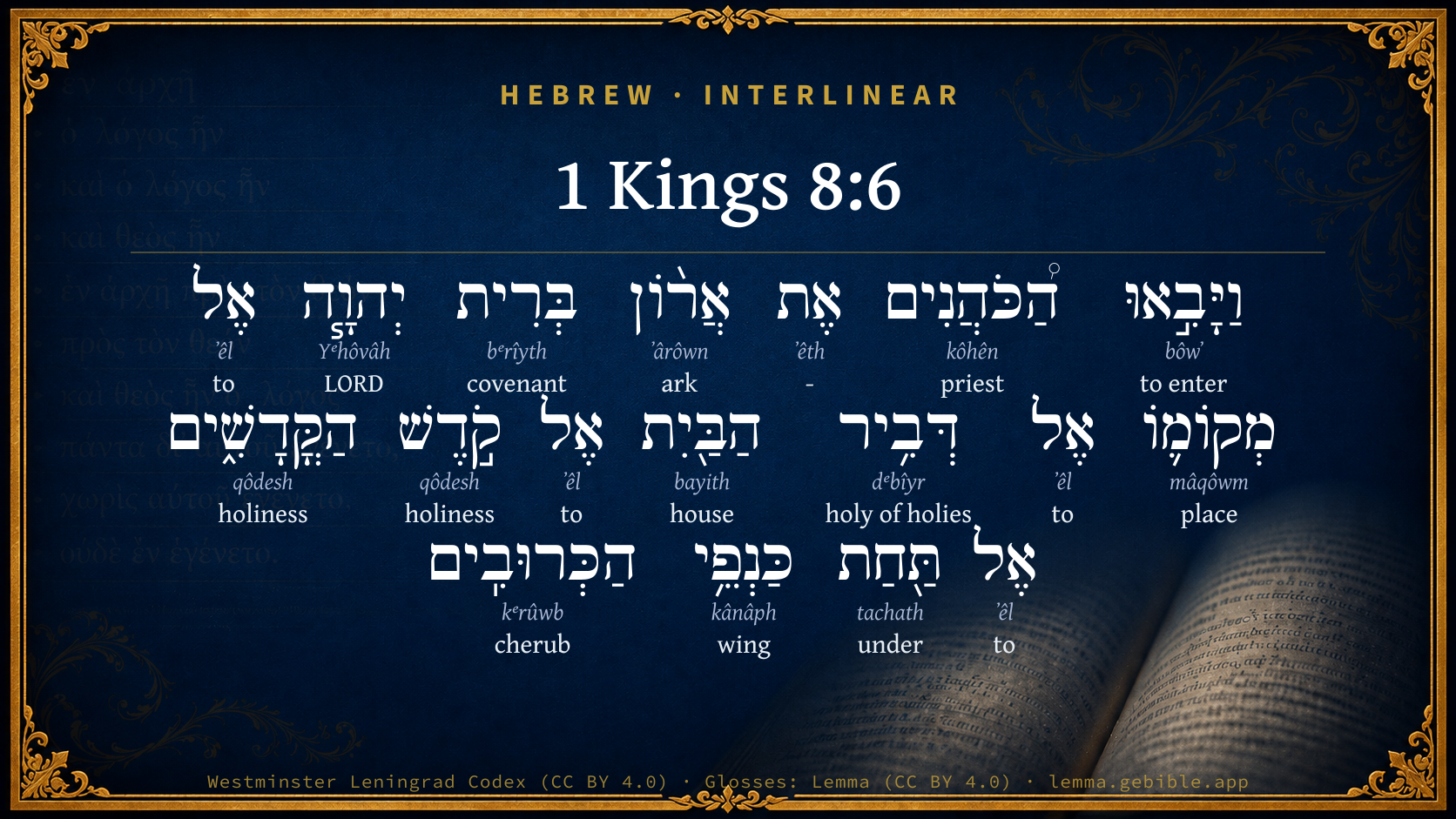
Hebrew (Westminster Leningrad Codex) 1 Kings 8:6 appears in the Hebrew Old Testament. The text above is from the Westminster Leningrad Codex. Each word links to its Strong’s number, a concise gloss, and parsing drawn from the Open Scriptures Hebrew Bible morphology. Click any word for its full Brown-Driver-Briggs (BDB) entry.
Download image
Cite this verse

1 Kings 8:6 (World English Bible). Public Domain. Lemma interlinear Bible study tool, https://lemma.gebible.app/v/1-kings/8/6.

Show BibTeX & RIS
BibTeX
RIS
English Translation
The priests brought in the ark of the covenant of Yahweh to its place, into the oracle of the house, to the most holy place, even under the wings of the cherubim.
World English Bible · Public Domain
Download a study sheet

One document with this verse’s original text, its word-by-word gloss line, the meaning frame, cross-references with their text, attributed commentary, and full source and license credits — printable, and it pastes into notes with its structure intact.

This verse Autodidact and up

Study sheet (.html) Plain text (.txt)

A passage Seminary Student

Up to 50 verses in one chapter. A passage sheet keeps up to 6 commentary sources and 12 cross-references per verse, in the order this page ranks them, and says so on the sheet whenever that leaves anything out. Ask for a single verse and you get the Autodidact verse sheet above.

Everything on this page stays free to read, with no account — the sheet is a download of what is already on screen, not access to it.

Want to remove ads? Support Godless Engineer
Compare translations 3

The same verse in 3 English versions, stacked beneath the original-language interlinear above. Click any original word for its lexicon entry.

Each is an independent rendering of the whole verse — the interlinear is not word-aligned to these translations.

Highlighted words mark where these versions differ — a whole-verse word diff, not a word-by-word alignment.

  • World English Bible Public Domain
    The priests brought in the ark of the covenant of Yahweh to its place, into the oracle of the house, to the most holy place, even under the wings of the cherubim.
  • King James Version Public Domain
    And the priests brought in the ark of the covenant of the LORD unto his place, into the oracle of the house, to the most holy place, even under the wings of the cherubim.
  • unfoldingWord Literal Text CC BY-SA 4.0
    And the priests brought the Box of the Covenant of Yahweh into its place, into the inner sanctuary of the house, into the Holy of Holies, to beneath the wings of the cherubs.

unfoldingWord Literal Text — © unfoldingWord, licensed CC BY-SA 4.0. Word-aligned USFM3 via Door43 (git.door43.org/unfoldingWord/en_ult).

Versions to compare (up to 4)

3 of 4 selected

Show all 18 translations

Every available English version of this verse, each an independent rendering of the whole verse.

  • World English Bible Public Domain
    The priests brought in the ark of the covenant of Yahweh to its place, into the oracle of the house, to the most holy place, even under the wings of the cherubim.
  • Berean Standard Bible Public Domain
    Then the priests brought the ark of the covenant of the LORD to its place in the inner sanctuary of the temple, the Most Holy Place, beneath the wings of the cherubim.
  • Majority Standard Bible Public Domain
    Then the priests brought the ark of the covenant of the LORD to its place in the inner sanctuary of the temple, the Most Holy Place, beneath the wings of the cherubim.
  • King James Version Public Domain
    And the priests brought in the ark of the covenant of the LORD unto his place, into the oracle of the house, to the most holy place, even under the wings of the cherubim.
  • American Standard Version (1901) Public Domain
    And the priests brought in the ark of the covenant of Jehovah unto its place, into the oracle of the house, to the most holy place, even under the wings of the cherubim.
  • Revised Version (1885) Public Domain
    And the priests brought in the ark of the covenant of the LORD unto its place, into the oracle of the house, to the most holy place, even under the wings of the cherubim.
  • Geneva Bible (1599) Public Domain
    So the Priestes brought the Arke of the couenant of the Lord vnto his place, into the oracle of the house, into the most holy place, euen vnder the wings of the Cherubims.
  • Douay-Rheims (1899) Public Domain
    And the priests brought in the ark of the covenant of the Lord into its place, into the oracle of the temple, into the holy of holies under the wings of the cherubims.
  • Young's Literal Translation Public Domain
    And the priests bring in the ark of the covenant of Jehovah unto its place, unto the oracle of the house, unto the holy of holies, unto the place of the wings of the cherubs;
  • Literal Standard Version CC BY-SA 4.0
    And the priests bring in the Ark of the Covenant of YHWH to its place, to the oracle of the house, to the Holy of Holies, to the place of the wings of the cherubim;
  • Unlocked Literal Bible CC BY-SA 4.0
    The priests brought in the ark of the covenant of Yahweh to its place, into the inner room of the house, to the most holy place, under the wings of the cherubim.
  • unfoldingWord Literal Text CC BY-SA 4.0
    And the priests brought the Box of the Covenant of Yahweh into its place, into the inner sanctuary of the house, into the Holy of Holies, to beneath the wings of the cherubs.
  • Darby Bible Public Domain
    And the priests brought in the ark of the covenant of Jehovah to its place, into the oracle of the house, into the most holy place, under the wings of the cherubim;
  • World Messianic Bible Public Domain
    The priests brought in the ark of the LORD’s covenant to its place, into the inner sanctuary of the house, to the most holy place, even under the cherubim’s wings.
  • Webster's Bible Public Domain
    And the priests brought the ark of the covenant of the LORD to its place, into the oracle of the house, to the most holy place, even under the wings of the cherubim.
  • Free Bible Version CC BY-SA 4.0
    Then the priests carried the Ark of the Lord's Agreement to its place in the inner sanctuary of the Temple, the Most Holy Place, underneath the wings of the cherubim.
  • Bible in Basic English Public Domain
    And the priests took the ark of the agreement of the Lord and put it in its place in the inner room of the house, in the most holy place, under the wings of the winged ones.
  • JPS Tanakh (1917) Public Domain
    And the priests brought in the ark of the covenant of the LORD unto its place, into the Sanctuary of the house, to the most holy place, even under the wings of the cherubim.

Literal Standard Version (2020), Covenant Press — licensed CC BY-SA 4.0. Text via the HelloAO Bible API (eBible.org). Unlocked Literal Bible (unfoldingWord) — licensed CC BY-SA 4.0. Text via the HelloAO Bible API (eBible.org). unfoldingWord Literal Text — © unfoldingWord, licensed CC BY-SA 4.0. Word-aligned USFM3 via Door43 (git.door43.org/unfoldingWord/en_ult). Free Bible Version, Dr. Jonathan Gallagher — licensed CC BY-SA 4.0. Text via the HelloAO Bible API (eBible.org).

Word by word

More ways to search: Search by grammar → Find every occurrence → Compare this word →

Practice this passage: Drill this verse → Learn its vocabulary →

דְּבִ֥יר
dᵉbîyr
H1687
“holy of holies of”
Noun, Common, Masculine, Singular, Construct
Part of Speech
Noun
Type
Common
Gender
Masculine
Number
Singular
State
Construct
Full BDB Definition

Origin: from H1696 (apparently in the sense of oracle)

TWOT: 399g

the holy of holies, the innermost room of the temple or tabernacle - hindmost chamber, innermost room of the temple of Solomon, most holy place, holy of holies - (TWOT) oracle
  1. וַיָּבִ֣אוּ bôwʼ H935 “and · to enter” Conjunction + Verb, Hiphil, Sequential Imperfect, 3rd Person, Masculine, Plural
  2. הַ֠כֹּהֲנִים kôhên H3548 “the · priests” Particle, Definite Article + Noun, Common, Masculine, Plural, Absolute
  3. אֶת ʼêth H853 “-” Particle, Direct Object
  4. אֲר֨וֹן ʼârôwn H727 “ark of” Noun, Common, Both, Singular, Construct
  5. בְּרִית bᵉrîyth H1285 “covenant of” Noun, Common, Feminine, Singular, Construct
  6. יְהוָ֧ה Yᵉhôvâh H3068 “LORD” Noun, Proper
  7. אֶל ʼêl H413 “to” Preposition
  8. מְקוֹמ֛וֹ mâqôwm H4725 “place · his” Noun, Common, Masculine, Singular, Construct + Suffix, Personal, 3rd Person, Masculine, Singular
  9. אֶל ʼêl H413 “to” Preposition
  10. הַבַּ֖יִת bayith H1004 “the · house” Particle, Definite Article + Noun, Common, Masculine, Singular, Absolute
  11. אֶל ʼêl H413 “to” Preposition
  12. קֹ֣דֶשׁ qôdesh H6944 “holiness of” Noun, Common, Masculine, Singular, Construct
  13. הַקֳּדָשִׁ֑ים qôdesh H6944 “the · holy things” Particle, Definite Article + Noun, Common, Masculine, Plural, Absolute
  14. אֶל ʼêl H413 “to” Preposition
  15. תַּ֖חַת tachath H8478 “under” Preposition
  16. כַּנְפֵ֥י kânâph H3671 “wings of” Noun, Common, Feminine, Dual, Construct
  17. הַכְּרוּבִֽים kᵉrûwb H3742 “the · cherubim” Particle, Definite Article + Noun, Common, Masculine, Plural, Absolute

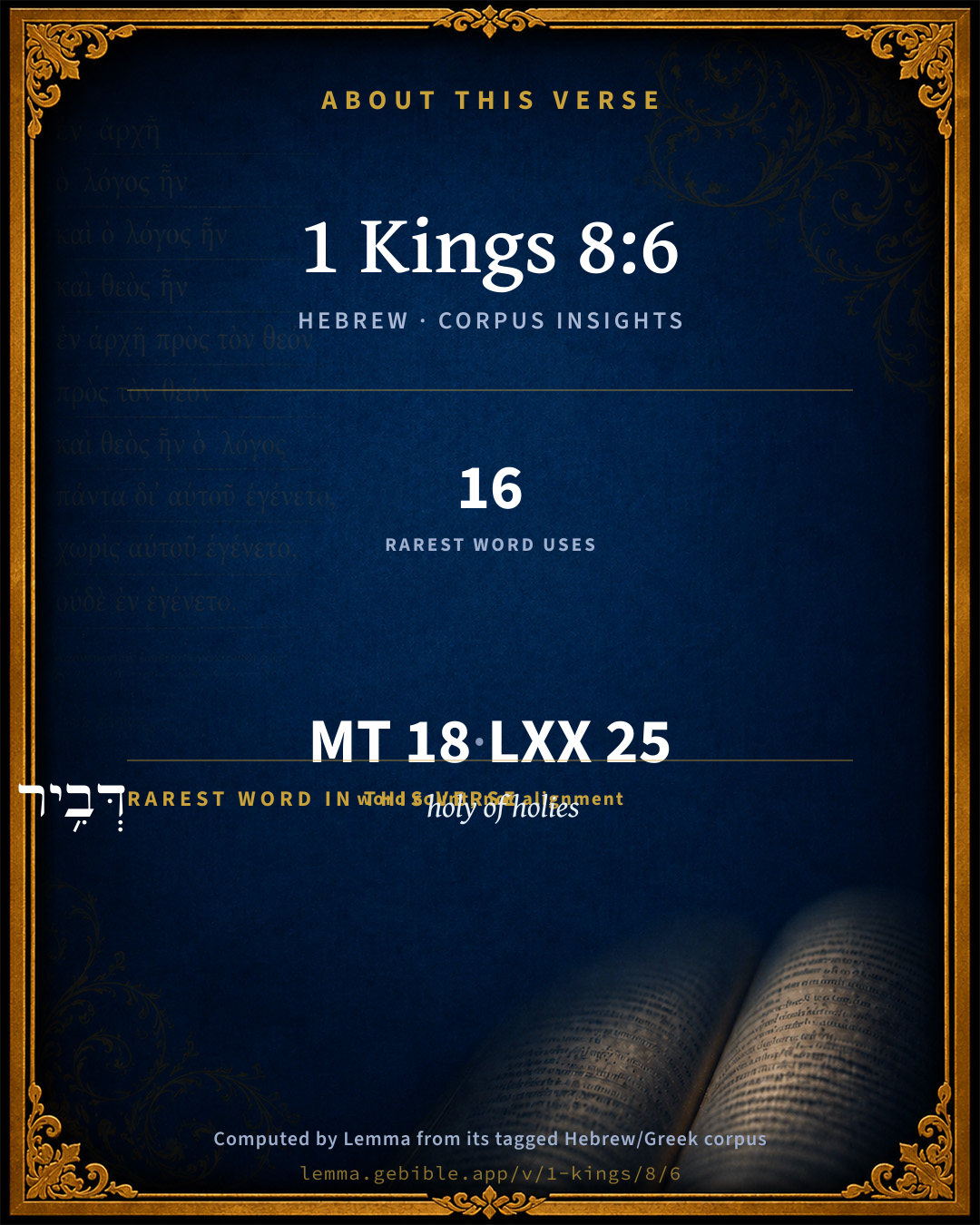
About this verse

These counts appear in no published source. They are computed here, from the morphology-tagged text and Lemma’s own curated glosses. What Lemma adds →

18
words
14
distinct lemmas
Historical
section

Notable vocabulary

The rarest word here is דְּבִ֥יר holy of holies H1687 — appearing just 16 times in the whole Hebrew Bible.

Shared distinctive vocabulary

דְּבִ֥יר holy of holies H1687 occurs in 16 verses of the Hebrew Bible. Also found in:

Grammatical profile

  • 1 verb
  • 11 nouns
  • 5 prepositions
  • 1 particle

Verb forms

  • וַיָּבִ֣אוּ Hiphil · Sequential Imperfect

Repetition

Words recur within this verse — often emphatic in Hebrew:

  • קֹ֣דֶשׁ holiness H6944 ×2
  • אֶל to H413 ×4

Hebrew & Septuagint length

In English translation the verse runs 32 words from the Hebrew and 28 from the Septuagint (LXX English) — closely comparable.

A rough comparison of the two English renderings, which tokenize alike — not a word-level alignment.

Word counts can differ between the Hebrew and the Greek without any difference in meaning — e.g. the Hebrew direct-object marker אֵת has no separate Greek word, and Greek often adds the article ὁ.

In the original languages it is 18 Hebrew tokens and 25 Greek tokens — but the two are counted differently (Hebrew bundles its prefixes and suffixes into one token; the Greek is in lemma form), so that isn’t a like-for-like length.

Cross-references

15

Topical passages linked to 1 Kings 8:6 in the Treasury of Scripture Knowledge — connected by theme and wording, ordered by reader-vote popularity; previews shown in the World English Bible.

  • 2 Samuel 6:17 They brought in the ark of Yahweh, and set it in its place, in the midst of the tent that David had pitched for it; and David offered burnt offerings and peace-offerings before Yahweh.
  • 1 Kings 6:19 He prepared an oracle in the midst of the house within, to set there the ark of the covenant of Yahweh.
  • 1 Kings 6:27 He set the cherubim within the inner house; and the wings of the cherubim were stretched forth, so that the wing of the one touched the one wall, and the wing of the other cherub touched the other wall; and their wings touched one another in the midst of the house.
  • Exodus 26:33–34 You shall hang up the veil under the clasps, and shall bring the ark of the testimony in there within the veil: and the veil shall separate the holy place from the most holy for you.
  • Exodus 25:20–22 The cherubim shall spread out their wings upward, covering the mercy seat with their wings, with their faces toward one another. The faces of the cherubim shall be toward the mercy seat.
  • Exodus 37:9 The cherubim spread out their wings on high, covering the mercy seat with their wings, with their faces toward one another. The faces of the cherubim were toward the mercy seat.
  • Exodus 40:20–21 He took and put the testimony into the ark, and set the poles on the ark, and put the mercy seat above on the ark.
  • 1 Samuel 4:4 So the people sent to Shiloh; and they brought from there the ark of the covenant of Yahweh of Hosts, who sits [above] the cherubim: and the two sons of Eli, Hophni and Phinehas, were there with the ark of the covenant of God.
  • 2 Samuel 6:2 David arose, and went with all the people who were with him, from Baale Judah, to bring up from there the ark of God, which is called by the Name, even the name of Yahweh of Hosts who sits [above] the cherubim.
  • 1 Kings 8:4 They brought up the ark of Yahweh, and the tent of meeting, and all the holy vessels that were in the Tent; even these did the priests and the Levites bring up.
  • 2 Chronicles 5:7 The priests brought in the ark of the covenant of Yahweh to its place, into the oracle of the house, to the most holy place, even under the wings of the cherubim.
  • Psalms 80:1 Hear us, Shepherd of Israel, You who lead Joseph like a flock, You who sit above the cherubim, shine forth.
  • Psalms 99:1 Yahweh reigns! Let the peoples tremble. He sits enthroned among the cherubim. Let the earth be moved.
  • Isaiah 37:16 Yahweh of hosts, the God of Israel, who sits [above] the cherubim, you are the God, even you alone, of all the kingdoms of the earth; you have made heaven and earth.
  • Ezekiel 10:5 The sound of the wings of the cherubim was heard even to the outer court, as the voice of God Almighty when he speaks.

Cross-references courtesy of OpenBible.info (CC BY 4.0).

Hebrew and Greek witnesses Masoretic Hebrew ↔ Greek Septuagint

The same verse in the two great witnesses to the Old Testament, shown verse-for-verse.

These are two independent witnesses, not word-aligned to each other, and the Septuagint is shown in lemma (dictionary) form.

Hebrew 1 Kings 8:6 Masoretic · Westminster Leningrad Codex

וַיָּבִ֣אוּ הַ֠כֹּהֲנִים אֶת אֲר֨וֹן בְּרִית יְהוָ֧ה אֶל מְקוֹמ֛וֹ אֶל דְּבִ֥יר הַבַּ֖יִת אֶל קֹ֣דֶשׁ הַקֳּדָשִׁ֑ים אֶל תַּ֖חַת כַּנְפֵ֥י הַכְּרוּבִֽים

The priests brought in the ark of the covenant of Yahweh to its place, into the oracle of the house, to the most holy place, even under the wings of the cherubim.

World English Bible · Public Domain

Greek LXX 1 Kings 8:6 Septuagint · lemma form

καί εἰςφέρω ὁ ἱερεύς ὁ κιβωτός εἰς ὁ τόπος αὐτός εἰς ὁ δαβιρ ὁ οἶκος εἰς ὁ ἅγιος ὁ ἅγιος ὑπό ὁ πτέρυξ ὁ χερουβιν

And the priests bring in the ark into its place, into the oracle of the house, even into the holy of holies, under the wings of the cherubs.

LXX2012 (modern English Septuagint) · Public Domain

Hebrew: Westminster Leningrad Codex (CC BY 4.0). Greek: Septuagint (public domain); English from LXX2012 (modern English Septuagint) (Public Domain). How the Septuagint differs from the Hebrew →

Targum (Aramaic paraphrase)

1

The Targum is the ancient Jewish Aramaic paraphrase of the Hebrew Scriptures — an interpretive translation, not the Hebrew text itself. Onkelos (literal) and Pseudo-Jonathan (expansive) render the Torah, and Jonathan the Prophets. Coverage is partial: where no permissively-licensed English translation exists for a verse, only the Aramaic is shown. This is verse-level text, not a word-by-word alignment to the Hebrew.

  1. Targum Jonathan Prophets (Joshua–Malachi)
    וְאָעִילוּ כַהֲנַיָא יַת אֲרוֹן קְיָמָא דַייָ לְאַתְרֵיהּ לְבֵית כַּפּוֹרֵי דִי מְתַקֵן לֵיהּ בְּגוֹ בֵיתָא לְקוֹדֶשׁ קוּדְשַׁיָא לִתְחוֹת כַּנְפֵי כְרוּבַיָא:

    (no public-domain English translation for this verse)

    Targum Jonathan — Aramaic: “Mikraot Gedolot” (public domain). English: “Sefaria Community Translation” (CC0 1.0 (public-domain dedication)); “London "Chaldee Paraphrase," 1871” (public domain). Text via Sefaria.

Commentary

Notes on 1 Kings 8:6 from classic Christian and Jewish commentators (each source and its license shown beneath its notes). The classic Christian expositions comment on the surrounding passage and are grouped to its opening verse, so a note may address several verses; the Jewish commentaries on the Tanakh (Rashi and others) are per-verse, so they appear only where the commentator wrote on this verse.

Lemma curates 59 commentaries, every one of them public domain or Creative Commons licensed, each selected and text-cleaned for this edition rather than reprinted as found. About our sources →

Trapp's Complete Commentary

John Trapp

1Ki 8:6 And the priests brought in the ark of the covenant of the LORD unto his place, into the oracle of the house, to the most holy [place, even] under the wings of the cherubims.

Ver. 6. And the priests brought in the ark.] Which they had taken off the Levites’ shoulders, to bring it into the place appointed for it, even the midst of the Most Holy.

John Trapp, A Commentary or Exposition upon All the Books of the Old and New Testament (1647–1656) — public domain. Text from a community e-Sword module.

Joseph Benson's Commentary

1Ki 8:6-8. Under the wings of the cherubim — Which Solomon had made. For the cherubim made by Moses were fixed to the mercy-seat and the ark, and were inseparable from it, and therefore, together with the ark, were placed under the wings of these cherubim. And they drew out the staves — Not wholly, which was expressly forbidden, (Exo 25:15; Num 4:6,) but in part. That the ends of the staves were seen out in the holy place — That is, the most holy, often called the holy place by way of eminence. And the next clause before the oracle, may be as well rendered, within the oracle. These staves were left in this posture, that the high-priest might thereby be certainly guided to that very place where he was, one day in a year, to sprinkle blood, and to offer incense before the ark, which otherwise he might have mistaken in that dark place, where the ark was wholly covered with the wings of the great cherubim, which stood between him and the ark when he entered in. They were not seen without — In the sanctuary. There they are unto this day — In that posture, namely, when this book was written.

Joseph Benson's Commentary on the Old and New Testaments (1811–1818) — public domain. Text from a community e-Sword module.

Geneva Bible (1599)

Geneva Bible translators

That is, the Kohathites, Num. 4:5.

Geneva Bible (1599) marginal notes — public domain. Text via Bolls.life.

Ellicott's Commentary for English Readers

(6-8) And the priests brought in the ark.—It is clear from this description that the ark was placed lengthways between the cherubim, so that the staves by which it was borne, when drawn out (though still partly attached to the ark) were seen—probably by projections visible through the veil—in the Holy Place; although, as the narrative remarks with characteristic minuteness of accuracy, “not without” from the porch. The reason why this detail is dwelt upon is obvious. Up to this time it had been forbidden to withdraw the staves (Exo_25:13-15), so that the ark might always be ready for transference; now the withdrawal marked the entrance on a new period, during which it was to rest unmoved.

There they are unto this day.—This phrase—not unfrequently repeated in the narrative (see 1Ki_9:21; 1Ki_10:12; 1Ki_12:19, &c.)—is an interesting indication of quotation from older documents; for at the time of the compilation of the book the Temple and all that it contained had been destroyed or removed. It is remarkable that in the record of the successive spoilings of the Temple by the Chaldæans (2Ki_24:13; 2Ki_25:13-17), while the various vessels, the brazen pillars, and the sea are mentioned in detail, nothing is said of their carrying away the ark, which would have been the choicest, as most sacred, of all the spoils. (See Notes on these passages.) About the Jewish tradition, referred to above (see Note on 1Ki_8:4), setting aside the supposed miracle, there is no intrinsic improbability, considering the respect paid to Jeremiah by the Chaldæans. (See Jer_39:11-14.)

A Bible Commentary for English Readers, edited by Charles John Ellicott (1878–1897) — public domain. Text from a community e-Sword module.

The Cambridge Bible for Schools and Colleges

gen. ed. J. J. S. Perowne

6. even under the wings of the cherubims] The outspread wings of the cherubim extended across the whole width of the oracle (1Ki_6:27) and their wings touched one another in the middle of the house. Beneath these wings that touched, the ark was set down. As it was only a cubit and a half high (Exo_25:10), and the figures of the cherubim were 10 cubits high (1Ki_6:23) it is probable that some base or stand was provided, so that the ark might be raised a little from the ground, though this is not stated. Josephus tells us that the joined wings overshadowed the ark, covering it as though it were under a tent or a dome.

The Cambridge Bible for Schools and Colleges (gen. ed. J. J. S. Perowne; Cambridge University Press, 1878–1918) — public domain. Text from a community e-Sword module.

John Gill's Exposition

And the priests brought in the ark of the covenant of the Lord unto his place,.... Destined for it, the like to which it had in the tabernacle:

into the oracle of the house, to the most holy place; that part of the house where the divine oracle was, the holy of holies; for though into it none but the high priest might enter, and he but once a year; yet in case of necessity, as for the repair of it, which the Jews (s) gather from hence, other priests might enter, as was the case now; an high priest could not carry in the ark himself, and therefore it was necessary to employ others; and besides, as yet the divine Majesty had not taken up his residence in it:

even under the wings of the cherubim; the large ones which Solomon had made, Kg1 6:23 not those of Moses.

(s) Vid. Maimon. Hilchot Beth Habechirah, c. 7. sect. 23.

John Gill's Exposition of the Whole Bible (1746–1763) — public domain (CC PDM 1.0). Text via the HelloAO Bible API.

Haydock's Catholic Bible Commentary

Wings. These covered the smaller cherubim, upon the ark. (Haydock) (Chap. vi. 23, 27.) --- The formed a sort of throne, with their wings extended, from one side of the building to the other, (Calmet) twenty cubits long. (Haydock)

George Leo Haydock (1774–1849), Haydock's Catholic Family Bible and Commentary, 1859 edition — public domain. Excludes Psalms (Douay-Rheims chapter numbering differs from Protestant) and Deuterocanonical books (Catholic canon only).

Matthew Poole's English Annotations

Into the oracle of the house, i.e. to that part of the house which is called the oracle, 1Ki 6:5,16,19,23; or, as it here follows,

the most holy place. Under the wings of the cherubims, to wit, of Solomon’s new-made cherubims, 1Ki 6:23,24,27; not of the Mosaical cherubims, which were far less, and unmovably fixed to the ark, Exo 37:7,8; and therefore, together with the ark, were put under the wings of these cherubims.

Matthew Poole's English Annotations on the Holy Bible (1683–1685) — public domain. Text from a community e-Sword/MySword module.

Whedon's Commentary on the Bible

Daniel D. Whedon

6. Under the wings of the cherubim — That is, under the wings of the colossal cherubim that had already been built within the oracle. See notes and cut at 1Ki_6:27.

Daniel D. Whedon (gen. ed.), Commentary on the Old and New Testaments (1874–1909) — public domain. Text from a community e-Sword module.

The Pulpit Commentary

And the priests brought in the ark of the covenant unto his i.e., its. But this word is never found in the A.V It has come into use since the date of our translation place (cf. 1Ki_6:19) into the oracle of the house, to the most holy place (Heb. holy of holies) , even under the wings of the cherubims. (1Ki_6:27) Whether the ark stood with its length east and west, or north and south, it is somewhat difficult to decide. But see on ver. 8.

HOMILIES BY A. ROWLAND. Ver. 6.

The Ark of the Covenant.

The ark was the heart of the temple. For it the shrine was erected. It was regarded as the throne of Jehovah. Hence the reverence with which it was approached. In itself the ark was not very remarkable. It was a chest 2.5 cubits long, and 1.5 cubits deep and broad, made of wood covered with gold; the lid, called "the mercy seat," being of pure gold, having the cherubim at its ends. For its construction see Exodus 25., where it is placed first as the most important of all the furniture of the tabernacle. Describe its connection with the people"s entrance to Canaan, leading them through the Jordan, and heading the procession round Jericho. A superstitious sanctity was attached to it later. The outward symbol was supposed to have the efficacy which belonged only to that which it symbolized. It was carried into battle (1Sa 4) under this delusion, but the ark could not save a people from whom God had withdrawn. Their superstition was rebuked by the defeat of the army, and the capture by the Philistines of the ark itself. Show how often in Church history the sign has been substituted for the thing signified, to the injury of God"s cause. Though the superstitions belief in the ark was always rebuked, its sanctity was vindicated: by its avenging progress through the cities of Phllistia, and by the punishment of Uzzah. Moreover a blessing came with it to those who received it aright, e.g., to the house of Obed-Edom. The ark had been brought up to Jerusalem by David amid national rejoicing and placed in a tent prepared for it; now it found its abiding place in Solomon"s temple. Throwing on the ark the light of the Epistle to the Hebrews, let us remind ourselves of certain religious truths to which it bore silent witness. These will be suggested by the contents of the ark, by its covering, by the mode of approaching it, and by its uses in worship.

I THE ARK SUGGESTED THAT THE COVENANT RESTED ON LAW. The safe custody of the material tables of stone implied the moral observance of the precepts inscribed on them. "There was nothing in the ark save the two tables of stone," etc. (If we are to understand Heb_9:4 as asserting that Aaron"s rod and the pot of manna were actually inside the ark, they had probably disappeared by Solomon"s time.) The term "a covenant" is only used by way of accommodation, when applied to the relation between man and God. Such a "covenant" is merely a promise, which God makes dependent on the fulfilment of certain conditions; e.g., the promise after the flood is called a "covenant." So the covenant of Sinai was a promise on God"s part, conditioned by the observance of the ten commandments on man"s part. This was proclaimed by the presence of the tables of the law in the ark of the covenant. Show from Scripture and experience that bliss is conditioned by obedience. There is nothing lawless either in morals or in nature.

II THE ARK PROCLAIMED THAT MERCY CAME BETWEEN MAN AND THE BROKEN LAW. "The mercy seat" covered "the tables." The value of mercy was typified by the pure gold of the capporeth. Exhibit the necessity of mercy to men who are prone to evil and forgetful of good. Illustrate it from God"s dealings with Israel, and Christ"s goodness to His disciples. The publican struck the keynote of true prayer when he exclaimed, "God be merciful to me, a sinner" Compare Psalm 51. Show how the sense of our want of mercy grows with our sensibility to the sinfulness of sin. Paul the apostle an example of this: "of sinners I am the chief.

III THE ARK DECLARED THAT AN ATONEMENT MADE MERCY POSSIBLE. Describe the day of atonement; the sacrifice offered; the high priest entering the holy of holies with the blood which he sprinkled on the mercy seat. Even he could only draw near to the mercy, seat after the sacrifice compare (Heb 9) "Without the shedding of blood there is no remission? Apply this to the sacrifice of "the Lamb of God," who was "wounded for our transgressions," whose "blood cleanseth from all sin." Describe him as the High Priest in the Holiest of all, having opened the way for all sinners to the abounding mercy of God.

IV THE ARK ENCOURAGED MEN TO DRAW NEAR TO GOD. The law (represented by the tables) was broken; but the mercy of God (represented by the capporeth) was revealed; and the atonement (represented by the sprinkled blood) was provided; so that God fulfilled promise about the mercy seat. "There will I commune with thee.

Apply the teaching of this subject to those conscious of guilt, burdened by sorrow, etc. "Let us, therefore, come boldly unto the throne of grace, that we may obtain mercy, and find grace to help in time of need. A.R.

The Pulpit Commentary (1880–1919), ed. H.D.M. Spence-Jones & Joseph S. Exell — public domain. Text from a community e-Sword module.

John Wesley's Explanatory Notes

Cherubim - Of Solomon's new made cherubim, not of the Mosaic cherubim, which were far less, and unmovably fixed to the ark, Exod. xxxvii, 7, 8, and therefore together with the ark, were put under the wings of these cherubim.

John Wesley, Explanatory Notes Upon the Whole Bible (1754–1765) — public domain. Text via the GEBible commentary corpus.

unfoldingWord translationNotes

Door43 World Missions Community

into the inner room of the house, to the most holy place, under

"into the inner room of the house—that is, to the most holy place—under"

poles by which it was carried

This can be stated in active form. AT: "poles by which the priests carried it" (See: Active or Passive)

their ends were seen ... they could not be seen

This can be stated in active form. AT: "people could see their ends ... people could not see them"

this day

This means the day on which the writer wrote.

translationWords

priest

ark of the covenant

Yahweh

holy place

cherub

unfoldingWord translationNotes — © Distant Shores Media and the Door43 World Missions Community, licensed CC BY-SA 4.0. Source: git.door43.org/Door43/en_tn.

Rashi

Rabbi Shlomo Yitzchaki (Rashi)

The wings of the cherubim. Those which Shlomo made, which are standing on their feet on the ground; and these are not the cherubim of the cover which was on the Ark.

Rashi on the Tanakh — English translations: “The Judaica Press complete Tanach with Rashi, translated by A. J. Rosenberg” (CC BY 4.0); “Pentateuch with Rashi's commentary by M. Rosenbaum and A.M. Silbermann, 1929-1934” (public domain); “The Metsudah Tanach series, Lakewood, N.J” (CC BY 4.0); and “The Book of Joshua, Metsudah Publications, 1997” (CC BY 4.0). Text via Sefaria.

Lesson kit

Teaching starters — assembled from the data on this page, not authored interpretation. Every prompt links to the verse data it draws on. Edit before teaching.

1 Kings, in the Historical, opens this verse with 18 words (14 distinct Hebrew lemmas). Its most distinctive word is dᵉbîyr (“holy of holies”). A historical commentator’s framing appears above. Read the whole chapter for the surrounding context.

Discussion questions

  1. The word dᵉbîyr carries the sense “holy of holies.” How does it shape the verse?
  2. How does 1 Kings 6:5, which shares the word «holy of holies», read alongside this verse?
  3. What does the repetition of “holiness” (2× in this one verse) do in this verse?
  4. The translations on this page render this verse differently — a whole-verse word diff, not a word-by-word alignment. What might account for the different wordings?
  5. «וַיָּבִ֣אוּ» is a Hiphil Sequential Imperfect verb. How does that grammatical form shape the action described?
  6. Compare how Trapp's Complete Commentary and Joseph Benson's Commentary read this verse. Where do they agree or differ?

Things to notice

Reading settings

Reading text

Shown beneath each verse's original-language words.

Old Testament
Old Testament edition

Read the OT as the Masoretic Hebrew (MT) or the Greek Septuagint (LXX).

English shown for the Greek Septuagint (in the Hebrew ↔ Greek comparison).

Comparing translations? Open the Compare panel on any verse page to stack up to four side by side.