
Leviticus 25:10

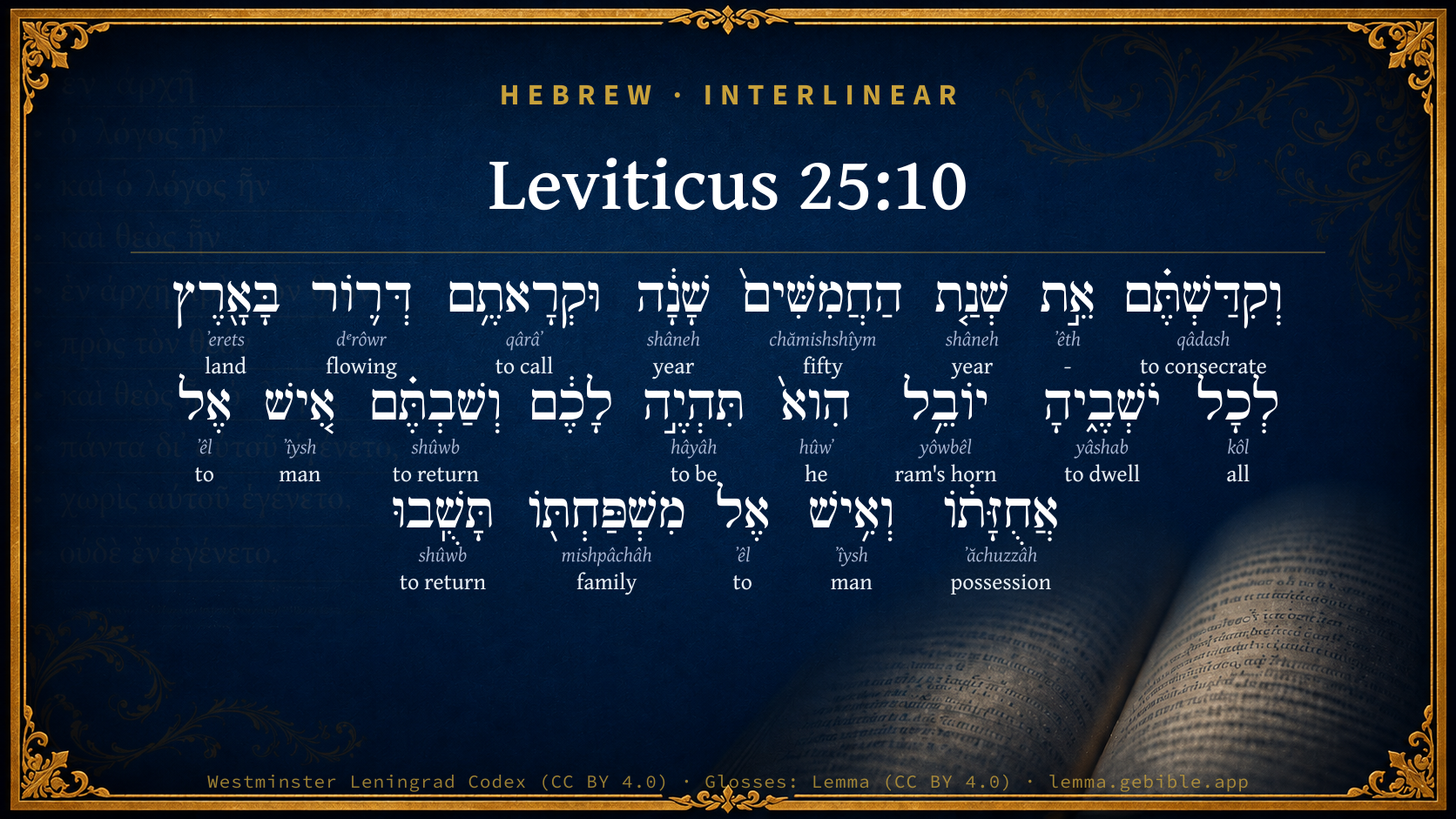
Hebrew (Westminster Leningrad Codex) Leviticus 25:10 appears in the Hebrew Old Testament. The text above is from the Westminster Leningrad Codex. Each word links to its Strong’s number, a concise gloss, and parsing drawn from the Open Scriptures Hebrew Bible morphology. Click any word for its full Brown-Driver-Briggs (BDB) entry.
Download image
Cite this verse

Leviticus 25:10 (World English Bible). Public Domain. Lemma interlinear Bible study tool, https://lemma.gebible.app/v/leviticus/25/10.

Show BibTeX & RIS
BibTeX
RIS
English Translation
You shall make the fiftieth year holy, and proclaim liberty throughout the land to all its inhabitants. It shall be a jubilee to you; and each of you shall return to his own property, and each of you shall return to his family.
World English Bible · Public Domain
Download a study sheet

One document with this verse’s original text, its word-by-word gloss line, the meaning frame, cross-references with their text, attributed commentary, and full source and license credits — printable, and it pastes into notes with its structure intact.

This verse Autodidact and up

Study sheet (.html) Plain text (.txt)

A passage Seminary Student

Up to 50 verses in one chapter. A passage sheet keeps up to 6 commentary sources and 12 cross-references per verse, in the order this page ranks them, and says so on the sheet whenever that leaves anything out. Ask for a single verse and you get the Autodidact verse sheet above.

Everything on this page stays free to read, with no account — the sheet is a download of what is already on screen, not access to it.

Want to remove ads? Support Godless Engineer
Compare translations 3

The same verse in 3 English versions, stacked beneath the original-language interlinear above. Click any original word for its lexicon entry.

Each is an independent rendering of the whole verse — the interlinear is not word-aligned to these translations.

Highlighted words mark where these versions differ — a whole-verse word diff, not a word-by-word alignment.

  • World English Bible Public Domain
    You shall make the fiftieth year holy, and proclaim liberty throughout the land to all its inhabitants. It shall be a jubilee to you; and each of you shall return to his own property, and each of you shall return to his family.
  • King James Version Public Domain
    And ye shall hallow the fiftieth year, and proclaim liberty throughout all the land unto all the inhabitants thereof: it shall be a jubilee unto you; and ye shall return every man unto his possession, and ye shall return every man unto his family.
  • unfoldingWord Literal Text CC BY-SA 4.0
    And you shall consecrate the year, the fiftieth year, and you shall proclaim liberty in the land to all its inhabitants. It shall be a jubilee for you, and you shall return, each to his possession, and each to his family you shall return.

unfoldingWord Literal Text — © unfoldingWord, licensed CC BY-SA 4.0. Word-aligned USFM3 via Door43 (git.door43.org/unfoldingWord/en_ult).

Versions to compare (up to 4)

3 of 4 selected

Show all 18 translations

Every available English version of this verse, each an independent rendering of the whole verse.

  • World English Bible Public Domain
    You shall make the fiftieth year holy, and proclaim liberty throughout the land to all its inhabitants. It shall be a jubilee to you; and each of you shall return to his own property, and each of you shall return to his family.
  • Berean Standard Bible Public Domain
    So you are to consecrate the fiftieth year and proclaim liberty in the land for all its inhabitants. It shall be your Jubilee, when each of you is to return to his property and to his clan.
  • Majority Standard Bible Public Domain
    So you are to consecrate the fiftieth year and proclaim liberty in the land for all its inhabitants. It shall be your Jubilee, when each of you is to return to his property and to his clan.
  • King James Version Public Domain
    And ye shall hallow the fiftieth year, and proclaim liberty throughout all the land unto all the inhabitants thereof: it shall be a jubilee unto you; and ye shall return every man unto his possession, and ye shall return every man unto his family.
  • American Standard Version (1901) Public Domain
    And ye shall hallow the fiftieth year, and proclaim liberty throughout the land unto all the inhabitants thereof: it shall be a jubilee unto you; and ye shall return every man unto his possession, and ye shall return every man unto his family.
  • Revised Version (1885) Public Domain
    And ye shall hallow the fiftieth year, and proclaim liberty throughout the land unto all the inhabitants thereof: it shall be a jubile unto you; and ye shall return every man unto his possession, and ye shall return every man unto his family.
  • Geneva Bible (1599) Public Domain
    And ye shall halowe that yeere, euen the fiftieth yeere, and proclaime libertie in the lande to all the inhabitants thereof: it shalbe the Iubile vnto you, and ye shall returne euery man vnto his possession, and euery man shall returne vnto his familie.
  • Douay-Rheims (1899) Public Domain
    And thou shalt sanctify the fiftieth year, and shalt proclaim remission to all the inhabitants of thy land: for it is the year of jubilee. Every man shall return to his possession, and every one shall go back to his former family:
  • Young's Literal Translation Public Domain
    and ye have hallowed the year, the fiftieth year; and ye have proclaimed liberty in the land to all its inhabitants; a jubilee it is to you; and ye have turned back each unto his possession; yea, each unto his family ye do turn back.
  • Literal Standard Version CC BY-SA 4.0
    and you have hallowed the year, the fiftieth year; and you have proclaimed liberty in the land to all its inhabitants; it is a Jubilee for you; and you have turned back each to his possession; indeed, you return each to his family.
  • Unlocked Literal Bible CC BY-SA 4.0
    You must set apart the fiftieth year to Yahweh and proclaim liberty throughout the land to all its inhabitants. It will be a Jubilee for you, in which property and slaves must be returned to their families.
  • unfoldingWord Literal Text CC BY-SA 4.0
    And you shall consecrate the year, the fiftieth year, and you shall proclaim liberty in the land to all its inhabitants. It shall be a jubilee for you, and you shall return, each to his possession, and each to his family you shall return.
  • Darby Bible Public Domain
    And ye shall hallow the year of the fiftieth year, and proclaim liberty in the land unto all the inhabitants thereof; a [year of] jubilee shall it be unto you, and ye shall return every man unto his possession, and ye shall return every man unto his family;
  • World Messianic Bible Public Domain
    You shall make the fiftieth year holy, and proclaim liberty throughout the land to all its inhabitants. It shall be a jubilee to you; and each of you shall return to his own property, and each of you shall return to his family.
  • Webster's Bible Public Domain
    And ye shall hallow the fiftieth year, and proclaim liberty throughout all the land to all its inhabitants: it shall be a jubilee to you; and ye shall return every man to his possession, and ye shall return every man to his family.
  • Free Bible Version CC BY-SA 4.0
    You are to dedicate the fiftieth year and announce freedom everywhere in the country for all who live there. This is to be your Jubilee, when each of you is to return to reclaim your property and to be part of your family once more.
  • Bible in Basic English Public Domain
    And let this fiftieth year be kept holy, and say publicly that everyone in the land is free from debt: it is the Jubilee, and every man may go back to his heritage and to his family.
  • JPS Tanakh (1917) Public Domain
    And ye shall hallow the fiftieth year, and proclaim liberty throughout the land unto all the inhabitants thereof; it shall be a jubilee unto you; and ye shall return every man unto his possession, and ye shall return every man unto his family.

Literal Standard Version (2020), Covenant Press — licensed CC BY-SA 4.0. Text via the HelloAO Bible API (eBible.org). Unlocked Literal Bible (unfoldingWord) — licensed CC BY-SA 4.0. Text via the HelloAO Bible API (eBible.org). unfoldingWord Literal Text — © unfoldingWord, licensed CC BY-SA 4.0. Word-aligned USFM3 via Door43 (git.door43.org/unfoldingWord/en_ult). Free Bible Version, Dr. Jonathan Gallagher — licensed CC BY-SA 4.0. Text via the HelloAO Bible API (eBible.org).

Word by word

More ways to search: Search by grammar → Find every occurrence → Compare this word →

Practice this passage: Drill this verse → Learn its vocabulary →

דְּר֛וֹר
dᵉrôwr
H1865
“flowing”
Noun, Common, Masculine, Singular, Absolute
Part of Speech
Noun
Type
Common
Gender
Masculine
Number
Singular
State
Absolute
Full BDB Definition

Origin: from an unused root (meaning to move rapidly)

TWOT: 454b

a flowing, free run, liberty - flowing (of myrrh) - liberty
  1. וְקִדַּשְׁתֶּ֗ם qâdash H6942 “and · to consecrate” Conjunction + Verb, Piel, Sequential Perfect, 2nd Person, Masculine, Plural
  2. אֵ֣ת ʼêth H853 “-” Particle, Direct Object
  3. שְׁנַ֤ת shâneh H8141 “year of” Noun, Common, Feminine, Singular, Construct
  4. הַחֲמִשִּׁים֙ chămishshîym H2572 “the · fifty” Particle, Definite Article + Adjective, Cardinal number, Both, Plural, Absolute
  5. שָׁנָ֔ה shâneh H8141 “year” Noun, Common, Feminine, Singular, Absolute
  6. וּקְרָאתֶ֥ם qârâʼ H7121 “and · to call” Conjunction + Verb, Qal, Sequential Perfect, 2nd Person, Masculine, Plural
  7. בָּאָ֖רֶץ ʼerets H776 “in/at the · land” Preposition, Determined + Noun, Common, Both, Singular, Absolute
  8. לְכָל kôl H3605 “to/for · all of” Preposition + Noun, Common, Masculine, Singular, Construct
  9. יֹשְׁבֶ֑יהָ yâshab H3427 “dwelling · her” Verb, Qal, Participle Active, Masculine, Plural, Construct + Suffix, Personal, 3rd Person, Feminine, Singular
  10. יוֹבֵ֥ל yôwbêl H3104 “ram's horn” Noun, Common, Masculine, Singular, Absolute
  11. הִוא֙ hûwʼ H1931 “he” Pronoun, Personal, 3rd Person, Feminine, Singular
  12. תִּהְיֶ֣ה hâyâh H1961 “to be” Verb, Qal, Imperfect, 3rd Person, Feminine, Singular
  13. וְשַׁבְתֶּ֗ם shûwb H7725 “and · to return” Conjunction + Verb, Qal, Sequential Perfect, 2nd Person, Masculine, Plural
  14. אִ֚ישׁ ʼîysh H376 “man” Noun, Common, Masculine, Singular, Absolute
  15. אֶל ʼêl H413 “to” Preposition
  16. אֲחֻזָּת֔וֹ ʼăchuzzâh H272 “possession · his” Noun, Common, Feminine, Singular, Construct + Suffix, Personal, 3rd Person, Masculine, Singular
  17. וְאִ֥ישׁ ʼîysh H376 “and · man” Conjunction + Noun, Common, Masculine, Singular, Absolute
  18. אֶל ʼêl H413 “to” Preposition
  19. מִשְׁפַּחְתּ֖וֹ mishpâchâh H4940 “family · his” Noun, Common, Feminine, Singular, Construct + Suffix, Personal, 3rd Person, Masculine, Singular
  20. תָּשֻֽׁבוּ shûwb H7725 “to return” Verb, Qal, Imperfect, 2nd Person, Masculine, Plural

About this verse

These counts appear in no published source. They are computed here, from the morphology-tagged text and Lemma’s own curated glosses. What Lemma adds →

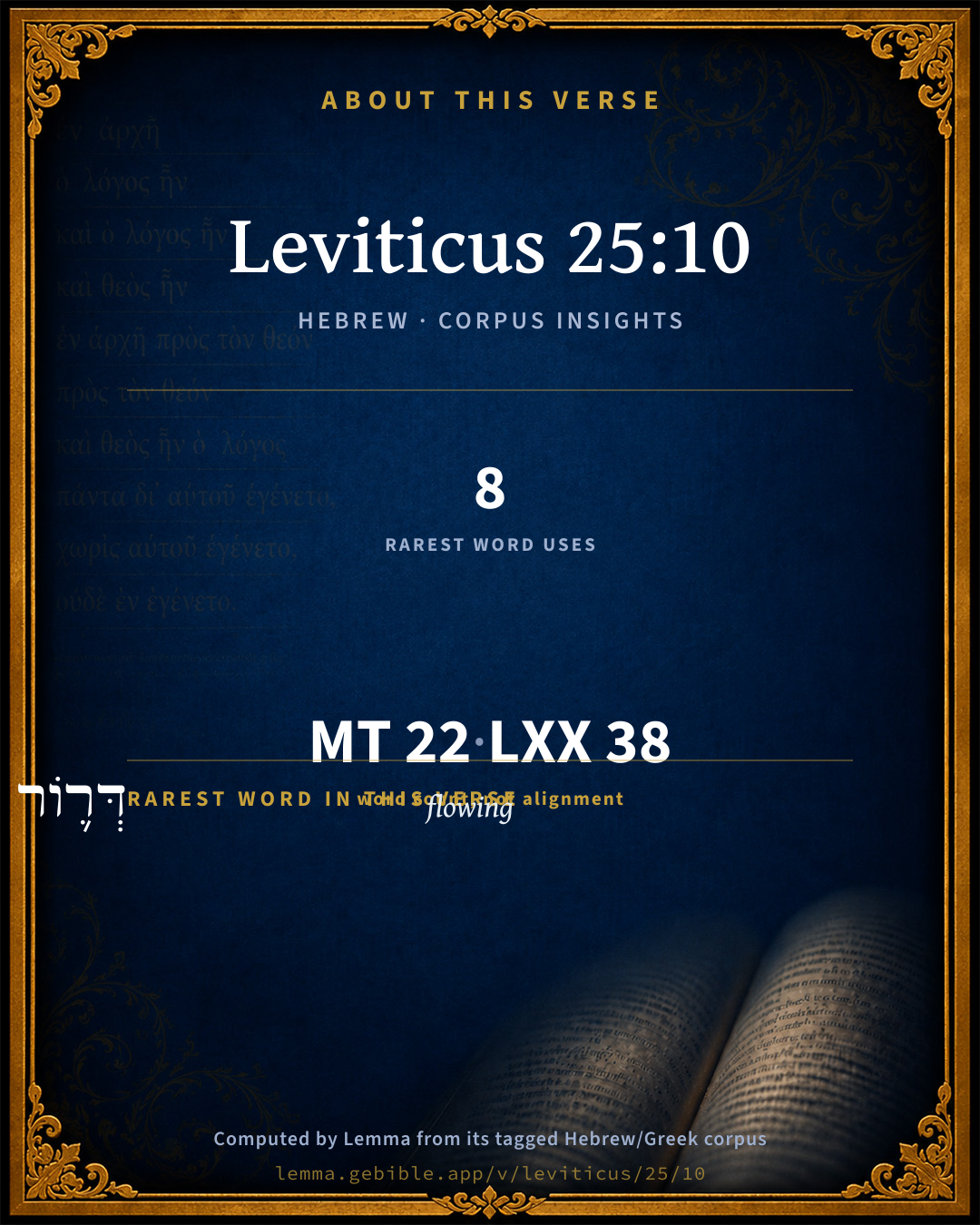
22
words
17
distinct lemmas
Pentateuch
section

Notable vocabulary

The rarest word here is דְּר֛וֹר flowing H1865 — appearing just 8 times in the whole Hebrew Bible.

Shared distinctive vocabulary

דְּר֛וֹר flowing H1865 occurs in 7 verses of the Hebrew Bible. Also found in:

Grammatical profile

  • 6 verbs
  • 10 nouns
  • 1 adjective
  • 1 pronoun
  • 3 prepositions
  • 1 particle

Verb forms

  • וְקִדַּשְׁתֶּ֗ם Piel · Sequential Perfect
  • וּקְרָאתֶ֥ם Qal · Sequential Perfect
  • יֹשְׁבֶ֑יהָ Qal · Participle Active
  • תִּהְיֶ֣ה Qal · Imperfect
  • וְשַׁבְתֶּ֗ם Qal · Sequential Perfect
  • תָּשֻֽׁבוּ Qal · Imperfect

Repetition

Words recur within this verse — often emphatic in Hebrew:

  • שְׁנַ֤ת year H8141 ×2
  • וְשַׁבְתֶּ֗ם to return H7725 ×2
  • אִ֚ישׁ man H376 ×2
  • אֶל to H413 ×2

Hebrew & Septuagint length

In English translation the verse runs 43 words from the Hebrew and 51 from the Septuagint (LXX English) — closely comparable.

A rough comparison of the two English renderings, which tokenize alike — not a word-level alignment.

Word counts can differ between the Hebrew and the Greek without any difference in meaning — e.g. the Hebrew direct-object marker אֵת has no separate Greek word, and Greek often adds the article ὁ.

In the original languages it is 22 Hebrew tokens and 38 Greek tokens — but the two are counted differently (Hebrew bundles its prefixes and suffixes into one token; the Greek is in lemma form), so that isn’t a like-for-like length.

Cross-references

24

Topical passages linked to Leviticus 25:10 in the Treasury of Scripture Knowledge — connected by theme and wording, ordered by reader-vote popularity; previews shown in the World English Bible.

  • Jeremiah 34:8 The word that came to Jeremiah from Yahweh, after that the king Zedekiah had made a covenant with all the people who were at Jerusalem, to proclaim liberty to them;
  • Isaiah 63:4 For the day of vengeance was in my heart, and the year of my redeemed is come.
  • 1 Peter 2:16 as free, and not using your freedom for a cloak of wickedness, but as bondservants of God.
  • Leviticus 25:13 "'In this Year of Jubilee each of you shall return to his property.
  • Isaiah 61:1–3 The Spirit of the Lord Yahweh is on me; because Yahweh has anointed me to preach good news to the humble; he has sent me to bind up the broken-hearted, to proclaim liberty to the captives, and the opening [of the prison] to those who are bound;
  • Galatians 5:13 For you, brothers, were called for freedom. Only don't use your freedom for gain to the flesh, but through love be servants to one another.
  • Exodus 20:2 "I am Yahweh your God, who brought you out of the land of Egypt, out of the house of bondage.
  • Psalms 146:7 Who executes justice for the oppressed; Who gives food to the hungry. Yahweh frees the prisoners.
  • Luke 1:74 To grant to us that we, being delivered out of the hand of our enemies, should serve him without fear,
  • Romans 6:17–18 But thanks be to God, that, whereas you were bondservants of sin, you became obedient from the heart to that form of teaching whereunto you were delivered.
  • 2 Corinthians 3:17 Now the Lord is the Spirit and where the Spirit of the Lord is, there is liberty.
  • Galatians 4:25–5:1 For this Hagar is Mount Sinai in Arabia, and answers to the Jerusalem that exists now, for she is in bondage with her children.
  • Isaiah 49:24–25 Shall the prey be taken from the mighty, or the lawful captives be delivered?
  • Zechariah 9:11–12 As for you also, Because of the blood of your covenant, I have set free your prisoners from the pit in which is no water.
  • John 8:32–36 You will know the truth, and the truth will make you free."
  • 2 Peter 2:19–20 promising them liberty, while they themselves are bondservants of corruption; for by whom a man is overcome, by the same is he also brought into bondage.
  • Leviticus 25:26–28 If a man has no one to redeem it, and he becomes prosperous and finds sufficient means to redeem it;
  • Leviticus 25:33–34 The Levites may redeem the house that was sold, and the city of his possession, and it shall be released in the Jubilee; for the houses of the cities of the Levites are their possession among the children of Israel.
  • Numbers 36:2–9 and they said, Yahweh commanded my lord to give the land for inheritance by lot to the children of Israel: and my lord was commanded by Yahweh to give the inheritance of Zelophehad our brother to his daughters.
  • Ezra 1:3 Whoever there is among you of all his people, his God be with him, and let him go up to Jerusalem, which is in Judah, and build the house of Yahweh, the God of Israel (he is God), which is in Jerusalem.
  • Isaiah 49:9 saying to those who are bound, Go forth; to those who are in darkness, Show yourselves. They shall feed in the ways, and on all bare heights shall be their pasture.
  • Jeremiah 34:13–17 Thus says Yahweh, the God of Israel: I made a covenant with your fathers in the day that I brought them forth out of the land of Egypt, out of the house of bondage, saying,
  • Luke 4:16–21 He came to Nazareth, where he had been brought up. He entered, as was his custom, into the synagogue on the Sabbath day, and stood up to read.
  • Leviticus 27:17–24 If he dedicates his field from the Year of Jubilee, according to your valuation it shall stand.

Cross-references courtesy of OpenBible.info (CC BY 4.0).

Hebrew and Greek witnesses Masoretic Hebrew ↔ Greek Septuagint

The same verse in the two great witnesses to the Old Testament, shown verse-for-verse.

These are two independent witnesses, not word-aligned to each other, and the Septuagint is shown in lemma (dictionary) form.

Hebrew Leviticus 25:10 Masoretic · Westminster Leningrad Codex

וְקִדַּשְׁתֶּ֗ם אֵ֣ת שְׁנַ֤ת הַחֲמִשִּׁים֙ שָׁנָ֔ה וּקְרָאתֶ֥ם דְּר֛וֹר בָּאָ֖רֶץ לְכָל יֹשְׁבֶ֑יהָ יוֹבֵ֥ל הִוא֙ תִּהְיֶ֣ה לָכֶ֔ם וְשַׁבְתֶּ֗ם אִ֚ישׁ אֶל אֲחֻזָּת֔וֹ וְאִ֥ישׁ אֶל מִשְׁפַּחְתּ֖וֹ תָּשֻֽׁבוּ

You shall make the fiftieth year holy, and proclaim liberty throughout the land to all its inhabitants. It shall be a jubilee to you; and each of you shall return to his own property, and each of you shall return to his family.

World English Bible · Public Domain

Greek LXX Leviticus 25:10 Septuagint · lemma form

καί ἁγιάζω ὁ ἔτος ὁ πεντηκοστός ἐνιαυτός καί διαβοάω ἄφεσις ἐπί ὁ γῆ πᾶς ὁ καταοἰκέω αὐτός ἐνιαυτός ἄφεσις σημασία οὗτος εἰμί σύ καί ἀποἔρχομαι εἷς ἕκαστος εἰς ὁ κτῆσις αὐτός καί ἕκαστος εἰς ὁ πατρίς αὐτός ἀποἔρχομαι

And you⌃ shall sanctify the year, the fifties year, and you⌃ shall proclaim a release upon the land to all that inhabit it; it shall be given a year of release, a jubilee for you; and each one shall depart to his possession, and you⌃ shall go each to his family.

LXX2012 (modern English Septuagint) · Public Domain

Hebrew: Westminster Leningrad Codex (CC BY 4.0). Greek: Septuagint (public domain); English from LXX2012 (modern English Septuagint) (Public Domain). How the Septuagint differs from the Hebrew →

Targum (Aramaic paraphrase)

2

The Targum is the ancient Jewish Aramaic paraphrase of the Hebrew Scriptures — an interpretive translation, not the Hebrew text itself. Onkelos (literal) and Pseudo-Jonathan (expansive) render the Torah, and Jonathan the Prophets. Coverage is partial: where no permissively-licensed English translation exists for a verse, only the Aramaic is shown. This is verse-level text, not a word-by-word alignment to the Hebrew.

  1. Targum Onkelos Torah (Genesis–Deuteronomy)
    וּתְקַדְשׁוּן יָת שְׁנַת חַמְשִׁין שְׁנִין וְתַקְרוּן חֵרוּתָא בְּאַרְעָא לְכָל יָתְבָהָא יוֹבֵלָא הִיא תְּהֵי לְכוֹן וּתְתוּבוּן גְבַר לְאַחֲסַנְתֵּהּ וּגְבַר לְזַרְעִיתֵהּ תְּתוּבוּן

    (no public-domain English translation for this verse)

    Targum Onkelos — Aramaic: “Onkelos Genesis” (public domain); “Onkelos Exodus” (public domain); “Onkelos Leviticus” (public domain); “Onkelos Numbers” (public domain); “Onkelos Deuteronomy” (public domain). English: “Sefaria Community Translation” (CC0 1.0 (public-domain dedication)); “J.W. Etheridge. The Targums of Onkelos and Jonathan Ben Uzziel on the Pentateuch. London: Longmans, Green, 1862” (public domain). Text via Sefaria.

  2. Targum Pseudo-Jonathan Torah (Genesis–Deuteronomy)
    וּתְקַדְשׁוּן יַת שְׁנַת חַמְשִׁין שְׁנִין וְתִכְרְזוּן חֵירוּתָא בְּאַרְעָא דְיִשְרָאֵל לְכָל יַתְבָהָא יוּבְלָא הִיא תְהֵי לְכוֹן גְבַר לְאַחְסָנוּתֵיהּ וּגְבַר לְיִיחוּסֵיהּ תְּתוּבוּן

    And you shall sanctify that year, the fiftieth year, and proclaim liberty in the land of Israel to all the inhabitants; Jubela shall it be to you, and you shall return every man to his inheritance, and every man unto his family, you shall return.

    Targum Pseudo-Jonathan — Aramaic: “Targum Jonathan on Genesis” (public domain); “Targum Jonathan on Exodus” (public domain); “Targum Jonathan on Leviticus” (public domain); “Targum Jonathan on Numbers” (public domain); “Targum Jonathan on Deuteronomy” (public domain). English: “The Targum of Jonathan ben Uzziel, trans. J. W. Etheridge, London, 1862” (public domain). Text via Sefaria.

Commentary

Notes on Leviticus 25:10 from classic Christian and Jewish commentators (each source and its license shown beneath its notes). The classic Christian expositions comment on the surrounding passage and are grouped to its opening verse, so a note may address several verses; the Jewish commentaries on the Tanakh (Rashi and others) are per-verse, so they appear only where the commentator wrote on this verse.

Lemma curates 59 commentaries, every one of them public domain or Creative Commons licensed, each selected and text-cleaned for this edition rather than reprinted as found. About our sources →

Trapp's Complete Commentary

John Trapp

Lev 25:10 And ye shall hallow the fiftieth year, and proclaim liberty throughout [all] the land unto all the inhabitants thereof: it shall be a jubile unto you; and ye shall return every man unto his possession, and ye shall return every man unto his family.

Ver. 10. And proclaim liberty.] See this expounded by the prophet Isaiah. {Isa 61:1-2 Luk 4:21} A most joyful jubilee indeed. In the year of Christ, 1617, the Pope proclaimed a jubilee for the peace of Italy and Austria. The Protestants also of Germany did the like, in honour of God, and for joy of the Reformation begun by Luther in Germany, a just {a} hundred of years before.

{a} [Exactly a hundred years before.]

John Trapp, A Commentary or Exposition upon All the Books of the Old and New Testament (1647–1656) — public domain. Text from a community e-Sword module.

Joseph Benson's Commentary

Lev 25:10. The fiftieth year — The year of jubilee was not the forty and ninth year, as some learned men have erroneously thought, but precisely the fiftieth. The old weekly sabbath is called the seventh day, because it truly was so, being next after the six days of the week, and distinct from them all: and the year of release is called the seventh year, (Lev 25:4,) as immediately following the six years, (Lev 25:3,) and distinct from them all. And in like manner the jubilee is called the fiftieth year, because it comes next after seven times seven or forty-nine years, (Lev 25:8,) and is distinct from them all. Unto all the inhabitants — Understand such as were Israelites; principally to all servants, even to such as would not and did not go out at the seventh year, and to the poor, who now were acquitted from all their debts, and restored to their possessions, which had been sold or otherwise alienated from them. This law was not at all unjust, because all buyers and sellers had an eye to this condition in their bargains; but it was expedient in many regards, as, 1st, To put them in mind that God alone was the Lord and proprietor both of them and of their lands, and that they were only his tenants; a point which they were apt to forget. 2d, That hereby inheritances, families, and tribes, might be kept entire and clear until the coming of the Messiah, who was to be known as by other things, so by the tribe and family out of which he was to come. And this accordingly was done by the singular providence of God until the Lord Jesus did come. Since which time those characters are miserably confounded: which is no small argument that the Messiah is come. 3d, To set bounds both to the insatiable avarice of some, and the foolish prodigality of others, that the former might not wholly and finally swallow up the inheritances of their brethren, and the latter might not be able to undo themselves and their posterity for ever, which was a singular privilege of this law and people.

His family — From whom he was gone, being sold to some other family either by himself or by his father.

Joseph Benson's Commentary on the Old and New Testaments (1811–1818) — public domain. Text from a community e-Sword module.

Tyndale Open Study Notes

Tyndale Open Resources

25:10 proclaim freedom throughout the land for all who live there: See 25:39-43, 47-55. • return to the land that belonged to your ancestors: If the individual who originally owned the land had died, the land was returned to his heirs.

Tyndale Open Study Notes — © Tyndale Open Resources, licensed CC BY-SA 4.0. Text via the HelloAO Bible API.

Geneva Bible (1599)

Geneva Bible translators

Which were in bondage.

Because the tribes should neither have their possessions or families diminished nor confounded.

Geneva Bible (1599) marginal notes — public domain. Text via Bolls.life.

Jamieson, Fausset & Brown

Robert Jamieson, A. R. Fausset & David Brown

ye shall hallow the fiftieth year--Much difference of opinion exists as to whether the jubilee was observed on the forty-ninth, or, in round numbers, it is called the fiftieth. The prevailing opinion, both in ancient and modern times, has been in favor of the latter.

Jamieson, Fausset & Brown — Commentary Critical and Explanatory on the Whole Bible (1871) — public domain (CC PDM 1.0). Text via the HelloAO Bible API.

Ellicott's Commentary for English Readers

(10) And ye shall hallow the fiftieth year.—Because it is here said “Ye shall hallow the fiftieth year,” the authorities during the second Temple inferred that the good work of the jubile is to begin with the first day of Tishri, which is the beginning of the year, and which ought to be hallowed. Hence as new year was with the Hebrews the preparation for the Day of Atonement, so it also became the prelude to the acts of mercy which finally came into operation on the Day of Atonement. They therefore began counting the cycle of the jubile from the first of Tishri, or new year, though they proclaimed it on the tenth, or on the close of the Day of Atonement. In accordance with this the authorities during the second Temple record that “from the Feast of Trumpets [i.e., Tishri 1] till the Day of Atonement [i.e., Tishri 10], the slaves were neither manumitted to return to their homes, nor were made use of by their masters, but ate, drank, rejoiced, and wore garlands; and when the Day of Atonement came the judges blew the cornet, the slaves were manumitted to return to their homes, and the fields were set free.”

And proclaim liberty . . . unto all the inhabitants—That is, to all the Israelites, who are the true possessors of the land. Hence the ancient authorities conclude that the law of jubile was only in force as long as the whole Jewish nation dwelt in the land, but not after the tribes of Reuben and Gad, and half the tribe of Manasseh, were carried into captivity by Pul and Tilgath-Pilneser kings of Assyria (1Ch_5:26), because “all the inhabitants” of the land dwelt no longer in it. It is from this declaration to proclaim liberty that the year of jubile is also called “the year of freedom” (Eze_46:17).

It shall be a jubile.—This is an abbreviation of the fuller form, “a year of jubile,” used in the other passages of this chapter (see Lev_25:13; Lev_25:28; Lev_25:40; Lev_25:50; Lev_25:52; Lev_25:54), and denotes “a year proclaimed by the blast of the horn,” since the word yôbel signifies both ram’s horn and the sound emitted from it.

And ye shall return every man.—See Lev_25:14-16; Lev_25:23-28.

Every man unto his family.—See Lev_25:39-40.

A Bible Commentary for English Readers, edited by Charles John Ellicott (1878–1897) — public domain. Text from a community e-Sword module.

The Cambridge Bible for Schools and Colleges

gen. ed. J. J. S. Perowne

10. a jubile] lit. ‘a ram’s horn’ (blowing). Doubtless the year had originally the name year of the ram’s horn, and afterwards the first part of this title was dropped in current speech, thus leaving the Heb. word yôbçl, which, through the Vulg. Jubilaeus, has been adopted into English as jubile.

The Cambridge Bible for Schools and Colleges (gen. ed. J. J. S. Perowne; Cambridge University Press, 1878–1918) — public domain. Text from a community e-Sword module.

John Gill's Exposition

And ye shall hallow the fiftieth year,.... The year following the seven sabbaths of years, or forty nine years; and which they were to sanctify by separating it from all others, and devoting it to the uses it was to be put to, and the services done on it, and by abstaining from the tillage of the land, sowing or reaping, and from the cultivation of vines, olives, &c.

and proclaim liberty throughout all the land; to servants, both to those whose ears were bored, and were to serve for ever, even unto the year of jubilee, and then be released; and to those whose six years were not ended, from the time that they were bought; for the jubilee year put an end to their servitude, let the time they had served be what it would; for this year was a general release of servants, excepting bondmen and bondmaids, who were never discharged; hence called the "year of liberty", Eze 46:17; and Josephus (w) says, the word "jobel" or "jubilee" signifies "liberty":

unto all the inhabitants thereof; that were in servitude or poverty, excepting the above mentioned; from hence the Jews gather, than when the tribes of Reuben and Gad, and the half tribe of Manasseh, went into captivity, the jubilees ceased (x), since all the inhabitants were not then in it; but that is a mistake, for the jubilees were continued unto the coming of the Messiah, and perhaps never omitted but once, in the time of the Babylonish captivity:

it shall be a jubilee unto you; to the Israelites, and to them only, as Aben Ezra observes; it was a time of joy and gladness to them, especially to servants, who were now free, and to the poor, who enjoyed their estates again:

and ye shall return every man unto his possession; which had been sold or mortgaged to another, but now reverted to its original owner:

and ye shall return every man unto his family; who through poverty had sold himself for a servant, and had lived in another family. The general design of this law was to preserve the rights of freeborn Israelites, as to person and property, to prevent perpetual servitude, and perpetual alienation of their estates; to continue families and estates as they were originally, that some might not become too rich, and others too poor; nor be blended, but the tribes and families might be kept distinct until the coming of the Messiah, to whom the jubilee had a particular respect, and in whom it ceased. The liberty proclaimed on this day was typical of that liberty from the bondage of sin, Satan, and the law, which Christ is the author of, and is proclaimed by him in the Gospel, Gal 5:1; a liberty of grace and glory, or the glorious liberty of the children of God: returning to possessions and inheritances may be an emblem of the enjoyment of the heavenly inheritance by the saints; though man by sin lost an earthly paradise, and came short of the glory of God, yet through Christ his people are restored to a better inheritance, an incorruptible one; to which they are begotten by his Spirit, have a right to it through his righteousness, and a meetness for it by his grace, and of which the Holy Spirit is the earnest and pledge, and into which Christ himself will introduce them. And the returning of them to their families may signify the return of God's elect through Christ to the family that is named of him; these were secretly of the family of God from all eternity, being taken into it in the covenant of grace, as well as predestinated to the adoption of children: but by the fall, and through a state of nature by it, they became children of wrath, even as others; yet through redemption by Christ, and faith in him, they receive the adoption of children, and openly appear to be of the family of God, Co2 6:18; and all this is proclaimed by the sound of the Gospel trumpet, which being a sound of liberty, peace, pardon, righteousness, salvation, and eternal life by Christ, is a joyful one, Psa 89:15; where the allusion seems to be to the jubilee trumpet.

(w) Antiqu. l. 3. c. 12. sect. 3. (x) Maimon. & Bartenora in Misn. Eracin, c. 8. sect. 1.

John Gill's Exposition of the Whole Bible (1746–1763) — public domain (CC PDM 1.0). Text via the HelloAO Bible API.

Haydock's Catholic Bible Commentary

Remission; that is, a general release and discharge from debts and bondage, and a reinstating of every man in his former possessions. (Challoner) --- Jubilee: Hebrew jubol means "liberty" (Josephus); "re-establishment" (Philo); (Calmet) --- "deliverance" (Abenezra). The Rabbins falsely assert, that a ram’s horn was used on this occasion: but Buchart shews that it is solid and unfit for the purpose. (B. ii. 42.) They also maintain, that from the 1st of this sacred month, as it is called by Philo, till the 10th, the slaves spent their time in continual rejoicings in their master’s house, and on the latter day they were set free. Cunæus (Rep., i. 6,) observes, that the jubilee was discontinued after the captivity, though the sabbatic year was still kept. (Calmet) --- Indeed the Jews were often very negligent in these respects, and God complained and punished them for it, chap. xxvii. 32.; &c. The avarice of the great ones chiefly caused these wise regulations to be despised, though, from time to time, God enforced their observance, that it might be clearly known from what family the Messias spring. After his birth they were abrogated, as no longer necessary. (Haydock) --- Something similar was instituted by Solon, and styled "the shaking off burdens," for the redemption both of men and good. (Laertius) (Menochius) --- The Locrians could not alienate their patrimony. (Aristotle, polit. ii. 7, and vi. 4.) The Rabbins deviate from the spirit of their lawgiver, when they assert, that persons might sell their inheritance for a greater number of years than 50, if they specified how many, &c. (Selden, Succes. iii. 24.) In the Christian dispensation, the jubilee denotes a time of indulgence, in consequence of the power left by Jesus Christ. (Matthew xvi. 19.; 2 Corinthians ii. 10.) The first was given by Boniface VIII in 1300; and others were granted every century, till Clement VI reduced the space to 50 years, 1542. Gregory XI would have them dispensed to the faithful every 33 years, and Paul XI every 25th, that more might partake of so great a benefit. This has been done since his time, and the Popes often grant them when the Church is in great danger, and also in the year when they are consecrated. (Calmet) --- They are designed to promote the fervour of piety, and the remission of punishment due to sin. (Haydock) --- Family. Slaves shall obtain their liberty. This law set a restraint upon the rich, that they might not get possession of too much land, or oppress the poor. Lycurgus, with the same view, established an equality of lands among the Spartans, and Solon acknowledged the propriety of the regulation, which he probably saw practised in Egypt. (Diodorus i.) (Calmet) --- The Agrarian laws at Rome, were often proposed; but they caused nothing but confusion and riot. (Haydock)

George Leo Haydock (1774–1849), Haydock's Catholic Family Bible and Commentary, 1859 edition — public domain. Excludes Psalms (Douay-Rheims chapter numbering differs from Protestant) and Deuterocanonical books (Catholic canon only).

Matthew Poole's English Annotations

By which it seems most probable that the year of jubilee was not the forty and ninth year, as some learned men think, but precisely the fiftieth year; which may appear,

1. Because the Jews account it so, which is confessed by the adversaries of this opinion, who say that the Jews err in the computation of the jubilee, as they do in Christ, the great end and antitype of the jubilee. But it is not probable that the Jews should universally err in a matter of constant practice among themselves, especially when there was nothing of interest or prejudice in the case, as there was in reference to Christ.

2. Because it is expressly called the fiftieth year here, and Lev 25:11, that fiftieth year, which was not true if it was but the nine and fortieth year. It is said it is called so popularly, and it was so if you take in the foregoing jubilee. But it must be remembered, that there was not yet any foregoing jubilee, but the very first of the kind is expressly called the fiftieth year, which in truth it was not if the jubilee was ended ere the fiftieth year began.

3. From the common course of computation. The old weekly sabbath is called the seventh day, because it truly was so, being next after the six days of the week, and distinct from them all; and the year of release is called the seventh year, Lev 25:4, as immediately following the six years, Lev 25:3, and distinct from them all. And therefore, in like manner, the jubilee must needs be called the fiftieth year, because it comes next after seven times seven, or forty-nine years, Lev 25:8, and is distinct from them all.

4. From Lev 25:11,12, where it is said, ye shall not sow, nor reap, &c. for it is the jubilee, &c.; which looks like a vain and useless repetition, if this year were but one of the seven years, for this very command was given concerning every seventh year, Lev 25:4; but if this year of jubilee was, as indeed it was, a year distinct from and coming after the seven sevens of years, then this repetition and application of that command to it was highly necessary, because otherwise it might seem hard and unreasonable that they should forbear sowing and reaping two years together, which hereby they are commanded to do. Two things are objected against this:

1. That the jubilee was only a revolution of forty-nine years. But that seems a great mistake, for it is most expressly distinguished from them all, and by way of distinction called the fiftieth year, therefore surely none of the forty-nine.

2. The difficulty propounded Lev 25:20 concerns only the seventh year, whereas it had been a greater difficulty if it had been extended to the jubilee, and the jubilee had been another vacant year coming next after the seventh year. But though the difficulty was greater for the jubilee, yet it was more frequent for the seventh year; and the resolution of the one made the way plan for the satisfaction of the other. For as God promised so to bless every sixth year, that it should bring forth fruit for three years, Lev 25:21; so when the case was extraordinary, as in the jubilee, it was but reasonable to expect an extraordinary blessing from God upon that sixth year which went next before the last of the seventh years, or the forty-ninth year, that it should then bring forth fruit for four years.

All the inhabitants thereof: understand such as were Israelites; principally to all servants, even to such as would not and did not go out at the seventh year, and to the poor, who now were acquitted from all their debts, and restored to their possessions. A jubilee; so called, either from the Hebrew word jobel, which signifies first a ram, and then a ram’s horn, by the sound whereof it was proclaimed; or from Jubal, the inventor of musical instruments, Gen 4:21, because it was celebrated with music and all expressions of joy. Every man unto his possession, which had been sold, or otherwise alienated from him. This law was not at all unjust, because all buyers and sellers had an eye to this condition in their bargains; but it was necessary and expedient in many regards; as,

1. To mind them that God alone was the Lord and Owner and Proprietor both of them and of their lands, and they only his tenants and farmers; a point which they were very apt to forget.

2. That hereby inheritances, families, and tribes might be kept entire and clear until the coming of the Messias, who was to be known, as by other things, so by the tribe and family out of which he was to come. And this accordingly was done by the singular providence of God until the Lord Jesus did come. Since which time those characters are miserably confounded; which is no small argument that the Messias is come.

3. To set bounds both to the insatiable avarice of some, and the foolish prodigality of others, that the former might not wholly and finally swallow up the inheritances of their brethren, and the latter might not be able to undo themselves and their posterity for ever, which was a singular privilege of this law and people. Every man unto his family, from whom he was gone, being sold to some other family, either by himself or by his father.

Matthew Poole's English Annotations on the Holy Bible (1683–1685) — public domain. Text from a community e-Sword/MySword module.

Whedon's Commentary on the Bible

Daniel D. Whedon

10. The fiftieth year was to be set apart for specific purposes, to be not only a year of rest but of release and restoration. To obviate the difficulty of two successive years of rest for the soil and idleness for the people, much ingenuity has been exhibited in trying to prove that the fiftieth means the forty-ninth! We prefer to let a clear, unequivocal statement, involving no inconsistency nor physical impossibility, stand as written by Moses. Thus the jubilee was strictly a pentecostal year, holding the same relation to the preceding seven sabbatical years as the pentecost day did to the seven sabbath days; substantially the same formula is used in each case. See Lev_23:15-16.

Proclaim liberty… unto all — Not to all Hebrews only, but “to all sitting in her,” that is, in the land. The only exception may have been those sold for theft, but even this class is not excepted in the law. See concluding note, (2.)

Jubilee — The term yobhel, primarily signifies a ram or ram’s horn, and secondarily, a cry of joy, as if from the verb yabhel, to shout joyfully. Others derive it from the causative form of the same verb, with the signification to make go, hence, to restore. We cannot speak with certainty on this obscure question. See Jos_6:4, note.

His possession — The land originally allotted to his ancestor by Joshua and the land commission. See Num_34:17-28; Jos_14:1, notes.

His family — From this he may have been separated either by selling himself, on account of poverty, (Lev_25:39; Lev_25:47,) or by being sold by judicial decree to compensate for a theft. Exo_22:2-3.

Daniel D. Whedon (gen. ed.), Commentary on the Old and New Testaments (1874–1909) — public domain. Text from a community e-Sword module.

The Pulpit Commentary

This verse contains a short statement of the two purposes of the jubilee:

(1) to proclaim liberty throughout all the land unto all the inhabitants thereof;

(2) ye shall return every man unto his possession.

The Pulpit Commentary (1880–1919), ed. H.D.M. Spence-Jones & Joseph S. Exell — public domain. Text from a community e-Sword module.

John Wesley's Explanatory Notes

The fiftieth year - The year of jubilee was not the forty and ninth year, as some learned men think, but precisely the fiftieth. The old weekly sabbath is called the seventh day, because it truly was so, being next after the six days of the week and distinct from them all: and the year of release is called the seventh year, ver. 4, as immediately following the six years, ver. 3, and distinct from them all. And in like manner the jubilee is called the fiftieth year, because it comes next after seven tines seven or forty-nine years, ver. 8, and is distinct from them all. Unto all the inhabitants - Understand such as were Israelites; principally to all servants, even to such as would not and did not go out at the seventh year, and to the poor, who now were acquitted from all their debts, and restored to their possessions. Jubilee - So called either from the Hebrew word Jobel which signifies first a ram, and then a ram's horn, by the sound whereof it was proclaimed; or from Jubal the inventor of musical instruments, Gen. iv, 21, because it was celebrated with music and all expressions of joy. Unto his possession - Which had been sold or otherwise alienated from him. This law was not at all unjust, because all buyers and sellers had an eye to this condition in their bargains; but it was expedient in many regards, as

1. To mind them that God alone was the Lord and proprietor both of them and of their lands, and they only his tenants; a point which they were very apt to forget.

2. That hereby inheritances, families, and tribes, might be kept entire and clear until the coming of the Messiah, who was to be known as by other things, so by the tribe and family out of which he was to come. And this accordingly was done by the singular providence of God until the Lord Jesus did come. Since which time those characters are miserably confounded: which is no small argument that the Messiah is come.

3. To set bounds both to the insatiable avarice of some, and the foolish prodigality of others, that the former might not wholly and finally swallow up the inheritances of their brethren, and the latter might not be able to undo themselves and their posterity forever, which was a singular privilege of this law and people. His family - From whom he was gone, being sold to some other family either by himself or by his father.

John Wesley, Explanatory Notes Upon the Whole Bible (1754–1765) — public domain. Text via the GEBible commentary corpus.

unfoldingWord translationNotes

Door43 World Missions Community

fiftieth year

This is an ordinal number. AT: "year 50" (See: Numbers)

a Jubilee for you

The Jubilee was a year when the Jews had to return land to its' original owners and set slaves free. AT: "a year of restoration for you" or "a year for you to return land and free slaves"

property and slaves must be returned

This can be stated in active form. AT: "you must return property and slaves" (See: Active or Passive)

translationWords

set apart

free

unfoldingWord translationNotes — © Distant Shores Media and the Door43 World Missions Community, licensed CC BY-SA 4.0. Source: git.door43.org/Door43/en_tn.

Rashi

Rabbi Shlomo Yitzchaki (Rashi)

וקדשתם AND YE SHALL SANCTIFY [THE FIFTIETH YEAR] — when it begins they declare it holy in the court by saying: “The year is holy!” (Sifra, Behar, Chapter 2 1; Rosh Hashanah 8b and Rosh Hashanah 24a).

וקראתם דרור AND YE SHALL PROCLAIM LIBERTY unto slaves, both to him whose ear has been pierced (and whose period of servitude has thus been prolonged until the Jubilee; cf. Exodus 21:6) and to him whose six years of servitude (the period prescribed for an ordinary Hebrew servant; Exodus 21:6 Exodus 21:2), reckoning from the time when he was sold, have not yet ended. R. Jehuda said, “What is the etymology of the term דרור, freedom? A free man is like a person who may dwell (דור) at an inn — meaning that he may reside in any place he pleases, and is not under the control of others. (דרור therefore implies liberty of residence) (Rosh Hashanah 9b).

יובל הוא IT SHALL BE A JUBILEE [UNTO YOU] — This year shall be distinguished from all other years by it alone being given a special name for itself. And what is its name? “Jobel” is its name — with reference to the “sounding of the Shofar” (the ram’s horn which is called יובל; cf. Exodus 19:13).

ושבתם איש אל אחזתו AND YE SHALL RETURN EVERY MAN UNTO HIS POSSESSION — This means that the fields return to their owners. (Not that each man actually goes back to his land — just as it goes on to state that the slave actually returns to his family).

ואיש אל משפחתו תשבו AND YE SHALL RETURN EVERY MAN UNTO HIS FAMILY — This verse is intended to include in the law of setting the slaves free also the slave whose ear has been pierced (cf. Sifra, Behar, Chapter 2 5; Kiddushin 15a).

Rashi on the Tanakh — English translations: “The Judaica Press complete Tanach with Rashi, translated by A. J. Rosenberg” (CC BY 4.0); “Pentateuch with Rashi's commentary by M. Rosenbaum and A.M. Silbermann, 1929-1934” (public domain); “The Metsudah Tanach series, Lakewood, N.J” (CC BY 4.0); and “The Book of Joshua, Metsudah Publications, 1997” (CC BY 4.0). Text via Sefaria.

Ramban (Nachmanides)

Rabbi Moshe ben Nachman (Ramban / Nachmanides)

YOVEIL HI’ (IT IS A JUBILEE). “This [the fiftieth] year is distinguished from all other years by being given a special name. And what is that name? Its name is yoveil [literally: ‘the ram’s horn’] on account of the blowing of the Shofar.” This is Rashi’s language, and such also is the opinion of the commentators. that [the word yoveil here] is of the roots: ‘b’keren hayoveil’ (with the ram’s horn); ‘shofroth ha’yovlim’ (the rams’ horns)., Verse 4. But I do not find this acceptable, because of [the expression here] shall be unto you [it shall be a Jubilee unto you]; for what sense is there in saying of a year that “it shall be ‘a blowing’ unto you” means “blowing the Shofar,” then it follows that ‘yoveil hi’ the fiftieth year shall be unto you means that “the fiftieth year shall be blowing the Shofar to you.” But how can this be said of a year? Mizrachi in defense of Rashi writes that Rashi means that “the year in which every man returns to his possession and to his family, is called yoveil (Jubilee) on account of the blowing of the Shofar,” but not that the word yoveil means “blowing.” and you shall return [every man unto his possession etc.]? Perhaps Scripture is stating: “It is a Jubilee distinguishable by that name which I have called it, and it shall be unto all of you known by the blowing of the Shofar which you will do thereon, reminding you of the purport [of the Jubilee year], that in it every man shall return unto his possession, and every man unto his family.” Similarly, A Jubilee shall that fiftieth year be unto you means that it shall be a Jubilee unto you, that ye shall not sow, neither reap, that is to say, it is known by its name that it is to be so.But all this appears to me to be incorrect. For the meaning of shofroth ha’yovlim, Verse 4. is “the horns of the rams,” and Yonathan [ben Uziel] also translated there: “shofroth [made] of rams’ horns.” It is also so stated in the Gemara: “What intimation is there that the term yoveil is an expression for a ram? In Arabic they call a ram yovlo.” Now the Shofar used on the Day of Atonement [in the Jubilee year] does not necessarily need to be a ram’s horn, for all shofroth (horns) are valid on it, and in the opinion of our Mishnah, 26 b. and all the Tannaim (Sages of the Mishnah), the commandment is [preferably to be performed in the year of the Jubilee] with the horn of wild goats. If so, why then would the [Jubilee] year be called “the year of the ram?”Now Rabbi Abraham ibn Ezra said that the meaning of yoveil is like “sending forth.” In my opinion, Scripture does not call the year yoveil with reference to the blowing [of the Shofar], but with reference to “the liberty” [that it brings to the inhabitants of the Land]; for this term is not mentioned in the first verse which states, Then shalt thou make proclamation with the blast of the horn. But when He stated [in the verse before us] and ye shall proclaim liberty throughout the Land unto all the inhabitants thereof, meaning that they shall all be free to reside wherever they please, He continued by saying ‘yoveil hi,’ that it is a year in which every man is “carried away” to his possession, and his feet “transport him” to his family afar off to sojourn. This term [yoveil] is used in connection with many subjects. Thus: ‘yuval’ (there shall be brought) a present unto the Eternal of hosts, 18:7. and it is further stated: and on ‘yuval’ it spreadeth out its roots; streams and ‘yivlei mayim’, which mean “channels through which water is conveyed.” And the Land shall yield ‘yevulah'; and neither shall ‘yevul’ be in the vines also signify a kind of “bringing” [of produce or fruits], just as they are called t’vuah [“produce,” which is of the root “bringing”]. Similarly in Aramaic [as will be explained]. Thus: and carry it quickly the Targum renders: “v’ovil quickly.” Thus the meaning of it shall be ‘yoveil’ unto you is “it is a year which ‘brings’ [liberty] and it shall be so to all of you, that you shall come and return every man unto his possession, and every man unto his family.” And He stated again [in the following verse], A ‘yoveil’ shall that fiftieth year be unto you meaning that the fiftieth year shall be to you only for yoveil [“bringing” liberty], and not for anything else, and ye shall not sow, neither reap, but instead it shall be holy and every man shall return unto his possession, so that the year shall be for all of you a yoveil [bringing everyone back to his possession and family], as its name indicates.And by way of the Truth, [the mystic teachings of the Cabala], the term d’ror (liberty) is related to the expression, ‘dor’ (a generation) passeth away, ‘v’dor’ (and a generation) cometh. means that ‘it had already come beforetime.’” See also in Genesis 38:8, Vol. I, p. 469, Note 155. Similarly, yoveil means that everyone will return to the yoveil (source) whence his roots are, and this shall be unto you, [until that time].

Ramban (Nachmanides) on the Tanakh — English translation: “Commentary on the Torah by Ramban (Nachmanides). Translated and annotated by Charles B. Chavel. New York, Shilo Pub. House, 1971-1976” (CC BY 4.0). Text via Sefaria.

Lesson kit

Teaching starters — assembled from the data on this page, not authored interpretation. Every prompt links to the verse data it draws on. Edit before teaching.

Leviticus, in the Pentateuch, opens this verse with 22 words (17 distinct Hebrew lemmas). Its most distinctive word is dᵉrôwr (“flowing”). A historical commentator’s framing appears above. Read the whole chapter for the surrounding context.

Discussion questions

  1. What does “flowing” (dᵉrôwr) contribute to the verse as a whole?
  2. Exodus 30:23 shares the word «flowing» with this verse. How do the two illuminate each other?
  3. “year” occurs 2× in this one verse. What is the effect of the repetition?
  4. These translations render this verse differently; the difference is in the English rendering, not the original. What questions does that raise?
  5. The verb «וְקִדַּשְׁתֶּ֗ם» is Piel Sequential Perfect. How does its form color the action?
  6. Reading how Trapp's Complete Commentary and Joseph Benson's Commentary read this verse, where do the two commentators agree and where do they part?

Things to notice

Reading settings

Reading text

Shown beneath each verse's original-language words.

Old Testament
Old Testament edition

Read the OT as the Masoretic Hebrew (MT) or the Greek Septuagint (LXX).

English shown for the Greek Septuagint (in the Hebrew ↔ Greek comparison).

Comparing translations? Open the Compare panel on any verse page to stack up to four side by side.