
Numbers 18:19

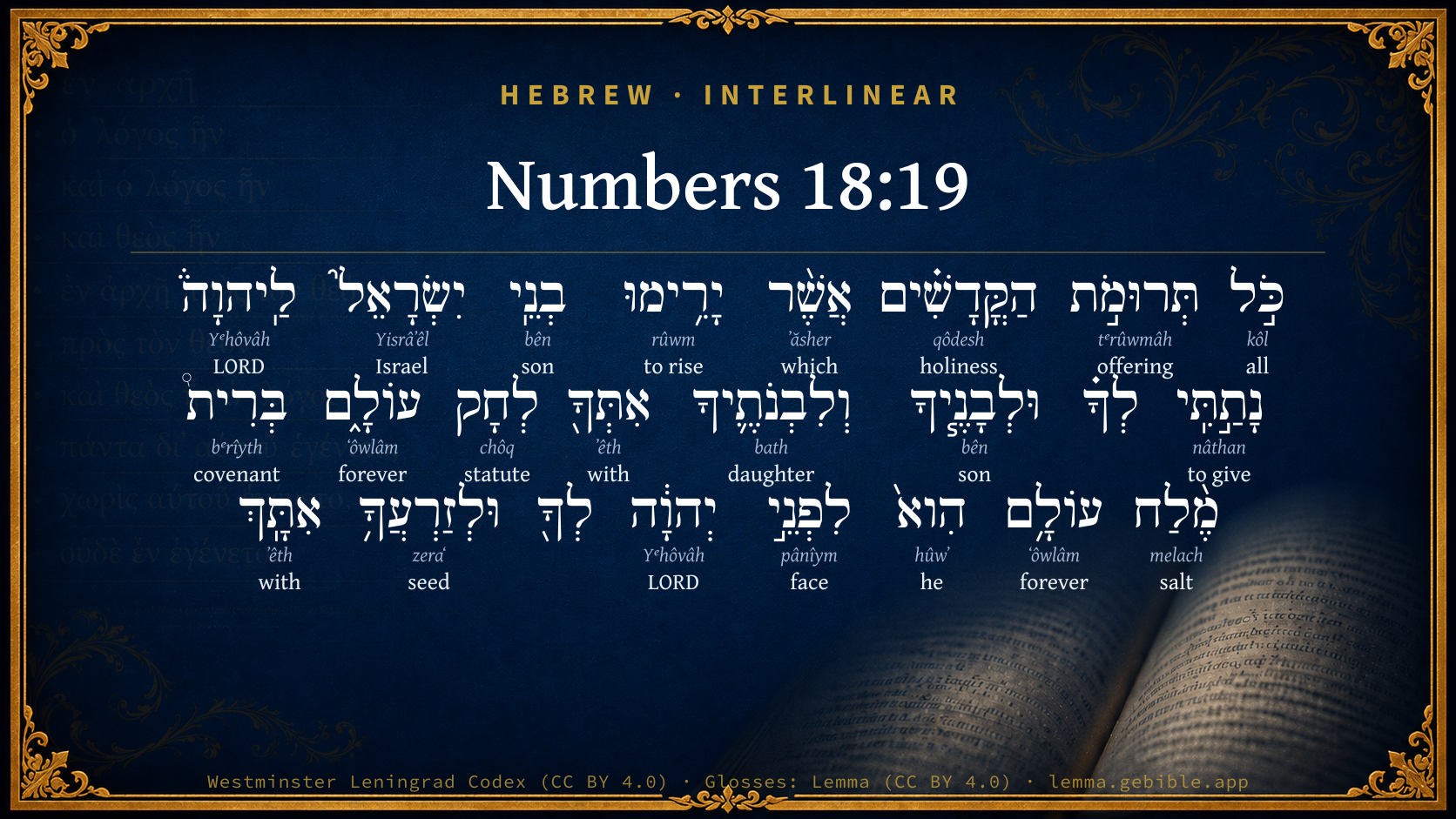
Hebrew (Westminster Leningrad Codex) Numbers 18:19 appears in the Hebrew Old Testament. The text above is from the Westminster Leningrad Codex. Each word links to its Strong’s number, a concise gloss, and parsing drawn from the Open Scriptures Hebrew Bible morphology. Click any word for its full Brown-Driver-Briggs (BDB) entry.
Download image
Cite this verse

Numbers 18:19 (World English Bible). Public Domain. Lemma interlinear Bible study tool, https://lemma.gebible.app/v/numbers/18/19.

Show BibTeX & RIS
BibTeX
RIS
English Translation
All the heave-offerings of the holy things, which the children of Israel offer to Yahweh, have I given you, and your sons and your daughters with you, as a portion forever: it is a covenant of salt forever before Yahweh to you and to your seed with you.
World English Bible · Public Domain
Download a study sheet

One document with this verse’s original text, its word-by-word gloss line, the meaning frame, cross-references with their text, attributed commentary, and full source and license credits — printable, and it pastes into notes with its structure intact.

This verse Autodidact and up

Study sheet (.html) Plain text (.txt)

A passage Seminary Student

Up to 50 verses in one chapter. A passage sheet keeps up to 6 commentary sources and 12 cross-references per verse, in the order this page ranks them, and says so on the sheet whenever that leaves anything out. Ask for a single verse and you get the Autodidact verse sheet above.

Everything on this page stays free to read, with no account — the sheet is a download of what is already on screen, not access to it.

Want to remove ads? Support Godless Engineer
Compare translations 3

The same verse in 3 English versions, stacked beneath the original-language interlinear above. Click any original word for its lexicon entry.

Each is an independent rendering of the whole verse — the interlinear is not word-aligned to these translations.

Highlighted words mark where these versions differ — a whole-verse word diff, not a word-by-word alignment.

  • World English Bible Public Domain
    All the heave-offerings of the holy things, which the children of Israel offer to Yahweh, have I given you, and your sons and your daughters with you, as a portion forever: it is a covenant of salt forever before Yahweh to you and to your seed with you.
  • King James Version Public Domain
    All the heave offerings of the holy things, which the children of Israel offer unto the LORD, have I given thee, and thy sons and thy daughters with thee, by a statute for ever: it is a covenant of salt for ever before the LORD unto thee and to thy seed with thee.
  • unfoldingWord Literal Text CC BY-SA 4.0
    All the contributions of the holy things that the sons of Israel raise to Yahweh I have given to you and to your sons and to your daughters with you for a statute of eternity. It a covenant of salt of eternity to the face of Yahweh, for you and for your seed with you.”

unfoldingWord Literal Text — © unfoldingWord, licensed CC BY-SA 4.0. Word-aligned USFM3 via Door43 (git.door43.org/unfoldingWord/en_ult).

Versions to compare (up to 4)

3 of 4 selected

Show all 18 translations

Every available English version of this verse, each an independent rendering of the whole verse.

  • World English Bible Public Domain
    All the heave-offerings of the holy things, which the children of Israel offer to Yahweh, have I given you, and your sons and your daughters with you, as a portion forever: it is a covenant of salt forever before Yahweh to you and to your seed with you.
  • Berean Standard Bible Public Domain
    All the holy offerings that the Israelites present to the LORD I give to you and to your sons and daughters as a permanent statute. It is a permanent covenant of salt before the LORD for you and your offspring.”
  • Majority Standard Bible Public Domain
    All the holy offerings that the Israelites present to the LORD I give to you and to your sons and daughters as a permanent statute. It is a permanent covenant of salt before the LORD for you and your offspring.”
  • King James Version Public Domain
    All the heave offerings of the holy things, which the children of Israel offer unto the LORD, have I given thee, and thy sons and thy daughters with thee, by a statute for ever: it is a covenant of salt for ever before the LORD unto thee and to thy seed with thee.
  • American Standard Version (1901) Public Domain
    All the heave-offerings of the holy things, which the children of Israel offer unto Jehovah, have I given thee, and thy sons and thy daughters with thee, as a portion for ever: it is a covenant of salt for ever before Jehovah unto thee and to thy seed with thee.
  • Revised Version (1885) Public Domain
    All the heave offerings of the holy things, which the children of Israel offer unto the LORD, have I given thee, and thy sons and thy daughters with thee, as a due for ever: it is a covenant of salt for ever before the LORD unto thee and to thy seed with thee.
  • Geneva Bible (1599) Public Domain
    All the heaue offrings of the holy things which the children of Israel shall offer vnto the Lord, haue I giuen thee, and thy sonnes, and thy daughters with thee, to be a duetie for euer: it is a perpetual couenant of salt before the Lord, to thee, and to thy seede with thee.
  • Douay-Rheims (1899) Public Domain
    All the firstfruits of the sanctuary which the children of Israel offer to the Lord, I have given to thee and to thy sons and daughters, by a perpetual ordinance. It is a covenant of salt for ever before the Lord, to thee and to thy sons.
  • Young's Literal Translation Public Domain
    all the heave-offerings of the holy things which the sons of Israel lift up to Jehovah I have given to thee and to thy sons, and to thy daughters with thee, by a statute age-during, a covenant of salt, age-during it `is' before Jehovah, to thee and to thy seed with thee.'
  • Literal Standard Version CC BY-SA 4.0
    All the raised-offerings of the holy things, which the sons of Israel lift up to YHWH, I have given to you, and to your sons, and to your daughters with you, by a continuous statute—a covenant of salt; it [is] continuous before YHWH to you and to your seed with you.”
  • Unlocked Literal Bible CC BY-SA 4.0
    All the holy offerings that the people of Israel present to Yahweh, I have given to you, and to your sons and to your daughters with you, as a continual share. It is an everlasting covenant of salt, a binding covenant forever, before Yahweh for both you and your descendants with you.”
  • unfoldingWord Literal Text CC BY-SA 4.0
    All the contributions of the holy things that the sons of Israel raise to Yahweh I have given to you and to your sons and to your daughters with you for a statute of eternity. It a covenant of salt of eternity to the face of Yahweh, for you and for your seed with you.”
  • Darby Bible Public Domain
    All the heave-offerings of the holy things, which the children of Israel offer to Jehovah, have I given thee, and to thy sons and to thy daughters with thee, by an everlasting statute: it shall be an everlasting covenant of salt before Jehovah unto thee and thy seed with thee.
  • World Messianic Bible Public Domain
    All the wave offerings of the holy things which the children of Israel offer to the LORD, I have given you and your sons and your daughters with you, as a portion forever. It is a covenant of salt forever before the LORD to you and to your offspring with you.”
  • Webster's Bible Public Domain
    All the heave-offerings of the holy things, which the children of Israel offer to the LORD, have I given to thee, and to thy sons and thy daughters with thee, by a statute for ever: it is a covenant of salt for ever before the LORD to thee and to thy seed with thee.
  • Free Bible Version CC BY-SA 4.0
    I am giving all the voluntary gifts that the Israelites present to the Lord to you and to your sons and daughters as a permanent rule. It is a permanent agreement of salt before the Lord for you and your descendants.
  • Bible in Basic English Public Domain
    All the lifted offerings of the holy things which the children of Israel give to the Lord, I have given to you and to your sons and to your daughters as a right for ever. This is an agreement made with salt before the Lord, to you and to your seed for ever.
  • JPS Tanakh (1917) Public Domain
    All the heave-offerings of the holy things, which the children of Israel offer unto the LORD, have I given thee, and thy sons and thy daughters with thee, as a due for ever; it is an everlasting covenant of salt before the LORD unto thee and to thy seed with thee.'

Literal Standard Version (2020), Covenant Press — licensed CC BY-SA 4.0. Text via the HelloAO Bible API (eBible.org). Unlocked Literal Bible (unfoldingWord) — licensed CC BY-SA 4.0. Text via the HelloAO Bible API (eBible.org). unfoldingWord Literal Text — © unfoldingWord, licensed CC BY-SA 4.0. Word-aligned USFM3 via Door43 (git.door43.org/unfoldingWord/en_ult). Free Bible Version, Dr. Jonathan Gallagher — licensed CC BY-SA 4.0. Text via the HelloAO Bible API (eBible.org).

Word by word

More ways to search: Search by grammar → Find every occurrence → Compare this word →

Practice this passage: Drill this verse → Learn its vocabulary →

מֶ֨לַח
melach
H4417
“salt of”
Noun, Common, Masculine, Singular, Construct
Part of Speech
Noun
Type
Common
Gender
Masculine
Number
Singular
State
Construct
Full BDB Definition

Origin: from H4414

TWOT: 1197a

salt
  1. כֹּ֣ל kôl H3605 “all of” Noun, Common, Masculine, Singular, Construct
  2. תְּרוּמֹ֣ת tᵉrûwmâh H8641 “offerings of” Noun, Common, Feminine, Plural, Construct
  3. הַקֳּדָשִׁ֗ים qôdesh H6944 “the · holy things” Particle, Definite Article + Noun, Common, Masculine, Plural, Absolute
  4. אֲשֶׁ֨ר ʼăsher H834 “which” Particle, Relative
  5. יָרִ֥ימוּ rûwm H7311 “to rise” Verb, Hiphil, Imperfect, 3rd Person, Masculine, Plural
  6. בְנֵֽי bên H1121 “sons of” Noun, Common, Masculine, Plural, Construct
  7. יִשְׂרָאֵל֮ Yisrâʼêl H3478 “Israel” Noun, Proper
  8. לַֽיהוָה֒ Yᵉhôvâh H3068 “to/for · LORD” Preposition + Noun, Proper
  9. נָתַ֣תִּֽי nâthan H5414 “to give” Verb, Qal, Perfect, 1st Person, Common, Singular
  10. וּלְבָנֶ֧יךָ bên H1121 “and · to/for · sons · your” Conjunction + Preposition + Noun, Common, Masculine, Plural, Construct + Suffix, Personal, 2nd Person, Masculine, Singular
  11. וְלִבְנֹתֶ֛יךָ bath H1323 “and · to/for · daughters · your” Conjunction + Preposition + Noun, Common, Feminine, Plural, Construct + Suffix, Personal, 2nd Person, Masculine, Singular
  12. אִתְּךָ֖ ʼêth H854 “with · you” Preposition + Suffix, Personal, 2nd Person, Masculine, Singular
  13. לְחָק chôq H2706 “to/for · statute of” Preposition + Noun, Common, Masculine, Singular, Construct
  14. עוֹלָ֑ם ʻôwlâm H5769 “forever” Noun, Common, Masculine, Singular, Absolute
  15. בְּרִית֩ bᵉrîyth H1285 “covenant of” Noun, Common, Feminine, Singular, Construct
  16. עוֹלָ֥ם ʻôwlâm H5769 “forever” Noun, Common, Masculine, Singular, Absolute
  17. הִוא֙ hûwʼ H1931 “he” Pronoun, Personal, 3rd Person, Feminine, Singular
  18. לִפְנֵ֣י pânîym H6440 “to/for · face(s) of” Preposition + Noun, Common, Both, Plural, Construct
  19. יְהוָ֔ה Yᵉhôvâh H3068 “LORD” Noun, Proper
  20. וּלְזַרְעֲךָ֥ zeraʻ H2233 “and · to/for · seed · your” Conjunction + Preposition + Noun, Common, Masculine, Singular, Construct + Suffix, Personal, 2nd Person, Masculine, Singular
  21. אִתָּֽךְ ʼêth H854 “with · you” Preposition + Suffix, Personal, 2nd Person, Feminine, Singular

About this verse

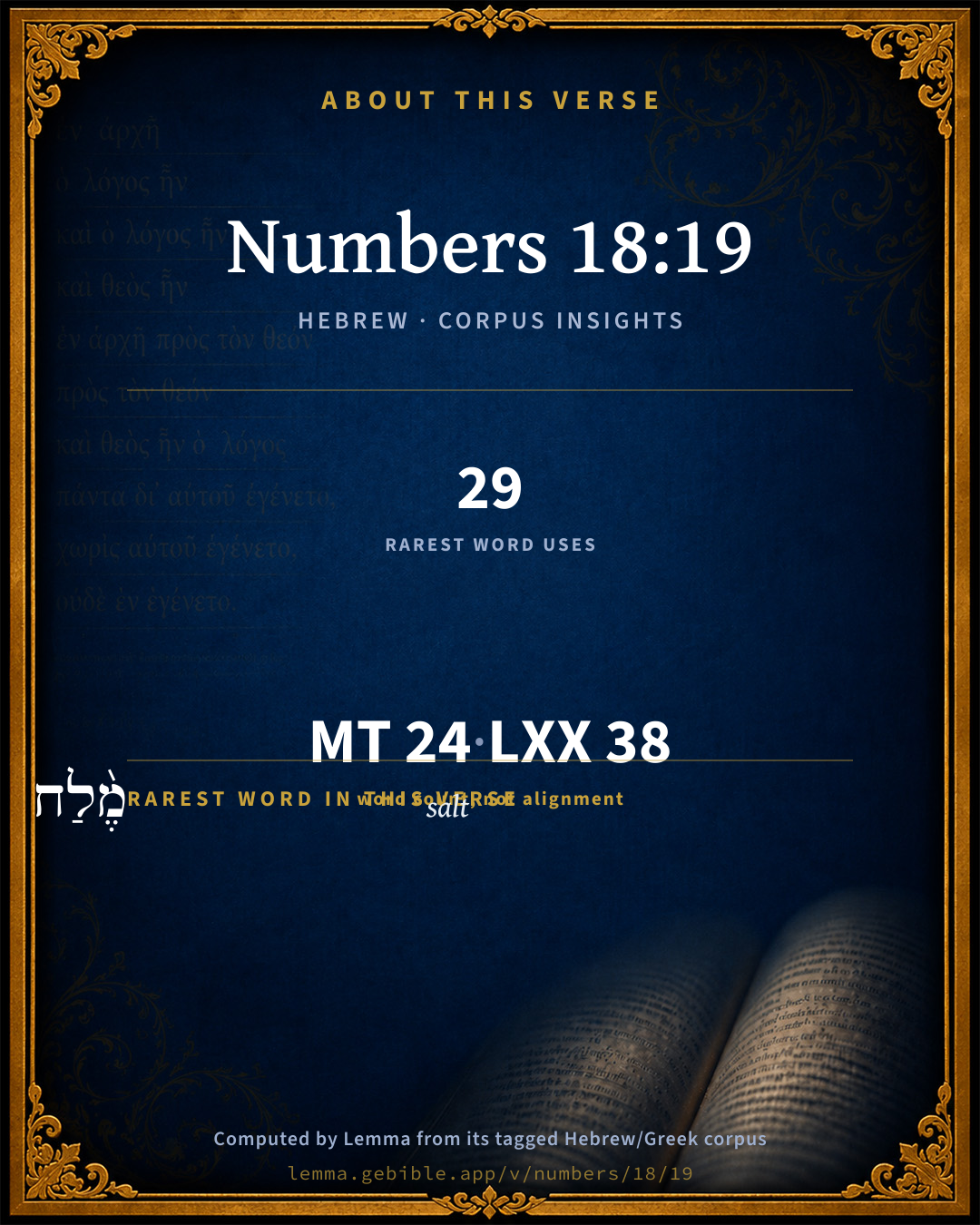
These counts appear in no published source. They are computed here, from the morphology-tagged text and Lemma’s own curated glosses. What Lemma adds →

24
words
18
distinct lemmas
Pentateuch
section

Shared distinctive vocabulary

מֶ֨לַח salt H4417 occurs in 26 verses of the Hebrew Bible. Also found in:

Grammatical profile

  • 2 verbs
  • 16 nouns
  • 1 pronoun
  • 4 prepositions
  • 1 particle

Verb forms

  • יָרִ֥ימוּ Hiphil · Imperfect
  • נָתַ֣תִּֽי Qal · Perfect

Repetition

Words recur within this verse — often emphatic in Hebrew:

  • בְנֵֽי son H1121 ×2
  • לַֽיהוָה֒ LORD H3068 ×2
  • עוֹלָ֑ם forever H5769 ×2
  • אִתְּךָ֖ with H854 ×2

Hebrew & Septuagint length

In English translation the verse runs 48 words from the Hebrew and 54 from the Septuagint (LXX English) — closely comparable.

A rough comparison of the two English renderings, which tokenize alike — not a word-level alignment.

Word counts can differ between the Hebrew and the Greek without any difference in meaning — e.g. the Hebrew direct-object marker אֵת has no separate Greek word, and Greek often adds the article ὁ.

In the original languages it is 24 Hebrew tokens and 38 Greek tokens — but the two are counted differently (Hebrew bundles its prefixes and suffixes into one token; the Greek is in lemma form), so that isn’t a like-for-like length.

Cross-references

10

Topical passages linked to Numbers 18:19 in the Treasury of Scripture Knowledge — connected by theme and wording, ordered by reader-vote popularity; previews shown in the World English Bible.

  • 2 Chronicles 13:5 Ought you not to know that Yahweh, the God of Israel, gave the kingdom over Israel to David forever, even to him and to his sons by a covenant of salt?
  • Leviticus 2:13 Every offering of your meal offering you shall season with salt; neither shall you allow the salt of the covenant of your God to be lacking from your meal offering. With all your offerings you shall offer salt.
  • Numbers 18:11 This is your: the heave-offering of their gift, even all the wave-offerings of the children of Israel; I have given them to you, and to your sons and to your daughters with you, as a portion forever; everyone who is clean in your house shall eat of it.
  • Leviticus 7:14 Of it he shall offer one out of each offering for a heave offering to Yahweh. It shall be the priest's who sprinkles the blood of the peace offerings.
  • Numbers 15:19–21 then it shall be that when you eat of the bread of the land, you shall offer up a heave-offering to Yahweh.
  • Numbers 18:8 Yahweh spoke to Aaron, I, behold, I have given you the charge of my heave-offerings, even all the holy things of the children of Israel; to you have I given them by reason of the anointing, and to your sons, as a portion forever.
  • Numbers 31:29 take it of their half, and give it to Eleazar the priest, for Yahweh's heave-offering.
  • Numbers 31:41 Moses gave the tribute, which was Yahweh's heave-offering, to Eleazar the priest, as Yahweh commanded Moses.
  • Deuteronomy 12:6 and there you shall bring your burnt offerings, and your sacrifices, and your tithes, and the heave-offering of your hand, and your vows, and your freewill-offerings, and the firstborn of your herd and of your flock:
  • 2 Chronicles 31:4 Moreover he commanded the people who lived in Jerusalem to give the portion of the priests and the Levites, that they might give themselves to the law of Yahweh.

Cross-references courtesy of OpenBible.info (CC BY 4.0).

Hebrew and Greek witnesses Masoretic Hebrew ↔ Greek Septuagint

The same verse in the two great witnesses to the Old Testament, shown verse-for-verse.

These are two independent witnesses, not word-aligned to each other, and the Septuagint is shown in lemma (dictionary) form.

Hebrew Numbers 18:19 Masoretic · Westminster Leningrad Codex

כֹּ֣ל תְּרוּמֹ֣ת הַקֳּדָשִׁ֗ים אֲשֶׁ֨ר יָרִ֥ימוּ בְנֵֽי יִשְׂרָאֵל֮ לַֽיהוָה֒ נָתַ֣תִּֽי לְךָ֗ וּלְבָנֶ֧יךָ וְלִבְנֹתֶ֛יךָ אִתְּךָ֖ לְחָק עוֹלָ֑ם בְּרִית֩ מֶ֨לַח עוֹלָ֥ם הִוא֙ לִפְנֵ֣י יְהוָ֔ה לְךָ֖ וּלְזַרְעֲךָ֥ אִתָּֽךְ

All the heave-offerings of the holy things, which the children of Israel offer to Yahweh, have I given you, and your sons and your daughters with you, as a portion forever: it is a covenant of salt forever before Yahweh to you and to your seed with you.

World English Bible · Public Domain

Greek LXX Numbers 18:19 Septuagint · lemma form

πᾶς ἀφαίρεμα ὁ ἅγιος ὅσος ἄν ἀποαἱρέω ὁ υἱός ἰσραήλ κύριος σύ δίδωμι καί ὁ υἱός σύ καί ὁ θυγάτηρ σύ μετά σύ νόμιμος αἰώνιος διαθήκη ἅλς αἰώνιος εἰμί ἔναντι κύριος σύ καί ὁ σπέρμα σύ μετά σύ

Every special offering of the holy things, whatever the children of Israel shall specially offer to the Lord, I have given to you and to your sons and to your daughters with you, a perpetual ordinance: it is a covenant of salt for ever before the Lord, for you and your seed after you.

LXX2012 (modern English Septuagint) · Public Domain

On this verse, The Pulpit Commentary discusses the Septuagint’s reading. Read the note in Commentary ↓

Hebrew: Westminster Leningrad Codex (CC BY 4.0). Greek: Septuagint (public domain); English from LXX2012 (modern English Septuagint) (Public Domain). How the Septuagint differs from the Hebrew →

Targum (Aramaic paraphrase)

2

The Targum is the ancient Jewish Aramaic paraphrase of the Hebrew Scriptures — an interpretive translation, not the Hebrew text itself. Onkelos (literal) and Pseudo-Jonathan (expansive) render the Torah, and Jonathan the Prophets. Coverage is partial: where no permissively-licensed English translation exists for a verse, only the Aramaic is shown. This is verse-level text, not a word-by-word alignment to the Hebrew.

  1. Targum Onkelos Torah (Genesis–Deuteronomy)
    כָּל אַפְרָשׁוּת קוּדְשַׁיָא דִי יִפְרְשׁוּן בְּנֵי יִשְׂרָאֵל קֳדָם יְיָ יְהָבִית לָךְ וְלִבְנָיךְ וְלִבְנָתָיךְ עִמָךְ לִקְיַם עֲלָם קְיַים מְלַח עֲלָם הִיא קֳדָם יְיָ לָךְ וְלִבְנָךְ עִמָךְ

    (no public-domain English translation for this verse)

    Targum Onkelos — Aramaic: “Onkelos Genesis” (public domain); “Onkelos Exodus” (public domain); “Onkelos Leviticus” (public domain); “Onkelos Numbers” (public domain); “Onkelos Deuteronomy” (public domain). English: “Sefaria Community Translation” (CC0 1.0 (public-domain dedication)); “J.W. Etheridge. The Targums of Onkelos and Jonathan Ben Uzziel on the Pentateuch. London: Longmans, Green, 1862” (public domain). Text via Sefaria.

  2. Targum Pseudo-Jonathan Torah (Genesis–Deuteronomy)
    כָּל אַפְרָשׁוּת קוּדְשַׁיָא דִי יְקַדְשׁוּן בְּנֵי יִשְרָאֵל קֳדָם יְיָ יְהָבִית לָךְ וְלִבְנָךְ וְלִבְנָתָךְ עִמָךְ לִקְיַים עֲלָם וְלָא יִתְבַּטֵיל הֵי כְּמִלְחָא דִמְבַסִים בְּשַר קוּרְבָּנַיָא דִקְיַים עֲלָם הוּא קֳדָם יְיָ הֵיכְדֵין הוּא לָךְ וְלִבְנָךְ

    Every thing set apart of the sacred things which the sons of Israel consecrate to the Lord have I given to thee, to thy sons and thy daughters with thee, by a perpetual statute not to be abolished; as the salt which seasoneth the flesh of the oblation, because it is an everlasting statute before the Lord, so shall it be for thee and for thy children.

    Targum Pseudo-Jonathan — Aramaic: “Targum Jonathan on Genesis” (public domain); “Targum Jonathan on Exodus” (public domain); “Targum Jonathan on Leviticus” (public domain); “Targum Jonathan on Numbers” (public domain); “Targum Jonathan on Deuteronomy” (public domain). English: “The Targum of Jonathan ben Uzziel, trans. J. W. Etheridge, London, 1862” (public domain). Text via Sefaria.

Commentary

Notes on Numbers 18:19 from classic Christian and Jewish commentators (each source and its license shown beneath its notes). The classic Christian expositions comment on the surrounding passage and are grouped to its opening verse, so a note may address several verses; the Jewish commentaries on the Tanakh (Rashi and others) are per-verse, so they appear only where the commentator wrote on this verse.

Lemma curates 59 commentaries, every one of them public domain or Creative Commons licensed, each selected and text-cleaned for this edition rather than reprinted as found. About our sources →

Trapp's Complete Commentary

John Trapp

Num 18:19 All the heave offerings of the holy things, which the children of Israel offer unto the LORD, have I given thee, and thy sons and thy daughters with thee, by a statute for ever: it [is] a covenant of salt for ever before the LORD unto thee and to thy seed with thee.

Ver. 19. It is a covenant of salt.] So 2Ch 13:5; that is, Inviolable, incorruptible; non computrescens vetustate, saith Flaccius. Pierius also tells us, that amity and friendship was symbolised by salt - Corpora enim solidiora facit, et diutissime conservat - for its consolidating and conserving property.

John Trapp, A Commentary or Exposition upon All the Books of the Old and New Testament (1647–1656) — public domain. Text from a community e-Sword module.

Joseph Benson's Commentary

Num 18:19. A covenant of salt — A durable and perpetual covenant; so called here, and 2Ch 13:5, either because salt is of singular use to preserve things from corruption, and was an emblem of friendship; or because it was ratified on their part by salt, which is therefore called the salt of the covenant, for which the priests were obliged to take care that it should never be lacking from any meal-offering, Lev 2:13. And this privilege conferred upon the priests is called a covenant, because it was given them conditionally, upon condition of their service and care about the worship of God.

Joseph Benson's Commentary on the Old and New Testaments (1811–1818) — public domain. Text from a community e-Sword module.

Tyndale Open Study Notes

Tyndale Open Resources

18:19 These arrangements were part of an eternal and unbreakable covenant (literally a covenant of salt; cp. 2 Chr 13:5). The covenant was apparently meant to be permanent, since salt (a preservative) was a symbol of permanence (Lev 2:13).

Tyndale Open Study Notes — © Tyndale Open Resources, licensed CC BY-SA 4.0. Text via the HelloAO Bible API.

Geneva Bible (1599)

Geneva Bible translators

That is, sure, stable, and incorruptible.

Geneva Bible (1599) marginal notes — public domain. Text via Bolls.life.

Jamieson, Fausset & Brown

Robert Jamieson, A. R. Fausset & David Brown

it is a covenant of salt--that is, a perpetual ordinance. This figurative form of expression was evidently founded on the conservative property of salt, which keeps meat from corruption; and hence it became an emblem of inviolability and permanence. It is a common phrase among Oriental people, who consider the eating of salt a pledge of fidelity, binding them in a covenant of friendship. Hence the partaking of the altar meats, which were appropriated to the priests on condition of their services and of which salt formed a necessary accompaniment, was naturally called "a covenant of salt" (Lev 2:13).

Jamieson, Fausset & Brown — Commentary Critical and Explanatory on the Whole Bible (1871) — public domain (CC PDM 1.0). Text via the HelloAO Bible API.

Adam Clarke's Commentary

Verse 19. It is a covenant of salt] That is, an incorruptible, everlasting covenant. As salt was added to different kinds of viands, not only to give them a relish, but to preserve them from putrefaction and decay, it became the emblem of incorruptibility and permanence. Hence, a covenant of salt signified an everlasting covenant. We have already seen that, among the Asiatics, eating together was deemed a bond of perpetual friendship; and as salt was a common article in all their repasts, it may be in reference to this circumstance that a perpetual covenant is termed a covenant of salt; because the parties ate together of the sacrifice offered on the occasion, and the whole transaction was considered as a league of endless friendship. See Clarke on Le 2:13.

Adam Clarke's Commentary on the Bible (1810–1826) — public domain. Text from a community e-Sword/MySword module.

Ellicott's Commentary for English Readers

(19) It is a covenant of salt.—i.e., an indissoluble covenant. (See Lev_2:13, and Note; also 2Ch_13:5.) Hence the phrases used by the Greeks to denote the breach of a covenant, “Where is the salt?” and “They overstepped the salt.” (Comp. Pliny, H. N., xxxi. 41; Cic., De Div., ii. 16; Virgil, Ecl., viii. 82.)

A Bible Commentary for English Readers, edited by Charles John Ellicott (1878–1897) — public domain. Text from a community e-Sword module.

The Cambridge Bible for Schools and Colleges

gen. ed. J. J. S. Perowne

19. a covenant of salt] In primitive days the eating of salt, or of the smallest portion of food belonging to another man, constituted a sacred bond of friendship. So the expression denotes ‘a covenant which cannot be broken.’ On the Hebrew ideas of a covenant see the writer’s Exodus, pp. 150–4.

The Cambridge Bible for Schools and Colleges (gen. ed. J. J. S. Perowne; Cambridge University Press, 1878–1918) — public domain. Text from a community e-Sword module.

John Gill's Exposition

And the Lord spake unto Aaron,.... What is said, being what concerned the tribe of Levi, at the head of which Aaron was, even concerning the maintenance of the Levites:

thou shalt have no inheritance in their land; in the land of Israel when they come to possess it, as the rest of the tribes had:

neither shalt thou have any part among them; any part of the land when it is divided by lot, as it was in the times of Joshua, when taken from the Canaanites; no tract of land was peculiarly assigned to them as were to the other tribes, as fields, nor vineyards; they had cities appointed them, and they had houses and fields devoted to the Lord which fell to them, and others they had by gift or legacy, or by purchase, as had Jeremiah the priest and Barnabas the Levite, Jer 32:9 Act 4:36; but they had no share in the distribution of the land of Canaan at the time of the division of it among the tribes; no, not even in the spoil of the cities of the land of Canaan, when they were conquered; this Maimonides (n) says they were warned not to take; and a son of Levi that took any part of the spoil was to be beaten; but the spoil of other lands, subdued by the kings of Israel, they might take, as other Israelites did: the reason of all this was, because they had a sufficient provision made for them in another way, and that they might not be entangled in worldly affairs, or spend their time in the culture of fields and vineyards, but wholly give themselves to the service of God in his house:

I am thy part and thine inheritance among the children of Israel; in things temporal, the offerings, tithes, firstfruits, &c. which were given to the Lord, being bestowed upon them; and in things spiritual, they being employed in the work and service of God, and having a peculiar nearness to him, and communion with him: so all that are made priests unto God, as all believers in Christ are, Pe1 2:5, have God for their portion and inheritance; God, in his persons and in all his perfections, and under every character, as the God of nature, providence, and grace, is the portion of his people; and a rich, large, and satisfying portion he is, and which is inexhaustible, and will endure for ever; he is their portion in life and at death, in time and to all eternity; see Psa 73:26.

(n) Hilchot Shemittah Veyobel, c. 13. sect. 10, 11.

John Gill's Exposition of the Whole Bible (1746–1763) — public domain (CC PDM 1.0). Text via the HelloAO Bible API.

Albert Barnes' Notes on the Bible

A covenant of salt - Compare the marginal reference. covenants were ordinarily cemented in the East by the rites of hospitality; of which salt was the obvious token, entering as it does into every article of diet. It indicates perpetuity: compare Lev 2:13 note.

Albert Barnes' Notes on the Bible (1834–1885) — public domain. Text from a community e-Sword/MySword module.

Haydock's Catholic Bible Commentary

A covenant of salt. It is a proverbial expression, signifying a covenant not to be altered or corrupted; as salt is used to keep things from corruption; a covenant perpetual, like that by which it was appointed that salt should be used in every sacrifice, Leviticus ii. 3. (Challoner) --- Thus God gave the kingdom to David for ever, by a covenant of salt, 2 Paralipomenon xiii. 5. Salt is an emblem of eternity. Oleaster believes, that salt was used in the ratification of all solemn covenants, to denote their stability. (Calmet)

George Leo Haydock (1774–1849), Haydock's Catholic Family Bible and Commentary, 1859 edition — public domain. Excludes Psalms (Douay-Rheims chapter numbering differs from Protestant) and Deuterocanonical books (Catholic canon only).

Matthew Poole's English Annotations

A covenant of salt, i.e. a durable and perpetual covenant; so called here and 2Ch 13:5, either because salt is a sign of incorruption, as being of singular use to preserve things from corruption; or because it is confirmed and ratified on their part by salt, which is therefore called

the salt of the covenant, for which the priests were obliged to take care that it should never be lacking from any meat-offering, Lev 2:13. And this promise or privilege conferred upon the priests is called a

covenant because it is given them conditionally, upon condition of their service, and care about the worship of God, and sacrifices, which were commonly accompanied with meat-offerings, and therefore with salt.

Matthew Poole's English Annotations on the Holy Bible (1683–1685) — public domain. Text from a community e-Sword/MySword module.

Whedon's Commentary on the Bible

Daniel D. Whedon

19. A covenant of salt — Salt symbolizes the unbending truthfulness of that self-surrender to the Lord implied in the sacrifice, excluding all impurity and hypocrisy.

“Unsavoury all our offerings are

Till acceptable through thy Son:

But hear well pleased our praise and prayer

Presented in his Name alone.

The salt we borrow from our Lord,

His meritorious righteousness,

And every deed, and thought, and word

Is season’d now with Jesus’ grace.” C. Wesley.

In common life salt was the emblem of a covenant. Among the modern Arabs, the parties to a treaty ratify it by eating bread and salt together. See Lev_2:13; Mar_9:49; Luk_14:34, notes.

For ever — See Lev_3:17, note.

Daniel D. Whedon (gen. ed.), Commentary on the Old and New Testaments (1874–1909) — public domain. Text from a community e-Sword module.

The Pulpit Commentary

All the heave offerings of the holy things. Those, viz., enumerated from verse 9. It is a covenant of salt for ever. Septuagint, diayhkh aloou . (cf. 2Ch_13:5) Salt was the natural emblem of that which is incorruptible; wherefore a binding alliance was (and still is) made by eating bread and salt together, and salt was always added to the sacrifices of the Lord. (Lev_2:13 Mar_9:49)

A covenant of salt.

God has defined the provisions for the priesthood, and indicated in what certainty and sufficiency they would come. He also indicates the permanency of the supply. The things given would be given to Aaron and to his sons and daughters with him by a statute for ever. Everything was done to make and keep the priesthood separate, and prevent those who had it from being tempted into the ordinary business of life, by fear lest they should lack sufficient support. And still further to emphasize the solemnity of the pledge, God adds this peculiar and suggestive expression: "It is a covenant of salt for ever." Dr. Thomson, in "The Land and the Book," tells us that it is a habit still common among the Bedawin, and probably coming from the remotest times, for host and guest to eat together. This is said to be bread and salt between them, and constitutes a pledge of protection, support, and fidelity even to death. Thus we may understand God saying to Aaron, and through him to the long succession of priests, "There is bread and salt between us." But we must also go back and consider Lev_2:13. All the meat offerings presented to God were to be seasoned with salt. When presented, a part was burnt, as it were, eaten by God himself, and the remainder he returns to the priest for his own use. Thus there are mutual pledges of fidelity. God is the guest of the priest, and the priest in turn the guest of God. In this way God lifted a social custom to a holy use. We cannot but notice in the second chapter of Leviticus that while some things are mentioned as constituents of the meat offering, viz., oil and frankincense, and others as excluded, viz., leaven and honey, a special emphasis is laid on the presence of salt. A special significance was to be indicated by that presence, and it agrees with this that when Ezra was going up from Babylon, furnished by Artaxerxes with all he might require for sacrifice, the salt is given without prescribing how much. (Num_7:22) We must, however, look further back than social customs even, to find the reason why salt was present in this covenant. Social customs, could they be traced back, rise, some of them at least, out of religious ordinances. Why was salt chosen as the symbol? It is something to notice that salt gives flavour to that which is insipid. God"s gifts may easily pall and become worthless if his presence is not associated with them; with the sense of that presence they cannot but be grateful. But the chief service of salt is to preserve that which is dead from decay. Salt will not bring back life, but it will hinder putrefaction. Under the old covenant God did not give life, though he was preparing to give it; but at the same time he did much to preserve the world, dead in trespasses and sins, from corpse decay, while he made ready in the fullness of time to bring back the dead to life. Thus the covenant with men through types and shadows was emphatically a covenant of salt. And the same may he said of the new covenant through the great reality in Christ Jesus. There is an element of salt in this covenant also. "Ye are the salt of the earth," said Christ to his disciples in the great and honourable burden of service which he laid on them. Indeed, what we call the old and the new covenant are really but shapes of that great covenant between God and man made in the very constitution of things. God, creating man in his own image, and planting within him certain powers and aspirations, is thereby recording the Divine articles in the covenant; and man also, by the manifestations of his nature, by his recognition of conscience, even by his idolatries and superstitions, and gropings after God, testifies to his part in the covenant. And in this covenant all true disciples are as the salt, the solemn, continuous pledge from God to the world that he does not look on it as beyond recovery. Be it the part of all disciples then to keep the savour of the salt that is in them. "Walk in wisdom towards them that are without, redeeming the time. Let your speech be array with grace, seasoned with salt". (Col_4:5, Col_4:6) It rests with us to honour God"s covenant of salt and make it more and more efficacious. Y.

The Pulpit Commentary (1880–1919), ed. H.D.M. Spence-Jones & Joseph S. Exell — public domain. Text from a community e-Sword module.

John Wesley's Explanatory Notes

A covenant of salt - A durable and perpetual covenant; so called here and 2 Chron. xiii, 5, either, because salt is a sign of incorruption, as being of singular use to preserve things from corruption: or, because it is ratified on their part by salt, which is therefore called the salt of the covenant, for which the priests were obliged to take care, that it should never be lacking from any meat-offering, Lev. ii, 13. And this privilege conferred upon the priests is called a covenant because it is given them conditionally, upon condition of their service, and care about the worship of God.

John Wesley, Explanatory Notes Upon the Whole Bible (1754–1765) — public domain. Text via the GEBible commentary corpus.

Keil & Delitzsch

C. F. Keil & F. Delitzsch

"All the holy heave-offerings" are not the thank-offerings (Knobel), but, as in Num 18:8, all the holy gifts enumerated in Num 18:9-18. Jehovah gives these to the priests as an eternal claim. "An eternal covenant of salt is this before Jehovah," for Aaron and his descendants. A "covenant of salt;" equivalent to an indissoluble covenant, or inviolable contract (see at Lev 2:13).

Keil & Delitzsch — Biblical Commentary on the Old Testament (1861–1891) — public domain (CC PDM 1.0). Text via the HelloAO Bible API. (Old Testament only.)

unfoldingWord translationNotes

Door43 World Missions Community

Connecting Statement:

God continues speaking to Aaron.

I have given to you

God speaks as if he had already done this because it is a decision that he had already made. AT: "I give to you"

as a continual share

A share is a portion of something that someone receives. AT: "as the portion that you will continually receive"

an everlasting covenant of salt ... a binding covenant forever

The two phrases refer to the same thing. Together they emphasize that the covenant will endure forever. AT: "an agreement forever" (See: Parallelism)

an everlasting covenant of salt

"a covenant made with salt." Salt represented permanence and was used in offerings and covenant meals. AT: "a permanent covenant" or "an everlasting covenant" (See: Symbolic Action)

You will have no inheritance in the people's land

God speaks of the land that the other people will possess as if they will inherit it. AT: "You will not possess any of the people's land" or "You will not receive any of the land that the Israelites will possess" (See: Metaphor)

I am your share and inheritance

God speaks of the great honor that Aaron and his descendants will have by serving him as priests as if God were something that they will inherit. AT: "Instead, I am what you will have" or "Instead, I will allow you to serve me and I will provide for you through that service" (See: Metaphor)

translationWords

people group

Israel

son

covenant

eternity

descend

Aaron

inherit

unfoldingWord translationNotes — © Distant Shores Media and the Door43 World Missions Community, licensed CC BY-SA 4.0. Source: git.door43.org/Door43/en_tn.

Rashi

Rabbi Shlomo Yitzchaki (Rashi)

כל תרומת הקדשים ALL THE HEAVE OFFERINGS OF THE HOLY THINGS [… HAVE I GIVEN THEE] — Out of a feeling of affection for the contents of this section, Scripture comprehends it at first in a general statement (v. 11: וזה לכם תרומת וגו׳), and comprehends it also in a general statement at the end (in this verse) and enumerates the details in between (vv. 12—18) (Sifrei Bamidbar 118).

ברית מלח עולם [IT IS] A COVENANT OF SALT FOR EVER — This means that He made a covenant with Aaron by means of something which is wholesome and lasting and keeps other things wholesome (Sifrei Bamidbar 118).

ברית מלח A COVENANT OF SALT — Another explanation is that ברית מלח is equivalent to כברית מלח, and the meaning is: like the covenant that was made with salt that it will never decay.

Rashi on the Tanakh — English translations: “The Judaica Press complete Tanach with Rashi, translated by A. J. Rosenberg” (CC BY 4.0); “Pentateuch with Rashi's commentary by M. Rosenbaum and A.M. Silbermann, 1929-1934” (public domain); “The Metsudah Tanach series, Lakewood, N.J” (CC BY 4.0); and “The Book of Joshua, Metsudah Publications, 1997” (CC BY 4.0). Text via Sefaria.

Lesson kit

Teaching starters — assembled from the data on this page, not authored interpretation. Every prompt links to the verse data it draws on. Edit before teaching.

Numbers, in the Pentateuch, opens this verse with 24 words (18 distinct Hebrew lemmas). Its most distinctive word is melach (“salt”). A historical commentator’s framing appears above. Read the whole chapter for the surrounding context.

Discussion questions

  1. What does “salt” (melach) contribute to the verse as a whole?
  2. How does Genesis 14:3, which shares the word «salt», read alongside this verse?
  3. What does the repetition of “son” (2× in this one verse) do in this verse?
  4. These translations render this verse differently; the difference is in the English rendering, not the original. What questions does that raise?
  5. «יָרִ֥ימוּ» is a Hiphil Imperfect verb. How does that grammatical form shape the action described?
  6. Compare how Trapp's Complete Commentary and Joseph Benson's Commentary read this verse. Where do they agree or differ?

Things to notice

Reading settings

Reading text

Shown beneath each verse's original-language words.

Old Testament
Old Testament edition

Read the OT as the Masoretic Hebrew (MT) or the Greek Septuagint (LXX).

English shown for the Greek Septuagint (in the Hebrew ↔ Greek comparison).

Comparing translations? Open the Compare panel on any verse page to stack up to four side by side.