

1 Samuel 21:5

Hebrew (Westminster Leningrad Codex) 1 Samuel 21:5 appears in the Hebrew Old Testament. The text above is from the Westminster Leningrad Codex. Each word links to its Strong’s number, a concise gloss, and parsing drawn from the Open Scriptures Hebrew Bible morphology. Click any word for its full Brown-Driver-Briggs (BDB) entry.
Download image
Cite this verse

1 Samuel 21:5 (World English Bible). Public Domain. Lemma interlinear Bible study tool, https://lemma.gebible.app/v/1-samuel/21/5.

Show BibTeX & RIS
BibTeX
RIS
English Translation
David answered the priest, and said to him, Of a truth women have been kept from us about these three days; when I came out, the vessels of the young men were holy, though it was but a common journey; how much more then today shall their vessels be holy?
World English Bible · Public Domain
Download a study sheet

One document with this verse’s original text, its word-by-word gloss line, the meaning frame, cross-references with their text, attributed commentary, and full source and license credits — printable, and it pastes into notes with its structure intact.

This verse Autodidact and up

Study sheet (.html) Plain text (.txt)

A passage Seminary Student

Up to 50 verses in one chapter. A passage sheet keeps up to 6 commentary sources and 12 cross-references per verse, in the order this page ranks them, and says so on the sheet whenever that leaves anything out. Ask for a single verse and you get the Autodidact verse sheet above.

Everything on this page stays free to read, with no account — the sheet is a download of what is already on screen, not access to it.

Want to remove ads? Support Godless Engineer
Compare translations 3

The same verse in 3 English versions, stacked beneath the original-language interlinear above. Click any original word for its lexicon entry.

Each is an independent rendering of the whole verse — the interlinear is not word-aligned to these translations.

Highlighted words mark where these versions differ — a whole-verse word diff, not a word-by-word alignment.

  • World English Bible Public Domain
    David answered the priest, and said to him, Of a truth women have been kept from us about these three days; when I came out, the vessels of the young men were holy, though it was but a common journey; how much more then today shall their vessels be holy?
  • King James Version Public Domain
    And David answered the priest, and said unto him, Of a truth women have been kept from us about these three days, since I came out, and the vessels of the young men are holy, and the bread is in a manner common, yea, though it were sanctified this day in the vessel.
  • unfoldingWord Literal Text CC BY-SA 4.0
    And David answered the priest and said to him, “Surely a woman has been kept from us as yesterday and the third day in my going out. If the vessels of the men have been holy when it a common journey, then indeed that it will be holy today with the vessels!”

unfoldingWord Literal Text — © unfoldingWord, licensed CC BY-SA 4.0. Word-aligned USFM3 via Door43 (git.door43.org/unfoldingWord/en_ult).

Versions to compare (up to 4)

3 of 4 selected

Show all 18 translations

Every available English version of this verse, each an independent rendering of the whole verse.

  • World English Bible Public Domain
    David answered the priest, and said to him, Of a truth women have been kept from us about these three days; when I came out, the vessels of the young men were holy, though it was but a common journey; how much more then today shall their vessels be holy?
  • Berean Standard Bible Public Domain
    David answered, “Women have indeed been kept from us, as is usual when I set out. And the equipment of the young men is holy, as it is even on common missions, and all the more at this time.”
  • Majority Standard Bible Public Domain
    David answered, “Women have indeed been kept from us, as is usual when I set out. And the bodies of the young men are holy even on common missions. How much more so today!”
  • King James Version Public Domain
    And David answered the priest, and said unto him, Of a truth women have been kept from us about these three days, since I came out, and the vessels of the young men are holy, and the bread is in a manner common, yea, though it were sanctified this day in the vessel.
  • American Standard Version (1901) Public Domain
    And David answered the priest, and said unto him, Of a truth women have been kept from us about these three days; when I came out, the vessels of the young men were holy, though it was but a common journey; how much more then to-day shall their vessels be holy?
  • Revised Version (1885) Public Domain
    And David answered the priest, and said unto him, Of a truth women have been kept from us about these three days; When I came out, the vessels of the young men were holy, though it was but a common journey; how much more then today shall their vessels be holy?
  • Geneva Bible (1599) Public Domain
    Dauid then answered the Priest, and sayde vnto him, Certainely women haue bene separarate from vs these two or three dayes since I came out: and the vessels of the yong men were holy, though the way were prophane, and how much more then shall euery one be sanctified this day in the vessell?
  • Douay-Rheims (1899) Public Domain
    And David answered the priest, and said to him: Truly, as to what concerneth women, we have refrained ourselves from yesterday and the day before, when we came out, and the vessels of the young men were holy. Now this way is defiled, but it shall also be sanctified this day in the vessels.
  • Young's Literal Translation Public Domain
    And David answereth the priest, and saith to him, `Surely, if women have been restrained from us as heretofore in my going out, then the vessels of the young men are holy, and it `is' a common way: and also, surely to-day it is sanctified in the vessel.'
  • Literal Standard Version CC BY-SA 4.0
    And David answers the priest and says to him, “Surely, if women have been restrained from us as before in my going out, then the vessels of the young men are holy, and it [is] a common way; and also, surely it is sanctified today in the vessel.”
  • Unlocked Literal Bible CC BY-SA 4.0
    David answered the priest, “Surely women have been kept from us for the past three days, as usual when I set out. The things belonging to the men have been set apart even on ordinary missions. How much more today will what they have be set apart!”
  • unfoldingWord Literal Text CC BY-SA 4.0
    And David answered the priest and said to him, “Surely a woman has been kept from us as yesterday and the third day in my going out. If the vessels of the men have been holy when it a common journey, then indeed that it will be holy today with the vessels!”
  • Darby Bible Public Domain
    And David answered the priest and said to him, Yes indeed, women have been kept from us about these three days, since I came out, and the vessels of the young men are holy, and the [bread] is in a manner common, and the more so, because to-day [new] is hallowed in the vessels.
  • World Messianic Bible Public Domain
    David answered the priest, and said to him, “Truly, women have been kept from us as usual these three days. When I came out, the vessels of the young men were holy, though it was only a common journey. How much more then today shall their vessels be holy?”
  • Webster's Bible Public Domain
    And David answered the priest, and said to him, Of a truth women have been kept from us about these three days, since I came out, and the vessels of the young men are holy, and the bread is in a manner common, yes, though it were sanctified this day in the vessel.
  • Free Bible Version CC BY-SA 4.0
    “We have not slept with any women,” David answered. “In fact that's the rule when I lead the troops on mission. They keep themselves pure even during ordinary missions, and all the more so right now.”
  • Bible in Basic English Public Domain
    And David in answer said to the priest, Certainly women have been kept from us; and as has been done before when I have gone out the arms of the young men were made holy, even though it was a common journey; how much more today will their arms be made holy.
  • JPS Tanakh (1917) Public Domain
    (21-6) And David answered the priest, and said unto him: 'Of a truth women have been kept from us about these three days; when I came out, the vessels of the young men were holy, though it was but a common journey; how much more then to-day, when there shall be holy bread in their vessels?'

Literal Standard Version (2020), Covenant Press — licensed CC BY-SA 4.0. Text via the HelloAO Bible API (eBible.org). Unlocked Literal Bible (unfoldingWord) — licensed CC BY-SA 4.0. Text via the HelloAO Bible API (eBible.org). unfoldingWord Literal Text — © unfoldingWord, licensed CC BY-SA 4.0. Word-aligned USFM3 via Door43 (git.door43.org/unfoldingWord/en_ult). Free Bible Version, Dr. Jonathan Gallagher — licensed CC BY-SA 4.0. Text via the HelloAO Bible API (eBible.org).

Word by word

More ways to search: Search by grammar → Find every occurrence → Compare this word →

Practice this passage: Drill this verse → Learn its vocabulary →

חֹ֔ל
chôl
H2455
“profane”
Noun, Common, Masculine, Singular, Absolute
Part of Speech
Noun
Type
Common
Gender
Masculine
Number
Singular
State
Absolute
Full BDB Definition

Origin: from H2490

TWOT: 623a , 661a

profaneness, commonness, unholy, profane, common, sand
  1. וַיַּעַן֩ ʻânâh H6030 “and · to answer” Conjunction + Verb, Qal, Sequential Imperfect, 3rd Person, Masculine, Singular
  2. דָּוִ֨ד Dâvid H1732 “David” Noun, Proper
  3. אֶת ʼêth H853 “-” Particle, Direct Object
  4. הַכֹּהֵ֜ן kôhên H3548 “the · priest” Particle, Definite Article + Noun, Common, Masculine, Singular, Absolute
  5. וַיֹּ֣אמֶר ʼâmar H559 “and · to say” Conjunction + Verb, Qal, Sequential Imperfect, 3rd Person, Masculine, Singular
  6. כִּ֣י kîy H3588 “that” Conjunction
  7. אִם ʼim H518 “if” Conjunction
  8. אִשָּׁ֤ה ʼishshâh H802 “woman” Noun, Common, Feminine, Singular, Absolute
  9. עֲצֻֽרָה ʻâtsâr H6113 “restrained” Verb, Qal, Participle Passive, Feminine, Singular, Absolute
  10. כִּתְמ֣וֹל tᵉmôwl H8543 “like/as · formerly” Preposition + Adverb
  11. שִׁלְשֹׁ֔ם shilshôwm H8032 “heretofore” Noun, Common, Masculine, Singular, Absolute
  12. בְּצֵאתִ֕י yâtsâʼ H3318 “in/at · to go out · me” Preposition + Verb, Qal, Infinitive Construct + Suffix, Personal, 1st Person, Common, Singular
  13. וַיִּהְי֥וּ hâyâh H1961 “and · to be” Conjunction + Verb, Qal, Sequential Imperfect, 3rd Person, Masculine, Plural
  14. כְלֵֽי kᵉlîy H3627 “vessels of” Noun, Common, Masculine, Plural, Construct
  15. הַנְּעָרִ֖ים naʻar H5288 “the · boys” Particle, Definite Article + Noun, Common, Masculine, Plural, Absolute
  16. קֹ֑דֶשׁ qôdesh H6944 “holiness” Noun, Common, Masculine, Singular, Absolute
  17. וְהוּא֙ hûwʼ H1931 “and · he” Conjunction + Pronoun, Personal, 3rd Person, Masculine, Singular
  18. דֶּ֣רֶךְ derek H1870 “way of” Noun, Common, Both, Singular, Construct
  19. וְאַ֕ף ʼaph H637 “and · also” Conjunction + Adverb
  20. כִּ֥י kîy H3588 “that” Conjunction
  21. הַיּ֖וֹם yôwm H3117 “the · day” Particle, Definite Article + Noun, Common, Masculine, Singular, Absolute
  22. יִקְדַּ֥שׁ qâdash H6942 “to consecrate” Verb, Qal, Imperfect, 3rd Person, Masculine, Singular
  23. בַּכֶּֽלִי kᵉlîy H3627 “in/at the · vessel” Preposition, Determined + Noun, Common, Masculine, Singular, Absolute

About this verse

These counts appear in no published source. They are computed here, from the morphology-tagged text and Lemma’s own curated glosses. What Lemma adds →

26
words
22
distinct lemmas
Historical
section

Notable vocabulary

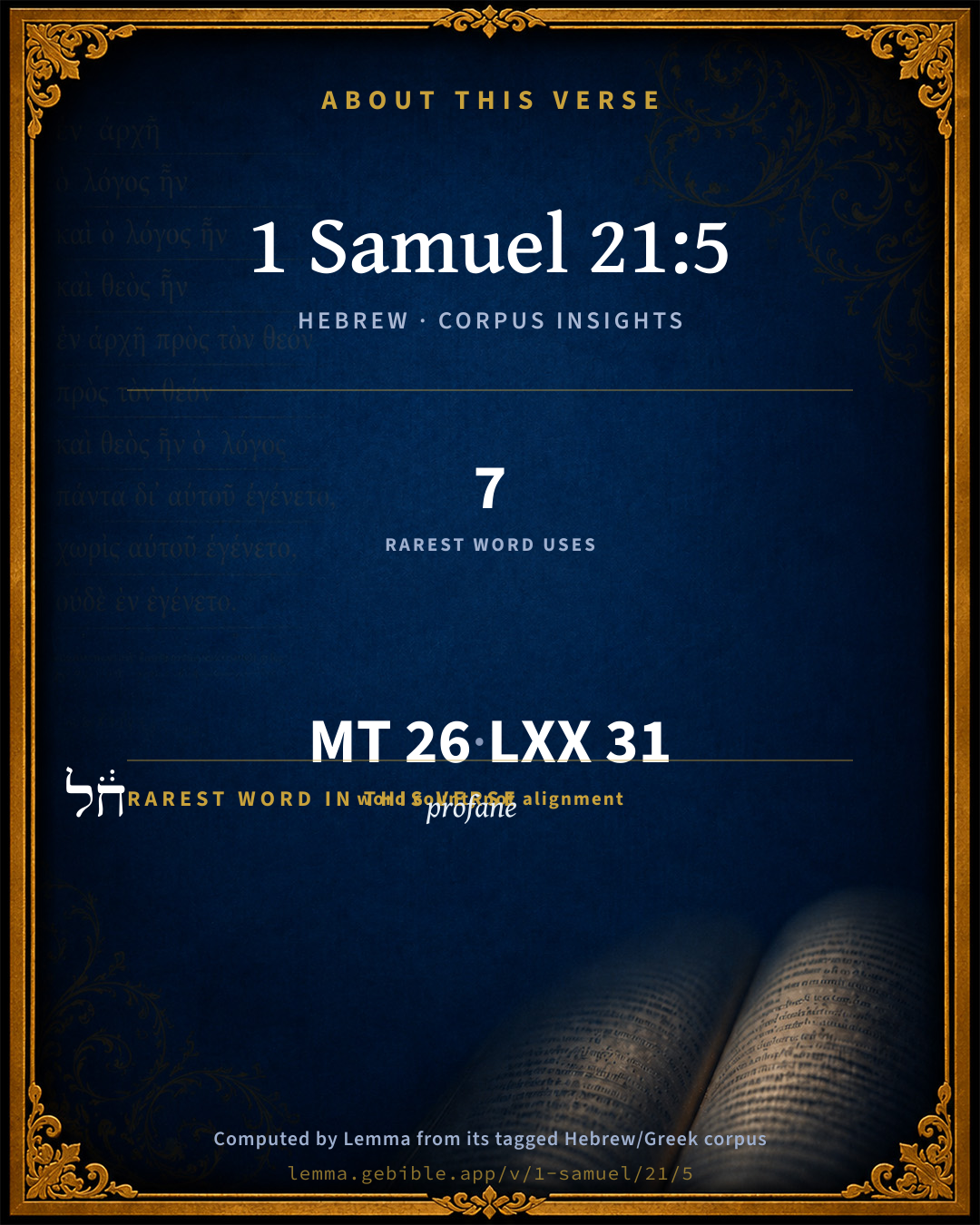
The rarest word here is חֹ֔ל profane H2455 — appearing just 7 times in the whole Hebrew Bible.

Shared distinctive vocabulary

חֹ֔ל profane H2455 occurs in 7 verses of the Hebrew Bible. Also found in:

Grammatical profile

  • 6 verbs
  • 11 nouns
  • 1 pronoun
  • 2 prepositions
  • 3 conjunctions
  • 2 adverbs
  • 1 particle

Verb forms

  • וַיַּעַן֩ Qal · Sequential Imperfect
  • וַיֹּ֣אמֶר Qal · Sequential Imperfect
  • עֲצֻֽרָה Qal · Participle Passive
  • בְּצֵאתִ֕י Qal · Infinitive Construct
  • וַיִּהְי֥וּ Qal · Sequential Imperfect
  • יִקְדַּ֥שׁ Qal · Imperfect

Repetition

Words recur within this verse — often emphatic in Hebrew:

  • כְלֵֽי vessel H3627 ×2
  • כִּ֣י that H3588 ×2

Hebrew & Septuagint length

In English translation the verse runs 50 words from the Hebrew and 48 from the Septuagint (LXX English) — closely comparable.

A rough comparison of the two English renderings, which tokenize alike — not a word-level alignment.

Word counts can differ between the Hebrew and the Greek without any difference in meaning — e.g. the Hebrew direct-object marker אֵת has no separate Greek word, and Greek often adds the article ὁ.

In the original languages it is 26 Hebrew tokens and 31 Greek tokens — but the two are counted differently (Hebrew bundles its prefixes and suffixes into one token; the Greek is in lemma form), so that isn’t a like-for-like length.

Cross-references

6

Topical passages linked to 1 Samuel 21:5 in the Treasury of Scripture Knowledge — connected by theme and wording, ordered by reader-vote popularity; previews shown in the World English Bible.

  • Leviticus 8:26 and out of the basket of unleavened bread, that was before Yahweh, he took one unleavened cake, and one cake of oiled bread, and one wafer, and placed them on the fat, and on the right thigh.
  • Leviticus 24:9 It shall be for Aaron and his sons; and they shall eat it in a holy place: for it is most holy to him of the offerings of Yahweh made by fire by a perpetual statute."
  • Acts 9:15 But the Lord said to him, "Go your way, for he is my chosen vessel to bear my name before the nations and kings, and the children of Israel.
  • 1 Thessalonians 4:3–4 For this is the will of God: your sanctification, that you abstain from sexual immorality,
  • 2 Timothy 2:20–21 Now in a great house there are not only vessels of gold and of silver, but also of wood and of clay. Some are for honor, and some for dishonor.
  • 1 Peter 3:17 For it is better, if the will of God should so will, that you suffer for doing well than for doing evil.

Cross-references courtesy of OpenBible.info (CC BY 4.0).

Hebrew and Greek witnesses Masoretic Hebrew ↔ Greek Septuagint

The same verse in the two great witnesses to the Old Testament, shown verse-for-verse.

These are two independent witnesses, not word-aligned to each other, and the Septuagint is shown in lemma (dictionary) form.

Hebrew 1 Samuel 21:5 Masoretic · Westminster Leningrad Codex

וַיַּעַן֩ דָּוִ֨ד אֶת הַכֹּהֵ֜ן וַיֹּ֣אמֶר ל֗וֹ כִּ֣י אִם אִשָּׁ֤ה עֲצֻֽרָה לָ֨נוּ֙ כִּתְמ֣וֹל שִׁלְשֹׁ֔ם בְּצֵאתִ֕י וַיִּהְי֥וּ כְלֵֽי הַנְּעָרִ֖ים קֹ֑דֶשׁ וְהוּא֙ דֶּ֣רֶךְ חֹ֔ל וְאַ֕ף כִּ֥י הַיּ֖וֹם יִקְדַּ֥שׁ בַּכֶּֽלִי

David answered the priest, and said to him, Of a truth women have been kept from us about these three days; when I came out, the vessels of the young men were holy, though it was but a common journey; how much more then today shall their vessels be holy?

World English Bible · Public Domain

Greek LXX 1 Samuel 21:5 Septuagint · lemma form

καί ἀποκρίνω ὁ ἱερεύς ὁ δαυίδ καί εἶπον οὐ εἰμί ἄρτος βέβηλος ὑπό ὁ χείρ ἐγώ ὅτι ἀλλά ἤ ἄρτος ἅγιος εἰμί εἰ φυλάσσω ὁ παιδάριον εἰμί ἀπό γυνή καί ἐσθίω

And David answered the priest, and said to him, Yes, we have been kept from women for three days: when I came forth for the journey all the young men were purified; but this expedition is unclean, therefore it shall be sanctified this day because of my weapons.

LXX2012 (modern English Septuagint) · Public Domain

On this verse, Ellicott's Commentary for English Readers discusses the Septuagint’s reading. Read the note in Commentary ↓

Hebrew: Westminster Leningrad Codex (CC BY 4.0). Greek: Septuagint (public domain); English from LXX2012 (modern English Septuagint) (Public Domain). How the Septuagint differs from the Hebrew →

Targum (Aramaic paraphrase)

1

The Targum is the ancient Jewish Aramaic paraphrase of the Hebrew Scriptures — an interpretive translation, not the Hebrew text itself. Onkelos (literal) and Pseudo-Jonathan (expansive) render the Torah, and Jonathan the Prophets. Coverage is partial: where no permissively-licensed English translation exists for a verse, only the Aramaic is shown. This is verse-level text, not a word-by-word alignment to the Hebrew.

  1. Targum Jonathan Prophets (Joshua–Malachi)
    וַאֲתֵיב כַּהֲנָא יַת דָוִד וַאֲמַר לֵית לְחֵם חוֹלִין לִתְחוֹת יְדָי אֱלָהֵין לַחְמָא דְקֻדְשָׁא אִית בְּרַם אִם נָטְרִין עוּלֵימַיָא לְחוֹד מִסוֹאֲבַת אִתְּתָא:

    (no public-domain English translation for this verse)

    Targum Jonathan — Aramaic: “Mikraot Gedolot” (public domain). English: “Sefaria Community Translation” (CC0 1.0 (public-domain dedication)); “London "Chaldee Paraphrase," 1871” (public domain). Text via Sefaria.

Commentary

Notes on 1 Samuel 21:5 from classic Christian and Jewish commentators (each source and its license shown beneath its notes). The classic Christian expositions comment on the surrounding passage and are grouped to its opening verse, so a note may address several verses; the Jewish commentaries on the Tanakh (Rashi and others) are per-verse, so they appear only where the commentator wrote on this verse.

Lemma curates 59 commentaries, every one of them public domain or Creative Commons licensed, each selected and text-cleaned for this edition rather than reprinted as found. About our sources →

Trapp's Complete Commentary

John Trapp

1Sa 21:5 And David answered the priest, and said unto him, Of a truth women [have been] kept from us about these three days, since I came out, and the vessels of the young men are holy, and [the bread is] in a manner common, yea, though it were sanctified this day in the vessel.

Ver. 5. And the vessels of the young men.] That is, Their bodies, as 2Co 4:7 1Th 4:3-4, or as some understand it, their knapsacks, wallets, baskets, &c., as 1Sa 9:7. Vatablus understandeth it of their garments.

Yea, though it were sanctified this day in the vessel.] Or, Especially when this day there is other sanctified in the vessel: and this seemeth to be the better translation. Hence some collect that it was on the Sabbath day that David came to Nob: since then the shewbread was to be renewed.

John Trapp, A Commentary or Exposition upon All the Books of the Old and New Testament (1647–1656) — public domain. Text from a community e-Sword module.

Joseph Benson's Commentary

1Sa 21:5. About these three days — As long as the law required, Exo 19:15. And so long, it seems, David and his men had hid themselves for fear of Saul, whereby they were kept both from their wives and from food convenient for them. The vessels of the young men are holy — That Isaiah , 1 st, Either their garments, or other utensils for their journey; or, 2d, Their bodies. The bread (Hebrew, והוא, vehu, and this) is in a manner common — That is, the bread which had been taken away from before the Lord, to make room for new bread to be placed there. For though, for a season, while it stood before the Lord, it was so holy that the priest himself might not eat it; yet afterward it was eaten by the priest and his whole family, and David pleads that it might be eaten by him and his young men in their necessitous circumstances. Yea, though it were sanctified this day in the vessel — This translation renders the passage obscure. The Hebrew may be translated, as by Le Clerc and in some other versions, Furthermore, or, forasmuch as it (namely, bread) is sanctified this day in the vessel; that is, there was new bread sanctified to be set before the Lord; and therefore this, which had been taken away from before him, was, in some degree, become common. For the law ordained, (Lev 24:8-9,) that the show, or hallowed bread, should be removed every sabbath day from the table before the Lord, and fresh set on.

Joseph Benson's Commentary on the Old and New Testaments (1811–1818) — public domain. Text from a community e-Sword module.

Geneva Bible (1599)

Geneva Bible translators

That is, their bodies.

Shall be more careful to keep his vessel holy, when he shall have eaten of this holy food?

Geneva Bible (1599) marginal notes — public domain. Text via Bolls.life.

Jamieson, Fausset & Brown

Robert Jamieson, A. R. Fausset & David Brown

these three days--as required by law (Exo 19:15). David and his attendants seem to have been lurking in some of the adjoining caves, to elude pursuit, and to have been, consequently, reduced to great extremities of hunger.

the bread is in a manner common--that is, now that it is no longer standing on the Lord's table. It is eaten by the priests, and may also, in our circumstances, be eaten by us.

yea, though it were sanctified this day in the vessel--that is, though the hallowed bread had been but newly placed on the vessel, the ritual ordinance would have to yield to the great law of necessity and mercy (see on Mat 12:3; also see Mar 2:25; Luk 6:3).

Jamieson, Fausset & Brown — Commentary Critical and Explanatory on the Whole Bible (1871) — public domain (CC PDM 1.0). Text via the HelloAO Bible API.

Ellicott's Commentary for English Readers

(5) The vessels.—Their clothes and light, portable baggage—answering to the modern “knapsack.” The Vulg. renders the Hebrew word by “vasa.” David means to say, “Since we have just left home, you may readily suppose that no impurity has been contracted; it would be different if we were returning home from a journey, when on the way—especially in war—uncleanness might be contracted by the blood of enemies or otherwise.”—Seb. Schmid, quoted in Lange.

The LXX., by a very slight change in the Hebrew letters, instead of “the vessels of the young men,” render, “all the young men.”

And the bread is in a manner common.—The original is here very difficult, almost utterly obscure. The English Version of the clause is simply meaningless. Of the many translations which have been suggested, two at least offer a fairly good sense. (a) “And if it is an unholy way (viz., the way David and his band were going—his purpose or enterprise), moreover there is also the fact that it becomes holy through the instrument” (viz., through me, as an ambassador of the anointed of the Lord), on the supposition of the important royal mission upon which David pretended to be sent. So Keil and O. von Gerlach. (b) Lange, however, and Thenius, maintain that the words in question must contain a remark by which the priest is to be induced to give the bread, and would translate, “Though it is an unholy (ceremonially illegal) procedure (to take the shewbread), yet it is sanctified (to-day) through the instrument” (David or Ahimelech). The instrument is here David, the appointed messenger of the Lord’s anointed, or, even better, Ahimelech, the sacred person of the high priest.

No doubt, the words of Lev_24:9, which speak of the destination of the stale shewbread—“And they (Aaron and his sons) shall eat it in the holy place”—suggested the practice of the Church of England embodied in the Rubric following the” Order of the Administration of the Holy Communion”—“And if any” (of the bread and wine) “remain of that which was consecrated, it shall not be carried out of the church, but the priest, and such other of the communicants as he shall then call unto him, shall immediately after the blessing reverently eat and drink the same.” Among the legendary Jewish lore that has gathered round the history of this transaction is one strange tradition that the holy bread thus given became useless in the hands of the king’s fugitive. (See Stanley, Lectures on the Jewish Church, Lect. 22, quoting from Jerome.)

A Bible Commentary for English Readers, edited by Charles John Ellicott (1878–1897) — public domain. Text from a community e-Sword module.

The Cambridge Bible for Schools and Colleges

gen. ed. J. J. S. Perowne

5. the vessels] The wallets or other utensils into which the bread would be put. If these were Levitically unclean they would defile the bread. David assures Ahimelech that there is no ceremonial objection to their taking the bread either in their persons or their baggage.

and the bread, &c.] The further argument which David employs to Persuade Ahimelech is stated in a sentence of almost hopeless obscurity. Perhaps either (1) “And when I came out the vessels of the young men were holy; how much more then, though it is a common journey, will it be holy in the vessel to-day:” i.e. the vessels were undefiled when we started, and though our journey has no religions object, yet as there has been no danger of pollution since, a fortiori they cannot defile bread put in them to-day:—or (2) “And if it is a profane procedure, yet It will be sanctified to-day by the instrument:” i.e. if the act is profane, the priest by whose instrumentality it is done, has power to sanction it under the exceptional circumstances of to-day:—a gentle flattery to persuade Ahimelech.

The Cambridge Bible for Schools and Colleges (gen. ed. J. J. S. Perowne; Cambridge University Press, 1878–1918) — public domain. Text from a community e-Sword module.

John Gill's Exposition

And David answered the priest, and said unto him,.... In reply to the case of the young men his servants, and of himself too, who also was intended by the priest, though out of reverence to him not mentioned:

of a truth women have been kept from us these three days since I came out; reckoning either from the time he fled from Saul at Naioth, or from the time he left Jonathan, during which time both he and his men could have no converse with women, and receive no pollution by them; and this was the time which according to the law was required for the sanctifying of persons in this way, Exo 19:15,

and the vessels of the young men are holy; their garments, as Kimchi, not being defiled with any ceremonial uncleanness, as by the touch of any unclean person: or what instruments soever they were provided with for their journey; or rather their bodies; see Co2 4:7; and with respect to the priest's saying that the bread he had was hallowed or sacred, and so not for common use, David replies:

and the bread is in a manner common; inasmuch as it was taken off of the shewbread table, and was now common to the priest and his family, though not to others, yet in case of necessity through hunger might be allowed to strangers:

yea, though it were sanctified this day in the vessel; even though it had been set but that day on the shewbread table, and so became holy to the Lord; and yet even in such a case and circumstances as David and his men were in, it might be taken from thence and eaten of; for, as Abendana observes, nothing stands in the way of preservation of life, but idolatry, adultery, and murder; everything else may be done for the sake of that but them: or as in the margin of our Bibles, "especially when there is this day other sanctified bread"; that is, since other bread is this day put upon the shewbread table, in the room of that which has been taken away, whereby it is become holy to the, Lord; then that which is removed may be eaten, and be allowed to us in our circumstances. It seems by this that this was the sabbath day; for on that day the removal of the shewbread loaves was made, Lev 24:8; and R. Isaiah says, that it was at the going out of the sabbath that David came there; and which still makes it a more appropriate case, as produced by our Lord to justify his disciples in plucking ears of corn on the sabbath day, Mat 12:1.

John Gill's Exposition of the Whole Bible (1746–1763) — public domain (CC PDM 1.0). Text via the HelloAO Bible API.

Albert Barnes' Notes on the Bible

The vessels of the young men ... - i. e., their clothes Deu 22:5 or wallets (marginal reference), or other articles which might be Levitically unclean and need cleansing (Lev 13:58; Exo 19:10, etc.; Mar 7:4), as well as the person.

And the bread ... - The meaning is; “Though it is treating it like common bread to give it to me and my young men, there is fresh showbread baked and put on the table in place of what you give us;” the day being Friday. as is indicated in the verse following.

Albert Barnes' Notes on the Bible (1834–1885) — public domain. Text from a community e-Sword/MySword module.

Haydock's Catholic Bible Commentary

Vessels, i.e., the bodies, have been holy; that is, have been kept from impurity: (Challoner) in which sense St. Paul uses the word, 1 Thessalonians iv. 4. It also includes garments, arms, &c. All was to be clean. Septuagint, "my men are all purified." (Calmet) --- Defiled. Is liable to expose us to dangers of uncleanness, (Challoner) as we shall perhaps have to fight. (Haydock) --- Sanctified. That is, we shall take care, notwithstanding these dangerous circumstances, to keep our vessels holy; that is, keep our bodies from every thing that may defile us. (Challoner) --- The text is very obscure. Hebrew, "the way is impure, because to-day it shall be purified in the vessel." (Calmet) --- Protestants, "and the bread is in a manner common, yea though it were sanctified this day in the vessel." We might eat of it in a case of such necessity. (Haydock) --- Though laics be commonly debarred from tasting of it, we will partake of it with all due respect. (Calmet) --- Septuagint, "the journey is (of a disagreeable nature, or) impure, therefore it will be rendered holy by my vessels," or arms, in the king’s cause. (Haydock) --- He seems to be going towards the infidel nations. (Menochius)

George Leo Haydock (1774–1849), Haydock's Catholic Family Bible and Commentary, 1859 edition — public domain. Excludes Psalms (Douay-Rheims chapter numbering differs from Protestant) and Deuterocanonical books (Catholic canon only).

Matthew Poole's English Annotations

About these three days; as long as the law required, Exo 19:15. And so long David and his men had, it seems, hid themselves for fear of Saul in some of those caves, whereof there were many in those parts; whereby they were kept both from all converse with any other persons besides themselves, and consequently from women; and withal, from food convenient for them.

Since I came out from the place where Jonathan and David met. The vessels, i.e. either,

1. Their garments, or other utensils for their journey. Or,

2. Their bodies, for of them the question was, 1Sa 21:4; and having now said that women had been kept from them, he infers that therefore their bodies were holy, their members were undefiled. Thus the word vessel is used 1Th 4:4, and in other authors, both Greek and Latin.

The bread is in a manner common, Heb. and this (to wit, the bread; which is easily supplied out of the former verse, because that was the thing about which the present discourse was, and against the giving whereof the priest started an objection, 1Sa 21:4, to which David here giveth an answer) is in a manner, or, after a sort, common, i.e. considering the time, and our necessity, this may be asked in a manner like common bread, and so is used by others. For though for a season, whilst it is to stand before the Lord, it be so holy, that the priest himself might not eat it; yet afterwards it is eaten by the priest, and by his whole family, as their common food; and so it may be by us, in our circumstances.

Though it were sanctified this day in the vessel; if it were but newly put into the vessel, it must give place to the great law of necessity and charity, because God will have mercy preferred before sacrifice. Or thus, especially, when, or, the rather because this day there is other (i.e. new bread) sanctified in the vessel, i.e. put into the vessel which was made to receive this bread, Exo 25:29, and thereby sanctified, or consecrated to God; and therefore the former shew-bread is now to be removed, and employed for the common use of the priest and his family.

Matthew Poole's English Annotations on the Holy Bible (1683–1685) — public domain. Text from a community e-Sword/MySword module.

Whedon's Commentary on the Bible

Daniel D. Whedon

5. Since I came out — Upon this secret business of the king. The conjunction and, which immediately follows these words, shows that they belong to the preceding sentence. David falsely tells Ahimelech that about three days had already passed since he started upon the king’s business.

The vessels of the young men are holy — By their vessels their bodies are intended — their persons. This word is thus used in 1Th_4:4, and 2Co_4:7; and in this same verse it is again used in this same sense, for the question was one of bodily purity. Some understand the word to refer to the implements or clothes of the young men; but Thenius well asks: What mattered it about the purity of their implements if their persons were not pure? David’s object certainly was to conciliate the priest so as to obtain through him the hallowed bread; and so he endeavoured to persuade him that himself and the servants mentioned (1Sa_21:2) were ceremonially clean, and that therefore there could be no reason to refuse them the show-bread on the ground of their personal defilement.

And the bread is in a manner common, yea, though it were sanctified this day in the vessel — If this were the meaning of the Hebrew it would represent David as contradicting both the high priest and the law itself. The marginal reading relieves the case but little. What the Jehovah had sanctified David would not most certainly, in the presence of the priest, call common or unclean. The Hebrew text here says nothing about bread, but, literally rendered, reads thus: And this way is common, and how much more is it to-day sanctified in the vessel? By this way we understand, with Keil and Ewald, the business on which David pretends the king has sent him. It was common, that is, ordinary, or secular, as distinguished from religious business, and therefore did not require such ceremonial purity as did a holy service. By the vessel the bodies or persons of the young men are meant, the phrase being equivalent to in body. In this sense the word vessel has already been used in this same verse. To day has reference to the three days previously mentioned, during which the young men had been kept from women, and the thought is, How much more are they pure in body to-day than three days ago! All that stands in the way of the conclusiveness of this interpretation is the verb יקדשׁin the singular number — it is sanctified. But in view of the obscurity that attaches to every other exposition, we feel constrained to emend the text by adding the plural ending to this verb, יקדשׁו, they are sanctified. Then the whole verse may be thus paraphrased: Truly women have been kept from us yesterday and the day before, when I came out, and so the bodies of the young men are in this respect pure; and though our business is not of a religious character, yet how much more are they pure in body today!

Daniel D. Whedon (gen. ed.), Commentary on the Old and New Testaments (1874–1909) — public domain. Text from a community e-Sword module.

The Pulpit Commentary

Vers. 5, 6. About these three days since I came out. This exactly agrees with the time during which David had lain concealed, (1Sa_20:24, 1Sa_20:27, 1Sa_20:35) and explains the hunger under which he was suffering, as he had no doubt taken with him only feed sufficient for his immediate wants, he wishes, however, the high priest to believe that he had been engaged with his men during this time on public business, whereas they had been at home and some of them possibly were unclean. The whole chapter sets David before us in a very humiliating light. Just as some books of Homer are styled "the prowess" of some hero, so this chapter might be called David"s degradation. The determined hatred of Saul seems to have thrown him off his balance, and it was not till he got among the hills of Judah, wherein was the cave of Adullam, that he recovered his serenity. The vessels of the young men. Their scrips, in which they would carry the bread, and their baggage generally. The bread is in a manner common, etc. The word bread is supplied by the translators, to give some sense to this most difficult passage. Literally translated, the two last clauses are, "And the way is profane, although it be sanctified today in the vessel." Among the numerous interpretations of these words the following seems the best: "And though our journey be not connected with a religious object, yet it (the bread) will be kept holy in the vessel (in which it will be carried)." There is no difficulty in supplying bread in the last clause, as the shewbread was the subject of the conversation, and a nominative is constantly supplied by the mind from the principal matter that is occupying the thoughts of the speakers. David"s argument, therefore, is that both his attendants and their wallets were free from legal defilement, and that though their expedition was on some secular business, yet that at all events the bread would be secure from pollution. The shewbread that was taken from before Jehovah. The Talmud ("Menach.," 92, 2) points out that this bread was not newly taken out of the sanctuary, but, as the last clause shows, had been removed on some previous day. As after a week"s exposure it was stale and dry, the priests, we are told, ate but little of it, and the rest was left (see Talmud, "Tract. Yom.," 39, 1). It also points out that, had such violations of the Levitical law been common, so much importance would not have been attached to this incident.

The Pulpit Commentary (1880–1919), ed. H.D.M. Spence-Jones & Joseph S. Exell — public domain. Text from a community e-Sword module.

John Wesley's Explanatory Notes

Three days - As long as the law required, Exod. xix, 15. And so long David, and his men hid, it seems, hid themselves for fear of Saul, whereby they were kept both from women: and from food convenient for them. Vessels - That is, Either,

1. Their garments, or other utensils for their journey. Or

2. their bodies. The bread - Hebrew. and this bread; is in a manner common: that is, considering the time, and our necessity, this maybe used in a manner, like common bread. For though for a season while it is to stand before the Lord, it be so holy, that the priest himself might not eat it; yet afterwards it is eaten by the priest, and his whole family, and so it may be by us, in our circumstances. Tho' it were - But newly put into the vessel, it must give place to the great law of necessity, and charity; because God will have mercy preferred before sacrifice.

John Wesley, Explanatory Notes Upon the Whole Bible (1754–1765) — public domain. Text via the GEBible commentary corpus.

unfoldingWord translationNotes

Door43 World Missions Community

women have been kept from us

This can be translated in active form. AT: "we have kept ourselves from women" (See: Active or Passive)

three days

"3 days" (See: Numbers)

when I set out

"when I begin a journey"

The things belonging to the men have been set apart

This can be translated in active form. AT: "The men have set what belongs to them apart" (See: Active or Passive)

How much more today will what they have be set apart

This is a statement, not a question. It can be translated in active form. AT: "It is especially true today that they will set apart what they have" (See: Active or Passive)

the bread that was set apart

This can be translated in active form. AT: "the bread that the priests had set apart" (See: Active or Passive)

which was removed from before Yahweh, in order to put

This can be translated in active form. AT: "which the priests had removed from before Yahweh so that they could put" (See: Active or Passive)

translationWords

David

priest

bread

Yahweh

unfoldingWord translationNotes — © Distant Shores Media and the Door43 World Missions Community, licensed CC BY-SA 4.0. Source: git.door43.org/Door43/en_tn.

Rashi

Rabbi Shlomo Yitzchaki (Rashi)

From women. With difficulty, I give them to non-kohanim to eat, but it is impossible to give it to unclean people to eat.

Rashi on the Tanakh — English translations: “The Judaica Press complete Tanach with Rashi, translated by A. J. Rosenberg” (CC BY 4.0); “Pentateuch with Rashi's commentary by M. Rosenbaum and A.M. Silbermann, 1929-1934” (public domain); “The Metsudah Tanach series, Lakewood, N.J” (CC BY 4.0); and “The Book of Joshua, Metsudah Publications, 1997” (CC BY 4.0). Text via Sefaria.

Lesson kit

Teaching starters — assembled from the data on this page, not authored interpretation. Every prompt links to the verse data it draws on. Edit before teaching.

1 Samuel, in the Historical, opens this verse with 26 words (22 distinct Hebrew lemmas). Its most distinctive word is chôl (“profane”). A historical commentator’s framing appears above. Read the whole chapter for the surrounding context.

Discussion questions

  1. What does “profane” (chôl) contribute to the verse as a whole?
  2. Leviticus 10:10 shares the word «profane» with this verse. How do the two illuminate each other?
  3. “vessel” occurs 2× in this one verse. What is the effect of the repetition?
  4. The translations on this page render this verse differently — a whole-verse word diff, not a word-by-word alignment. What might account for the different wordings?
  5. The verb «וַיַּעַן֩» is Qal Sequential Imperfect. How does its form color the action?
  6. Reading how Trapp's Complete Commentary and Joseph Benson's Commentary read this verse, where do the two commentators agree and where do they part?

Things to notice

Reading settings

Reading text

Shown beneath each verse's original-language words.

Old Testament
Old Testament edition

Read the OT as the Masoretic Hebrew (MT) or the Greek Septuagint (LXX).

English shown for the Greek Septuagint (in the Hebrew ↔ Greek comparison).

Comparing translations? Open the Compare panel on any verse page to stack up to four side by side.