
Numbers 7:19

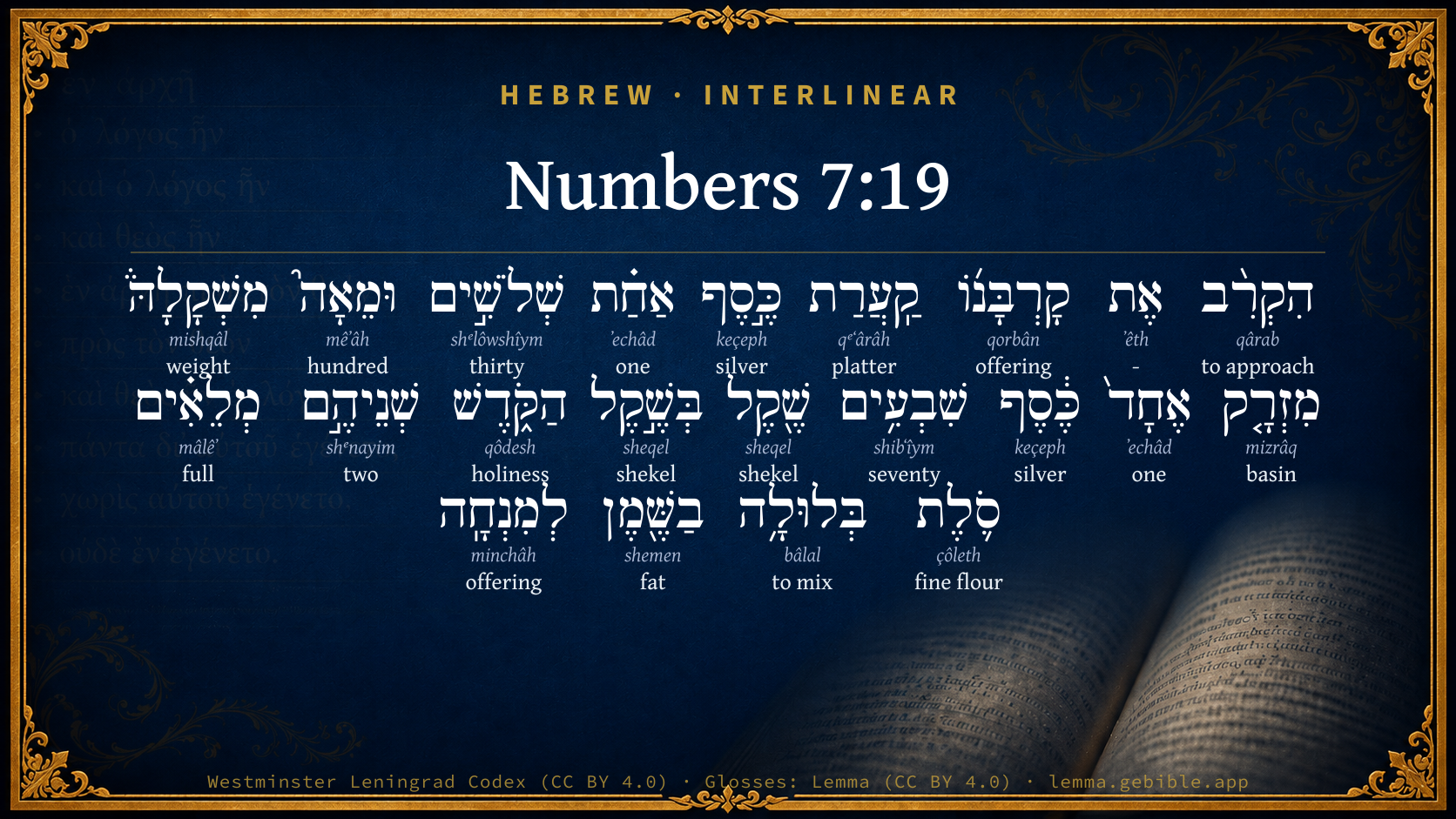
Hebrew (Westminster Leningrad Codex) Numbers 7:19 appears in the Hebrew Old Testament. The text above is from the Westminster Leningrad Codex. Each word links to its Strong’s number, a concise gloss, and parsing drawn from the Open Scriptures Hebrew Bible morphology. Click any word for its full Brown-Driver-Briggs (BDB) entry.
Download image
Cite this verse

Numbers 7:19 (World English Bible). Public Domain. Lemma interlinear Bible study tool, https://lemma.gebible.app/v/numbers/7/19.

Show BibTeX & RIS
BibTeX
RIS
English Translation
He offered for his offering: one silver platter, the weight of which was one hundred thirty shekels, one silver bowl of seventy shekels, after the shekel of the sanctuary; both of them full of fine flour mixed with oil for a meal offering;
World English Bible · Public Domain
Download a study sheet

One document with this verse’s original text, its word-by-word gloss line, the meaning frame, cross-references with their text, attributed commentary, and full source and license credits — printable, and it pastes into notes with its structure intact.

This verse Autodidact and up

Study sheet (.html) Plain text (.txt)

A passage Seminary Student

Up to 50 verses in one chapter. A passage sheet keeps up to 6 commentary sources and 12 cross-references per verse, in the order this page ranks them, and says so on the sheet whenever that leaves anything out. Ask for a single verse and you get the Autodidact verse sheet above.

Everything on this page stays free to read, with no account — the sheet is a download of what is already on screen, not access to it.

Want to remove ads? Support Godless Engineer
Compare translations 3

The same verse in 3 English versions, stacked beneath the original-language interlinear above. Click any original word for its lexicon entry.

Each is an independent rendering of the whole verse — the interlinear is not word-aligned to these translations.

Highlighted words mark where these versions differ — a whole-verse word diff, not a word-by-word alignment.

  • World English Bible Public Domain
    He offered for his offering: one silver platter, the weight of which was one hundred thirty shekels, one silver bowl of seventy shekels, after the shekel of the sanctuary; both of them full of fine flour mixed with oil for a meal offering;
  • King James Version Public Domain
    He offered for his offering one silver charger, the weight whereof was an hundred and thirty shekels, one silver bowl of seventy shekels, after the shekel of the sanctuary; both of them full of fine flour mingled with oil for a meat offering:
  • unfoldingWord Literal Text CC BY-SA 4.0
    He presented his offering: one silver dish (its weight 130), one silver basin (70 shekels in the shekel of the holy place), the two of them full of flour mixed with the oil for a grain offering,

unfoldingWord Literal Text — © unfoldingWord, licensed CC BY-SA 4.0. Word-aligned USFM3 via Door43 (git.door43.org/unfoldingWord/en_ult).

Versions to compare (up to 4)

3 of 4 selected

Show all 18 translations

Every available English version of this verse, each an independent rendering of the whole verse.

  • World English Bible Public Domain
    He offered for his offering: one silver platter, the weight of which was one hundred thirty shekels, one silver bowl of seventy shekels, after the shekel of the sanctuary; both of them full of fine flour mixed with oil for a meal offering;
  • Berean Standard Bible Public Domain
    The offering he presented was one silver platter weighing a hundred and thirty shekels, and one silver bowl weighing seventy shekels, both according to the sanctuary shekel and filled with fine flour mixed with oil for a grain offering;
  • Majority Standard Bible Public Domain
    The offering he presented was one silver platter weighing a hundred and thirty shekels, and one silver bowl weighing seventy shekels, both according to the sanctuary shekel and filled with fine flour mixed with oil for a grain offering;
  • King James Version Public Domain
    He offered for his offering one silver charger, the weight whereof was an hundred and thirty shekels, one silver bowl of seventy shekels, after the shekel of the sanctuary; both of them full of fine flour mingled with oil for a meat offering:
  • American Standard Version (1901) Public Domain
    he offered for his oblation one silver platter, the weight whereof was a hundred and thirty `shekels', one silver bowl of seventy shekels, after the shekel of the sanctuary; both of them full of fine flour mingled with oil for a meal-offering;
  • Revised Version (1885) Public Domain
    he offered for his oblation one silver charger, the weight thereof was an hundred and thirty shekels, one silver bowl of seventy shekels, after the shekel of the sanctuary; both of them full of fine flour mingled with oil for a meal offering;
  • Geneva Bible (1599) Public Domain
    Who offred for his offring a siluer charger of an hundreth and thirtie shekels weight, a siluer boule of seuentie shekels, after the shekel of the Sanctuarie, both ful of fine floure, mingled with oyle, for a meat offring,
  • Douay-Rheims (1899) Public Domain
    And a buck goat for sin:
  • Young's Literal Translation Public Domain
    He hath brought near his offering, one silver dish, its weight a hundred and thirty `shekels'; one silver bowl of seventy shekels, by the shekel of the sanctuary, both of them full of flour mixed with oil, for a present;
  • Literal Standard Version CC BY-SA 4.0
    He has brought his offering near: one silver dish, its weight one hundred and thirty [shekels], [and] one silver bowl of seventy shekels, by the shekel of the holy place, both of them full of flour mixed with oil for a present;
  • Unlocked Literal Bible CC BY-SA 4.0
    He offered as his sacrifice one silver platter weighing 130 shekels and one silver bowl weighing seventy shekels, by the standard weight of the sanctuary shekel. Both of these objects were full of fine flour mixed with oil for a grain offering.
  • unfoldingWord Literal Text CC BY-SA 4.0
    He presented his offering: one silver dish (its weight 130), one silver basin (70 shekels in the shekel of the holy place), the two of them full of flour mixed with the oil for a grain offering,
  • Darby Bible Public Domain
    he presented his offering; one silver dish of the weight of a hundred and thirty [shekels], one silver bowl of seventy shekels, according to the shekel of the sanctuary, both of them full of fine flour, mingled with oil for an oblation;
  • World Messianic Bible Public Domain
    He offered for his offering: one silver platter, the weight of which was one hundred thirty shekels, one silver bowl of seventy shekels, according to the shekel of the sanctuary, both of them full of fine flour mixed with oil for a meal offering;
  • Webster's Bible Public Domain
    He offered for his offering one silver charger, the weight of which was a hundred and thirty shekels, one silver bowl of seventy shekels, after the shekel of the sanctuary; both of them full of fine flour mingled with oil for a meat-offering:
  • Free Bible Version CC BY-SA 4.0
    The offering he presented was a silver plate that weighed a hundred and thirty shekels, and a silver bowl that weighed seventy shekels (using the sanctuary shekel standard). They were both filled with the best flour mixed with olive oil as a grain offering.
  • Bible in Basic English Public Domain
    He gave one silver plate, a hundred and thirty shekels in weight, one silver basin of seventy shekels, by the scale of the holy place; the two of them full of the best meal mixed with oil for a meal offering;
  • JPS Tanakh (1917) Public Domain
    he presented for his offering one silver dish, the weight thereof was a hundred and thirty shekels, one silver basin of seventy shekels, after the shekel of the sanctuary; both of them full of fine flour mingled with oil for a meal-offering;

Literal Standard Version (2020), Covenant Press — licensed CC BY-SA 4.0. Text via the HelloAO Bible API (eBible.org). Unlocked Literal Bible (unfoldingWord) — licensed CC BY-SA 4.0. Text via the HelloAO Bible API (eBible.org). unfoldingWord Literal Text — © unfoldingWord, licensed CC BY-SA 4.0. Word-aligned USFM3 via Door43 (git.door43.org/unfoldingWord/en_ult). Free Bible Version, Dr. Jonathan Gallagher — licensed CC BY-SA 4.0. Text via the HelloAO Bible API (eBible.org).

Word by word

More ways to search: Search by grammar → Find every occurrence → Compare this word →

Practice this passage: Drill this verse → Learn its vocabulary →

קַֽעֲרַת
qᵉʻârâh
H7086
“platter of”
Noun, Common, Feminine, Singular, Construct
Part of Speech
Noun
Type
Common
Gender
Feminine
Number
Singular
State
Construct
Full BDB Definition

Origin: probably from H7167

TWOT: 2047a

dish, platter
  1. הִקְרִ֨ב qârab H7126 “to approach” Verb, Hiphil, Perfect, 3rd Person, Masculine, Singular
  2. אֶת ʼêth H853 “-” Particle, Direct Object
  3. קָרְבָּנ֜וֹ qorbân H7133 “offering · his” Noun, Common, Masculine, Singular, Construct + Suffix, Personal, 3rd Person, Masculine, Singular
  4. כֶּ֣סֶף keçeph H3701 “silver” Noun, Common, Masculine, Singular, Absolute
  5. אַחַ֗ת ʼechâd H259 “one” Adjective, Cardinal number, Feminine, Singular, Absolute
  6. שְׁלֹשִׁ֣ים shᵉlôwshîym H7970 “thirty” Adjective, Cardinal number, Both, Plural, Absolute
  7. וּמֵאָה֮ mêʼâh H3967 “and · hundred” Conjunction + Adjective, Cardinal number, Both, Singular, Absolute
  8. מִשְׁקָלָהּ֒ mishqâl H4948 “weight · her” Noun, Common, Masculine, Singular, Construct + Suffix, Personal, 3rd Person, Feminine, Singular
  9. מִזְרָ֤ק mizrâq H4219 “basin” Noun, Common, Masculine, Singular, Absolute
  10. אֶחָד֙ ʼechâd H259 “one” Adjective, Cardinal number, Masculine, Singular, Absolute
  11. כֶּ֔סֶף keçeph H3701 “silver” Noun, Common, Masculine, Singular, Absolute
  12. שִׁבְעִ֥ים shibʻîym H7657 “seventy” Adjective, Cardinal number, Both, Plural, Absolute
  13. שֶׁ֖קֶל sheqel H8255 “shekel” Noun, Common, Masculine, Singular, Absolute
  14. בְּשֶׁ֣קֶל sheqel H8255 “in/at · shekel of” Preposition + Noun, Common, Masculine, Singular, Construct
  15. הַקֹּ֑דֶשׁ qôdesh H6944 “the · holiness” Particle, Definite Article + Noun, Common, Masculine, Singular, Absolute
  16. שְׁנֵיהֶ֣ם shᵉnayim H8147 “two · their” Adjective, Cardinal number, Masculine, Dual, Construct + Suffix, Personal, 3rd Person, Masculine, Plural
  17. מְלֵאִ֗ים mâlêʼ H4392 “full” Adjective, Adjective, Masculine, Plural, Absolute
  18. סֹ֛לֶת çôleth H5560 “fine flour” Noun, Common, Feminine, Singular, Absolute
  19. בְּלוּלָ֥ה bâlal H1101 “mixed” Verb, Qal, Participle Passive, Feminine, Singular, Absolute
  20. בַשֶּׁ֖מֶן shemen H8081 “in/at the · fat” Preposition, Determined + Noun, Common, Masculine, Singular, Absolute
  21. לְמִנְחָֽה minchâh H4503 “to/for · offering” Preposition + Noun, Common, Feminine, Singular, Absolute

About this verse

These counts appear in no published source. They are computed here, from the morphology-tagged text and Lemma’s own curated glosses. What Lemma adds →

22
words
19
distinct lemmas
Pentateuch
section

Notable vocabulary

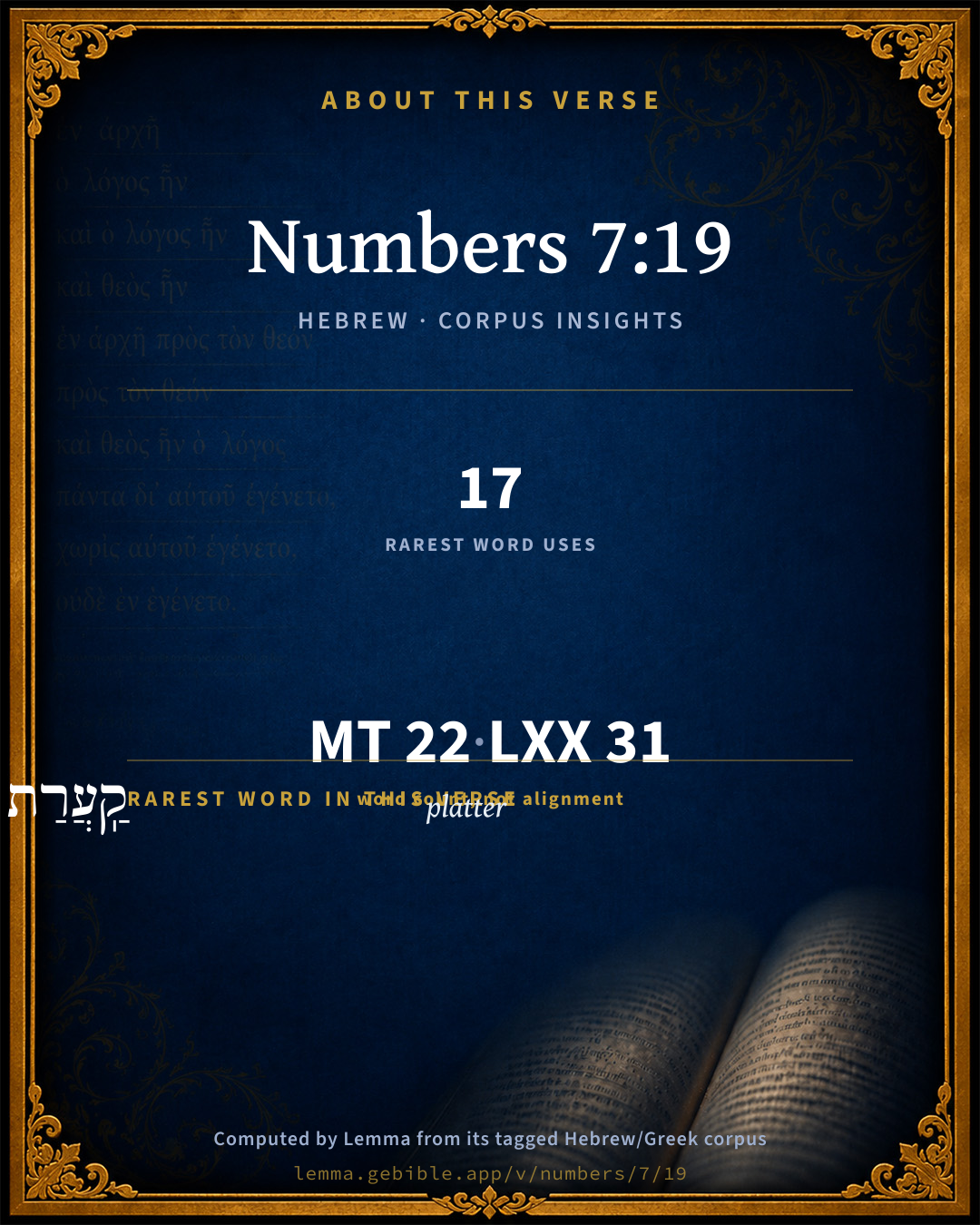
The rarest word here is קַֽעֲרַת platter H7086 — appearing just 17 times in the whole Hebrew Bible.

Shared distinctive vocabulary

קַֽעֲרַת platter H7086 occurs in 17 verses of the Hebrew Bible. Also found in:

Grammatical profile

  • 2 verbs
  • 12 nouns
  • 7 adjectives
  • 1 particle

Verb forms

  • הִקְרִ֨ב Hiphil · Perfect
  • בְּלוּלָ֥ה Qal · Participle Passive

Repetition

Words recur within this verse — often emphatic in Hebrew:

  • כֶּ֣סֶף silver H3701 ×2
  • אַחַ֗ת one H259 ×2
  • שֶׁ֖קֶל shekel H8255 ×2

Hebrew & Septuagint length

In English translation the verse runs 43 words from the Hebrew and 37 from the Septuagint (LXX English) — closely comparable.

A rough comparison of the two English renderings, which tokenize alike — not a word-level alignment.

Word counts can differ between the Hebrew and the Greek without any difference in meaning — e.g. the Hebrew direct-object marker אֵת has no separate Greek word, and Greek often adds the article ὁ.

In the original languages it is 22 Hebrew tokens and 31 Greek tokens — but the two are counted differently (Hebrew bundles its prefixes and suffixes into one token; the Greek is in lemma form), so that isn’t a like-for-like length.

Hebrew and Greek witnesses Masoretic Hebrew ↔ Greek Septuagint

The same verse in the two great witnesses to the Old Testament, shown verse-for-verse.

These are two independent witnesses, not word-aligned to each other, and the Septuagint is shown in lemma (dictionary) form.

Hebrew Numbers 7:19 Masoretic · Westminster Leningrad Codex

הִקְרִ֨ב אֶת קָרְבָּנ֜וֹ קַֽעֲרַת כֶּ֣סֶף אַחַ֗ת שְׁלֹשִׁ֣ים וּמֵאָה֮ מִשְׁקָלָהּ֒ מִזְרָ֤ק אֶחָד֙ כֶּ֔סֶף שִׁבְעִ֥ים שֶׁ֖קֶל בְּשֶׁ֣קֶל הַקֹּ֑דֶשׁ שְׁנֵיהֶ֣ם מְלֵאִ֗ים סֹ֛לֶת בְּלוּלָ֥ה בַשֶּׁ֖מֶן לְמִנְחָֽה

He offered for his offering: one silver platter, the weight of which was one hundred thirty shekels, one silver bowl of seventy shekels, after the shekel of the sanctuary; both of them full of fine flour mixed with oil for a meal offering;

World English Bible · Public Domain

Greek LXX Numbers 7:19 Septuagint · lemma form

καί προςφέρω ὁ δῶρον αὐτός τρυβλίον ἀργυροῦς εἷς τριάκοντα καί ἑκατόν ὁλκή αὐτός φιάλη εἷς ἀργυροῦς ἑβδομήκοντα σίκλος κατά ὁ σίκλος ὁ ἅγιος ἀμφότεροι πλήρης σεμίδαλις ἀναποιέω ἐν ἔλαιον εἰς θυσία

And he brought his gift, one silver charger, its weight one hundred and thirty shekels, one silver bowl of seventy shekels according to the holy shekel; both full of fine flour kneaded with oil for a meat-offering.

LXX2012 (modern English Septuagint) · Public Domain

Hebrew: Westminster Leningrad Codex (CC BY 4.0). Greek: Septuagint (public domain); English from LXX2012 (modern English Septuagint) (Public Domain). How the Septuagint differs from the Hebrew →

Targum (Aramaic paraphrase)

2

The Targum is the ancient Jewish Aramaic paraphrase of the Hebrew Scriptures — an interpretive translation, not the Hebrew text itself. Onkelos (literal) and Pseudo-Jonathan (expansive) render the Torah, and Jonathan the Prophets. Coverage is partial: where no permissively-licensed English translation exists for a verse, only the Aramaic is shown. This is verse-level text, not a word-by-word alignment to the Hebrew.

  1. Targum Onkelos Torah (Genesis–Deuteronomy)
    קָרִיב יָת קֻרְבָּנֵהּ מְגִסְתָּא דִכְסַף חֲדָא מְאָה וּתְלָתִין סִלְעִין הֲוָה מַתְקְלֵהּ מִזְרְקָא חַד דִכְסַף מַתְקְלַהּ שַׁבְעִין סִלְעִין בְּסִלְעֵי קוּדְשָׁא תַּרְוֵיהוֹן מְלַן סֻלְתָּא דְפִילָא בִמְשַׁח לְמִנְחָתָא

    (no public-domain English translation for this verse)

    Targum Onkelos — Aramaic: “Onkelos Genesis” (public domain); “Onkelos Exodus” (public domain); “Onkelos Leviticus” (public domain); “Onkelos Numbers” (public domain); “Onkelos Deuteronomy” (public domain). English: “Sefaria Community Translation” (CC0 1.0 (public-domain dedication)); “J.W. Etheridge. The Targums of Onkelos and Jonathan Ben Uzziel on the Pentateuch. London: Longmans, Green, 1862” (public domain). Text via Sefaria.

  2. Targum Pseudo-Jonathan Torah (Genesis–Deuteronomy)
    קָרֵיב יַת קוּרְבָּנֵיהּ בָּתַר יְהוּדָה עַל פּוּם קוּדְשָׁא פַיְילֵי דִכְסַף חֲדָא גִילְדָא סְמִיךְ מְאָה וּתְלָתִין סִלְעִין בְּסִלְעֵי בֵּית קוּדְשָׁה הֲוָה מַתְקְלֵיה מַזִירְקָא חֲדָא דִכְסֵף דְגִילְדָא קַלִיש שׁוּבְעִין סִלְעִין בְּסִלְעֵי בֵּית קוּדְשָׁה תְּרֵין מָנַיָא הָאִילֵן קְרֵיב יַתְהוֹן מַלְיָין סְמִידָא מִן אַפְרָשוּתָא פְּתִיכָא בִּמְשַׁח זֵיתָא לְמִנְחָתָא

    He brought his oblation after Jehudah by commandment of the Holy: one silver dish thickly embossed, one hundred and thirty shekels, &c., as the first.

    Targum Pseudo-Jonathan — Aramaic: “Targum Jonathan on Genesis” (public domain); “Targum Jonathan on Exodus” (public domain); “Targum Jonathan on Leviticus” (public domain); “Targum Jonathan on Numbers” (public domain); “Targum Jonathan on Deuteronomy” (public domain). English: “The Targum of Jonathan ben Uzziel, trans. J. W. Etheridge, London, 1862” (public domain). Text via Sefaria.

Commentary

Notes on Numbers 7:19 from classic Christian and Jewish commentators (each source and its license shown beneath its notes). The classic Christian expositions comment on the surrounding passage and are grouped to its opening verse, so a note may address several verses; the Jewish commentaries on the Tanakh (Rashi and others) are per-verse, so they appear only where the commentator wrote on this verse.

Lemma curates 59 commentaries, every one of them public domain or Creative Commons licensed, each selected and text-cleaned for this edition rather than reprinted as found. About our sources →

Trapp's Complete Commentary

John Trapp

Num 7:19 He offered [for] his offering one silver charger, the weight whereof [was] an hundred and thirty [shekels], one silver bowl of seventy shekels, after the shekel of the sanctuary; both of them full of fine flour mingled with oil for a meat offering:

Ver. 19. And when Moses was gone into, &c.] Scipio Africanus was wont, before day, to go into the Capitol, in cellam Iovis, and there to stay a great while, quasi consultans de Rep. cum Iove, as if he had advised with his god about the public businesses. {a}

{a} Gell., lib. vii., cap. 1.

John Trapp, A Commentary or Exposition upon All the Books of the Old and New Testament (1647–1656) — public domain. Text from a community e-Sword module.

John Gill's Exposition

One kid of the goats for a sin offering. See Gill on Num 7:16.

.

Numbers 7:23

num 7:23

num 7:23

num 7:23And for a sacrifice of peace offerings,.... See Gill on Num 7:17.

Nethaneel the son of Zuar; see Num 1:8.

John Gill's Exposition of the Whole Bible (1746–1763) — public domain (CC PDM 1.0). Text via the HelloAO Bible API.

Rashi

Rabbi Shlomo Yitzchaki (Rashi)

קערת כסף — The numerical value of its letters (of the letters of these two words) is 930 corresponding to the years of Adam ha-Rishon (Numbers Rabbah 14:12).

שלשים ומאה משקלה THE WEIGHT THEREOF WAS AN HUNDRED AND THIRTY SHEKELS — in allusion to the fact that when he (Adam) first raised children to maintain the world in existence he was 130 years old, for it is said, (Genesis 5:3) “and Adam lived a hundred and thirty years and then begat [a son]” (Numbers Rabbah 14:12).

מזרק אחד כסף — The numerical value of these words is 520, being an allusion to Noah who begot children at the age of 500 and also an allusion to the twenty years before his offspring were born when the decree regarding the flood was made (thus together 520 years) — just as I have set forth in my comment upon the verse (Genesis 6:3): “yet his days shall be 120 years”. — It is for this reason that it is here said, מזרק אחד כסף and it is not said, מזרק כסף אחד, the number being placed at the end of the phrase, as it is said of the charger (קערת כסף אחת), — to indicate that the letters of the word אחד, too, should be taken into account in this reckoning (Numbers Rabbah 14:12).

שבעים שקל SEVENTY SHEKELS — corresponding to the seventy nations that descended from his (Noah’s) sons (Numbers Rabbah 14:12).

Rashi on the Tanakh — English translations: “The Judaica Press complete Tanach with Rashi, translated by A. J. Rosenberg” (CC BY 4.0); “Pentateuch with Rashi's commentary by M. Rosenbaum and A.M. Silbermann, 1929-1934” (public domain); “The Metsudah Tanach series, Lakewood, N.J” (CC BY 4.0); and “The Book of Joshua, Metsudah Publications, 1997” (CC BY 4.0). Text via Sefaria.

Lesson kit

Teaching starters — assembled from the data on this page, not authored interpretation. Every prompt links to the verse data it draws on. Edit before teaching.

Numbers, in the Pentateuch, opens this verse with 22 words (19 distinct Hebrew lemmas). Its most distinctive word is qᵉʻârâh (“platter”). A historical commentator’s framing appears above. Read the whole chapter for the surrounding context.

Discussion questions

  1. The word qᵉʻârâh carries the sense “platter.” How does it shape the verse?
  2. How does Exodus 25:29, which shares the word «platter», read alongside this verse?
  3. What does the repetition of “silver” (2× in this one verse) do in this verse?
  4. The translations on this page render this verse differently — a whole-verse word diff, not a word-by-word alignment. What might account for the different wordings?
  5. «הִקְרִ֨ב» is a Hiphil Perfect verb. How does that grammatical form shape the action described?
  6. Compare how Trapp's Complete Commentary and John Gill's Exposition read this verse. Where do they agree or differ?

Things to notice

Reading settings

Reading text

Shown beneath each verse's original-language words.

Old Testament
Old Testament edition

Read the OT as the Masoretic Hebrew (MT) or the Greek Septuagint (LXX).

English shown for the Greek Septuagint (in the Hebrew ↔ Greek comparison).

Comparing translations? Open the Compare panel on any verse page to stack up to four side by side.