Exodus 30:32

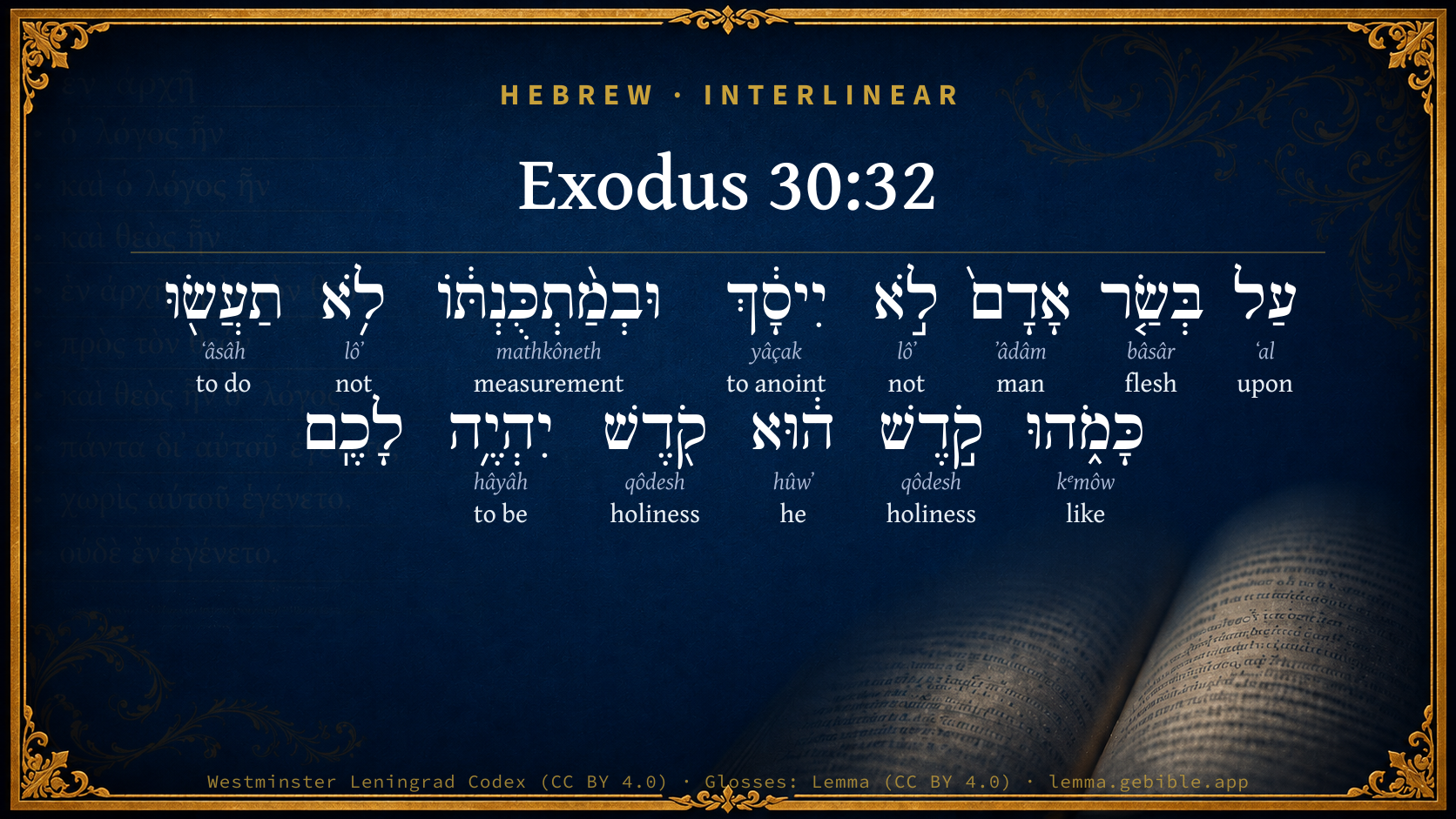
Hebrew (Westminster Leningrad Codex) Exodus 30:32 appears in the Hebrew Old Testament. The text above is from the Westminster Leningrad Codex. Each word links to its Strong’s number, a concise gloss, and parsing drawn from the Open Scriptures Hebrew Bible morphology. Click any word for its full Brown-Driver-Briggs (BDB) entry.
Download image
Cite this verse

Exodus 30:32 (World English Bible). Public Domain. Lemma interlinear Bible study tool, https://lemma.gebible.app/v/exodus/30/32.

Show BibTeX & RIS
BibTeX
RIS
English Translation
It shall not be poured on man's flesh, neither shall you make any like it, according to its composition: it is holy. It shall be holy to you.
World English Bible · Public Domain
Highlights
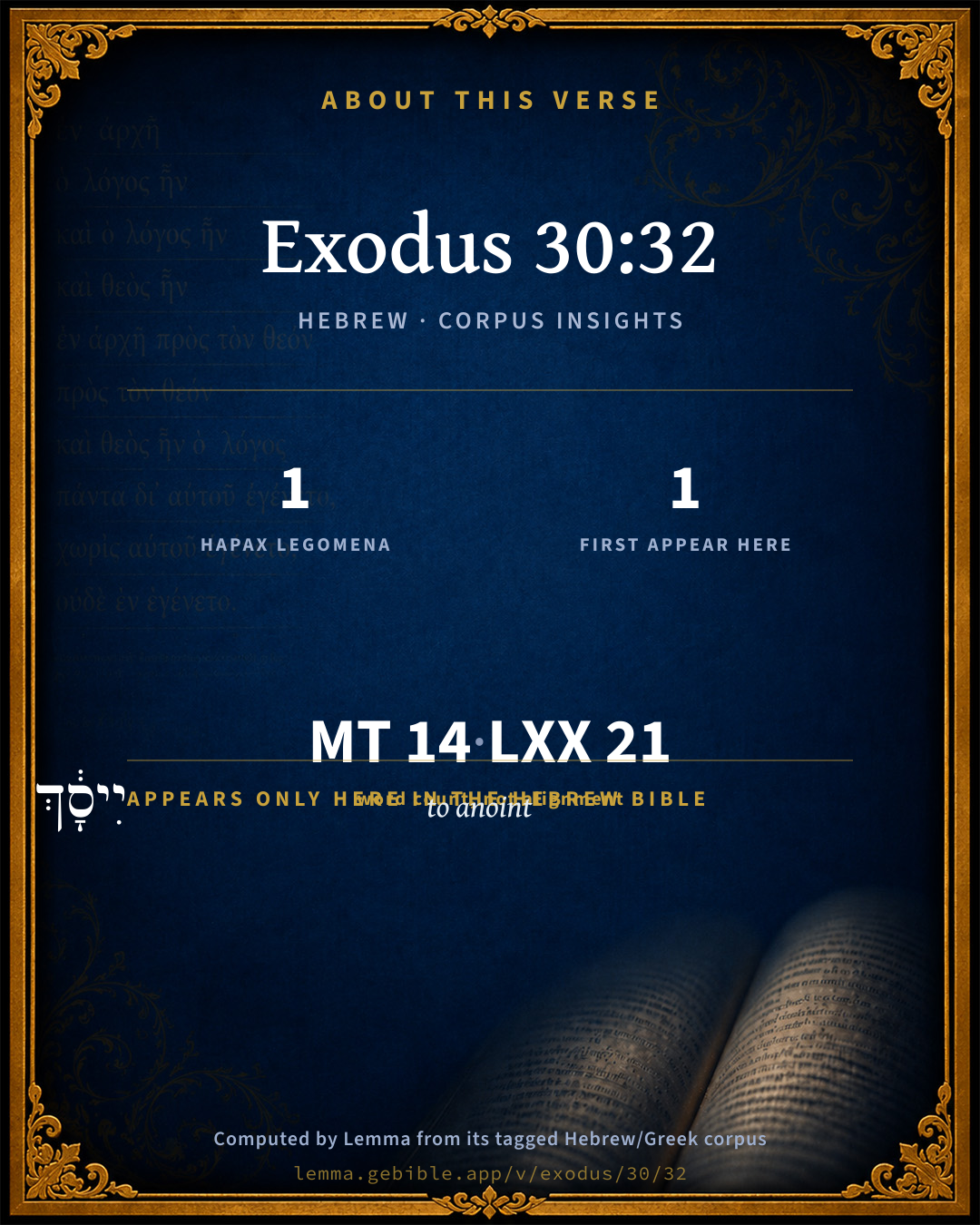
  • 1 hapax legomenon — only here in the Hebrew Bible
  • 1 first appearance in the Hebrew Bible
Full analysis ↓
Download a study sheet

One document with this verse’s original text, its word-by-word gloss line, the meaning frame, cross-references with their text, attributed commentary, and full source and license credits — printable, and it pastes into notes with its structure intact.

This verse Autodidact and up

Study sheet (.html) Plain text (.txt)

A passage Seminary Student

Up to 50 verses in one chapter. A passage sheet keeps up to 6 commentary sources and 12 cross-references per verse, in the order this page ranks them, and says so on the sheet whenever that leaves anything out. Ask for a single verse and you get the Autodidact verse sheet above.

Everything on this page stays free to read, with no account — the sheet is a download of what is already on screen, not access to it.

Want to remove ads? Support Godless Engineer
Compare translations 3

The same verse in 3 English versions, stacked beneath the original-language interlinear above. Click any original word for its lexicon entry.

Each is an independent rendering of the whole verse — the interlinear is not word-aligned to these translations.

Highlighted words mark where these versions differ — a whole-verse word diff, not a word-by-word alignment.

  • World English Bible Public Domain
    It shall not be poured on man's flesh, neither shall you make any like it, according to its composition: it is holy. It shall be holy to you.
  • King James Version Public Domain
    Upon man's flesh shall it not be poured, neither shall ye make any other like it, after the composition of it: it is holy, and it shall be holy unto you.
  • unfoldingWord Literal Text CC BY-SA 4.0
    It shall not be poured on the body of a man, and you shall not make anything like it with its formula. It is holy; it shall be holy to you.

unfoldingWord Literal Text — © unfoldingWord, licensed CC BY-SA 4.0. Word-aligned USFM3 via Door43 (git.door43.org/unfoldingWord/en_ult).

Versions to compare (up to 4)

3 of 4 selected

Show all 18 translations

Every available English version of this verse, each an independent rendering of the whole verse.

  • World English Bible Public Domain
    It shall not be poured on man's flesh, neither shall you make any like it, according to its composition: it is holy. It shall be holy to you.
  • Berean Standard Bible Public Domain
    It must not be used to anoint an ordinary man, and you must not make anything like it with the same formula. It is holy, and it must be holy to you.
  • Majority Standard Bible Public Domain
    It must not be used to anoint an ordinary man, and you must not make anything like it with the same formula. It is holy, and it must be holy to you.
  • King James Version Public Domain
    Upon man's flesh shall it not be poured, neither shall ye make any other like it, after the composition of it: it is holy, and it shall be holy unto you.
  • American Standard Version (1901) Public Domain
    Upon the flesh of man shall it not be poured, neither shall ye make any like it, according to the composition thereof: it is holy, `and' it shall be holy unto you.
  • Revised Version (1885) Public Domain
    Upon the flesh of man shall it not be poured, neither shall ye make any like it, according to the composition thereof: it is holy, and it shall be holy unto you.
  • Geneva Bible (1599) Public Domain
    None shall anoynt, mans flesh therewith, neither shall ye make any composition like vnto it: for it is holy, and shalbe holy vnto you.
  • Douay-Rheims (1899) Public Domain
    The flesh of man shall not be anointed therewith, and you shall make none other of the same composition, because it is sanctified, and shall be holy unto you.
  • Young's Literal Translation Public Domain
    on flesh of man it is not poured, and with its proper proportion ye make none like it; it `is' holy; it is holy to you;
  • Literal Standard Version CC BY-SA 4.0
    it is not poured on [the] flesh of man, and you make nothing [else] like it in its proportion; it [is] holy—it is holy to you;
  • Unlocked Literal Bible CC BY-SA 4.0
    It must not be applied to people's skin, nor must you make any oil like it with the same formula, because it is set apart to Yahweh. You must regard it in this manner.
  • unfoldingWord Literal Text CC BY-SA 4.0
    It shall not be poured on the body of a man, and you shall not make anything like it with its formula. It is holy; it shall be holy to you.
  • Darby Bible Public Domain
    Upon man's flesh shall it not be poured, neither shall ye make [any] like it, after the preparation of it: it is holy -- holy shall it be unto you.
  • World Messianic Bible Public Domain
    It shall not be poured on man’s flesh, and do not make any like it, according to its composition. It is holy. It shall be holy to you.
  • Webster's Bible Public Domain
    Upon man's flesh shall it not be poured, neither shall ye make any other like it, after the composition of it: it is holy, and it shall be holy to you.
  • Free Bible Version CC BY-SA 4.0
    Don't use it on ordinary people and don't make anything like it using the same formula. It is holy, and you must treat it as being holy.
  • Bible in Basic English Public Domain
    It is not to be used for man's flesh, and no other is to be made like it: holy it is, and you are to keep it holy.
  • JPS Tanakh (1917) Public Domain
    Upon the flesh of man shall it not be poured, neither shall ye make any like it, according to the composition thereof; it is holy, and it shall be holy unto you.

Literal Standard Version (2020), Covenant Press — licensed CC BY-SA 4.0. Text via the HelloAO Bible API (eBible.org). Unlocked Literal Bible (unfoldingWord) — licensed CC BY-SA 4.0. Text via the HelloAO Bible API (eBible.org). unfoldingWord Literal Text — © unfoldingWord, licensed CC BY-SA 4.0. Word-aligned USFM3 via Door43 (git.door43.org/unfoldingWord/en_ult). Free Bible Version, Dr. Jonathan Gallagher — licensed CC BY-SA 4.0. Text via the HelloAO Bible API (eBible.org).

Word by word

More ways to search: Search by grammar → Find every occurrence → Compare this word →

Practice this passage: Drill this verse → Learn its vocabulary →

יִיסָ֔ךְ
yâçak
H3251
“to anoint”
Verb, Qal, Imperfect, 3rd Person, Masculine, Singular
Part of Speech
Verb
Stem
Qal
Form
Imperfect
Person
3rd Person
Gender
Masculine
Number
Singular
Full BDB Definition

Origin: a primitive root

TWOT: 1474

(Qal) to anoint, be poured
  1. עַל ʻal H5921 “upon” Preposition
  2. בְּשַׂ֤ר bâsâr H1320 “flesh of” Noun, Common, Masculine, Singular, Construct
  3. אָדָם֙ ʼâdâm H120 “man” Noun, Common, Masculine, Singular, Absolute
  4. לֹ֣א lôʼ H3808 “not” Particle, Negative
  5. וּבְמַ֨תְכֻּנְתּ֔וֹ mathkôneth H4971 “and · in/at · measurement · his” Conjunction + Preposition + Noun, Common, Feminine, Singular, Construct + Suffix, Personal, 3rd Person, Masculine, Singular
  6. לֹ֥א lôʼ H3808 “not” Particle, Negative
  7. תַעֲשׂ֖וּ ʻâsâh H6213 “to do” Verb, Qal, Imperfect, 2nd Person, Masculine, Plural
  8. כָּמֹ֑הוּ kᵉmôw H3644 “like · him” Preposition + Suffix, Personal, 3rd Person, Masculine, Singular
  9. קֹ֣דֶשׁ qôdesh H6944 “holiness” Noun, Common, Masculine, Singular, Absolute
  10. ה֔וּא hûwʼ H1931 “he” Pronoun, Personal, 3rd Person, Masculine, Singular
  11. קֹ֖דֶשׁ qôdesh H6944 “holiness” Noun, Common, Masculine, Singular, Absolute
  12. יִהְיֶ֥ה hâyâh H1961 “to be” Verb, Qal, Imperfect, 3rd Person, Masculine, Singular

About this verse

These counts appear in no published source. They are computed here, from the morphology-tagged text and Lemma’s own curated glosses. What Lemma adds →

14
words
11
distinct lemmas
Pentateuch
section

Notable vocabulary

1 hapax legomenon — a word that appears only here in the entire Hebrew Bible:

  • יִיסָ֔ךְ to anoint H3251

First appearance in Scripture

This word makes its first canonical appearance in the Hebrew Bible here:

  • יִיסָ֔ךְ to anoint H3251

Shared distinctive vocabulary

וּבְמַ֨תְכֻּנְתּ֔וֹ measurement H4971 occurs in 5 verses of the Hebrew Bible. Also found in:

Grammatical profile

  • 3 verbs
  • 5 nouns
  • 1 pronoun
  • 3 prepositions
  • 2 particles

Verb forms

  • יִיסָ֔ךְ Qal · Imperfect
  • תַעֲשׂ֖וּ Qal · Imperfect
  • יִהְיֶ֥ה Qal · Imperfect

Repetition

Words recur within this verse — often emphatic in Hebrew:

  • קֹ֣דֶשׁ holiness H6944 ×2
  • לֹ֣א not H3808 ×2

Hebrew & Septuagint length

In English translation the verse runs 28 words from the Hebrew and 29 from the Septuagint (LXX English) — closely comparable.

A rough comparison of the two English renderings, which tokenize alike — not a word-level alignment.

Word counts can differ between the Hebrew and the Greek without any difference in meaning — e.g. the Hebrew direct-object marker אֵת has no separate Greek word, and Greek often adds the article ὁ.

In the original languages it is 14 Hebrew tokens and 21 Greek tokens — but the two are counted differently (Hebrew bundles its prefixes and suffixes into one token; the Greek is in lemma form), so that isn’t a like-for-like length.

Cross-references

4

Topical passages linked to Exodus 30:32 in the Treasury of Scripture Knowledge — connected by theme and wording, ordered by reader-vote popularity; previews shown in the World English Bible.

  • Exodus 30:25 You shall make it a holy anointing oil, a perfume compounded after the art of the perfumer: it shall be a holy anointing oil.
  • Exodus 30:37–38 The incense which you shall make, according to its composition you shall not make for yourselves: it shall be to you holy for Yahweh.
  • Leviticus 21:10 "'He who is the high priest among his brothers, upon whose head the anointing oil is poured, and that is consecrated to put on the garments, shall not let the hair of his head hang loose, nor tear his clothes;
  • Matthew 7:6 "Don't give that which is holy to the dogs, neither throw your pearls before the pigs, lest perhaps they trample them under their feet, and turn and tear you to pieces.

Cross-references courtesy of OpenBible.info (CC BY 4.0).

Hebrew and Greek witnesses Masoretic Hebrew ↔ Greek Septuagint

The same verse in the two great witnesses to the Old Testament, shown verse-for-verse.

These are two independent witnesses, not word-aligned to each other, and the Septuagint is shown in lemma (dictionary) form.

Hebrew Exodus 30:32 Masoretic · Westminster Leningrad Codex

עַל בְּשַׂ֤ר אָדָם֙ לֹ֣א יִיסָ֔ךְ וּבְמַ֨תְכֻּנְתּ֔וֹ לֹ֥א תַעֲשׂ֖וּ כָּמֹ֑הוּ קֹ֣דֶשׁ ה֔וּא קֹ֖דֶשׁ יִהְיֶ֥ה לָכֶֽם

It shall not be poured on man's flesh, neither shall you make any like it, according to its composition: it is holy. It shall be holy to you.

World English Bible · Public Domain

Greek LXX Exodus 30:32 Septuagint · lemma form

ἐπί σάρξ ἄνθρωπος οὐ χρίω καί κατά ὁ σύνθεσις οὗτος οὐ ποιέω σύ ἑαυτοῦ ὡσαύτως ἅγιος εἰμί καί ἁγίασμα εἰμί σύ

On man's flesh it shall not be poured, and you⌃ shall not make any for yourselves according to this composition: it is holy, and shall be holiness to you.

LXX2012 (modern English Septuagint) · Public Domain

Hebrew: Westminster Leningrad Codex (CC BY 4.0). Greek: Septuagint (public domain); English from LXX2012 (modern English Septuagint) (Public Domain). How the Septuagint differs from the Hebrew →

Targum (Aramaic paraphrase)

2

The Targum is the ancient Jewish Aramaic paraphrase of the Hebrew Scriptures — an interpretive translation, not the Hebrew text itself. Onkelos (literal) and Pseudo-Jonathan (expansive) render the Torah, and Jonathan the Prophets. Coverage is partial: where no permissively-licensed English translation exists for a verse, only the Aramaic is shown. This is verse-level text, not a word-by-word alignment to the Hebrew.

  1. Targum Onkelos Torah (Genesis–Deuteronomy)
    עַל בִּסְרָא דַאֲנָשָׁא לָא יִתְנַסַךְ וּבִדְמוּתֵהּ לָא תַעְבְּדוּן כְּוָתֵהּ קוּדְשָׁא הוּא קוּדְשָׁא יְהֵי לְכוֹן:

    (no public-domain English translation for this verse)

    Targum Onkelos — Aramaic: “Onkelos Genesis” (public domain); “Onkelos Exodus” (public domain); “Onkelos Leviticus” (public domain); “Onkelos Numbers” (public domain); “Onkelos Deuteronomy” (public domain). English: “Sefaria Community Translation” (CC0 1.0 (public-domain dedication)); “J.W. Etheridge. The Targums of Onkelos and Jonathan Ben Uzziel on the Pentateuch. London: Longmans, Green, 1862” (public domain). Text via Sefaria.

  2. Targum Pseudo-Jonathan Torah (Genesis–Deuteronomy)
    עַל בִּישְרָא דְּאֵינָשָׁא לָא יִתְמְרַק וְכִדְמוּיֵיהּ לָא תַעַבְדוּן כְּוָותֵיהּ קוּדְשָׁא הוּא קוּדְשָׁא יְהֵי לְכוֹן

    Upon the flesh of man it may not be poured, and the like of it you shall not make to resemble it; unto you it shall be most sacred.

    Targum Pseudo-Jonathan — Aramaic: “Targum Jonathan on Genesis” (public domain); “Targum Jonathan on Exodus” (public domain); “Targum Jonathan on Leviticus” (public domain); “Targum Jonathan on Numbers” (public domain); “Targum Jonathan on Deuteronomy” (public domain). English: “The Targum of Jonathan ben Uzziel, trans. J. W. Etheridge, London, 1862” (public domain). Text via Sefaria.

Commentary

Notes on Exodus 30:32 from classic Christian and Jewish commentators (each source and its license shown beneath its notes). The classic Christian expositions comment on the surrounding passage and are grouped to its opening verse, so a note may address several verses; the Jewish commentaries on the Tanakh (Rashi and others) are per-verse, so they appear only where the commentator wrote on this verse.

Lemma curates 59 commentaries, every one of them public domain or Creative Commons licensed, each selected and text-cleaned for this edition rather than reprinted as found. About our sources →

Trapp's Complete Commentary

John Trapp

Exo 30:32 Upon man’s flesh shall it not be poured, neither shall ye make [any other] like it, after the composition of it: it [is] holy, [and] it shall be holy unto you.

Ver. 32. Upon man’s flesh.] A Latine Postiller hence infers, in a hyperbolical sense, that priests are angels, not having human flesh.

John Trapp, A Commentary or Exposition upon All the Books of the Old and New Testament (1647–1656) — public domain. Text from a community e-Sword module.

Geneva Bible (1599)

Geneva Bible translators

Neither at their burials nor otherwise.

Geneva Bible (1599) marginal notes — public domain. Text via Bolls.life.

Ellicott's Commentary for English Readers

(32) Upon man’s flesh shall it not be poured—i.e., it shall not be in ordinary use as an unguent—a mere “man,” who is not a priest, shall not apply it to his private use. It shall be reserved altogether for holy purposes.

Neither shall ye make any other like it, after the composition of it—i.e., after the recipe given in Exo_30:23-25. The ingredients might be used in unguents separately—they might even be so used when united in some different proportions from those laid down for the “holy ointment”—but in the proportions fixed for the holy oil they must have no secular employment.

A Bible Commentary for English Readers, edited by Charles John Ellicott (1878–1897) — public domain. Text from a community e-Sword module.

The Cambridge Bible for Schools and Colleges

gen. ed. J. J. S. Perowne

32. of man] i.e. of ordinary men (cf. Psa_82:7, Isa_8:1, Hos_6:7 [2nd marg.]).

poured] poured for anointing, viz. for the toilet; the Heb. word (sûk) being the one used distinctively in this connexion (footnote, p. 337).

The Cambridge Bible for Schools and Colleges (gen. ed. J. J. S. Perowne; Cambridge University Press, 1878–1918) — public domain. Text from a community e-Sword module.

John Gill's Exposition

Upon man's flesh shall it not be poured,.... That is, not upon common men, or on men's flesh in common, as was usual at feasts and entertainments in the eastern countries, see Psa 23:5 but this was not to be used on such occasions, otherwise it was poured on the flesh of some men, as Aaron and his sons, on whose head it was poured and ran down to the beard:

neither shall ye make any other like it, after the composition of it; for private uses:

it is holy, and it shall be holy unto you; it was set apart for sacred use by the Lord, and so it was to be reckoned by them, and not to be used in any way, or for any other purpose than he had directed: all which shows, that the grace of the Spirit belongs to the Lord's people, his priests; other men are carnal, and have no lot or part in this matter, and are not to be admitted to holy ordinances, as if they were holy persons; nor is fellowship in holy things to be allowed them; nor is counterfeit grace of any avail, which, though it may bear a likeness to true grace, is not that, nor to be so accounted, nor rested on, as feigned faith, the hypocrite's hope, dissembled love, and pretended humility.

John Gill's Exposition of the Whole Bible (1746–1763) — public domain (CC PDM 1.0). Text via the HelloAO Bible API.

Haydock's Catholic Bible Commentary

Of man. Some except the king of Juda, till the reign of Josias. (Rabbins) --- But they were anointed with common oil. (Menochius)

George Leo Haydock (1774–1849), Haydock's Catholic Family Bible and Commentary, 1859 edition — public domain. Excludes Psalms (Douay-Rheims chapter numbering differs from Protestant) and Deuterocanonical books (Catholic canon only).

Matthew Poole's English Annotations

Upon man’s flesh shall it not be poured, except those whom God himself, the author of this law, excepts, to wit, the high priests, of which see Exo 30:30; and some of the kings, of which see 1Ki 1:39; Psa 89:20, though others think the kings were only anointed with common oil.

It shall be holy unto you, as it is unto me, Exo 30:31; you shall account it holy, as I do.

Matthew Poole's English Annotations on the Holy Bible (1683–1685) — public domain. Text from a community e-Sword/MySword module.

The Pulpit Commentary

Upon man"s flesh shall it not be pouredi.e. , "it shall not be used by any privately as a mere unguent, but shall be reserved wholly for sacred purposes." Neither shall ye make any other like it, after the composition of it. Rather, "after its proportion." The Israelites were not forbidden the use of the different materials in their unguents, or even the combination of the same materials, provided they varied the proportions. The object is simply that the holy oil should remain a thing separate and apart, never applied to any but a holy use.

The Pulpit Commentary (1880–1919), ed. H.D.M. Spence-Jones & Joseph S. Exell — public domain. Text from a community e-Sword module.

unfoldingWord translationNotes

Door43 World Missions Community

General Information:

Yahweh continues telling Moses what Moses must tell the people.

It must not be applied to people's skin

This can be stated in active form. AT: "You must not put the anointing oil that is dedicated to Yahweh on a person's skin" (See: Active or Passive)

with the same formula

"with the same ingredients" or "with the same items"

that person must be cut off from his people

The metaphor "cut off" has at least three possible meanings. They can be expressed in active form: 1) "I will no longer consider him to be one of the people of Israel" 2) "the people of Israel must send him away" or 3) "the people of Israel must kill him." (See: Metaphor and Active or Passive)

translationWords

oil

set apart

Yahweh

cut off

people group

unfoldingWord translationNotes — © Distant Shores Media and the Door43 World Missions Community, licensed CC BY-SA 4.0. Source: git.door43.org/Door43/en_tn.

Rashi

Rabbi Shlomo Yitzchaki (Rashi)

לא ייסך with two “yods” has the meaning “he shall not do something” (i. e. it is 3rd person masc. sing. Kal), similar to ייטב in (Deuteronomy 6:18) “that it may be well (ייטב) with thee”.

על בשר אדם לא ייסך UPON MAN’S FLESH SHALL IT NOT BE POURED — anything from that selfsame oil (which Moses had prepared).

ובמתכנתו לא תעשו כמהו AND ACCORDING TO ITS PROPORTION YE SHALL NOT MAKE ANY LIKE IT — In regard to the quantities of its spices ye shall not make any other oil like it — i. e. in regard to the weights of these spices in proportion to the measure of a hin of oil; but if one uses less or more of these spices in proportion to the measure of a hin of oil, it is permitted to do so. And even if it is made in the same proportions as this (the oil made by Moses) it is not the one who anoints himself with it that is punishable (for this applies only to one who anoints himself with the oil made by Moses) but he who compounds it (Keritot 5a).

ובמתכנתו is a term denoting amount, as (Exodus 5:8) “the quantity (מתכנת) of bricks”. Similar is the word מתכנת used of the incense (v. 37).

Rashi on the Tanakh — English translations: “The Judaica Press complete Tanach with Rashi, translated by A. J. Rosenberg” (CC BY 4.0); “Pentateuch with Rashi's commentary by M. Rosenbaum and A.M. Silbermann, 1929-1934” (public domain); “The Metsudah Tanach series, Lakewood, N.J” (CC BY 4.0); and “The Book of Joshua, Metsudah Publications, 1997” (CC BY 4.0). Text via Sefaria.

Lesson kit

Teaching starters — assembled from the data on this page, not authored interpretation. Every prompt links to the verse data it draws on. Edit before teaching.

Exodus, in the Pentateuch, opens this verse with 14 words (11 distinct Hebrew lemmas). Its most distinctive word is yâçak (“to anoint”). A historical commentator’s framing appears above. Read the whole chapter for the surrounding context.

Discussion questions

  1. The word yâçak carries the sense “to anoint.” How does it shape the verse?
  2. This verse holds 1 word here found nowhere else in the Hebrew Bible. What might the rare word draw attention to?
  3. The word “to anoint” first appears here in Scripture. What is being introduced at this debut?
  4. Exodus 5:8 shares the word «measurement» with this verse. How do the two illuminate each other?
  5. “holiness” occurs 2× in this one verse. What is the effect of the repetition?
  6. These translations render this verse differently. What is at stake in choosing one wording over another?
  7. The verb «יִיסָ֔ךְ» is Qal Imperfect. How does its form color the action?
  8. Reading how Trapp's Complete Commentary and Geneva Bible (1599) read this verse, where do the two commentators agree and where do they part?

Things to notice

  • 1 word in this verse appears nowhere else in the Hebrew Bible.
  • 1 word makes its first canonical appearance in Scripture here.
  • This verse counts 14 Hebrew ↔ 21 Greek words.
  • These translations choose different wording for 13 words in this verse.
  • “holiness” occurs 2× in this single verse.

Reading settings

Reading text

Shown beneath each verse's original-language words.

Old Testament
Old Testament edition

Read the OT as the Masoretic Hebrew (MT) or the Greek Septuagint (LXX).

English shown for the Greek Septuagint (in the Hebrew ↔ Greek comparison).

Comparing translations? Open the Compare panel on any verse page to stack up to four side by side.