
Leviticus 23:37

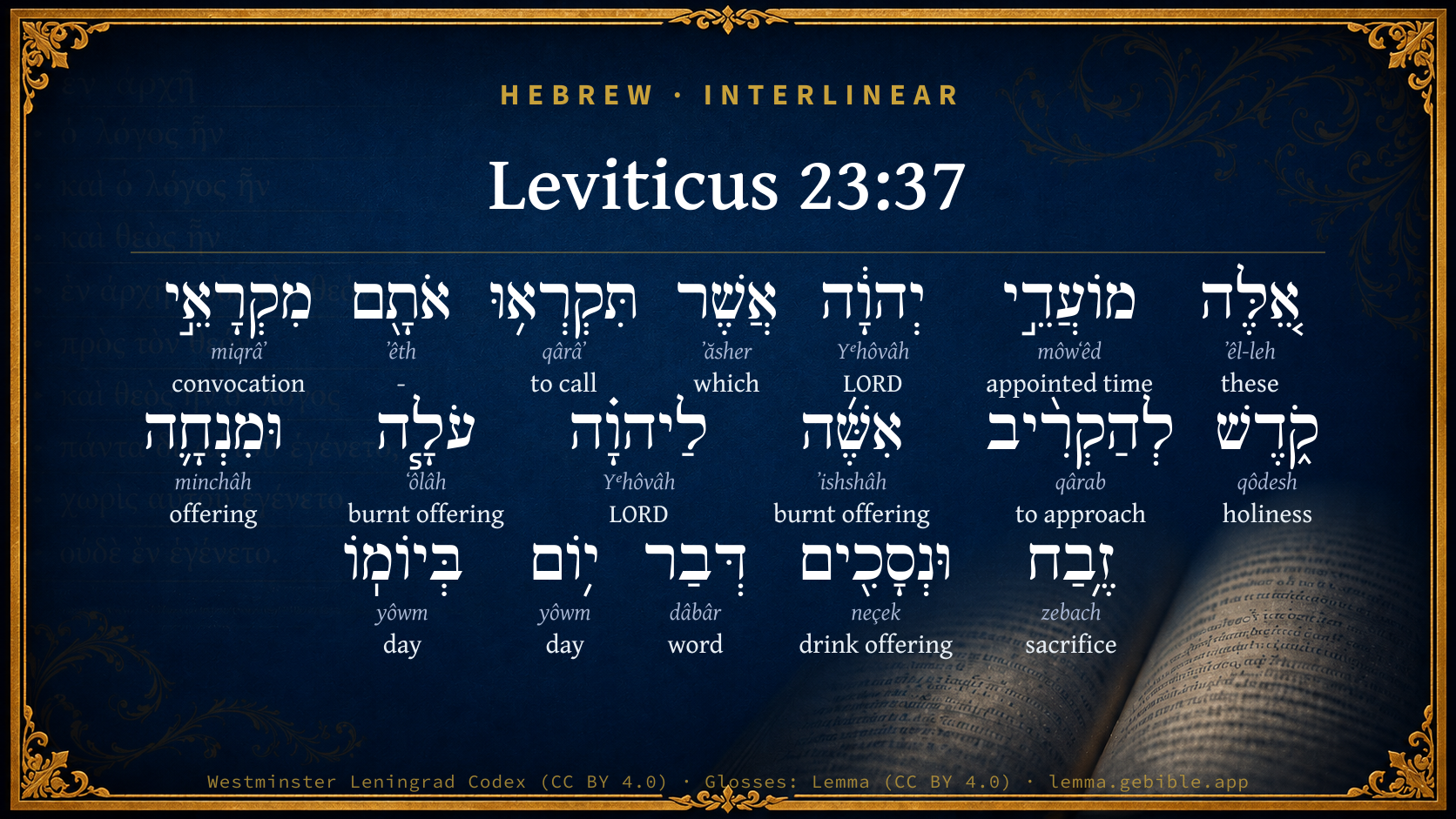
Hebrew (Westminster Leningrad Codex) Leviticus 23:37 appears in the Hebrew Old Testament. The text above is from the Westminster Leningrad Codex. Each word links to its Strong’s number, a concise gloss, and parsing drawn from the Open Scriptures Hebrew Bible morphology. Click any word for its full Brown-Driver-Briggs (BDB) entry.
Download image
Cite this verse

Leviticus 23:37 (World English Bible). Public Domain. Lemma interlinear Bible study tool, https://lemma.gebible.app/v/leviticus/23/37.

Show BibTeX & RIS
BibTeX
RIS
English Translation
"'These are the appointed feasts of Yahweh, which you shall proclaim to be holy convocations, to offer an offering made by fire to Yahweh, a burnt offering, and a meal offering, a sacrifice, and drink offerings, each on its own day;
World English Bible · Public Domain
Download a study sheet

One document with this verse’s original text, its word-by-word gloss line, the meaning frame, cross-references with their text, attributed commentary, and full source and license credits — printable, and it pastes into notes with its structure intact.

This verse Autodidact and up

Study sheet (.html) Plain text (.txt)

A passage Seminary Student

Up to 50 verses in one chapter. A passage sheet keeps up to 6 commentary sources and 12 cross-references per verse, in the order this page ranks them, and says so on the sheet whenever that leaves anything out. Ask for a single verse and you get the Autodidact verse sheet above.

Everything on this page stays free to read, with no account — the sheet is a download of what is already on screen, not access to it.

Want to remove ads? Support Godless Engineer
Compare translations 3

The same verse in 3 English versions, stacked beneath the original-language interlinear above. Click any original word for its lexicon entry.

Each is an independent rendering of the whole verse — the interlinear is not word-aligned to these translations.

Highlighted words mark where these versions differ — a whole-verse word diff, not a word-by-word alignment.

  • World English Bible Public Domain
    "'These are the appointed feasts of Yahweh, which you shall proclaim to be holy convocations, to offer an offering made by fire to Yahweh, a burnt offering, and a meal offering, a sacrifice, and drink offerings, each on its own day;
  • King James Version Public Domain
    These are the feasts of the LORD, which ye shall proclaim to be holy convocations, to offer an offering made by fire unto the LORD, a burnt offering, and a meat offering, a sacrifice, and drink offerings, every thing upon his day:
  • unfoldingWord Literal Text CC BY-SA 4.0
    These the appointed times of Yahweh which you shall proclaim assemblies of holiness, to present a gift to Yahweh: a burnt offering and a grain offering, a sacrifice and drink offerings, the thing of a day on its day,

unfoldingWord Literal Text — © unfoldingWord, licensed CC BY-SA 4.0. Word-aligned USFM3 via Door43 (git.door43.org/unfoldingWord/en_ult).

Versions to compare (up to 4)

3 of 4 selected

Show all 18 translations

Every available English version of this verse, each an independent rendering of the whole verse.

  • World English Bible Public Domain
    "'These are the appointed feasts of Yahweh, which you shall proclaim to be holy convocations, to offer an offering made by fire to Yahweh, a burnt offering, and a meal offering, a sacrifice, and drink offerings, each on its own day;
  • Berean Standard Bible Public Domain
    These are the LORD’s appointed feasts, which you are to proclaim as sacred assemblies for presenting offerings by fire to the LORD—burnt offerings and grain offerings, sacrifices and drink offerings, each on its designated day.
  • Majority Standard Bible Public Domain
    These are the LORD’s appointed feasts, which you are to proclaim as sacred assemblies for presenting food offerings to the LORD—burnt offerings and grain offerings, sacrifices and drink offerings, each on its designated day.
  • King James Version Public Domain
    These are the feasts of the LORD, which ye shall proclaim to be holy convocations, to offer an offering made by fire unto the LORD, a burnt offering, and a meat offering, a sacrifice, and drink offerings, every thing upon his day:
  • American Standard Version (1901) Public Domain
    These are the set feasts of Jehovah, which ye shall proclaim to be holy convocations, to offer an offering made by fire unto Jehovah, a burnt-offering, and a meal-offering, a sacrifice, and drink-offerings, each on its own day;
  • Revised Version (1885) Public Domain
    These are the set feasts of the LORD, which ye shall proclaim to be holy convocations, to offer an offering made by fire unto the LORD, a burnt offering, and a meal offering, a sacrifice, and drink offerings, each on its own day:
  • Geneva Bible (1599) Public Domain
    These are the feastes of the Lord (which ye shall call holie conuocations) to offer sacrifice made by fire vnto the Lord, as burnt offring, and meate offring, sacrifice, and drinke offrings, euery one vpon his day,
  • Douay-Rheims (1899) Public Domain
    These are the feasts of the Lord, which you shall call most solemn and most holy, and shall offer on them oblations to the Lord, holocausts and libations according to the rite of every day,
  • Young's Literal Translation Public Domain
    `These `are' appointed seasons of Jehovah, which ye proclaim holy convocations, to bring near a fire-offering to Jehovah, a burnt-offering, and a present, a sacrifice, and libations, a thing of a day in its day,
  • Literal Standard Version CC BY-SA 4.0
    These [are] appointed times of YHWH, which you proclaim [as] holy convocations, to bring a fire-offering near to YHWH, a burnt-offering, and a present, a sacrifice, and drink-offerings, a thing of a day in its day,
  • Unlocked Literal Bible CC BY-SA 4.0
    These are the appointed festivals for Yahweh, which you must proclaim as holy assemblies to offer sacrifice by fire to Yahweh, a burnt offering and a grain offering, sacrifices and drink offerings, each on its own day.
  • unfoldingWord Literal Text CC BY-SA 4.0
    These the appointed times of Yahweh which you shall proclaim assemblies of holiness, to present a gift to Yahweh: a burnt offering and a grain offering, a sacrifice and drink offerings, the thing of a day on its day,
  • Darby Bible Public Domain
    These are the set feasts of Jehovah, which ye shall proclaim as holy convocations, to present an offering by fire to Jehovah, a burnt-offering, and an oblation, a sacrifice, and drink-offerings, everything upon its day;
  • World Messianic Bible Public Domain
    “‘These are the appointed feasts of the LORD which you shall proclaim to be holy convocations, to offer an offering made by fire to the LORD, a burnt offering, a meal offering, a sacrifice, and drink offerings, each on its own day—
  • Webster's Bible Public Domain
    These are the feasts of the LORD, which ye shall proclaim to be holy convocations, to offer an offering made by fire to the LORD, a burnt-offering, and a meat-offering, a sacrifice, and drink-offerings, every thing upon its day:
  • Free Bible Version CC BY-SA 4.0
    These are the Lord's holy festivals, which you are to announce as holy meetings for presenting food offerings to the Lord. These include burnt offerings, grain offerings, sacrifices and drink offerings, each according to the specific day.
  • Bible in Basic English Public Domain
    These are the fixed feasts of the Lord, to be kept by you as holy days of worship, for making an offering by fire to the Lord; a burned offering, a meal offering, an offering of beasts, and drink offerings; every one on its special day;
  • JPS Tanakh (1917) Public Domain
    These are the appointed seasons of the LORD, which ye shall proclaim to be holy convocations, to bring an offering made by fire unto the LORD, a burnt-offering, and a meal-offering, a sacrifice, and drink-offerings, each on its own day;

Literal Standard Version (2020), Covenant Press — licensed CC BY-SA 4.0. Text via the HelloAO Bible API (eBible.org). Unlocked Literal Bible (unfoldingWord) — licensed CC BY-SA 4.0. Text via the HelloAO Bible API (eBible.org). unfoldingWord Literal Text — © unfoldingWord, licensed CC BY-SA 4.0. Word-aligned USFM3 via Door43 (git.door43.org/unfoldingWord/en_ult). Free Bible Version, Dr. Jonathan Gallagher — licensed CC BY-SA 4.0. Text via the HelloAO Bible API (eBible.org).

Word by word

More ways to search: Search by grammar → Find every occurrence → Compare this word →

Practice this passage: Drill this verse → Learn its vocabulary →

מִקְרָאֵ֣י
miqrâʼ
H4744
“convocations of”
Noun, Common, Masculine, Plural, Construct
Part of Speech
Noun
Type
Common
Gender
Masculine
Number
Plural
State
Construct
Full BDB Definition

Origin: from H7121

TWOT: 2063d

convocation, convoking, reading, a calling together - convocation, sacred assembly - convoking - reading
  1. אֵ֚לֶּה ʼêl-leh H428 “these” Pronoun, Demonstrative, Common, Plural
  2. מוֹעֲדֵ֣י môwʻêd H4150 “appointed times of” Noun, Common, Masculine, Plural, Construct
  3. יְהוָ֔ה Yᵉhôvâh H3068 “LORD” Noun, Proper
  4. אֲשֶׁר ʼăsher H834 “which” Particle, Relative
  5. תִּקְרְא֥וּ qârâʼ H7121 “to call” Verb, Qal, Imperfect, 2nd Person, Masculine, Plural
  6. אֹתָ֖ם ʼêth H853 “- · them” Particle, Direct Object + Suffix, Personal, 3rd Person, Masculine, Plural
  7. קֹ֑דֶשׁ qôdesh H6944 “holiness” Noun, Common, Masculine, Singular, Absolute
  8. לְהַקְרִ֨יב qârab H7126 “to approach” Preposition + Verb, Hiphil, Infinitive Construct
  9. אִשֶּׁ֜ה ʼishshâh H801 “burnt offering” Noun, Common, Masculine, Singular, Absolute
  10. לַיהוָ֗ה Yᵉhôvâh H3068 “to/for · LORD” Preposition + Noun, Proper
  11. עֹלָ֧ה ʻôlâh H5930 “burnt offering” Noun, Common, Feminine, Singular, Absolute
  12. וּמִנְחָ֛ה minchâh H4503 “and · offering” Conjunction + Noun, Common, Feminine, Singular, Absolute
  13. זֶ֥בַח zebach H2077 “sacrifice” Noun, Common, Masculine, Singular, Absolute
  14. וּנְסָכִ֖ים neçek H5262 “and · drink offerings” Conjunction + Noun, Common, Masculine, Plural, Absolute
  15. דְּבַר dâbâr H1697 “word of” Noun, Common, Masculine, Singular, Construct
  16. י֥וֹם yôwm H3117 “day” Noun, Common, Masculine, Singular, Absolute
  17. בְּיוֹמֽוֹ yôwm H3117 “in/at · day · his” Preposition + Noun, Common, Masculine, Singular, Construct + Suffix, Personal, 3rd Person, Masculine, Singular

About this verse

These counts appear in no published source. They are computed here, from the morphology-tagged text and Lemma’s own curated glosses. What Lemma adds →

18
words
16
distinct lemmas
Pentateuch
section

Notable vocabulary

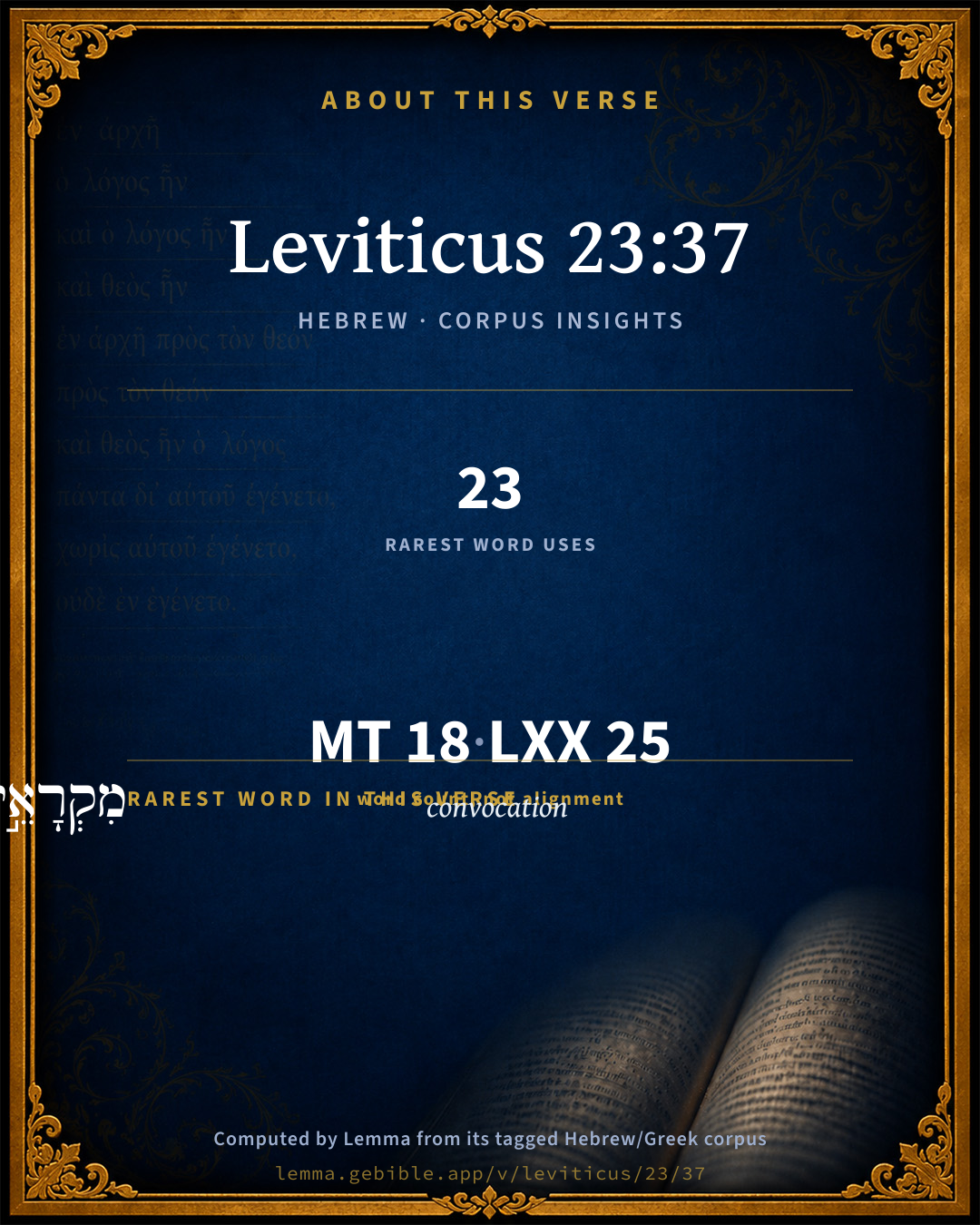
The rarest word here is מִקְרָאֵ֣י convocation H4744 — appearing just 23 times in the whole Hebrew Bible.

Shared distinctive vocabulary

מִקְרָאֵ֣י convocation H4744 occurs in 22 verses of the Hebrew Bible. Also found in:

Grammatical profile

  • 2 verbs
  • 13 nouns
  • 1 pronoun
  • 2 particles

Verb forms

  • תִּקְרְא֥וּ Qal · Imperfect
  • לְהַקְרִ֨יב Hiphil · Infinitive Construct

Repetition

Words recur within this verse — often emphatic in Hebrew:

  • יְהוָ֔ה LORD H3068 ×2
  • י֥וֹם day H3117 ×2

Hebrew & Septuagint length

In English translation the verse runs 41 words from the Hebrew and 36 from the Septuagint (LXX English) — closely comparable.

A rough comparison of the two English renderings, which tokenize alike — not a word-level alignment.

Word counts can differ between the Hebrew and the Greek without any difference in meaning — e.g. the Hebrew direct-object marker אֵת has no separate Greek word, and Greek often adds the article ὁ.

In the original languages it is 18 Hebrew tokens and 25 Greek tokens — but the two are counted differently (Hebrew bundles its prefixes and suffixes into one token; the Greek is in lemma form), so that isn’t a like-for-like length.

Cross-references

4

Topical passages linked to Leviticus 23:37 in the Treasury of Scripture Knowledge — connected by theme and wording, ordered by reader-vote popularity; previews shown in the World English Bible.

  • Leviticus 23:2 "Speak to the children of Israel, and tell them, 'The set feasts of Yahweh, which you shall proclaim to be holy convocations, even these are my set feasts.
  • Leviticus 23:4 "'These are the set feasts of Yahweh, even holy convocations, which you shall proclaim in their appointed season.
  • Ecclesiastes 3:1 For everything there is a season, and a time for every purpose under heaven:
  • Deuteronomy 16:16–17 Three times in a year shall all your males appear before Yahweh your God in the place which he shall choose: in the feast of unleavened bread, and in the feast of weeks, and in the feast of tents; and they shall not appear before Yahweh empty:

Cross-references courtesy of OpenBible.info (CC BY 4.0).

Hebrew and Greek witnesses Masoretic Hebrew ↔ Greek Septuagint

The same verse in the two great witnesses to the Old Testament, shown verse-for-verse.

These are two independent witnesses, not word-aligned to each other, and the Septuagint is shown in lemma (dictionary) form.

Hebrew Leviticus 23:37 Masoretic · Westminster Leningrad Codex

אֵ֚לֶּה מוֹעֲדֵ֣י יְהוָ֔ה אֲשֶׁר תִּקְרְא֥וּ אֹתָ֖ם מִקְרָאֵ֣י קֹ֑דֶשׁ לְהַקְרִ֨יב אִשֶּׁ֜ה לַיהוָ֗ה עֹלָ֧ה וּמִנְחָ֛ה זֶ֥בַח וּנְסָכִ֖ים דְּבַר י֥וֹם בְּיוֹמֽוֹ

"'These are the appointed feasts of Yahweh, which you shall proclaim to be holy convocations, to offer an offering made by fire to Yahweh, a burnt offering, and a meal offering, a sacrifice, and drink offerings, each on its own day;

World English Bible · Public Domain

Greek LXX Leviticus 23:37 Septuagint · lemma form

οὗτος ὁ ἑορτή κύριος ὅς καλέω κλητός ἅγιος ὥστε προςφέρω κάρπωμα ὁ κύριος ὁλοκαύτωμα καί θυσία αὐτός καί σπονδή αὐτός ὁ κατά ἡμέρα εἰς ἡμέρα

These are the feasts to the Lord, which you⌃ shall call holy convocations, to offer burnt offerings to the Lord, whole burnt offerings and their meat-offerings, and their drink-offerings, that for each day on its day:

LXX2012 (modern English Septuagint) · Public Domain

Hebrew: Westminster Leningrad Codex (CC BY 4.0). Greek: Septuagint (public domain); English from LXX2012 (modern English Septuagint) (Public Domain). How the Septuagint differs from the Hebrew →

Targum (Aramaic paraphrase)

2

The Targum is the ancient Jewish Aramaic paraphrase of the Hebrew Scriptures — an interpretive translation, not the Hebrew text itself. Onkelos (literal) and Pseudo-Jonathan (expansive) render the Torah, and Jonathan the Prophets. Coverage is partial: where no permissively-licensed English translation exists for a verse, only the Aramaic is shown. This is verse-level text, not a word-by-word alignment to the Hebrew.

  1. Targum Onkelos Torah (Genesis–Deuteronomy)
    אִלֵין מוֹעֲדַיָא דַיְיָ דִי תְעָרְעוּן יָתְהוֹן מְעָרְעֵי קַדִישׁ לְקָרָבָא קֻרְבָּנָא קֳדָם יְיָ עֲלָתָא וּמִנְחָתָא נִכְסַת קוּדְשִׁין וְנִסוּכִין פִּתְגַם יוֹם בְּיוֹמֵהּ

    (no public-domain English translation for this verse)

    Targum Onkelos — Aramaic: “Onkelos Genesis” (public domain); “Onkelos Exodus” (public domain); “Onkelos Leviticus” (public domain); “Onkelos Numbers” (public domain); “Onkelos Deuteronomy” (public domain). English: “Sefaria Community Translation” (CC0 1.0 (public-domain dedication)); “J.W. Etheridge. The Targums of Onkelos and Jonathan Ben Uzziel on the Pentateuch. London: Longmans, Green, 1862” (public domain). Text via Sefaria.

  2. Targum Pseudo-Jonathan Torah (Genesis–Deuteronomy)
    אִילֵין זִמְנֵי סִדְרֵי מוֹעֲדַיָא דַיְיָ דִתְעַרְעוּן יַתְהוֹן מְאַרְעֵי קַדִישׁ לְקָרָבָא קוּרְבָּנָא לִשְׁמָא דַיְיָ עֲלָתָא וּמִנְחָתָא נִכְסַת קוּדְשִׁין וְנִיסוּכִין פִּתְגַם יוֹם בְּיוֹמֵיהּ

    These are the times of the order of the Lord's festivals which you are to convoke for holy convocations, to offer an oblation to the name of the Lord, a burnt sacrifice and a mincha, sanctified offerings and libations, the rite of a day in its day;

    Targum Pseudo-Jonathan — Aramaic: “Targum Jonathan on Genesis” (public domain); “Targum Jonathan on Exodus” (public domain); “Targum Jonathan on Leviticus” (public domain); “Targum Jonathan on Numbers” (public domain); “Targum Jonathan on Deuteronomy” (public domain). English: “The Targum of Jonathan ben Uzziel, trans. J. W. Etheridge, London, 1862” (public domain). Text via Sefaria.

Commentary

Notes on Leviticus 23:37 from classic Christian and Jewish commentators (each source and its license shown beneath its notes). The classic Christian expositions comment on the surrounding passage and are grouped to its opening verse, so a note may address several verses; the Jewish commentaries on the Tanakh (Rashi and others) are per-verse, so they appear only where the commentator wrote on this verse.

Lemma curates 59 commentaries, every one of them public domain or Creative Commons licensed, each selected and text-cleaned for this edition rather than reprinted as found. About our sources →

Joseph Benson's Commentary

Lev 23:37. A sacrifice — A sin-offering, called by the general name, a sacrifice, because it was designed for that which was the principal end of all sacrifices, the expiation of sin.

Joseph Benson's Commentary on the Old and New Testaments (1811–1818) — public domain. Text from a community e-Sword module.

Geneva Bible (1599)

Geneva Bible translators

Or, peace offering.

Geneva Bible (1599) marginal notes — public domain. Text via Bolls.life.

Ellicott's Commentary for English Readers

(37) These are the feasts of the Lord.—That is, the above-named six festivals, viz.—(1) the Passover (Lev_23:4-14), (2) Pentecost Lev_23:15-22), (3) New Year (Lev_23:23-25), (4) Day of Atonement (Lev_23:26-32), (5) Tabernacles (Lev_23:33-36 a), and (6) the concluding festival (Lev_23:36 b). Thus the list of these festivals concludes with the formula by which they were introduced in Lev_23:4.

To offer an offering.—On these festivals sacrifices are to be offered as prescribed in Numbers 28, 29.

A Bible Commentary for English Readers, edited by Charles John Ellicott (1878–1897) — public domain. Text from a community e-Sword module.

The Cambridge Bible for Schools and Colleges

gen. ed. J. J. S. Perowne

37, 38. Subscription to the whole (see on Lev_23:2-4)

We may note that in the summary given in these vv. there is no mention of the Sin-Offering prescribed in Num_28:15; Num_28:22; Num_28:30; Num_29:5, &c.

The Cambridge Bible for Schools and Colleges (gen. ed. J. J. S. Perowne; Cambridge University Press, 1878–1918) — public domain. Text from a community e-Sword module.

John Gill's Exposition

These are the feasts of the Lord,.... Besides the sabbath, as Gersom observes; even the passover, the seven days of unleavened bread the day of Pentecost, the day of blowing the trumpets, the day of atonement, and the seven days of the feast of tabernacles:

which ye shall proclaim to be holy convocations: as they had been directed, Lev 23:2,

to offer an offering made by fire unto the Lord; which is explained by

a burnt offering, and a meat offering, which went along with it:

a sacrifice, which the Targums of Onkelos and Jonathan call the sacrifice of holy things; according to Gersom it was the sacrifice of the peace offerings; but rather it seems to be the sacrifice of the sin offering, which was ordered along with the rest in all those feasts:

and drink offerings; which also accompanied the meat offerings:

everything upon his day; there being different sacrifices on one day than on another, everyone was to be offered peculiar to the day as was ordered; of which see Num 28:29.

John Gill's Exposition of the Whole Bible (1746–1763) — public domain (CC PDM 1.0). Text via the HelloAO Bible API.

Albert Barnes' Notes on the Bible

The meaning appears to be; “these are the yearly appointed times on which ye shall hold holy convocations and offer to Yahweh sacrifices, in addition to the Sabbath offerings Num 28:9-10 and to all your voluntary offerings.” Compare Num 29:39.

Albert Barnes' Notes on the Bible (1834–1885) — public domain. Text from a community e-Sword/MySword module.

Matthew Poole's English Annotations

A sacrifice, i.e. another sacrifice, to wit, for a sin-offering, as we shall find it Num 29:16,19,22, &c., called by the general name, a sacrifice, because it was designed for that which was the principal end of all sacrifices, to wit, for the expiation of sin.

Matthew Poole's English Annotations on the Holy Bible (1683–1685) — public domain. Text from a community e-Sword/MySword module.

Whedon's Commentary on the Bible

Daniel D. Whedon

37. Burnt offering — See notes on chap. 1.

Meat offering — See notes on chap. 2.

A sacrifice — This stands here for the peace offering. See notes on chap. 3.

Drink offerings — See note on Lev_23:13.

Daniel D. Whedon (gen. ed.), Commentary on the Old and New Testaments (1874–1909) — public domain. Text from a community e-Sword module.

The Pulpit Commentary

Vers. 37, 38. These verses form the conclusion of the immediate subject. The feasts have been enumerated in which holy convocations are to be held and public sacrifices offered; these sacrifices, it is explained, not including those of the sabbath or of individual offerers.

The Pulpit Commentary (1880–1919), ed. H.D.M. Spence-Jones & Joseph S. Exell — public domain. Text from a community e-Sword module.

John Wesley's Explanatory Notes

A sacrifice - A sin-offering, called by the general name, a sacrifice, because it was designed for that which was the principal end of all sacrifices, the expiation of sin.

John Wesley, Explanatory Notes Upon the Whole Bible (1754–1765) — public domain. Text via the GEBible commentary corpus.

unfoldingWord translationNotes

Door43 World Missions Community

Connecting Statement:

Yahweh continues telling Moses what the people must do every year.

These are the appointed festivals

This refers to the festivals mentioned in Lev 23:1-36.

translationWords

appoint

preach

grain offering

drink offering

Sabbath

gift

vow

freewill offering

unfoldingWord translationNotes — © Distant Shores Media and the Door43 World Missions Community, licensed CC BY-SA 4.0. Source: git.door43.org/Door43/en_tn.

Rashi

Rabbi Shlomo Yitzchaki (Rashi)

עלה ומנחה A BURNT OFFERING AND A MEAL OFFERING — This means the מנחת נסכים (the meal-offering due with the drink-offering) that is brought together with the‎ עולה (Menachot 44b)‎.

‎‎ביומו‎ ‎יום‎ ‎דבר EVERYTHING UPON ITS DAY (lit., the thing of the day, on its day) — the quantity definitely assigned to each day in the Book of Numbers (cf. Rashi on Exodus 16:4).

דבר יום ביומו EVERYTHING UPON ITS DAY (which may mean the matter of the day shall be on its day) — consequently if its day (the day on which some particular one of these sacrifices is due) be past, it's (the day’s) offering is past (cf. Sifra, Emor, Section 12 9).

Rashi on the Tanakh — English translations: “The Judaica Press complete Tanach with Rashi, translated by A. J. Rosenberg” (CC BY 4.0); “Pentateuch with Rashi's commentary by M. Rosenbaum and A.M. Silbermann, 1929-1934” (public domain); “The Metsudah Tanach series, Lakewood, N.J” (CC BY 4.0); and “The Book of Joshua, Metsudah Publications, 1997” (CC BY 4.0). Text via Sefaria.

Lesson kit

Teaching starters — assembled from the data on this page, not authored interpretation. Every prompt links to the verse data it draws on. Edit before teaching.

Leviticus, in the Pentateuch, opens this verse with 18 words (16 distinct Hebrew lemmas). Its most distinctive word is miqrâʼ (“convocation”). A historical commentator’s framing appears above. Read the whole chapter for the surrounding context.

Discussion questions

  1. How does “convocation” (miqrâʼ) shape what this verse is saying?
  2. How does Exodus 12:16, which shares the word «convocation», read alongside this verse?
  3. What does the repetition of “LORD” (2× in this one verse) do in this verse?
  4. These translations render this verse differently. What is at stake in choosing one wording over another?
  5. «תִּקְרְא֥וּ» is a Qal Imperfect verb. How does that grammatical form shape the action described?
  6. Compare how Joseph Benson's Commentary and Geneva Bible (1599) read this verse. Where do they agree or differ?

Things to notice

Reading settings

Reading text

Shown beneath each verse's original-language words.

Old Testament
Old Testament edition

Read the OT as the Masoretic Hebrew (MT) or the Greek Septuagint (LXX).

English shown for the Greek Septuagint (in the Hebrew ↔ Greek comparison).

Comparing translations? Open the Compare panel on any verse page to stack up to four side by side.