Leviticus 22:10

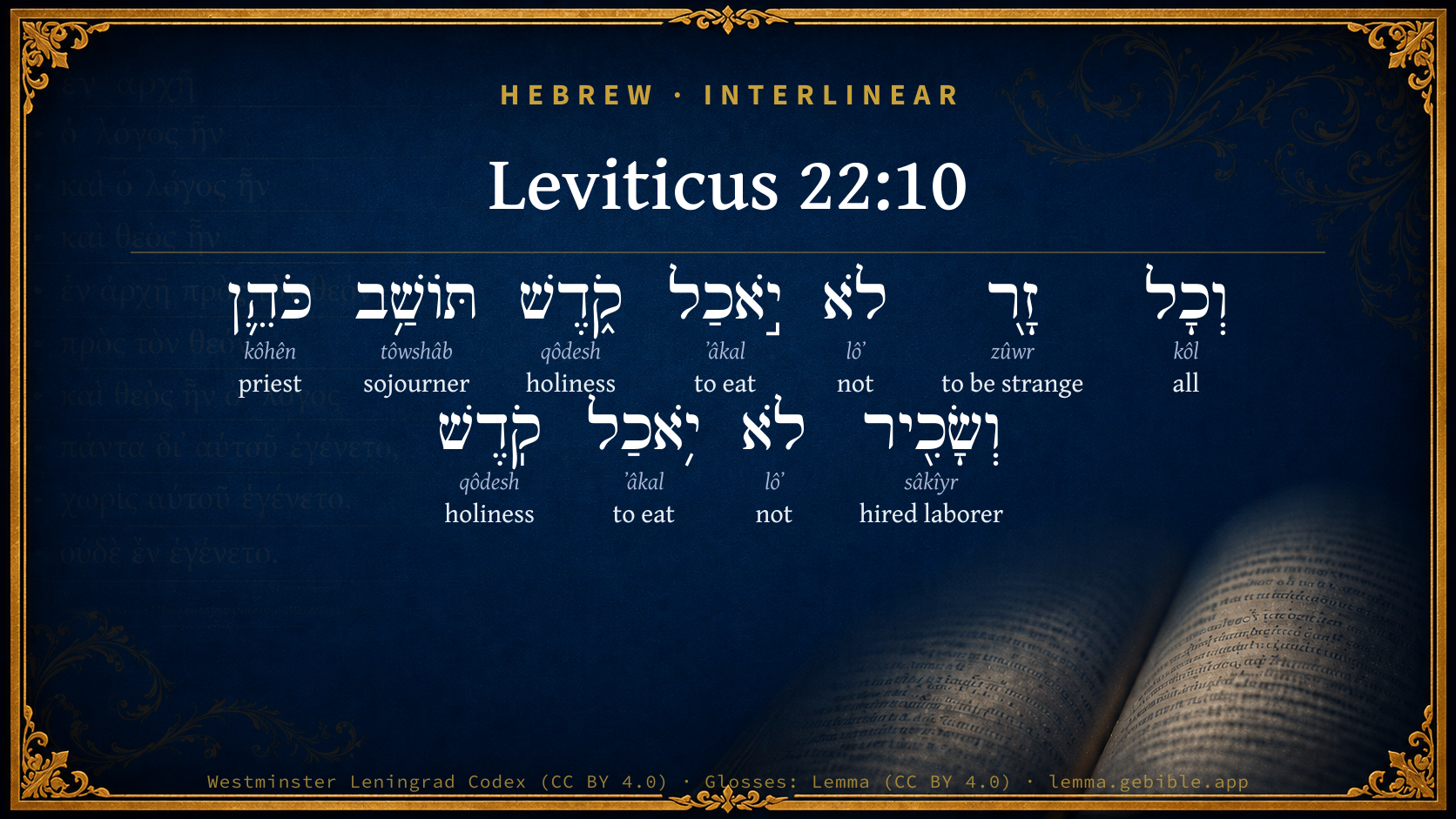
Hebrew (Westminster Leningrad Codex) Leviticus 22:10 appears in the Hebrew Old Testament. The text above is from the Westminster Leningrad Codex. Each word links to its Strong’s number, a concise gloss, and parsing drawn from the Open Scriptures Hebrew Bible morphology. Click any word for its full Brown-Driver-Briggs (BDB) entry.
Download image
Cite this verse

Leviticus 22:10 (World English Bible). Public Domain. Lemma interlinear Bible study tool, https://lemma.gebible.app/v/leviticus/22/10.

Show BibTeX & RIS
BibTeX
RIS
English Translation
"'No stranger shall eat of the holy thing: a foreigner living with the priests, or a hired servant, shall not eat of the holy thing.
World English Bible · Public Domain
Download a study sheet

One document with this verse’s original text, its word-by-word gloss line, the meaning frame, cross-references with their text, attributed commentary, and full source and license credits — printable, and it pastes into notes with its structure intact.

This verse Autodidact and up

Study sheet (.html) Plain text (.txt)

A passage Seminary Student

Up to 50 verses in one chapter. A passage sheet keeps up to 6 commentary sources and 12 cross-references per verse, in the order this page ranks them, and says so on the sheet whenever that leaves anything out. Ask for a single verse and you get the Autodidact verse sheet above.

Everything on this page stays free to read, with no account — the sheet is a download of what is already on screen, not access to it.

Want to remove ads? Support Godless Engineer
Compare translations 3

The same verse in 3 English versions, stacked beneath the original-language interlinear above. Click any original word for its lexicon entry.

Each is an independent rendering of the whole verse — the interlinear is not word-aligned to these translations.

Highlighted words mark where these versions differ — a whole-verse word diff, not a word-by-word alignment.

  • World English Bible Public Domain
    "'No stranger shall eat of the holy thing: a foreigner living with the priests, or a hired servant, shall not eat of the holy thing.
  • King James Version Public Domain
    There shall no stranger eat of the holy thing: a sojourner of the priest, or an hired servant, shall not eat of the holy thing.
  • unfoldingWord Literal Text CC BY-SA 4.0
    But any stranger may not eat the holy thing. A dweller of the priest or a hired may not eat the holy thing.

unfoldingWord Literal Text — © unfoldingWord, licensed CC BY-SA 4.0. Word-aligned USFM3 via Door43 (git.door43.org/unfoldingWord/en_ult).

Versions to compare (up to 4)

3 of 4 selected

Show all 18 translations

Every available English version of this verse, each an independent rendering of the whole verse.

  • World English Bible Public Domain
    "'No stranger shall eat of the holy thing: a foreigner living with the priests, or a hired servant, shall not eat of the holy thing.
  • Berean Standard Bible Public Domain
    No one outside a priest’s family may eat the sacred offering, nor may the guest of a priest or his hired hand eat it.
  • Majority Standard Bible Public Domain
    No one outside a priest’s family may eat the sacred offering, nor may the guest of a priest or his hired hand eat it.
  • King James Version Public Domain
    There shall no stranger eat of the holy thing: a sojourner of the priest, or an hired servant, shall not eat of the holy thing.
  • American Standard Version (1901) Public Domain
    There shall no stranger eat of the holy thing: a sojourner of the priest's, or a hired servant, shall not eat of the holy thing.
  • Revised Version (1885) Public Domain
    There shall no stranger eat of the holy thing: a sojourner of the priest’s, or an hired servant, shall not eat of the holy thing.
  • Geneva Bible (1599) Public Domain
    There shall no stranger also eate of the holie thing, neither the ghest of the Priest, neither shall an hired seruant eat of the holie thing:
  • Douay-Rheims (1899) Public Domain
    No stranger shall eat of the sanctified things: a sojourner of the priests, or a hired servant, shall not eat of them.
  • Young's Literal Translation Public Domain
    `And no stranger doth eat of the holy thing; a settler of a priest and an hireling doth not eat of the holy thing;
  • Literal Standard Version CC BY-SA 4.0
    And no stranger eats of the holy thing; a settler [with] a priest and a hired worker does not eat of the holy thing;
  • Unlocked Literal Bible CC BY-SA 4.0
    No one outside the priest's family, including guests of a priest or his hired servants, may eat anything that is holy.
  • unfoldingWord Literal Text CC BY-SA 4.0
    But any stranger may not eat the holy thing. A dweller of the priest or a hired may not eat the holy thing.
  • Darby Bible Public Domain
    And no stranger shall eat the holy thing; the sojourner with the priest, and the hired servant, shall not eat of the holy thing.
  • World Messianic Bible Public Domain
    “‘No stranger shall eat of the holy thing: a foreigner living with the priests, or a hired servant, shall not eat of the holy thing.
  • Webster's Bible Public Domain
    There shall no stranger eat of the holy thing: a sojourner of the priest, or a hired servant, shall not eat of the holy thing.
  • Free Bible Version CC BY-SA 4.0
    Anyone who isn't part of a priest's family is not allowed to eat the holy offerings. This also applies to a priest's guest or his paid worker.
  • Bible in Basic English Public Domain
    No outside person may take of the holy food, or one living as a guest in the priest's house, or a servant working for payment.
  • JPS Tanakh (1917) Public Domain
    There shall no common man eat of the holy thing; a tenant of a priest, or a hired servant, shall not eat of the holy thing.

Literal Standard Version (2020), Covenant Press — licensed CC BY-SA 4.0. Text via the HelloAO Bible API (eBible.org). Unlocked Literal Bible (unfoldingWord) — licensed CC BY-SA 4.0. Text via the HelloAO Bible API (eBible.org). unfoldingWord Literal Text — © unfoldingWord, licensed CC BY-SA 4.0. Word-aligned USFM3 via Door43 (git.door43.org/unfoldingWord/en_ult). Free Bible Version, Dr. Jonathan Gallagher — licensed CC BY-SA 4.0. Text via the HelloAO Bible API (eBible.org).

Word by word

More ways to search: Search by grammar → Find every occurrence → Compare this word →

Practice this passage: Drill this verse → Learn its vocabulary →

About this verse

These counts appear in no published source. They are computed here, from the morphology-tagged text and Lemma’s own curated glosses. What Lemma adds →

11
words
8
distinct lemmas
Pentateuch
section

Notable vocabulary

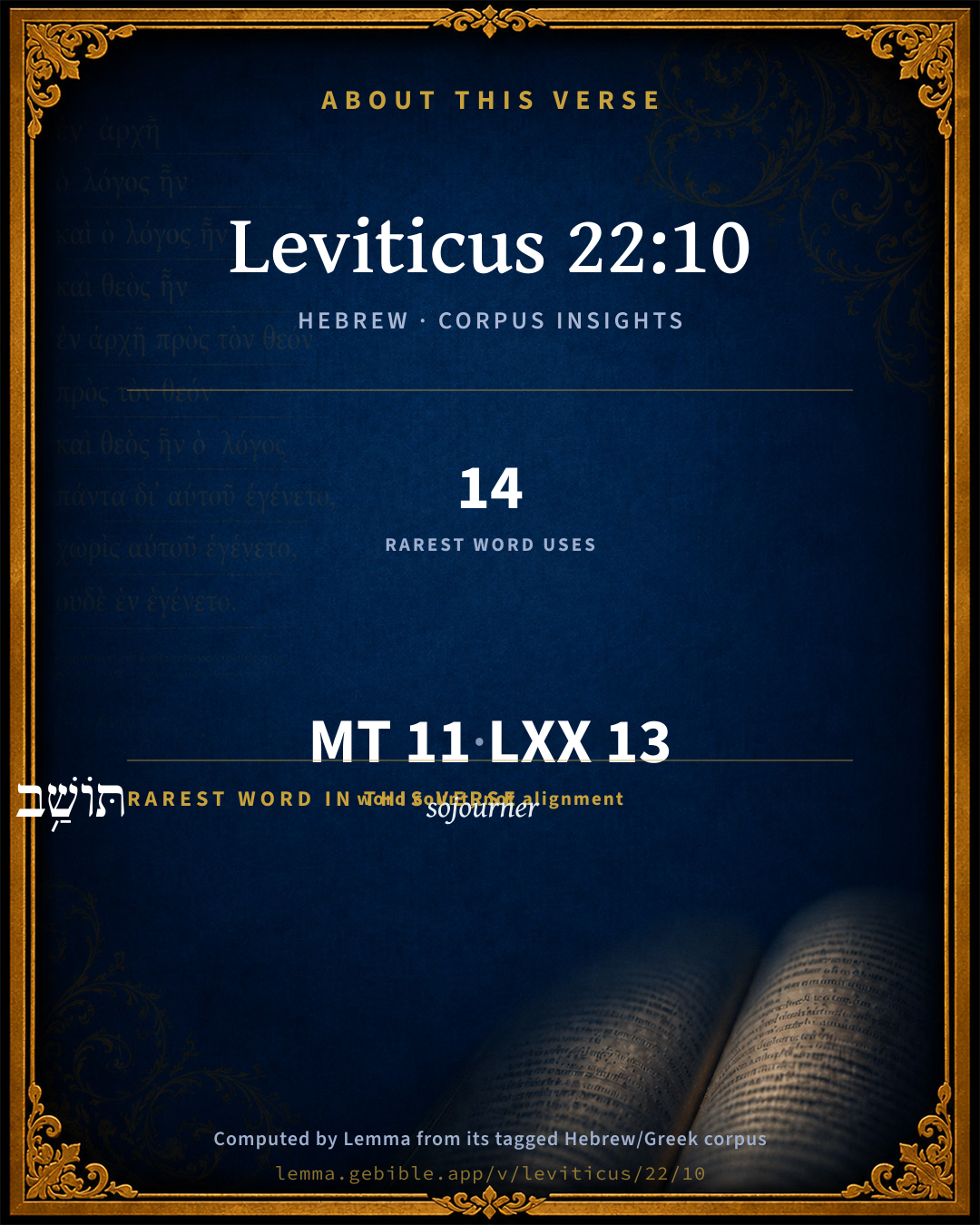
The rarest word here is תּוֹשַׁ֥ב sojourner H8453 — appearing just 14 times in the whole Hebrew Bible.

Shared distinctive vocabulary

תּוֹשַׁ֥ב sojourner H8453 occurs in 13 verses of the Hebrew Bible. Also found in:

Grammatical profile

  • 2 verbs
  • 6 nouns
  • 1 adjective
  • 2 particles

Verb forms

  • יֹ֣אכַל Qal · Imperfect
  • יֹ֥אכַל Qal · Imperfect

Repetition

Words recur within this verse — often emphatic in Hebrew:

  • יֹ֣אכַל to eat H398 ×2
  • קֹ֑דֶשׁ holiness H6944 ×2
  • לֹא not H3808 ×2

Hebrew & Septuagint length

In English translation the verse runs 25 words from the Hebrew and 23 from the Septuagint (LXX English) — closely comparable.

A rough comparison of the two English renderings, which tokenize alike — not a word-level alignment.

Word counts can differ between the Hebrew and the Greek without any difference in meaning — e.g. the Hebrew direct-object marker אֵת has no separate Greek word, and Greek often adds the article ὁ.

In the original languages it is 11 Hebrew tokens and 13 Greek tokens — but the two are counted differently (Hebrew bundles its prefixes and suffixes into one token; the Greek is in lemma form), so that isn’t a like-for-like length.

Cross-references

3

Topical passages linked to Leviticus 22:10 in the Treasury of Scripture Knowledge — connected by theme and wording, ordered by reader-vote popularity; previews shown in the World English Bible.

  • 1 Samuel 21:6 So the priest gave him holy [bread]; for there was no bread there but the show bread, that was taken from before Yahweh, to put hot bread in the day when it was taken away.
  • Matthew 12:4 how he entered into the house of God, and ate the show bread, which was not lawful for him to eat, neither for those who were with him, but only for the priests?
  • Exodus 29:33 They shall eat those things with which atonement was made, to consecrate and sanctify them: but a stranger shall not eat of it, because they are holy.

Cross-references courtesy of OpenBible.info (CC BY 4.0).

Hebrew and Greek witnesses Masoretic Hebrew ↔ Greek Septuagint

The same verse in the two great witnesses to the Old Testament, shown verse-for-verse.

These are two independent witnesses, not word-aligned to each other, and the Septuagint is shown in lemma (dictionary) form.

Hebrew Leviticus 22:10 Masoretic · Westminster Leningrad Codex

וְכָל זָ֖ר לֹא יֹ֣אכַל קֹ֑דֶשׁ תּוֹשַׁ֥ב כֹּהֵ֛ן וְשָׂכִ֖יר לֹא יֹ֥אכַל קֹֽדֶשׁ

"'No stranger shall eat of the holy thing: a foreigner living with the priests, or a hired servant, shall not eat of the holy thing.

World English Bible · Public Domain

Greek LXX Leviticus 22:10 Septuagint · lemma form

καί πᾶς ἀλλογενής οὐ ἐσθίω ἅγιος πάροικος ἱερεύς ἤ μισθωτός οὐ ἐσθίω ἅγιος

And no stranger shall eat the holy things: one that sojourns with a priest, or a hireling, shall not eat the holy things.

LXX2012 (modern English Septuagint) · Public Domain

Hebrew: Westminster Leningrad Codex (CC BY 4.0). Greek: Septuagint (public domain); English from LXX2012 (modern English Septuagint) (Public Domain). How the Septuagint differs from the Hebrew →

Targum (Aramaic paraphrase)

2

The Targum is the ancient Jewish Aramaic paraphrase of the Hebrew Scriptures — an interpretive translation, not the Hebrew text itself. Onkelos (literal) and Pseudo-Jonathan (expansive) render the Torah, and Jonathan the Prophets. Coverage is partial: where no permissively-licensed English translation exists for a verse, only the Aramaic is shown. This is verse-level text, not a word-by-word alignment to the Hebrew.

  1. Targum Onkelos Torah (Genesis–Deuteronomy)
    וְכָל חִלוֹנַי לָא יֵיכוּל קוּדְשָׁא תּוֹתָבָא דְכַהֲנָא וַאֲגִירָא לָא יֵיכוּל קוּדְשָׁא

    (no public-domain English translation for this verse)

    Targum Onkelos — Aramaic: “Onkelos Genesis” (public domain); “Onkelos Exodus” (public domain); “Onkelos Leviticus” (public domain); “Onkelos Numbers” (public domain); “Onkelos Deuteronomy” (public domain). English: “Sefaria Community Translation” (CC0 1.0 (public-domain dedication)); “J.W. Etheridge. The Targums of Onkelos and Jonathan Ben Uzziel on the Pentateuch. London: Longmans, Green, 1862” (public domain). Text via Sefaria.

  2. Targum Pseudo-Jonathan Torah (Genesis–Deuteronomy)
    וְכָל חִילוֹנֵי לָא יֵיכוּל קוּדְשָׁא בַּר יִשְרָאֵל דְהוּא תּוֹתָבָא דְכַהֲנָא וְאַגִירָא לָא יֵיכוּל קוּדְשָׁא

    No stranger or profane person shall eat of a consecrated thing, (neither) a son of Israel who is an inmate of the priest, nor any hireling, may eat of the hallowed thing.

    Targum Pseudo-Jonathan — Aramaic: “Targum Jonathan on Genesis” (public domain); “Targum Jonathan on Exodus” (public domain); “Targum Jonathan on Leviticus” (public domain); “Targum Jonathan on Numbers” (public domain); “Targum Jonathan on Deuteronomy” (public domain). English: “The Targum of Jonathan ben Uzziel, trans. J. W. Etheridge, London, 1862” (public domain). Text via Sefaria.

Commentary

Notes on Leviticus 22:10 from classic Christian and Jewish commentators (each source and its license shown beneath its notes). The classic Christian expositions comment on the surrounding passage and are grouped to its opening verse, so a note may address several verses; the Jewish commentaries on the Tanakh (Rashi and others) are per-verse, so they appear only where the commentator wrote on this verse.

Lemma curates 59 commentaries, every one of them public domain or Creative Commons licensed, each selected and text-cleaned for this edition rather than reprinted as found. About our sources →

Matthew Henry's Commentary

The holy things were to be eaten by the priests and their families. Now,

I. Here is a law that no stranger should eat of them, that is, no person whatsoever but the priests only, and those that pertained to them, Lev 22:10. The priests are charged with this care, not to profane the holy things by permitting the strangers to eat of them (Lev 22:15) or suffer them to bear the iniquity of trespass (Lev 22:16); that is, suffer them to bring guilt upon themselves, by meddling with that which they have no right to. Thus it is commonly understood. Note, We must not only be careful that we do not bear iniquity ourselves, but we must do what we can to prevent others bearing it. We must not only not suffer sin to lie upon our brother, but, if we can help it, we must not suffer it to come upon him. But perhaps there is another meaning of those words: the priests' eating the sin-offerings is said to signify their bearing the iniquity of the congregation, to make an atonement for them, Lev 10:17. Let not a stranger therefore eat of that holy thing particularly, and so pretend to bear the iniquity of trespass; for it is daring presumption for any to do that, but such as are appointed to do it. Those that set up other mediators besides Christ our priest, to bear the iniquity of trespass, sacrilegiously rob Christ of his honour, and invade his rights. When we warn people not to trust to their own righteousness, nor dare to appear before God in it, but to rely on Christ's righteousness only for peace and pardon, it is because we dare not suffer them to bear the iniquity of trespass, for we know it is too heavy for them.

II. Here is an explanation of the law, showing who were to be looked upon as belonging to the priest's family, and who not. 1. Sojourners and hired servants abode not in the house for ever; they were in the family, but not of it; and therefore they might not eat of the holy things (Lev 22:10): but the servant that was born in the house or bought with money, being a heirloom to the family, though a servant, yet might eat of the holy things, Lev 22:11. Note, Those only are entitled to the comforts of God's house who make it their rest for ever, and resolve to dwell in it all the days of their life. As for those who for a time only believe, to serve a present turn. They are looked upon but as sojourners and mercenaries, and have no part nor lot in the matter. 2. As to the children of the family, concerning the sons there could be no dispute, they were themselves priests, but concerning the daughters there was a distinction. While they continued in their father's house they might eat of the holy things; but, if they married such as were not priests, they lost their right (Lev 22:12), for now they were cut off from the family of the priests. Yet if a priest's daughter became a widow, and had no children in whom she might preserve a distinct family, and returned to her father's house again, being neither wife nor mother, she should again be looked upon as a daughter, and might eat of the holy things. If those whom Providence has made sorrowful widows, and who are dislodged from the rest they had in the house of a husband, yet find it again in a father's house, they have reason to be thankful to the widows' God, who does not leave them comfortless. 3. Here is a demand of restitution to be made by him that had no right to the holy things, and yet should eat of them unwittingly, Lev 22:14. If he did it presumptuously, and in contempt of the divine institution, he was liable to be cut off by the hand of God, and to be beaten by the magistrate; but, if he did it through weakness in inconsideration, he was to restore the value, adding a fifth part to it, besides which he was to bring an offering to atone for the trespass; see Lev 5:15, Lev 5:16.

III. This law might be dispensed with in a case of necessity, as it was when David and his men ate of the show-bread, Sa1 21:6. And our Saviour justifies them, and gives a reason for it, which furnishes us with a lasting rule in all such cases, that God will have mercy and not sacrifice, Mat 12:3, Mat 12:4, Mat 12:7. Rituals must give way to morals.

IV. It is an instruction to gospel ministers, who are stewards of the mysteries of God, not to admit all, without distinction, to eat of the holy things, but to take out the precious from the vile. Those that are scandalously ignorant or profane are strangers and aliens to the family of the Lord's priests; and it is not meet to take the children's bread and to cast it to such. Holy things are for holy persons, for those who are holy, at least, in profession, Mat 7:6.

Matthew Henry's Commentary on the Whole Bible (1708–1710) — public domain (CC PDM 1.0). Text via the HelloAO Bible API.

Jamieson, Fausset & Brown

Robert Jamieson, A. R. Fausset & David Brown

WHO OF THE PRIESTS' HOUSE MAY EAT OF THEM. (Lev 22:10-16)

There shall no stranger eat the holy thing--The portion of the sacrifices assigned for the support of the officiating priests was restricted to the exclusive use of his own family. A temporary guest or a hired servant was not at liberty to eat of them; but an exception was made in favor of a bought or homeborn slave, because such was a stated member of his household. On the same principle, his own daughter, who married a husband not a priest, could not eat of them. However, if a widow and childless, she was reinstated in the privileges of her father's house as before her marriage. But if she had become a mother, as her children had no right to the privileges of the priesthood, she was under a necessity of finding support for them elsewhere than under her father's roof.

Jamieson, Fausset & Brown — Commentary Critical and Explanatory on the Whole Bible (1871) — public domain (CC PDM 1.0). Text via the HelloAO Bible API.

Adam Clarke's Commentary

Verse 10. There shall no stranger eat of the holy thing] For the meaning of the word stranger, see the note on "Ex 12:43". The Jews suppose that stranger here means one who has had his ear pierced, (see the note on "Ex 21:6",) and that sojourner means a servant who is to go free on the Sabbatical year. Neither of these was permitted to eat of the holy things, because they were not properly members of the priest's family, and might go out and defile themselves even with the abominations of the heathen; but the servant or slave that was bought with money, Le 22:10, might eat of these things, because he was the property of the master for ever.

We see that it was lawful, under the Mosaic economy, to have slaves under certain restrictions; but these were taken from among the heathen, and instructed in the true religion: hence we find, as in the above case, that they were reckoned as a part of the priest's own family, and treated as such. They certainly had privileges which did not extend either to sojourners or to hired servants; therefore their situation was incomparably better than the situation of the slaves under different European governments, of whose souls their pitiless possessors in general take no care, while they themselves venture to profess the Christian religion, and quote the Mosaic law in vindication of their system of slavery. How preposterous is such conduct! and how intolerable!

Adam Clarke's Commentary on the Bible (1810–1826) — public domain. Text from a community e-Sword/MySword module.

Trapp's Complete Commentary

John Trapp

Lev 22:10 There shall no stranger eat [of] the holy thing: a sojourner of the priest, or an hired servant, shall not eat [of] the holy thing.

Ver. 10. There shall no stranger.] The equity of all this was, that ministers should have a comfortable subsistence for them and theirs; and that the things that are appointed to that purpose should not be converted to other uses. {1Co 9:13} It is certainly a sad complaint that Luther {a} makes: Nisi superisset spolium Aegypti quod rapuimus Papae, omnibus ministris verbi fame pereundum esset, &c. Were it not for such spoils of Egypt as we have won from the Pope, God’s ministers might starve and perish. And if ever it come to that, that they must be maintained by the people’s benevolence, a miserable maintenance they are like to have of it. That little that we have now, diripitur a magistratu, is got from us by the great ones who rob our churches and schools, as if they meant to make an end of us with hard hunger. Thus he. See Hag 2:14. All the water in Jordan, and the ceremonies in Leviticus, cannot cleanse a man so long as the polluted thing remains in his hand.

{a} Luther, in Gen, xlvii.

John Trapp, A Commentary or Exposition upon All the Books of the Old and New Testament (1647–1656) — public domain. Text from a community e-Sword module.

Joseph Benson's Commentary

Lev 22:10. There shall no stranger eat of the holy thing — By holy thing here is meant, that portion of the sacrifices which belonged to the priests. And by stranger is not meant one of another nation, in distinction from a native Jew, but one who was not of the priest’s own family, whether Jew, or Gentile proselyte. A sojourner — One that came to his house, and abode there for a season, and ate at his table, was not to eat of it. There is one exception, however, to this rule, in the next verse.

Joseph Benson's Commentary on the Old and New Testaments (1811–1818) — public domain. Text from a community e-Sword module.

Geneva Bible (1599)

Geneva Bible translators

Which is not of the tribe of Levi.

Some read, the servant which had his ear bored, and would not go free, Exod. 21:6.

Geneva Bible (1599) marginal notes — public domain. Text via Bolls.life.

Ellicott's Commentary for English Readers

(10) There shall no stranger eat of the holy thing.—By “stranger” here is meant a non-Aaronite who was a stranger to the priestly family, though he was an Israelite, or even a Levite. The holy things are the peace offerings. (See Lev_7:30.)

A sojourner of the priest.—This, during the second Temple, was a Hebrew servant whose ear had been pierced, and who thus became his master’s property till the year of jubile. (See Exo_21:6.)

Or an hired servant.—That is, a Hebrew servant who is hired for several years, and who goes out free after six years. (See Exo_21:2.) Neither of them was the property of the priest, though his labour and services belonged to him. As these Hebrew servants could not be bought with money like a heathen slave, they were treated like strangers, or non-Aaronites, and hence were not permitted to partake of the holy food.

A Bible Commentary for English Readers, edited by Charles John Ellicott (1878–1897) — public domain. Text from a community e-Sword module.

The Cambridge Bible for Schools and Colleges

gen. ed. J. J. S. Perowne

10. The ‘sojourner,’ and the hired servant, were not considered as members of the family; not so the cases mentioned in Lev_22:11.

The Cambridge Bible for Schools and Colleges (gen. ed. J. J. S. Perowne; Cambridge University Press, 1878–1918) — public domain. Text from a community e-Sword module.

John Gill's Exposition

There shall no stranger eat of the holy thing,.... Any one of the holy things, as the heave shoulder, wave breast, &c. by a "stranger" is not meant one of another nation; though indeed all such were called strangers, and might not eat of these things, Eph 2:12; but one that was not of the family of a priest, though he might be an Israelite, and even a Levite; anyone that was not of the seed of Aaron, as Aben Ezra; any common man or laic, as the Targums of Onkelos and Jonathan, excepting those after mentioned:

a sojourner of the priests, or an hired servant, shall not eat of the holy thing: by the former is not intended an Heathen, a proselyte of the gate, one that has renounced idolatry, and so permitted to live among the Israelites, of it uncircumcised, who is often understood by one that sojourneth in the gate, but here an Israelitish sojourner; and so the Targum of Jonathan expressly has it,"a son of an Israelite, who is a sojourner of the priests;''not that is a guest for a short time, or a boarder with him; for if he may not eat of the holy things, what must he live on while with him? but one that dwells in some part of his house: and by the latter is meant anyone that is hired by the day, or week, or year, and when the time is expired is at his liberty; though the Jewish writers commonly, and particularly Jarchi, interpret the sojourner of the servant that has his ear bored, and is bought with money, until the year of jubilee, and serves for ever; and the hireling of one that is purchased for years, and goes out in the sixth year; but the above objection will lie against these.

John Gill's Exposition of the Whole Bible (1746–1763) — public domain (CC PDM 1.0). Text via the HelloAO Bible API.

Albert Barnes' Notes on the Bible

Stranger - One of another family. See Exo 29:33 note.

Albert Barnes' Notes on the Bible (1834–1885) — public domain. Text from a community e-Sword/MySword module.

Haydock's Catholic Bible Commentary

Sojourner. "Guest," or friend, Syriac. None but priests could taste this meat, except they were going to remain in the family for ever. Hence servants and slaves of the Jewish nation, who would one day regain their liberty, are excluded.

George Leo Haydock (1774–1849), Haydock's Catholic Family Bible and Commentary, 1859 edition — public domain. Excludes Psalms (Douay-Rheims chapter numbering differs from Protestant) and Deuterocanonical books (Catholic canon only).

Matthew Poole's English Annotations

No stranger, i.e. of a strange family, who is not a priest, as Lev 22:12; compare Mat 12:4. But there is an exception to this rule, Lev 22:11.

A sojourner; one that comes to his house and abides there for a season, and eats at his table.

Of the holy things; of those parts of the offerings which fell to the priest’s share, as the breast and shoulder.

Matthew Poole's English Annotations on the Holy Bible (1683–1685) — public domain. Text from a community e-Sword/MySword module.

Whedon's Commentary on the Bible

Daniel D. Whedon

10. No stranger — The non-Levite Hebrew is included in this term. See Num_1:51, note.

A sojourner of the priest — This excludes the foreigner temporarily residing with the priest and his hired servant of another nation.

Daniel D. Whedon (gen. ed.), Commentary on the Old and New Testaments (1874–1909) — public domain. Text from a community e-Sword module.

The Pulpit Commentary

Vers. 10-13. The previous paragraph having forbidden the priests to eat of the holy things while in a state of ceremonial uncleanness, naturally leads to the question, who has the right of eating them? The answer is, the priest"s family. The members of the priest"s family here specified are those only about whom any question might have arisen, namely, the slaves, who, as bring incorporated into the priest"s household, have a right of eating of the priestly food not enjoyed by lodgers in his house or by servants hired with his money; and married daughters who have returned to their father"s roof in consequence of the death of their husband, or of being divorced, without any children of their own. Under these circumstances, it is ruled that they become once more a part of the priest"s family, and able to exercise the privileges of that position. The priest"s wife and sons and unmarried daughters are not here mentioned, as no question arose about them.

Vers. 10-15. The guilt of profanation.

That which had been offered in sacrifice was "holy unto the Lord;" these were "holy things" (verse 10); "I the Lord do sanctify them" (verse 16). They might only be partaken of by the priests and their families. Hence we have here a precise limitation of membership of the family; it included the returned daughter and the permanent servant, but did not include the hireling or the visitor, etc. We may note, in passing,

(1) the regard which God paid (and still pays) to the sanctity of family life, and our duty to guard it;

(2) the fact, on the other hand, that mere blood relationship does not suffice to secure the favour of God; witness Nadab and Abihu. The son of the holiest minister of Christ may be a servant of the evil one, and an enemy of God. But the lesson of the text is

I THAT GOD WOULD HAVE US SEPARATE SOME THINGS FROM OTHERS WHICH WE MUST TREAT AS SACRED. "I the Lord do sanctify them" (verse 16). That which is closely connected with himself is particularly "holy, his Name, his truth, his worship; also our own spiritual and immortal nature; the world which is to come, etc.

II THAT WE ARE UNDER SOME TEMPTATION TO DISREGARD HIS HOLY WILL. Forgetfulness, the spirit of levity and untimely humour, the contagiousness of human example, that tendency towards the formal and mechanical which belongs to our frail humanity, these things will account for it. The forms which this irreverence or profanation takes are manifold:

(1) taking in vain the holy Name of God, our Father, Saviour, Sanctifier;

(2) misuse of scriptural words those especially which are of peculiar sacredness;

(3) irreverence in prayer or praise;

(4) the utterance of Divine truth by unhallowed, unappreciative lips;

(5) the partaking of the sacramental elements by those who are unreconciled to God;

(6) misappropriation of substance which has been dedicated to the service of Christ.

III THAT MINISTERS OF CHRIST SHOULD BE SPECIALLY ON THEIR GUARD AGAINST THIS COMMON AND OFFENSIVE SIN. There are two reasons why those who minister in holy things should "watch and pray" against the commission of this wrong-doing.

1. They are under special temptation to commit it. Their very professional familiarity with the truth and service of God is likely to beget irreverence, utterance without feeling, action without inspiration.

2. Their example is more influential. Irreverence on the part of the minister is certain, in time if not immediately, to tell on the people. It will be communicated to them; or, at the very least, it will seriously lessen and lower the impression which would otherwise be made on their hearts and lives. C.

The Pulpit Commentary (1880–1919), ed. H.D.M. Spence-Jones & Joseph S. Exell — public domain. Text from a community e-Sword module.

John Wesley's Explanatory Notes

No stranger - Of a strange family, who is not a priest; but there is an exception to this rule, ver. 11. A sojourner - One that comes to his house and abides there for a season, and eats at his table.

John Wesley, Explanatory Notes Upon the Whole Bible (1754–1765) — public domain. Text via the GEBible commentary corpus.

unfoldingWord translationNotes

Door43 World Missions Community

General Information:

Yahweh continues telling Moses what Aaron and his sons must do.

translationWords

priest

family

servant

holy

Yahweh

house

unfoldingWord translationNotes — © Distant Shores Media and the Door43 World Missions Community, licensed CC BY-SA 4.0. Source: git.door43.org/Door43/en_tn.

Rashi

Rabbi Shlomo Yitzchaki (Rashi)

לא יאכל קדש [THERE SHALL] NO [LAYMAN] EAT OF THE HOLY THINGS — Scripture is speaking here of the heave-offering (i. e., the word קדש means here תרומה only, and not any holy food) because the whole section (cf. Rashi on v. 7 and 9) is speaking of this.

תושב כהן ושכיר A SOJOURNER WITH THE PRIEST OR A HIRED SERVANT [SHALL NOT EAT OF THE HOLY THINGS] — These words mean: the תושב of a כהן and his שכיר (not a כהן who is a תושב or a שכיר); on this account this word תושב here is punctuated with a Patach, because it is in the construct state. What is a תושב? One (a Hebrew servant) whose ear has been pierced (cf. Exodus 21:6), who thereby becomes his (the master’s) possession until the Jubilee year. And what is a שכיר? One (a Hebrew servant) who has been acquired as his possession for a limited number of years only — who goes free at the end of six years (cf. Exodus 21:2). Scripture intends to teach you here that it is not his body (that of the תושב or the שכיר), but only his labour for a term of years that has been acquired by his master that he should become entitled to eat of his heave-offering (as is the case with the קנין כספו, with “a person obtained as a property with money”, mentioned in the next verse) (Sifra, Emor, Section 5 17; Yevamot 70b).

Rashi on the Tanakh — English translations: “The Judaica Press complete Tanach with Rashi, translated by A. J. Rosenberg” (CC BY 4.0); “Pentateuch with Rashi's commentary by M. Rosenbaum and A.M. Silbermann, 1929-1934” (public domain); “The Metsudah Tanach series, Lakewood, N.J” (CC BY 4.0); and “The Book of Joshua, Metsudah Publications, 1997” (CC BY 4.0). Text via Sefaria.

Lesson kit

Teaching starters — assembled from the data on this page, not authored interpretation. Every prompt links to the verse data it draws on. Edit before teaching.

Leviticus, in the Pentateuch, opens this verse with 11 words (8 distinct Hebrew lemmas). Its most distinctive word is tôwshâb (“sojourner”). A historical commentator’s framing appears above. Read the whole chapter for the surrounding context.

Discussion questions

  1. The word tôwshâb carries the sense “sojourner.” How does it shape the verse?
  2. How does Genesis 23:4, which shares the word «sojourner», read alongside this verse?
  3. What does the repetition of “to eat” (2× in this one verse) do in this verse?
  4. These translations render this verse differently; the difference is in the English rendering, not the original. What questions does that raise?
  5. «יֹ֣אכַל» is a Qal Imperfect verb. How does that grammatical form shape the action described?
  6. Compare how Matthew Henry's Commentary and Jamieson, Fausset & Brown read this verse. Where do they agree or differ?

Things to notice

Reading settings

Reading text

Shown beneath each verse's original-language words.

Old Testament
Old Testament edition

Read the OT as the Masoretic Hebrew (MT) or the Greek Septuagint (LXX).

English shown for the Greek Septuagint (in the Hebrew ↔ Greek comparison).

Comparing translations? Open the Compare panel on any verse page to stack up to four side by side.