
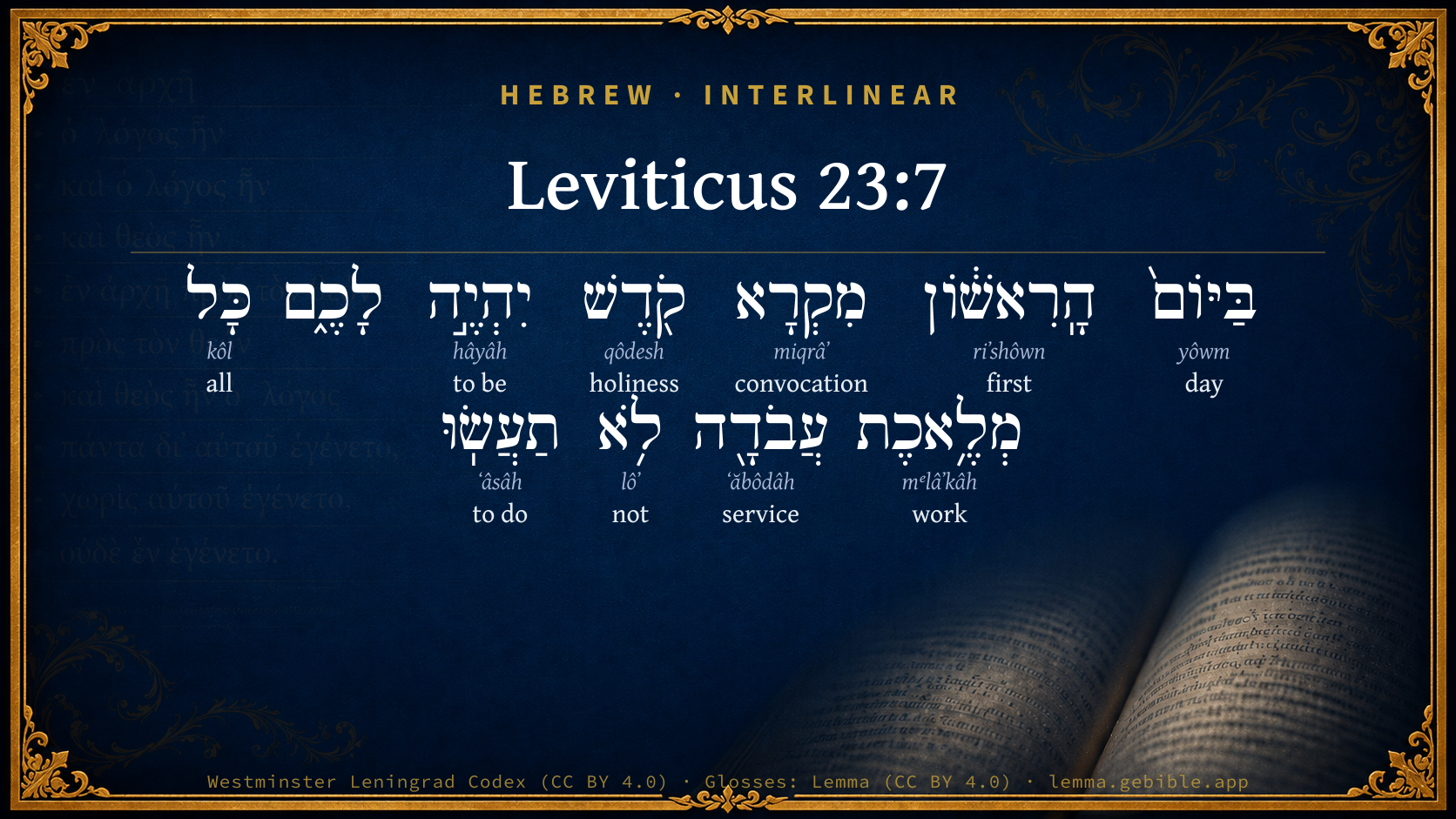
Leviticus 23:7

Hebrew (Westminster Leningrad Codex) Leviticus 23:7 appears in the Hebrew Old Testament. The text above is from the Westminster Leningrad Codex. Each word links to its Strong’s number, a concise gloss, and parsing drawn from the Open Scriptures Hebrew Bible morphology. Click any word for its full Brown-Driver-Briggs (BDB) entry.
Download image
Cite this verse

Leviticus 23:7 (World English Bible). Public Domain. Lemma interlinear Bible study tool, https://lemma.gebible.app/v/leviticus/23/7.

Show BibTeX & RIS
BibTeX
RIS
English Translation
In the first day you shall have a holy convocation. You shall do no regular work.
World English Bible · Public Domain
Download a study sheet

One document with this verse’s original text, its word-by-word gloss line, the meaning frame, cross-references with their text, attributed commentary, and full source and license credits — printable, and it pastes into notes with its structure intact.

This verse Autodidact and up

Study sheet (.html) Plain text (.txt)

A passage Seminary Student

Up to 50 verses in one chapter. A passage sheet keeps up to 6 commentary sources and 12 cross-references per verse, in the order this page ranks them, and says so on the sheet whenever that leaves anything out. Ask for a single verse and you get the Autodidact verse sheet above.

Everything on this page stays free to read, with no account — the sheet is a download of what is already on screen, not access to it.

Want to remove ads? Support Godless Engineer
Compare translations 3

The same verse in 3 English versions, stacked beneath the original-language interlinear above. Click any original word for its lexicon entry.

Each is an independent rendering of the whole verse — the interlinear is not word-aligned to these translations.

Highlighted words mark where these versions differ — a whole-verse word diff, not a word-by-word alignment.

  • World English Bible Public Domain
    In the first day you shall have a holy convocation. You shall do no regular work.
  • King James Version Public Domain
    In the first day ye shall have an holy convocation: ye shall do no servile work therein.
  • unfoldingWord Literal Text CC BY-SA 4.0
    On the first day there shall be an assembly of holiness for you. You shall not do any work of labor.

unfoldingWord Literal Text — © unfoldingWord, licensed CC BY-SA 4.0. Word-aligned USFM3 via Door43 (git.door43.org/unfoldingWord/en_ult).

Versions to compare (up to 4)

3 of 4 selected

Show all 18 translations

Every available English version of this verse, each an independent rendering of the whole verse.

  • World English Bible Public Domain
    In the first day you shall have a holy convocation. You shall do no regular work.
  • Berean Standard Bible Public Domain
    On the first day you are to hold a sacred assembly; you are not to do any regular work.
  • Majority Standard Bible Public Domain
    On the first day you are to hold a sacred assembly; you are not to do any regular work.
  • King James Version Public Domain
    In the first day ye shall have an holy convocation: ye shall do no servile work therein.
  • American Standard Version (1901) Public Domain
    In the first day ye shall have a holy convocation: ye shall do no servile work.
  • Revised Version (1885) Public Domain
    In the first day ye shall have an holy convocation: ye shall do no servile work.
  • Geneva Bible (1599) Public Domain
    In the first day yee shall haue an holy conuocation: ye shall do no seruile worke therein.
  • Douay-Rheims (1899) Public Domain
    The first day shall be most solemn unto you, and holy: you shall do no servile work therein:
  • Young's Literal Translation Public Domain
    on the first day ye have a holy convocation, ye do no servile work;
  • Literal Standard Version CC BY-SA 4.0
    on the first day you have a holy convocation, you do no servile work;
  • Unlocked Literal Bible CC BY-SA 4.0
    The first day you must set apart to gather together; you will not do any of your regular work.
  • unfoldingWord Literal Text CC BY-SA 4.0
    On the first day there shall be an assembly of holiness for you. You shall not do any work of labor.
  • Darby Bible Public Domain
    On the first day ye shall have a holy convocation: no manner of servile work shall ye do.
  • World Messianic Bible Public Domain
    In the first day you shall have a holy convocation. You shall do no regular work.
  • Webster's Bible Public Domain
    In the first day ye shall have a holy convocation: ye shall do no servile work in it.
  • Free Bible Version CC BY-SA 4.0
    On the first day you are to hold a holy meeting. You must not do any of your usual work.
  • Bible in Basic English Public Domain
    On the first day you will have a holy meeting; you may do no sort of field-work.
  • JPS Tanakh (1917) Public Domain
    In the first day ye shall have a holy convocation; ye shall do no manner of servile work.

Literal Standard Version (2020), Covenant Press — licensed CC BY-SA 4.0. Text via the HelloAO Bible API (eBible.org). Unlocked Literal Bible (unfoldingWord) — licensed CC BY-SA 4.0. Text via the HelloAO Bible API (eBible.org). unfoldingWord Literal Text — © unfoldingWord, licensed CC BY-SA 4.0. Word-aligned USFM3 via Door43 (git.door43.org/unfoldingWord/en_ult). Free Bible Version, Dr. Jonathan Gallagher — licensed CC BY-SA 4.0. Text via the HelloAO Bible API (eBible.org).

Word by word

More ways to search: Search by grammar → Find every occurrence → Compare this word →

Practice this passage: Drill this verse → Learn its vocabulary →

מִקְרָא
miqrâʼ
H4744
“convocation of”
Noun, Common, Masculine, Singular, Construct
Part of Speech
Noun
Type
Common
Gender
Masculine
Number
Singular
State
Construct
Full BDB Definition

Origin: from H7121

TWOT: 2063d

convocation, convoking, reading, a calling together - convocation, sacred assembly - convoking - reading
  1. בַּיּוֹם֙ yôwm H3117 “in/at the · day” Preposition, Determined + Noun, Common, Masculine, Singular, Absolute
  2. הָֽרִאשׁ֔וֹן riʼshôwn H7223 “the · first” Particle, Definite Article + Adjective, Adjective, Masculine, Singular, Absolute
  3. קֹ֖דֶשׁ qôdesh H6944 “holiness” Noun, Common, Masculine, Singular, Absolute
  4. יִהְיֶ֣ה hâyâh H1961 “to be” Verb, Qal, Imperfect, 3rd Person, Masculine, Singular
  5. כָּל kôl H3605 “all of” Noun, Common, Masculine, Singular, Construct
  6. מְלֶ֥אכֶת mᵉlâʼkâh H4399 “work of” Noun, Common, Feminine, Singular, Construct
  7. עֲבֹדָ֖ה ʻăbôdâh H5656 “service” Noun, Common, Feminine, Singular, Absolute
  8. לֹ֥א lôʼ H3808 “not” Particle, Negative
  9. תַעֲשֽׂוּ ʻâsâh H6213 “to do” Verb, Qal, Imperfect, 2nd Person, Masculine, Plural

About this verse

These counts appear in no published source. They are computed here, from the morphology-tagged text and Lemma’s own curated glosses. What Lemma adds →

11
words
10
distinct lemmas
Pentateuch
section

Notable vocabulary

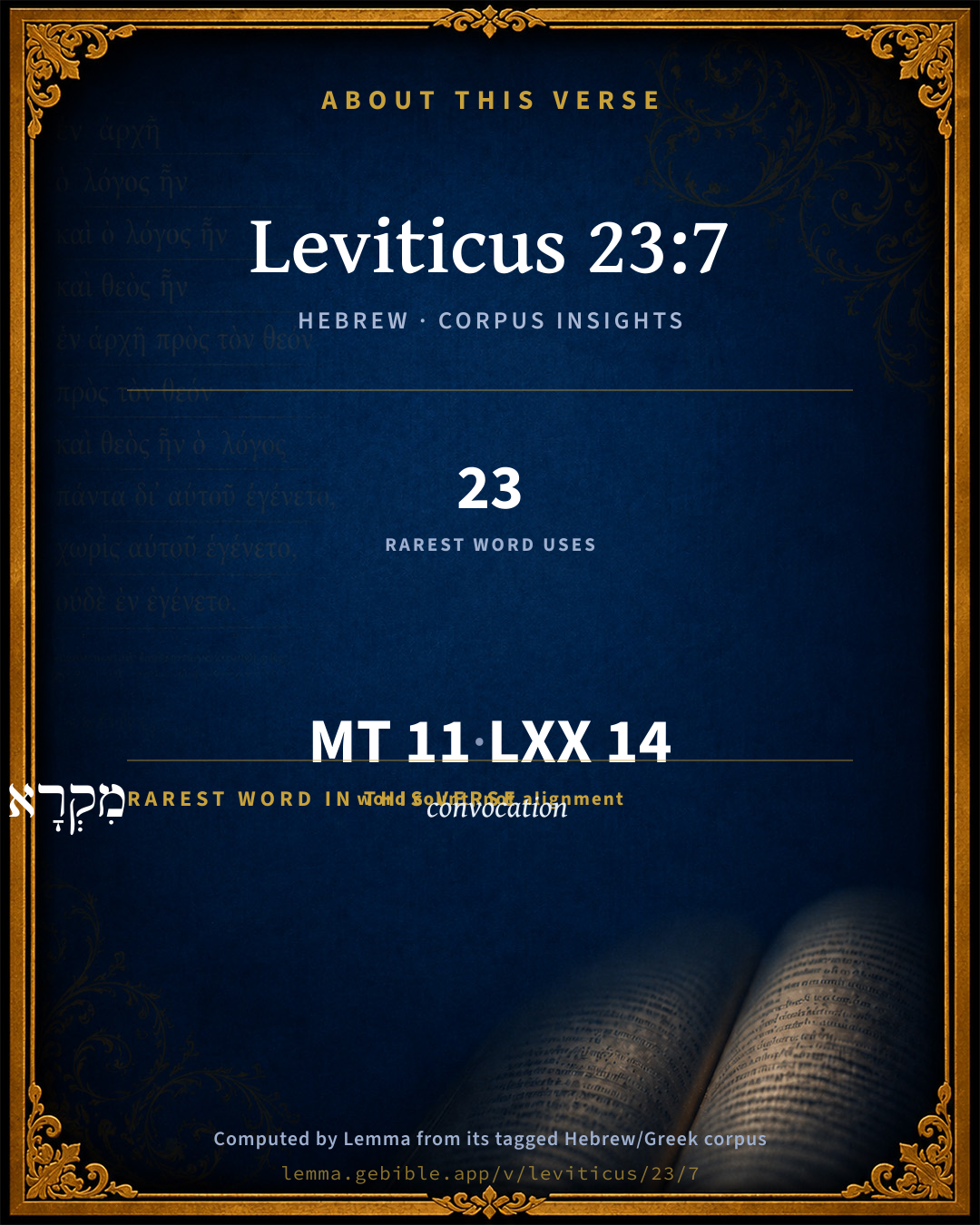
The rarest word here is מִקְרָא convocation H4744 — appearing just 23 times in the whole Hebrew Bible.

Shared distinctive vocabulary

מִקְרָא convocation H4744 occurs in 22 verses of the Hebrew Bible. Also found in:

Grammatical profile

  • 2 verbs
  • 6 nouns
  • 1 adjective
  • 1 preposition
  • 1 particle

Verb forms

  • יִהְיֶ֣ה Qal · Imperfect
  • תַעֲשֽׂוּ Qal · Imperfect

Hebrew & Septuagint length

In English translation the verse runs 16 words from the Hebrew and 17 from the Septuagint (LXX English) — closely comparable.

A rough comparison of the two English renderings, which tokenize alike — not a word-level alignment.

Word counts can differ between the Hebrew and the Greek without any difference in meaning — e.g. the Hebrew direct-object marker אֵת has no separate Greek word, and Greek often adds the article ὁ.

In the original languages it is 11 Hebrew tokens and 14 Greek tokens — but the two are counted differently (Hebrew bundles its prefixes and suffixes into one token; the Greek is in lemma form), so that isn’t a like-for-like length.

Cross-references

5

Topical passages linked to Leviticus 23:7 in the Treasury of Scripture Knowledge — connected by theme and wording, ordered by reader-vote popularity; previews shown in the World English Bible.

  • Leviticus 23:8 But you shall offer an offering made by fire to Yahweh seven days. In the seventh day is a holy convocation: you shall do no regular work.'"
  • Numbers 28:18–25 In the first day shall be a holy convocation: you shall do no servile work;
  • Leviticus 23:25 You shall do no regular work; and you shall offer an offering made by fire to Yahweh.'"
  • Leviticus 23:35–36 On the first day shall be a holy convocation: you shall do no regular work.
  • Leviticus 23:21 You shall make proclamation on the same day: there shall be a holy convocation to you; you shall do no regular work. This is a statute forever in all your dwellings throughout your generations.

Cross-references courtesy of OpenBible.info (CC BY 4.0).

Hebrew and Greek witnesses Masoretic Hebrew ↔ Greek Septuagint

The same verse in the two great witnesses to the Old Testament, shown verse-for-verse.

These are two independent witnesses, not word-aligned to each other, and the Septuagint is shown in lemma (dictionary) form.

Hebrew Leviticus 23:7 Masoretic · Westminster Leningrad Codex

בַּיּוֹם֙ הָֽרִאשׁ֔וֹן מִקְרָא קֹ֖דֶשׁ יִהְיֶ֣ה לָכֶ֑ם כָּל מְלֶ֥אכֶת עֲבֹדָ֖ה לֹ֥א תַעֲשֽׂוּ

In the first day you shall have a holy convocation. You shall do no regular work.

World English Bible · Public Domain

Greek LXX Leviticus 23:7 Septuagint · lemma form

καί ὁ ἡμέρα ὁ πρῶτος κλητός ἅγιος εἰμί σύ πᾶς ἔργον λατρευτός οὐ ποιέω

And the first day shall be a holy convocation to you: you⌃ shall do no servile work.

LXX2012 (modern English Septuagint) · Public Domain

Hebrew: Westminster Leningrad Codex (CC BY 4.0). Greek: Septuagint (public domain); English from LXX2012 (modern English Septuagint) (Public Domain). How the Septuagint differs from the Hebrew →

Targum (Aramaic paraphrase)

2

The Targum is the ancient Jewish Aramaic paraphrase of the Hebrew Scriptures — an interpretive translation, not the Hebrew text itself. Onkelos (literal) and Pseudo-Jonathan (expansive) render the Torah, and Jonathan the Prophets. Coverage is partial: where no permissively-licensed English translation exists for a verse, only the Aramaic is shown. This is verse-level text, not a word-by-word alignment to the Hebrew.

  1. Targum Onkelos Torah (Genesis–Deuteronomy)
    בְּיוֹמָא קַדְמָאָה מְעָרַע קַדִישׁ יְהֵי לְכוֹן כָּל עִבִידַת פָּלְחַן לָא תַעֲבְּדוּן

    (no public-domain English translation for this verse)

    Targum Onkelos — Aramaic: “Onkelos Genesis” (public domain); “Onkelos Exodus” (public domain); “Onkelos Leviticus” (public domain); “Onkelos Numbers” (public domain); “Onkelos Deuteronomy” (public domain). English: “Sefaria Community Translation” (CC0 1.0 (public-domain dedication)); “J.W. Etheridge. The Targums of Onkelos and Jonathan Ben Uzziel on the Pentateuch. London: Longmans, Green, 1862” (public domain). Text via Sefaria.

  2. Targum Pseudo-Jonathan Torah (Genesis–Deuteronomy)
    בְּיוֹמָא קַדְמָאָה דְחַגָא מְאַרַע קַדִישׁ יְהֵי לְכוֹן כָּל עִיבִידַת פּוּלְחָנָא לָא תַעַבְדוּן

    On the first day of the feast a holy convocation shall be to you; ye shall do no work of labour,

    Targum Pseudo-Jonathan — Aramaic: “Targum Jonathan on Genesis” (public domain); “Targum Jonathan on Exodus” (public domain); “Targum Jonathan on Leviticus” (public domain); “Targum Jonathan on Numbers” (public domain); “Targum Jonathan on Deuteronomy” (public domain). English: “The Targum of Jonathan ben Uzziel, trans. J. W. Etheridge, London, 1862” (public domain). Text via Sefaria.

Commentary

Notes on Leviticus 23:7 from classic Christian and Jewish commentators (each source and its license shown beneath its notes). The classic Christian expositions comment on the surrounding passage and are grouped to its opening verse, so a note may address several verses; the Jewish commentaries on the Tanakh (Rashi and others) are per-verse, so they appear only where the commentator wrote on this verse.

Lemma curates 59 commentaries, every one of them public domain or Creative Commons licensed, each selected and text-cleaned for this edition rather than reprinted as found. About our sources →

Trapp's Complete Commentary

John Trapp

Lev 23:7 In the first day ye shall have an holy convocation: ye shall do no servile work therein.

Ver. 7. No servile work.] But that about victuals. {Exo 12:26}

John Trapp, A Commentary or Exposition upon All the Books of the Old and New Testament (1647–1656) — public domain. Text from a community e-Sword module.

Geneva Bible (1599)

Geneva Bible translators

Or, bodily labor, save about that which one must eat, Exod. 22:16.

Geneva Bible (1599) marginal notes — public domain. Text via Bolls.life.

Ellicott's Commentary for English Readers

(7) In the first day.—That is, the first of the seven days, or the fifteenth of the month Nisan. (See Exo_12:16.)

Ye shall do no servile work therein.—Servile work was defined during the second Temple to consist in building, pulling down edifices, weaving, reaping, threshing, winnowing, grinding, &c, whilst needful work which was allowed was killing beasts, kneading dough, baking bread, boiling, roasting, &e. For violating this law the offender was not to be stoned to death, as in the case of violating the sabbath, but to receive forty stripes save one.

A Bible Commentary for English Readers, edited by Charles John Ellicott (1878–1897) — public domain. Text from a community e-Sword module.

The Cambridge Bible for Schools and Colleges

gen. ed. J. J. S. Perowne

7. servile work] The expression (see R.V. mg. and introd. note to ch.) is used in reference to the three great festivals and that of the New Year, and implies a less strict abstinence from labour than was demanded by the corresponding rule for the sabbath (Lev_23:3) and the Day of Atonement (Lev_23:28). In the former case it was probably only work of an agricultural kind that was forbidden.

The Cambridge Bible for Schools and Colleges (gen. ed. J. J. S. Perowne; Cambridge University Press, 1878–1918) — public domain. Text from a community e-Sword module.

John Gill's Exposition

In the first day ye shall have an holy convocation,.... That is, on the first of the seven days of the feast of unleavened bread, even the fifteenth day of the month Nisan; this was separated from the other days of the festival, and more particularly devoted to religions exercises, see Exo 12:16,

ye shall do no servile work therein; such as agriculture, or any manufacture or mechanical business, which they and their servants were at other times employed in; but they might bake bread, and boil or roast their meat, and walk abroad, which they might not do on their sabbaths; and therefore it is so expressed as to distinguish it from the work forbidden on that day.

John Gill's Exposition of the Whole Bible (1746–1763) — public domain (CC PDM 1.0). Text via the HelloAO Bible API.

Whedon's Commentary on the Bible

Daniel D. Whedon

7. No servile work — Literally, no service of husbandry, no manual toil. The law always speaks of the days of holy convocation as sabbaths. But labour incident to the festivities, such as the building of booths, was lawful. In addition to the fifty-two sabbaths, the day of atonement was the only day when all kinds of labor was forbidden. On the other six days of holy convocation certain acts not called servile labour might be performed. Too many days of absolute rest are detrimental to the moral tone of a people, and are apt to degenerate from holy days to holidays. God made no such mistake.

Daniel D. Whedon (gen. ed.), Commentary on the Old and New Testaments (1874–1909) — public domain. Text from a community e-Sword module.

The Pulpit Commentary

Vers. 7, 8. The first and the last day were to be days of holy convocation, on which no servile work might be done. It was on the first day, Nisan 15, that our Lord was crucified. The Pharisees found nothing in the holiness of the day to prevent their taking virtual part in his seizure and condemnation and death; but we are told by St. John that "they themselves went not into the judgment hall, lest they should be defiled, but that they might eat the Passover". (Joh_18:28) What is meant in this passage by "the Passover" is not the Paschal lamb which had already been consumed, but probably the peace offering, or chagigah, which had to be offered and eaten on the first day of Unleavened Bread. The public sacrifices on each of the seven days of the week were two young bullocks, one ram, and seven Iambs for a burnt offering, with the accompanying meat offerings, and one goat for a sin offering. (Num_28:19-24) And these were followed by peace offerings made at the discretion of individuals, "according to the blessing of the Lord which he had given them". (Deu_16:17)

The Pulpit Commentary (1880–1919), ed. H.D.M. Spence-Jones & Joseph S. Exell — public domain. Text from a community e-Sword module.

unfoldingWord translationNotes

Door43 World Missions Community

The first day you must set apart to gather together

"You must set apart the first day to gather together" or "You must treat the first day as different and gather together"

will present a food offering

They would present it to Yahweh by burning it on the altar.

The seventh day is an assembly set apart to Yahweh

The requirement that people assemble on that day is spoken of as if that day were the assembly. Being set apart to Yahweh means that when they assemble, they must worship Yahweh. AT: "The seventh day is a day when you must assemble together to worship Yahweh" (See: Metonymy)

translationWords

set apart

works

Yahweh

assembly

unfoldingWord translationNotes — © Distant Shores Media and the Door43 World Missions Community, licensed CC BY-SA 4.0. Source: git.door43.org/Door43/en_tn.

Ramban (Nachmanides)

Rabbi Moshe ben Nachman (Ramban / Nachmanides)

YE SHALL DO NO MANNER OF ‘M’LECHETH AVODAH’ (SERVILE WORK). “[Not] even such work as is considered by you important and necessary work, because the neglect of it would involve a monetary loss, as for example a matter that will not permit delay. So I understood from the Torath Kohanim which teaches as follows: 12:6. ‘I might think that on intermediate days of the festival it is also forbidden to do m’lecheth avodah (servile work) etc’” This is Rashi’s language.But this is not correct at all. For what reason is there that Scripture should say, “Do not do [on the festival days even] such work that will not permit delay,” and [the prohibition for] all other labors be deduced by a kal vachomer. and if so it would have been proper to say it in the same way in the case of the Sabbath too! [However, with reference to the Sabbath it says Ye shall do ‘no manner’ of ‘m’lachah’ (work), and it does not say m’lecheth avodah (servile work) as in the case of the festivals!] Moreover, if it be [as Rashi explained it], then there is an allusion in the Torah to the effect that on the intermediate days of the festival it is permissible to do work that will not permit delay, but the Rabbis have said, “Scripture has handed over this matter [of determining which activities are forbidden and which are permitted on the intermediate days of the festival] only to the Sages,” which means that there is no allusion in the Torah as to which work is permitted and which is forbidden! Again, the term avodah (work) includes all kinds of labors and purposes, [as the following verses indicate]: ‘oveid’ (he that tilleth) his ground shall have plenty of bread; ‘va’avadcha’ (he shall serve thee) six years; ‘v’avad’ta’ (thou shalt serve) thine enemy, 28:48. — and nowhere does the term avodah mean only work that permits no delay, which, if not done today, can no longer be done on the following day [as Rashi had written]!Rather, the meaning of m’lecheth avodah (servile work) is all work that is not necessary in the preparation of food, similar to that which it is said, Six days ‘ta’avod (shalt thou labor), and do all thy work; and in all ‘avodah’ (manner of work) in the field;, 1:14. ‘v’ne’evadtem’ (and ye shall be tilled) and sown; but Cain was an ‘oved’ (tiller) of the ground. But work which is done in preparation of food is work of direct benefit, and is not [called] m’lecheth avodah (servile work). This [distinction] is clearly explained in the Torah. For with reference to the Festival of Unleavened Bread where He said at first, no manner of work shall be done in them, it was necessary to explain [in the same verse], Save that which every man must eat, that only may be done by you; therefore with respect to the other festivals He shortened [the command] and said [as in the verse before us], ye shall do no manner of servile work, thus prohibiting all work which is not done in preparation of food, and informing us that the preparation of food is permissible on the festival days. And in no place does Scripture say concerning any of the festival days, that “no manner of work” [shall be done on it] without explaining [immediately] that the preparation of food is permissible on it, because the form m’lecheth avodah (servile work) establishes that principle. (servile work). But where Scripture states concerning a festival, “no manner ‘of work’ shall be done on it” [an expression which is similar to that stated concerning the Sabbath], then it is always followed with a permission for the preparing of necessary food, since the term “work” is inclusive of all labors. However, in the section of All the firstling males [where all the festivals are mentioned], He states with reference to the Festival of Unleavened Bread, and on the seventh day shall be a solemn assembly to the Eternal thy G-d; thou shalt do no work therein, 16:8. [and yet Scripture does not follow it up with a permission for preparing food]! The reason for this is that He had already clearly permitted the preparation of food on it [Passover], and it was therefore no longer necessary [there in the section of All the firstling males] to say in connection with it: “all manner of servile work.” He mentioned there merely “work” (thou shalt do no ‘work’ therein), 16:8. and did not say kol m’lachah (“all work” or “any manner of work”) as He said with reference to the Sabbath and the Day of Atonement, because the intention is, “Do not do that work about which I have admonished you [elsewhere, i.e., ‘servile work’].”Now Rabbi Chananel Note 286. It is important to note that in the printed editions of Ramban the text here is “Rabbi Abraham” (ibn Ezra) instead of “Rabbi [or Rabbeinu] Chananel,” as found in Ramban manuscripts. It is, however, not found at all in Ibn Ezra’s commentaries, thus proving that the correct reading is “Rabbeinu Chananel.” Ramban’s interpretation of the term m’lecheth avodah, as substantiated by Rabbeinu Chananel, has had a wide influence on the whole concept of “work” on the festivals (see an article of mine in “Hadarom,” No. 34, pp. 234-237). wrote: “Do no manner of ‘m’lecheth avodah’ (servile work). This teaches that He only permitted [on a festival day] the preparation of food, as it is written in connection with this matter in another place: And in the first day [of Passover] there shall be to you a holy convocation, and in the seventh day a holy convocation; no manner of work shall be done in them. And because He mentioned there any manner of work [which indicates a prohibition covering even preparation of food], it was essential that He should explain [in the same verse]: save that which every man must eat, that only may be done by you. The meaning of m’lecheth avodah is work for the purpose of material possessions, such as sowing, harvesting, digging and the like, but the preparation of food is not m’lecheth avodah.” This is Rabbeinu Chananel’s language.And the Beraitha in the Torath Kohanim [which Rashi quoted at the beginning of the section] is taught as follows in the correct texts thereof: 12:5-8. See also in Vol. II, p. 106, Note 45 on Rabbeinu Chananel. “Do no manner of ‘m’lecheth avodah.’ This is intended to elucidate [the law] about the intermediate days of the festival, that it is prohibited to do work on them. I might think that any manner of m’lecheth avodah (servile work) is forbidden on them. Scripture therefore states it [i.e., the eighth day of Tabernacles, is a day of solemn assembly], meaning: it is a day on which all manner of servile work is forbidden, but on the intermediate days [of the festival] such work is not forbidden. These are the words of Rabbi Yosei the Galilean. Rabbi Akiba says: What need is there for Scripture to say: These are the appointed seasons of the Eternal which ye shall proclaim to be holy convocations? If it refers to the festivals, they are each stated [separately]! If so, why is it said, These are the appointed seasons of the Eternal, which ye shall proclaim to be holy convocations? This refers to the intermediate days of the festival, on which the doing of work is forbidden. I might think that all manner of servile work is forbidden to be done on them. Scripture therefore states, it etc.” [as quoted above].The explanation of this Beraitha is [as follows]: Rabbi Yosei the Galilean interprets the verses, Ye shall do [no manner of servile work], and These are the appointed seasons of the Eternal, as meaning that Scripture prohibits the doing of work on all [the days] which are termed “the appointed festivals of the Eternal.” Thus I might think that they are all alike with respect to this prohibition, and that any manner of servile work is prohibited to be done on [the intermediate days of the festival] just as on the first and eighth days [of Tabernacles], and [then] we would interpret the verses thus: Ye shall do no manner of servile work. These are the appointed seasons of the Eternal, since a verse may be interpreted together with an antecedent phrase or even together with a penultimate phrase. ] is explained by an antecedent phrase in Verse 36 [Ye shall do no manner of servile work]. Ramban in speaking of “a penultimate phrase” is merely completing the quotation of the Talmudic saying, but the intent here is perforce to “an antecedent phrase.” It is for this reason that Scripture excludes it by saying, ‘it’ is a day of solemn assembly; ye shall do no manner of servile work, meaning: “the eighth day [of Tabernacles] is restricted as regards all servile work, but on the intermediate days of the festival the prohibition is not like that of [the eighth day], affecting all manner of ‘servile work,’ but it is only ‘work’ which He said they must not do,” and [the precise nature of the work forbidden on the intermediate days of the festival] Scripture did not mention, nor did it allude to it at all, but entrusted it to the Sages [to establish which work is permitted and which is prohibited]. The text which Rashi brings [further on in Verse 36]. I might think that it is forbidden to do servile work also on the intermediate days of the festival. Scripture therefore states it (the eighth day of Tabernacles) is a day of solemn assembly [but not the intermediate days]” (Rashi, Verse 36). is also to be explained in this way.This Beraitha [of the Torath Kohanim] is taught in the Gemara of Tractate Chagigah in the following way: “Ye shall do no manner of servile work. This teaches us about the intermediate days of the festival, that it is forbidden to do work [on them]. These are the words of Rabbi Yosei the Galilean. Rabbi Akiba says etc.” [as quoted above]. And there [in Tractate Chagigah] it is further taught: “Just as [servile work] is forbidden on the seventh day [of Passover], so also it is forbidden on the sixth day; if so [I might think], just as the seventh day is restricted with respect to all work,. Since it does not state “servile work,” the restriction would seem to apply to “all work,” as the Gemara expresses it. Now Ramban has already explained above that the real intention of this verse in Deuteronomy is “servile work,” and the reason why it mentions “work,” is because Scripture has already explained (in Exodus 12:16 — see Note 215), that it applies specifically to “servile work.” The argument of the Gemara, however, merely proceeds on the basis of the expression as stated there in Deuteronomy. Further on in the text Ramban will again remove this difficulty in accordance with this line of thought, by saying that the Gemara is merely following the expressio of the verse. so also the sixth day [as well as the other intermediate days of the festival] are restricted with respect to all work. Scripture therefore states ‘ha’shvi’i’, (‘the’ seventh day), ] is limiting, meaning: only on the seventh day are you so restricted, but not on the preceding intermediate days. meaning: “the seventh day is restricted with regard to all work, but the sixth day is not restricted with respect to all work, for Scripture entrusted [the determining of which work is permitted and which is forbidden] only to the Sages, etc.” Now the Gemara states that [on the seventh day of the festival we are] restricted against doing “all work,” but the Torath Kohanim [mentioned above] states “all servile work.” This is because in the interpretation [of the Gemara] the Sages chose the wording of the Scriptural text [and since in Deuteronomy 16:8 it says with reference to the seventh day of Passover, thou shalt do no ‘work’ therein, the Gemara followed that expression, but the intention is really only to “servile work”], for with respect to a festival it cannot be said that “all work” is forbidden therein, but only “all servile work.” Thus both [the Torath Kohanim and the Gemara] meant the same thing, namely, that on the festival days all manner of servile work is forbidden, but on the intermediate days of the festival all manner of servile work is not forbidden; however, forbidden are those kinds of labor which [although] have not been set forth in the Torah, but which Scripture entrusted to the Sages [to be specified as forbidden].And in the Sifre [we have been taught]: 135. “Rabbi Yishmael says: Since we have not been instructed that on the intermediate days of a festival it is forbidden to do work, therefore Scripture states, Six days thou shalt eat unleavened bread, and on the seventh day shall be a solemn assembly, 16:8. [thus teaching that] just as the seventh day is restricted [as regarding work], so also is the sixth day [and all intermediate days of the festival] restricted. Now I might think that just as the seventh day is restricted with regard to all work, so also is the sixth day restricted with regard to all work. Scripture therefore states ‘the’ seventh day, ] is limiting, meaning: only on the seventh day are you so restricted, but not on the preceding intermediate days. thus teaching that the seventh day is restricted with regard to all work, but the sixth day is not restricted with respect to all work.” This Beraitha too [speaking of “all work” being prohibited on the seventh day of Passover] is to be explained in accordance with the principle we have laid down [i.e., that the intention is “all servile work,” the Beraitha merely following the language of the verse, as explained above]. Thus we have discussed at length the matter of the Beraithoth dealing with this subject, in order that the words of our Rabbis, of blessed memory, should conform with the clear and correct interpretation which we have said of these verses.Yet despite all this, I have found a contradiction to our words from a Beraitha taught in the Sifre:, Pinchas 147. “Ye shall do no manner of ‘m’lecheth avodah’ (servile work). This teaches that the doing of work [on the first day of Passover] is forbidden. How do we know that the preparation of food is permitted thereon? Here it is stated a holy convocation [In the first day shall be ‘a holy convocation'; ye shall do no manner of servile work], and there it is said [with respect to the same day] a holy convocation. Now just as there [the verse explicitly] permits preparing food, so here too the intention is to permit the preparation of food [on the same day].” (servile work) does not include a prohibition against preparing necessary food on a festival. For if so, seeing that with respect to the first day of Passover it states in Numbers 28:18: Ye shall do no manner of ‘m’lecheth avodah,’ why then did the Sifre have to search for a special source to establish the permissibility of preparing necessary food? Ramban will now proceed to remove this contradiction.It appears to me that the term avodah was understood by our Rabbis, of blessed memory, in the sense of labor and toil which one does for another, [the usage being] similar to these expressions: ‘avodath aved’ (the work of a bondservant); ‘eved avadim’ (a servant of servants) shall he be unto his brethren; ‘avdu’ (they served) Chedorlaomer., 14:4. Similarly: ‘avodath avodah va’avodath masa’ (the work of service, and the work of bearing burdens), which means the work of any task in the Tent [of Meeting], and the work of [bearing] burdens upon the shoulder. If so, it would be possible [to think] that light works which one does for one’s own enjoyment are permissible, even though they are not for the preparation of food, while those difficult labors done in the course of preparation of food, which a servant performs for his master, are forbidden to be done. Therefore this [Beraitha just quoted from the Sifre] asked: “Whence do we know that this permission [for certain works] refers to preparation of food, so that all work done in the preparation of food is permissible, even if it involves difficult labor, and that we should prohibit all other kinds of work, for even the easiest of them are called m’lecheth avodah? From the similarity of phrases, a holy convocation, for there it is indicated that all works [even easy ones] are prohibited, and all works done for the preparation of food [even those difficult tasks that a servant does for his master, such as cooking, baking, etc.] are permitted to be done.”Now I have seen the following text taught in the Mechilta: 9. “Save that which every man must eat, that only may be done by you. All works necessary for the preparation of food overrule the festival, but not all Services [in the Sanctuary, as will be explained] overrule the festival. Now [the argument may be advanced]: Let some works done for the preparation of food overrule the Sabbath! And the following reasoning would favor it: If in a situation when all Services do not overrule the festival, nonetheless all works necessary for the preparation of food do overrule the festival, then in the situation where some Services [in the Sanctuary] do overrule the Sabbath, is it not logical that some works done for the preparation of food overrule the Sabbath! Scripture therefore states, Save that which every man must eat, [that only may be done by you. — on the festival, but not on the Sabbath. It is thus established that although] some Services [in the Sanctuary] overrule the Sabbath, no work for the preparation of food may overrule the Sabbath.” Now the meaning of the phrase [in the Beraitha] “some Services [in the Sanctuary which overrule the Sabbath],” is such things as offerings which are obligatory for the day, these being the Daily Whole-offering and the Additional Offerings; “but the festival is not overruled by all Services [in the Sanctuary],” these are vow-offerings and freewill-offerings [of individuals], or a freewill burnt-offering [which, although wholly for the altar, may yet not be offered on a festival]. But the meaning of the phrase [“is it not logical that] some works for the preparation of food [overrule the Sabbath]” has not been clarified to me. However, it alludes to what we have said, that work which is accomplished by means of great toil, akin to work [which a servant does for his master], is included in the prohibition, but that which is accomplished easily, and is customary for a man to do for himself, is permitted; or “some works” may mean [those necessary] for maintenance of life, and “all works” may mean abundance of dishes for pleasure. The principle then of ‘m’lecheth avodah’ [servile work — stated in the case of the festivals], is thus to permit the preparation of food [since that is not within the terms of “servile work” which is forbidden on the festival].

Ramban (Nachmanides) on the Tanakh — English translation: “Commentary on the Torah by Ramban (Nachmanides). Translated and annotated by Charles B. Chavel. New York, Shilo Pub. House, 1971-1976” (CC BY 4.0). Text via Sefaria.

Lesson kit

Teaching starters — assembled from the data on this page, not authored interpretation. Every prompt links to the verse data it draws on. Edit before teaching.

Leviticus, in the Pentateuch, opens this verse with 11 words (10 distinct Hebrew lemmas). Its most distinctive word is miqrâʼ (“convocation”). A historical commentator’s framing appears above. Read the whole chapter for the surrounding context.

Discussion questions

  1. How does “convocation” (miqrâʼ) shape what this verse is saying?
  2. Exodus 12:16 shares the word «convocation» with this verse. How do the two illuminate each other?
  3. The translations on this page render this verse differently — a whole-verse word diff, not a word-by-word alignment. What might account for the different wordings?
  4. The verb «יִהְיֶ֣ה» is Qal Imperfect. How does its form color the action?
  5. Reading how Trapp's Complete Commentary and Geneva Bible (1599) read this verse, where do the two commentators agree and where do they part?

Things to notice

Reading settings

Reading text

Shown beneath each verse's original-language words.

Old Testament
Old Testament edition

Read the OT as the Masoretic Hebrew (MT) or the Greek Septuagint (LXX).

English shown for the Greek Septuagint (in the Hebrew ↔ Greek comparison).

Comparing translations? Open the Compare panel on any verse page to stack up to four side by side.