
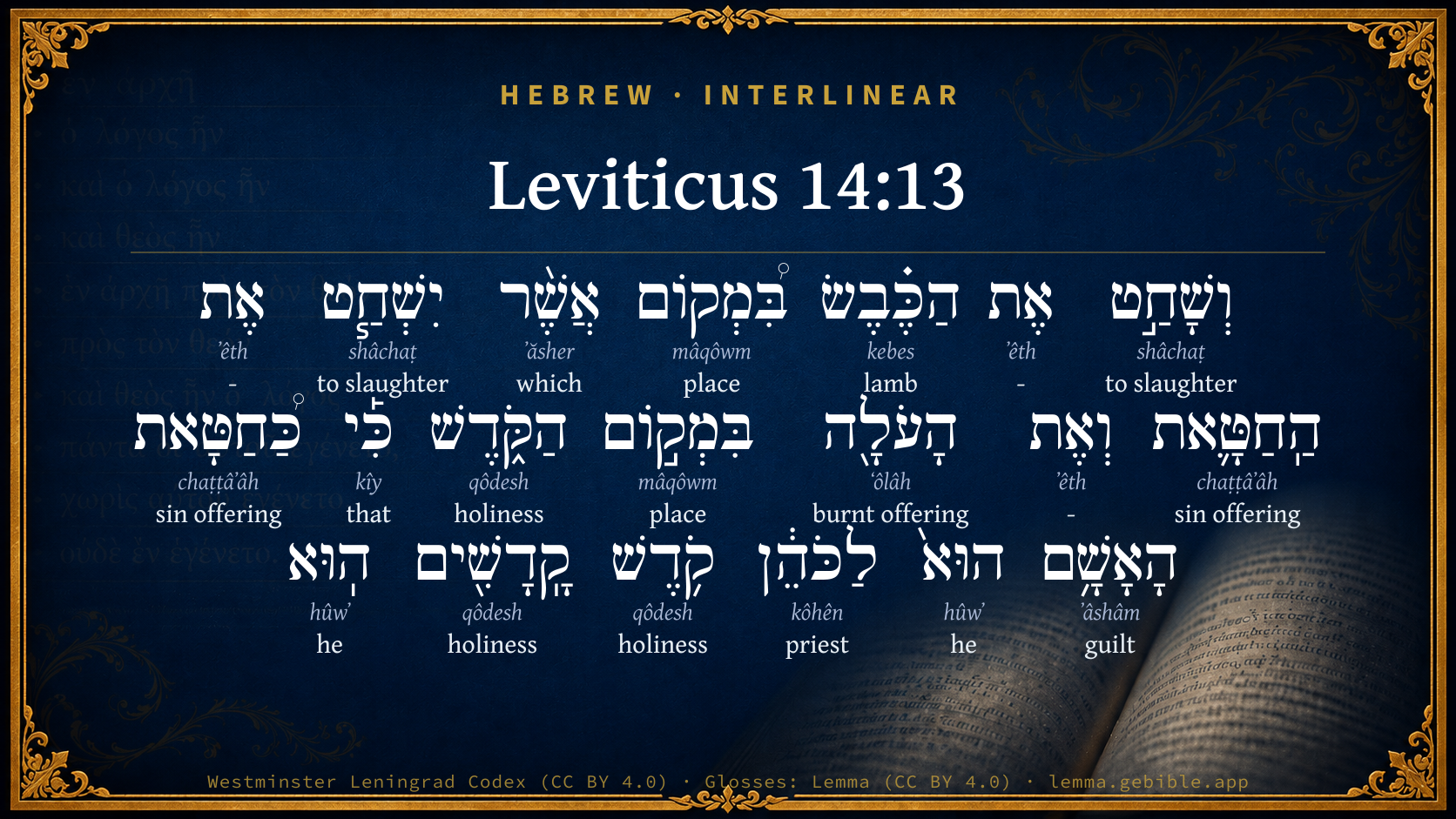
Leviticus 14:13

Hebrew (Westminster Leningrad Codex) Leviticus 14:13 appears in the Hebrew Old Testament. The text above is from the Westminster Leningrad Codex. Each word links to its Strong’s number, a concise gloss, and parsing drawn from the Open Scriptures Hebrew Bible morphology. Click any word for its full Brown-Driver-Briggs (BDB) entry.
Download image
Cite this verse

Leviticus 14:13 (World English Bible). Public Domain. Lemma interlinear Bible study tool, https://lemma.gebible.app/v/leviticus/14/13.

Show BibTeX & RIS
BibTeX
RIS
English Translation
He shall kill the male lamb in the place where they kill the sin offering and the burnt offering, in the place of the sanctuary; for as the sin offering is the priest's, so is the trespass offering. It is most holy.
World English Bible · Public Domain
Download a study sheet

One document with this verse’s original text, its word-by-word gloss line, the meaning frame, cross-references with their text, attributed commentary, and full source and license credits — printable, and it pastes into notes with its structure intact.

This verse Autodidact and up

Study sheet (.html) Plain text (.txt)

A passage Seminary Student

Up to 50 verses in one chapter. A passage sheet keeps up to 6 commentary sources and 12 cross-references per verse, in the order this page ranks them, and says so on the sheet whenever that leaves anything out. Ask for a single verse and you get the Autodidact verse sheet above.

Everything on this page stays free to read, with no account — the sheet is a download of what is already on screen, not access to it.

Want to remove ads? Support Godless Engineer
Compare translations 3

The same verse in 3 English versions, stacked beneath the original-language interlinear above. Click any original word for its lexicon entry.

Each is an independent rendering of the whole verse — the interlinear is not word-aligned to these translations.

Highlighted words mark where these versions differ — a whole-verse word diff, not a word-by-word alignment.

  • World English Bible Public Domain
    He shall kill the male lamb in the place where they kill the sin offering and the burnt offering, in the place of the sanctuary; for as the sin offering is the priest's, so is the trespass offering. It is most holy.
  • King James Version Public Domain
    And he shall slay the lamb in the place where he shall kill the sin offering and the burnt offering, in the holy place: for as the sin offering is the priest's, so is the trespass offering: it is most holy:
  • unfoldingWord Literal Text CC BY-SA 4.0
    And he shall slaughter the lamb in the place where one slaughters the sin offering and the burnt offering, in the Holy Place, for the guilt offering like the sin offering; it for the priest. It a holy thing of holy things.

unfoldingWord Literal Text — © unfoldingWord, licensed CC BY-SA 4.0. Word-aligned USFM3 via Door43 (git.door43.org/unfoldingWord/en_ult).

Versions to compare (up to 4)

3 of 4 selected

Show all 18 translations

Every available English version of this verse, each an independent rendering of the whole verse.

  • World English Bible Public Domain
    He shall kill the male lamb in the place where they kill the sin offering and the burnt offering, in the place of the sanctuary; for as the sin offering is the priest's, so is the trespass offering. It is most holy.
  • Berean Standard Bible Public Domain
    Then he is to slaughter the lamb in the sanctuary area where the sin offering and burnt offering are slaughtered. Like the sin offering, the guilt offering belongs to the priest; it is most holy.
  • Majority Standard Bible Public Domain
    Then he is to slaughter the lamb in the sanctuary area where the sin offering and burnt offering are slaughtered. Like the sin offering, the guilt offering belongs to the priest; it is most holy.
  • King James Version Public Domain
    And he shall slay the lamb in the place where he shall kill the sin offering and the burnt offering, in the holy place: for as the sin offering is the priest's, so is the trespass offering: it is most holy:
  • American Standard Version (1901) Public Domain
    and he shall kill the he-lamb in the place where they kill the sin-offering and the burnt-offering, in the place of the sanctuary: for as the sin-offering is the priest's, so is the trespass-offering: it is most holy:
  • Revised Version (1885) Public Domain
    and he shall kill the he-lamb in the place where they kill the sin offering and the burnt offering, in the place of the sanctuary: for as the sin offering is the priest’s, so is the guilt offering: it is most holy:
  • Geneva Bible (1599) Public Domain
    And hee shall kill the lambe in the place where the sinne offring and the burnt offring are slaine, euen in the holy place: for as the sinne offring is the Priests, so is the trespasse offring: for it is most holy.
  • Douay-Rheims (1899) Public Domain
    He shall immolate the lamb, where the victim for sin is wont to be immolated, and the holocaust, that is, in the holy place: for as that which is for sin, so also the victim for a trespass offering pertaineth to the priest: it is holy of holies.
  • Young's Literal Translation Public Domain
    `And he hath slaughtered the lamb in the place where he slaughtereth the sin-offering and the burnt-offering, in the holy place; for like the sin-offering the guilt-offering is to the priest; it `is' most holy.
  • Literal Standard Version CC BY-SA 4.0
    And he has slaughtered the lamb in the place where he slaughters the sin-offering and the burnt-offering, in the holy place; for like the sin-offering, the guilt-offering is for the priest; it [is] most holy.
  • Unlocked Literal Bible CC BY-SA 4.0
    He must kill the male lamb in the place where they kill the sin offerings and the burnt offerings, in the area of the tabernacle, for the sin offering belongs to the priest, as does the guilt offering, because it is most holy.
  • unfoldingWord Literal Text CC BY-SA 4.0
    And he shall slaughter the lamb in the place where one slaughters the sin offering and the burnt offering, in the Holy Place, for the guilt offering like the sin offering; it for the priest. It a holy thing of holy things.
  • Darby Bible Public Domain
    And he shall slaughter the he-lamb at the place where the sin-offering and the burnt-offering are slaughtered, in a holy place; for as the sin-offering, so the trespass-offering is the priest's: it is most holy.
  • World Messianic Bible Public Domain
    He shall kill the male lamb in the place where they kill the sin offering and the burnt offering, in the place of the sanctuary; for as the sin offering is the priest’s, so is the trespass offering. It is most holy.
  • Webster's Bible Public Domain
    And he shall slay the lamb in the place where he shall kill the sin-offering and the burnt-offering, in the holy-place: for as the sin-offering is the priest's, so is the trespass-offering: it is most holy.
  • Free Bible Version CC BY-SA 4.0
    Then he will kill the lamb near the sanctuary where the sin offering and burnt offering are killed. The sin offering and the guilt offering belong to the priest; they are most holy.
  • Bible in Basic English Public Domain
    And he is to put the male lamb to death in the place where they put to death the sin-offering and the burned offering, in the holy place; for as the sin-offering is the property of the priest, so is the offering for wrongdoing: it is most holy.
  • JPS Tanakh (1917) Public Domain
    And he shall kill the he-lamb in the place where they kill the sin-offering and the burnt-offering, in the place of the sanctuary; for as the sin-offering is the priest's, so is the guilt-offering; it is most holy.

Literal Standard Version (2020), Covenant Press — licensed CC BY-SA 4.0. Text via the HelloAO Bible API (eBible.org). Unlocked Literal Bible (unfoldingWord) — licensed CC BY-SA 4.0. Text via the HelloAO Bible API (eBible.org). unfoldingWord Literal Text — © unfoldingWord, licensed CC BY-SA 4.0. Word-aligned USFM3 via Door43 (git.door43.org/unfoldingWord/en_ult). Free Bible Version, Dr. Jonathan Gallagher — licensed CC BY-SA 4.0. Text via the HelloAO Bible API (eBible.org).

Word by word

More ways to search: Search by grammar → Find every occurrence → Compare this word →

Practice this passage: Drill this verse → Learn its vocabulary →

הָאָשָׁ֥ם
ʼâshâm
H817
“the · guilt”
Particle, Definite Article + Noun, Common, Masculine, Singular, Absolute
Part of Speech
Particle + Noun
Type
Common
Gender
Masculine
Number
Singular
State
Absolute
Full BDB Definition

Origin: from H816

TWOT: 180b

guilt, offense, guiltiness - offense, trespass, fault - guilt, guiltiness - compensation (for offense) - trespass offering, guilt offering
  1. וְשָׁחַ֣ט shâchaṭ H7819 “and · to slaughter” Conjunction + Verb, Qal, Sequential Perfect, 3rd Person, Masculine, Singular
  2. אֶת ʼêth H853 “-” Particle, Direct Object
  3. הַכֶּ֗בֶשׂ kebes H3532 “the · lamb” Particle, Definite Article + Noun, Common, Masculine, Singular, Absolute
  4. בִּ֠מְקוֹם mâqôwm H4725 “in/at · place of” Preposition + Noun, Common, Masculine, Singular, Construct
  5. אֲשֶׁ֨ר ʼăsher H834 “which” Particle, Relative
  6. יִשְׁחַ֧ט shâchaṭ H7819 “to slaughter” Verb, Qal, Imperfect, 3rd Person, Masculine, Singular
  7. אֶת ʼêth H853 “-” Particle, Direct Object
  8. הַֽחַטָּ֛את chaṭṭâʼâh H2403 “the · sin offering” Particle, Definite Article + Noun, Common, Feminine, Singular, Absolute
  9. וְאֶת ʼêth H853 “and · -” Conjunction + Particle, Direct Object
  10. הָעֹלָ֖ה ʻôlâh H5930 “the · burnt offering” Particle, Definite Article + Noun, Common, Feminine, Singular, Absolute
  11. בִּמְק֣וֹם mâqôwm H4725 “in/at · place of” Preposition + Noun, Common, Masculine, Singular, Construct
  12. הַקֹּ֑דֶשׁ qôdesh H6944 “the · holiness” Particle, Definite Article + Noun, Common, Masculine, Singular, Absolute
  13. כִּ֡י kîy H3588 “that” Conjunction
  14. כַּ֠חַטָּאת chaṭṭâʼâh H2403 “like/as the · sin offering” Preposition, Determined + Noun, Common, Feminine, Singular, Absolute
  15. הוּא֙ hûwʼ H1931 “he” Pronoun, Personal, 3rd Person, Masculine, Singular
  16. לַכֹּהֵ֔ן kôhên H3548 “to/for the · priest” Preposition, Determined + Noun, Common, Masculine, Singular, Absolute
  17. קֹ֥דֶשׁ qôdesh H6944 “holiness of” Noun, Common, Masculine, Singular, Construct
  18. קָֽדָשִׁ֖ים qôdesh H6944 “holy things” Noun, Common, Masculine, Plural, Absolute
  19. הֽוּא hûwʼ H1931 “he” Pronoun, Personal, 3rd Person, Masculine, Singular

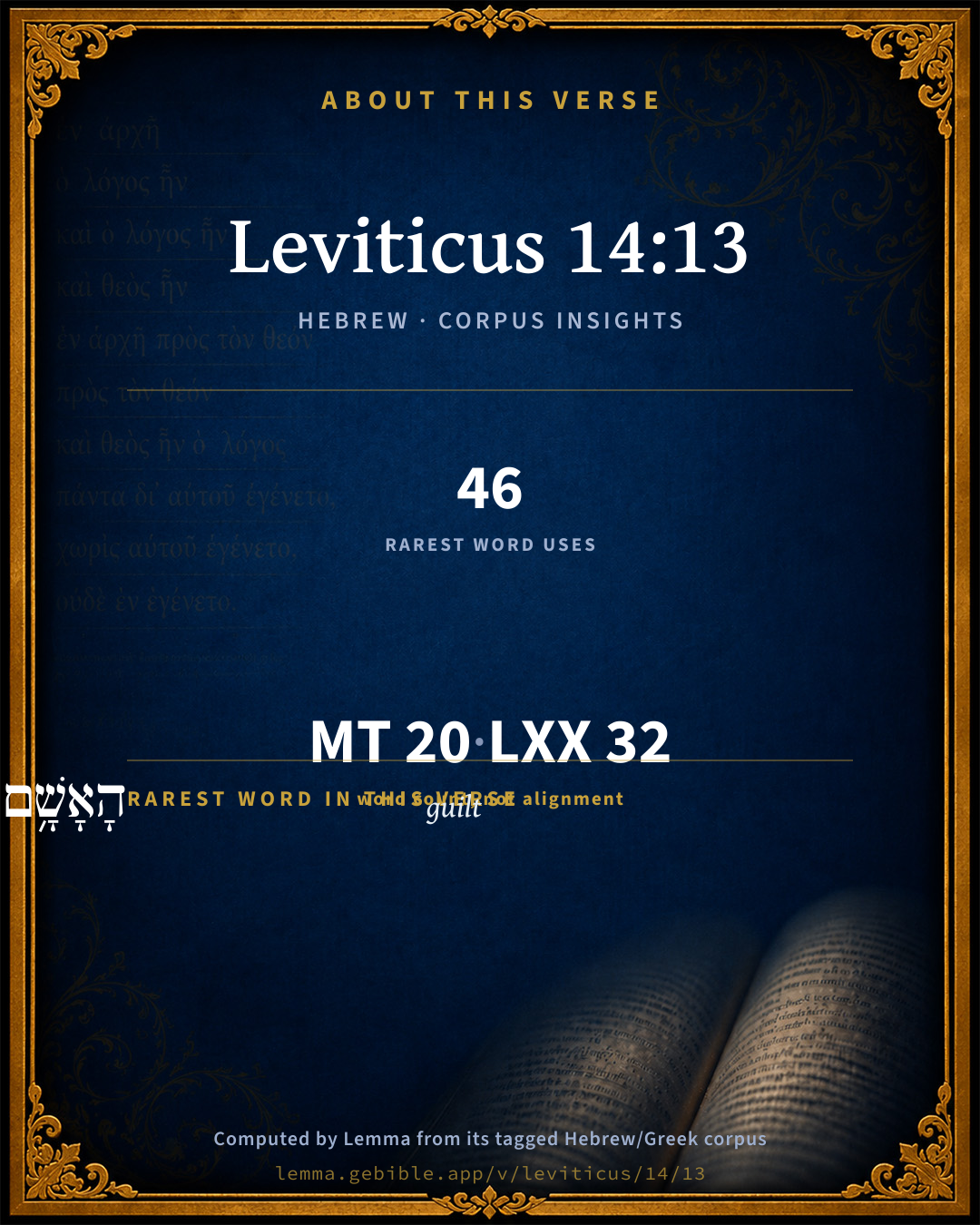
About this verse

These counts appear in no published source. They are computed here, from the morphology-tagged text and Lemma’s own curated glosses. What Lemma adds →

20
words
12
distinct lemmas
Pentateuch
section

Shared distinctive vocabulary

הָאָשָׁ֥ם guilt H817 occurs in 41 verses of the Hebrew Bible. Also found in:

Grammatical profile

  • 2 verbs
  • 11 nouns
  • 2 pronouns
  • 1 conjunction
  • 4 particles

Verb forms

  • וְשָׁחַ֣ט Qal · Sequential Perfect
  • יִשְׁחַ֧ט Qal · Imperfect

Repetition

Words recur within this verse — often emphatic in Hebrew:

  • הַקֹּ֑דֶשׁ holiness H6944 ×3
  • וְשָׁחַ֣ט to slaughter H7819 ×2
  • בִּ֠מְקוֹם place H4725 ×2
  • הַֽחַטָּ֛את sin offering H2403 ×2
  • הוּא֙ he H1931 ×2

Hebrew & Septuagint length

In English translation the verse runs 42 words from the Hebrew and 40 from the Septuagint (LXX English) — closely comparable.

A rough comparison of the two English renderings, which tokenize alike — not a word-level alignment.

Word counts can differ between the Hebrew and the Greek without any difference in meaning — e.g. the Hebrew direct-object marker אֵת has no separate Greek word, and Greek often adds the article ὁ.

In the original languages it is 20 Hebrew tokens and 32 Greek tokens — but the two are counted differently (Hebrew bundles its prefixes and suffixes into one token; the Greek is in lemma form), so that isn’t a like-for-like length.

Cross-references

10

Topical passages linked to Leviticus 14:13 in the Treasury of Scripture Knowledge — connected by theme and wording, ordered by reader-vote popularity; previews shown in the World English Bible.

  • Exodus 29:11 You shall kill the bull before Yahweh, at the door of the tent of meeting.
  • Leviticus 1:11 He shall kill it on the north side of the altar before Yahweh. Aaron's sons, the priests, shall sprinkle its blood around on the altar.
  • Leviticus 4:24 He shall lay his hand on the head of the goat, and kill it in the place where they kill the burnt offering before Yahweh. It is a sin offering.
  • Leviticus 2:3 That which is left of the meal offering shall be Aaron's and his sons'. It is a most holy thing of the offerings of Yahweh made by fire.
  • Leviticus 4:4 He shall bring the bull to the door of the Tent of Meeting before Yahweh; and he shall lay his hand on the head of the bull, and kill the bull before Yahweh.
  • Leviticus 7:6–7 Every male among the priests may eat of it. It shall be eaten in a holy place. It is most holy.
  • Leviticus 1:5 He shall kill the bull before Yahweh. Aaron's sons, the priests, shall present the blood and sprinkle the blood around on the altar that is at the door of the Tent of Meeting.
  • Leviticus 6:24–30 Yahweh spoke to Moses, saying,
  • Leviticus 10:17 "Why haven't you eaten the sin offering in the place of the sanctuary, seeing it is most holy, and he has given it you to bear the iniquity of the congregation, to make atonement for them before Yahweh?
  • Leviticus 21:22 He shall eat the bread of his God, both of the most holy, and of the holy.

Cross-references courtesy of OpenBible.info (CC BY 4.0).

Hebrew and Greek witnesses Masoretic Hebrew ↔ Greek Septuagint

The same verse in the two great witnesses to the Old Testament, shown verse-for-verse.

These are two independent witnesses, not word-aligned to each other, and the Septuagint is shown in lemma (dictionary) form.

Hebrew Leviticus 14:13 Masoretic · Westminster Leningrad Codex

וְשָׁחַ֣ט אֶת הַכֶּ֗בֶשׂ בִּ֠מְקוֹם אֲשֶׁ֨ר יִשְׁחַ֧ט אֶת הַֽחַטָּ֛את וְאֶת הָעֹלָ֖ה בִּמְק֣וֹם הַקֹּ֑דֶשׁ כִּ֡י כַּ֠חַטָּאת הָאָשָׁ֥ם הוּא֙ לַכֹּהֵ֔ן קֹ֥דֶשׁ קָֽדָשִׁ֖ים הֽוּא

He shall kill the male lamb in the place where they kill the sin offering and the burnt offering, in the place of the sanctuary; for as the sin offering is the priest's, so is the trespass offering. It is most holy.

World English Bible · Public Domain

Greek LXX Leviticus 14:13 Septuagint · lemma form

καί σφάζω ὁ ἀμνός ἐν τόπος οὗ σφάζω ὁ ὁλοκαύτωμα καί ὁ περί ἁμαρτία ἐν τόπος ἅγιος εἰμί γάρ ὁ περί ἁμαρτία ὥσπερ ὁ ὁ πλημμέλεια εἰμί ὁ ἱερεύς ἅγιος ἅγιος εἰμί

and they shall kill the lamb in the place where they kill the whole burnt offerings, and the sin-offerings, in the holy places; for it is a sin-offering: as the trespass-offering, it belongs to the priest, it is most holy.

LXX2012 (modern English Septuagint) · Public Domain

Hebrew: Westminster Leningrad Codex (CC BY 4.0). Greek: Septuagint (public domain); English from LXX2012 (modern English Septuagint) (Public Domain). How the Septuagint differs from the Hebrew →

Targum (Aramaic paraphrase)

2

The Targum is the ancient Jewish Aramaic paraphrase of the Hebrew Scriptures — an interpretive translation, not the Hebrew text itself. Onkelos (literal) and Pseudo-Jonathan (expansive) render the Torah, and Jonathan the Prophets. Coverage is partial: where no permissively-licensed English translation exists for a verse, only the Aramaic is shown. This is verse-level text, not a word-by-word alignment to the Hebrew.

  1. Targum Onkelos Torah (Genesis–Deuteronomy)
    וְיִכּוֹס יָת אִמְרָא בַּאֲתַר דִי יִכּוֹס יָת חַטָאתָא וְיָת עֲלָתָא בַּאֲתַר קַדִישׁ אֲרֵי כְּחַטָאתָא אֲשָׁמָא הוּא לְכַהֲנָא קֹדֶשׁ קוּדְשִׁין הוּא

    (no public-domain English translation for this verse)

    Targum Onkelos — Aramaic: “Onkelos Genesis” (public domain); “Onkelos Exodus” (public domain); “Onkelos Leviticus” (public domain); “Onkelos Numbers” (public domain); “Onkelos Deuteronomy” (public domain). English: “Sefaria Community Translation” (CC0 1.0 (public-domain dedication)); “J.W. Etheridge. The Targums of Onkelos and Jonathan Ben Uzziel on the Pentateuch. London: Longmans, Green, 1862” (public domain). Text via Sefaria.

  2. Targum Pseudo-Jonathan Torah (Genesis–Deuteronomy)
    וְיִכּוֹס טַבְּחָא יַת אִימְרָא בְּאַתְרָא דְיִכּוֹס יַת חַטָאתָא וְיַת עֲלָתָא בַּאֲתַר קַדִישׁ אֲרוּם הֵי כְּחַטָאתָא הֵיכְדֵין אֲשָׁמָא הוּא לְכַהֲנָא קוֹדֶשׁ קוּדְשִׁין הוּא

    And the slayer shall kill the lamb in the place where the sin offering is killed, and the burnt offering, in the holy place; because, as the sin offering, so the trespass offering is the priest's; it is most sacred.

    Targum Pseudo-Jonathan — Aramaic: “Targum Jonathan on Genesis” (public domain); “Targum Jonathan on Exodus” (public domain); “Targum Jonathan on Leviticus” (public domain); “Targum Jonathan on Numbers” (public domain); “Targum Jonathan on Deuteronomy” (public domain). English: “The Targum of Jonathan ben Uzziel, trans. J. W. Etheridge, London, 1862” (public domain). Text via Sefaria.

Commentary

Notes on Leviticus 14:13 from classic Christian and Jewish commentators (each source and its license shown beneath its notes). The classic Christian expositions comment on the surrounding passage and are grouped to its opening verse, so a note may address several verses; the Jewish commentaries on the Tanakh (Rashi and others) are per-verse, so they appear only where the commentator wrote on this verse.

Lemma curates 59 commentaries, every one of them public domain or Creative Commons licensed, each selected and text-cleaned for this edition rather than reprinted as found. About our sources →

Trapp's Complete Commentary

John Trapp

Lev 14:13 And he shall slay the lamb in the place where he shall kill the sin offering and the burnt offering, in the holy place: for as the sin offering [is] the priest’s, [so is] the trespass offering: it [is] most holy:

Ver. 13. It is most holy.] The way of holiness in and by Christ is an absolute way as ever was devised.

John Trapp, A Commentary or Exposition upon All the Books of the Old and New Testament (1647–1656) — public domain. Text from a community e-Sword module.

Ellicott's Commentary for English Readers

(13) And he shall slay the lamb.—Better, And the lamb shall be killed. On ordinary occasions the sacrificer himself slaughtered the victim on the north side of the altar (see Lev_1:5); but as the convalescent was not as yet allowed to enter the court, other persons appointed for these occasions killed the sacrifice. Hence the ancient Chaldee Version of the so-called Jonathan ben Uzziel rightly renders it, “And the slaughterer shall slay the lamb.” The phrase is therefore better rendered in the passive, as is often the case in Hebrew. Before the sacrifice was slain the offerer had to lay his hands on the victim. (See Lev_1:4.) For the reason, however, already stated, the convalescent could not do it before the altar. The lamb was therefore brought to the door of the court where the leper stood, and the convalescent put his hands through the gate of Nicanor, and laid them on the victim. From this place the purification was performed of men who contracted defilement from a running issue, and of women when they brought their offerings after childbirth. (See Lev_12:6.)

In the place where he shall kill the sin offering.—Better, in the place where they kill, &c, as exactly the same phrase is rendered by the Authorised Version in chap 4:33: that is, in the court of the sanctuary, on the north side of the altar (see Lev_1:11; Lev_6:25), which was more holy than the entrance where the convalescent stood.

For as the sin offering . . . —The flesh of both these sacrifices was the perquisite of the officiating priest, and could only be eaten by him and the male members of his family within the court of the sanctuary, being of the class of sacrifices which were most holy. (See Lev_6:18.)

A Bible Commentary for English Readers, edited by Charles John Ellicott (1878–1897) — public domain. Text from a community e-Sword module.

The Cambridge Bible for Schools and Colleges

gen. ed. J. J. S. Perowne

13. in the place where they kill the sin offering and the burnt offering] For the Burnt-Offering see ch. Lev_1:11; for the Sin-Offering, Lev_6:25; and for the Guilt-Offering, Lev_7:2.

in the place of the sanctuary] i.e. in the court, not in the tabernacle.

The Cambridge Bible for Schools and Colleges (gen. ed. J. J. S. Perowne; Cambridge University Press, 1878–1918) — public domain. Text from a community e-Sword module.

John Gill's Exposition

And he shall slay the lamb,.... The priest, or the butcher, as the Targum of Jonathan, the slaughterer, the priest appointed for that service; at which time both the hands of the leper were laid upon it, as says the Misnah (p); for though the leper might not go into the court as yet, the sacrifice was brought to the door of the tabernacle for him to put his hands on it: so Maimonides (q) relates; the trespass offering of the leper is brought to the door, and he puts both his hands into the court, and lays them on it, and they immediately slay it:

in the place where he shall kill the sin offering in the holy place; in the court of the tabernacle, on the north side of the altar, as Jarchi observes, see Lev 1:11,

for as the sin offering is the priest's, so is the trespass offering; and to be eaten by him and his sons in the holy place, and by none but them, see Lev 6:26,

it is most holy; which is the reason why none else might eat of it, typical of Christ the most Holy, whose flesh is only eaten by true believers in him, made priests unto God by him.

(p) Negaim, c. 14. sect. 8. (q) Ut supra. (Hilchot Mechosre Capharah, c. 4. sect. 2.)

John Gill's Exposition of the Whole Bible (1746–1763) — public domain (CC PDM 1.0). Text via the HelloAO Bible API.

Albert Barnes' Notes on the Bible

It is most holy - See Lev 6:25 note.

Albert Barnes' Notes on the Bible (1834–1885) — public domain. Text from a community e-Sword/MySword module.

Haydock's Catholic Bible Commentary

Place; on the left hand of the altar of holocausts, chap. i. 11. This sacrifice is different from that for sin, ver. 19. (Calmet)

George Leo Haydock (1774–1849), Haydock's Catholic Family Bible and Commentary, 1859 edition — public domain. Excludes Psalms (Douay-Rheims chapter numbering differs from Protestant) and Deuterocanonical books (Catholic canon only).

Matthew Poole's English Annotations

In the holy place, to wit, in the court of the tabernacle. See Lev 1:11; 7:7.

It is most holy; both of them are equally holy, and therefore to be offered in the same place.

Matthew Poole's English Annotations on the Holy Bible (1683–1685) — public domain. Text from a community e-Sword/MySword module.

Rashi

Rabbi Shlomo Yitzchaki (Rashi)

‎ ‎'במקום אשר ישחט וגו‎‎‎ IN THE PLACE WHERE HE SHALL SLAUGHTER etc. — i.e. on the side of the altar on the north. But why is this stated at all? Has it not already been stated in in the law about the guilt-offering in the section צו את אהרן that the guilt-offering requires slaughtering on the north side of the altar? But because this guilt-offering has gone forth from (was made an exception to) the general rule of the guilt- offerings in that it is subject to the law of being placed before the Lord (v. 11), one might think that its slaughtering should be in the spot where it was placed (in the gateway of Nicanor; i. e. it shall be made an exception also in respect to the place where it should be slaughtered); on that account it states, “and he shall slaughter [the lamb] in the place where he slaughters [the sin-offering] etc ” (Sifra, Metzora, Section 3 8).

‎י כחטאת‏‎כ FOR AS THE SIN-OFFERING [SO IS THE GUILT-OFFERING TO THE PRIEST] — This means, for as all sin-offerings so this guilt-offering הוא לכהן is to the priest, i. e. as regards all sacrificial rites which depend upon the priest this guilt-offering is made exactly similar to the sin-offering. In order that you should not say: Since its blood is made an exception to the general rule governing other guilt-offerings in that this is placed upon the tip of the ear and upon the thumbs, it must also form an exception in that it should not require the placing of the blood and the fat portions upon the altar, it therefore expressly states, “for as all sin-offerings so is this guilt-offering to the priest” (לכהן, in reference to the priest, so far as he is concerned). One might also think that its blood must be sprinkled on the upper part of the altar as is the case with the sin-offering! Therefore it says: (Leviticus 7:1, 2) “it is most holy … and its blood shall he sprinkle round about the altar”. So it is set forth in Torath Cohanim (cf. Sifra, Metzora, Chapter 3 1; Zevachim 49a).

Rashi on the Tanakh — English translations: “The Judaica Press complete Tanach with Rashi, translated by A. J. Rosenberg” (CC BY 4.0); “Pentateuch with Rashi's commentary by M. Rosenbaum and A.M. Silbermann, 1929-1934” (public domain); “The Metsudah Tanach series, Lakewood, N.J” (CC BY 4.0); and “The Book of Joshua, Metsudah Publications, 1997” (CC BY 4.0). Text via Sefaria.

Lesson kit

Teaching starters — assembled from the data on this page, not authored interpretation. Every prompt links to the verse data it draws on. Edit before teaching.

Leviticus, in the Pentateuch, opens this verse with 20 words (12 distinct Hebrew lemmas). Its most distinctive word is ʼâshâm (“guilt”). A historical commentator’s framing appears above. Read the whole chapter for the surrounding context.

Discussion questions

  1. How does “guilt” (ʼâshâm) shape what this verse is saying?
  2. How does Genesis 26:10, which shares the word «guilt», read alongside this verse?
  3. What does the repetition of “holiness” (3× in this one verse) do in this verse?
  4. The translations on this page render this verse differently — a whole-verse word diff, not a word-by-word alignment. What might account for the different wordings?
  5. «וְשָׁחַ֣ט» is a Qal Sequential Perfect verb. How does that grammatical form shape the action described?
  6. Compare how Trapp's Complete Commentary and Ellicott's Commentary for English Readers read this verse. Where do they agree or differ?

Things to notice

Reading settings

Reading text

Shown beneath each verse's original-language words.

Old Testament
Old Testament edition

Read the OT as the Masoretic Hebrew (MT) or the Greek Septuagint (LXX).

English shown for the Greek Septuagint (in the Hebrew ↔ Greek comparison).

Comparing translations? Open the Compare panel on any verse page to stack up to four side by side.