Exodus 40:10

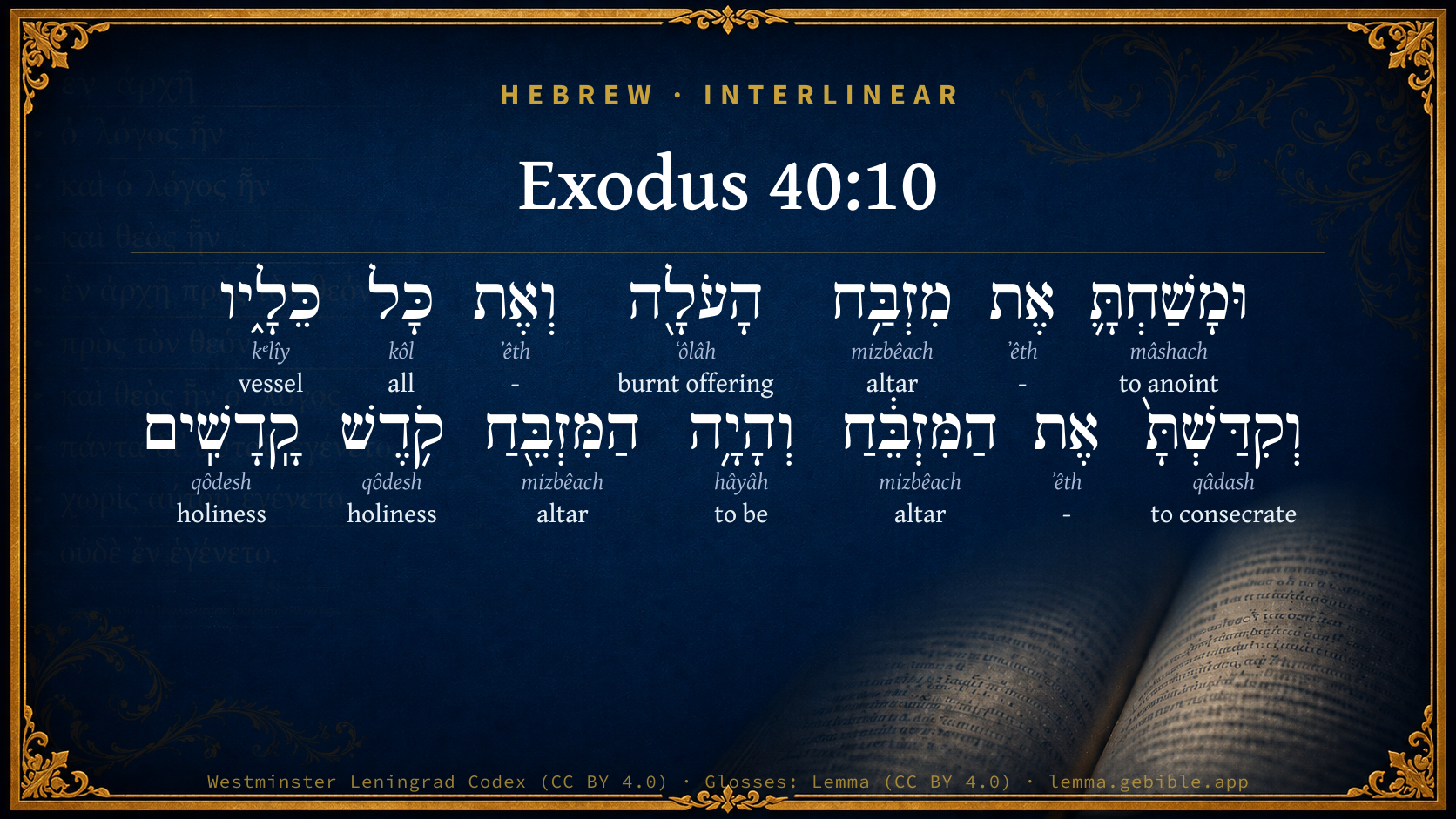
Hebrew (Westminster Leningrad Codex) Exodus 40:10 appears in the Hebrew Old Testament. The text above is from the Westminster Leningrad Codex. Each word links to its Strong’s number, a concise gloss, and parsing drawn from the Open Scriptures Hebrew Bible morphology. Click any word for its full Brown-Driver-Briggs (BDB) entry.
Download image
Cite this verse

Exodus 40:10 (World English Bible). Public Domain. Lemma interlinear Bible study tool, https://lemma.gebible.app/v/exodus/40/10.

Show BibTeX & RIS
BibTeX
RIS
English Translation
You shall anoint the altar of burnt offering, with all its vessels, and sanctify the altar: and the altar will be most holy.
World English Bible · Public Domain
Download a study sheet

One document with this verse’s original text, its word-by-word gloss line, the meaning frame, cross-references with their text, attributed commentary, and full source and license credits — printable, and it pastes into notes with its structure intact.

This verse Autodidact and up

Study sheet (.html) Plain text (.txt)

A passage Seminary Student

Up to 50 verses in one chapter. A passage sheet keeps up to 6 commentary sources and 12 cross-references per verse, in the order this page ranks them, and says so on the sheet whenever that leaves anything out. Ask for a single verse and you get the Autodidact verse sheet above.

Everything on this page stays free to read, with no account — the sheet is a download of what is already on screen, not access to it.

Want to remove ads? Support Godless Engineer
Compare translations 3

The same verse in 3 English versions, stacked beneath the original-language interlinear above. Click any original word for its lexicon entry.

Each is an independent rendering of the whole verse — the interlinear is not word-aligned to these translations.

Highlighted words mark where these versions differ — a whole-verse word diff, not a word-by-word alignment.

  • World English Bible Public Domain
    You shall anoint the altar of burnt offering, with all its vessels, and sanctify the altar: and the altar will be most holy.
  • King James Version Public Domain
    And thou shalt anoint the altar of the burnt offering, and all his vessels, and sanctify the altar: and it shall be an altar most holy.
  • unfoldingWord Literal Text CC BY-SA 4.0
    And you shall anoint the altar of the burnt offering and all its utensils. And you shall set apart the altar, and the altar will be a holiest holy thing.

unfoldingWord Literal Text — © unfoldingWord, licensed CC BY-SA 4.0. Word-aligned USFM3 via Door43 (git.door43.org/unfoldingWord/en_ult).

Versions to compare (up to 4)

3 of 4 selected

Show all 18 translations

Every available English version of this verse, each an independent rendering of the whole verse.

  • World English Bible Public Domain
    You shall anoint the altar of burnt offering, with all its vessels, and sanctify the altar: and the altar will be most holy.
  • Berean Standard Bible Public Domain
    Anoint the altar of burnt offering and all its utensils; consecrate the altar, and it shall be most holy.
  • Majority Standard Bible Public Domain
    Anoint the altar of burnt offering and all its utensils; consecrate the altar, and it shall be most holy.
  • King James Version Public Domain
    And thou shalt anoint the altar of the burnt offering, and all his vessels, and sanctify the altar: and it shall be an altar most holy.
  • American Standard Version (1901) Public Domain
    And thou shalt anoint the altar of burnt-offering, and all its vessels, and sanctify the altar: and the altar shall be most holy.
  • Revised Version (1885) Public Domain
    And thou shalt anoint the altar of burnt offering, and all its vessels, and sanctify the altar: and the altar shall be most holy.
  • Geneva Bible (1599) Public Domain
    And thou shalt anoynt the Altar of the burnt offring, and all his instruments, and shalt sanctifie the Altar, that it may bee an altar most holie.
  • Douay-Rheims (1899) Public Domain
    The altar of holocaust and all its vessels:
  • Young's Literal Translation Public Domain
    and thou hast anointed the altar of the burnt-offering, and all its vessels, and sanctified the altar, and the altar hath been most holy;
  • Literal Standard Version CC BY-SA 4.0
    and you have anointed the altar of the burnt-offering, and all its vessels, and sanctified the altar, and the altar has been most holy;
  • Unlocked Literal Bible CC BY-SA 4.0
    You must anoint the altar for burnt offerings and all its utensils. You must set apart the altar to me and it will become very holy to me.
  • unfoldingWord Literal Text CC BY-SA 4.0
    And you shall anoint the altar of the burnt offering and all its utensils. And you shall set apart the altar, and the altar will be a holiest holy thing.
  • Darby Bible Public Domain
    And thou shalt anoint the altar of burnt-offering, and all its utensils; and thou shalt hallow the altar, and the altar shall be most holy.
  • World Messianic Bible Public Domain
    You shall anoint the altar of burnt offering, with all its vessels, and sanctify the altar, and the altar will be most holy.
  • Webster's Bible Public Domain
    And thou shalt anoint the altar of the burnt-offering and all its vessels, and sanctify the altar: and it shall be an altar most holy.
  • Free Bible Version CC BY-SA 4.0
    Anoint the altar of burnt offering and all its utensils. Dedicate the altar and it will be especially holy.
  • Bible in Basic English Public Domain
    And put oil on the altar of burned offering, and make it and all its vessels holy; this altar is to be most holy.
  • JPS Tanakh (1917) Public Domain
    And thou shalt anoint the altar of burnt-offering, and all its vessels, and sanctify the altar; and the altar shall be most holy.

Literal Standard Version (2020), Covenant Press — licensed CC BY-SA 4.0. Text via the HelloAO Bible API (eBible.org). Unlocked Literal Bible (unfoldingWord) — licensed CC BY-SA 4.0. Text via the HelloAO Bible API (eBible.org). unfoldingWord Literal Text — © unfoldingWord, licensed CC BY-SA 4.0. Word-aligned USFM3 via Door43 (git.door43.org/unfoldingWord/en_ult). Free Bible Version, Dr. Jonathan Gallagher — licensed CC BY-SA 4.0. Text via the HelloAO Bible API (eBible.org).

Word by word

More ways to search: Search by grammar → Find every occurrence → Compare this word →

Practice this passage: Drill this verse → Learn its vocabulary →

וּמָשַׁחְתָּ֛
mâshach
H4886
“and · to anoint”
Conjunction + Verb, Qal, Sequential Perfect, 2nd Person, Masculine, Singular
Part of Speech
Conjunction + Verb
Stem
Qal
Form
Sequential Perfect
Person
2nd Person
Gender
Masculine
Number
Singular
Full BDB Definition

Origin: a primitive root

TWOT: 1255

to smear, anoint, spread a liquid - (Qal) - to smear - to anoint (as consecration) - to anoint, consecrate - (Niphal) to be anointed
  1. אֶת ʼêth H853 “-” Particle, Direct Object
  2. מִזְבַּ֥ח mizbêach H4196 “altar of” Noun, Common, Masculine, Singular, Construct
  3. הָעֹלָ֖ה ʻôlâh H5930 “the · burnt offering” Particle, Definite Article + Noun, Common, Feminine, Singular, Absolute
  4. וְאֶת ʼêth H853 “and · -” Conjunction + Particle, Direct Object
  5. כָּל kôl H3605 “all of” Noun, Common, Masculine, Singular, Construct
  6. כֵּלָ֑יו kᵉlîy H3627 “vessels · his” Noun, Common, Masculine, Plural, Construct + Suffix, Personal, 3rd Person, Masculine, Singular
  7. וְקִדַּשְׁתָּ֙ qâdash H6942 “and · to consecrate” Conjunction + Verb, Piel, Sequential Perfect, 2nd Person, Masculine, Singular
  8. אֶת ʼêth H853 “-” Particle, Direct Object
  9. הַמִּזְבֵּ֔חַ mizbêach H4196 “the · altar” Particle, Definite Article + Noun, Common, Masculine, Singular, Absolute
  10. וְהָיָ֥ה hâyâh H1961 “and · to be” Conjunction + Verb, Qal, Sequential Perfect, 3rd Person, Masculine, Singular
  11. הַמִּזְבֵּ֖חַ mizbêach H4196 “the · altar” Particle, Definite Article + Noun, Common, Masculine, Singular, Absolute
  12. קֹ֥דֶשׁ qôdesh H6944 “holiness of” Noun, Common, Masculine, Singular, Construct
  13. קָֽדָשִֽׁים qôdesh H6944 “holy things” Noun, Common, Masculine, Plural, Absolute

About this verse

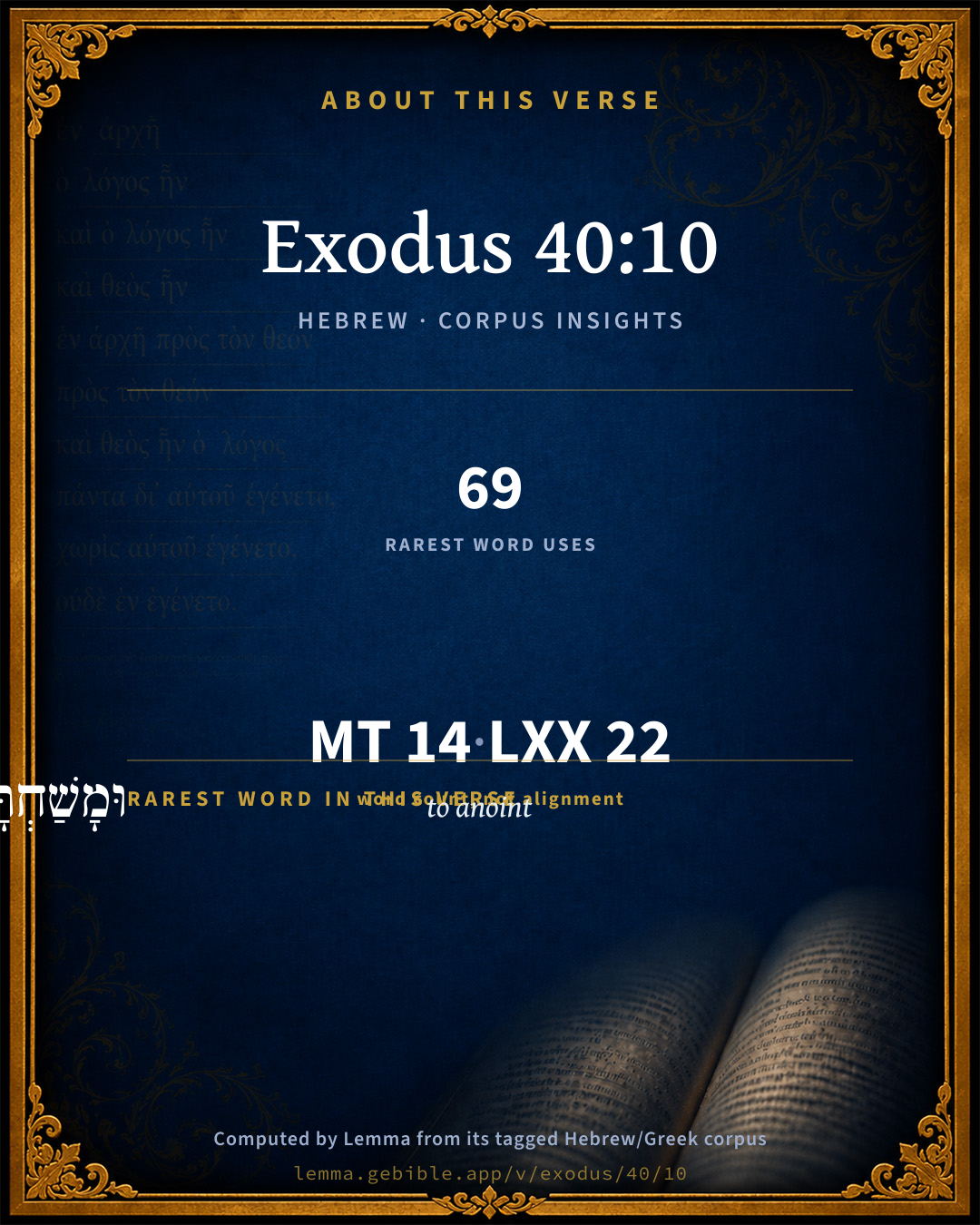
These counts appear in no published source. They are computed here, from the morphology-tagged text and Lemma’s own curated glosses. What Lemma adds →

14
words
9
distinct lemmas
Pentateuch
section

Grammatical profile

  • 3 verbs
  • 8 nouns
  • 3 particles

Verb forms

  • וּמָשַׁחְתָּ֛ Qal · Sequential Perfect
  • וְקִדַּשְׁתָּ֙ Piel · Sequential Perfect
  • וְהָיָ֥ה Qal · Sequential Perfect

Repetition

Words recur within this verse — often emphatic in Hebrew:

  • מִזְבַּ֥ח altar H4196 ×3
  • קֹ֥דֶשׁ holiness H6944 ×2

Hebrew & Septuagint length

In English translation the verse runs 23 words from the Hebrew and 26 from the Septuagint (LXX English) — closely comparable.

A rough comparison of the two English renderings, which tokenize alike — not a word-level alignment.

Word counts can differ between the Hebrew and the Greek without any difference in meaning — e.g. the Hebrew direct-object marker אֵת has no separate Greek word, and Greek often adds the article ὁ.

In the original languages it is 14 Hebrew tokens and 22 Greek tokens — but the two are counted differently (Hebrew bundles its prefixes and suffixes into one token; the Greek is in lemma form), so that isn’t a like-for-like length.

Cross-references

10

Topical passages linked to Exodus 40:10 in the Treasury of Scripture Knowledge — connected by theme and wording, ordered by reader-vote popularity; previews shown in the World English Bible.

  • Exodus 29:36–37 Every day shall you offer the bull of sin-offering for atonement: and you shall cleanse the altar, when you make atonement for it; and you shall anoint it, to sanctify it.
  • Isaiah 61:1 The Spirit of the Lord Yahweh is on me; because Yahweh has anointed me to preach good news to the humble; he has sent me to bind up the broken-hearted, to proclaim liberty to the captives, and the opening [of the prison] to those who are bound;
  • Luke 1:35 The angel answered her, "The Holy Spirit will come on you, and the power of the Most High will overshadow you. Therefore also the holy one who is born from you will be called the Son of God.
  • Leviticus 8:11 He sprinkled it on the altar seven times, and anointed the altar and all its vessels, and the basin and its base, to sanctify them.
  • Isaiah 11:2 The Spirit of Yahweh shall rest on him, the spirit of wisdom and understanding, the spirit of counsel and might, the spirit of knowledge and of the fear of Yahweh.
  • John 3:34 For he whom God has sent speaks the words of God; for God gives the Spirit without measure.
  • John 17:19 For their sakes I sanctify myself, that they themselves also may be sanctified in truth.
  • 1 Corinthians 1:30 But of him, you are in Christ Jesus, who was made to us wisdom from God, and righteousness and sanctification, and redemption:
  • 2 Corinthians 5:21 For him who knew no sin he made to be sin on our behalf; so that in him we might become the righteousness of God.
  • Hebrews 7:26 For such a high priest was fitting for us: holy, guiltless, undefiled, separated from sinners, and made higher than the heavens;

Cross-references courtesy of OpenBible.info (CC BY 4.0).

Hebrew and Greek witnesses Masoretic Hebrew ↔ Greek Septuagint

The same verse in the two great witnesses to the Old Testament, shown verse-for-verse.

These are two independent witnesses, not word-aligned to each other, and the Septuagint is shown in lemma (dictionary) form.

Hebrew Exodus 40:10 Masoretic · Westminster Leningrad Codex

וּמָשַׁחְתָּ֛ אֶת מִזְבַּ֥ח הָעֹלָ֖ה וְאֶת כָּל כֵּלָ֑יו וְקִדַּשְׁתָּ֙ אֶת הַמִּזְבֵּ֔חַ וְהָיָ֥ה הַמִּזְבֵּ֖חַ קֹ֥דֶשׁ קָֽדָשִֽׁים

You shall anoint the altar of burnt offering, with all its vessels, and sanctify the altar: and the altar will be most holy.

World English Bible · Public Domain

Greek LXX Exodus 40:10 Septuagint · lemma form

καί χρίω ὁ θυσιαστήριον ὁ κάρπωμα καί πᾶς αὐτός ὁ σκεῦος καί ἁγιάζω ὁ θυσιαστήριον καί εἰμί ὁ θυσιαστήριον ἅγιος ὁ ἅγιος

And you shall anoint the altar of burnt offerings, and all its furniture; and you shall hallow the altar, and the altar shall be most holy.

LXX2012 (modern English Septuagint) · Public Domain

Hebrew: Westminster Leningrad Codex (CC BY 4.0). Greek: Septuagint (public domain); English from LXX2012 (modern English Septuagint) (Public Domain). How the Septuagint differs from the Hebrew →

Targum (Aramaic paraphrase)

2

The Targum is the ancient Jewish Aramaic paraphrase of the Hebrew Scriptures — an interpretive translation, not the Hebrew text itself. Onkelos (literal) and Pseudo-Jonathan (expansive) render the Torah, and Jonathan the Prophets. Coverage is partial: where no permissively-licensed English translation exists for a verse, only the Aramaic is shown. This is verse-level text, not a word-by-word alignment to the Hebrew.

  1. Targum Onkelos Torah (Genesis–Deuteronomy)
    וּתְרַבֵי יָת מַדְבְּחָא דַעֲלָתָא וְיָת כָּל מָנוֹהִי וּתְקַדֵשׁ יָת מַדְבְּחָא וִיהֵי מַדְבְּחָא קֹדֶשׁ קוּדְשִׁין:

    (no public-domain English translation for this verse)

    Targum Onkelos — Aramaic: “Onkelos Genesis” (public domain); “Onkelos Exodus” (public domain); “Onkelos Leviticus” (public domain); “Onkelos Numbers” (public domain); “Onkelos Deuteronomy” (public domain). English: “Sefaria Community Translation” (CC0 1.0 (public-domain dedication)); “J.W. Etheridge. The Targums of Onkelos and Jonathan Ben Uzziel on the Pentateuch. London: Longmans, Green, 1862” (public domain). Text via Sefaria.

  2. Targum Pseudo-Jonathan Torah (Genesis–Deuteronomy)
    וּתְרַבֵּי יַת מַדְבְּחָא דַעֲלָתָא וְיַת כָּל מָנוֹי וּתְקַדֵּשׁ יַת מַדְבְּחָא וִיהֵי מַדְבְּחָא קוֹדֶשׁ קוּדְשִׁין מְטוּל כְּלִילָא דִכְהוּנְתָּא דְאַהֲרן וּבְנוֹי וְאֵלִיָהוּ כַּהֲנָא רַבָּא דַּעֲתִיד לְמִשְׁתַּלְחָא בְּסוֹף גַּלְוָותָא

    And thou shalt anoint the altar of burnt offering, and all its vessels, and consecrate the altar, that it may be an altar most holy, on account of the crown of the priesthood of Aharon, and his sons, and of Elijah, the great Priest who is to be sent at the end of the captivity.

    Targum Pseudo-Jonathan — Aramaic: “Targum Jonathan on Genesis” (public domain); “Targum Jonathan on Exodus” (public domain); “Targum Jonathan on Leviticus” (public domain); “Targum Jonathan on Numbers” (public domain); “Targum Jonathan on Deuteronomy” (public domain). English: “The Targum of Jonathan ben Uzziel, trans. J. W. Etheridge, London, 1862” (public domain). Text via Sefaria.

Commentary

Notes on Exodus 40:10 from classic Christian and Jewish commentators (each source and its license shown beneath its notes). The classic Christian expositions comment on the surrounding passage and are grouped to its opening verse, so a note may address several verses; the Jewish commentaries on the Tanakh (Rashi and others) are per-verse, so they appear only where the commentator wrote on this verse.

Lemma curates 59 commentaries, every one of them public domain or Creative Commons licensed, each selected and text-cleaned for this edition rather than reprinted as found. About our sources →

The Pulpit Commentary

An altar most holy. Not really more holy than the rest of the tabernacle and its contents, which are all pronounced" most holy" in Exo_30:29; but requiring more to have its holiness continually borne in mind, since "it was more exposed to contact with the people" than the tabernacle and its vessels (Keil).

HOMILIES BY D. YOUNG Ver. 10. The altar most holy.

There is a difference at once perceptible between the words of sanctifying in ver. 9, and the words of sanctifying in ver. 10. Whereas the tabernacle and all therein are declared as holy, a special sanctity is somehow attached to the altar of burnt offering. "It shall be an altar most holy." The reasonable explanation of this is, not that there was any special sanctity in the altar of burnt offering itself, but that from its exterior position it was in great danger of being treated thoughtlessly, and therefore needed special attention to be called to it. Hence we are led to note the existence of a similar distinction among such things as we are bound to treat in a reverent and careful manner. Certain persons, things, and places are of such a kind as to be their own protection. Perhaps it is still true to some extent, though doubtless it was much more felt in former times, that there is a divinity which doth hedge a king. Men of coarse and scandalous tongues manage to put a check on them selves in the presence of women and children. Some are still alive who remember the horror and indignation excited by the resurrection-men of fifty or sixty years ago, and how little watch-houses were built in some churchyards, and men took it in turns to guard by night the resting-places of their beloved dead. But those who would shrink with loathing from the bare possibility that they could be guilty of such desecration are nevertheless found treating great realities of holiness with indifference, if not with contempt. Remember with what profaning hands the Holy One of God was abused; he who spake concerning the temple of his body; he who was holy, not by any mere association, not for the purposes of some temporary economy, but essentially holy. Are there not those who, thoughtless enough of all the evil they are doing, crucify the Son of God afresh, and put him to an open shame? (Heb_6:6) What a fearful outlook is indicated for those who tread underfoot the Son of God, and count the blood of the covenant, wherewith they are sanctified, an unholy thing, and do despite unto the spirit of grace! (Heb_10:29) The very same thing may in one way be hallowed, and in another be desecrated. There is a great semblance of hallowing in the huge family Bibles so often seen in English houses, rich, and not unfrequently tawdry, in their binding and gilding; but after all they may only be there as part of a reputation for respectability. The true hallowing is in the dog"s-eared, well-worn book, poorly printed it may be, and on common paper, and with that indefinable appearance about it which tells of constant use. It is only too easy a thing to put superstition in the place of an intelligent, diligent, profound, and practical reverence. Even Christians are strangely negligent concerning the holiness inherent in them if they are really born again. Very unobservant are they of the persistent references in the New Testament to the holiness of a Christian"s personality. How much is done, as a matter of course, that is inconsistent, yea, scarcely compatible with being, indeed, a living sacrifice! Y.

The Pulpit Commentary (1880–1919), ed. H.D.M. Spence-Jones & Joseph S. Exell — public domain. Text from a community e-Sword module.

Ramban (Nachmanides)

Rabbi Moshe ben Nachman (Ramban / Nachmanides)

AND THE ALTAR SHALL BE MOST HOLY. Since they would also sacrifice on it the most holy offerings, Scripture describes the altar as “most holy,” even though it stood in the court of the Tabernacle. Of the Tabernacle, however, Scripture says, and it shall be holy, because the term “most holy” is used usually only with reference to the place where the ark rests, just as it is said, and the veil shall divide unto you between the holy place and the most holy. It is possible that He said of the altar “most holy,” because it sanctifies other things, just as He said, whatsoever toucheth the altar shall be holy., 29:37. See also Ramban above in Seder Ki Thisa 34:25, towards the end, for the specific explanation of how the altar sanctifies whatever touches it.

Ramban (Nachmanides) on the Tanakh — English translation: “Commentary on the Torah by Ramban (Nachmanides). Translated and annotated by Charles B. Chavel. New York, Shilo Pub. House, 1971-1976” (CC BY 4.0). Text via Sefaria.

Lesson kit

Teaching starters — assembled from the data on this page, not authored interpretation. Every prompt links to the verse data it draws on. Edit before teaching.

Exodus, in the Pentateuch, opens this verse with 14 words (9 distinct Hebrew lemmas). Its most distinctive word is mâshach (“to anoint”). A historical commentator’s framing appears above. Read the whole chapter for the surrounding context.

Discussion questions

  1. What does “to anoint” (mâshach) contribute to the verse as a whole?
  2. How does Exodus 29:36–37, which shares this passage’s theme, read alongside this verse?
  3. What does the repetition of “altar” (3× in this one verse) do in this verse?
  4. These translations render this verse differently; the difference is in the English rendering, not the original. What questions does that raise?
  5. «וּמָשַׁחְתָּ֛» is a Qal Sequential Perfect verb. How does that grammatical form shape the action described?
  6. Compare how The Pulpit Commentary and Ramban (Nachmanides) read this verse. Where do they agree or differ?

Things to notice

Reading settings

Reading text

Shown beneath each verse's original-language words.

Old Testament
Old Testament edition

Read the OT as the Masoretic Hebrew (MT) or the Greek Septuagint (LXX).

English shown for the Greek Septuagint (in the Hebrew ↔ Greek comparison).

Comparing translations? Open the Compare panel on any verse page to stack up to four side by side.