
2 Chronicles 29:7

Hebrew (Westminster Leningrad Codex) 2 Chronicles 29:7 appears in the Hebrew Old Testament. The text above is from the Westminster Leningrad Codex. Each word links to its Strong’s number, a concise gloss, and parsing drawn from the Open Scriptures Hebrew Bible morphology. Click any word for its full Brown-Driver-Briggs (BDB) entry.
Download image
Cite this verse

2 Chronicles 29:7 (World English Bible). Public Domain. Lemma interlinear Bible study tool, https://lemma.gebible.app/v/2-chronicles/29/7.

Show BibTeX & RIS
BibTeX
RIS
English Translation
Also they have shut up the doors of the porch, and put out the lamps, and have not burned incense nor offered burnt offerings in the holy place to the God of Israel.
World English Bible · Public Domain
Download a study sheet

One document with this verse’s original text, its word-by-word gloss line, the meaning frame, cross-references with their text, attributed commentary, and full source and license credits — printable, and it pastes into notes with its structure intact.

This verse Autodidact and up

Study sheet (.html) Plain text (.txt)

A passage Seminary Student

Up to 50 verses in one chapter. A passage sheet keeps up to 6 commentary sources and 12 cross-references per verse, in the order this page ranks them, and says so on the sheet whenever that leaves anything out. Ask for a single verse and you get the Autodidact verse sheet above.

Everything on this page stays free to read, with no account — the sheet is a download of what is already on screen, not access to it.

Want to remove ads? Support Godless Engineer
Compare translations 3

The same verse in 3 English versions, stacked beneath the original-language interlinear above. Click any original word for its lexicon entry.

Each is an independent rendering of the whole verse — the interlinear is not word-aligned to these translations.

Highlighted words mark where these versions differ — a whole-verse word diff, not a word-by-word alignment.

  • World English Bible Public Domain
    Also they have shut up the doors of the porch, and put out the lamps, and have not burned incense nor offered burnt offerings in the holy place to the God of Israel.
  • King James Version Public Domain
    Also they have shut up the doors of the porch, and put out the lamps, and have not burned incense nor offered burnt offerings in the holy place unto the God of Israel.
  • unfoldingWord Literal Text CC BY-SA 4.0
    Also, they shut the doors of the porch. And they extinguished the lamps, and incense they did not offer and burnt offerings they did not offer in the holy place of the God of Israel.

unfoldingWord Literal Text — © unfoldingWord, licensed CC BY-SA 4.0. Word-aligned USFM3 via Door43 (git.door43.org/unfoldingWord/en_ult).

Versions to compare (up to 4)

3 of 4 selected

Show all 18 translations

Every available English version of this verse, each an independent rendering of the whole verse.

  • World English Bible Public Domain
    Also they have shut up the doors of the porch, and put out the lamps, and have not burned incense nor offered burnt offerings in the holy place to the God of Israel.
  • Berean Standard Bible Public Domain
    They also shut the doors of the portico and extinguished the lamps. They did not burn incense or present burnt offerings in the Holy Place of the God of Israel.
  • Majority Standard Bible Public Domain
    They also shut the doors of the portico and extinguished the lamps. They did not burn incense or present burnt offerings in the Holy Place of the God of Israel.
  • King James Version Public Domain
    Also they have shut up the doors of the porch, and put out the lamps, and have not burned incense nor offered burnt offerings in the holy place unto the God of Israel.
  • American Standard Version (1901) Public Domain
    Also they have shut up the doors of the porch, and put out the lamps, and have not burned incense nor offered burnt-offerings in the holy place unto the God of Israel.
  • Revised Version (1885) Public Domain
    Also they have shut up the doors of the porch, and put out the lamps, and have not burned incense nor offered burnt offerings in the holy place unto the God of Israel.
  • Geneva Bible (1599) Public Domain
    They haue also shut the doores of ye porch, and quenched the lampes, and haue neither burnt incense, nor offred burnt offrings in the Sanctuarie vnto the God of Israel.
  • Douay-Rheims (1899) Public Domain
    They have shut up the doors that were in tile porch, and put out the lamps. and have not burnt incense, nor offered holocausts in the sanctuary of the God of Israel.
  • Young's Literal Translation Public Domain
    `Also -- they have shut the doors of the porch, and quench the lamps, and perfume they have not made, and burnt-offering have not caused to ascend in the sanctuary to the God of Israel,
  • Literal Standard Version CC BY-SA 4.0
    They have also shut the doors of the porch, and quench the lamps, and they have not made incense, and have not caused burnt-offering to ascend in the holy place to the God of Israel,
  • Unlocked Literal Bible CC BY-SA 4.0
    Also they shut up the doors of the porch and put out the lamps; they did not burn incense or offer burnt offerings in the holy place to the God of Israel.
  • unfoldingWord Literal Text CC BY-SA 4.0
    Also, they shut the doors of the porch. And they extinguished the lamps, and incense they did not offer and burnt offerings they did not offer in the holy place of the God of Israel.
  • Darby Bible Public Domain
    Also they have shut up the doors of the porch, and put out the lamps, and have not burned incense nor offered up burnt-offerings in the sanctuary to the God of Israel.
  • World Messianic Bible Public Domain
    Also they have shut up the doors of the porch, and put out the lamps, and have not burned incense nor offered burnt offerings in the holy place to the God of Israel.
  • Webster's Bible Public Domain
    Also they have shut up the doors of the porch, and put out the lamps, and have not burned incense nor offered burnt-offerings in the holy place to the God of Israel.
  • Free Bible Version CC BY-SA 4.0
    They shut the doors at the entrance to the Temple and put out the lamps. They didn't burn incense or present burnt offerings at the sanctuary of the God of Israel.
  • Bible in Basic English Public Domain
    The doors of his house have been shut and the lights put out; no perfumes have been burned or offerings made to the God of Israel in his holy place.
  • JPS Tanakh (1917) Public Domain
    Also they have shut up the doors of the porch, and put out the lamps, and have not burned incense nor offered burnt-offerings in the holy place unto the God of Israel.

Literal Standard Version (2020), Covenant Press — licensed CC BY-SA 4.0. Text via the HelloAO Bible API (eBible.org). Unlocked Literal Bible (unfoldingWord) — licensed CC BY-SA 4.0. Text via the HelloAO Bible API (eBible.org). unfoldingWord Literal Text — © unfoldingWord, licensed CC BY-SA 4.0. Word-aligned USFM3 via Door43 (git.door43.org/unfoldingWord/en_ult). Free Bible Version, Dr. Jonathan Gallagher — licensed CC BY-SA 4.0. Text via the HelloAO Bible API (eBible.org).

Word by word

More ways to search: Search by grammar → Find every occurrence → Compare this word →

Practice this passage: Drill this verse → Learn its vocabulary →

וַיְכַבּוּ֙
kâbâh
H3518
“and · to quench”
Conjunction + Verb, Piel, Sequential Imperfect, 3rd Person, Masculine, Plural
Part of Speech
Conjunction + Verb
Stem
Piel
Form
Sequential Imperfect
Person
3rd Person
Gender
Masculine
Number
Plural
Full BDB Definition

Origin: a primitive root

TWOT: 944

to quench, put out, be put out, be quenched, be extinguished - (Qal) to be quenched, be extinguished - (Piel) to quench, extinguish
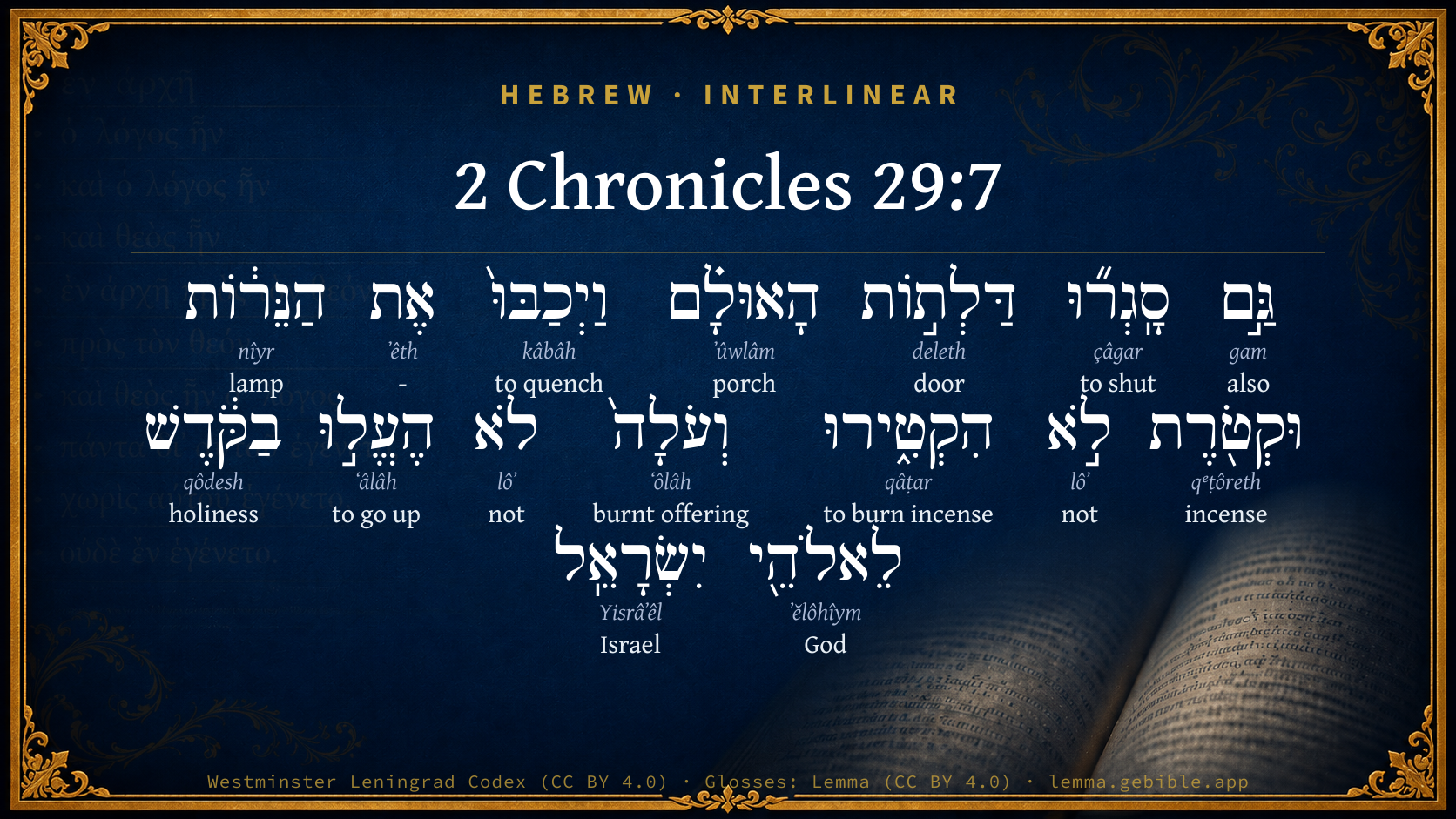
  1. גַּ֣ם gam H1571 “also” Particle, Accusative
  2. סָֽגְר֞וּ çâgar H5462 “to shut” Verb, Qal, Perfect, 3rd Person, Common, Plural
  3. דַּלְת֣וֹת deleth H1817 “doors of” Noun, Common, Feminine, Plural, Construct
  4. הָאוּלָ֗ם ʼûwlâm H197 “the · porch” Particle, Definite Article + Noun, Common, Masculine, Singular, Absolute
  5. אֶת ʼêth H853 “-” Particle, Direct Object
  6. הַנֵּר֔וֹת nîyr H5216 “the · lamps” Particle, Definite Article + Noun, Common, Masculine, Plural, Absolute
  7. וּקְטֹ֖רֶת qᵉṭôreth H7004 “and · incense” Conjunction + Noun, Common, Feminine, Singular, Absolute
  8. לֹ֣א lôʼ H3808 “not” Particle, Negative
  9. הִקְטִ֑ירוּ qâṭar H6999 “to burn incense” Verb, Hiphil, Perfect, 3rd Person, Common, Plural
  10. וְעֹלָה֙ ʻôlâh H5930 “and · burnt offering” Conjunction + Noun, Common, Feminine, Singular, Absolute
  11. לֹא lôʼ H3808 “not” Particle, Negative
  12. הֶעֱל֣וּ ʻâlâh H5927 “to go up” Verb, Hiphil, Perfect, 3rd Person, Common, Plural
  13. בַקֹּ֔דֶשׁ qôdesh H6944 “in/at the · holiness” Preposition, Determined + Noun, Common, Masculine, Singular, Absolute
  14. לֵאלֹהֵ֖י ʼĕlôhîym H430 “to/for · God(s) of” Preposition + Noun, Common, Masculine, Plural, Construct
  15. יִשְׂרָאֵֽל Yisrâʼêl H3478 “Israel” Noun, Proper

About this verse

These counts appear in no published source. They are computed here, from the morphology-tagged text and Lemma’s own curated glosses. What Lemma adds →

16
words
15
distinct lemmas
Historical
section

Notable vocabulary

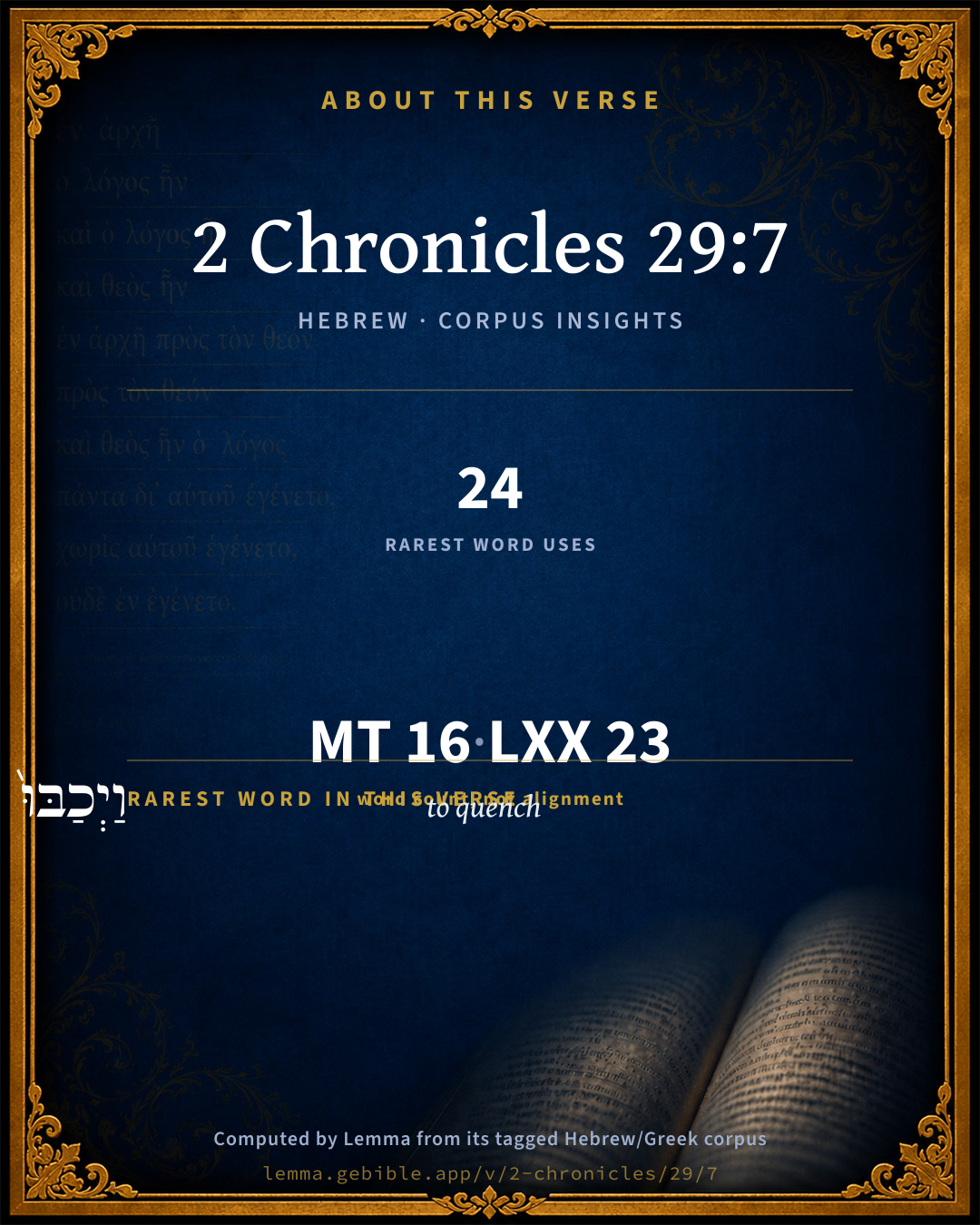
The rarest word here is וַיְכַבּוּ֙ to quench H3518 — appearing just 24 times in the whole Hebrew Bible.

Shared distinctive vocabulary

וַיְכַבּוּ֙ to quench H3518 occurs in 24 verses of the Hebrew Bible. Also found in:

Grammatical profile

  • 4 verbs
  • 8 nouns
  • 4 particles

Verb forms

  • סָֽגְר֞וּ Qal · Perfect
  • וַיְכַבּוּ֙ Piel · Sequential Imperfect
  • הִקְטִ֑ירוּ Hiphil · Perfect
  • הֶעֱל֣וּ Hiphil · Perfect

Repetition

A word recurs within this verse — often emphatic in Hebrew:

Hebrew & Septuagint length

In English translation the verse runs 33 words from the Hebrew and 36 from the Septuagint (LXX English) — closely comparable.

A rough comparison of the two English renderings, which tokenize alike — not a word-level alignment.

Word counts can differ between the Hebrew and the Greek without any difference in meaning — e.g. the Hebrew direct-object marker אֵת has no separate Greek word, and Greek often adds the article ὁ.

In the original languages it is 16 Hebrew tokens and 23 Greek tokens — but the two are counted differently (Hebrew bundles its prefixes and suffixes into one token; the Greek is in lemma form), so that isn’t a like-for-like length.

Cross-references

5

Topical passages linked to 2 Chronicles 29:7 in the Treasury of Scripture Knowledge — connected by theme and wording, ordered by reader-vote popularity; previews shown in the World English Bible.

  • 2 Chronicles 28:24 Ahaz gathered together the vessels of the house of God, and cut in pieces the vessels of the house of God, and shut up the doors of the house of Yahweh; and he made him altars in every corner of Jerusalem.
  • Leviticus 24:2–8 "Command the children of Israel, that they bring to you pure olive oil beaten for the light, to cause a lamp to burn continually.
  • 2 Kings 16:17–18 King Ahaz cut off the panels of the bases, and removed the basin from off them, and took down the sea from off the brazen oxen that were under it, and put it on a pavement of stone.
  • 2 Chronicles 29:3 He in the first year of his reign, in the first month, opened the doors of the house of Yahweh, and repaired them.
  • Malachi 1:10 "Oh that there were one among you who would shut the doors, that you might not kindle fire on my altar in vain! I have no pleasure in you," says Yahweh of hosts, "neither will I accept an offering at your hand.

Cross-references courtesy of OpenBible.info (CC BY 4.0).

Hebrew and Greek witnesses Masoretic Hebrew ↔ Greek Septuagint

The same verse in the two great witnesses to the Old Testament, shown verse-for-verse.

These are two independent witnesses, not word-aligned to each other, and the Septuagint is shown in lemma (dictionary) form.

Hebrew 2 Chronicles 29:7 Masoretic · Westminster Leningrad Codex

גַּ֣ם סָֽגְר֞וּ דַּלְת֣וֹת הָאוּלָ֗ם וַיְכַבּוּ֙ אֶת הַנֵּר֔וֹת וּקְטֹ֖רֶת לֹ֣א הִקְטִ֑ירוּ וְעֹלָה֙ לֹא הֶעֱל֣וּ בַקֹּ֔דֶשׁ לֵאלֹהֵ֖י יִשְׂרָאֵֽל

Also they have shut up the doors of the porch, and put out the lamps, and have not burned incense nor offered burnt offerings in the holy place to the God of Israel.

World English Bible · Public Domain

Greek LXX 2 Chronicles 29:7 Septuagint · lemma form

καί ἀποκλείω ὁ θύρα ὁ ναός καί σβέννυμι ὁ λύχνος καί θυμίαμα οὐ θυμιάω καί ὁλοκαύτωμα οὐ προςφέρω ἐν ὁ ἅγιος θεός ἰσραήλ

And they have shut up the doors of the temple, and put out the lamps, and have not burnt incense, and have not offered whole burnt offerings in the holy place to the God of Israel.

LXX2012 (modern English Septuagint) · Public Domain

Hebrew: Westminster Leningrad Codex (CC BY 4.0). Greek: Septuagint (public domain); English from LXX2012 (modern English Septuagint) (Public Domain). How the Septuagint differs from the Hebrew →

Commentary

Notes on 2 Chronicles 29:7 from classic Christian and Jewish commentators (each source and its license shown beneath its notes). The classic Christian expositions comment on the surrounding passage and are grouped to its opening verse, so a note may address several verses; the Jewish commentaries on the Tanakh (Rashi and others) are per-verse, so they appear only where the commentator wrote on this verse.

Lemma curates 59 commentaries, every one of them public domain or Creative Commons licensed, each selected and text-cleaned for this edition rather than reprinted as found. About our sources →

Trapp's Complete Commentary

John Trapp

2Ch 29:7 Also they have shut up the doors of the porch, and put out the lamps, and have not burned incense nor offered burnt offerings in the holy [place] unto the God of Israel.

Ver. 7. Unto the God of Israel.] Whom they have sacrilegiously robbed and wronged. We should be sensible of, and humbled for, the sins of our forefathers, else we are justly chargeable with them.

John Trapp, A Commentary or Exposition upon All the Books of the Old and New Testament (1647–1656) — public domain. Text from a community e-Sword module.

Ellicott's Commentary for English Readers

(7) The porch.—Of the holy place, or nave of the Temple; the only entrance to the two holy chambers.

Put out the lamps.—Of the great golden stand, in the holy place.

Have not burned incense.—On the golden altar. Literally, And incense they have not burned, and burnt offering they have not offered in the sanctuary. The sanctuary is not the holy place, or larger chamber of the Temple, but it includes the whole sacred precincts, courts as well as buildings. The burnt offerings presented on the new Syrian altar of Ahaz (2Ki_16:15) are here counted as nought, because they were irregular. (Comp. also 2Ki_16:14.)

A Bible Commentary for English Readers, edited by Charles John Ellicott (1878–1897) — public domain. Text from a community e-Sword module.

The Cambridge Bible for Schools and Colleges

gen. ed. J. J. S. Perowne

7. the lamps] Cp. 2Ch_13:11; Exo_25:31 ff.

The Cambridge Bible for Schools and Colleges (gen. ed. J. J. S. Perowne; Cambridge University Press, 1878–1918) — public domain. Text from a community e-Sword module.

John Gill's Exposition

Wherefore the wrath of the Lord was upon. Judah and Jerusalem,.... As appeared, by suffering the Syrians, and Israelites, and Edomites, and Philistines, to come upon them, and distress them, as the history of the preceding chapter shows:

and he hath delivered them to trouble, to astonishment, and to hissing, as ye see with your eyes; such desolation and destruction were made among them, as not only threw them into a stupor, that they knew not what to do, but were amazing to all their neighbours, and caused them to hiss at them, which they could not but be sensible of.

John Gill's Exposition of the Whole Bible (1746–1763) — public domain (CC PDM 1.0). Text via the HelloAO Bible API.

Haydock's Catholic Bible Commentary

Sanctuary, or court of the priests, where the victims were slain. The blood of some was taken into the most holy place, on the day of expiation. C.

George Leo Haydock (1774–1849), Haydock's Catholic Family Bible and Commentary, 1859 edition — public domain. Excludes Psalms (Douay-Rheims chapter numbering differs from Protestant) and Deuterocanonical books (Catholic canon only).

Whedon's Commentary on the Bible

Daniel D. Whedon

7. Shut up the doors — See 2Ch_28:24, note.

Daniel D. Whedon (gen. ed.), Commentary on the Old and New Testaments (1874–1909) — public domain. Text from a community e-Sword module.

The Pulpit Commentary

This verse is the answering echo of 2Ch_28:24.

The Pulpit Commentary (1880–1919), ed. H.D.M. Spence-Jones & Joseph S. Exell — public domain. Text from a community e-Sword module.

John Wesley's Explanatory Notes

They - He saith not, my father, because it became him as a son, to be as tender as might be of his father's name: and because his father would not have done all this, if their fathers had not neglected their duty.

John Wesley, Explanatory Notes Upon the Whole Bible (1754–1765) — public domain. Text via the GEBible commentary corpus.

Rashi

Rabbi Shlomo Yitzchaki (Rashi)

extinguished the lamps, and they did not burn incense nor offer up burnt offerings in the Sanctuary to the God of Israel but they made high places to alien gods in every city, to burn incense to them.

Rashi on the Tanakh — English translations: “The Judaica Press complete Tanach with Rashi, translated by A. J. Rosenberg” (CC BY 4.0); “Pentateuch with Rashi's commentary by M. Rosenbaum and A.M. Silbermann, 1929-1934” (public domain); “The Metsudah Tanach series, Lakewood, N.J” (CC BY 4.0); and “The Book of Joshua, Metsudah Publications, 1997” (CC BY 4.0). Text via Sefaria.

Lesson kit

Teaching starters — assembled from the data on this page, not authored interpretation. Every prompt links to the verse data it draws on. Edit before teaching.

2 Chronicles, in the Historical, opens this verse with 16 words (15 distinct Hebrew lemmas). Its most distinctive word is kâbâh (“to quench”). A historical commentator’s framing appears above. Read the whole chapter for the surrounding context.

Discussion questions

  1. How does “to quench” (kâbâh) shape what this verse is saying?
  2. Leviticus 6:12 shares the word «to quench» with this verse. How do the two illuminate each other?
  3. “not” occurs 2× in this one verse. What is the effect of the repetition?
  4. These translations render this verse differently; the difference is in the English rendering, not the original. What questions does that raise?
  5. The verb «סָֽגְר֞וּ» is Qal Perfect. How does its form color the action?
  6. Reading how Trapp's Complete Commentary and Ellicott's Commentary for English Readers read this verse, where do the two commentators agree and where do they part?

Things to notice

Reading settings

Reading text

Shown beneath each verse's original-language words.

Old Testament
Old Testament edition

Read the OT as the Masoretic Hebrew (MT) or the Greek Septuagint (LXX).

English shown for the Greek Septuagint (in the Hebrew ↔ Greek comparison).

Comparing translations? Open the Compare panel on any verse page to stack up to four side by side.