Exodus 37:29

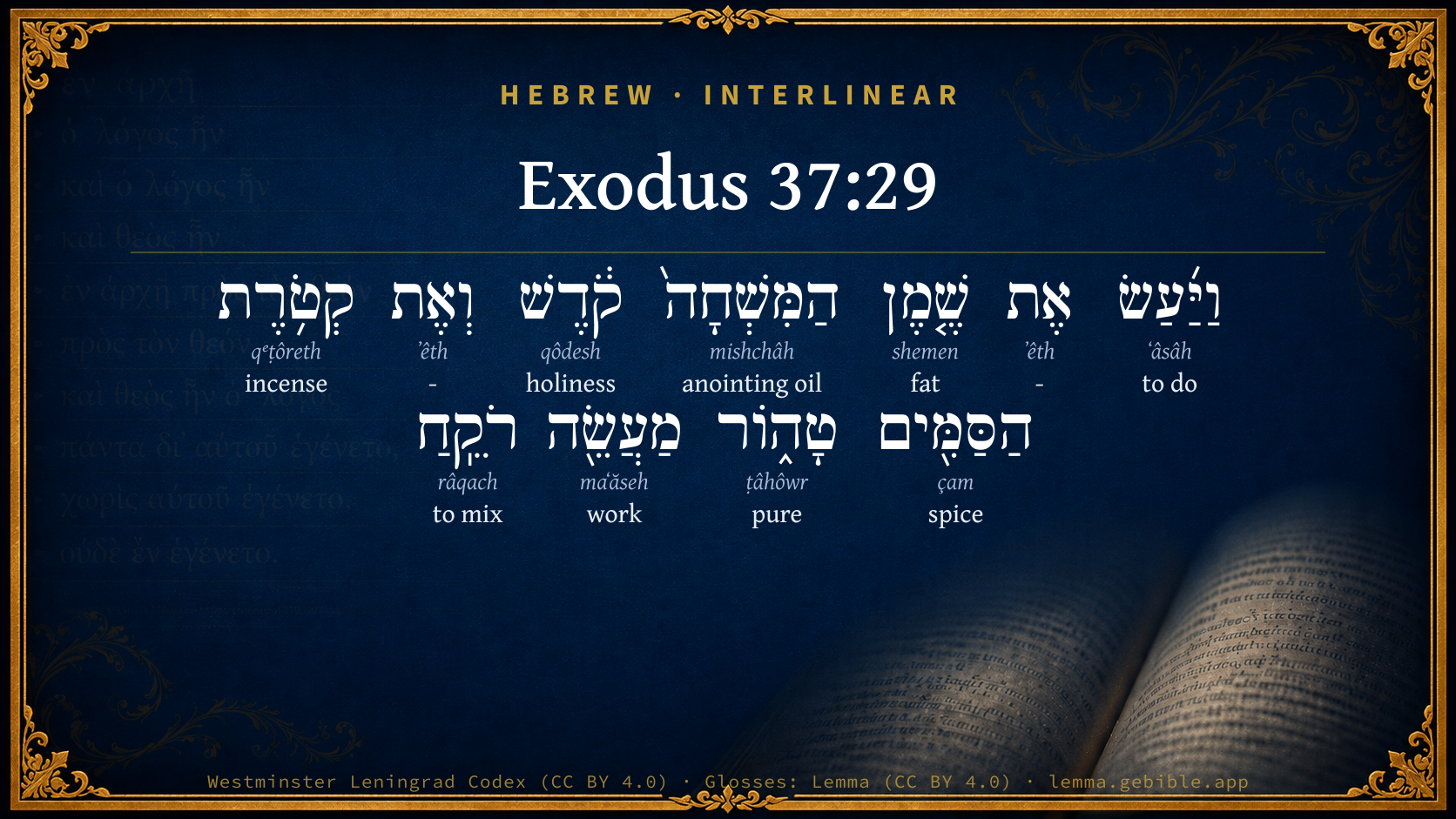
Hebrew (Westminster Leningrad Codex) Exodus 37:29 appears in the Hebrew Old Testament. The text above is from the Westminster Leningrad Codex. Each word links to its Strong’s number, a concise gloss, and parsing drawn from the Open Scriptures Hebrew Bible morphology. Click any word for its full Brown-Driver-Briggs (BDB) entry.
Download image
Cite this verse

Exodus 37:29 (World English Bible). Public Domain. Lemma interlinear Bible study tool, https://lemma.gebible.app/v/exodus/37/29.

Show BibTeX & RIS
BibTeX
RIS
English Translation
He made the holy anointing oil and the pure incense of sweet spices, after the art of the perfumer.
World English Bible · Public Domain
Download a study sheet

One document with this verse’s original text, its word-by-word gloss line, the meaning frame, cross-references with their text, attributed commentary, and full source and license credits — printable, and it pastes into notes with its structure intact.

This verse Autodidact and up

Study sheet (.html) Plain text (.txt)

A passage Seminary Student

Up to 50 verses in one chapter. A passage sheet keeps up to 6 commentary sources and 12 cross-references per verse, in the order this page ranks them, and says so on the sheet whenever that leaves anything out. Ask for a single verse and you get the Autodidact verse sheet above.

Everything on this page stays free to read, with no account — the sheet is a download of what is already on screen, not access to it.

Want to remove ads? Support Godless Engineer
Compare translations 3

The same verse in 3 English versions, stacked beneath the original-language interlinear above. Click any original word for its lexicon entry.

Each is an independent rendering of the whole verse — the interlinear is not word-aligned to these translations.

Highlighted words mark where these versions differ — a whole-verse word diff, not a word-by-word alignment.

  • World English Bible Public Domain
    He made the holy anointing oil and the pure incense of sweet spices, after the art of the perfumer.
  • King James Version Public Domain
    And he made the holy anointing oil, and the pure incense of sweet spices, according to the work of the apothecary.
  • unfoldingWord Literal Text CC BY-SA 4.0
    And he made the oil of anointment of holiness and the pure incense of fragrance, the work of an ointment maker.

unfoldingWord Literal Text — © unfoldingWord, licensed CC BY-SA 4.0. Word-aligned USFM3 via Door43 (git.door43.org/unfoldingWord/en_ult).

Versions to compare (up to 4)

3 of 4 selected

Show all 18 translations

Every available English version of this verse, each an independent rendering of the whole verse.

  • World English Bible Public Domain
    He made the holy anointing oil and the pure incense of sweet spices, after the art of the perfumer.
  • Berean Standard Bible Public Domain
    He also made the sacred anointing oil and the pure, fragrant incense, the work of a perfumer.
  • Majority Standard Bible Public Domain
    He also made the sacred anointing oil and the pure, fragrant incense, the work of a perfumer.
  • King James Version Public Domain
    And he made the holy anointing oil, and the pure incense of sweet spices, according to the work of the apothecary.
  • American Standard Version (1901) Public Domain
    And he made the holy anointing oil, and the pure incense of sweet spices, after the art of the perfumer.
  • Revised Version (1885) Public Domain
    And he made the holy anointing oil, and the pure incense of sweet spices, after the art of the perfumer.
  • Geneva Bible (1599) Public Domain
    And he made the holy anointing oyle, and the sweete pure incense after ye apothecaries arte.
  • Douay-Rheims (1899) Public Domain
    He compounded also the oil for the ointment of sanctification, and incense of the purest spices, according to the work of a perfumer.
  • Young's Literal Translation Public Domain
    and he maketh the holy anointing oil, and the pure spice-perfume -- work of a compounder.
  • Literal Standard Version CC BY-SA 4.0
    and he makes the holy anointing oil, and the pure spice-incense—work of a compounder.
  • Unlocked Literal Bible CC BY-SA 4.0
    He made the holy anointing oil and the pure fragrant incense, the work of a perfumer.
  • unfoldingWord Literal Text CC BY-SA 4.0
    And he made the oil of anointment of holiness and the pure incense of fragrance, the work of an ointment maker.
  • Darby Bible Public Domain
    And he made the holy anointing oil, and the pure incense of fragrant drugs, according to the work of the perfumer.
  • World Messianic Bible Public Domain
    He made the holy anointing oil and the pure incense of sweet spices, after the art of the perfumer.
  • Webster's Bible Public Domain
    And he made the holy anointing oil, and the pure incense of sweet spices, according to the work of the apothecary.
  • Free Bible Version CC BY-SA 4.0
    He made the holy anointing oil and the pure, aromatic incense like the product of an expert perfumer.
  • Bible in Basic English Public Domain
    And he made the holy oil and the perfume of sweet spices for burning, after the art of the perfume-maker.
  • JPS Tanakh (1917) Public Domain
    And he made the holy anointing oil, and the pure incense of sweet spices, after the art of the perfumer.

Literal Standard Version (2020), Covenant Press — licensed CC BY-SA 4.0. Text via the HelloAO Bible API (eBible.org). Unlocked Literal Bible (unfoldingWord) — licensed CC BY-SA 4.0. Text via the HelloAO Bible API (eBible.org). unfoldingWord Literal Text — © unfoldingWord, licensed CC BY-SA 4.0. Word-aligned USFM3 via Door43 (git.door43.org/unfoldingWord/en_ult). Free Bible Version, Dr. Jonathan Gallagher — licensed CC BY-SA 4.0. Text via the HelloAO Bible API (eBible.org).

Word by word

More ways to search: Search by grammar → Find every occurrence → Compare this word →

Practice this passage: Drill this verse → Learn its vocabulary →

רֹקֵֽחַ
râqach
H7543
“mixing”
Verb, Qal, Participle Active, Masculine, Singular, Absolute
Part of Speech
Verb
Stem
Qal
Form
Participle Active
Gender
Masculine
Number
Singular
State
Absolute
Full BDB Definition

Origin: a primitive root

TWOT: 2215

to mix, compound - (Qal) - to mix, compound - compounder, mixer, perfumer (participle) (substantive) - (Pual) mixed (participle) - (Hiphil) to mix
  1. וַיַּ֜עַשׂ ʻâsâh H6213 “and · to do” Conjunction + Verb, Qal, Sequential Imperfect, 3rd Person, Masculine, Singular
  2. אֶת ʼêth H853 “-” Particle, Direct Object
  3. שֶׁ֤מֶן shemen H8081 “fat of” Noun, Common, Masculine, Singular, Construct
  4. הַמִּשְׁחָה֙ mishchâh H4888 “the · anointing oil” Particle, Definite Article + Noun, Common, Feminine, Singular, Absolute
  5. קֹ֔דֶשׁ qôdesh H6944 “holiness” Noun, Common, Masculine, Singular, Absolute
  6. וְאֶת ʼêth H853 “and · -” Conjunction + Particle, Direct Object
  7. קְטֹ֥רֶת qᵉṭôreth H7004 “incense of” Noun, Common, Feminine, Singular, Construct
  8. הַסַּמִּ֖ים çam H5561 “the · spices” Particle, Definite Article + Noun, Common, Masculine, Plural, Absolute
  9. טָה֑וֹר ṭâhôwr H2889 “pure” Adjective, Adjective, Masculine, Singular, Absolute
  10. מַעֲשֵׂ֖ה maʻăseh H4639 “work of” Noun, Common, Masculine, Singular, Construct

About this verse

These counts appear in no published source. They are computed here, from the morphology-tagged text and Lemma’s own curated glosses. What Lemma adds →

11
words
10
distinct lemmas
Pentateuch
section

Notable vocabulary

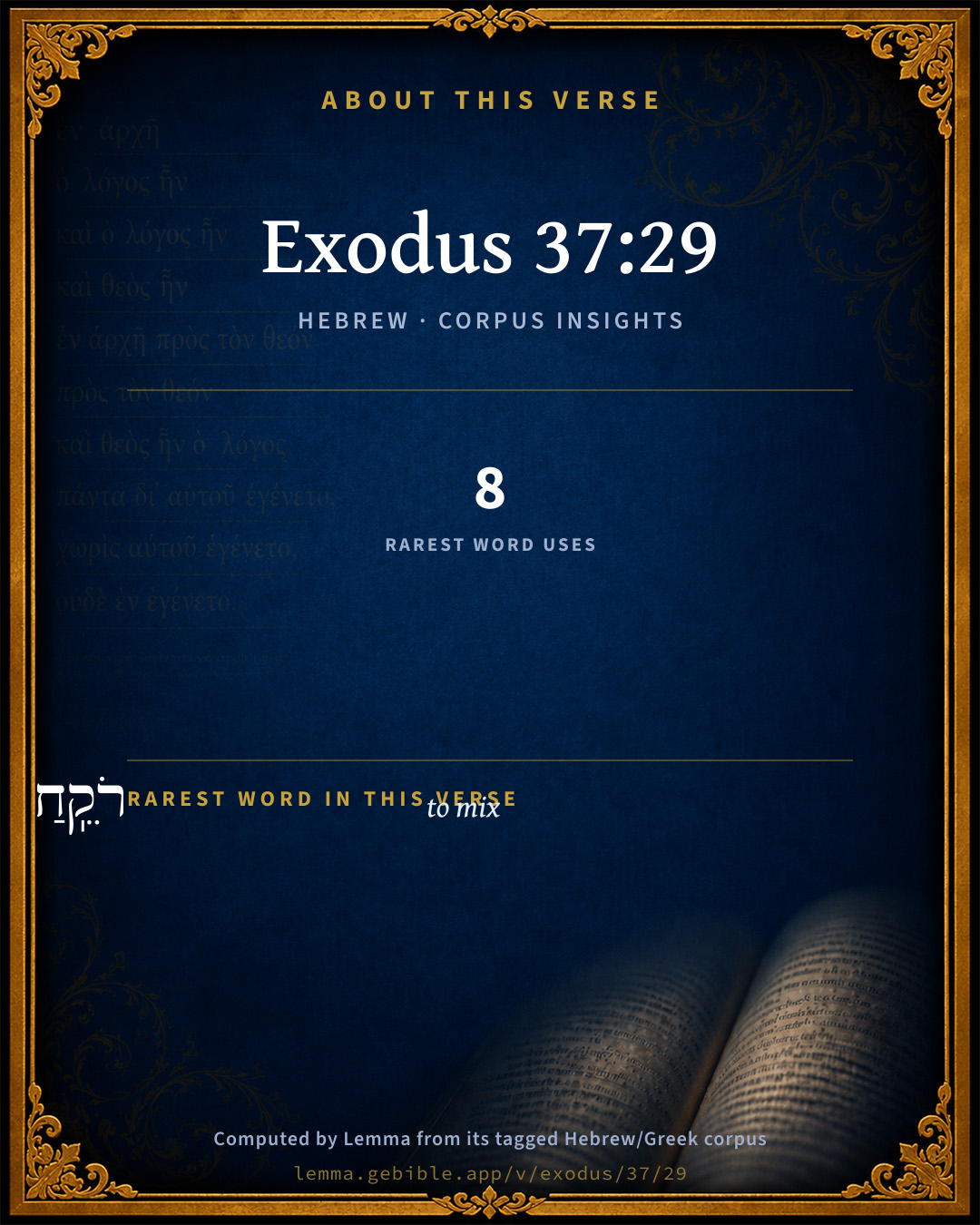
The rarest word here is רֹקֵֽחַ to mix H7543 — appearing just 8 times in the whole Hebrew Bible.

Shared distinctive vocabulary

רֹקֵֽחַ to mix H7543 occurs in 8 verses of the Hebrew Bible. Also found in:

Grammatical profile

  • 2 verbs
  • 6 nouns
  • 1 adjective
  • 2 particles

Verb forms

  • וַיַּ֜עַשׂ Qal · Sequential Imperfect
  • רֹקֵֽחַ Qal · Participle Active

Cross-references

16

Topical passages linked to Exodus 37:29 in the Treasury of Scripture Knowledge — connected by theme and wording, ordered by reader-vote popularity; previews shown in the World English Bible.

  • Exodus 30:23–38 "Also take fine spices: of liquid myrrh, five hundred shekels; and of fragrant cinnamon half as much, even two hundred and fifty; and of fragrant cane, two hundred and fifty;
  • Psalms 14:1–2 The fool has said in his heart, "There is no God." They are corrupt. They have done abominable works. There is none who does good.
  • Psalms 23:5 You prepare a table before me in the presence of my enemies. You anoint my head with oil. My cup runs over.
  • Psalms 92:10 But you have exalted my horn like that of the wild ox. I am anointed with fresh oil.
  • Psalms 141:2 Let my prayer be set before you like incense; The lifting up of my hands like the evening sacrifice.
  • Ecclesiastes 10:1 Dead flies cause the oil of the perfumer to send forth an evil odor; so does a little folly outweigh wisdom and honor.
  • Isaiah 11:2 The Spirit of Yahweh shall rest on him, the spirit of wisdom and understanding, the spirit of counsel and might, the spirit of knowledge and of the fear of Yahweh.
  • Isaiah 61:1 The Spirit of the Lord Yahweh is on me; because Yahweh has anointed me to preach good news to the humble; he has sent me to bind up the broken-hearted, to proclaim liberty to the captives, and the opening [of the prison] to those who are bound;
  • Isaiah 61:3 to appoint to those who mourn in Zion, to give to them a garland for ashes, the oil of joy for mourning, the garment of praise for the spirit of heaviness; that they may be called trees of righteousness, the planting of Yahweh, that he may be glorified.
  • John 3:34 For he whom God has sent speaks the words of God; for God gives the Spirit without measure.
  • 2 Corinthians 1:21–22 Now he who establishes us with you in Christ, and anointed us, is God;
  • Hebrews 5:7 He, in the days of his flesh, having offered up prayers and petitions with strong crying and tears to him who was able to save him from death, and having been heard for his godly fear,
  • Hebrews 7:25 Therefore he is also able to save to the uttermost those who draw near to God through him, seeing he ever lives to make intercession for them.
  • 1 John 2:20 You have an anointing from the Holy One, and you know the truth.
  • 1 John 2:27 As for you, the anointing which you received from him remains in you, and you don't need for anyone to teach you. But as his anointing teaches you concerning all things, and is true, and is no lie, and even as it taught you, you will remain in him.
  • Revelation 8:3–4 Another angel came and stood over the altar, having a golden censer. Much incense was given to him, that he should add it to the prayers of all the saints on the golden altar which was before the throne.

Cross-references courtesy of OpenBible.info (CC BY 4.0).

Hebrew and Greek witnesses Masoretic Hebrew ↔ Greek Septuagint

The same verse in the two great witnesses to the Old Testament, shown verse-for-verse.

These are two independent witnesses, not word-aligned to each other, and the Septuagint is shown in lemma (dictionary) form.

Hebrew Exodus 37:29 Masoretic · Westminster Leningrad Codex

וַיַּ֜עַשׂ אֶת שֶׁ֤מֶן הַמִּשְׁחָה֙ קֹ֔דֶשׁ וְאֶת קְטֹ֥רֶת הַסַּמִּ֖ים טָה֑וֹר מַעֲשֵׂ֖ה רֹקֵֽחַ

He made the holy anointing oil and the pure incense of sweet spices, after the art of the perfumer.

World English Bible · Public Domain

Hebrew: Westminster Leningrad Codex (CC BY 4.0). Greek: Septuagint (public domain); English from a public-domain English Septuagint. How the Septuagint differs from the Hebrew →

Targum (Aramaic paraphrase)

2

The Targum is the ancient Jewish Aramaic paraphrase of the Hebrew Scriptures — an interpretive translation, not the Hebrew text itself. Onkelos (literal) and Pseudo-Jonathan (expansive) render the Torah, and Jonathan the Prophets. Coverage is partial: where no permissively-licensed English translation exists for a verse, only the Aramaic is shown. This is verse-level text, not a word-by-word alignment to the Hebrew.

  1. Targum Onkelos Torah (Genesis–Deuteronomy)
    וַעֲבַד יָת מִשְׁחָא דִרְבוּתָא קוּדְשָׁא וְיָת קְטֹרֶת בּוּסְמַיָא דְכֵי עוֹבַד בּוּסְמָנוּ:

    (no public-domain English translation for this verse)

    Targum Onkelos — Aramaic: “Onkelos Genesis” (public domain); “Onkelos Exodus” (public domain); “Onkelos Leviticus” (public domain); “Onkelos Numbers” (public domain); “Onkelos Deuteronomy” (public domain). English: “Sefaria Community Translation” (CC0 1.0 (public-domain dedication)); “J.W. Etheridge. The Targums of Onkelos and Jonathan Ben Uzziel on the Pentateuch. London: Longmans, Green, 1862” (public domain). Text via Sefaria.

  2. Targum Pseudo-Jonathan Torah (Genesis–Deuteronomy)
    וַעֲבַד יַת מִשְׁחָא דִרְבוּתָא קוּדְשָׁא וְיַת קְטוֹרֶת בּוּסְמַיָא דְכֵי עוֹבַד בּוּסְמָנוּ

    And he made the sacred oil of anointing, and the pure sweet incense, the work of the perfumer.

    Targum Pseudo-Jonathan — Aramaic: “Targum Jonathan on Genesis” (public domain); “Targum Jonathan on Exodus” (public domain); “Targum Jonathan on Leviticus” (public domain); “Targum Jonathan on Numbers” (public domain); “Targum Jonathan on Deuteronomy” (public domain). English: “The Targum of Jonathan ben Uzziel, trans. J. W. Etheridge, London, 1862” (public domain). Text via Sefaria.

Commentary

Notes on Exodus 37:29 from classic Christian and Jewish commentators (each source and its license shown beneath its notes). The classic Christian expositions comment on the surrounding passage and are grouped to its opening verse, so a note may address several verses; the Jewish commentaries on the Tanakh (Rashi and others) are per-verse, so they appear only where the commentator wrote on this verse.

Lemma curates 59 commentaries, every one of them public domain or Creative Commons licensed, each selected and text-cleaned for this edition rather than reprinted as found. About our sources →

Adam Clarke's Commentary

Verse 29. He made the holy anointing oil] See this and the perfume, and the materials out of which they were made, described at large in the notes on Ex 30:23-25 and Ex 30:34-38. As this chapter also is a repetition of what has been mentioned in preceding chapters, the reader is desired to refer to them.

Adam Clarke's Commentary on the Bible (1810–1826) — public domain. Text from a community e-Sword/MySword module.

Ellicott's Commentary for English Readers

(29) In this verse we have the composition by Bezaleel of the holy oil and the incense, described in Exo_30:22-25; Exo_30:34-35, related with the utmost brevity.

A Bible Commentary for English Readers, edited by Charles John Ellicott (1878–1897) — public domain. Text from a community e-Sword module.

The Cambridge Bible for Schools and Colleges

gen. ed. J. J. S. Perowne

29. The holy Anointing Oil, and the Incense. A summary abridgement of Exo_30:22-25; Exo_30:34-35; Exo_30:26-33; Exo_30:36-38, also, being not repeated.

The Cambridge Bible for Schools and Colleges (gen. ed. J. J. S. Perowne; Cambridge University Press, 1878–1918) — public domain. Text from a community e-Sword module.

The Pulpit Commentary

The holy anointing oil. For the composition of the oil, see Exo_30:23-25; for the uses whereto it was to be applied, ib, 26-30. The pure incense of sweet spices. The composition of the incense is given Exo_30:34, Exo_30:35. It is there said to have been "a confection after the art of the apothecary tempered together, pure and holy." The combination of artistic power with practical knowledge in Bezaleel and Ahollab calls to mind cinque-cento Italy, and the wonderful grasp of art and science possessed by Michael Angelo and Benvenuto Cellini

The Pulpit Commentary (1880–1919), ed. H.D.M. Spence-Jones & Joseph S. Exell — public domain. Text from a community e-Sword module.

Ramban (Nachmanides)

Rabbi Moshe ben Nachman (Ramban / Nachmanides)

AND HE MADE THE HOLY ANOINTING OIL, AND THE PURE INCENSE OF SWEET SPICES. Scripture did not explain these as it did with the others, for according to the way it writes about the others it should have said, “and he took the chief spices, of flowing myrrh etc., and he made them into the holy anointing oil; and he took sweet spices, stacte, and onycha etc., Verse 34. and he made them into an incense compounded after the art of the perfumers.” But the reason [for Scripture not saying so] is because He did not state the whole process of the making of the oil of anointment when He gave the command for them, as I have explained there., Verse 34. In the making of the incense likewise it does not mention all the spices, but relied on them [the craftsmen who made the Tabernacle] by saying that it should be made after the art of the perfumer, Verse 35. and therefore when they made it Scripture only mentioned that they made it according to the way of the perfumers. This is the sense of the expression, holy… pure, after the art of the perfumer.

Ramban (Nachmanides) on the Tanakh — English translation: “Commentary on the Torah by Ramban (Nachmanides). Translated and annotated by Charles B. Chavel. New York, Shilo Pub. House, 1971-1976” (CC BY 4.0). Text via Sefaria.

Lesson kit

Teaching starters — assembled from the data on this page, not authored interpretation. Every prompt links to the verse data it draws on. Edit before teaching.

Exodus, in the Pentateuch, opens this verse with 11 words (10 distinct Hebrew lemmas). Its most distinctive word is râqach (“to mix”). A historical commentator’s framing appears above. Read the whole chapter for the surrounding context.

Discussion questions

  1. The word râqach carries the sense “to mix.” How does it shape the verse?
  2. How does Exodus 30:25, which shares the word «to mix», read alongside this verse?
  3. These translations render this verse differently. What is at stake in choosing one wording over another?
  4. «וַיַּ֜עַשׂ» is a Qal Sequential Imperfect verb. How does that grammatical form shape the action described?
  5. Compare how Adam Clarke's Commentary and Ellicott's Commentary for English Readers read this verse. Where do they agree or differ?

Things to notice

Reading settings

Reading text

Shown beneath each verse's original-language words.

Old Testament
Old Testament edition

Read the OT as the Masoretic Hebrew (MT) or the Greek Septuagint (LXX).

English shown for the Greek Septuagint (in the Hebrew ↔ Greek comparison).

Comparing translations? Open the Compare panel on any verse page to stack up to four side by side.