Numbers 3:28

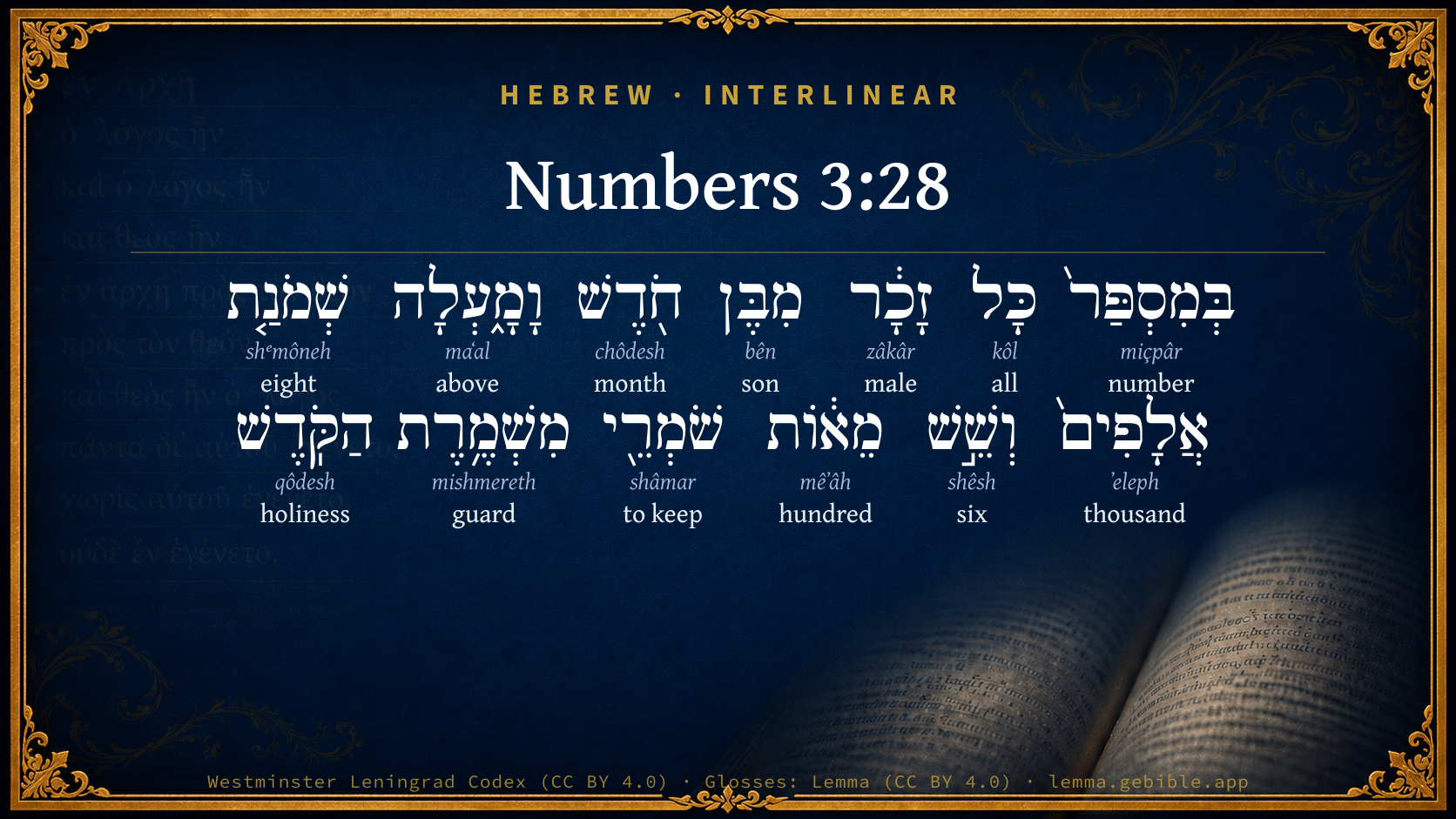
Hebrew (Westminster Leningrad Codex) Numbers 3:28 appears in the Hebrew Old Testament. The text above is from the Westminster Leningrad Codex. Each word links to its Strong’s number, a concise gloss, and parsing drawn from the Open Scriptures Hebrew Bible morphology. Click any word for its full Brown-Driver-Briggs (BDB) entry.
Download image
Cite this verse

Numbers 3:28 (World English Bible). Public Domain. Lemma interlinear Bible study tool, https://lemma.gebible.app/v/numbers/3/28.

Show BibTeX & RIS
BibTeX
RIS
English Translation
According to the number of all the males, from a month old and upward, there were eight thousand six hundred, keeping the charge of the sanctuary.
World English Bible · Public Domain
Download a study sheet

One document with this verse’s original text, its word-by-word gloss line, the meaning frame, cross-references with their text, attributed commentary, and full source and license credits — printable, and it pastes into notes with its structure intact.

This verse Autodidact and up

Study sheet (.html) Plain text (.txt)

A passage Seminary Student

Up to 50 verses in one chapter. A passage sheet keeps up to 6 commentary sources and 12 cross-references per verse, in the order this page ranks them, and says so on the sheet whenever that leaves anything out. Ask for a single verse and you get the Autodidact verse sheet above.

Everything on this page stays free to read, with no account — the sheet is a download of what is already on screen, not access to it.

Want to remove ads? Support Godless Engineer
Compare translations 3

The same verse in 3 English versions, stacked beneath the original-language interlinear above. Click any original word for its lexicon entry.

Each is an independent rendering of the whole verse — the interlinear is not word-aligned to these translations.

Highlighted words mark where these versions differ — a whole-verse word diff, not a word-by-word alignment.

  • World English Bible Public Domain
    According to the number of all the males, from a month old and upward, there were eight thousand six hundred, keeping the charge of the sanctuary.
  • King James Version Public Domain
    In the number of all the males, from a month old and upward, were eight thousand and six hundred, keeping the charge of the sanctuary.
  • unfoldingWord Literal Text CC BY-SA 4.0
    By the number of every male from a son of a month and upward, 8,600 the keepers of the keeping of the holy place.

unfoldingWord Literal Text — © unfoldingWord, licensed CC BY-SA 4.0. Word-aligned USFM3 via Door43 (git.door43.org/unfoldingWord/en_ult).

Versions to compare (up to 4)

3 of 4 selected

Show all 18 translations

Every available English version of this verse, each an independent rendering of the whole verse.

  • World English Bible Public Domain
    According to the number of all the males, from a month old and upward, there were eight thousand six hundred, keeping the charge of the sanctuary.
  • Berean Standard Bible Public Domain
    The number of all the males a month old or more was 8,600. They were responsible for the duties of the sanctuary.
  • Majority Standard Bible Public Domain
    The number of all the males a month old or more was 8,600. They were responsible for the duties of the sanctuary.
  • King James Version Public Domain
    In the number of all the males, from a month old and upward, were eight thousand and six hundred, keeping the charge of the sanctuary.
  • American Standard Version (1901) Public Domain
    According to the number of all the males, from a month old and upward, there were eight thousand and six hundred, keeping the charge of the sanctuary.
  • Revised Version (1885) Public Domain
    According to the number of all the males, from a month old and upward, there were eight thousand and six hundred, keeping the charge of the sanctuary.
  • Geneva Bible (1599) Public Domain
    The nomber of all the males from a moneth olde and aboue was eight thousand and sixe hundreth, hauing the charge of the Sanctuarie.
  • Douay-Rheims (1899) Public Domain
    All of the male sex from one month and upward, eight thousand six hundred: they shall have the guard of the sanctuary,
  • Young's Literal Translation Public Domain
    In number, all the males, from a son of a month and upward, `are' eight thousand and six hundred, keeping the charge of the sanctuary.
  • Literal Standard Version CC BY-SA 4.0
    In number, all the males, from a son of a month and upward, [are] eight thousand and six hundred, keeping the charge of the holy place.
  • Unlocked Literal Bible CC BY-SA 4.0
    8,600 males have been counted aged one month old and older to take care of the things that belong to Yahweh.
  • unfoldingWord Literal Text CC BY-SA 4.0
    By the number of every male from a son of a month and upward, 8,600 the keepers of the keeping of the holy place.
  • Darby Bible Public Domain
    According to the number of all the males, from a month old and upward, there were eight thousand six hundred, who kept the charge of the sanctuary.
  • World Messianic Bible Public Domain
    According to the number of all the males from a month old and upward, there were eight thousand six hundred keeping the requirements of the sanctuary.
  • Webster's Bible Public Domain
    In the number of all the males from a month old and upward, were eight thousand and six hundred, keeping the charge of the sanctuary.
  • Free Bible Version CC BY-SA 4.0
    The total of all males aged one month or older was 8,600. Their assigned responsibility was to take care of the sanctuary.
  • Bible in Basic English Public Domain
    Those who were numbered of them, the males from one month old and over, were eight thousand, six hundred, who were responsible for the care of the holy place.
  • JPS Tanakh (1917) Public Domain
    according to the number of all the males, from a month old and upward, eight thousand and six hundred, keepers of the charge of the sanctuary.

Literal Standard Version (2020), Covenant Press — licensed CC BY-SA 4.0. Text via the HelloAO Bible API (eBible.org). Unlocked Literal Bible (unfoldingWord) — licensed CC BY-SA 4.0. Text via the HelloAO Bible API (eBible.org). unfoldingWord Literal Text — © unfoldingWord, licensed CC BY-SA 4.0. Word-aligned USFM3 via Door43 (git.door43.org/unfoldingWord/en_ult). Free Bible Version, Dr. Jonathan Gallagher — licensed CC BY-SA 4.0. Text via the HelloAO Bible API (eBible.org).

Word by word

More ways to search: Search by grammar → Find every occurrence → Compare this word →

Practice this passage: Drill this verse → Learn its vocabulary →

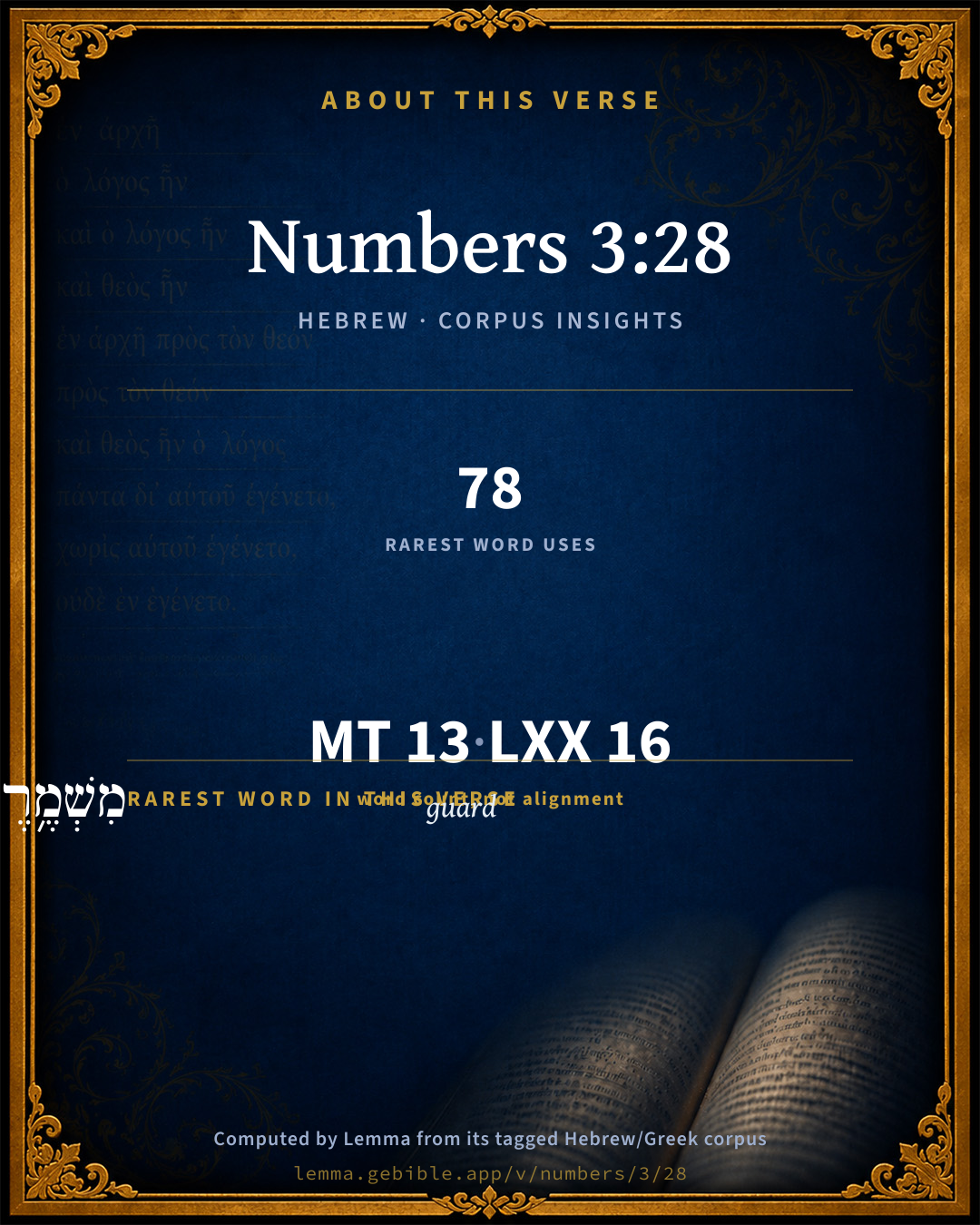
מִשְׁמֶ֥רֶת
mishmereth
H4931
“guard of”
Noun, Common, Feminine, Singular, Construct
Part of Speech
Noun
Type
Common
Gender
Feminine
Number
Singular
State
Construct
Full BDB Definition

Origin: from H4929

TWOT: 2414g

guard, charge, function, obligation, service, watch - guard, watch, house of detention or confinement - keeping, preserving - charge, injunction - office, function (ceremonial)
  1. בְּמִסְפַּר֙ miçpâr H4557 “in/at · number of” Preposition + Noun, Common, Masculine, Singular, Construct
  2. כָּל kôl H3605 “all of” Noun, Common, Masculine, Singular, Construct
  3. זָכָ֔ר zâkâr H2145 “male” Adjective, Adjective, Masculine, Singular, Absolute
  4. מִבֶּן bên H1121 “from · son of” Preposition + Noun, Common, Masculine, Singular, Construct
  5. חֹ֖דֶשׁ chôdesh H2320 “month” Noun, Common, Masculine, Singular, Absolute
  6. וָמָ֑עְלָה maʻal H4605 “and · above · toward” Conjunction + Adverb + Suffix, Demonstrative
  7. שְׁמֹנַ֤ת shᵉmôneh H8083 “eight” Adjective, Cardinal number, Masculine, Singular, Construct
  8. אֲלָפִים֙ ʼeleph H505 “thousand” Adjective, Cardinal number, Both, Plural, Absolute
  9. וְשֵׁ֣שׁ shêsh H8337 “and · six” Conjunction + Adjective, Cardinal number, Feminine, Singular, Absolute
  10. מֵא֔וֹת mêʼâh H3967 “hundred” Adjective, Cardinal number, Both, Plural, Absolute
  11. שֹׁמְרֵ֖י shâmar H8104 “keeping” Verb, Qal, Participle Active, Masculine, Plural, Construct
  12. הַקֹּֽדֶשׁ qôdesh H6944 “the · holiness” Particle, Definite Article + Noun, Common, Masculine, Singular, Absolute

About this verse

These counts appear in no published source. They are computed here, from the morphology-tagged text and Lemma’s own curated glosses. What Lemma adds →

13
words
13
distinct lemmas
Pentateuch
section

Grammatical profile

  • 1 verb
  • 6 nouns
  • 5 adjectives
  • 1 adverb

Verb forms

  • שֹׁמְרֵ֖י Qal · Participle Active

Hebrew & Septuagint length

In English translation the verse runs 26 words from the Hebrew and 20 from the Septuagint (LXX English) — closely comparable.

A rough comparison of the two English renderings, which tokenize alike — not a word-level alignment.

Word counts can differ between the Hebrew and the Greek without any difference in meaning — e.g. the Hebrew direct-object marker אֵת has no separate Greek word, and Greek often adds the article ὁ.

In the original languages it is 13 Hebrew tokens and 16 Greek tokens — but the two are counted differently (Hebrew bundles its prefixes and suffixes into one token; the Greek is in lemma form), so that isn’t a like-for-like length.

Cross-references

3

Topical passages linked to Numbers 3:28 in the Treasury of Scripture Knowledge — connected by theme and wording, ordered by reader-vote popularity; previews shown in the World English Bible.

  • Numbers 3:7 They shall keep his charge, and the charge of the whole congregation before the Tent of Meeting, to do the service of the tabernacle.
  • Numbers 3:31 Their charge shall be the ark, the table, the lamp stand, the altars, the vessels of the sanctuary with which they minister, and the screen, and all its service.
  • Numbers 4:35–36 from thirty years old and upward even to fifty years old, everyone who entered into the service, for work in the Tent of Meeting.

Cross-references courtesy of OpenBible.info (CC BY 4.0).

Hebrew and Greek witnesses Masoretic Hebrew ↔ Greek Septuagint

The same verse in the two great witnesses to the Old Testament, shown verse-for-verse.

These are two independent witnesses, not word-aligned to each other, and the Septuagint is shown in lemma (dictionary) form.

Hebrew Numbers 3:28 Masoretic · Westminster Leningrad Codex

בְּמִסְפַּר֙ כָּל זָכָ֔ר מִבֶּן חֹ֖דֶשׁ וָמָ֑עְלָה שְׁמֹנַ֤ת אֲלָפִים֙ וְשֵׁ֣שׁ מֵא֔וֹת שֹׁמְרֵ֖י מִשְׁמֶ֥רֶת הַקֹּֽדֶשׁ

According to the number of all the males, from a month old and upward, there were eight thousand six hundred, keeping the charge of the sanctuary.

World English Bible · Public Domain

Greek LXX Numbers 3:28 Septuagint · lemma form

κατά ἀριθμός πᾶς ἀρσενικός ἀπό μηνιαῖος καί ἐπάνω ὀκτακισχίλιοι καί ἑξακόσιοι φυλάσσω ὁ φυλακή ὁ ἅγιος

Every male from a month old and upward, eight thousand and six hundred, keeping the charges of the holy things.

LXX2012 (modern English Septuagint) · Public Domain

Hebrew: Westminster Leningrad Codex (CC BY 4.0). Greek: Septuagint (public domain); English from LXX2012 (modern English Septuagint) (Public Domain). How the Septuagint differs from the Hebrew →

Targum (Aramaic paraphrase)

2

The Targum is the ancient Jewish Aramaic paraphrase of the Hebrew Scriptures — an interpretive translation, not the Hebrew text itself. Onkelos (literal) and Pseudo-Jonathan (expansive) render the Torah, and Jonathan the Prophets. Coverage is partial: where no permissively-licensed English translation exists for a verse, only the Aramaic is shown. This is verse-level text, not a word-by-word alignment to the Hebrew.

  1. Targum Onkelos Torah (Genesis–Deuteronomy)
    בְּמִנְיַן כָּל דְכוּרָא מִבַּר יַרְחָא וּלְעֵלָא תְּמַנְיָא אַלְפִין וְשִׁית מְאָה נַטְּרֵי מַטַרְתָּא דְקוּדְשָׁא

    (no public-domain English translation for this verse)

    Targum Onkelos — Aramaic: “Onkelos Genesis” (public domain); “Onkelos Exodus” (public domain); “Onkelos Leviticus” (public domain); “Onkelos Numbers” (public domain); “Onkelos Deuteronomy” (public domain). English: “Sefaria Community Translation” (CC0 1.0 (public-domain dedication)); “J.W. Etheridge. The Targums of Onkelos and Jonathan Ben Uzziel on the Pentateuch. London: Longmans, Green, 1862” (public domain). Text via Sefaria.

  2. Targum Pseudo-Jonathan Torah (Genesis–Deuteronomy)
    בְּמִנְיַן כָּל דְכוּרָא מִבַּר יַרְחָא וּלְעֵילָא תְּמַנְיָא אַלְפִין וְשִׁית מְאָה נַטְרֵי מַטַרְתָּא דְקוּדְשָׁא

    the numbers eight thousand six hundred, keeping the charge of the sanctuary.

    Targum Pseudo-Jonathan — Aramaic: “Targum Jonathan on Genesis” (public domain); “Targum Jonathan on Exodus” (public domain); “Targum Jonathan on Leviticus” (public domain); “Targum Jonathan on Numbers” (public domain); “Targum Jonathan on Deuteronomy” (public domain). English: “The Targum of Jonathan ben Uzziel, trans. J. W. Etheridge, London, 1862” (public domain). Text via Sefaria.

Commentary

Notes on Numbers 3:28 from classic Christian and Jewish commentators (each source and its license shown beneath its notes). The classic Christian expositions comment on the surrounding passage and are grouped to its opening verse, so a note may address several verses; the Jewish commentaries on the Tanakh (Rashi and others) are per-verse, so they appear only where the commentator wrote on this verse.

Lemma curates 59 commentaries, every one of them public domain or Creative Commons licensed, each selected and text-cleaned for this edition rather than reprinted as found. About our sources →

The Cambridge Bible for Schools and Colleges

gen. ed. J. J. S. Perowne

28. eight thousand and six hundred] This should probably be read eight thousand and three hundred (שלש for שש); Num_3:39, and a comparison of Num_3:43 with Num_3:46, shew that the Levites numbered 22,000, whereas the figures given in Num_3:22; Num_3:28; Num_3:34 make a total of 22,300.

The Cambridge Bible for Schools and Colleges (gen. ed. J. J. S. Perowne; Cambridge University Press, 1878–1918) — public domain. Text from a community e-Sword module.

Tyndale Open Study Notes

Tyndale Open Resources

3:28 8,600: Some Greek manuscripts read 8,300. The “six” (Hebrew shsh) in 8,600 could result from misreading a “three” (Hebrew shlsh).

Tyndale Open Study Notes — © Tyndale Open Resources, licensed CC BY-SA 4.0. Text via the HelloAO Bible API.

Geneva Bible (1599)

Geneva Bible translators

Doing every one his duty in the Sanctuary.

Geneva Bible (1599) marginal notes — public domain. Text via Bolls.life.

John Gill's Exposition

In the number of all the males, from a month old and upwards, were eight thousand and six hundred,.... 8,600 men, which was the largest number of any of the houses of the Levites; but considering it had double the number of families in it, the increase was not so large in proportion, at least to Gershon, whose two families wanted but 1,100 of these four:

keeping the charge of the sanctuary; of the holy and most holy places, and the vessels and instruments belonging thereunto; not that the males of a month old were keeping them, but when they were grown up and were capable of it, they had the charge thereof, in which they were instructed and trained up from their youth.

John Gill's Exposition of the Whole Bible (1746–1763) — public domain (CC PDM 1.0). Text via the HelloAO Bible API.

Haydock's Catholic Bible Commentary

Sanctuary, with respect to the things mentioned, ver. 31. (Menochius) --- The Samaritan copy observes, that they also carried the brazen laver, as we find they did, chap. iv. 14. All these things were folded up in the violet curtains of the sanctuary, while the ark was covered with the veil which hung before it, chap. iv. 5. Some pretend that the number here specified ought to be 830, to obviate a difficulty [in] ver. 39. But this amendment has no solid foundation. (Calmet)

George Leo Haydock (1774–1849), Haydock's Catholic Family Bible and Commentary, 1859 edition — public domain. Excludes Psalms (Douay-Rheims chapter numbering differs from Protestant) and Deuterocanonical books (Catholic canon only).

Matthew Poole's English Annotations

Keeping, or keepers, &c., i.e. appointed for that work, as soon as they were capable of it.

Of the sanctuary, i.e. of those holy things contained in or nearly belonging to the sanctuary, expressed Num 3:31.

Matthew Poole's English Annotations on the Holy Bible (1683–1685) — public domain. Text from a community e-Sword/MySword module.

The Pulpit Commentary

Eight thousand and six hundred. The four families of the Kohathites, of which that of Amram was one, must have contained about 18, 000 souls. Moses and Aaron were sons of Amram, and they seem to have had but two sons apiece at this time. If, therefore, the family of the Amramites was at all equal in numbers to the other three, they must have had more than 4000 brothers and sisters, nephews and nieces. It is urged in reply that Amram lived 137 years, and may have had many other children, and that the variations in the comparative rates of increase are so great and so unaccountable that it is useless to speculate upon them. There is, however, a more serious difficulty connected with the genealogy of Moses and Aaron, as given here and elsewhere. If they were the great-grandchildren of Levi on their father"s side, and his grandchildren on their mother"s side, it is impossible to maintain the obvious meaning of Exo_12:40. Either the genealogy must be lengthened, or the time must be very much shortened for the sojourning in Egypt. The known and undoubted habit of the sacred writers to omit names in their genealogies, even in those which seem most precise, lessens the difficulty of the first alternative, whereas every consideration of numbers, including those in this passage, increases the difficulty of the second. To endeavour to avoid either alternative, and to force the apparent statements of Scripture into accord by assuming a multiplicity of unrecorded and improbable miracles at every turn (as, e.g., that Jochebed, the mother of Moses, was restored to youth and beauty at an extreme old age), is to expose the holy writings to contempt. It is much more reverent to believe, either that the genealogies are very imperfect, or that the numbers in the text have been very considerably altered. Every consideration of particular examples, still more the general impression left by the whole narrative, favours the former as against the latter alternative.

The Pulpit Commentary (1880–1919), ed. H.D.M. Spence-Jones & Joseph S. Exell — public domain. Text from a community e-Sword module.

John Wesley's Explanatory Notes

Keeping - That is, appointed for that work, as soon as they were capable of it. Of the sanctuary - That is, of the holy things contained in or belonging to the sanctuary.

John Wesley, Explanatory Notes Upon the Whole Bible (1754–1765) — public domain. Text via the GEBible commentary corpus.

Lesson kit

Teaching starters — assembled from the data on this page, not authored interpretation. Every prompt links to the verse data it draws on. Edit before teaching.

Numbers, in the Pentateuch, opens this verse with 13 words (13 distinct Hebrew lemmas). Its most distinctive word is mishmereth (“guard”). A historical commentator’s framing appears above. Read the whole chapter for the surrounding context.

Discussion questions

  1. How does “guard” (mishmereth) shape what this verse is saying?
  2. How does Numbers 3:7, which shares this passage’s theme, read alongside this verse?
  3. The translations on this page render this verse differently — a whole-verse word diff, not a word-by-word alignment. What might account for the different wordings?
  4. «שֹׁמְרֵ֖י» is a Qal Participle Active verb. How does that grammatical form shape the action described?
  5. Compare how The Cambridge Bible for Schools and Colleges and Tyndale Open Study Notes read this verse. Where do they agree or differ?

Things to notice

Reading settings

Reading text

Shown beneath each verse's original-language words.

Old Testament
Old Testament edition

Read the OT as the Masoretic Hebrew (MT) or the Greek Septuagint (LXX).

English shown for the Greek Septuagint (in the Hebrew ↔ Greek comparison).

Comparing translations? Open the Compare panel on any verse page to stack up to four side by side.