
Ezekiel 44:13

Hebrew (Westminster Leningrad Codex) Ezekiel 44:13 appears in the Hebrew Old Testament. The text above is from the Westminster Leningrad Codex. Each word links to its Strong’s number, a concise gloss, and parsing drawn from the Open Scriptures Hebrew Bible morphology. Click any word for its full Brown-Driver-Briggs (BDB) entry.
Download image
Cite this verse

Ezekiel 44:13 (World English Bible). Public Domain. Lemma interlinear Bible study tool, https://lemma.gebible.app/v/ezekiel/44/13.

Show BibTeX & RIS
BibTeX
RIS
English Translation
They shall not come near to me, to execute the office of priest to me, nor to come near to any of my holy things, to the things that are most holy; but they shall bear their shame, and their abominations which they have committed.
World English Bible · Public Domain
Download a study sheet

One document with this verse’s original text, its word-by-word gloss line, the meaning frame, cross-references with their text, attributed commentary, and full source and license credits — printable, and it pastes into notes with its structure intact.

This verse Autodidact and up

Study sheet (.html) Plain text (.txt)

A passage Seminary Student

Up to 50 verses in one chapter. A passage sheet keeps up to 6 commentary sources and 12 cross-references per verse, in the order this page ranks them, and says so on the sheet whenever that leaves anything out. Ask for a single verse and you get the Autodidact verse sheet above.

Everything on this page stays free to read, with no account — the sheet is a download of what is already on screen, not access to it.

Want to remove ads? Support Godless Engineer
Compare translations 3

The same verse in 3 English versions, stacked beneath the original-language interlinear above. Click any original word for its lexicon entry.

Each is an independent rendering of the whole verse — the interlinear is not word-aligned to these translations.

Highlighted words mark where these versions differ — a whole-verse word diff, not a word-by-word alignment.

  • World English Bible Public Domain
    They shall not come near to me, to execute the office of priest to me, nor to come near to any of my holy things, to the things that are most holy; but they shall bear their shame, and their abominations which they have committed.
  • King James Version Public Domain
    And they shall not come near unto me, to do the office of a priest unto me, nor to come near to any of my holy things, in the most holy place: but they shall bear their shame, and their abominations which they have committed.
  • unfoldingWord Literal Text CC BY-SA 4.0
    They will not come near me to act as my priests or to approach any of my holy things, the most holy things. Instead, they will bear their reproach and their guilt for the disgusting actions that they have done.

unfoldingWord Literal Text — © unfoldingWord, licensed CC BY-SA 4.0. Word-aligned USFM3 via Door43 (git.door43.org/unfoldingWord/en_ult).

Versions to compare (up to 4)

3 of 4 selected

Show all 18 translations

Every available English version of this verse, each an independent rendering of the whole verse.

  • World English Bible Public Domain
    They shall not come near to me, to execute the office of priest to me, nor to come near to any of my holy things, to the things that are most holy; but they shall bear their shame, and their abominations which they have committed.
  • Berean Standard Bible Public Domain
    They must not approach Me to serve Me as priests or come near any of My holy things or the most holy things. They will bear the shame of the abominations they have committed.
  • Majority Standard Bible Public Domain
    They must not approach Me to serve Me as priests or come near any of My holy things or the most holy things. They will bear the shame of the abominations they have committed.
  • King James Version Public Domain
    And they shall not come near unto me, to do the office of a priest unto me, nor to come near to any of my holy things, in the most holy place: but they shall bear their shame, and their abominations which they have committed.
  • American Standard Version (1901) Public Domain
    And they shall not come near unto me, to execute the office of priest unto me, nor to come near to any of my holy things, unto the things that are most holy; but they shall bear their shame, and their abominations which they have committed.
  • Revised Version (1885) Public Domain
    And they shall not come near unto me, to execute the office of priest unto me, nor to come near to any of my holy things, unto the things that are most holy: but they shall bear their shame, and their abominations which they have committed.
  • Geneva Bible (1599) Public Domain
    And they shall not come neere vnto me to do ye office of ye Priest vnto me, neyther shall they come neere vnto any of mine holy things in the most holy place, but they shall beare their shame and their abominations, which they haue comitted.
  • Douay-Rheims (1899) Public Domain
    And they shall not come near to me to do the office of priest to me, neither shall they come near to any of my holy things that are by the holy of holies: but they shall bear their shame, and their wickednesses which they have committed.
  • Young's Literal Translation Public Domain
    And they draw not nigh unto Me to act as My priest, and to draw nigh unto any of My holy things, unto the holy of holies, and they have borne their shame and their abominations that they have done,
  • Literal Standard Version CC BY-SA 4.0
    And they do not draw near to Me to act as My priest, and to draw near to any of My holy things, to the Holy of Holies, and they have borne their shame and their abominations that they have done,
  • Unlocked Literal Bible CC BY-SA 4.0
    They will not come near me to act as my priests or to approach any of my holy things, the most holy things. Instead, they will bear their reproach and their guilt for the disgusting actions that they have done.
  • unfoldingWord Literal Text CC BY-SA 4.0
    They will not come near me to act as my priests or to approach any of my holy things, the most holy things. Instead, they will bear their reproach and their guilt for the disgusting actions that they have done.
  • Darby Bible Public Domain
    And they shall not draw near unto me, to do the office of a priest unto me, nor to draw near to any of my holy things, [even] to the most holy; but they shall bear their confusion, and their abominations which they have committed.
  • World Messianic Bible Public Domain
    They shall not come near to me, to execute the office of priest to me, nor to come near to any of my holy things, to the things that are most holy; but they will bear their shame and their abominations which they have committed.
  • Webster's Bible Public Domain
    And they shall not come near to me, to do the office of a priest to me, nor to come near to any of my holy things, in the most holy place: but they shall bear their shame, and their abominations which they have committed.
  • Free Bible Version CC BY-SA 4.0
    They are not allowed to come near me to serve me as priests, and they are not to touch anything I regard as holy or most holy. They will have to experience the shame of the disgusting sins they committed.
  • Bible in Basic English Public Domain
    And they will not come near me to do the work of priests to me, or come near any of my holy things, or the things which are most holy: but their shame will be on them, and the punishment for the disgusting things which they have done.
  • JPS Tanakh (1917) Public Domain
    And they shall not come near unto Me, to minister unto Me in the priest's office, nor to come near to any of My holy things, unto the things that are most holy; but they shall bear their shame, and their abominations which they have committed.

Literal Standard Version (2020), Covenant Press — licensed CC BY-SA 4.0. Text via the HelloAO Bible API (eBible.org). Unlocked Literal Bible (unfoldingWord) — licensed CC BY-SA 4.0. Text via the HelloAO Bible API (eBible.org). unfoldingWord Literal Text — © unfoldingWord, licensed CC BY-SA 4.0. Word-aligned USFM3 via Door43 (git.door43.org/unfoldingWord/en_ult). Free Bible Version, Dr. Jonathan Gallagher — licensed CC BY-SA 4.0. Text via the HelloAO Bible API (eBible.org).

Word by word

More ways to search: Search by grammar → Find every occurrence → Compare this word →

Practice this passage: Drill this verse → Learn its vocabulary →

לְכַהֵ֣ן
kâhan
H3547
“to serve as priest”
Preposition + Verb, Piel, Infinitive Construct
Part of Speech
Preposition + Verb
Stem
Piel
Form
Infinitive Construct
Full BDB Definition

Origin: a primitive root, apparently meaning to mediate in religious services

TWOT: 959

to act as a priest, minister in a priest's office - (Piel) - to minister as a priest, serve as a priest - to be or become a priest - to play the priest
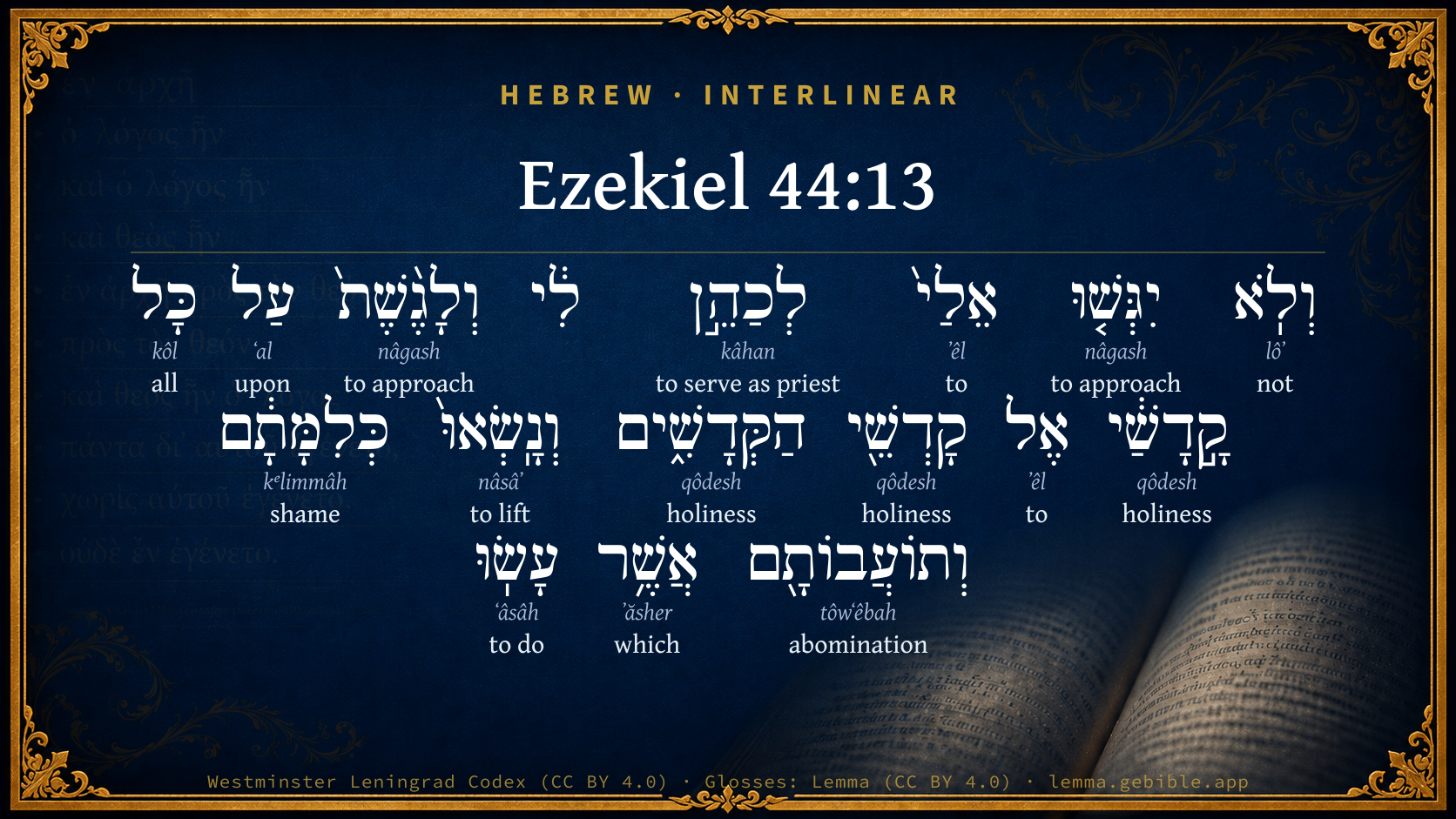
  1. וְלֹֽא lôʼ H3808 “and · not” Conjunction + Particle, Negative
  2. יִגְּשׁ֤וּ nâgash H5066 “to approach” Verb, Qal, Imperfect, 3rd Person, Masculine, Plural
  3. אֵלַי֙ ʼêl H413 “to · me” Preposition + Suffix, Personal, 1st Person, Common, Singular
  4. וְלָגֶ֨שֶׁת֙ nâgash H5066 “and · to approach” Conjunction + Preposition + Verb, Qal, Infinitive Construct
  5. עַל ʻal H5921 “upon” Preposition
  6. כָּל kôl H3605 “all of” Noun, Common, Masculine, Singular, Construct
  7. קָ֣דָשַׁ֔י qôdesh H6944 “holy things · my” Noun, Common, Masculine, Plural, Construct + Suffix, Personal, 1st Person, Common, Singular
  8. אֶל ʼêl H413 “to” Preposition
  9. קָדְשֵׁ֖י qôdesh H6944 “holy things of” Noun, Common, Masculine, Plural, Construct
  10. הַקְּדָשִׁ֑ים qôdesh H6944 “the · holy things” Particle, Definite Article + Noun, Common, Masculine, Plural, Absolute
  11. וְנָֽשְׂאוּ֙ nâsâʼ H5375 “and · to lift” Conjunction + Verb, Qal, Sequential Perfect, 3rd Person, Common, Plural
  12. כְּלִמָּתָ֔ם kᵉlimmâh H3639 “shame · their” Noun, Common, Feminine, Singular, Construct + Suffix, Personal, 3rd Person, Masculine, Plural
  13. וְתוֹעֲבוֹתָ֖ם tôwʻêbah H8441 “and · abominations · their” Conjunction + Noun, Common, Feminine, Plural, Construct + Suffix, Personal, 3rd Person, Masculine, Plural
  14. אֲשֶׁ֥ר ʼăsher H834 “which” Particle, Relative
  15. עָשֽׂוּ ʻâsâh H6213 “to do” Verb, Qal, Perfect, 3rd Person, Common, Plural

About this verse

These counts appear in no published source. They are computed here, from the morphology-tagged text and Lemma’s own curated glosses. What Lemma adds →

17
words
12
distinct lemmas
Prophets
section

Notable vocabulary

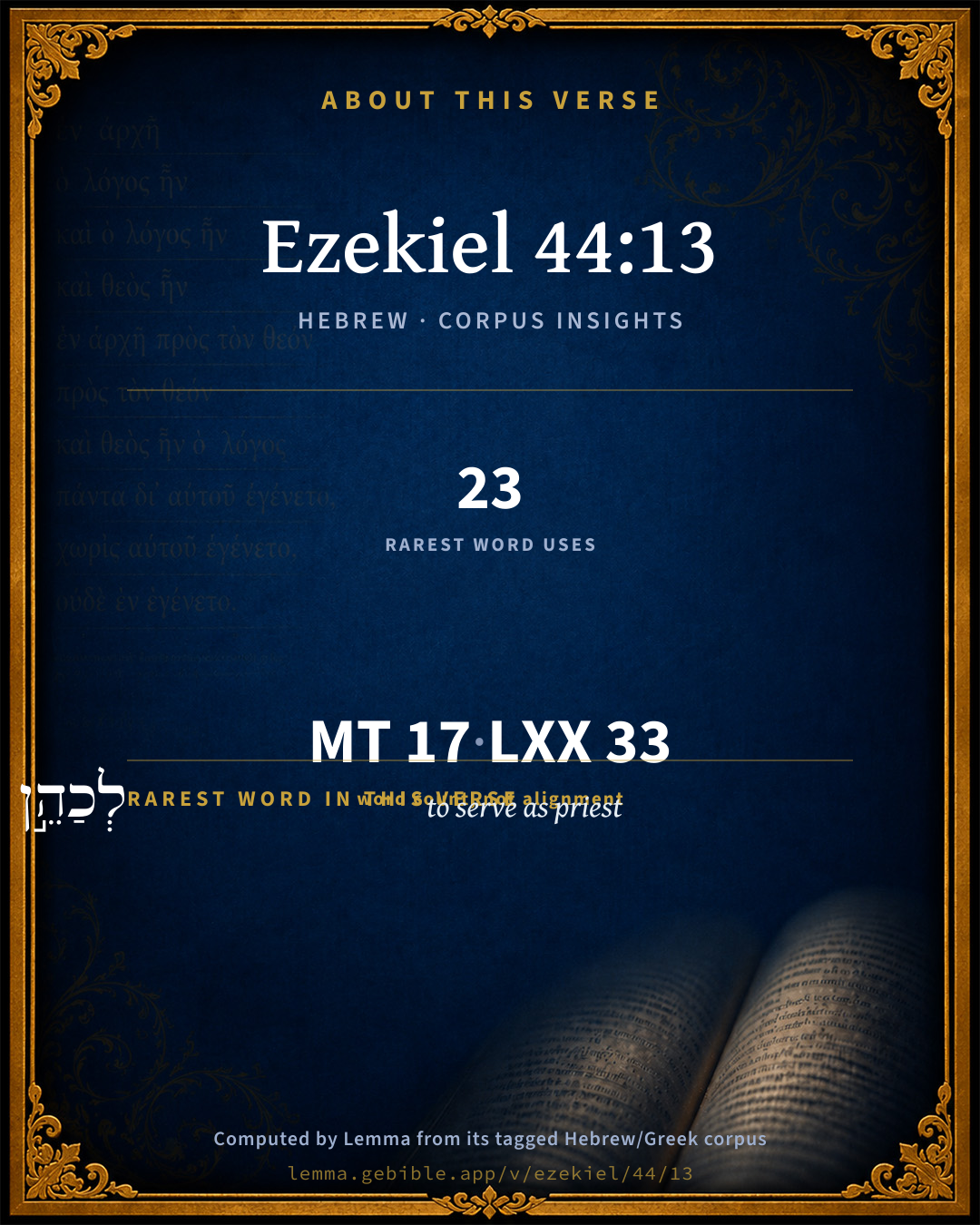
The rarest word here is לְכַהֵ֣ן to serve as priest H3547 — appearing just 23 times in the whole Hebrew Bible.

Shared distinctive vocabulary

לְכַהֵ֣ן to serve as priest H3547 occurs in 23 verses of the Hebrew Bible. Also found in:

Grammatical profile

  • 5 verbs
  • 6 nouns
  • 4 prepositions
  • 2 particles

Verb forms

  • יִגְּשׁ֤וּ Qal · Imperfect
  • לְכַהֵ֣ן Piel · Infinitive Construct
  • וְלָגֶ֨שֶׁת֙ Qal · Infinitive Construct
  • וְנָֽשְׂאוּ֙ Qal · Sequential Perfect
  • עָשֽׂוּ Qal · Perfect

Repetition

Words recur within this verse — often emphatic in Hebrew:

  • קָ֣דָשַׁ֔י holiness H6944 ×3
  • יִגְּשׁ֤וּ to approach H5066 ×2
  • אֵלַי֙ to H413 ×2

Hebrew & Septuagint length

In English translation the verse runs 45 words from the Hebrew and 46 from the Septuagint (LXX English) — closely comparable.

A rough comparison of the two English renderings, which tokenize alike — not a word-level alignment.

Word counts can differ between the Hebrew and the Greek without any difference in meaning — e.g. the Hebrew direct-object marker אֵת has no separate Greek word, and Greek often adds the article ὁ.

In the original languages it is 17 Hebrew tokens and 33 Greek tokens — but the two are counted differently (Hebrew bundles its prefixes and suffixes into one token; the Greek is in lemma form), so that isn’t a like-for-like length.

Cross-references

5

Topical passages linked to Ezekiel 44:13 in the Treasury of Scripture Knowledge — connected by theme and wording, ordered by reader-vote popularity; previews shown in the World English Bible.

  • Numbers 18:3 They shall keep your charge, and the charge of all the Tent: only they shall not come near to the vessels of the sanctuary and to the altar, that they not die, neither they, nor you.
  • 2 Kings 23:9 Nevertheless the priests of the high places didn't come up to the altar of Yahweh in Jerusalem, but they ate unleavened bread among their brothers.
  • Ezekiel 16:61 Then shall you remember your ways, and be ashamed, when you shall receive your sisters, your elder [sisters] and your younger; and I will give them to you for daughters, but not by your covenant.
  • Ezekiel 32:20 They shall fall in the midst of those who are slain by the sword: she is delivered to the sword; draw her away and all her multitudes.
  • Ezekiel 36:7 therefore thus says the Lord Yahweh: I have sworn, [saying], Surely the nations that are round about you, they shall bear their shame.

Cross-references courtesy of OpenBible.info (CC BY 4.0).

Hebrew and Greek witnesses Masoretic Hebrew ↔ Greek Septuagint

The same verse in the two great witnesses to the Old Testament, shown verse-for-verse.

These are two independent witnesses, not word-aligned to each other, and the Septuagint is shown in lemma (dictionary) form.

Hebrew Ezekiel 44:13 Masoretic · Westminster Leningrad Codex

וְלֹֽא יִגְּשׁ֤וּ אֵלַי֙ לְכַהֵ֣ן לִ֔י וְלָגֶ֨שֶׁת֙ עַל כָּל קָ֣דָשַׁ֔י אֶל קָדְשֵׁ֖י הַקְּדָשִׁ֑ים וְנָֽשְׂאוּ֙ כְּלִמָּתָ֔ם וְתוֹעֲבוֹתָ֖ם אֲשֶׁ֥ר עָשֽׂוּ

They shall not come near to me, to execute the office of priest to me, nor to come near to any of my holy things, to the things that are most holy; but they shall bear their shame, and their abominations which they have committed.

World English Bible · Public Domain

Greek LXX Ezekiel 44:13 Septuagint · lemma form

καί οὐ ἐγγίζω πρός ἐγώ ὁ ἱερατεύω ἐγώ οὐδέ ὁ προςἄγω πρός ὁ ἅγιος υἱός ὁ ἰσραήλ οὐδέ πρός ὁ ἅγιος ὁ ἅγιος ἐγώ καί λαμβάνω ἀτιμία αὐτός ἐν ὁ πλάνησις ὅς πλανάω

And they shall not draw near to me to minister to me in the priests' office, nor to approach the holy things of the children of Israel, nor to approach my holy of holies: but they shall bear their reproach for the error wherein they erred.

LXX2012 (modern English Septuagint) · Public Domain

Hebrew: Westminster Leningrad Codex (CC BY 4.0). Greek: Septuagint (public domain); English from LXX2012 (modern English Septuagint) (Public Domain). How the Septuagint differs from the Hebrew →

Targum (Aramaic paraphrase)

1

The Targum is the ancient Jewish Aramaic paraphrase of the Hebrew Scriptures — an interpretive translation, not the Hebrew text itself. Onkelos (literal) and Pseudo-Jonathan (expansive) render the Torah, and Jonathan the Prophets. Coverage is partial: where no permissively-licensed English translation exists for a verse, only the Aramaic is shown. This is verse-level text, not a word-by-word alignment to the Hebrew.

  1. Targum Jonathan Prophets (Joshua–Malachi)
    וְלָא יִתְקַרְבוּן לְפוּלְחָנִי לְשַׁמָשָׁא קֳדָמַי וּלְמִקְרַב עַל כָּל קוּדְשֵׁי קוּדְשַׁיָא וְיִתְקַבְּלוּן אִתְכְּנָעוּתְהוֹן וְתוֹעֲבָתְהוֹן דִי עֲבָדוּ:

    (no public-domain English translation for this verse)

    Targum Jonathan — Aramaic: “Mikraot Gedolot” (public domain). English: “Sefaria Community Translation” (CC0 1.0 (public-domain dedication)); “London "Chaldee Paraphrase," 1871” (public domain). Text via Sefaria.

Commentary

Notes on Ezekiel 44:13 from classic Christian and Jewish commentators (each source and its license shown beneath its notes). The classic Christian expositions comment on the surrounding passage and are grouped to its opening verse, so a note may address several verses; the Jewish commentaries on the Tanakh (Rashi and others) are per-verse, so they appear only where the commentator wrote on this verse.

Lemma curates 59 commentaries, every one of them public domain or Creative Commons licensed, each selected and text-cleaned for this edition rather than reprinted as found. About our sources →

The Cambridge Bible for Schools and Colleges

gen. ed. J. J. S. Perowne

13. Eze_44:13 is closely connected with Eze_44:12 … bear their iniquity, and they shall not come near unto me.

in the most holy place] Rather: unto the things that are most holy. The words are in apposition with “my holy things.”

The Cambridge Bible for Schools and Colleges (gen. ed. J. J. S. Perowne; Cambridge University Press, 1878–1918) — public domain. Text from a community e-Sword module.

Trapp's Complete Commentary

John Trapp

Eze 44:13 And they shall not come near unto me, to do the office of a priest unto me, nor to come near to any of my holy things, in the most holy [place]: but they shall bear their shame, and their abominations which they have committed.

Ver. 13. And they shall not come near unto me.] How great then was the love of the Lord Jesus to Peter and the rest of his disciples after his resurrection, as in sending them that sweet message, {Mar 16:7} so in readmitting them to the work of the ministry after so foul a revolt. {Joh 20:21-23} And doth he not the very same still for his poor sinful servants, who desire indeed to fear his name, but are often overtaken in a fault through infirmity of the flesh? Surely, Father Traves, said Mr Bradford, martyr, in a letter to him, I have clean forgotten God; I am all secure, idle, proud hearted, utterly void of brotherly love; I am envious, and disdain others; I am a very stark hypocrite, &c. {a} Thus he, and much more to like purpose, in his heavenly letters.

{a} Acts and Mon., 1511.

John Trapp, A Commentary or Exposition upon All the Books of the Old and New Testament (1647–1656) — public domain. Text from a community e-Sword module.

John Gill's Exposition

And they shall not come near unto me, to do the office of priest unto me,.... To bring the sacrifice to the altar, and offer it there; to sprinkle the blood, or burn the fat, or the incense; to intercede for the people, or bless them; see Hos 4:6,

nor to come near to any of my holy things in the most holy place; to do any business, either in the holy or in the most holy place; to offer holy things, or eat of them. The sense is, that these degraded ministers, who had sinned so greatly, and had fallen so foully, though restored by repentance; yet should not preach the word, nor administer any ordinance:

but they shall bear their shame, and their abominations which they have committed; that is, the shame of their abominations, of their abominable principles and practices, which they have held and maintained; being publicly disgraced and degraded, and so notoriously distinguished.

John Gill's Exposition of the Whole Bible (1746–1763) — public domain (CC PDM 1.0). Text via the HelloAO Bible API.

Matthew Poole's English Annotations

They shall never be admitted to the office, nor employed in the proper work of a priest that ministers to me. They shall not come into the temple, much less into the oracle, nor have any part in the offering up of sacrifices on the altar, though they have meat, drink, and lodging about the temple; yet, as discarded servants, that are retained lest they starve.

They shall bear their shame; they shall be little regarded, but disesteemed, and put to shame, and this shall be part of their punishment. They shall be dealt with according to their abominations, i.e. their apostacy and idolatry, and bear the punishment thereof.

Matthew Poole's English Annotations on the Holy Bible (1683–1685) — public domain. Text from a community e-Sword/MySword module.

John Wesley's Explanatory Notes

Shall bear their shame - They shall be dealt with according to their abominations, and bear the punishment thereof.

John Wesley, Explanatory Notes Upon the Whole Bible (1754–1765) — public domain. Text via the GEBible commentary corpus.

unfoldingWord translationNotes

Door43 World Missions Community

General Information:

Yahweh continues giving Ezekiel his message to the house of Israel.

They

the Levites (Ezekiel 44:10)

They will not come near

"I will not permit them to come near." Yahweh does not want them to come to him the way a servant comes to a king to receive commands, as the descendants of Zadok will do (Ezekiel 40:46).

will bear their reproach and their guilt

"will be ashamed and suffer when I punish them"

disgusting actions

"the disgusting things you do." God was angry because the people were worshiping idols and false gods. See how you translated this in Ezekiel 5:9.

keepers

people who guard or take care of something

that is done in it

This can be translated in active form. AT: "that they need to do in it" (See: Active or Passive)

translationWords

priest

holy

reproach

guilt

unfoldingWord translationNotes — © Distant Shores Media and the Door43 World Missions Community, licensed CC BY-SA 4.0. Source: git.door43.org/Door43/en_tn.

Lesson kit

Teaching starters — assembled from the data on this page, not authored interpretation. Every prompt links to the verse data it draws on. Edit before teaching.

Ezekiel, in the Prophets, opens this verse with 17 words (12 distinct Hebrew lemmas). Its most distinctive word is kâhan (“to serve as priest”). A historical commentator’s framing appears above. Read the whole chapter for the surrounding context.

Discussion questions

  1. What does “to serve as priest” (kâhan) contribute to the verse as a whole?
  2. How does Exodus 28:1, which shares the word «to serve as priest», read alongside this verse?
  3. What does the repetition of “holiness” (3× in this one verse) do in this verse?
  4. These translations render this verse differently. What is at stake in choosing one wording over another?
  5. «יִגְּשׁ֤וּ» is a Qal Imperfect verb. How does that grammatical form shape the action described?
  6. Compare how The Cambridge Bible for Schools and Colleges and Trapp's Complete Commentary read this verse. Where do they agree or differ?

Things to notice

Reading settings

Reading text

Shown beneath each verse's original-language words.

Old Testament
Old Testament edition

Read the OT as the Masoretic Hebrew (MT) or the Greek Septuagint (LXX).

English shown for the Greek Septuagint (in the Hebrew ↔ Greek comparison).

Comparing translations? Open the Compare panel on any verse page to stack up to four side by side.