
Malachi 2:11

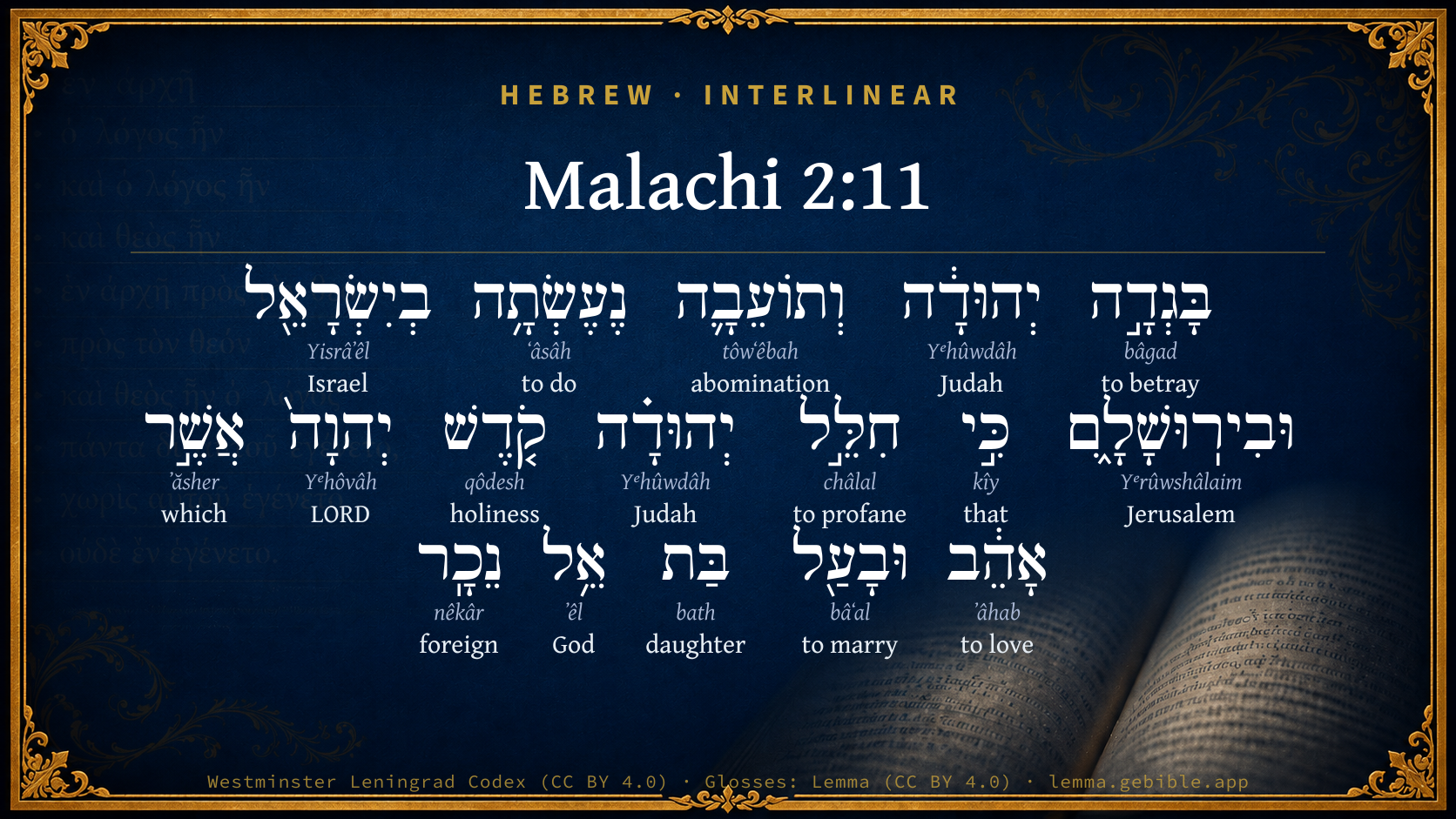
Hebrew (Westminster Leningrad Codex) Malachi 2:11 appears in the Hebrew Old Testament. The text above is from the Westminster Leningrad Codex. Each word links to its Strong’s number, a concise gloss, and parsing drawn from the Open Scriptures Hebrew Bible morphology. Click any word for its full Brown-Driver-Briggs (BDB) entry.
Download image
Cite this verse

Malachi 2:11 (World English Bible). Public Domain. Lemma interlinear Bible study tool, https://lemma.gebible.app/v/malachi/2/11.

Show BibTeX & RIS
BibTeX
RIS
English Translation
Judah has dealt treacherously, and an abomination is committed in Israel and in Jerusalem; for Judah has profaned the holiness of Yahweh which he loves, and has married the daughter of a foreign god.
World English Bible · Public Domain
Download a study sheet

One document with this verse’s original text, its word-by-word gloss line, the meaning frame, cross-references with their text, attributed commentary, and full source and license credits — printable, and it pastes into notes with its structure intact.

This verse Autodidact and up

Study sheet (.html) Plain text (.txt)

A passage Seminary Student

Up to 50 verses in one chapter. A passage sheet keeps up to 6 commentary sources and 12 cross-references per verse, in the order this page ranks them, and says so on the sheet whenever that leaves anything out. Ask for a single verse and you get the Autodidact verse sheet above.

Everything on this page stays free to read, with no account — the sheet is a download of what is already on screen, not access to it.

Want to remove ads? Support Godless Engineer
Compare translations 3

The same verse in 3 English versions, stacked beneath the original-language interlinear above. Click any original word for its lexicon entry.

Each is an independent rendering of the whole verse — the interlinear is not word-aligned to these translations.

Highlighted words mark where these versions differ — a whole-verse word diff, not a word-by-word alignment.

  • World English Bible Public Domain
    Judah has dealt treacherously, and an abomination is committed in Israel and in Jerusalem; for Judah has profaned the holiness of Yahweh which he loves, and has married the daughter of a foreign god.
  • King James Version Public Domain
    Judah hath dealt treacherously, and an abomination is committed in Israel and in Jerusalem; for Judah hath profaned the holiness of the LORD which he loved, and hath married the daughter of a strange god.
  • unfoldingWord Literal Text CC BY-SA 4.0
    Judah has dealt treacherously, and an abomination has been done in Israel and in Jerusalem. For Judah has profaned the holy place of Yahweh, which he loves, and has married the daughter of a foreign god.

unfoldingWord Literal Text — © unfoldingWord, licensed CC BY-SA 4.0. Word-aligned USFM3 via Door43 (git.door43.org/unfoldingWord/en_ult).

Versions to compare (up to 4)

3 of 4 selected

Show all 18 translations

Every available English version of this verse, each an independent rendering of the whole verse.

  • World English Bible Public Domain
    Judah has dealt treacherously, and an abomination is committed in Israel and in Jerusalem; for Judah has profaned the holiness of Yahweh which he loves, and has married the daughter of a foreign god.
  • Berean Standard Bible Public Domain
    Judah has broken faith; an abomination has been committed in Israel and in Jerusalem. For Judah has profaned the LORD’s beloved sanctuary by marrying the daughter of a foreign god.
  • Majority Standard Bible Public Domain
    Judah has broken faith; an abomination has been committed in Israel and in Jerusalem. For Judah has profaned the LORD’s beloved sanctuary by marrying the daughter of a foreign god.
  • King James Version Public Domain
    Judah hath dealt treacherously, and an abomination is committed in Israel and in Jerusalem; for Judah hath profaned the holiness of the LORD which he loved, and hath married the daughter of a strange god.
  • American Standard Version (1901) Public Domain
    Judah hath dealt treacherously, and an abomination is committed in Israel and in Jerusalem; for Judah hath profaned the holiness of Jehovah which he loveth, and hath married the daughter of a foreign god.
  • Revised Version (1885) Public Domain
    Judah hath dealt treacherously, and an abomination is committed in Israel and in Jerusalem; for Judah hath profaned the holiness of the LORD which he loveth, and hath married the daughter of a strange god.
  • Geneva Bible (1599) Public Domain
    Iudah hath transgressed, and an abomination is committed in Israel and in Ierusalem: for Iudah hath defiled the holinesse of the Lord, which hee loued, and hath maried the daughter of a strange God.
  • Douay-Rheims (1899) Public Domain
    Juda hath transgressed, and abomination hath been committed in Israel, and in Jerusalem: for Juda hath profaned the holiness of the Lord, which he loved, and hath married the daughter of a strange God.
  • Young's Literal Translation Public Domain
    Dealt treacherously hath Judah, And abomination hath been done in Israel, and in Jerusalem, For polluted hath Judah the holy thing of Jehovah, That He hath loved, and hath married the daughter of a strange god.
  • Literal Standard Version CC BY-SA 4.0
    Judah has dealt treacherously, || And abomination has been done in Israel and in Jerusalem, || For Judah has defiled the holy thing of YHWH that He has loved, || And has married the daughter of a strange god.
  • Unlocked Literal Bible CC BY-SA 4.0
    Judah has been faithless. A disgusting thing has been committed in Israel and in Jerusalem. For Judah has profaned the holy place of Yahweh which he loves, and has married the daughter of a foreign god.
  • unfoldingWord Literal Text CC BY-SA 4.0
    Judah has dealt treacherously, and an abomination has been done in Israel and in Jerusalem. For Judah has profaned the holy place of Yahweh, which he loves, and has married the daughter of a foreign god.
  • Darby Bible Public Domain
    Judah hath dealt unfaithfully, and an abomination is committed in Israel and in Jerusalem; for Judah hath profaned the sanctuary of Jehovah which he loved, and hath married the daughter of a strange ùgod.
  • World Messianic Bible Public Domain
    Judah has dealt treacherously, and an abomination is committed in Israel and in Jerusalem; for Judah has profaned the holiness of the LORD which he loves, and has married the daughter of a foreign god.
  • Webster's Bible Public Domain
    Judah hath dealt treacherously, and an abomination is committed in Israel and in Jerusalem; for Judah hath profaned the holiness of the LORD whom he loved, and hath married the daughter of a strange god.
  • Free Bible Version CC BY-SA 4.0
    The people of Judah have been unfaithful and have committed a disgusting sin in Israel and Jerusalem. For the men of Judah have defiled the Lord's Temple (which he loves) by marrying women who worship idols.
  • Bible in Basic English Public Domain
    Judah has been acting falsely, and a disgusting thing has been done in Jerusalem; for Judah has made unclean the holy place of the Lord which is dear to him, and has taken as his wife the daughter of a strange god.
  • JPS Tanakh (1917) Public Domain
    Judah hath dealt treacherously, and an abomination is committed in Israel and in Jerusalem; for Judah hath profaned the holiness of the LORD which He loveth, and hath married the daughter of a strange god.

Literal Standard Version (2020), Covenant Press — licensed CC BY-SA 4.0. Text via the HelloAO Bible API (eBible.org). Unlocked Literal Bible (unfoldingWord) — licensed CC BY-SA 4.0. Text via the HelloAO Bible API (eBible.org). unfoldingWord Literal Text — © unfoldingWord, licensed CC BY-SA 4.0. Word-aligned USFM3 via Door43 (git.door43.org/unfoldingWord/en_ult). Free Bible Version, Dr. Jonathan Gallagher — licensed CC BY-SA 4.0. Text via the HelloAO Bible API (eBible.org).

Word by word

More ways to search: Search by grammar → Find every occurrence → Compare this word →

Practice this passage: Drill this verse → Learn its vocabulary →

וּבָעַ֖ל
bâʻal
H1166
“and · to marry”
Conjunction + Verb, Qal, Perfect, 3rd Person, Masculine, Singular
Part of Speech
Conjunction + Verb
Stem
Qal
Form
Perfect
Person
3rd Person
Gender
Masculine
Number
Singular
Full BDB Definition

Origin: a primitive root

TWOT: 262

to marry, rule over, possess, own - (Qal) - to marry, be lord (husband) over - to rule over - (Niphal) to be married
  1. בָּגְדָ֣ה bâgad H898 “to betray” Verb, Qal, Perfect, 3rd Person, Feminine, Singular
  2. יְהוּדָ֔ה Yᵉhûwdâh H3063 “Judah” Noun, Proper
  3. וְתוֹעֵבָ֛ה tôwʻêbah H8441 “and · abomination” Conjunction + Noun, Common, Feminine, Singular, Absolute
  4. נֶעֶשְׂתָ֥ה ʻâsâh H6213 “to do” Verb, Niphal, Perfect, 3rd Person, Feminine, Singular
  5. בְיִשְׂרָאֵ֖ל Yisrâʼêl H3478 “in/at · Israel” Preposition + Noun, Proper
  6. וּבִירֽוּשָׁלִָ֑ם Yᵉrûwshâlaim H3389 “and · in/at · Jerusalem” Conjunction + Preposition + Noun, Proper
  7. כִּ֣י kîy H3588 “that” Conjunction
  8. חִלֵּ֣ל châlal H2490 “to profane” Verb, Piel, Perfect, 3rd Person, Masculine, Singular
  9. יְהוּדָ֗ה Yᵉhûwdâh H3063 “Judah” Noun, Proper
  10. קֹ֤דֶשׁ qôdesh H6944 “holiness of” Noun, Common, Masculine, Singular, Construct
  11. יְהוָה֙ Yᵉhôvâh H3068 “LORD” Noun, Proper
  12. אֲשֶׁ֣ר ʼăsher H834 “which” Particle, Relative
  13. אָהֵ֔ב ʼâhab H157 “to love” Verb, Qal, Perfect, 3rd Person, Masculine, Singular
  14. בַּת bath H1323 “daughter of” Noun, Common, Feminine, Singular, Construct
  15. אֵ֥ל ʼêl H410 “God of” Noun, Common, Masculine, Singular, Construct
  16. נֵכָֽר nêkâr H5236 “foreign” Noun, Common, Masculine, Singular, Absolute

About this verse

These counts appear in no published source. They are computed here, from the morphology-tagged text and Lemma’s own curated glosses. What Lemma adds →

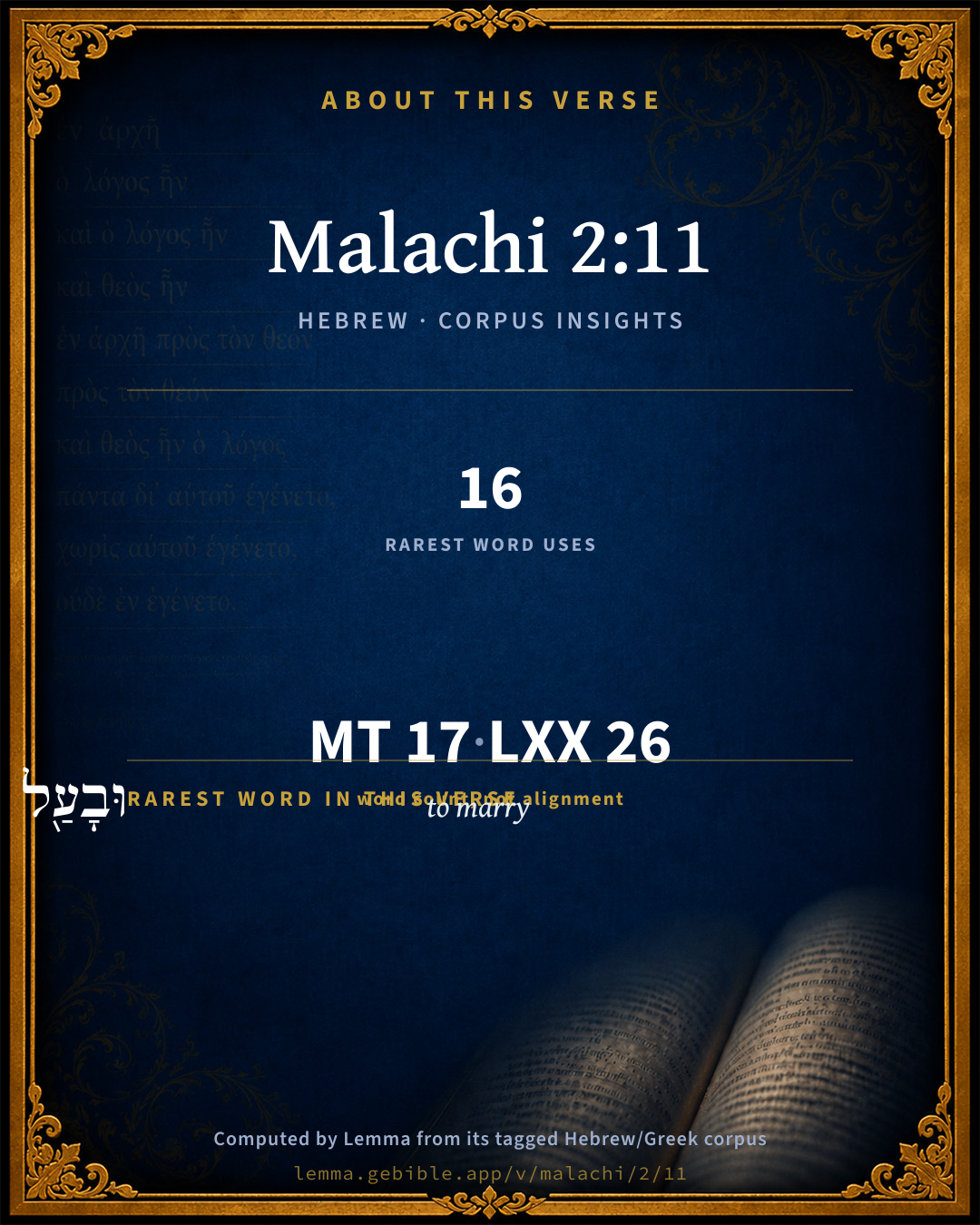
17
words
16
distinct lemmas
Prophets
section

Notable vocabulary

The rarest word here is וּבָעַ֖ל to marry H1166 — appearing just 16 times in the whole Hebrew Bible.

Shared distinctive vocabulary

וּבָעַ֖ל to marry H1166 occurs in 14 verses of the Hebrew Bible. Also found in:

Grammatical profile

  • 5 verbs
  • 10 nouns
  • 1 conjunction
  • 1 particle

Verb forms

  • בָּגְדָ֣ה Qal · Perfect
  • נֶעֶשְׂתָ֥ה Niphal · Perfect
  • חִלֵּ֣ל Piel · Perfect
  • אָהֵ֔ב Qal · Perfect
  • וּבָעַ֖ל Qal · Perfect

Repetition

A word recurs within this verse — often emphatic in Hebrew:

  • יְהוּדָ֔ה Judah H3063 ×2

Hebrew & Septuagint length

In English translation the verse runs 34 words from the Hebrew and 35 from the Septuagint (LXX English) — closely comparable.

A rough comparison of the two English renderings, which tokenize alike — not a word-level alignment.

Word counts can differ between the Hebrew and the Greek without any difference in meaning — e.g. the Hebrew direct-object marker אֵת has no separate Greek word, and Greek often adds the article ὁ.

In the original languages it is 17 Hebrew tokens and 26 Greek tokens — but the two are counted differently (Hebrew bundles its prefixes and suffixes into one token; the Greek is in lemma form), so that isn’t a like-for-like length.

Cross-references

25

Topical passages linked to Malachi 2:11 in the Treasury of Scripture Knowledge — connected by theme and wording, ordered by reader-vote popularity; previews shown in the World English Bible.

  • 2 Corinthians 6:14–18 Don't be unequally yoked with unbelievers, for what fellowship have righteousness and iniquity? Or what communion has light with darkness?
  • Ezra 9:1–2 Now when these things were done, the princes drew near to me, saying, The people of Israel, and the priests and the Levites, have not separated themselves from the peoples of the lands, [doing] according to their abominations, even of the Canaanites, the Hittites, the Perizzites, the Jebusites, the Ammonites, the Moabites, the Egyptians, and the Amorites.
  • Exodus 19:5–6 Now therefore, if you will indeed obey my voice, and keep my covenant, then you shall be my own possession from among all peoples; for all the earth is mine;
  • Leviticus 20:26 You shall be holy to me: for I, Yahweh, am holy, and have set you apart from the peoples, that you should be mine.
  • Deuteronomy 7:3–6 neither shall you make marriages with them; your daughter you shall not give to his son, nor his daughter shall you take to your son.
  • 1 Kings 11:1–8 Now king Solomon loved many foreign women, together with the daughter of Pharaoh, women of the Moabites, Ammonites, Edomites, Sidonians, and Hittites;
  • Nehemiah 13:23–29 In those days also saw I the Jews who had married women of Ashdod, of Ammon, [and] of Moab:
  • Psalms 106:34–39 They didn't destroy the peoples, As Yahweh commanded them,
  • Revelation 21:8 But for the cowardly, unbelieving, sinners, abominable, murderers, sexually immoral, sorcerers, idolaters, and all liars, their part is in the lake that burns with fire and sulfur, which is the second death."
  • Genesis 6:1–2 It happened, when men began to multiply on the surface of the ground, and daughters were born to them,
  • Leviticus 18:24–30 "'Don't defile yourselves in any of these things: for in all these the nations which I am casting out before you were defiled.
  • Deuteronomy 14:2 For you are a holy people to Yahweh your God, and Yahweh has chosen you to be a people for his own possession, above all peoples who are on the face of the earth.
  • Deuteronomy 33:26–29 There is none like God, Jeshurun, Who rides on the heavens for your help, In his excellency on the skies.
  • Judges 3:6 and they took their daughters to be their wives, and gave their own daughters to their sons and served their gods.
  • Ezra 9:12 now therefore don't give your daughters to their sons, neither take their daughters to your sons, nor seek their peace or their prosperity forever; that you may be strong, and eat the good of the land, and leave it for an inheritance to your children forever.
  • Ezra 10:2 Shecaniah the son of Jehiel, one of the sons of Elam, answered Ezra, We have trespassed against our God, and have married foreign women of the peoples of the land: yet now there is hope for Israel concerning this thing.
  • Psalms 106:28 They joined themselves also to Baal Peor, And ate the sacrifices of the dead.
  • Jeremiah 2:3 Israel [was] holiness to Yahweh, the first fruits of his increase: all who devour him shall be held guilty; evil shall come on them, says Yahweh.
  • Jeremiah 2:7–8 I brought you into a plentiful land, to eat the fruit of it and the goodness of it; but when you entered, you defiled my land, and made my heritage an abomination.
  • Jeremiah 2:21–22 Yet I had planted you a noble vine, wholly a right seed: how then are you turned into the degenerate branches of a foreign vine to me?
  • Jeremiah 3:7–9 I said after she had done all these things, She will return to me; but she didn't return: and her treacherous sister Judah saw it.
  • Jeremiah 7:10 and come and stand before me in this house, which is called by my name, and say, We are delivered; that you may do all these abominations?
  • Ezekiel 18:13 has given forth on interest, and has taken increase; shall he then live? he shall not live: he has done all these abominations; he shall surely die; his blood shall be on him.
  • Ezekiel 22:11 One has committed abomination with his neighbor's wife; and another has lewdly defiled his daughter-in-law; and another in you has humbled his sister, his father's daughter.
  • Hosea 6:7 But they, like Adam, have broken the covenant. They were unfaithful to me, there.

Cross-references courtesy of OpenBible.info (CC BY 4.0).

Hebrew and Greek witnesses Masoretic Hebrew ↔ Greek Septuagint

The same verse in the two great witnesses to the Old Testament, shown verse-for-verse.

These are two independent witnesses, not word-aligned to each other, and the Septuagint is shown in lemma (dictionary) form.

Hebrew Malachi 2:11 Masoretic · Westminster Leningrad Codex

בָּגְדָ֣ה יְהוּדָ֔ה וְתוֹעֵבָ֛ה נֶעֶשְׂתָ֥ה בְיִשְׂרָאֵ֖ל וּבִירֽוּשָׁלִָ֑ם כִּ֣י חִלֵּ֣ל יְהוּדָ֗ה קֹ֤דֶשׁ יְהוָה֙ אֲשֶׁ֣ר אָהֵ֔ב וּבָעַ֖ל בַּת אֵ֥ל נֵכָֽר

Judah has dealt treacherously, and an abomination is committed in Israel and in Jerusalem; for Judah has profaned the holiness of Yahweh which he loves, and has married the daughter of a foreign god.

World English Bible · Public Domain

Greek LXX Malachi 2:11 Septuagint · lemma form

ἐν καταλείπω ἰούδας καί βδέλυγμα γίγνομαι ἐν ὁ ἰσραήλ καί ἐν ἰερουσαλήμ διότι βεβηλόω ἰούδας ὁ ἅγιος κύριος ἐν ὅς ἀγαπάω καί ἐπιτηδεύω εἰς θεός ἀλλότριος

Juda has been forsaken, and an abomination has been committed in Israel and in Jerusalem; for Juda has profaned the holy things of the Lord, which he delighted in, and has gone after other gods.

LXX2012 (modern English Septuagint) · Public Domain

On this verse, The Cambridge Bible for Schools and Colleges discusses the Septuagint’s reading. Read the note in Commentary ↓

Hebrew: Westminster Leningrad Codex (CC BY 4.0). Greek: Septuagint (public domain); English from LXX2012 (modern English Septuagint) (Public Domain). How the Septuagint differs from the Hebrew →

Targum (Aramaic paraphrase)

1

The Targum is the ancient Jewish Aramaic paraphrase of the Hebrew Scriptures — an interpretive translation, not the Hebrew text itself. Onkelos (literal) and Pseudo-Jonathan (expansive) render the Torah, and Jonathan the Prophets. Coverage is partial: where no permissively-licensed English translation exists for a verse, only the Aramaic is shown. This is verse-level text, not a word-by-word alignment to the Hebrew.

  1. Targum Jonathan Prophets (Joshua–Malachi)
    שְׁקַרוּ דְבֵית יְהוּדָה וְתוֹעֶבְתָּא אִתְעֲבִידַת בְּיִשְׂרָאֵל וּבִירוּשְׁלֵם אֲרֵי אֲפִיסוּ דְבֵית יְהוּדָה נַפְשֵׁהוֹן דַהֲוָת קַדִישָׁא קֳדָם יְיָ דִרְחַם וְאִתְרְעִיאוּ לְמִסַב לְהוֹן נְשִׁין בְּנַת פַּלְחֵי כּוֹכְבַיָא:

    (no public-domain English translation for this verse)

    Targum Jonathan — Aramaic: “Mikraot Gedolot” (public domain). English: “Sefaria Community Translation” (CC0 1.0 (public-domain dedication)); “London "Chaldee Paraphrase," 1871” (public domain). Text via Sefaria.

Commentary

Notes on Malachi 2:11 from classic Christian and Jewish commentators (each source and its license shown beneath its notes). The classic Christian expositions comment on the surrounding passage and are grouped to its opening verse, so a note may address several verses; the Jewish commentaries on the Tanakh (Rashi and others) are per-verse, so they appear only where the commentator wrote on this verse.

Lemma curates 59 commentaries, every one of them public domain or Creative Commons licensed, each selected and text-cleaned for this edition rather than reprinted as found. About our sources →

Trapp's Complete Commentary

John Trapp

Mal 2:11 Judah hath dealt treacherously, and an abomination is committed in Israel and in Jerusalem; for Judah hath profaned the holiness of the LORD which he loved, and hath married the daughter of a strange god.

Ver. 11. Judah hath dealt treacherously] Judah, the confessor, as his name imports; Judah, that once ruled with God, and was faithful with the saints, Hos 11:12; Judah, in whom God was known, his name was great in Israel, Psa 76:1. Prosper’s conceit was that Iudaei Judah were so called because they received ius Dei, the law from God’s mouth; whence Josephus calls the commonwealth of Israel Yεοκρατειαν, a God government. For to them pertained (among sundry other precious privileges recited, Rom 9:4-5) the covenants, that is, 1. The moral law in two tables. 2. The giving of the law, that is, the judicial law. 3. The service, that is, the ceremonial law, which was their gospel; whence Judaea is called the glorious land, Dan 11:41 (or the land of delights, or ornaments, as the Hebrew hath it), a pleasant land, or a land of desire, Jer 3:19, because, as it is Eze 20:6; Eze 20:15, it was the glory of all lands. Jerusalem, the metropolis, was not only the most famous of all the cities of the East, as Pliny confesseth it, but also of the whole world, si insignia Dei spectemus beneficia, as one saith, if we consider God’s marvellous kindness showed to it in a strong city, as David hath it. But, as ingentia beneficia, flagitia, supplicia, the greater the privileges of any place or people are the more heinous are their offences, and the more hideous their punishments; so it happened with this nation, so advanced, so obliged, so shamelessly, so lawlessly wicked. They were but newly returned from captivity, scarce yet warm in their nests, when they fell afresh to their old trade of treachery, doing wickedly with both hands earnestly. Abomination was committed in Israel and in Jerusalem, even such as God’s soul abhorred, and was ready to be loosened or disjointed from them, Jer 6:8, because "in the land of uprightness they dealt unjustly, and would not behold the majesty of the Lord," Isa 26:10. Judah had profaned the holiness of the Lord, which he loved, that is, the very place that he had espied out for himself, and that was dedicated to his name and service, the holy and separate land, the isle, as it is called, Isa 20:6 (though part of the continent), because compassed about with God’s favour as with a shield, Psa 5:12. In such a consecrated country to act their villany was no small aggravation of their wickedness; this made it swell like a toad in the eyes of the Almighty, it was an abomination. Filthiness in a cook, in a strumpet, is nothing so odious as in a pretended virgin. A nettle on the waste is better borne with than in a garden. To see the devil in hell is no wonder; but what makes he in paradise? England was anciently called the kingdom of God; it may much better be so called now that the gospel of the kingdom is preached among us. It was also called Albion, quasi Olbion (happy or fortunate, the fortunate island, say some), or ab albis rupibus, from the whiteness of the rocks. True it is, we were black all over with superstition; first Pagan, and theu Papagan; but Christ hath made us white again as snow in Salmon. And do we again sully and soil ourselves with sin’s filthiness, with that unclean kitchen stuff? do we profane the holiness of the Lord, which he loved, to drive him away from us by degrees, as those Jews did, Eze 8:9-11; sin is the leaven that defiles our passover, and urgeth God to pass away and depart from us; sin is the snuff that dims our candlestick, and threatens the removal of it. Let those that live in God’s good land, but not in God’s good laws (as Aristotle complained of his Athenians to like purpose, and as Seneca said to the Romans, that they were become more filthy since they had baths to wash in), look forward to the following verse, and tremble at that utter destruction there threatened to such, Disperdet Dominus, &c. And thereunto St Paul seemeth to allude, 1Co 3:17 "If any man defile the temple of God, him will God destroy."

And hath married the daughter of a strange god] This is that particular sin whereby they had dealt treacherously against their brethren profaned the covenant, polluted the Church, and committed abomination in Israel; they had married with women of a strange worship, and joined in affinity with the people of those abominations, as holy Ezra phraseth it, Ezr 9:14, and also setteth it forth for such a sin in those newly returned captives, as he thinks heaven and earth might well be ashamed of. A sin it is, flatly forbidden in both Testaments, Deu 7:8 2Co 6:14; and reasons added: as, 1. Danger of defection, at least, from former forwardness; but most commonly of infection, as in Solomon, 1Ki 11:4 Neh 13:26. What is the reason the Pope will not dispense in Spain and Italy if a Papist marry a Protestant, yet here he will, but in hope to draw more to them. See 1Ki 12:25 2Ki 8:27 2. Great inconvenience: as, 1. Of grief to the godly parents, Gen 26:35; Gen 27:36 2. Ill education of children, who commonly take after the mother (as did most of those idolatrous kings of Judah), and follow the worse of the two sides, though it be the weaker, as the conclusion in a syllogism follows the weaker proposition. The birth, we say, followeth the belly; and most men, we see, do matrissare, take after the mother in matters of religion. Hereunto might be added, that God’s service must by these unequal matches necessarily be hindered, if not altogether omitted (to gratify a froward Zipporah, or a mocking Michal), and the better party forced to see and hear that that cannot but grieve the Spirit of God. Besides danger of disloyalty, and a cursed posterity, as Edomites of the daughters of Heth. Here, then, I could join with that reverend contemplator in that holy wish of his (Dr Hall), that Manoah could speak so loud that all our Israelites might hear him: "Is there never a woman among the daughters of thy brethren, or among all God’s people, that thou goest to take a wife of the uncircumcised Philistines?" If religion be any other than a cipher, how dare we not regard it in our most important choices? how dare we yoke ourselves with any untamed heifer that beareth not Christ’s yoke? What mad work made that noble pair of naughty packs, Jezebel and Athaliah, in the kingdoms of Israel and Judah, the latter beginning her reign in the same year that the former perished, as Bucholcer observeth! And who knoweth not what a deal of mischief was done to the poor people of God in France, by Katherine de Medicis, Queenmother, with the advice and assistance of the Cardinal of Lorrain? Concerning which two it was said,

“ Non audet stygius Pluto tentare quod audet

Effraenis Monachus plenaque fraudis anus. ”

John Trapp, A Commentary or Exposition upon All the Books of the Old and New Testament (1647–1656) — public domain. Text from a community e-Sword module.

The Biblical Illustrator

Joseph S. Exell

Mal_2:11

And hath married the daughter of a strange god.

Unholy marriages

The Jews were commanded to keep themselves separate from the heathen nations around them (Deu_7:2; Deu_7:4). This was necessary that they might maintain their position as custodians of a peculiar revelation, and as abiding witnesses of the existence of the true God. But they often disobeyed this requirement, and formed idolatrous connections. This evil was now prevalent. Nehemiah and Ezra sought to remove this evil, and now Malachi strongly condemns it.

I. This evil may now be committed literally. Similar religious sympathies can alone form a true basis of connubial Union. Without religion marriage loses its sanctity, and is merely a convenient alliance, a worldly compact, a carnal revel. Every woman that is not truly devoted to God is a daughter of a strange god. She is under the influence of the god of this world. Christian men, for the sake of sensual and worldly considerations, sometimes marry such idolaters. They do so when--

1. They marry women who sacrifice their noblest feelings for wealth.

2. Who have bound themselves upon the altar of fashion.

3. Who sacrifice their holiest impulses for pleasure.

4. Who are devoted to the triumphs of ambition.

Christians should not violate their union with Jehovah to unite themselves with idolaters. To do so, even under the most plausible circumstances, is--

(1) To disobey a Divine command.

(2) To lose the Divine blessing.

(3) To incur the Divine displeasure.

II. This evil may be committed spiritually. The souls union with Jehovah is often spoken of in the Scriptures as marriage. God expects us to unite ourselves with Him in the closest bends. From this celestial marriage spring all virtues and graces. But men have joined themselves to idols. The worship of strange gods has been most prolific in pernicious customs, degrading vices, and dangerous errors. Men marry the daughter of a strange god spiritually--

1. When they join themselves with popular customs which have emanated from the spirit of idolatry.

2. When they embrace false and erroneous systems of religion.

3. When they associate themselves freely with unholy religionists. God requires His people to separate themselves from all the fascinating forms of evil. All unholy unions are as breaches of a marriage covenant, or as marriage with an idolater. They are a voluntary preference of evil to God.

III. This evil, whether committed literally or spiritually, will produce disastrous results.

1. Literally. It will result in--

(1) Domestic unhappiness.

(2) A divided household.

(3) Ill-trained children--probably generations of evil-doers.

(4) Neglect of the true religion on the part of both.

One religion matching with another not seldom breeds an atheist, one of no religion at all.

2. Spiritually. It will result in--

(1) Blindness in spiritual things.

(2) Loss of the Divine favour.

(3) Wandering in deceptive errors.

(4) Loss of religious influence.

(5) Being given up by God.

Learn to guard against uniting ourselves with anything that will separate us from God. An evil association has often been a devils chain, binding the soul to everlasting wretchedness. (W. Osborne Lilley.)

The Biblical Illustrator, edited by Joseph S. Exell (c. 1880s–1900s) — public domain. Text from a community e-Sword module.

Joseph Benson's Commentary

Mal 2:11-13. Judah hath profaned the holiness of the Lord which he loved — As if he had said, “This sin,” says Lowth, “implies the profanation of God’s holy people, which he set apart for his own worship and service; a profanation of the temple, when the priests who officiated there were guilty of the same crime; (see Mal 2:12;) and lastly, a profanation of that covenant God made with the Jews, Mal 2:10; God hath expressed a tender regard for these three sorts of holiness, and threatened severe punishments to those that break the laws made to preserve them.” And hath married the daughter of a strange god — That is, one who worships a strange god. For as gods were called fathers by their worshippers, (Jer 2:27,) therefore those who worshipped them might properly be called their children. The Lord will cut off the man that doeth this — Will take him away by death; the master and the scholar — Him that persuades and instructs others that these marriages are lawful, and him that follows such advice. The expression seems to comprehend both the priest and the people. The Hebrew is, he that wakes and he that answers. An instructer is described, (Isa 50:4,) as one that wakeneth the ear of his disciple. The meaning is, there shall be left neither any to teach nor any to learn. And him that offereth an offering — Although he should make great offerings, yet that would avail him nothing if he continued in his sin, and did not put away his strange wife. Perhaps this might be intended chiefly of the priests, many of whom were guilty of this crime. And this have ye done — Or, “This also you have done: you have covered the altar of the Lord with tears, with weeping, and with groanings; so that no respect is now had to your offering, nor is any thing accepted from your hand. The priests not only had married strange wives, but also had divorced those of their own country whom they had married; with whose tears the altar was imbued, when these wives offered up their sacrifices to God, entreating him to give their husbands a better mind; whom God heard so effectually, that he would not accept the sacrifices of their husbands on account of the tears and just complaints of their wives.” — Houbigant. The complaints of the distressed, if made known to God in prayer, will be heard, and redress granted.

Joseph Benson's Commentary on the Old and New Testaments (1811–1818) — public domain. Text from a community e-Sword module.

Tyndale Open Study Notes

Tyndale Open Resources

2:11 Judah has been unfaithful (or treacherous), and a detestable thing has been done in Israel and in Jerusalem: Men were divorcing their wives for the economic advantage of intermarriage with non-Israelite women who worshiped idols. Through these marriages, Jewish men gained access to the merchant guilds and trading cartels already in place when the Israelites returned from Babylonia. Malachi equates this adultery with idolatry. Israelite history had shown that intermarriage with foreign women went hand in hand with worship of foreign gods. Loyalty was to be the hallmark of Israel’s covenant relationships, whether with God or with a marriage partner. Divorce treats with contempt the oneness of the marriage covenant (2:15; see Gen 2:24).

Tyndale Open Study Notes — © Tyndale Open Resources, licensed CC BY-SA 4.0. Text via the HelloAO Bible API.

Geneva Bible (1599)

Geneva Bible translators

They have joined themselves in marriage with them that are of another religion.

Geneva Bible (1599) marginal notes — public domain. Text via Bolls.life.

Jamieson, Fausset & Brown

Robert Jamieson, A. R. Fausset & David Brown

dealt treacherously--namely, in respect to the Jewish wives who were put away (Mal 2:14; also Mal 2:10, Mal 2:15-16).

profaned the holiness of . . . Lord--by ill-treating the Israelites (namely, the wives), who were set apart as a people holy unto the Lord: "the holy seed" (Ezr 9:2; compare Jer 2:3). Or, "the holiness of the Lord" means His holy ordinance and covenant (Deu 7:3). But "which He loved," seems to refer to the holy people, Israel, whom God so gratuitously loved (Mal 1:2), without merit on their part (Psa 47:4).

married, &c.-- (Ezr 9:1-2; Ezr 10:2; Neh 13:23, &c.).

daughter of a strange god--women worshipping idols: as the worshipper in Scripture is regarded in the relation of a child to a father (Jer 2:27).

Jamieson, Fausset & Brown — Commentary Critical and Explanatory on the Whole Bible (1871) — public domain (CC PDM 1.0). Text via the HelloAO Bible API.

Adam Clarke's Commentary

Verse 11. Daughter of a strange god.] Of a man who worships an idol.

Adam Clarke's Commentary on the Bible (1810–1826) — public domain. Text from a community e-Sword/MySword module.

John Calvin's Commentaries

The Prophet now explains how the Jews departed from the covenant of their fathers, and he exaggerates their sin and says, that abomination was done in Israel; as though he had said, that this perfidy was abominable. Some render the verb, בגד, begad, transgressed, and so it is often taken in Hebrew: but as in the last verse the Prophet had said, נבגד, nubegad, “Why do we deal perfidiously every one with his brother?” I doubt not but that it is repeated here in the same sense. But as I have already stated, he shows the crime to be detestable, and says that it existed in Judah and in Jerusalem. God had indeed, as it is well known, preferred that tribe to others; and it was not a common favor that the Jews almost alone returned to their own country, while others nearly all remained in their dispersions. He adds Jerusalem, not for honor’s sake, but for greater reproach, as though he had said, that not only some of the race of Abraham were subject to this condemnation, but that even the Jews were so, who had been allowed to return to their own country, and that even the holy city rendered itself subject to this reproof, in which the temple was, the sanctuary of God, which was then alone the true one in the whole world. By these circumstances then does the Prophet enhance their crime.

But he immediately comes to particulars: Polluted, he says, has Judah the holiness of Jehovah, which he loved; that is, because they individually indulged their lusts, and procured for themselves wives from heathen nations.

Some take, קדש, kodash, for the sanctuary or the temple; others for the keeping of the law; but I prefer to apply it to the covenant itself; and we might suitably take it in a collective sense, except the simpler meaning be more approved — that Judah polluted his separation. As to the Prophet’s object and the subject itself, he charges them here, I have no doubt, with profanation, because the Jews rendered themselves vile, though God had consecrated them to himself. They had then polluted holiness, even when they had been separated from the world; for they had disregarded so great an honor, by which they might have been pre-eminent, had they continued in their integrity. It may be also taken collectively, they have polluted holiness, that is, they have polluted that nation which has been separated from other nations: but as this exposition may seem hard and somewhat strained, I am inclined to think that what is here meant is that separation by which the Jews were known from other nations. But yet what I have stated may serve to remove whatever obscurity there may be. And that this holiness ought to be referred to that gratuitous election by which God had adopted the Jews as his peculiar people, is evident from what the Prophet says, that they married foreign wives.

We then see the purpose of this passage, which is to show, — that the Jews were ungrateful to God, because they mingled with heathen nations, and knowingly and wilfully cast aside that glory by which God had adorned them by choosing them, as Moses says, to be to him a royal priesthood. (Exodus 19:6.) Holiness, we know, was much recommended to the Jews, in order that they might not abandon themselves to any of the pollutions of the heathens. Hence God had forbidden them under the law to take foreign wives, except they were first purified, as we find in Deuteronomy 21:11,12; if any one wished to marry a captive, she was to have her head shaven and her nails pared; by which it was intimated, that such women were impure, and that their husbands would be contaminated, except they were first purified. And, yet it was not wholly a blameless thing, when one observed the law as to a captive: but it was a lust abominable to God, when they were not content with their own nation, and burnt in love with strange women. As however the Jews, like all mortals without exception, were inclined to corruptions, God purposed to keep them together as one people, lest the wife by her flatteries should draw the husband away from the pure and legitimate worship of God. And Moses tells us, that there was a crafty counsel given by Balsam when he saw that the people could not be conquered in open war; he at length invented this artifice, that the heathens should offer to them their wives and their daughters. It hence happened that the people provoked God’s wrath, as we find it recorded in Numbers 25:4.

As then the Jews after their return had again lapsed into this corruption, it is not without reason that the Prophet so severely reproves them, and that he says, that by marrying strange women they had polluted holiness, or that separation, which was their great honor, as God had adopted them alone as his people; and he calls it a holiness which God loved. Thus their crime was doubled, because God had not only bound them to himself, but he had also embraced them gratuitously. For if the cause of the separation be enquired, whether they excelled other nations, or whether they had any worthiness or merit? the answer is, No; but God loved them freely. For by the word love, the Prophet means the mere kindness and bounty of God, with which he favored Abraham and his race, without regard to any worthiness or excellency. He therefore condemns them for this ingratitude, because they had not only departed from the covenant which the Lord had made with their fathers, but had also neglected and despised that gratuitous love, which ought to have softened even their iron hearts. For if God had found anything in them as a reason why he preferred them to other nations, they might have been more excusable, at least they might have extenuated their fault; but since God had adopted them as his peculiar people, though they were unworthy and wholly undeserving, they must surely have been extremely brutish, to have thus despised the gratuitous favor of God. Their baseness then is increased, as I have said, by this circumstance, — that so great a kindness of God did not turn their hearts to obedience.

At the end of the verse the Prophet makes known, as I have already stated, their profanation; they had married the daughters of another god. By way of reproach he calls them the daughters of a strange god. He might have simply said foreign daughters; but he intended here to imply a comparison between the God of Israel and idols: as though he had said, “Whence have these wives come to you? from idols. Ye ought then to have hated them as monsters: had you any religion in your heart, what but detestable to you must have been everything which may have come from idols? but your hearts have become attached to the daughters of false gods.”

And we find that this vice had been condemned by Moses, and branded with reproach, before the giving of the Law, when he said, that the human race had been corrupted, because the sons of God married the daughters of men, (Genesis 6:2,) even because the posterity of Seth, who were born of the holy family, degraded themselves and polluted that small portion, which was holy and consecrated to God, by mixing with the world; for the whole world had at that time departed from God, except the descendants of Seth. The Lord then had before the Law marked this lust with perpetual disgrace; but when the Law itself which ought to have been like a rampart, again condemned it, was it not a perverseness wholly inexcusable, when the wantonness of the people broke through all restraints? He then adds —

John Calvin's Commentaries (1540-1563) — public domain. Text from the Calvin Translation Society English edition (1840s-50s) via the Christian Classics Ethereal Library (ccel.org). Calvin's coverage is partial (roughly two-thirds of the Bible); uncommented books and verses are honest gaps, never fabricated. The 19th-century editor's footnotes and remarks are omitted so the notes are faithfully Calvin's own voice.

Ellicott's Commentary for English Readers

(11) For the same collocation of “Judah, Israel, and Jerusalem,” comp. Zec_1:19.

The holiness of the Lord.—That is, their own “holy nation” (Deu_7:6; Deu_14:2; comp. Jer_2:3).

Daughter of a strange god—i.e., one who worships a strange god, and such they were forbidden to marry (Exo_24:16; Deu_7:3; comp. 1Ki_11:2).

A Bible Commentary for English Readers, edited by Charles John Ellicott (1878–1897) — public domain. Text from a community e-Sword module.

The Cambridge Bible for Schools and Colleges

gen. ed. J. J. S. Perowne

11. the holiness of the Lord] Comp. Lev_11:44; 1Th_4:7. This is better than sanctuary of the Lord, R.V. margin. Comp. τὰ ἅγια, LXX.

which he loved] In like manner Almighty God is said to love righteousness and judgment. Psa_11:7; Psa_33:5; Isa_61:8.

the daughter of a strange god] “As those who acknowledge, worship and serve the true God are called His sons and daughters (Deu_32:19), so they that worshipped any strange god are, by like reason, here called the daughters of that god. Hence the Jews say, ‘He that marrieth a heathen woman is as if he made himself son-in-law to an idol’.” Pocock.

The Cambridge Bible for Schools and Colleges (gen. ed. J. J. S. Perowne; Cambridge University Press, 1878–1918) — public domain. Text from a community e-Sword module.

John Gill's Exposition

Judah hath dealt treacherously,.... Not only every man against his brother, by being partial in the law; or against the women of their nation, by marrying others; or against their wives, by putting them away; but against Christ the Son of God by betraying and delivering him up into the hands of the Gentiles, to be mocked, and scourged, and crucified:

and an abomination is committed in Israel, and in Jerusalem; which was the taking of the true Messiah with wicked hands, condemning him and putting him to death, even the shameful and accursed death of the cross; which was done in the land of Israel, and in and near the city of Jerusalem:

for Judah hath profaned the holiness of the Lord, which he loved; Christ, who is the Lord's Holy One, holiness itself, the most holy, and holiness to the Lord for his people; and who is his dear Son, the Son of his love, whom he loved from everlasting, continued to love in time amidst all his meanness, sorrows, and sufferings, and will love for evermore; him the Jews profaned by blaspheming him, falsely accusing him, and condemning him; by spitting upon him, buffeting, scourging, and crucifying him: some interpret this "holiness" of the soul of Judah, which was holy before the Lord, and loved, as the Targum; so Jarchi of Judah himself, or Israel, who was holiness to the Lord; and others of the holy place, the sanctuary, and all holy things belonging thereto; and others of the holy state of marriage, since it follows:

and hath married the daughter of a strange god; which the Targum paraphrases thus,

"and they were pleased to take to them wives, the daughters of the people;''

the Gentiles, such as Moabites, Ammonites, and the like: and this sense is followed by most interpreters, though the phrase seems rather to be expressive of idolatry; and so the Septuagint, Syriac, and Arabic versions interpret it of their being intent upon, and serving, strange gods; and as the Jews rejected the Son of God, and his word, ordinances, and worship, they had not the true God, nor did they worship him, but became guilty of idolatry; and besides, as they rejected the King Messiah from being their King, so they declared they had no king but Caesar, an idolatrous emperor, and joined with the idolatrous Gentiles in putting Christ to death, Joh 19:12.

John Gill's Exposition of the Whole Bible (1746–1763) — public domain (CC PDM 1.0). Text via the HelloAO Bible API.

Albert Barnes' Notes on the Bible

Treacherously has Judah dealt; an abomination is committed in Israel - The prophet, by the order of the words, emphasizes the “treachery” and the “abomination.” This have they done; the very contrary to what was required of them as the people of God. He calls the remnant of Judah by the sacred name of the whole people, of whom they were the surviving representatives. The word “abomination” is a word belonging to the Hebrew, and is used especially of things offensive to, or separating from, Almighty God; idolatry, as the central dereliction of God, and involving offences against the laws of nature, but also all other sins, as adultery, which violate His most sacred laws and alienate from Him.

Hath profaned the holiness of the Lord which He loved - , in themselves, who had been separated and set apart by God to Himself as a Exo 19:6. “holy nation. Jer 2:3. Israel was holiness to the Lord.” “The Lord is holy, perfect holiness; His name, holy; all things relating to Him, holy; His law, covenant and all His ordinances and institutions holy; Israel, His special people, an holy people; the temple and all things therein consecrated to Him, holy; Jerusalem, the city of the great God, holy; yea, the whole and of His inheritance, holy; so that whosoever doth not observe those due respects which to any of these belong, may be said to have profaned the holiness which He loved.”

Unlawful marriages and unlawful lusts were in themselves a special profanation of that holiness. The high priest was to Lev 21:14-15, “take a virgin of his own people to wife, and not to profane his seed among the people.” The priests who “married stranqe wives, defiled the priesthood and the covenant of the priesthood” Neh 13:29. The marriage with idolatresses brought, as one consequence, the profanation by their idolatries. The prohibition is an anticipation of the fuller revelation in the Gospel, that 1Co 6:15-20 the body is the temple of the Holy Spirit, and so, that “sins against the body” are profanations of the temple of God. “As those who acknowledge, worship and serve the true God are called His Deu 32:19; 2Co 6:18 sons and daughters, so they that worshiped any strange god are, by like reason, here called the daughters of that god. Hence, the Jews say, ‘He that marrieth a pagan woman is, as if he made himself son-in-law to an idol. ‘“

Hath married the daughter of a strange god - And so he came into closest relation with idols and with devils.

Albert Barnes' Notes on the Bible (1834–1885) — public domain. Text from a community e-Sword/MySword module.

Haydock's Catholic Bible Commentary

God, or one addicted to idol-worship, (Haydock) which was contrary to the law, Deuteronomy vii. 3. (Calmet) --- Septuagint, "the holy things of the Lord, by what he has loved and done for strange gods." (Haydock)

George Leo Haydock (1774–1849), Haydock's Catholic Family Bible and Commentary, 1859 edition — public domain. Excludes Psalms (Douay-Rheims chapter numbering differs from Protestant) and Deuterocanonical books (Catholic canon only).

Matthew Poole's English Annotations

Judah: though Judah only is named, yet the rest of the returned captives are included.

Dealt treacherously: see Mal 2:10.

An abomination; such treachery is a very abominable thing, God and all good men abhor it, and yet here it is committed in Israel, who are God’s peculiar people, and above others should have been holy.

And in Jerusalem; under the eye of the governors, the high priest and sanhedrim, nay, under the eye of God, who dwelt at Jerusalem; this could not but greatly provoke God.

Profaned the holiness of the Lord: profanely violated the necessary cautionary law of marriage, confining Israel to marry within themselves, and not to endanger themselves and religion by joining affinity with idolaters, who would draw them and their children from the holy law, worship, and temple of God, which are the holiness that he loved.

Which he loved; which he, i.e. Judah, once loved; so it was apostacy in Judah. Or which he, i.e. the Lord, loved above all; so it is a neglect of a main duty, it is slighting what God so greatly loved.

And hath married the daughter of a strange god: Ezr 9:1; 10:2, mentions what nations they were whose daughters were by these Jews taken for wives, they were idolatrous nations, and the women were idolatresses when the Jews did marry them. This was bad; but these Jews had wives before, and they cast them off, or else took in these strangers and despised their former wives: this is the treachery and abomination that is here committed.

Matthew Poole's English Annotations on the Holy Bible (1683–1685) — public domain. Text from a community e-Sword/MySword module.

The Pulpit Commentary

Judah, the whole nation, is guilty of this crime, has broken her promised faith. The special sin, mixed marriages, is named at the end of the verse. In Israel and in Jerusalem. The mention of Israel, the sacred covenant name, is meant to make the contrast between profession and practice more marked. But some critics would hero cancel the word "Israel," as being a clerical error. (see note, Zec_1:19) Jerusalem is named as the centre of the theocracy, which gave its tone to the-people. For Judah hath profaned the holiness (sanctuary) of the Lord, which he loved (loveth); Septuagint, Ebebhlwsen Ioudav ta agia Kuriou en oiv hgaphse , "Judah profaned the holy things of the Lord in which he delighted." Many consider that by the "sanctuary" is meant the temple, into which these heathen wives had penetrated, either led by curiosity or introduced by their profane husbands. But we have no knowledge that this was the case. It is better to take "the sanctuary," or that which is holy unto the Lord, to be the chosen nation itself, the community beloved by God, which was holy by election and profession, even as Christians are commonly called saints in the Epistles. (For the term as applied to the Israelites, see Exo_19:6 Exo_22:31 Lev_11:44 Lev_19:2; comp. Ezr_9:2 Neh_13:29) The daughter of a strange god. A woman who is an idolatress, who adhered to a foreign deity, (Jer_2:27) as the Israelites are called "sons of Jehovah," as joined to him in communion. (Deu_14:1 Pro_14:26) The LXX omits the point of the charge, rendering, kai epethdeusen eiv yeououv , "and followed after strange gods.

Worship spoiled by the tears of the injured.

The divorced and abandoned wives went to the courts of the temple "with tears, with weeping, and with crying." "Their wail of lamentation mingled with the prayers and hymns of the sacrificing priests. How could the Lord "regard the offering any more, or accept it at their hands," when attended by such accompaniments?" The point forced on attention is this: Here were men bringing their sacrifices, and offering their prayers for God"s blessing. And at the same time, here were the injured women praying against their prayers, and pleading that their worship should not be accepted. The tears were spoiling the worship. There is scarcely a thought more solemn and searching than the thought that few, if any, of our prayers go up to God unqualified and unchecked. We pray for, something prays against, and God withholds the blessing because the balance is in favour of the "against.

I WE MAY PRAY AGAINST OUR OWN PRAYERS. It is said of St. Augustine that for some time he prayed," Lord, convert me, but not yet." That was himself praying against himself. When duty prays one way and heart another; when we are not quite sure whether we want what we ask for; and when we are careless about receiving the answer, we really pray against our own prayers. God may see our real prayer to be something quite other than our words.

II OTHERS MAY BE PRAYING AGAINST OUR PRAYERS. This may be done unreasonably, and then God makes the prayer against strengthen the prayer for. Or it may be done reasonably, as when the cry of the widow, the fatherless, the divorced wife, the sweated workman, or the neglected sufferer, goes up to God against us. It would be well sometimes to ask ourselves whether there can be anything praying against our prayers. R.T.

The Pulpit Commentary (1880–1919), ed. H.D.M. Spence-Jones & Joseph S. Exell — public domain. Text from a community e-Sword module.

John Wesley's Explanatory Notes

Hath profaned - Profanely violated the law, confining Israel to marry within themselves, and not to endanger themselves, by contracting affinity with idolaters. Which he loved - Which he, Judah, once loved. The daughter - Idolatresses. Even tho' they had wives before, whom they now cast off.

John Wesley, Explanatory Notes Upon the Whole Bible (1754–1765) — public domain. Text via the GEBible commentary corpus.

Rashi

Rabbi Shlomo Yitzchaki (Rashi)

for Judah has profaned himself, who was the holy one of the Lord, the first of His grain.

and married the daughter of a foreign god that they married gentile women in Babylon, and even the priests, as is delineated in the Book of Ezra (chap. 9 and 10). Our Sages said that Malachi is Ezra.

Rashi on the Tanakh — English translations: “The Judaica Press complete Tanach with Rashi, translated by A. J. Rosenberg” (CC BY 4.0); “Pentateuch with Rashi's commentary by M. Rosenbaum and A.M. Silbermann, 1929-1934” (public domain); “The Metsudah Tanach series, Lakewood, N.J” (CC BY 4.0); and “The Book of Joshua, Metsudah Publications, 1997” (CC BY 4.0). Text via Sefaria.

Lesson kit

Teaching starters — assembled from the data on this page, not authored interpretation. Every prompt links to the verse data it draws on. Edit before teaching.

Malachi, in the Prophets, opens this verse with 17 words (16 distinct Hebrew lemmas). Its most distinctive word is bâʻal (“to marry”). A historical commentator’s framing appears above. Read the whole chapter for the surrounding context.

Discussion questions

  1. What does “to marry” (bâʻal) contribute to the verse as a whole?
  2. How does Genesis 20:3, which shares the word «to marry», read alongside this verse?
  3. What does the repetition of “Judah” (2× in this one verse) do in this verse?
  4. These translations render this verse differently; the difference is in the English rendering, not the original. What questions does that raise?
  5. «בָּגְדָ֣ה» is a Qal Perfect verb. How does that grammatical form shape the action described?
  6. Compare how Trapp's Complete Commentary and The Biblical Illustrator read this verse. Where do they agree or differ?

Things to notice

Reading settings

Reading text

Shown beneath each verse's original-language words.

Old Testament
Old Testament edition

Read the OT as the Masoretic Hebrew (MT) or the Greek Septuagint (LXX).

English shown for the Greek Septuagint (in the Hebrew ↔ Greek comparison).

Comparing translations? Open the Compare panel on any verse page to stack up to four side by side.