Leviticus 23:4

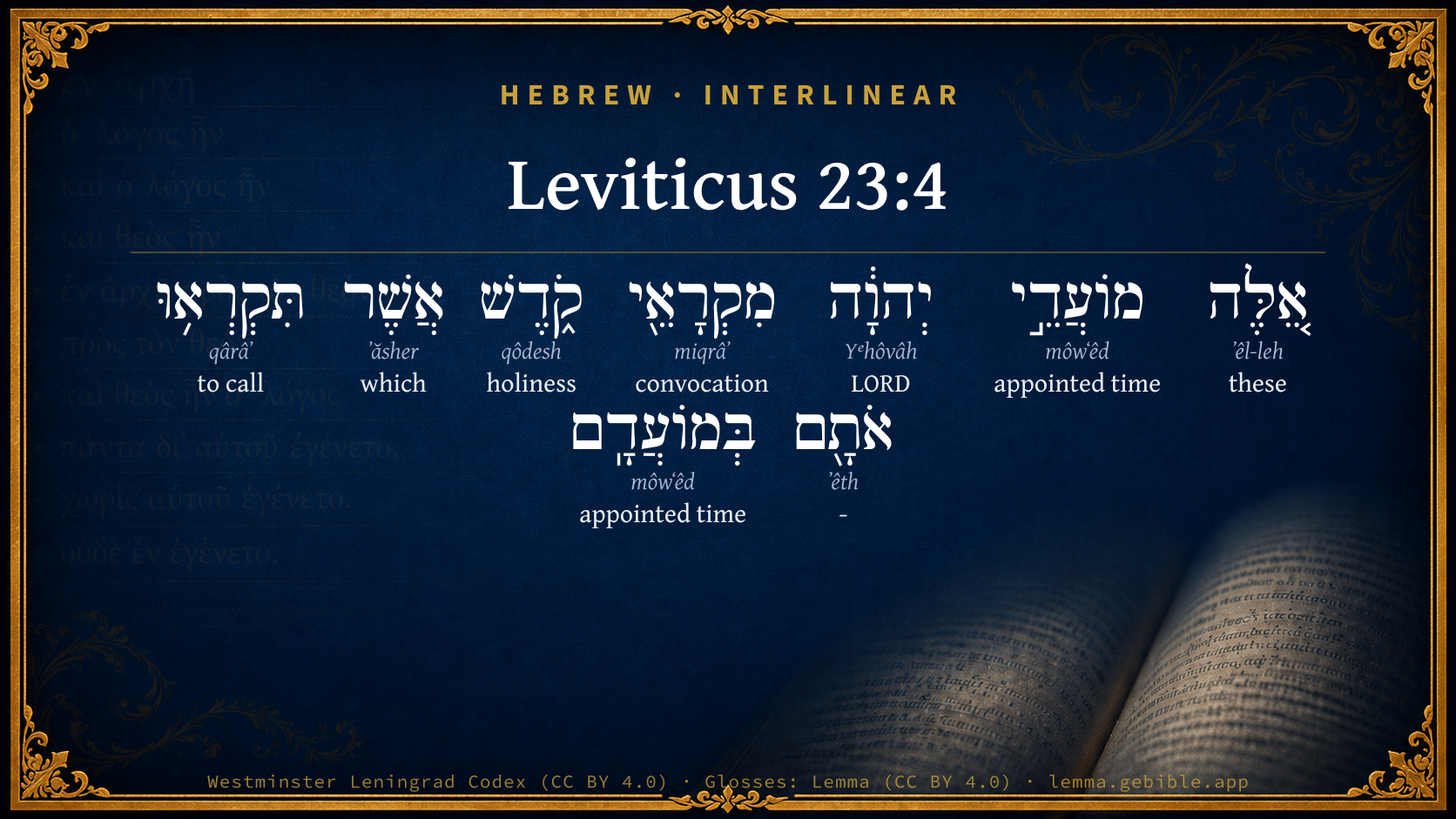
Hebrew (Westminster Leningrad Codex) Leviticus 23:4 appears in the Hebrew Old Testament. The text above is from the Westminster Leningrad Codex. Each word links to its Strong’s number, a concise gloss, and parsing drawn from the Open Scriptures Hebrew Bible morphology. Click any word for its full Brown-Driver-Briggs (BDB) entry.
Download image
Cite this verse

Leviticus 23:4 (World English Bible). Public Domain. Lemma interlinear Bible study tool, https://lemma.gebible.app/v/leviticus/23/4.

Show BibTeX & RIS
BibTeX
RIS
English Translation
"'These are the set feasts of Yahweh, even holy convocations, which you shall proclaim in their appointed season.
World English Bible · Public Domain
Download a study sheet

One document with this verse’s original text, its word-by-word gloss line, the meaning frame, cross-references with their text, attributed commentary, and full source and license credits — printable, and it pastes into notes with its structure intact.

This verse Autodidact and up

Study sheet (.html) Plain text (.txt)

A passage Seminary Student

Up to 50 verses in one chapter. A passage sheet keeps up to 6 commentary sources and 12 cross-references per verse, in the order this page ranks them, and says so on the sheet whenever that leaves anything out. Ask for a single verse and you get the Autodidact verse sheet above.

Everything on this page stays free to read, with no account — the sheet is a download of what is already on screen, not access to it.

Want to remove ads? Support Godless Engineer
Compare translations 3

The same verse in 3 English versions, stacked beneath the original-language interlinear above. Click any original word for its lexicon entry.

Each is an independent rendering of the whole verse — the interlinear is not word-aligned to these translations.

Highlighted words mark where these versions differ — a whole-verse word diff, not a word-by-word alignment.

  • World English Bible Public Domain
    "'These are the set feasts of Yahweh, even holy convocations, which you shall proclaim in their appointed season.
  • King James Version Public Domain
    These are the feasts of the LORD, even holy convocations, which ye shall proclaim in their seasons.
  • unfoldingWord Literal Text CC BY-SA 4.0
    These the appointed times of Yahweh, assemblies of holiness which you shall proclaim them in their appointed times.

unfoldingWord Literal Text — © unfoldingWord, licensed CC BY-SA 4.0. Word-aligned USFM3 via Door43 (git.door43.org/unfoldingWord/en_ult).

Versions to compare (up to 4)

3 of 4 selected

Show all 18 translations

Every available English version of this verse, each an independent rendering of the whole verse.

  • World English Bible Public Domain
    "'These are the set feasts of Yahweh, even holy convocations, which you shall proclaim in their appointed season.
  • Berean Standard Bible Public Domain
    These are the LORD’s appointed feasts, the sacred assemblies you are to proclaim at their appointed times.
  • Majority Standard Bible Public Domain
    These are the LORD’s appointed feasts, the sacred assemblies you are to proclaim at their appointed times.
  • King James Version Public Domain
    These are the feasts of the LORD, even holy convocations, which ye shall proclaim in their seasons.
  • American Standard Version (1901) Public Domain
    These are the set feasts of Jehovah, even holy convocations, which ye shall proclaim in their appointed season.
  • Revised Version (1885) Public Domain
    These are the set feasts of the LORD, even holy convocations, which ye shall proclaim in their appointed season.
  • Geneva Bible (1599) Public Domain
    These are the feastes of the Lord, and holie conuocations, which yee shall proclaime in their seasons.
  • Douay-Rheims (1899) Public Domain
    These also are the holy days of the Lord, which you must celebrate in their seasons.
  • Young's Literal Translation Public Domain
    `These `are' appointed seasons of Jehovah, holy convocations, which ye proclaim in their appointed seasons:
  • Literal Standard Version CC BY-SA 4.0
    These [are] appointed times of YHWH, holy convocations, which you proclaim in their appointed times:
  • Unlocked Literal Bible CC BY-SA 4.0
    These are the appointed festivals of Yahweh, the holy assemblies that you must announce at their appointed times:
  • unfoldingWord Literal Text CC BY-SA 4.0
    These the appointed times of Yahweh, assemblies of holiness which you shall proclaim them in their appointed times.
  • Darby Bible Public Domain
    These are the set feasts of Jehovah, holy convocations, which ye shall proclaim in their seasons:
  • World Messianic Bible Public Domain
    “‘These are the set feasts of the LORD, even holy convocations, which you shall proclaim in their appointed season.
  • Webster's Bible Public Domain
    These are the feasts of the LORD, holy convocations, which ye shall proclaim in their seasons.
  • Free Bible Version CC BY-SA 4.0
    These are the Lord's religious festivals, the holy meetings that you are to announce at their specific times.
  • Bible in Basic English Public Domain
    These are the fixed feasts of the Lord, the holy days of worship which you will keep at their regular times.
  • JPS Tanakh (1917) Public Domain
    These are the appointed seasons of the LORD, even holy convocations, which ye shall proclaim in their appointed season.

Literal Standard Version (2020), Covenant Press — licensed CC BY-SA 4.0. Text via the HelloAO Bible API (eBible.org). Unlocked Literal Bible (unfoldingWord) — licensed CC BY-SA 4.0. Text via the HelloAO Bible API (eBible.org). unfoldingWord Literal Text — © unfoldingWord, licensed CC BY-SA 4.0. Word-aligned USFM3 via Door43 (git.door43.org/unfoldingWord/en_ult). Free Bible Version, Dr. Jonathan Gallagher — licensed CC BY-SA 4.0. Text via the HelloAO Bible API (eBible.org).

Word by word

More ways to search: Search by grammar → Find every occurrence → Compare this word →

Practice this passage: Drill this verse → Learn its vocabulary →

About this verse

These counts appear in no published source. They are computed here, from the morphology-tagged text and Lemma’s own curated glosses. What Lemma adds →

9
words
8
distinct lemmas
Pentateuch
section

Notable vocabulary

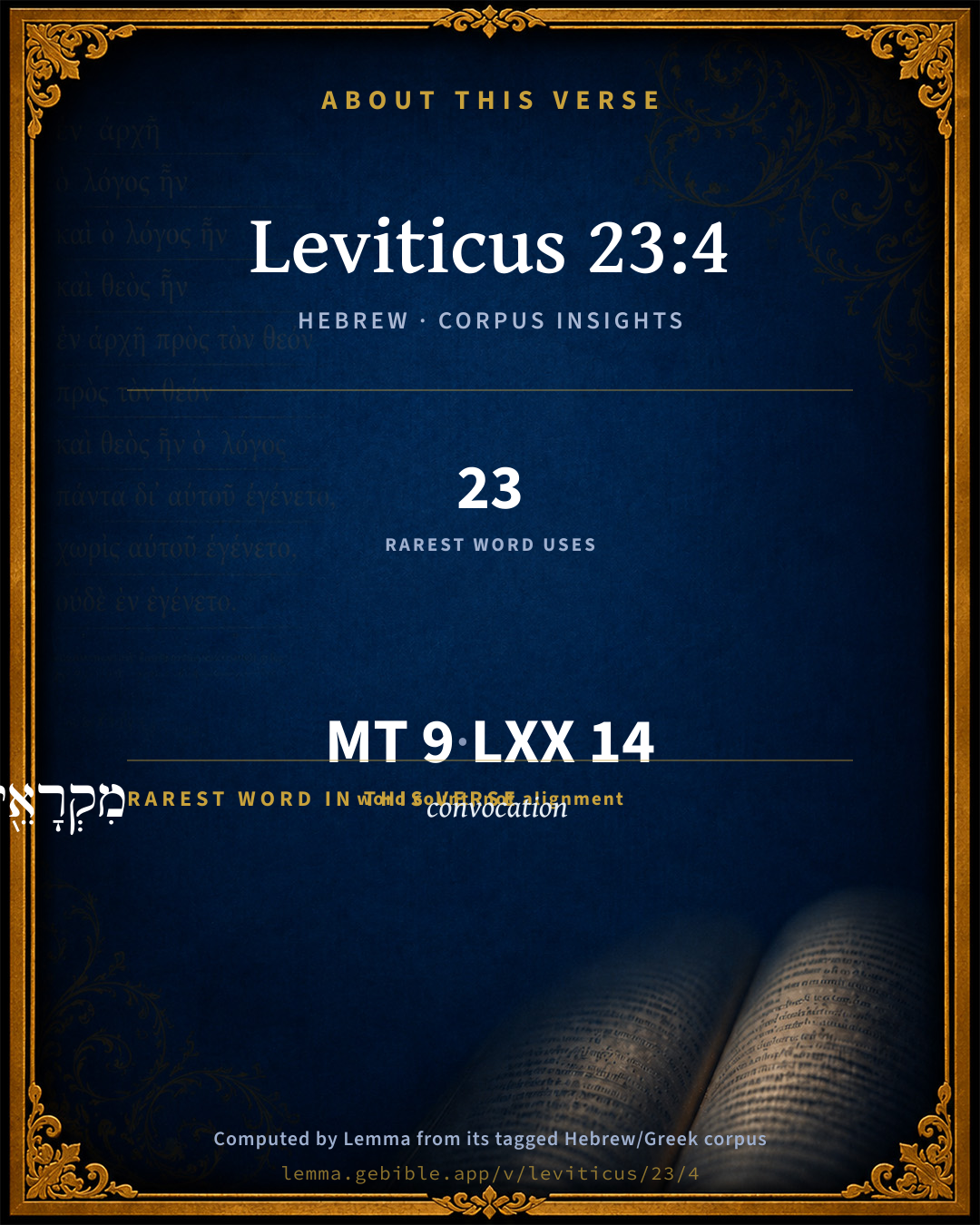
The rarest word here is מִקְרָאֵ֖י convocation H4744 — appearing just 23 times in the whole Hebrew Bible.

Shared distinctive vocabulary

מִקְרָאֵ֖י convocation H4744 occurs in 22 verses of the Hebrew Bible. Also found in:

Grammatical profile

  • 1 verb
  • 5 nouns
  • 1 pronoun
  • 2 particles

Verb forms

  • תִּקְרְא֥וּ Qal · Imperfect

Repetition

A word recurs within this verse — often emphatic in Hebrew:

  • מוֹעֲדֵ֣י appointed time H4150 ×2

Hebrew & Septuagint length

In English translation the verse runs 18 words from the Hebrew and 16 from the Septuagint (LXX English) — closely comparable.

A rough comparison of the two English renderings, which tokenize alike — not a word-level alignment.

Word counts can differ between the Hebrew and the Greek without any difference in meaning — e.g. the Hebrew direct-object marker אֵת has no separate Greek word, and Greek often adds the article ὁ.

In the original languages it is 9 Hebrew tokens and 14 Greek tokens — but the two are counted differently (Hebrew bundles its prefixes and suffixes into one token; the Greek is in lemma form), so that isn’t a like-for-like length.

Cross-references

3

Topical passages linked to Leviticus 23:4 in the Treasury of Scripture Knowledge — connected by theme and wording, ordered by reader-vote popularity; previews shown in the World English Bible.

  • Exodus 23:14 "You shall observe a feast to me three times a year.
  • Leviticus 23:2 "Speak to the children of Israel, and tell them, 'The set feasts of Yahweh, which you shall proclaim to be holy convocations, even these are my set feasts.
  • Leviticus 23:37 "'These are the appointed feasts of Yahweh, which you shall proclaim to be holy convocations, to offer an offering made by fire to Yahweh, a burnt offering, and a meal offering, a sacrifice, and drink offerings, each on its own day;

Cross-references courtesy of OpenBible.info (CC BY 4.0).

Hebrew and Greek witnesses Masoretic Hebrew ↔ Greek Septuagint

The same verse in the two great witnesses to the Old Testament, shown verse-for-verse.

These are two independent witnesses, not word-aligned to each other, and the Septuagint is shown in lemma (dictionary) form.

Hebrew Leviticus 23:4 Masoretic · Westminster Leningrad Codex

אֵ֚לֶּה מוֹעֲדֵ֣י יְהוָ֔ה מִקְרָאֵ֖י קֹ֑דֶשׁ אֲשֶׁר תִּקְרְא֥וּ אֹתָ֖ם בְּמוֹעֲדָֽם

"'These are the set feasts of Yahweh, even holy convocations, which you shall proclaim in their appointed season.

World English Bible · Public Domain

Greek LXX Leviticus 23:4 Septuagint · lemma form

οὗτος ὁ ἑορτή ὁ κύριος κλητός ἅγιος ὅς καλέω αὐτός ἐν ὁ καιρός αὐτός

These are the feasts to the Lord, holy convocations, which you⌃ shall call in their seasons.

LXX2012 (modern English Septuagint) · Public Domain

Hebrew: Westminster Leningrad Codex (CC BY 4.0). Greek: Septuagint (public domain); English from LXX2012 (modern English Septuagint) (Public Domain). How the Septuagint differs from the Hebrew →

Targum (Aramaic paraphrase)

2

The Targum is the ancient Jewish Aramaic paraphrase of the Hebrew Scriptures — an interpretive translation, not the Hebrew text itself. Onkelos (literal) and Pseudo-Jonathan (expansive) render the Torah, and Jonathan the Prophets. Coverage is partial: where no permissively-licensed English translation exists for a verse, only the Aramaic is shown. This is verse-level text, not a word-by-word alignment to the Hebrew.

  1. Targum Onkelos Torah (Genesis–Deuteronomy)
    אִלֵין מוֹעֲדַיָא דַיְיָ מְעָרְעֵי קַדִישׁ דִי תְעָרְעוּן יָתְהוֹן בְּזִמְנֵיהוֹן

    (no public-domain English translation for this verse)

    Targum Onkelos — Aramaic: “Onkelos Genesis” (public domain); “Onkelos Exodus” (public domain); “Onkelos Leviticus” (public domain); “Onkelos Numbers” (public domain); “Onkelos Deuteronomy” (public domain). English: “Sefaria Community Translation” (CC0 1.0 (public-domain dedication)); “J.W. Etheridge. The Targums of Onkelos and Jonathan Ben Uzziel on the Pentateuch. London: Longmans, Green, 1862” (public domain). Text via Sefaria.

  2. Targum Pseudo-Jonathan Torah (Genesis–Deuteronomy)
    אִלֵין זְמַנֵי סִדוּרֵי מוֹעֲדַיָא דַיְיָ מְאַרַע קַדִישׁ דִי יִתְרְעוּן יַתְהוֹן בִּזְמַנֵיהוֹן

    These are the times of the Festivals of the Lord, holy convocations which you shall proclaim in their times:

    Targum Pseudo-Jonathan — Aramaic: “Targum Jonathan on Genesis” (public domain); “Targum Jonathan on Exodus” (public domain); “Targum Jonathan on Leviticus” (public domain); “Targum Jonathan on Numbers” (public domain); “Targum Jonathan on Deuteronomy” (public domain). English: “The Targum of Jonathan ben Uzziel, trans. J. W. Etheridge, London, 1862” (public domain). Text via Sefaria.

Commentary

Notes on Leviticus 23:4 from classic Christian and Jewish commentators (each source and its license shown beneath its notes). The classic Christian expositions comment on the surrounding passage and are grouped to its opening verse, so a note may address several verses; the Jewish commentaries on the Tanakh (Rashi and others) are per-verse, so they appear only where the commentator wrote on this verse.

Lemma curates 59 commentaries, every one of them public domain or Creative Commons licensed, each selected and text-cleaned for this edition rather than reprinted as found. About our sources →

Matthew Henry's Commentary

Here again the feasts are called the feasts of the Lord, because he appointed them. Jeroboam's feast, which he devised of his own heart (Kg1 12:33), was an affront to God, and a reproach upon the people. These feasts were to be proclaimed in their seasons (Lev 23:4), and the seasons God chose for them were in March, May and September (according to our present computation), not in winter, because travelling would then be uncomfortable, when the days were short, and the ways foul; not in the middle of summer, because then in those countries they were gathering in their harvest and vintage, and could be ill spared from their country business. Thus graciously does God consult our comfort in his appointments, obliging us thereby religiously to regard his glory in our observance of them, and not to complain of them as a burden. The solemnities appointed them were, 1. Many and returned frequently, which was intended to preserve in them a deep sense of God and religion, and to prevent their inclining to the superstitions of the heathen. God kept them fully employed in his service, that they might not have time to hearken to the temptations of the idolatrous neighbourhood they lived in. 2. They were most of them times of joy and rejoicing. The weekly sabbath is so, and all their yearly solemnities, except the day of atonement. God would thus teach them that wisdom's ways are pleasantness, and engage them to his service by encouraging them to be cheerful in it and to sing at their work. Seven days were days of strict rest and holy convocations; the first day and the seventh of the feast of unleavened bread, the day of pentecost, the day of the feast of trumpets, the first day and the eighth of the feast of tabernacles, and the day of atonement: here were six for holy joy and one only for holy mourning. We are commanded to rejoice evermore, but not to be evermore weeping. Here is,

I. A repetition of the law of the passover, which was to be observed on the fourteenth day of the first month, in remembrance of their deliverance out of Egypt and the distinguishing preservation of their first-born, mercies never to be forgotten. This feast was to begin with the killing of the paschal lamb, Lev 23:5. It was to continue seven days, during all which time they were to eat sad bread, that was unleavened (Lev 23:6), and the first and last day of the seven were to be days of holy rest and holy convocations, Lev 23:7, Lev 23:8. They were not idle days spent in sport and recreation (as many that are called Christians spend their holy days), but offerings were made by fire unto the Lord at his altar; and we have reason to think that the people were taught to employ their time in prayer, and praise, and godly meditation.

II. An order for the offering of a sheaf of the first-fruits, upon the second day of the feast of unleavened bread; the first is called the sabbath, because it was observed as a sabbath (Lev 23:11), and, on the morrow after, they had this solemnity. A sheaf or handful of new corn was brought to the priest, who was to heave it up, in token of his presenting it to the God of Heaven, and to wave it to and fro before the Lord, as the Lord of the whole earth, and this should be accepted for them as a thankful acknowledgment of God's mercy to them in clothing their fields with corn, and of their dependence upon God, and desire towards him, for the preserving of it to their use. For it was the expression both of prayer and praise, Lev 23:11. A lamb for a burnt-offering was to be offered with it, Lev 23:12. As the sacrifice of animals was generally attended with meat-offerings, so this sacrifice of corn was attended with a burnt-offering, that bread and flesh might be set together on God's table. They are forbidden to eat of their new corn till this handful was offered to God; for it was fit, if God and Israel feast together, that he should be served first. And the offering of this sheaf of first-fruits in the name of the whole congregation did, as it were, sanctify to them their whole harvest, and give them a comfortable use of all the rest; for then we may eat our bread with joy when we have, in some measure, performed our duty to God, and God has accepted our works, for thus all our enjoyments become clean to us. Now, 1. This law was given now, though there was no occasion for putting it in execution till they came to Canaan: in the wilderness they sowed no corn; but God's feeding them there with bread from heaven obliged them hereafter not to grudge him his share of their bread out of the earth. We find that when they came into Canaan the manna ceased upon the very day that the sheaf of first-fruits was offered; they had eaten of the old corn the day before (Jos 5:11), and then on this day they offered the first-fruits, by which they became entitled to the new corn too (Lev 23:12), so that there was no more occasion for manna. 1. This sheaf of first-fruits was typical of our Lord Jesus, who has risen from the dead as the first-fruits of those that slept, Co1 15:20. That branch of the Lord (Isa 4:2) was then presented to him, in virtue of the sacrifice of himself, the Lamb of God, and it was accepted for us. It is very observable that our Lord Jesus rose from the dead on the very day that the first-fruits were offered, to show that he was the substance of this shadow. 3. We are taught by this law to honour the Lord with our substance, and with the first-fruits of all our increase, Pro 3:9. They were not to eat of their new corn till God's part was offered to him out of it (Lev 23:14), for we must always begin with God, begin our lives with him, begin every day with him, begin every meal with him, begin every affair and business with him; seek first the kingdom of God.

Matthew Henry's Commentary on the Whole Bible (1708–1710) — public domain (CC PDM 1.0). Text via the HelloAO Bible API.

Trapp's Complete Commentary

John Trapp

Lev 23:4 These [are] the feasts of the LORD, [even] holy convocations, which ye shall proclaim in their seasons.

Ver. 4. In their seasons,] i.e., Once a year.

John Trapp, A Commentary or Exposition upon All the Books of the Old and New Testament (1647–1656) — public domain. Text from a community e-Sword module.

Joseph Benson's Commentary

Lev 23:4. These are the feasts of the Lord — The solemnities, as the same word is rendered, Isa 33:20, where Zion is called the city of our solemnities.

Joseph Benson's Commentary on the Old and New Testaments (1811–1818) — public domain. Text from a community e-Sword module.

Keil & Delitzsch

C. F. Keil & F. Delitzsch

Lev 23:4 contains the special heading for the yearly feasts. בּמועדם at their appointed time.

Lev 23:5-14

The leading directions for the Passover and feast of Mazzoth are repeated from Exo 12:6, Exo 12:11, Exo 12:15-20. עבדה מלאכת, occupation of a work, signifies labour at some definite occupation, e.g., the building of the tabernacle, Exo 35:24; Exo 36:1, Exo 36:3; hence occupation in connection with trade or one's social calling, such as agriculture, handicraft, and so forth; whilst מלאכה is the performance of any kind of work, e.g., kindling fire for cooking food (Exo 35:2-3). On the Sabbath and the day of atonement every kind of civil work was prohibited, even to the kindling of fire for the purpose of cooking (Lev 23:3, Lev 23:30, Lev 23:31, cf. Exo 20:10; Exo 31:14; Exo 35:2-3; Deu 5:14 and Lev 16:29; Num 29:7); on the other feast-days with a holy convocation, only servile work (Lev 23:7, Lev 23:8, Lev 23:21, Lev 23:25, Lev 23:35, Lev 23:36, cf. Exo 12:16, and the explanation on Lev 12:1-8 :15ff., and Num 28:18, Num 28:25-26; Num 29:1, Num 29:12, Num 29:35). To this there is appended a fresh regulation in Lev 23:9-14, with the repetition of the introductory clause, "And the Lord spake," etc. When the Israelites had come into the land to be given them by the Lord, and had reaped the harvest, they were to bring a sheaf as first-fruits of their harvest to the priest, that he might wave it before Jehovah on the day after the Sabbath, i.e., after the first day of Mazzoth. According to Josephus and Philo, it was a sheaf of barley; but this is not expressly commanded, because it would be taken for granted in Canaan, where the harvest began with the barley. In the warmer parts of Palestine the barley ripens about the middle of April, and is reaped in April or the beginning of May, whereas the wheat ripens two or three weeks later (Seetzen; Robinson's Pal. ii. 263, 278). The priest was to wave the sheaf before Jehovah, i.e., to present it symbolically to Jehovah by the ceremony of waving, without burning any of it upon the altar. The rabbinical rule, viz., to dry a portion of the ears by the fire, and then, after rubbing them out, to burn them on the altar, was an ordinance of the later scribes, who knew not the law, and was based upon Lev 2:14. For the law in Lev 2:14 refers to the offerings of first-fruits made by private persons, which are treated of in Num 18:12-13, and Deu 26:2. The sheaf of first-fruits, on the other hand, which was to be offered before Jehovah as a wave-offering in the name of the congregation, corresponded to the two wave-loaves which were leavened and then baked, and were to be presented to the Lord as first-fruits (Lev 23:17). As no portion of these wave-loaves was burned upon the altar, because nothing leavened was to be placed upon it (Lev 2:11), but they were assigned entirely to the priests, we have only to assume that the same application was intended by the law in the case of the sheaf of first-fruits, since the text only prescribes the waving, and does not contain a word about roasting, rubbing, or burning the grains upon the altar. השּׁבּת מחרת (the morrow after the Sabbath) signifies the next day after the first day of the feast of Mazzoth, i.e., the 16th Abib (Nisan), not the day of the Sabbath which fell in the seven days' feast of Mazzoth, as the Baethoseans supposed, still less the 22nd of Nisan, or the day after the conclusion of the seven days' feast, which always closed with a Sabbath, as Hitzig imagines.

(Note: The view advocated by the Baethoseans, which has been lately supported by W. Schultz, is refuted not only by Jos 5:11, but by the definite article used, השּׁבּת, which points back to one of the feast-days already mentioned, and still more decisively by the circumstance, that according to Lev 23:15 the seven weeks, at the close of which the feast of Pentecost was to be kept, were to be reckoned from this Sabbath; and if the Sabbath was not fixed, but might fall upon any day of the seven days' feast of Mazzoth, and therefore as much as give or six days after the Passover, the feast of Passover itself would be forced out of the fundamental position which it occupied in the series of annual festivals (cf. Ranke, Pentateuch ii. 108). Hitzig's hypothesis has been revived by Hupfeld and Knobel, without any notice of the conclusive refutation given to it by Bהhr and Wieseler; only Knobel makes "the Sabbath" not the concluding but the opening Sabbath of the feast of Passover, on the ground that "otherwise the festal sheaf would not have been offered till the 22nd of the month, and therefore would have come post festum." But this hypothesis, which renders it necessary that the commencement of the ecclesiastical year should always be assigned to a Saturday (Sabbath), in order to gain weekly Sabbaths for the 14th and 21st of the month, as the opening and close of the feast of Passover, gives such a form to the Jewish year as would involve its invariably closing with a broken week; a hypothesis which is not only incapable of demonstration, but, from the holiness attached to the Jewish division of weeks, is a priori improbable, and in fact inconceivable. The Mosaic law, which gave such sanctity to the division of time into weeks, as founded upon the history of creation, by the institution of the observance of the Sabbath, that it raised the Sabbath into the groundwork of a magnificent festal cycle, could not possibly have made such an arrangement with regard to the time for the observance of the Passover, as would involve almost invariably the mutilation of the last week of the year, and an interruption of the old and sacred weekly cycle with the Sabbath festival at its close. The arguments by which so forced a hypothesis is defended, must be very conclusive indeed, to meet with any acceptance. But neither Hitzig nor his followers have been able to adduce any such arguments as these. Besides the word "Sabbath" and Jos 5:11, which prove nothing at all, the only other argument adduced by Knobel is, that "it is impossible to see why precisely the second day of the azyma, when the people went about their ordinary duties, and there was no meeting at the sanctuary, should have been distinguished by the sacrificial gift which was the peculiar characteristic of the feast," - an argument based upon the fallacious principle, that anything for which I can see no reason, cannot possibly have occurred.)

The "Sabbath" does not mean the seventh day of the week, but the day of rest, although the weekly Sabbath was always the seventh or last day of the week; hence not only the seventh day of the week (Exo 31:15, etc.), but the day of atonement (the tenth of the seventh month), is called "Sabbath," and "Shabbath shabbathon" (Lev 23:32; Lev 16:31). As a day of rest, on which no laborious work was to be performed (Lev 23:8), the first day of the feast of Mazzoth is called "Sabbath," irrespectively of the day of the week upon which it fell; and "the morrow after the Sabbath" is equivalent to "the morrow after the Passover" mentioned in Jos 5:11, where "Passover" signifies the day at the beginning of which the paschal meal was held, i.e., the first day of unleavened bread, which commenced on the evening of the 14th, in other words, the 15th Abib. By offering the sheaf of first-fruits of the harvest, the Israelites were to consecrate their daily bread to the Lord their God, and practically to acknowledge that they owed the blessing of the harvest to the grace of God. They were not to eat any bread or roasted grains of the new corn till they had presented the offering of their God (Lev 23:14). This offering was fixed for the second day of the feast of the Passover, that the connection between the harvest and the Passover might be kept in subordination to the leading idea of the Passover itself (see at Exo 12:15.). But as the sheaf was not burned upon the altar, but only presented symbolically to the Lord by waving, and then handed over to the priests, an altar-gift had to be connected with it, - namely, a yearling sheep as a burnt-offering, a meat-offering of two-tenths of an ephah of fine flour mixed with oil, and a drink-offering of a quarter of a hin of wine, - to give expression to the obligation and willingness of the congregation not only to enjoy their earthly food, but to strengthen all the members of their body for growth in holiness and diligence in good works. The burnt-offering, for which a yearling lamb was prescribed, as in fact for all the regular festal sacrifices, was of course in addition to the burnt-offerings prescribed in Num 28:19-20, for every feast-day. The meat-offering, however, was not to consist of one-tenth of an ephah of fine flour, as on other occasions (Exo 29:40; Num 28:9, Num 28:13, etc.), but of two-tenths, that the offering of corn at the harvest-feast might be a more plentiful one than usual.

Keil & Delitzsch — Biblical Commentary on the Old Testament (1861–1891) — public domain (CC PDM 1.0). Text via the HelloAO Bible API. (Old Testament only.)

The Expositor's Bible

THE FEAST OF PASSOVER AND UNLEAVENED BREAD

Lev_23:4-14

"These are the set feasts of the Lord, even holy convocations, which ye shall proclaim in their appointed season. In the first month, on the fourteenth day of the month at even, is the Lords passover. And on the fifteenth day of the same month is the feast of unleavened bread unto the Lord: seven days ye shall eat unleavened bread. In the first day ye shall have a holy convocation: ye shall do no servile work. But ye shall offer an offering made by fire unto the Lord seven days: in the seventh day is a holy convocation; ye shall do no servile work. And the Lord spake unto Moses, saying, Speak unto the children of Israel, and say unto them, When ye be come into the land which I give unto you, and shall reap the harvest thereof, then ye shall bring the sheaf of the firstfruits of your harvest unto the priest: and he shall wave the sheaf before the Lord, to be accepted for you: on the morrow after the sabbath the priest shall wave it. And in the day when ye wave the sheaf, ye shall offer a he-lamb without blemish of the first year for a burnt offering unto the Lord. And the meal offering thereof shall be two tenth parts of an ephah of fine flour mingled with oil, an offering made by fire unto the Lord for a sweet savour: and the drink offering thereof shall be of wine, the fourth part of a hin. And ye shall eat neither bread, nor parched corn, nor fresh ears, until this selfsame day, until ye have brought the oblation of your God: it is a statute forever throughout your generations in all your dwellings."

Lev_23:5-8 give the law for the first of the annual feasts, the passover and unleavened bread. The passover lamb was to be slain and eaten on the evening of the fourteenth day; and thereafter, for seven days, they were all to eat unleavened bread. The first and seventh days of unleavened bread were to be kept as a "holy convocation"; in both of which "servile work," i.e., the usual occupations in the field or in ones handicraft, were forbidden. Further than this the restriction did not extend.

The utter impossibility of making this feast of passover also to have been at first merely a harvest festival is best shown by the signal failure of the many attempts to explain on this theory the name "passover" as applied to the sacrificial victim, and the exclusion of leaven for the whole period. Admit the statements of the Pentateuch on this subject, and all is simple. The feast was a most suitable commemoration by Israel of the solemn circumstances under which they began their national life; their exemption from the plague of the death of the firstborn, through the blood of a slain victim; and their exodus thereafter in such haste that they stopped not to leaven their bread.

And there was a deeper spiritual meaning than this. Whereas, secured by the sprinkling of blood, they then fed in safety on the flesh of the victim, by which they received strength for their flight from Egypt, the same two thoughts were thereby naturally suggested which we have seen represented in the peace offering; namely, friendship and fellowship with God secured through sacrifice, and life sustained by His bounty. And the unleavened bread, also, had more than a historic reference; else it had sufficed to eat it only on the anniversary night, and it had not been commanded also to put away the leaven from their houses. For leaven is the established symbol of moral corruption; and in that the passover lamb having been slain, Israel must abstain for a full septenary period of a week from every use of leaven, it was signified in symbol that the redeemed nation must not live by means of what is evil, but be a holy people, according to their calling. And the inseparable connection of this with full consecration of person and service, and with the expiation of sin, was daily symbolised (Lev_23:8) by the "offerings made by fire," burnt offerings, meal offerings, and sin offerings, "offerings made by fire unto the Lord."

On "the morrow after the Sabbath" (Lev_23:15) of this sacred week, it was ordered (Lev_23:10) that "the sheaf of the firstfruits of the (barley) harvest" should be brought "unto the priest"; and (Lev_23:11) that he should consecrate it unto the Lord, by the ceremony of waving it before Him. This wave offering of the sheaf of firstfruits was to be accompanied (Lev_23:2-13) by a burnt offering, a meal offering, and a drink offering of wine. Until all this was done (Lev_23:14) they were to "eat neither bread, nor parched corn, nor fresh ears" of the new harvest. By the consecration of the firstfruits is ever signified the consecration of the whole, of which it is the first part, unto the Lord. By this act, Israel, at the very beginning of their harvest, solemnly consecrated the whole harvest to the Lord; and are only permitted to use it, when they receive it thus as a gift from Him. This ethical reference to the harvest is here expressly taught; but still more was thereby taught in symbol.

For Israel was declared {Exo_4:22} to be Gods firstborn; that is, in the great redemptive plan of God, which looks forward to the final salvation of all nations, Israel ever comes historically first. "The Jew first, and also the Greek," is the New Testament formula of this fundamental dispensational truth. The offering unto God, therefore, of the sheaf of firstfruits, at the very beginning of the harvest, -in fullest harmony with the historic reference of this feast, which commemorated Israels deliverance from bondage and separation from the nations, as a firstfruits of redemption, -symbolically signified the consecration of Israel unto God as the firstborn unto Him from the nations, the beginning of the worlds great harvest.

But this is not all. For in these various ceremonies of this first of the feasts, all who acknowledge the authority of the New Testament will recognise a yet more profound, and prophetic, spiritual meaning. Passover and unleavened bread not only looked backward, but forward. For the Apostle Paul writes, addressing all believers: {1 Corinthians 7, 8} "Purge out the old leaven, that ye may be a new lump, even as ye are unleavened. For our passover also hath been sacrificed, even Christ: wherefore let us keep the feast, not with old leaven, neither with the leaven of malice and wickedness, but with the unleavened bread of sincerity and truth";-an exposition so plain that comment is scarcely needed. And as following upon the passover, on the morrow after the Sabbath, the first day of the week, the sheaf of firstfruits was presented before Jehovah, so in type is brought before us that of which the same Apostle tells us, {1Co_15:20} that Christ, in that He rose from the dead on the first day after the Sabbath, became "the firstfruits of them that are asleep"; thus, for the first time, finally and exhaustively fulfilling this type, in full accord also with His own representation of Himself {Joh_12:24} as "a grain of wheat;"which should "fall into the earth and die, and then, living again, bear much fruit."

William Robertson Nicoll, ed., The Expositor's Bible (London: Hodder & Stoughton, 1887–1910) — public domain. 65 of 66 books (1 Corinthians is not separately keyed, as that volume carries no machine-parseable verse references); section-level commentary keyed to the opening verse. Introductory and overview sections not keyed to a specific passage are excluded.

Geneva Bible (1599)

Geneva Bible translators

For the Sabbath was kept every week, and these others were kept but once every year.

Geneva Bible (1599) marginal notes — public domain. Text via Bolls.life.

Jamieson, Fausset & Brown

Robert Jamieson, A. R. Fausset & David Brown

These are the feasts of the Lord, which ye shall proclaim in their seasons--Their observance took place in the parts of the year corresponding to our March, May, and September. Divine wisdom was manifested in fixing them at those periods; in winter, when the days were short and the roads broken up, a long journey was impracticable; while in summer the harvest and vintage gave busy employment in the fields. Besides, another reason for the choice of those seasons probably was to counteract the influence of Egyptian associations and habits. And God appointed more sacred festivals for the Israelites in the month of September than the people of Egypt had in honor of their idols. These institutions, however, were for the most part prospective, the observance being not binding on the Israelites during their wanderings in the wilderness, while the regular celebration was not to commence till their settlement in Canaan.

Jamieson, Fausset & Brown — Commentary Critical and Explanatory on the Whole Bible (1871) — public domain (CC PDM 1.0). Text via the HelloAO Bible API.

Ellicott's Commentary for English Readers

(4) These are the feasts of the Lord.—Because the following are the festivals proper as distinguished from the sabbath (see Lev_23:37-38), and because they are now enumerated in their regular order, the introductory heading is here repeated.

Ye shall proclaim in their seasons.—By the blast of trumpets on the day of the month on which they are to be observed.

A Bible Commentary for English Readers, edited by Charles John Ellicott (1878–1897) — public domain. Text from a community e-Sword module.

John Gill's Exposition

These are the feasts of the Lord, even holy convocations,.... What follow besides the sabbath mentioned:

which ye shall proclaim in their seasons; the proper times of the year, the day or days, and month in which they are to be observed; these were to be proclaimed by the priests with the sound of trumpet, namely, what follow, for they are put together, which had been before for the most part singly delivered.

John Gill's Exposition of the Whole Bible (1746–1763) — public domain (CC PDM 1.0). Text via the HelloAO Bible API.

Albert Barnes' Notes on the Bible

The recurrence of the sabbatical number in the five annual days of holy convocation should be noticed.

Albert Barnes' Notes on the Bible (1834–1885) — public domain. Text from a community e-Sword/MySword module.

Matthew Poole's English Annotations

In their appointed and proper times, as the word is used Gen 1:14; Psa 104:19.

Matthew Poole's English Annotations on the Holy Bible (1683–1685) — public domain. Text from a community e-Sword/MySword module.

The Pulpit Commentary

This verse repeats the statement or heading contained in verse 2, with reference to the annual holy day, the sabbath having been disposed of in verse 3.

HOMILIES BY R.M. EDGAR Vers. 4-8The Passover.

cf. Ex 12; also 1Co_5:7, 1Co_5:8. In addition to the weekly "offering of rest," there were emphasized offerings of a similar character at select seasons throughout the Jewish year. These were to bring to remembrance great national deliverances, or to celebrate the blessings with which Jehovah crowned the year. The first of these feasts was the Passover. It was to celebrate the deliverance preceding the Exodus. It began with a holy convocation; there was then a week of complete freedom from leaven; and then a holy convocation completed the special observances. Burnt offerings were also presented of a special character every day of the holy week. The following line of thought is suggested by this feast.

I THE WHOLE POPULATION IN EGYPT WAS EXPOSED TO A COMMON DANGER. It is evident from the narrative that the destroying angel might justly have carried death into every house, and that it was only the special arrangement which prevented his doing so. For though a difference was made between the Egyptians and the Israelites, it had its reason and its root in God"s sovereign grace. The Israelites may not have carried their enmity to God with so high a hand as the Egyptians, yet their pilgrimage demonstrated that the hostility was there. The judgment on the firstborn was consequently only a sample of what all deserved.

Unless we begin with the truth that "there is no difference," for "all have sinned and come short of God"s glory," we are likely to underestimate the grace which maketh us afterwards to differ. We are not, properly speaking, in a state of probation, but in a state either of condemnation or of salvation. "He that believeth not is condemned already"; (Joh_3:18) "he that believeth is not condemned." When we start with the idea that we are really culprits and condemned already, we are stirred up to lay hold by faith of the deliverance. How we reach the blessed condition, "There is therefore now no condemnation," is beautifully symbolized by the Passover. For

II GOD"S PLAN OF DELIVERANCE WAS THROUGH THE SPRINKLING OF BLOOD. Each Israelite was directed to take a lamb and slay it, and sprinkle on the doorpost and lintel, with a hyssop branch, its blood. The destroying angel respected the sprinkled blood, and passed over the houses on which it appeared. Here was God"s plan, by the sacrifice of the life of an innocent substitute to secure the remission of the sins of his people.

And need I say that the Paschal lamb was one of the most beautiful types of Jesus? He, as our Passover, was "sacrificed for us". (1Co_5:7) It is through his blood we have remission. His life, laid down in payment of the penalty, secures our just release. The destroying angel passes over all who are under the shelter of Christ"s blood.

III THE PASCHAL LAMB WAS TO AFFORD LIFE AS WELL AS SECURE DELIVERANCE. Roasted with fire, with bitter herbs and unleavened bread, it was to be eaten by all the delivered ones. Within the blood-protected houses they stood and partook of a wholesome meal. It entered into their physical constitution, and strengthened them to begin their journey.

In the same way does Jesus Christ sustain all who trust in him. He becomes oar Life. He strengthens us for our wilderness journey. The Exodus from Egypt becomes easy through his imputed strength. And so our Lord spoke not only of eating his flesh, but even of drinking his blood, (Joh_6:54) and so receiving his eternal life. Not more surely does vital power come to the body through the digestion of food than does spiritual power come to the soul through partaking by faith of Jesus Christ. We are not only saved from wrath through him, but sustained by his life.

IV THE PASSOVER WAS THE DATE OF A NEW LIFE. An Exodus began with the first Passover, succeeded by a wilderness journey; and every succeeding Passover preceded a week of feasting on unleavened bread. Thus was a new and heroic life regarded as dating from the Passover. Hence the Lord changed the year at its institution, and made it the beginning of months with his people.

The same is experienced by believers. Unless our salvation by Christ"s blood is succeeded by pure living and the putting away of "the leaven of malice and wickedness", (1Co_5:8) we are only deceiving ourselves by supposing we are saved. Our salvation is with a view to our pilgrimage and purity. Therefore we must keep the Feast of Unleavened Bread as well as celebrate the Passover. It will not do to accept of salvation as an "indulgence." God makes no arrangement for impunity in sin. The death of the Lamb shows plainly that under God"s government no sin will go unpunished. To purity we are consequently called as part and parcel of a Divine salvation. R.M.E.

HOMILIES BY J.A. MACDONALD Vers. 4-14. The Passover.

Under this general title we include the Feast of Unleavened Bread, and the offering of the firstfruits which was connected with it. The history of the institution is given in Exodus 12. That the Passover was a type of Christ is evident. (see 1Co_5:6-8)

I THE LAMB TYPIFIED HIS PERSON. (Joh_1:36)

1. It was taken from the flock. (Exo_12:9)

(1) As it had been one with the flock, so was Jesus one with us. His humanity was no phantom, but a reality.

(2) What an honour is conferred upon us, that the God of glory should stoop to assume our nature, to become "bone of our bone"! Let us not dishonour ourselves by sinning against such grace.

2. It was a male of the first year.

(1) This was ordered because the male is the stronger animal, and was viewed as an emblem of excellence. Christ amongst men is the most excellent; "the fairest amongst ten thousand.

(2) Hence he is distinguished as "The Son of David," as "The Seed of Abraham," as "The Son of man." David had many sons, but in comparison with him they were nowhere; so he is the Son of David, the one glorious descendant who throws all others into the shade. So with the seed of Abraham. So with the sons of Adam. In the whole race there is no one to compare with him.

3. It was without blemish.

(1) The blemishes that would disqualify a Paschal lamb were physical, and so, abstractedly considered, of little account. But these blemishes were typical of moral evils, and in this view were very important.

(2) But Christ was, in the moral sense, absolutely blemishless. He was unique. Singular, however, not in eccentricity but in transcendent goodness. As under the microscope the works of God are seen to differ essentially from those of men, appearing more variously and wonderfully beautiful as they are more nearly examined under higher powers, so the more minutely Christ is considered the more wonderful and beautiful is he seen to be.

II ITS SACRIFICE FORESHADOWED HIS PASSION,

1. The lamb suffered vicariously.

(1) When taken from the flock the rest of the flock was spared. So was Jesus chosen that by his suffering his nation and his race might not perish. (see Joh_11:49-53)

(2) The blood of the lamb was sprinkled on the doorposts of the houses to avert the wrath of the destroying angel. The firstborn in every house was sacrificed where no vicarious blood appeared. So are we saved from wrath by the sprinkling of the blood of Jesus Christ through faith.

(3) Those saved from destruction through the blood of the lamb were immediately led out of Egypt, and set on their way to Canaan. So those justified through the blood of Christ are delivered also from the bondage of corruption, and set on their way to heaven.

2. Remarkable circumstances claim attention.

(1) The lamb was to be "of the first year," i.e., in its prime. So was Christ in the prime of his manhood when he was offered.

(2) It was to be offered "in the place which the Lord should choose". (Deu_16:5-7) That place was Jerusalem. (2Ki_21:7 Psa_132:13, Psa_132:14) There also "our Passover was sacrificed for us.

(3) "In the fourteenth day of the first month at even is the Lord"s Passover" (verse 5). Some think that our Lord, in accordance with the usage of the Karaites, or Seriptiarii, killed and ate the Passover a day earlier than the Pharisees, and that he expired on the cross at the time when the Traditionarii wore employed in killing their Paschal lambs (see Ikenii, "Dissert. Theolog.," tom. 2, chapters 9, 10, 11). Be this as it may, the word in the text translated "at even" is literally between the evenings; that is, between the chronological and ecclesiastical, which would be at the "ninth hour," or three p.m. This was the very hour at which Jesus expired. (Luk_23:44-46)

(4) It was ordered that no bone of the Paschal lamb should be broken. And whereas the legs of the malefactors were broken, the soldiers, seeing that Jesus was dead already, brake not his legs. (see Joh_19:31-36) Such things could not have been ordered by chance.

III THE FEAST CORRESPONDED TO THE CHRISTIAN EUCHARIST.

1. The latter was accommodated to the former.

(1) This is evident from the history of the institution. For the cup of the Eucharist Christ used that cup of the Passover, which was called by the Jews the "cup of blessing," and which description Paul applies to the Christian cup. (1Co_10:16) For the bread of the Supper he used that of the Passover. (Luk_22:15-20)

(2) So when Paul speaks of Christ as "our Passover sacrificed for us," he adds, "let us keep the feast," meaning, allusively, the Feast of Unleavened Bread, and really that which replaces it in the Church.

2. Both are retrospective and anticipative.

(1) The Hebrews commemorated the type, viz. the deliverance from the destroying angel and from Egypt. The Christians commemorate the antitype, viz. the deliverance of souls from the anger of God and from the tyranny of sin.

(2) The Hebrews anticipated their entrance into Canaan. The Christians anticipate the joys of heaven; the new wine of the kingdom.

3. Both are tokens of Church communion.

(1) The Passover was not the rite initiatory into the Church of Israel. Circumcision was that rite. To this, baptism, under the gospel, corresponds, and is therefore called the circumcision of Christianity. (Col_2:11, Col_2:12)

(2) But it was the rite continuative of such communion. Exclusion from the Passover was excommunication under the Law. So is the Eucharist the sign amongst Christians of a continued Church communion. "On the morrow after the sabbath," viz. of the Paschal week, the sheaf of the firstfruits was waved before the Lord (verses 10, 11). This was a type of Christ in his resurrection as the Firstfruits of the great harvest. (see 1Co_15:20-23) But when Christ died, the sabbath of the Paschal week happened upon the day in which he lay in the tomb. (comp. Joh_19:31 Luk_6:1) Thus the morrow after this sabbath was precisely that first day of the week on which our Lord arose. (Mar_16:9) How strengthening to faith are all these correspondences! J.A.M.

HOMILIES BY W. CLARKSON Vers. 4-8. The influence of sacred recollections.

The great festival of the Passover derived all its meaning from one memorable historic scene. It annually recalled one event of surpassing interest, and, by so doing, it impressed all susceptible souls with those leading truths to which God called Israel to bear its living testimony. We look at

I THE SPECIAL SCENE WHICH THIS FEAST COMMEMORATED, AND THE INFLUENCE IT WAS FITTED TO EXERT. What a night in Hebrew history that night of the Lord"s Passover! What false confidence in every Egyptian, what agitated hearts and trembling hopes in every Hebrew, home! With what solemn awe, and yet with what thrilling expectation, did their forefathers in the land of bondage partake of that strange meal! With what eager carefulness did they see that the saving blood-stream marked the lintels of the door which would shut in their dear ones! And what a morning on the morrow! What joyous congratulations in each Hebrew home when they all met, in life and health, on that memorable march! And what terrible consternation, what wild cries of anguish and remorse in those Egyptian houses where the angel of death had not passed by, but had struck his fearful stroke! It was the hour of Jehovah"s most signal interposition; it was the hour of national redemption. They might well remember it "in all their dwellings through all their generations." This festival recalled the scene and also the deliverance to which it immediately led. And the influence on the minds of all who observed it, both parents and children, was, or surely should have been:

1. To strengthen their attachment to one another. There was danger, with the distribution into tribes, and with the Jordan cutting off two tribes and a half from the rest, that their national unity might be lost, and thus the distinctiveness for which they were called into being disappear. These common, sacred memories would help to bind them together and to keep them one.

2. To preserve their allegiance to their Divine Deliverer. These sacred recollections must excite

(1) a sense of deepest obligation;

(2) a corresponding feeling of profound gratitude for such signal mercy;

(3) a consequent renewal of their consecration of themselves to Jehovah"s service; and especially

(4) a determination to live that life of purity and separateness from heathen iniquity of which the "unleavened bread" spoke daily to their minds.

II NATIONAL MERCIES WHICH WE HAVE RECEIVED FROM GOD AND THE INFLUENCE THESE SHOULD EXERT ON US. We are apt to celebrate the greatness of our country with too little reference in our minds to the special favours we have received from God. The separation, through geological processes, of our land from the continent; the store of treasure laid up for our use beneath the surface; the mingling of races resulting in our strong English character; the upraising of mighty and godly men (Alfred, Wickliffe, Tindale, Wesley, etc.), who have wrought great things for us; the effectual and lasting deliverance of our land from the bonds and corruptions of Rome; the security of religious freedom; the rise and growth of the missionary and, subsequently, the evangelistic spirit, etc. These things and such things as these are national mercies; which we should frequently recall, and, remembering them, we should

(1) guard against national boastfulness, as if our "right hand" had done everything;

(2) cultivate a sense of national obligation, with its accompaniment of reverent gratitude; and especially

(3) realize that we are what we are in order that we may bear witness to God"s truth, and extend the kingdom of Jesus Christ.

III SPECIAL INDIVIDUAL MERCIES WE HAVE RECEIVED AND THE INFLUENCE WE SHOULD GAIN FROM THEIR REMEMBRANCE. Every human life, when it has reached maturity, contains instances of special as well as ordinary loving-kindness from the hand of God. These may be

(1) recovery from dangerous illness; or

(2) extrication from financial embarrassment; or

(3) preservation of some precious life; or

(4) deliverance from forming a foolish and fatal friendship, or from the perils attending compulsory association with the wicked; or

(5) sense, suddenly or gradually imparted, of the supremacy of sacred things resulting in the acceptance of Christ as Lord and Saviour; or

(6) revival from spiritual sloth and backsliding. The remembrance of these calls for

(1) humility,

(2) gratitude,

(3) consecration. C.

Vers. 4-8. The Passover and the Feast of Unleavened Bread.

This may be regarded as the opening festival of the year, and the closing one was the Feast of Tabernacles; typically representing the life of God"s people passing from redemption to restitution. The Jewish sacred year may be taken to represent the progress of Divine grace. The foundation of all is the Passover redemption, the death of Christ the Paschal Lamb. The main ideas are

I All true life resting on the true beginning of peace and rest in the offering up of the Lamb of God for the sins of the world.

II All true holiness, bread without leaven, pure fruits of man"s labour, offered to God, springs out of faith. Morality is an outcome of religion. Reconciliation with God is the beginning of the consecrated life.

III The Passover, a national celebration, set forth the true strength of the national life, as the life of God in the nation. The world can be renovated only as it is regarded as a world redeemed. Christianity is the only religion adapted to be a universal message to mankind. Hence its catholicity. R.

HOMILIES BY S.R. ALDRIDGE Ver. 4. Religious festivals.

This chapter has been termed, from its contents, the Calendar of Feasts. Underneath much that has been abolished by the gospel, we can trace principles and truths of permanent application, invested with interest for the Christian as well as the Jewish Church. Surface views are of little worth; if not misleading, they are at best transitory in nature.

I TRUE RELIGION HAS ITS FESTIVALS. The word rendered "feasts" in the text means "fixed times;" but in verse 6 "feast" is the translation of a word that signifies rejoicing, whose expression is dancing or processions. By their devotion to Jehovah, the Israelites were not to be continually shadowed in gloom, nor deprived of the legitimate mirth that attached even to heathen celebrations. Only they were to be the "feasts of the Lord," in his honour not to the deification of Baalim or Ashtaroth. "Rejoice in the Lord" is our privilege as Christians, and to realize every privilege is also a duty. It is time that the popular idea were corrected which dissociates a profession of religion from all that savours of high enjoyment.

II THE CHARACTERISTIC OF A FESTIVAL IS THE GATHERING TOGETHER OF GOD"S PEOPLE. "Convocation" gives the force of the original it is "a place of calling?" Solitary joy does not constitute a feast of Jehovah. Just as some are prone to neglect private meditation, so do others slight the public communion of saints. The chief promise of the Lord"s presence is granted to those "assembling" in his name. We ought to make an effort to attend all the festivals of the Church; we are called to them, and are guilty of disobedience if, without reasonable excuse, we do not respond. Numbers exert an exhilarating influence upon the mind; a large meeting is generally inspiriting to all concerned. The gatherings, sometimes held apart from the tabernacle in accordance with the injunctions of this chapter, developed into the worship of the synagogue, the model of our services upon the Lord"s day.

III HOLINESS IS THE PURPOSE, AND SHOULD BE THE RULING FEATURE, OF THESE GATHERINGS. They are termed "holy" convocations, and are thus distinguished from the wild orgies of heathendom. Neither Roundhead austereness nor Cavalier licentiousness is here designed. Especially should we aim in our modern religious meetings at edification; not indulging to excess in humour and. levity, but preserving decorum whilst rising to intelligent, godly enthusiasm. By such a time of sacred gladness we shall prove the truth of the utterance, "The joy of the Lord is your strength." The apostle intimates (1Co_11:10) that our behaviour in Church assemblies should be governed by a knowledge of the fact that the angels are spectators. Let our august visitors be treated with respect. So shall these meetings prove preparations for above, for the general assembly and Church of the Firstborn, and the innumerable hosts of angels.

IV THE FESTIVAL INVOLVES ABSTINENCE FROM SERVILE WORK. (See verse 7) The usual occupations are renounced, and rest, not of indolence, but of spiritual activity, is enjoyed. The good that thereby results to the physical and spiritual frame can hardly be overestimated. Energy and time are not wasted, but improved. It is well that a man should not be always trammeled by the claims of business, but discern that there are other obligations it is incumbent on him to discharge. The chain that never leaves the neck will eat itself into the flesh, and liberty become impossible. If the head be continually bent towards the earth, it will become a matter of utmost difficulty to raise it to behold the heavens. To work at our worldly calling, to minister to the wants of the body, is not the only or the noblest task we are expected to perform; the soul has its rights and needs, and Jehovah his prerogatives.

V FESTIVAL GATHERINGS ARE OF REGULAR RECURRENCE. "Which ye shall proclaim in their seasons." What is irregularly attended to is liable to be overlooked; what is anticipated can be prepared for. The weekly observance of a day of holy convocation prevents every pretext of forgetfulness and insufficient notice, and reminds us, in addition, of the flight of time. The methodical man parcels out his days; and a regard for order is evident in all the precepts of Scripture. S.R.A.

The Pulpit Commentary (1880–1919), ed. H.D.M. Spence-Jones & Joseph S. Exell — public domain. Text from a community e-Sword module.

John Wesley's Explanatory Notes

These are the feasts of the Lord - Or rather, the solemnities: (for the day of atonement was a fast:) and so the word is used, Isaiah xxxiii, 20, where Zion is called the city of our solemnities.

John Wesley, Explanatory Notes Upon the Whole Bible (1754–1765) — public domain. Text via the GEBible commentary corpus.

Kretzmann's Popular Commentary

Paul E. Kretzmann

The Passover and the offering which Followed It

v. 4. These are the feasts of the Lord, in the narrower sense, even holy convocations, which ye shall proclaim in their seasons. This instruction was carried out with strict literalness in after-years, the exact date of the new moon in each month being fixed by the elders of the Jews and announced with great solemnity.

v. 5. In the fourteenth day of the first month, of the month Abib, or Nisan, with which the church-year began, at even, is the Lord’s Passover. Cf Exo 12:6-20.

v. 6. And on the fifteenth day of the same month is the Feast of Unleavened Bread unto the Lord; seven days ye must eat unleavened bread. Although at a later period the two festivals were considered as one, for all practical purposes, and often identified, yet the distinction was observed, and careful writers did not neglect to refer to it, Mar 14:1.

v. 7. In the first day ye shall have an holy convocation, a solemn assembly for purposes of worship; ye shall do no servile work therein. On this day all business and work was strictly suspended, as on a most solemn Sabbath.

v. 8. But ye shall offer an offering made by fire unto the Lord seven days, although these days were not closed to the ordinary work in the house, in the shop, and on the farm. In the seventh day is an holy convocation; ye shall do no servile work therein, as on the first day. of the annual festivals, the Passover, with the Feast of Unleavened Bread connected with it, came first in the cycle of the church-year, first in the great historic event it commemorated, first in its obligation, and first in its spiritual and typical significance.

v. 9. And the Lord spake unto Moses, saying,

v. 10. Speak unto the children of Israel and say unto them, When ye come in to the land which I give unto you, for it was only at that time that this special instruction was to come into force, and shall reap the harvest thereof, then ye shall bring a sheaf of the first-fruits of your harvest unto the priest, a sheaf of barley, which ripens in Palestine in April;

v. 11. and he shall wave the sheaf before the Lord, by which the gift was sanctified to Jehovah, who then designated it for the use of the priests, to be accepted for you; on the morrow after the Sabbath, after the first day of the holy convocation, on the sixteenth of Nisan, the priest shall wave it.

v. 12. and ye shall offer that day when ye wave the sheaf an he-lamb without blemish of the first year for a burnt offering unto the Lord. As Israel, by the offering of the sheaf of first-fruits, consecrated the entire new harvest and the daily bread depending upon this harvest to the Lord and confessed that its maintenance depended upon the divine goodness, so, by the burnt offering, the people declared their unworthiness of the Lord’s goodness and their need of His mercy.

v. 13. And the meat-offering thereof, to accompany the burnt offering, shall be two-tenth deals (somewhat over five quarts) of fine flour, wheaten flour, mingled with oil, an offering made by fire unto the Lord for a sweet savor; and the drink-offering thereof shall be of wine, the fourth part of an hin, a trifle more than a quart.

v. 14. And ye shall eat neither bread, nor parched corn, roasted at the fire, nor green ears, of the new harvest, until the selfsame day that ye have brought an offering unto your god; it shall be a statute forever throughout your generations in all your dwellings, in the land of Canaan, as long as the Levitical priesthood endured. The use of the new grain for food in any form whatever before the ceremony of waving on the sixteenth of Nisan was absolutely forbidden. All our possessions, all the members of our bodies, should be consecrated to the Lord for diligence in good works.

Paul E. Kretzmann, Popular Commentary of the Bible (1921–1924) — public domain. Text from a community e-Sword module.

unfoldingWord translationNotes

Door43 World Missions Community

at their appointed times

"at their proper times"

first month, on the fourteenth day of the month ... the fifteenth day of the same month

The first month of the Hebrew calendar marks when Yahweh brought the Israelites out of Egypt. The fourteenth day and fifteenth day are around the beginning of April on the Western calendar. (See: Hebrew Months and Ordinal Numbers)

at twilight

"at sunset"

translationWords

appoint

assembly

day

Passover

unleavened bread

unfoldingWord translationNotes — © Distant Shores Media and the Door43 World Missions Community, licensed CC BY-SA 4.0. Source: git.door43.org/Door43/en_tn.

Rashi

Rabbi Shlomo Yitzchaki (Rashi)

'אלה מועדי ה THESE ARE THE APPOINTED FESTIVALS OF THE LORD [EVEN CONVOCATIONS OF HOLINESS WHICH YE SHALL PROCLAIM] — Above (v. 2), where similar words are used, Scripture is speaking of proclaiming the year to be a leap-year, here it is speaking of the קדוש החדש, sanctification of the month (a technical expression denoting proclaiming when is the New Moon — the beginning of a month) (Sifra, Emor, Chapter 10 1).

Rashi on the Tanakh — English translations: “The Judaica Press complete Tanach with Rashi, translated by A. J. Rosenberg” (CC BY 4.0); “Pentateuch with Rashi's commentary by M. Rosenbaum and A.M. Silbermann, 1929-1934” (public domain); “The Metsudah Tanach series, Lakewood, N.J” (CC BY 4.0); and “The Book of Joshua, Metsudah Publications, 1997” (CC BY 4.0). Text via Sefaria.

Lesson kit

Teaching starters — assembled from the data on this page, not authored interpretation. Every prompt links to the verse data it draws on. Edit before teaching.

Leviticus, in the Pentateuch, opens this verse with 9 words (8 distinct Hebrew lemmas). Its most distinctive word is miqrâʼ (“convocation”). A historical commentator’s framing appears above. Read the whole chapter for the surrounding context.

Discussion questions

  1. What does “convocation” (miqrâʼ) contribute to the verse as a whole?
  2. How does Exodus 12:16, which shares the word «convocation», read alongside this verse?
  3. What does the repetition of “appointed time” (2× in this one verse) do in this verse?
  4. These translations render this verse differently; the difference is in the English rendering, not the original. What questions does that raise?
  5. «תִּקְרְא֥וּ» is a Qal Imperfect verb. How does that grammatical form shape the action described?
  6. Compare how Matthew Henry's Commentary and Trapp's Complete Commentary read this verse. Where do they agree or differ?

Things to notice

Reading settings

Reading text

Shown beneath each verse's original-language words.

Old Testament
Old Testament edition

Read the OT as the Masoretic Hebrew (MT) or the Greek Septuagint (LXX).

English shown for the Greek Septuagint (in the Hebrew ↔ Greek comparison).

Comparing translations? Open the Compare panel on any verse page to stack up to four side by side.