
Leviticus 22:4

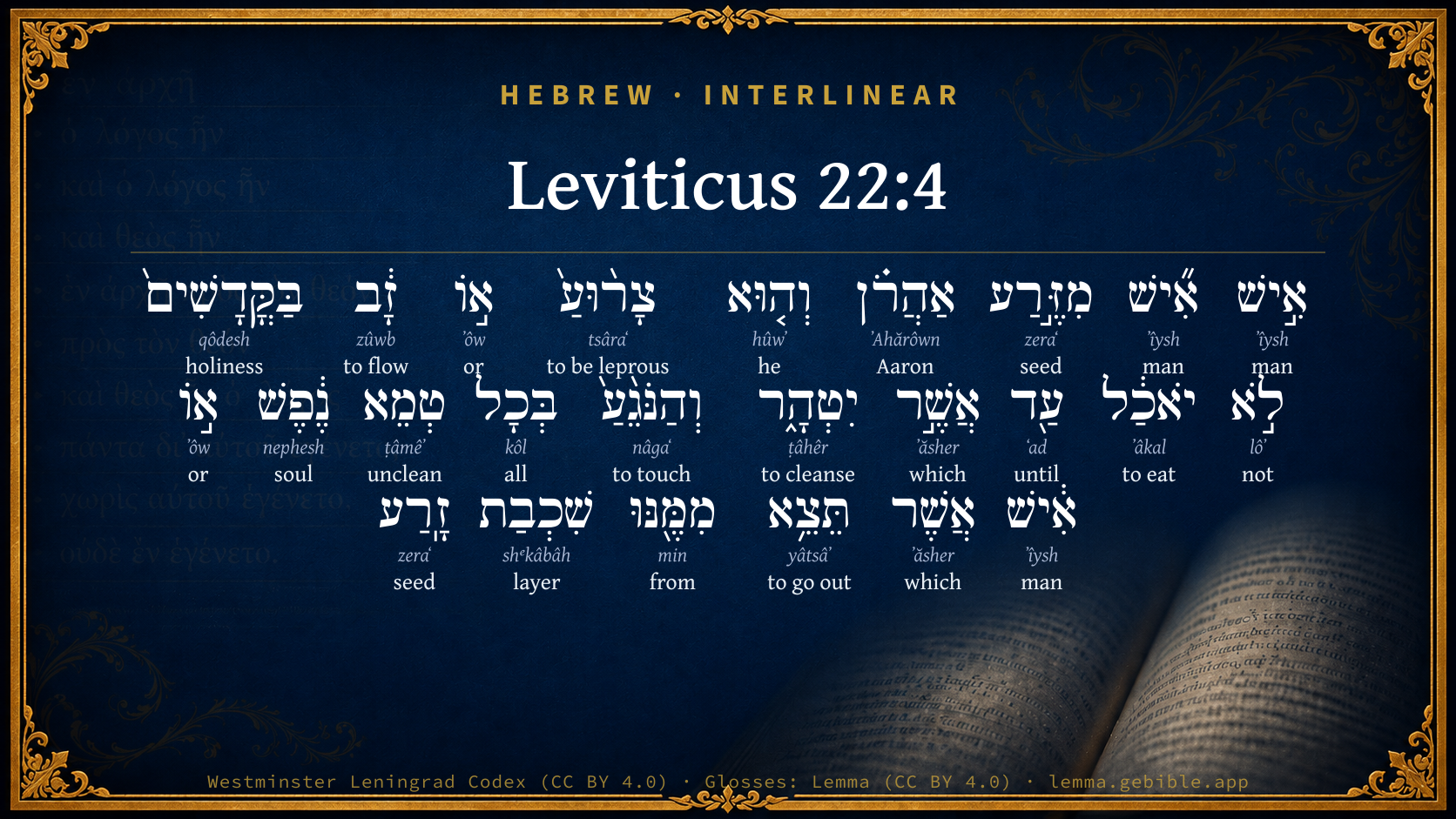
Hebrew (Westminster Leningrad Codex) Leviticus 22:4 appears in the Hebrew Old Testament. The text above is from the Westminster Leningrad Codex. Each word links to its Strong’s number, a concise gloss, and parsing drawn from the Open Scriptures Hebrew Bible morphology. Click any word for its full Brown-Driver-Briggs (BDB) entry.
Download image
Cite this verse

Leviticus 22:4 (World English Bible). Public Domain. Lemma interlinear Bible study tool, https://lemma.gebible.app/v/leviticus/22/4.

Show BibTeX & RIS
BibTeX
RIS
English Translation
"'Whoever of the seed of Aaron is a leper or has an issue; he shall not eat of the holy things, until he is clean. Whoever touches anything that is unclean by the dead, or a man whose seed goes from him;
World English Bible · Public Domain
Download a study sheet

One document with this verse’s original text, its word-by-word gloss line, the meaning frame, cross-references with their text, attributed commentary, and full source and license credits — printable, and it pastes into notes with its structure intact.

This verse Autodidact and up

Study sheet (.html) Plain text (.txt)

A passage Seminary Student

Up to 50 verses in one chapter. A passage sheet keeps up to 6 commentary sources and 12 cross-references per verse, in the order this page ranks them, and says so on the sheet whenever that leaves anything out. Ask for a single verse and you get the Autodidact verse sheet above.

Everything on this page stays free to read, with no account — the sheet is a download of what is already on screen, not access to it.

Want to remove ads? Support Godless Engineer
Compare translations 3

The same verse in 3 English versions, stacked beneath the original-language interlinear above. Click any original word for its lexicon entry.

Each is an independent rendering of the whole verse — the interlinear is not word-aligned to these translations.

Highlighted words mark where these versions differ — a whole-verse word diff, not a word-by-word alignment.

  • World English Bible Public Domain
    "'Whoever of the seed of Aaron is a leper or has an issue; he shall not eat of the holy things, until he is clean. Whoever touches anything that is unclean by the dead, or a man whose seed goes from him;
  • King James Version Public Domain
    What man soever of the seed of Aaron is a leper, or hath a running issue; he shall not eat of the holy things, until he be clean. And whoso toucheth any thing that is unclean by the dead, or a man whose seed goeth from him;
  • unfoldingWord Literal Text CC BY-SA 4.0
    A man, a man from the seed of Aaron, and he skin diseased or flowing, he shall not eat of the holy things until he is clean. And the one touching anything unclean of a person or a man who has go out from him a lying of seed

unfoldingWord Literal Text — © unfoldingWord, licensed CC BY-SA 4.0. Word-aligned USFM3 via Door43 (git.door43.org/unfoldingWord/en_ult).

Versions to compare (up to 4)

3 of 4 selected

Show all 18 translations

Every available English version of this verse, each an independent rendering of the whole verse.

  • World English Bible Public Domain
    "'Whoever of the seed of Aaron is a leper or has an issue; he shall not eat of the holy things, until he is clean. Whoever touches anything that is unclean by the dead, or a man whose seed goes from him;
  • Berean Standard Bible Public Domain
    If a descendant of Aaron has a skin disease or a discharge, he may not eat the sacred offerings until he is clean. Whoever touches anything defiled by a corpse or by a man who has an emission of semen,
  • Majority Standard Bible Public Domain
    If a descendant of Aaron has a skin disease or a discharge, he may not eat the sacred offerings until he is clean. Whoever touches anything defiled by a corpse or by a man who has an emission of semen,
  • King James Version Public Domain
    What man soever of the seed of Aaron is a leper, or hath a running issue; he shall not eat of the holy things, until he be clean. And whoso toucheth any thing that is unclean by the dead, or a man whose seed goeth from him;
  • American Standard Version (1901) Public Domain
    What man soever of the seed of Aaron is a leper, or hath an issue; he shall not eat of the holy things, until he be clean. And whoso toucheth anything that is unclean by the dead, or a man whose seed goeth from him;
  • Revised Version (1885) Public Domain
    What man soever of the seed of Aaron is a leper, or hath an issue; he shall not eat of the holy things, until he be clean. And whoso toucheth any thing that is unclean by the dead, or a man whose seed goeth from him;
  • Geneva Bible (1599) Public Domain
    Whosoeuer also of the seede of Aaron is a leper, or hath a running issue, he shall not eate of the holy things vntill he be cleane: and who so toucheth any that is vncleane, by reason of the dead, or a man whose issue of seede runneth from him,
  • Douay-Rheims (1899) Public Domain
    The man of the seed of Aaron, that is a leper, or that suffereth a running of the seed, shall not eat of those things that are sanctified to me, until he be healed. He that toucheth any thing unclean by occasion of the dead, and he whose seed goeth from him as in generation,
  • Young's Literal Translation Public Domain
    `Any man of the seed of Aaron, and is leprous or hath an issue -- of the holy things he doth not eat till that he is clean; and he who is coming against any uncleanness of a person, or a man whose seed of copulation goeth out from him,
  • Literal Standard Version CC BY-SA 4.0
    Any man of the seed of Aaron, and he is leprous or has discharging—he does not eat of the holy things until he is clean; and he who is coming against any uncleanness of a person, or a man whose seed [from] intercourse goes out from him,
  • Unlocked Literal Bible CC BY-SA 4.0
    None of the descendants of Aaron who has an infectious skin disease, or an infection flowing from his body, may eat any of the sacrifices made to Yahweh until he is clean. Whoever touches anything unclean through contact with the dead, or by contact with a man who has a flow of semen,
  • unfoldingWord Literal Text CC BY-SA 4.0
    A man, a man from the seed of Aaron, and he skin diseased or flowing, he shall not eat of the holy things until he is clean. And the one touching anything unclean of a person or a man who has go out from him a lying of seed
  • Darby Bible Public Domain
    Whatsoever man of the seed of Aaron is a leper, or hath a flux, he shall not eat of the holy things, until he is clean. And he that toucheth any one that is unclean by a dead person, or a man whose seed of copulation hath passed from him;
  • World Messianic Bible Public Domain
    “‘Whoever of the offspring of Aaron is a leper or has a discharge shall not eat of the holy things until he is clean. Whoever touches anything that is unclean by the dead, or a man who has a seminal emission,
  • Webster's Bible Public Domain
    Whatever man of the seed of Aaron is a leper, or hath a running issue; he shall not eat of the holy things, until he is clean. And whoever toucheth any thing that is unclean by the dead, or a man whose seed goeth from him;
  • Free Bible Version CC BY-SA 4.0
    If one of Aaron's descendants has a skin disease or a discharge, he is not allowed to eat the holy offerings until he is clean. Anyone who touches anything made unclean by a dead body or by a man who has had a release of semen,
  • Bible in Basic English Public Domain
    No man of the seed of Aaron who is a leper, or who has a flow from his body, may take of the holy food till he is clean. And any man touching anything which is unclean because of the dead, or any man whose seed goes from him;
  • JPS Tanakh (1917) Public Domain
    What man soever of the seed of Aaron is a leper, or hath an issue, he shall not eat of the holy things, until he be clean. And whoso toucheth any one that is unclean by the dead; or from whomsoever the flow of seed goeth out;

Literal Standard Version (2020), Covenant Press — licensed CC BY-SA 4.0. Text via the HelloAO Bible API (eBible.org). Unlocked Literal Bible (unfoldingWord) — licensed CC BY-SA 4.0. Text via the HelloAO Bible API (eBible.org). unfoldingWord Literal Text — © unfoldingWord, licensed CC BY-SA 4.0. Word-aligned USFM3 via Door43 (git.door43.org/unfoldingWord/en_ult). Free Bible Version, Dr. Jonathan Gallagher — licensed CC BY-SA 4.0. Text via the HelloAO Bible API (eBible.org).

Word by word

More ways to search: Search by grammar → Find every occurrence → Compare this word →

Practice this passage: Drill this verse → Learn its vocabulary →

שִׁכְבַת
shᵉkâbâh
H7902
“layer of”
Noun, Common, Feminine, Singular, Construct
Part of Speech
Noun
Type
Common
Gender
Feminine
Number
Singular
State
Construct
Full BDB Definition

Origin: from H7901

TWOT: 2381a

act of lying, layer, coating - act of lying (of sexual relations) - layer
  1. אִ֣ישׁ ʼîysh H376 “man” Noun, Common, Masculine, Singular, Absolute
  2. אִ֞ישׁ ʼîysh H376 “man” Noun, Common, Masculine, Singular, Absolute
  3. מִזֶּ֣רַע zeraʻ H2233 “from · seed of” Preposition + Noun, Common, Masculine, Singular, Construct
  4. אַהֲרֹ֗ן ʼAhărôwn H175 “Aaron” Noun, Proper
  5. וְה֤וּא hûwʼ H1931 “and · he” Conjunction + Pronoun, Personal, 3rd Person, Masculine, Singular
  6. צָר֨וּעַ֙ tsâraʻ H6879 “leprous” Verb, Qal, Participle Passive, Masculine, Singular, Absolute
  7. א֣וֹ ʼôw H176 “or” Conjunction
  8. זָ֔ב zûwb H2100 “flowing” Verb, Qal, Participle Active, Masculine, Singular, Absolute
  9. בַּקֳּדָשִׁים֙ qôdesh H6944 “in/at the · holy things” Preposition, Determined + Noun, Common, Masculine, Plural, Absolute
  10. לֹ֣א lôʼ H3808 “not” Particle, Negative
  11. יֹאכַ֔ל ʼâkal H398 “to eat” Verb, Qal, Imperfect, 3rd Person, Masculine, Singular
  12. עַ֖ד ʻad H5704 “until” Preposition
  13. אֲשֶׁ֣ר ʼăsher H834 “which” Particle, Relative
  14. יִטְהָ֑ר ṭâhêr H2891 “to cleanse” Verb, Qal, Imperfect, 3rd Person, Masculine, Singular
  15. וְהַנֹּגֵ֨עַ֙ nâgaʻ H5060 “and · the · touching” Conjunction + Particle, Definite Article + Verb, Qal, Participle Active, Masculine, Singular, Absolute
  16. בְּכָל kôl H3605 “in/at · all of” Preposition + Noun, Common, Masculine, Singular, Construct
  17. טְמֵא ṭâmêʼ H2931 “unclean of” Adjective, Adjective, Masculine, Singular, Construct
  18. נֶ֔פֶשׁ nephesh H5315 “soul” Noun, Common, Both, Singular, Absolute
  19. א֣וֹ ʼôw H176 “or” Conjunction
  20. אִ֔ישׁ ʼîysh H376 “man” Noun, Common, Masculine, Singular, Absolute
  21. אֲשֶׁר ʼăsher H834 “which” Particle, Relative
  22. תֵּצֵ֥א yâtsâʼ H3318 “to go out” Verb, Qal, Imperfect, 3rd Person, Feminine, Singular
  23. מִמֶּ֖נּוּ min H4480 “from · us” Preposition + Suffix, Personal, 1st Person, Common, Plural
  24. זָֽרַע zeraʻ H2233 “seed” Noun, Common, Masculine, Singular, Absolute

About this verse

These counts appear in no published source. They are computed here, from the morphology-tagged text and Lemma’s own curated glosses. What Lemma adds →

25
words
20
distinct lemmas
Pentateuch
section

Notable vocabulary

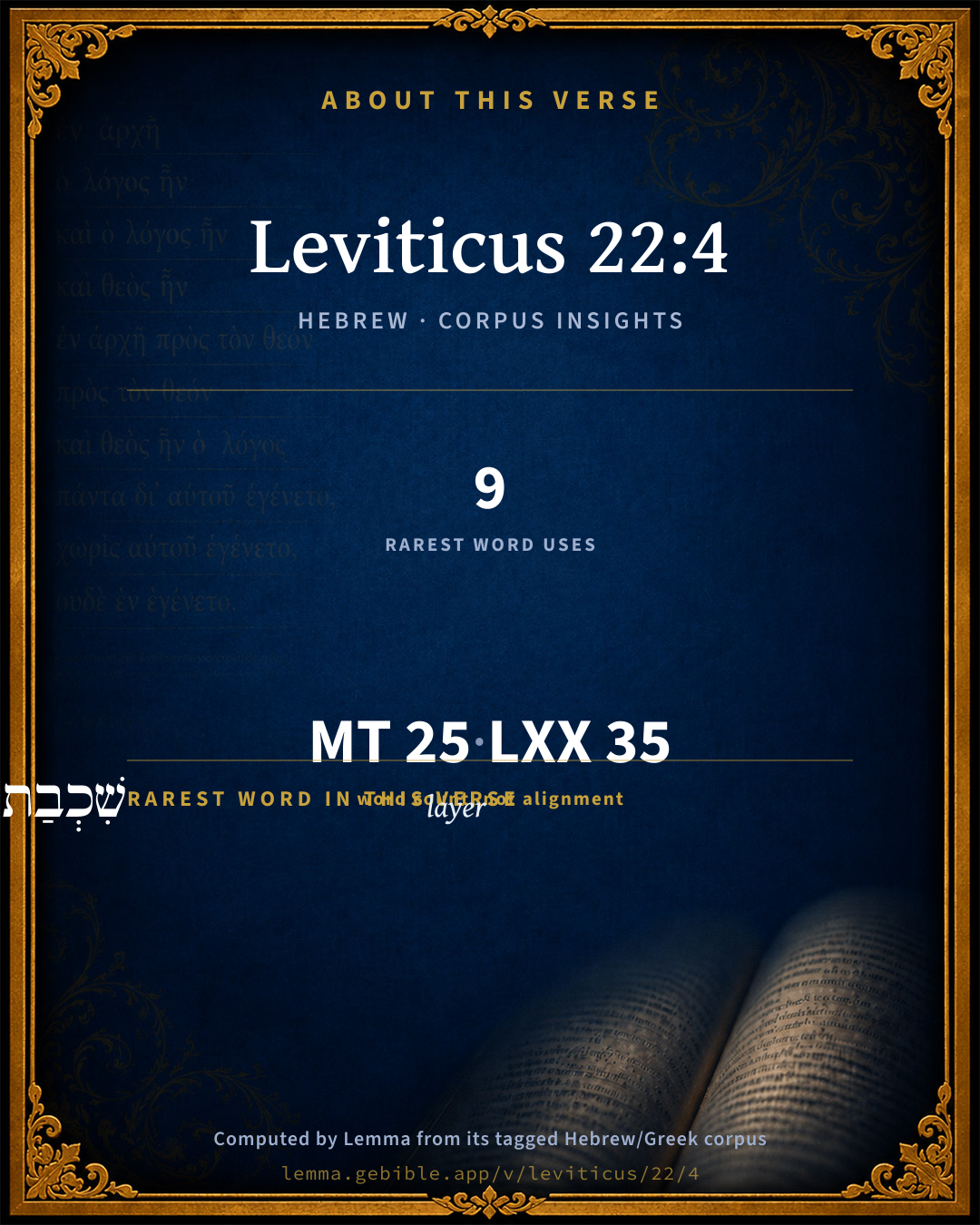
The rarest word here is שִׁכְבַת layer H7902 — appearing just 9 times in the whole Hebrew Bible.

Shared distinctive vocabulary

שִׁכְבַת layer H7902 occurs in 9 verses of the Hebrew Bible. Also found in:

Grammatical profile

  • 6 verbs
  • 10 nouns
  • 1 adjective
  • 1 pronoun
  • 2 prepositions
  • 2 conjunctions
  • 3 particles

Verb forms

  • צָר֨וּעַ֙ Qal · Participle Passive
  • זָ֔ב Qal · Participle Active
  • יֹאכַ֔ל Qal · Imperfect
  • יִטְהָ֑ר Qal · Imperfect
  • וְהַנֹּגֵ֨עַ֙ Qal · Participle Active
  • תֵּצֵ֥א Qal · Imperfect

Repetition

Words recur within this verse — often emphatic in Hebrew:

  • אִ֣ישׁ man H376 ×3
  • מִזֶּ֣רַע seed H2233 ×2
  • א֣וֹ or H176 ×2
  • אֲשֶׁ֣ר which H834 ×2

Hebrew & Septuagint length

In English translation the verse runs 42 words from the Hebrew and 54 from the Septuagint (LXX English) — closely comparable.

A rough comparison of the two English renderings, which tokenize alike — not a word-level alignment.

Word counts can differ between the Hebrew and the Greek without any difference in meaning — e.g. the Hebrew direct-object marker אֵת has no separate Greek word, and Greek often adds the article ὁ.

In the original languages it is 25 Hebrew tokens and 35 Greek tokens — but the two are counted differently (Hebrew bundles its prefixes and suffixes into one token; the Greek is in lemma form), so that isn’t a like-for-like length.

Cross-references

15

Topical passages linked to Leviticus 22:4 in the Treasury of Scripture Knowledge — connected by theme and wording, ordered by reader-vote popularity; previews shown in the World English Bible.

  • Leviticus 11:39 "'If any animal, of which you may eat, dies; he who touches its carcass shall be unclean until the evening.
  • Leviticus 15:2–3 "Speak to the children of Israel, and tell them, 'When any man has a discharge from his body, because of his discharge he is unclean.
  • Leviticus 15:13–16 "'When he who has a discharge is cleansed of his discharge, then he shall count to himself seven days for his cleansing, and wash his clothes; and he shall bathe his flesh in running water, and shall be clean.
  • Leviticus 2:3 That which is left of the meal offering shall be Aaron's and his sons'. It is a most holy thing of the offerings of Yahweh made by fire.
  • Leviticus 2:10 That which is left of the meal offering shall be Aaron's and his sons'. It is a thing most holy of the offerings of Yahweh made by fire.
  • Leviticus 6:25–29 "Speak to Aaron and to his sons, saying, 'This is the law of the sin offering: in the place where the burnt offering is killed, the sin offering shall be killed before Yahweh. It is most holy.
  • Leviticus 11:24–28 "'By these you will become unclean: whoever touches the carcass of them shall be unclean until the evening.
  • Leviticus 13:2–3 "When a man shall have a rising in his body's skin, or a scab, or a bright spot, and it becomes in the skin of his body the plague of leprosy, then he shall be brought to Aaron the priest, or to one of his sons the priests:
  • Leviticus 13:44–46 he is a leprous man. He is unclean. The priest shall surely pronounce him unclean. His plague is on his head.
  • Leviticus 14:1–32 Yahweh spoke to Moses, saying,
  • Leviticus 21:1 Yahweh said to Moses, "Speak to the priests, the sons of Aaron, and say to them, 'A priest shall not defile himself for the dead among his people;
  • Leviticus 21:22 He shall eat the bread of his God, both of the most holy, and of the holy.
  • Numbers 18:9 This shall be your of the most holy things, [reserved] from the fire: every offering of theirs, even every meal-offering of theirs, and every sin-offering of theirs, and every trespass-offering of theirs, which they shall render to me, shall be most holy for you and for your sons.
  • Numbers 18:19 All the heave-offerings of the holy things, which the children of Israel offer to Yahweh, have I given you, and your sons and your daughters with you, as a portion forever: it is a covenant of salt forever before Yahweh to you and to your seed with you.
  • Numbers 19:11–16 He who touches the dead body of any man shall be unclean seven days:

Cross-references courtesy of OpenBible.info (CC BY 4.0).

Hebrew and Greek witnesses Masoretic Hebrew ↔ Greek Septuagint

The same verse in the two great witnesses to the Old Testament, shown verse-for-verse.

These are two independent witnesses, not word-aligned to each other, and the Septuagint is shown in lemma (dictionary) form.

Hebrew Leviticus 22:4 Masoretic · Westminster Leningrad Codex

אִ֣ישׁ אִ֞ישׁ מִזֶּ֣רַע אַהֲרֹ֗ן וְה֤וּא צָר֨וּעַ֙ א֣וֹ זָ֔ב בַּקֳּדָשִׁים֙ לֹ֣א יֹאכַ֔ל עַ֖ד אֲשֶׁ֣ר יִטְהָ֑ר וְהַנֹּגֵ֨עַ֙ בְּכָל טְמֵא נֶ֔פֶשׁ א֣וֹ אִ֔ישׁ אֲשֶׁר תֵּצֵ֥א מִמֶּ֖נּוּ שִׁכְבַת זָֽרַע

"'Whoever of the seed of Aaron is a leper or has an issue; he shall not eat of the holy things, until he is clean. Whoever touches anything that is unclean by the dead, or a man whose seed goes from him;

World English Bible · Public Domain

Greek LXX Leviticus 22:4 Septuagint · lemma form

καί ἄνθρωπος ἐκ ὁ σπέρμα ἀαρών ὁ ἱερεύς καί οὗτος λεπράω ἤ γονορρυής ὁ ἅγιος οὐ ἐσθίω ἕως ἄν καθαρίζω καί ὁ ἅπτομαι πᾶς ἀκαθαρσία ψυχή ἤ ἄνθρωπος ὅς ἄν ἐκἔρχομαι ἐκ αὐτός κοίτη σπέρμα

And the man of the seed of Aaron the priest, if he should have leprosy or issue of the reins, shall not eat of the holy things, until he be cleansed; and he that touches any uncleanness of a dead body, or the man whose seed of copulation shall have gone out from him,

LXX2012 (modern English Septuagint) · Public Domain

Hebrew: Westminster Leningrad Codex (CC BY 4.0). Greek: Septuagint (public domain); English from LXX2012 (modern English Septuagint) (Public Domain). How the Septuagint differs from the Hebrew →

Targum (Aramaic paraphrase)

2

The Targum is the ancient Jewish Aramaic paraphrase of the Hebrew Scriptures — an interpretive translation, not the Hebrew text itself. Onkelos (literal) and Pseudo-Jonathan (expansive) render the Torah, and Jonathan the Prophets. Coverage is partial: where no permissively-licensed English translation exists for a verse, only the Aramaic is shown. This is verse-level text, not a word-by-word alignment to the Hebrew.

  1. Targum Onkelos Torah (Genesis–Deuteronomy)
    גְבַר גְבַר מִזַרְעָא דְאַהֲרֹן וְהוּא סְגִיר אוֹ דָאִיב בְּקוּדְשַׁיָא לָא יֵיכוּל עַד דִי יִדְכֵּי וּדְיִקְרַב בְּכָל טְמֵא נַפְשָׁא אוֹ גְבַר דִי תִפּוֹק מִנֵהּ שִׁכְבַת זַרְעָא

    (no public-domain English translation for this verse)

    Targum Onkelos — Aramaic: “Onkelos Genesis” (public domain); “Onkelos Exodus” (public domain); “Onkelos Leviticus” (public domain); “Onkelos Numbers” (public domain); “Onkelos Deuteronomy” (public domain). English: “Sefaria Community Translation” (CC0 1.0 (public-domain dedication)); “J.W. Etheridge. The Targums of Onkelos and Jonathan Ben Uzziel on the Pentateuch. London: Longmans, Green, 1862” (public domain). Text via Sefaria.

  2. Targum Pseudo-Jonathan Torah (Genesis–Deuteronomy)
    גְבַר טְלֵי אוֹ גְבַר סִיב מִזַרְעָא דְאַהֲרן וְהוּא מְצָרְעָא אוֹ דַיֵיב בְּקוּדְשַׁיָא לָא יֵיכוֹל עַד זְמַן דְמִידְכֵּי וּדְיִקְרַב בְּכָל סוֹאֲבַת בַּר נַשׁ אוֹ גְבַר דְתִפּוֹק מִינֵיהּ שִׁכְבַת זַרְעָא

    Any man, young or old of the offspring of Aharon, who is a leper, or hath a running issue, shall not eat of things consecrated till he be clean: and whoever toucheth any uncleanness of man, or one from whom uncleanness hath proceeded,

    Targum Pseudo-Jonathan — Aramaic: “Targum Jonathan on Genesis” (public domain); “Targum Jonathan on Exodus” (public domain); “Targum Jonathan on Leviticus” (public domain); “Targum Jonathan on Numbers” (public domain); “Targum Jonathan on Deuteronomy” (public domain). English: “The Targum of Jonathan ben Uzziel, trans. J. W. Etheridge, London, 1862” (public domain). Text via Sefaria.

Commentary

Notes on Leviticus 22:4 from classic Christian and Jewish commentators (each source and its license shown beneath its notes). The classic Christian expositions comment on the surrounding passage and are grouped to its opening verse, so a note may address several verses; the Jewish commentaries on the Tanakh (Rashi and others) are per-verse, so they appear only where the commentator wrote on this verse.

Lemma curates 59 commentaries, every one of them public domain or Creative Commons licensed, each selected and text-cleaned for this edition rather than reprinted as found. About our sources →

Trapp's Complete Commentary

John Trapp

Lev 22:4 What man soever of the seed of Aaron [is] a leper, or hath a running issue; he shall not eat of the holy things, until he be clean. And whoso toucheth any thing [that is] unclean [by] the dead, or a man whose seed goeth from him;

Ver. 4. Or hath a running issue.] Seminifluus: especially if it come by contemning that counsel of the wise man. {Pro 31:3}

John Trapp, A Commentary or Exposition upon All the Books of the Old and New Testament (1647–1656) — public domain. Text from a community e-Sword module.

Geneva Bible (1599)

Geneva Bible translators

By touching any dead thing, or being at burial of the dead.

Geneva Bible (1599) marginal notes — public domain. Text via Bolls.life.

Jamieson, Fausset & Brown

Robert Jamieson, A. R. Fausset & David Brown

wash his flesh with water--Any Israelite who had contracted a defilement of such a nature as debarred him from the enjoyment of his wonted privileges, and had been legally cleansed from the disqualifying impurity, was bound to indicate his state of recovery by the immersion of his whole person in water. Although all ceremonial impurity formed a ground of exclusion, there were degrees of impurity which entailed a longer or shorter period of excommunication, and for the removal of which different rites required to be observed according to the trivial or the malignant nature of the case. A person who came inadvertently into contact with an unclean animal was rendered unclean for a specified period; and then, at the expiry of that term, he washed, in token of his recovered purity. But a leper was unclean so long as he remained subject to that disease, and on his convalescence, he also washed, not to cleanse himself, for the water was ineffectual for that purpose, but to signify that he was clean. Not a single case is recorded of a leper being restored to communion by the use of water; it served only as an outward and visible sign that such a restoration was to be made. The Book of Leviticus abounds with examples which show that in all the ceremonial washings, as uncleanness meant loss of privileges, so baptism with water indicated a restoration to those privileges. There was no exemption; for as the unclean Israelite was exiled from the congregation, so the unclean priest was disqualified from executing his sacred functions in the sanctuary; and in the case of both, the same observance was required--a formal intimation of their being readmitted to forfeited privileges was intimated by the appointed rite of baptism. If any one neglected or refused to perform the washing, he disobeyed a positive precept, and he remained in his uncleanness; he forbore to avail himself of this privilege, and was therefore said to be "cut off" from the presence of the Lord.

Jamieson, Fausset & Brown — Commentary Critical and Explanatory on the Whole Bible (1871) — public domain (CC PDM 1.0). Text via the HelloAO Bible API.

Adam Clarke's Commentary

Verse 4. Is a leper, or hath a running issue] See the case of the leper treated at large in the notes on Le 13:1-14:57; and for other uncleannesses, see the notes on Le 15:1-30.

Adam Clarke's Commentary on the Bible (1810–1826) — public domain. Text from a community e-Sword/MySword module.

Ellicott's Commentary for English Readers

(4) Is a leper.—The different forms of uncleanness are now specified. (For the leper, see Lev_13:3.)

Or hath a running issue.—See Lev_15:2.

Whoso toucheth any thing that is unclean by the dead.—That is, if he touches any person or anything that had been defiled through contact with a corpse. (See Num_19:11-14.)

Whose seed goeth from him.—This is the same case mentioned in Lev_15:16. The two passages ought therefore to be uniform in the translation.

A Bible Commentary for English Readers, edited by Charles John Ellicott (1878–1897) — public domain. Text from a community e-Sword module.

John Gill's Exposition

What man soever of the seed of Aaron is a leper,.... A young, or an old man, as the Targum of Jonathan, and indeed man or woman; for the wives and daughters of the priests, if in this, and other circumstances following, might not eat of the holy things until cleansed, who otherwise might, see Lev 13:2,

or hath a running issue; a gonorrhoea, whether man or woman, Lev 15:2,

he shall not eat of the holy things until he be clean; he might eat of the tithes, but not of the wave breast, or heave shoulder:

and whoso toucheth any that is unclean by the dead; not only that touched the dead, which made unclean, but that touched any person or thing that was made unclean by it:

or a man whose seed goeth from him; involuntarily when asleep, in a dream, and through a lustful imagination; see Lev 15:16.

John Gill's Exposition of the Whole Bible (1746–1763) — public domain (CC PDM 1.0). Text via the HelloAO Bible API.

Albert Barnes' Notes on the Bible

See Lev 15:13-16.

Albert Barnes' Notes on the Bible (1834–1885) — public domain. Text from a community e-Sword/MySword module.

Haydock's Catholic Bible Commentary

And he, &c. Hence it is plain, even the Jewish priests were bound to observe continence during the time of their ministry. (Calmet) --- For the same reason, the priests of the new law, who may be called at any time to perform their more sacred functions, engage voluntarily in the state of perpetual celibacy. (Haydock)

George Leo Haydock (1774–1849), Haydock's Catholic Family Bible and Commentary, 1859 edition — public domain. Excludes Psalms (Douay-Rheims chapter numbering differs from Protestant) and Deuterocanonical books (Catholic canon only).

Matthew Poole's English Annotations

What man soever, i.e. or woman, of Aaron’s seed; for they were under the same law.

Matthew Poole's English Annotations on the Holy Bible (1683–1685) — public domain. Text from a community e-Sword/MySword module.

Whedon's Commentary on the Bible

Daniel D. Whedon

4. A leper — Leprosy was a ceremonial defilement which excluded even the laymen from the camp; much more would it disqualify a priest for the tabernacle. See chaps. 13 and 14, notes.

A running issue — This was probably limited to the gonorrhea. See Lev_15:2, note.

Unclean by the dead — See Lev_21:1, note.

Seed goeth from him — See Lev_15:16, note.

Daniel D. Whedon (gen. ed.), Commentary on the Old and New Testaments (1874–1909) — public domain. Text from a community e-Sword module.

unfoldingWord translationNotes

Door43 World Missions Community

infectious skin disease

a disease on the skin easily spread from one person to another

an infection flowing from his body

"a bodily discharge"

from his body

This is a polite way of referring to a man's private parts. See how you translated a similar phrase in Leviticus 15:1. AT: "from his private parts" (See: Euphemism)

until he is clean

A person who is acceptable for God's purposes is spoken of as if the person were physically clean. (See: Metaphor)

Whoever touches anything unclean

Something that Yahweh has said is unfit to touch or eat is spoken of as if it were physically unclean. (See: Metaphor)

through contact with the dead

"by touching a dead body"

the sacrifices made to Yahweh

This can be stated in active form. AT: "the sacrifices that someone has offered to Yahweh" (See: Active or Passive)

or whoever touches any creeping animal that makes him unclean, or any person who makes him unclean

This can be made explicit. AT: "or whoever is unclean from touching a creeping animal or from touching another unclean person" (See: Assumed Knowledge and Implicit Information)

the priest ... will be unclean

A person who is not acceptable for God's purposes is spoken of as if the person were physically unclean. (See: Metaphor)

until evening

"until sunset"

translationWords

body

sacrifice

clean

clean

die

seed

priest

holy

water

unfoldingWord translationNotes — © Distant Shores Media and the Door43 World Missions Community, licensed CC BY-SA 4.0. Source: git.door43.org/Door43/en_tn.

Rashi

Rabbi Shlomo Yitzchaki (Rashi)

בכל טמא נפש [AND WHOSO TOUCHETH] ANY טמא נפש — This means: who touches a person who has become defiled by a corpse.

Rashi on the Tanakh — English translations: “The Judaica Press complete Tanach with Rashi, translated by A. J. Rosenberg” (CC BY 4.0); “Pentateuch with Rashi's commentary by M. Rosenbaum and A.M. Silbermann, 1929-1934” (public domain); “The Metsudah Tanach series, Lakewood, N.J” (CC BY 4.0); and “The Book of Joshua, Metsudah Publications, 1997” (CC BY 4.0). Text via Sefaria.

Lesson kit

Teaching starters — assembled from the data on this page, not authored interpretation. Every prompt links to the verse data it draws on. Edit before teaching.

Leviticus, in the Pentateuch, opens this verse with 25 words (20 distinct Hebrew lemmas). Its most distinctive word is shᵉkâbâh (“layer”). A historical commentator’s framing appears above. Read the whole chapter for the surrounding context.

Discussion questions

  1. How does “layer” (shᵉkâbâh) shape what this verse is saying?
  2. Exodus 16:13 shares the word «layer» with this verse. How do the two illuminate each other?
  3. “man” occurs 3× in this one verse. What is the effect of the repetition?
  4. These translations render this verse differently; the difference is in the English rendering, not the original. What questions does that raise?
  5. The verb «צָר֨וּעַ֙» is Qal Participle Passive. How does its form color the action?
  6. Reading how Trapp's Complete Commentary and Geneva Bible (1599) read this verse, where do the two commentators agree and where do they part?

Things to notice

Reading settings

Reading text

Shown beneath each verse's original-language words.

Old Testament
Old Testament edition

Read the OT as the Masoretic Hebrew (MT) or the Greek Septuagint (LXX).

English shown for the Greek Septuagint (in the Hebrew ↔ Greek comparison).

Comparing translations? Open the Compare panel on any verse page to stack up to four side by side.