
Joshua 5:15

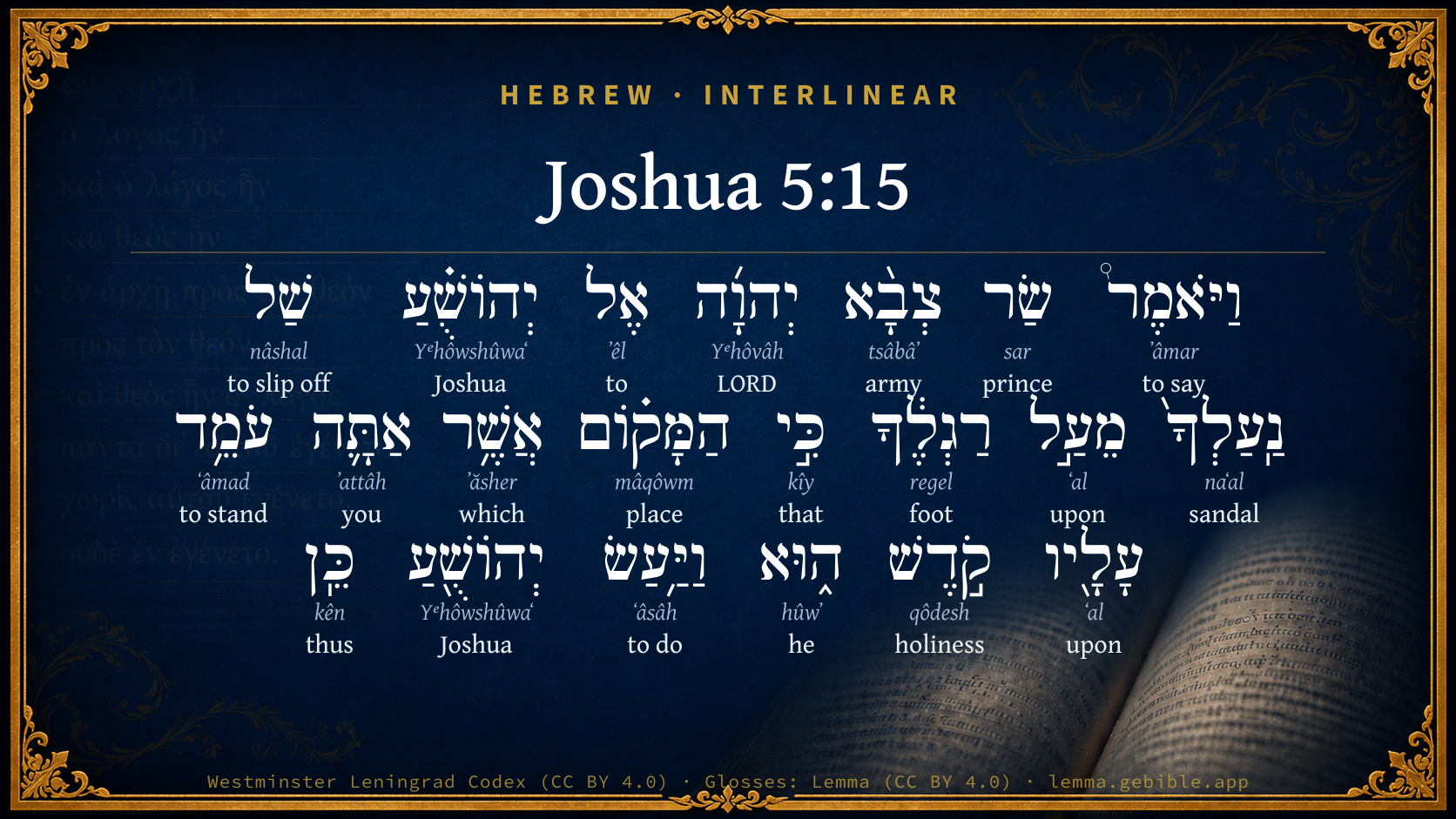
Hebrew (Westminster Leningrad Codex) Joshua 5:15 appears in the Hebrew Old Testament. The text above is from the Westminster Leningrad Codex. Each word links to its Strong’s number, a concise gloss, and parsing drawn from the Open Scriptures Hebrew Bible morphology. Click any word for its full Brown-Driver-Briggs (BDB) entry.
Download image
Cite this verse

Joshua 5:15 (World English Bible). Public Domain. Lemma interlinear Bible study tool, https://lemma.gebible.app/v/joshua/5/15.

Show BibTeX & RIS
BibTeX
RIS
English Translation
The prince of Yahweh's host said to Joshua, Put off your shoe from off your foot; for the place whereon you stand is holy. Joshua did so.
World English Bible · Public Domain
Download a study sheet

One document with this verse’s original text, its word-by-word gloss line, the meaning frame, cross-references with their text, attributed commentary, and full source and license credits — printable, and it pastes into notes with its structure intact.

This verse Autodidact and up

Study sheet (.html) Plain text (.txt)

A passage Seminary Student

Up to 50 verses in one chapter. A passage sheet keeps up to 6 commentary sources and 12 cross-references per verse, in the order this page ranks them, and says so on the sheet whenever that leaves anything out. Ask for a single verse and you get the Autodidact verse sheet above.

Everything on this page stays free to read, with no account — the sheet is a download of what is already on screen, not access to it.

Want to remove ads? Support Godless Engineer
Compare translations 3

The same verse in 3 English versions, stacked beneath the original-language interlinear above. Click any original word for its lexicon entry.

Each is an independent rendering of the whole verse — the interlinear is not word-aligned to these translations.

Highlighted words mark where these versions differ — a whole-verse word diff, not a word-by-word alignment.

  • World English Bible Public Domain
    The prince of Yahweh's host said to Joshua, Put off your shoe from off your foot; for the place whereon you stand is holy. Joshua did so.
  • King James Version Public Domain
    And the captain of the LORD's host said unto Joshua, Loose thy shoe from off thy foot; for the place whereon thou standest is holy. And Joshua did so.
  • unfoldingWord Literal Text CC BY-SA 4.0
    And the commander of the army of Yahweh said to Joshua, “Slip off your sandal from upon your foot, because the place that you are standing on, it holy.” And Joshua did so.

unfoldingWord Literal Text — © unfoldingWord, licensed CC BY-SA 4.0. Word-aligned USFM3 via Door43 (git.door43.org/unfoldingWord/en_ult).

Versions to compare (up to 4)

3 of 4 selected

Show all 18 translations

Every available English version of this verse, each an independent rendering of the whole verse.

  • World English Bible Public Domain
    The prince of Yahweh's host said to Joshua, Put off your shoe from off your foot; for the place whereon you stand is holy. Joshua did so.
  • Berean Standard Bible Public Domain
    The Commander of the LORD’s army replied, “Take off your sandals, for the place where you are standing is holy.” And Joshua did so.
  • Majority Standard Bible Public Domain
    The Commander of the LORD’s army replied, “Take off your sandals, for the place where you are standing is holy.” And Joshua did so.
  • King James Version Public Domain
    And the captain of the LORD's host said unto Joshua, Loose thy shoe from off thy foot; for the place whereon thou standest is holy. And Joshua did so.
  • American Standard Version (1901) Public Domain
    And the prince of Jehovah's host said unto Joshua, Put off thy shoe from off thy foot; for the place whereon thou standest is holy. And Joshua did so.
  • Revised Version (1885) Public Domain
    And the captain of the LORD’S host said unto Joshua, Put off thy shoe from off thy foot; for the place whereon thou standest is holy. And Joshua did so.
  • Geneva Bible (1599) Public Domain
    And the captaine of ye Lords host said vnto Ioshua, Loose thy shoe of thy foote: for ye place wheron thou standest, is holy: and Ioshua did so.
  • Douay-Rheims (1899) Public Domain
    Josue fell on his face to the ground. And worshipping, add: What saith my lord to his servant?
  • Young's Literal Translation Public Domain
    And the Prince of Jehovah's host saith unto Joshua, `Cast off thy shoe from off thy foot, for the place on which thou art standing is holy;' and Joshua doth so;
  • Literal Standard Version CC BY-SA 4.0
    And the Prince of YHWH’s host says to Joshua, “Cast off your shoe from off your foot, for the place on which you are standing is holy”; and Joshua does so.
  • Unlocked Literal Bible CC BY-SA 4.0
    The commander of Yahweh's army said to Joshua, “Take off your sandals from your feet, because the place you are standing is holy.” That is what Joshua did.
  • unfoldingWord Literal Text CC BY-SA 4.0
    And the commander of the army of Yahweh said to Joshua, “Slip off your sandal from upon your foot, because the place that you are standing on, it holy.” And Joshua did so.
  • Darby Bible Public Domain
    And the captain of Jehovah's army said to Joshua, Loose thy sandal from off thy foot: for the place whereon thou standest is holy. And Joshua did so.
  • World Messianic Bible Public Domain
    The prince of the LORD’s army said to Joshua, “Take off your sandals, for the place on which you stand is holy.” Joshua did so.
  • Webster's Bible Public Domain
    And the captain of the LORD'S host said to Joshua, Loose thy shoe from off thy foot, for the place on which thou standest is holy: and Joshua did so.
  • Free Bible Version CC BY-SA 4.0
    The commander of the Lord's army told Joshua, “Take off your sandals, for the place where you're standing is holy ground.” Joshua did so.
  • Bible in Basic English Public Domain
    And the captain of the Lord's army said to Joshua, Take off your shoes from your feet, for the place where you are is holy. And Joshua did so.
  • JPS Tanakh (1917) Public Domain
    And the captain of the LORD'S host said unto Joshua: 'Put off thy shoe from off thy foot; for the place whereon thou standest is holy.' And Joshua did so.

Literal Standard Version (2020), Covenant Press — licensed CC BY-SA 4.0. Text via the HelloAO Bible API (eBible.org). Unlocked Literal Bible (unfoldingWord) — licensed CC BY-SA 4.0. Text via the HelloAO Bible API (eBible.org). unfoldingWord Literal Text — © unfoldingWord, licensed CC BY-SA 4.0. Word-aligned USFM3 via Door43 (git.door43.org/unfoldingWord/en_ult). Free Bible Version, Dr. Jonathan Gallagher — licensed CC BY-SA 4.0. Text via the HelloAO Bible API (eBible.org).

Word by word

More ways to search: Search by grammar → Find every occurrence → Compare this word →

Practice this passage: Drill this verse → Learn its vocabulary →

שַׁל
nâshal
H5394
“slip off”
Verb, Qal, Imperative, 2nd Person, Masculine, Singular
Part of Speech
Verb
Stem
Qal
Form
Imperative
Person
2nd Person
Gender
Masculine
Number
Singular
Full BDB Definition

Origin: a primitive root

TWOT: 1432

to slip off, drop off, clear away, draw off - (Qal) - to slip or drop off - to draw off - to clear away - (Piel) to clear out completely, clear entirely
  1. וַיֹּאמֶר֩ ʼâmar H559 “and · to say” Conjunction + Verb, Qal, Sequential Imperfect, 3rd Person, Masculine, Singular
  2. שַׂר sar H8269 “prince of” Noun, Common, Masculine, Singular, Construct
  3. צְבָ֨א tsâbâʼ H6635 “army of” Noun, Common, Both, Singular, Construct
  4. יְהוָ֜ה Yᵉhôvâh H3068 “LORD” Noun, Proper
  5. אֶל ʼêl H413 “to” Preposition
  6. יְהוֹשֻׁ֗עַ Yᵉhôwshûwaʻ H3091 “Joshua” Noun, Proper
  7. נַֽעַלְךָ֙ naʻal H5275 “sandal · your” Noun, Common, Feminine, Singular, Construct + Suffix, Personal, 2nd Person, Masculine, Singular
  8. מֵעַ֣ל ʻal H5921 “from · upon” Preposition + Preposition
  9. רַגְלֶ֔ךָ regel H7272 “foot · your” Noun, Common, Feminine, Singular, Construct + Suffix, Personal, 2nd Person, Masculine, Singular
  10. כִּ֣י kîy H3588 “that” Conjunction
  11. הַמָּק֗וֹם mâqôwm H4725 “the · place” Particle, Definite Article + Noun, Common, Masculine, Singular, Absolute
  12. אֲשֶׁ֥ר ʼăsher H834 “which” Particle, Relative
  13. אַתָּ֛ה ʼattâh H859 “you” Pronoun, Personal, 2nd Person, Masculine, Singular
  14. עֹמֵ֥ד ʻâmad H5975 “standing” Verb, Qal, Participle Active, Masculine, Singular, Absolute
  15. עָלָ֖יו ʻal H5921 “upon · him” Preposition + Suffix, Personal, 3rd Person, Masculine, Singular
  16. קֹ֣דֶשׁ qôdesh H6944 “holiness” Noun, Common, Masculine, Singular, Absolute
  17. ה֑וּא hûwʼ H1931 “he” Pronoun, Personal, 3rd Person, Masculine, Singular
  18. וַיַּ֥עַשׂ ʻâsâh H6213 “and · to do” Conjunction + Verb, Qal, Sequential Imperfect, 3rd Person, Masculine, Singular
  19. יְהוֹשֻׁ֖עַ Yᵉhôwshûwaʻ H3091 “Joshua” Noun, Proper
  20. כֵּֽן kên H3651 “thus” Particle, Demonstrative

About this verse

These counts appear in no published source. They are computed here, from the morphology-tagged text and Lemma’s own curated glosses. What Lemma adds →

21
words
19
distinct lemmas
Historical
section

Notable vocabulary

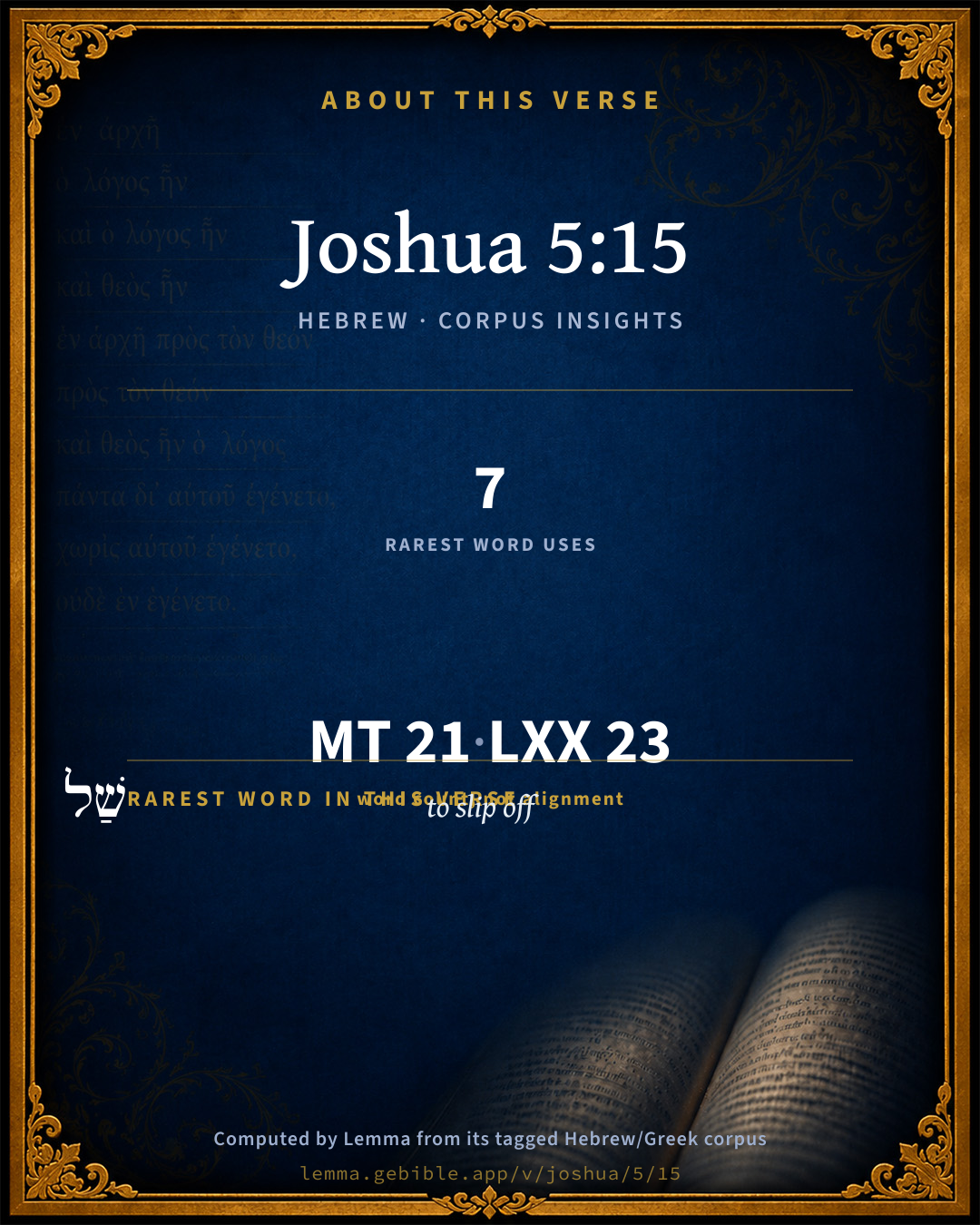
The rarest word here is שַׁל to slip off H5394 — appearing just 7 times in the whole Hebrew Bible.

Shared distinctive vocabulary

שַׁל to slip off H5394 occurs in 7 verses of the Hebrew Bible. Also found in:

Grammatical profile

  • 4 verbs
  • 9 nouns
  • 2 pronouns
  • 3 prepositions
  • 1 conjunction
  • 2 particles

Verb forms

  • וַיֹּאמֶר֩ Qal · Sequential Imperfect
  • שַׁל Qal · Imperative
  • עֹמֵ֥ד Qal · Participle Active
  • וַיַּ֥עַשׂ Qal · Sequential Imperfect

Repetition

Words recur within this verse — often emphatic in Hebrew:

  • יְהוֹשֻׁ֗עַ Joshua H3091 ×2
  • מֵעַ֣ל upon H5921 ×2

Hebrew & Septuagint length

In English translation the verse runs 27 words from the Hebrew and 19 from the Septuagint (LXX English) — the Septuagint runs noticeably shorter here. See the side-by-side →

A rough comparison of the two English renderings, which tokenize alike — not a word-level alignment.

Word counts can differ between the Hebrew and the Greek without any difference in meaning — e.g. the Hebrew direct-object marker אֵת has no separate Greek word, and Greek often adds the article ὁ.

In the original languages it is 21 Hebrew tokens and 23 Greek tokens — but the two are counted differently (Hebrew bundles its prefixes and suffixes into one token; the Greek is in lemma form), so that isn’t a like-for-like length.

Cross-references

3

Topical passages linked to Joshua 5:15 in the Treasury of Scripture Knowledge — connected by theme and wording, ordered by reader-vote popularity; previews shown in the World English Bible.

  • Exodus 3:5 He said, "Don't come close. Take off your sandals from off your feet, for the place you are standing on is holy ground."
  • Acts 7:32–33 'I am the God of your fathers, the God of Abraham, the God of Isaac, and the God of Jacob.' Moses trembled, and dared not look.
  • 2 Peter 1:18 This voice we heard come out of heaven when we were with him in the holy mountain.

Cross-references courtesy of OpenBible.info (CC BY 4.0).

Hebrew and Greek witnesses Masoretic Hebrew ↔ Greek Septuagint

The same verse in the two great witnesses to the Old Testament, shown verse-for-verse.

Here the Septuagint runs noticeably shorter than the Hebrew — LXX2012 (modern English Septuagint) 19 words vs World English Bible 27. A rough length comparison of the two English translations, not a word-level alignment — read both below.

These are two independent witnesses, not word-aligned to each other, and the Septuagint is shown in lemma (dictionary) form.

Hebrew Joshua 5:15 Masoretic · Westminster Leningrad Codex

וַיֹּאמֶר֩ שַׂר צְבָ֨א יְהוָ֜ה אֶל יְהוֹשֻׁ֗עַ שַׁל נַֽעַלְךָ֙ מֵעַ֣ל רַגְלֶ֔ךָ כִּ֣י הַמָּק֗וֹם אֲשֶׁ֥ר אַתָּ֛ה עֹמֵ֥ד עָלָ֖יו קֹ֣דֶשׁ ה֑וּא וַיַּ֥עַשׂ יְהוֹשֻׁ֖עַ כֵּֽן

The prince of Yahweh's host said to Joshua, Put off your shoe from off your foot; for the place whereon you stand is holy. Joshua did so.

World English Bible · Public Domain

Greek LXX Joshua 5:15 Septuagint · lemma form

καί λέγω ὁ ἀρχιστράτηγος κύριος πρός ἰησοῦς λύω ὁ ὑπόδημα ἐκ ὁ πούς σύ ὁ γάρ τόπος ἐπί ὅς σύ ἵστημι ἅγιος εἰμί

And Joshua fell on his face upon the earth, and said to him, Lord, what command you your servant?

LXX2012 (modern English Septuagint) · Public Domain

Hebrew: Westminster Leningrad Codex (CC BY 4.0). Greek: Septuagint (public domain); English from LXX2012 (modern English Septuagint) (Public Domain). How the Septuagint differs from the Hebrew →

Targum (Aramaic paraphrase)

1

The Targum is the ancient Jewish Aramaic paraphrase of the Hebrew Scriptures — an interpretive translation, not the Hebrew text itself. Onkelos (literal) and Pseudo-Jonathan (expansive) render the Torah, and Jonathan the Prophets. Coverage is partial: where no permissively-licensed English translation exists for a verse, only the Aramaic is shown. This is verse-level text, not a word-by-word alignment to the Hebrew.

  1. Targum Jonathan Prophets (Joshua–Malachi)
    וַאֲמַר מַלְאָכָה דִשְׁלִיחַ מִן קֳדָם יְיָ לִיהוֹשֻׁעַ שְׁרֵי סִינָךְ מֵעַל רִגְלָךְ אֲרֵי אַתְרָא דִי אַתְּ קָאִים עֲלוֹהִי קַדִישָׁא הוּא וַעֲבַד יְהוֹשֻׁעַ כֵּן:

    (no public-domain English translation for this verse)

    Targum Jonathan — Aramaic: “Mikraot Gedolot” (public domain). English: “Sefaria Community Translation” (CC0 1.0 (public-domain dedication)); “London "Chaldee Paraphrase," 1871” (public domain). Text via Sefaria.

Commentary

Notes on Joshua 5:15 from classic Christian and Jewish commentators (each source and its license shown beneath its notes). The classic Christian expositions comment on the surrounding passage and are grouped to its opening verse, so a note may address several verses; the Jewish commentaries on the Tanakh (Rashi and others) are per-verse, so they appear only where the commentator wrote on this verse.

Lemma curates 59 commentaries, every one of them public domain or Creative Commons licensed, each selected and text-cleaned for this edition rather than reprinted as found. About our sources →

Trapp's Complete Commentary

John Trapp

Jos 5:15 And the captain of the LORD’S host said unto Joshua, Loose thy shoe from off thy foot; for the place whereon thou standest [is] holy. And Joshua did so.

Ver. 15. Loose thy shoes.] Deny thyself wholly, and put thy confidence in my power and prowess. Frustra nititur qui Christo non innititur. Among the Turks no man may come into the church, besides the Grand Seignior, with his shoes on, but must leave them at the door, or give them to their servants to keep. {a}

{a} Grand Sign. Serag., 195.

John Trapp, A Commentary or Exposition upon All the Books of the Old and New Testament (1647–1656) — public domain. Text from a community e-Sword module.

Joseph Benson's Commentary

Jos 5:15. From off thy foot — In token of reverence and subjection. Holy — Consecrated by my presence. The very same order which God gave to Moses at the bush, when he was sending him to bring Israel out of Egypt, he here gives to Joshua for the confirming his faith, that as he had been with Moses, so he would be with him.

Joseph Benson's Commentary on the Old and New Testaments (1811–1818) — public domain. Text from a community e-Sword module.

Tyndale Open Study Notes

Tyndale Open Resources

5:15 Take off your sandals, for the place . . . is holy: This was what God told Moses at the burning bush (Exod 3:5). Joshua certainly recognized the similarity. This encounter would have encouraged Joshua of God’s blessing on Israel’s first action against Canaan.

Tyndale Open Study Notes — © Tyndale Open Resources, licensed CC BY-SA 4.0. Text via the HelloAO Bible API.

Adam Clarke's Commentary

Verse 15. Loose thy shoe from off thy foot, c.] These were the same words which the angel, on Mount Sinai, spoke to Moses (see Ex 3:5-8); and from this it seems likely that it was the same person that appeared in both places: in the first, to encourage Moses to deliver the oppressed Israelites, and bring them to the promised land; in the second, to encourage Joshua in his arduous labour in expelling the ancient inhabitants, and establishing the people in the inheritance promised to their fathers.

THERE is scarcely a more unfortunate division of chapters in the whole Bible than that here. Through this very circumstance many persons have been puzzled to know what was intended by this extraordinary appearance, because they supposed that the whole business ends with the chapter, whereas, it is continued in the succeeding one, the first verse of which is a mere parenthesis, simply relating the state of Jericho at the time that Joshua was favoured by this encouraging vision. We may draw two useful reflections from the subjects of this chapter: -

1. As the manna had now failed, the people always greatly addicted to incredulity, might have been led to imagine that God had now given them up, and would be no longer in their armies, had he not given them this strong assurance, that the Angel of his presence should be with them as the guide and protector of the whole camp; for Joshua undoubtedly informed them of the encouragement he had received from the captain of the Lord's host.

2. By this vision he showed them that their help came from himself, and that it was not by human might or power, but by the Lord of hosts, they were to have the victory over all their adversaries; and he gave them the most convincing proof of this in the miraculous destruction of Jericho. By this means he continued to keep them dependent on his arm alone, without which dependence the spirit of religion could not have been preserved among them.

Adam Clarke's Commentary on the Bible (1810–1826) — public domain. Text from a community e-Sword/MySword module.

John Calvin's Commentaries

15. Loose thy shoe from off thy foot, etc To give additional sanctity to the vision, the great Angel requires as a sign of reverence and fear that Joshua put off his shoes. Moses relates, (Exodus 3:5) that the same command was given to him on Mount Sinai, and for no other reason than that the Lord there manifested his glory. For one place cannot have a greater sanctity than another, except God deigns specially to make it so. Thus Jacob exclaims, (Genesis 28:17 ) that the place where he had known God more nearly is the house of God, a dreadful place, and the gate of heaven. Here, therefore, when God orders his holy servant to take off his shoes, he by this ceremony attests the reality of his presence, and adds more weight to the vision; not that nakedness of feet is of itself of any value in the worship of God, but because the weakness of men requires to be aided by helps of this kind, that they may the better excite and prepare themselves for veneration. Moreover, as God by his presence sanctifies the places in which he appears, I think it probable that the expression, holy ground, is in part commendatory of the excellence of the land of Canaan, which God had chosen for his own habitation and the seat of his pure worship. Hence in various passages it is called “his rest.” (Psalm 95:11, and Psalm 132:14 ) In the end of the verse Joshua is praised for his obedience, that posterity might learn by his example to cultivate pure piety in that land. There seems thus to be a kind of tacit comparison or antithesis, by which the land of Canaan is extolled above all other countries.

John Calvin's Commentaries (1540-1563) — public domain. Text from the Calvin Translation Society English edition (1840s-50s) via the Christian Classics Ethereal Library (ccel.org). Calvin's coverage is partial (roughly two-thirds of the Bible); uncommented books and verses are honest gaps, never fabricated. The 19th-century editor's footnotes and remarks are omitted so the notes are faithfully Calvin's own voice.

The Cambridge Bible for Schools and Colleges

gen. ed. J. J. S. Perowne

15. Loose thy shoe] “Vnlace thi schoo fro thi feet,” Wyclif. Comp. Exo_3:5. It was a mark of reverence to cast off the sandals in approaching a place or person of eminent sanctity.

The Cambridge Bible for Schools and Colleges (gen. ed. J. J. S. Perowne; Cambridge University Press, 1878–1918) — public domain. Text from a community e-Sword module.

John Gill's Exposition

And the Captain of the Lord's host said unto Joshua,.... As a trial and proof of his obedience to him:

loose thy shoe from off thy foot; which is to be understood literally, as when the like was commanded Moses at Horeb, Exo 3:5; though some interpret it figuratively; as Abarbinel,"remove from thee such thoughts that thou shall take this city by strength:"

for the place whereon thou standest is holy; because of the presence of this Person, and as long as he was there, though afterwards was as another place; the Jewish commentator, last mentioned, thinks this intimates that the city, and all in it (and all round about it), should be "cherem", devoted, and so be holy to the Lord:

and Joshua did so; loosed his shoe from his foot, in obedience to the Captain of the Lord's host, thereby giving proof of his readiness, willingness, and alacrity to serve under him.

Next: Joshua Chapter 6

John Gill's Exposition of the Whole Bible (1746–1763) — public domain (CC PDM 1.0). Text via the HelloAO Bible API.

Haydock's Catholic Bible Commentary

Worshipping. Not with divine honour, but with a religious veneration of an inferior kind, suitable to the dignity of his person. (Challoner) --- He styles the angel Adonai, which is a title frequently given to men; and hence he does not seem to have designed to give him supreme worship. (Calmet) --- If he did, (Haydock) it was referred to God. (Calmet) (Exodus xx.)

George Leo Haydock (1774–1849), Haydock's Catholic Family Bible and Commentary, 1859 edition — public domain. Excludes Psalms (Douay-Rheims chapter numbering differs from Protestant) and Deuterocanonical books (Catholic canon only).

Matthew Poole's English Annotations

Loose thy shoe from off thy foot, in token of reverence and subjection: see on Exo 3:5. The place is holy, consecrated by my presence; which when it was withdrawn, it was no more holy than any other place, the reason of its holiness being removed.

Matthew Poole's English Annotations on the Holy Bible (1683–1685) — public domain. Text from a community e-Sword/MySword module.

The Pulpit Commentary

Loose thy shoe from off thy feet. Cf. Exo_3:6. We have here a clear proof (see also Jos_6:2) that He who now spoke to Joshua was a Divine Person. The loosing the shoe from the feet is regarded by Origen and other patristic commentators as emblematic of the removal of worldly engagements and pollutions from the soul. Now Jericho was straitly shut up.

The Pulpit Commentary (1880–1919), ed. H.D.M. Spence-Jones & Joseph S. Exell — public domain. Text from a community e-Sword module.

John Wesley's Explanatory Notes

From thy foot - In token of reverence and subjection. Holy - Consecrated by my presence. The very same orders which God gave to Moses at the bush, when he was sending him to bring Israel out of Egypt, he here gives to Joshua, for the confirming his faith, that as he had been with Moses, so he would be with him.

John Wesley, Explanatory Notes Upon the Whole Bible (1754–1765) — public domain. Text via the GEBible commentary corpus.

Scofield Reference Notes

C. I. Scofield

holy

Trans. "consecrated," Jos 6:19 in R.V. "holy."

The Scofield Reference Bible (1917 edition), notes by C. I. Scofield — public domain. Text from a community e-Sword module.

Rashi

Rabbi Shlomo Yitzchaki (Rashi)

The officer of Adonoy’s host. This refers to Bnei Yisroel, who are Adonoy’s host. The officer mentioned here is the Angel, Michoeil, as it is said, ‘Michoeil, your officer.’

Rashi on the Tanakh — English translations: “The Judaica Press complete Tanach with Rashi, translated by A. J. Rosenberg” (CC BY 4.0); “Pentateuch with Rashi's commentary by M. Rosenbaum and A.M. Silbermann, 1929-1934” (public domain); “The Metsudah Tanach series, Lakewood, N.J” (CC BY 4.0); and “The Book of Joshua, Metsudah Publications, 1997” (CC BY 4.0). Text via Sefaria.

Lesson kit

Teaching starters — assembled from the data on this page, not authored interpretation. Every prompt links to the verse data it draws on. Edit before teaching.

Joshua, in the Historical, opens this verse with 21 words (19 distinct Hebrew lemmas). Its most distinctive word is nâshal (“to slip off”). The Greek Septuagint runs shorter here. A historical commentator’s framing appears above. Read the whole chapter for the surrounding context.

Discussion questions

  1. What does “to slip off” (nâshal) contribute to the verse as a whole?
  2. How does Exodus 3:5, which shares the word «to slip off», read alongside this verse?
  3. What does the repetition of “Joshua” (2× in this one verse) do in this verse?
  4. The Septuagint runs shorter here than the Hebrew. What might account for the difference?
  5. These translations render this verse differently; the difference is in the English rendering, not the original. What questions does that raise?
  6. «וַיֹּאמֶר֩» is a Qal Sequential Imperfect verb. How does that grammatical form shape the action described?
  7. Compare how Trapp's Complete Commentary and Joseph Benson's Commentary read this verse. Where do they agree or differ?

Things to notice

Reading settings

Reading text

Shown beneath each verse's original-language words.

Old Testament
Old Testament edition

Read the OT as the Masoretic Hebrew (MT) or the Greek Septuagint (LXX).

English shown for the Greek Septuagint (in the Hebrew ↔ Greek comparison).

Comparing translations? Open the Compare panel on any verse page to stack up to four side by side.