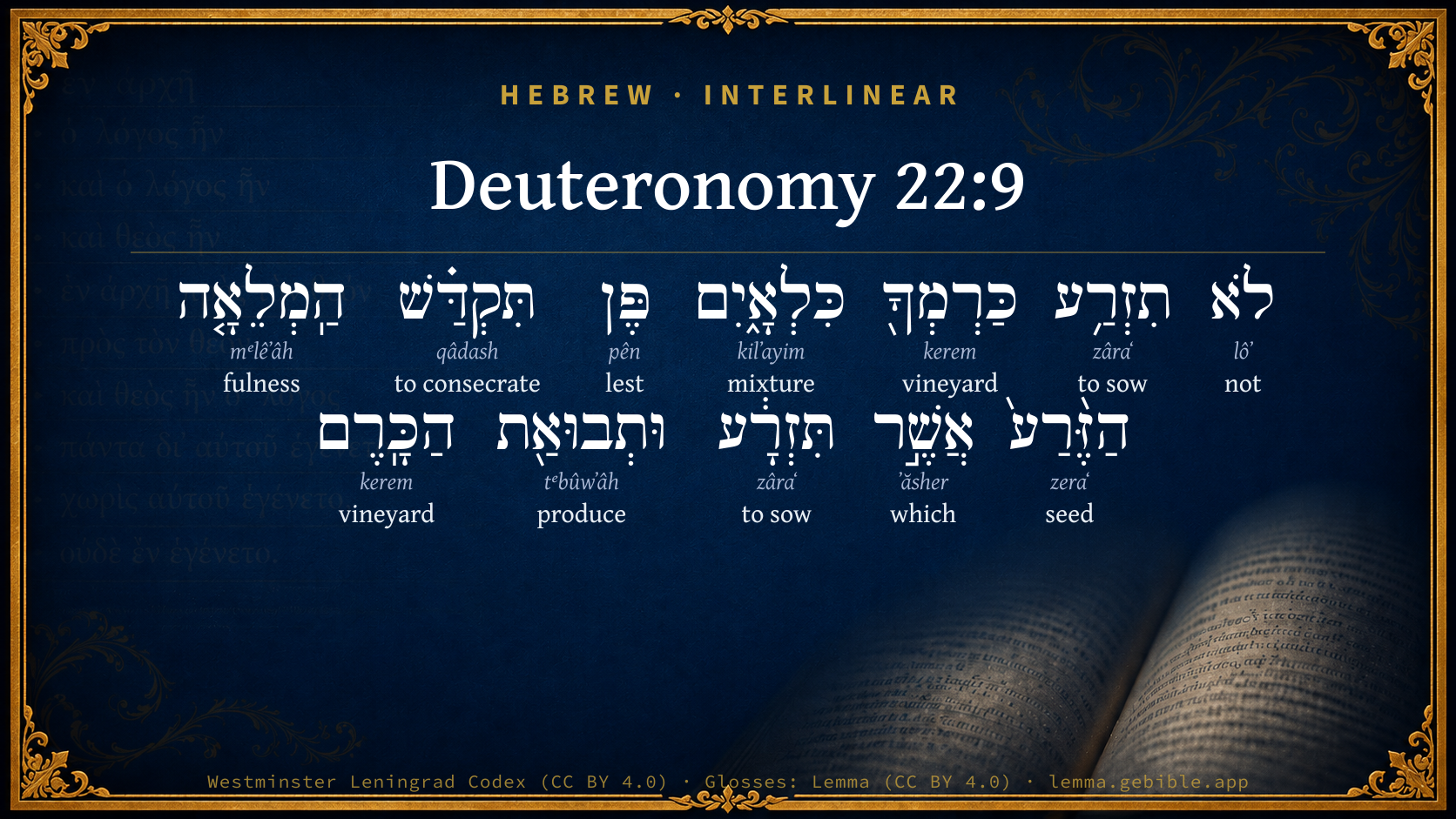
Deuteronomy 22:9

Hebrew (Westminster Leningrad Codex) Deuteronomy 22:9 appears in the Hebrew Old Testament. The text above is from the Westminster Leningrad Codex. Each word links to its Strong’s number, a concise gloss, and parsing drawn from the Open Scriptures Hebrew Bible morphology. Click any word for its full Brown-Driver-Briggs (BDB) entry.
Download image
Cite this verse

Deuteronomy 22:9 (World English Bible). Public Domain. Lemma interlinear Bible study tool, https://lemma.gebible.app/v/deuteronomy/22/9.

Show BibTeX & RIS
BibTeX
RIS
English Translation
You shall not sow your vineyard with two kinds of seed, lest the whole fruit be forfeited, the seed which you have sown, and the increase of the vineyard.
World English Bible · Public Domain
Download a study sheet

One document with this verse’s original text, its word-by-word gloss line, the meaning frame, cross-references with their text, attributed commentary, and full source and license credits — printable, and it pastes into notes with its structure intact.

This verse Autodidact and up

Study sheet (.html) Plain text (.txt)

A passage Seminary Student

Up to 50 verses in one chapter. A passage sheet keeps up to 6 commentary sources and 12 cross-references per verse, in the order this page ranks them, and says so on the sheet whenever that leaves anything out. Ask for a single verse and you get the Autodidact verse sheet above.

Everything on this page stays free to read, with no account — the sheet is a download of what is already on screen, not access to it.

Want to remove ads? Support Godless Engineer
Compare translations 3

The same verse in 3 English versions, stacked beneath the original-language interlinear above. Click any original word for its lexicon entry.

Each is an independent rendering of the whole verse — the interlinear is not word-aligned to these translations.

Highlighted words mark where these versions differ — a whole-verse word diff, not a word-by-word alignment.

  • World English Bible Public Domain
    You shall not sow your vineyard with two kinds of seed, lest the whole fruit be forfeited, the seed which you have sown, and the increase of the vineyard.
  • King James Version Public Domain
    Thou shalt not sow thy vineyard with divers seeds: lest the fruit of thy seed which thou hast sown, and the fruit of thy vineyard, be defiled.
  • unfoldingWord Literal Text CC BY-SA 4.0
    You shall not plant your vineyard with two kinds of seed, lest all the produce of the seed that you have sown and the yield of the vineyard be set apart.

unfoldingWord Literal Text — © unfoldingWord, licensed CC BY-SA 4.0. Word-aligned USFM3 via Door43 (git.door43.org/unfoldingWord/en_ult).

Versions to compare (up to 4)

3 of 4 selected

Show all 18 translations

Every available English version of this verse, each an independent rendering of the whole verse.

  • World English Bible Public Domain
    You shall not sow your vineyard with two kinds of seed, lest the whole fruit be forfeited, the seed which you have sown, and the increase of the vineyard.
  • Berean Standard Bible Public Domain
    Do not plant your vineyard with two types of seed; if you do, the entire harvest will be defiled—both the crop you plant and the fruit of your vineyard.
  • Majority Standard Bible Public Domain
    Do not plant your vineyard with two types of seed; if you do, the entire harvest will be defiled—both the crop you plant and the fruit of your vineyard.
  • King James Version Public Domain
    Thou shalt not sow thy vineyard with divers seeds: lest the fruit of thy seed which thou hast sown, and the fruit of thy vineyard, be defiled.
  • American Standard Version (1901) Public Domain
    Thou shalt not sow thy vineyard with two kinds of seed, lest the whole fruit be forfeited, the seed which thou hast sown, and the increase of the vineyard.
  • Revised Version (1885) Public Domain
    Thou shalt not sow thy vineyard with two kinds of seed: lest the whole fruit be forfeited, the seed which thou hast sown, and the increase of the vineyard.
  • Geneva Bible (1599) Public Domain
    Thou shalt not sow thy vineyard with diuers kinds of seedes, lest thou defile the increase of the seede which thou hast sowen, and the fruite of the vineyarde.
  • Douay-Rheims (1899) Public Domain
    Thou shalt not sow thy vineyard with divers seeds: lest both the seed which thou hast sown, and the fruit of the vineyard, be sanctified together.
  • Young's Literal Translation Public Domain
    `Thou dost not sow thy vineyard `with' divers things, lest the fulness of the seed which thou dost sow, and the increase of the vineyard, be separated.
  • Literal Standard Version CC BY-SA 4.0
    You do not sow your vineyard [with] two kinds [of seed], lest the fullness of the seed which you sow and the increase of the vineyard be separated.
  • Unlocked Literal Bible CC BY-SA 4.0
    You must not plant your vineyard with two kinds of seed, so that the whole harvest is not confiscated by the holy place, the seed that you have sown and the yield of the vineyard.
  • unfoldingWord Literal Text CC BY-SA 4.0
    You shall not plant your vineyard with two kinds of seed, lest all the produce of the seed that you have sown and the yield of the vineyard be set apart.
  • Darby Bible Public Domain
    Thou shalt not sow thy vineyard with [seed of] two sorts, lest the whole of thy seed which thou hast sown, and the produce of thy vineyard, be forfeited.
  • World Messianic Bible Public Domain
    You shall not sow your vineyard with two kinds of seed, lest all the fruit be defiled, the seed which you have sown, and the increase of the vineyard.
  • Webster's Bible Public Domain
    Thou shalt not sow thy vineyard with divers seeds: lest the fruit of thy seed which thou hast sown, and the fruit of thy vineyard, should be defiled.
  • Free Bible Version CC BY-SA 4.0
    Don't plant your vineyard with another kind of crop. Otherwise everything you produce—the crop you planted and the fruit of your vineyard—must be dedicated to the Lord.
  • Bible in Basic English Public Domain
    Do not have your vine-garden planted with two sorts of seed: or all of it may become a loss, the seed you have put in as well as the increase.
  • JPS Tanakh (1917) Public Domain
    Thou shalt not sow thy vineyard with two kinds of seed; lest the fulness of the seed which thou hast sown be forfeited together with the increase of the vineyard.

Literal Standard Version (2020), Covenant Press — licensed CC BY-SA 4.0. Text via the HelloAO Bible API (eBible.org). Unlocked Literal Bible (unfoldingWord) — licensed CC BY-SA 4.0. Text via the HelloAO Bible API (eBible.org). unfoldingWord Literal Text — © unfoldingWord, licensed CC BY-SA 4.0. Word-aligned USFM3 via Door43 (git.door43.org/unfoldingWord/en_ult). Free Bible Version, Dr. Jonathan Gallagher — licensed CC BY-SA 4.0. Text via the HelloAO Bible API (eBible.org).

Word by word

More ways to search: Search by grammar → Find every occurrence → Compare this word →

Practice this passage: Drill this verse → Learn its vocabulary →

כִּלְאָ֑יִם
kilʼayim
H3610
“mixture”
Noun, Common, Masculine, Dual, Absolute
Part of Speech
Noun
Type
Common
Gender
Masculine
Number
Dual
State
Absolute
Full BDB Definition

Origin: dual of H3608 in the original sense of separation

TWOT: 980d

two kinds, mixture - forbidden practice among cattle (cross breeding), seeds
  1. לֹא lôʼ H3808 “not” Particle, Negative
  2. תִזְרַ֥ע zâraʻ H2232 “to sow” Verb, Qal, Imperfect, 2nd Person, Masculine, Singular
  3. כַּרְמְךָ֖ kerem H3754 “vineyard · your” Noun, Common, Both, Singular, Construct + Suffix, Personal, 2nd Person, Masculine, Singular
  4. פֶּן pên H6435 “lest” Conjunction
  5. תִּקְדַּ֗שׁ qâdash H6942 “to consecrate” Verb, Qal, Imperfect, 2nd Person, Feminine, Singular
  6. הַֽמְלֵאָ֤ה mᵉlêʼâh H4395 “the · fulness” Particle, Definite Article + Noun, Common, Feminine, Singular, Absolute
  7. הַזֶּ֨רַע֙ zeraʻ H2233 “the · seed” Particle, Definite Article + Noun, Common, Masculine, Singular, Absolute
  8. אֲשֶׁ֣ר ʼăsher H834 “which” Particle, Relative
  9. תִּזְרָ֔ע zâraʻ H2232 “to sow” Verb, Qal, Imperfect, 2nd Person, Masculine, Singular
  10. וּתְבוּאַ֖ת tᵉbûwʼâh H8393 “and · produce of” Conjunction + Noun, Common, Feminine, Singular, Construct
  11. הַכָּֽרֶם kerem H3754 “the · vineyard” Particle, Definite Article + Noun, Common, Both, Singular, Absolute

About this verse

These counts appear in no published source. They are computed here, from the morphology-tagged text and Lemma’s own curated glosses. What Lemma adds →

12
words
10
distinct lemmas
Pentateuch
section

Notable vocabulary

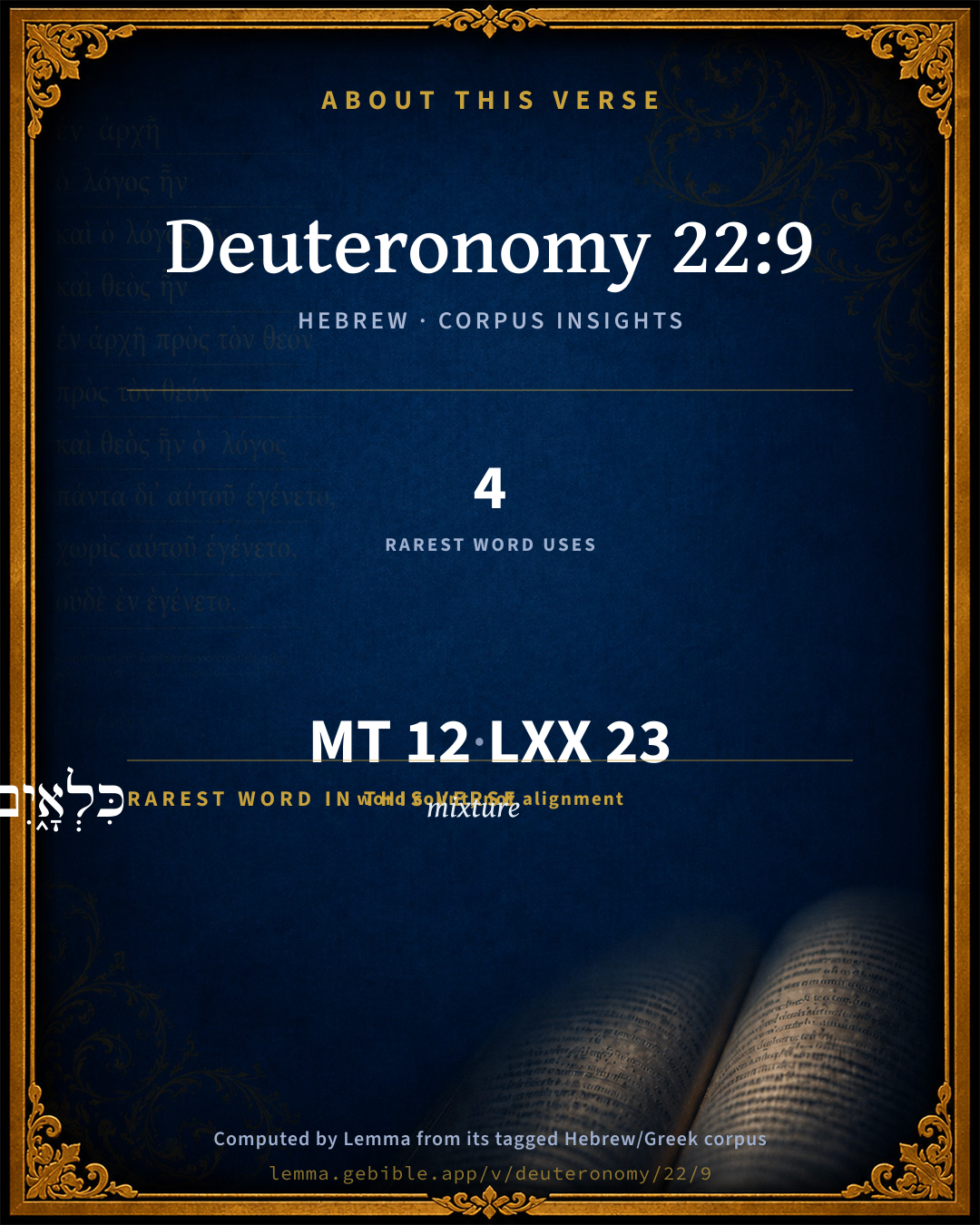
The rarest word here is כִּלְאָ֑יִם mixture H3610 — appearing just 4 times in the whole Hebrew Bible.

Shared distinctive vocabulary

כִּלְאָ֑יִם mixture H3610 occurs in 2 verses of the Hebrew Bible. Also found in:

Grammatical profile

  • 3 verbs
  • 6 nouns
  • 1 conjunction
  • 2 particles

Verb forms

  • תִזְרַ֥ע Qal · Imperfect
  • תִּקְדַּ֗שׁ Qal · Imperfect
  • תִּזְרָ֔ע Qal · Imperfect

Repetition

Words recur within this verse — often emphatic in Hebrew:

  • תִזְרַ֥ע to sow H2232 ×2
  • כַּרְמְךָ֖ vineyard H3754 ×2

Hebrew & Septuagint length

In English translation the verse runs 29 words from the Hebrew and 26 from the Septuagint (LXX English) — closely comparable.

A rough comparison of the two English renderings, which tokenize alike — not a word-level alignment.

Word counts can differ between the Hebrew and the Greek without any difference in meaning — e.g. the Hebrew direct-object marker אֵת has no separate Greek word, and Greek often adds the article ὁ.

In the original languages it is 12 Hebrew tokens and 23 Greek tokens — but the two are counted differently (Hebrew bundles its prefixes and suffixes into one token; the Greek is in lemma form), so that isn’t a like-for-like length.

Cross-references

8

Topical passages linked to Deuteronomy 22:9 in the Treasury of Scripture Knowledge — connected by theme and wording, ordered by reader-vote popularity; previews shown in the World English Bible.

  • Leviticus 19:19 "'You shall keep my statutes. "'You shall not crossbreed different kinds of animals. "'you shall not sow your field with two kinds of seed; "'neither shall there come upon on you a garment made of two kinds of material.
  • 2 Corinthians 11:3 But I am afraid that somehow, as the serpent deceived Eve in his craftiness, so your minds might be corrupted from the simplicity that is in Christ.
  • Matthew 9:16 No one puts a piece of unshrunk cloth on an old garment; for the patch would tear away from the garment, and a worse hole is made.
  • Matthew 6:24 "No one can serve two masters, for either he will hate the one and love the other; or else he will be devoted to one and despise the other. You can't serve both God and Mammon.
  • Romans 11:6 And if by grace, then it is no longer of works; otherwise grace is no longer grace. But if it is of works, it is no longer grace; otherwise work is no longer work.
  • James 1:6–8 But let him ask in faith, without any doubting, for he who doubts is like a wave of the sea, driven by the wind and tossed.
  • James 3:10 Out of the same mouth comes forth blessing and cursing. My brothers, these things ought not to be so.
  • 2 Corinthians 1:12 For our boasting is this: the testimony of our conscience, that in holiness and sincerity of God, not in fleshly wisdom but in the grace of God we behaved ourselves in the world, and more abundantly toward you.

Cross-references courtesy of OpenBible.info (CC BY 4.0).

Hebrew and Greek witnesses Masoretic Hebrew ↔ Greek Septuagint

The same verse in the two great witnesses to the Old Testament, shown verse-for-verse.

These are two independent witnesses, not word-aligned to each other, and the Septuagint is shown in lemma (dictionary) form.

Hebrew Deuteronomy 22:9 Masoretic · Westminster Leningrad Codex

לֹא תִזְרַ֥ע כַּרְמְךָ֖ כִּלְאָ֑יִם פֶּן תִּקְדַּ֗שׁ הַֽמְלֵאָ֤ה הַזֶּ֨רַע֙ אֲשֶׁ֣ר תִּזְרָ֔ע וּתְבוּאַ֖ת הַכָּֽרֶם

You shall not sow your vineyard with two kinds of seed, lest the whole fruit be forfeited, the seed which you have sown, and the increase of the vineyard.

World English Bible · Public Domain

Greek LXX Deuteronomy 22:9 Septuagint · lemma form

οὐ κατασπείρω ὁ ἀμπελών σύ διάφορος ἵνα μή ἁγιάζω ὁ γένημα καί ὁ σπέρμα ὅς ἐάν σπείρω μετά ὁ γένημα ὁ ἀμπελών σύ

You shall not sow your vineyard with diverse seed, lest the fruit be devoted, and whatever seed you may sow, with the fruit of your vineyard.

LXX2012 (modern English Septuagint) · Public Domain

Hebrew: Westminster Leningrad Codex (CC BY 4.0). Greek: Septuagint (public domain); English from LXX2012 (modern English Septuagint) (Public Domain). How the Septuagint differs from the Hebrew →

Targum (Aramaic paraphrase)

2

The Targum is the ancient Jewish Aramaic paraphrase of the Hebrew Scriptures — an interpretive translation, not the Hebrew text itself. Onkelos (literal) and Pseudo-Jonathan (expansive) render the Torah, and Jonathan the Prophets. Coverage is partial: where no permissively-licensed English translation exists for a verse, only the Aramaic is shown. This is verse-level text, not a word-by-word alignment to the Hebrew.

  1. Targum Onkelos Torah (Genesis–Deuteronomy)
    לָא תִזְרַע כַּרְמָךְ עֵרוּבִין דִילְמָא תִסְתָּאַב דִמְעַת זַרְעָא דִי תִזְרַע וַעֲלָלַת כַּרְמָא

    (no public-domain English translation for this verse)

    Targum Onkelos — Aramaic: “Onkelos Genesis” (public domain); “Onkelos Exodus” (public domain); “Onkelos Leviticus” (public domain); “Onkelos Numbers” (public domain); “Onkelos Deuteronomy” (public domain). English: “Sefaria Community Translation” (CC0 1.0 (public-domain dedication)); “J.W. Etheridge. The Targums of Onkelos and Jonathan Ben Uzziel on the Pentateuch. London: Longmans, Green, 1862” (public domain). Text via Sefaria.

  2. Targum Pseudo-Jonathan Torah (Genesis–Deuteronomy)
    לָא תִזְרְעוּן כַּרְמֵיכוֹן עֵירוּבִין דִּלְמָא תִתְחַיֵּיב יַקִידְתָּא דִּימְעַת זַרְעָא דְתִזְרְעוּן וַעֲלָלַת כַּרְמָא

    You shall not sow your vineyard with seeds of dif ferent kinds, lest thou be chargeable with burning the mixed seed that you have sown and the produce of the vine.

    Targum Pseudo-Jonathan — Aramaic: “Targum Jonathan on Genesis” (public domain); “Targum Jonathan on Exodus” (public domain); “Targum Jonathan on Leviticus” (public domain); “Targum Jonathan on Numbers” (public domain); “Targum Jonathan on Deuteronomy” (public domain). English: “The Targum of Jonathan ben Uzziel, trans. J. W. Etheridge, London, 1862” (public domain). Text via Sefaria.

Commentary

Notes on Deuteronomy 22:9 from classic Christian and Jewish commentators (each source and its license shown beneath its notes). The classic Christian expositions comment on the surrounding passage and are grouped to its opening verse, so a note may address several verses; the Jewish commentaries on the Tanakh (Rashi and others) are per-verse, so they appear only where the commentator wrote on this verse.

Lemma curates 59 commentaries, every one of them public domain or Creative Commons licensed, each selected and text-cleaned for this edition rather than reprinted as found. About our sources →

Trapp's Complete Commentary

John Trapp

Deu 22:9 Thou shalt not sow thy vineyard with divers seeds: lest the fruit of thy seed which thou hast sown, and the fruit of thy vineyard, be defiled.

Ver. 9. And the fruit of thy vineyard be defiled.] Heb., Be sanctified, per antiphrasin, as, auri sacra fames; and Anthony’s fire is ignis sacer. So a whore is called in Hebrew, Kedesha, of kadash, i.e., holiness, {Deu 23:17} by a contrary meaning, as most unholy and unchaste.

John Trapp, A Commentary or Exposition upon All the Books of the Old and New Testament (1647–1656) — public domain. Text from a community e-Sword module.

Joseph Benson's Commentary

Deu 22:9-10. Divers seeds — Either, 1st, With divers kinds of seeds mixed and sowed together between the rows of vines in thy vineyard: which was forbidden to be done in the field, (Lev 19:19,) and here in the vineyard. Or, 2d, With any kind of seed differing from that of the vine, which would produce either herbs, or corn, or fruit-bearing trees, whose fruit might be mingled with the fruit of the vines. Now this and the following precepts, though in themselves small and trivial, are given, according to that time and state of the church, for instructions in greater matters, and particularly to commend to them simplicity in all their carriage toward God and men, and to forbid all mixture of their inventions with God’s institutions in doctrine and worship. An ox and an ass — Because the one was a clean beast, the other unclean; whereby God would teach men to avoid polluting themselves by the touch of unclean persons or things.

Joseph Benson's Commentary on the Old and New Testaments (1811–1818) — public domain. Text from a community e-Sword module.

Tyndale Open Study Notes

Tyndale Open Resources

22:9 any other crop between the rows: This would bring about a mingling of things that should be kept separate.

Tyndale Open Study Notes — © Tyndale Open Resources, licensed CC BY-SA 4.0. Text via the HelloAO Bible API.

Geneva Bible (1599)

Geneva Bible translators

The tenor of this Law, is to walk in simplicity, and not to be curious of new inventions.

Geneva Bible (1599) marginal notes — public domain. Text via Bolls.life.

Jamieson, Fausset & Brown

Robert Jamieson, A. R. Fausset & David Brown

Thou shalt not sow thy vineyard with divers seeds--(See on Lev 19:19).

Jamieson, Fausset & Brown — Commentary Critical and Explanatory on the Whole Bible (1871) — public domain (CC PDM 1.0). Text via the HelloAO Bible API.

Adam Clarke's Commentary

Verse 9. Divers seeds] See Clarke on Le 19:19.

Adam Clarke's Commentary on the Bible (1810–1826) — public domain. Text from a community e-Sword/MySword module.

Ellicott's Commentary for English Readers

(9) Defiled—or sanctified. Different crops become “common” at different times. The year’s corn was freed by the wave-sheaf and wave-loaves. The trees not for five years. The rule about the ox and the ass may rest partly on the ground of humanity, the step and the pull of the two creatures being so very unlike. St. Paul gives a spiritual sense to the precept in 2Co_6:14. “Be not unequally yoked together with unbelievers.” The ox was a clean animal and fit for sacrifice. The ass was unclean, and must be redeemed with a lamb. The clean and unclean must not till the holy land of Jehovah together.

All these precepts are part of the laws of holiness in Leviticus—rules of behaviour arising from the fact that Israel is the special people of a holy God.

(9-11) These precepts appear also in Lev_19:19, more briefly.

A Bible Commentary for English Readers, edited by Charles John Ellicott (1878–1897) — public domain. Text from a community e-Sword module.

The Cambridge Bible for Schools and Colleges

gen. ed. J. J. S. Perowne

9. thy vineyard] which in Palestine is frequently so planted that there is room for the growth of vegetables, etc., between the vines. Lev_19:19, thy field. Why D mentions only vineyard is not explicable. The inference that his law is later than that in Lev. (Dillm.) is unjustified. More probably the wider term is the later correcting the narrower.

two kinds] Only here and Lev_19:19. The Heb. implies mutually exclusive kinds.

whole fruit] Right; for the Heb., the fulness, means not the overflow (so Ges. as in Exo_22:29 (28)) but the whole ultimate contents of the vineyard, as the rest of the v. explains.

be forfeited] Lit. as R.V. margin, consecrated, separated unto Jehovah and His sanctuary like things under the ban (Jos_6:19); proof that the prohibited mixture was regarded as a religious, i.e. a ritual, offence.

9–11. Three Laws against Mixing (1) seeds, (2) animals in ploughing, (3) cloths in a garment. The first and third also in H, Lev_19:19 (cp. P, Lev_11:37, against defiling seed), along with one against cross-breeding; the second peculiar to D. The religious reason given for the first is to be inferred for the other two. To appreciate it we must keep in mind not only the attention of the mind of that time to the distinctness of species as created by God, Gen_1:11 f., Gen_1:21, Gen_1:24 f. (Driver), but the principle stated by Isaiah (Deu_28:24 f.) that all the husbandman’s customs and methods including his discrimination and separation of different kinds of seed were taught him by divine revelation (cp. Lev_19:19 : ye shall keep my statutes); and the possibility that in a more primitive society different seeds, animals and the stuffs produced from them were regarded as animated by different spirits whom it was unlucky to offend by confusing them (see on Deu_22:11). But it is remarkable that Ḫammurabi’s Code shows no trace of this. For the later more detailed Jewish law see the Mishnah, ‘Kil’aim.’

The Cambridge Bible for Schools and Colleges (gen. ed. J. J. S. Perowne; Cambridge University Press, 1878–1918) — public domain. Text from a community e-Sword module.

John Gill's Exposition

Thou shall not sow thy vineyards with divers seeds,.... As wheat and barley between the rows of the vines; and this is to be understood only of divers sorts of corn, and of divers sorts of herbs, but not of trees; hence we read of a fig tree in a vineyard, Luk 13:6, and this only respects what is sown with design, and not what is casual, as the Jews interpret it (e);"if a man passes through a vineyard, and seeds fall from him, or they are carried out along with dung, or with water; or when a man is sowing, and a storm of wind carries it behind him (i.e. to a vineyard behind him), it is lawful;''that is, it may be let grow, and the fruit of it enjoyed; the same here is said of the vineyard as of the field in See Gill on Lev 19:19,

lest the fruit of thy seed which thou hast sown, and the fruit of thy vineyard; be defiled; that is, lest not only the increase of these divers seeds sown, but also the increase of the vines among which they are sown, become unlawful, and unfit for use, and so a loss of all be sustained: the Targum of Jonathan is,"lest it be condemned to burning;''or thou art obliged to burn it; for, according to the Jewish canons (f), the mixtures of a vineyard, or the divers seeds of it, and the increase thereof, were to be burnt; and the commentators of the Misnah (g) frequently explain this phrase by "lest it be burnt".

(e) Misn. Celaim, c. 5. sect. 7. (f) Misn. Temurah, c. 7. sect. 5. (g) Maimon. & Bartenora in Misn. Terumot, c. 10. sect. 6. Orla, c. 3. sect. 7. Kiddushin, c. 2. sect. 9.

John Gill's Exposition of the Whole Bible (1746–1763) — public domain (CC PDM 1.0). Text via the HelloAO Bible API.

Albert Barnes' Notes on the Bible

Compare the marginal reference. The prohibition of Deu 22:10 was also dictated by humanity. The ox and the donkey being of such different size and strength, it would be cruel to the latter to yoke them together. These two animals are named as being those ordinarily employed in agriculture; compare Isa 32:20.

Albert Barnes' Notes on the Bible (1834–1885) — public domain. Text from a community e-Sword/MySword module.

Haydock's Catholic Bible Commentary

Together. If wheat was sown in a vineyard, it would ripen much sooner than the grapes; and as the first-fruits of both were offered to the Lord, the owner would lose the profit which he had too greedily sought after, the place being esteemed both pure and impure at the same time. This mixture of seeds would also impoverish the land, so that it would be like a place defiled, and unfit for cultivation. (Jansenius in Leviticus xix. 19.) Maimonides supposes that the practice of the Zabians is here reprobated. They sowed the land with corn and dry grapes, in honour of Ceres and Bacchus, (More. Nev. p. 3. c. 37,) who presided over the harvest and vintage among the pagans. (Wm. of Paris. Leg. 13.) --- Moses might also, by this symbolical language, condemn unnatural connexions, as he perhaps does, ver. 10.

George Leo Haydock (1774–1849), Haydock's Catholic Family Bible and Commentary, 1859 edition — public domain. Excludes Psalms (Douay-Rheims chapter numbering differs from Protestant) and Deuterocanonical books (Catholic canon only).

Matthew Poole's English Annotations

With divers seeds; either,

1. With divers kinds of seed mixed and sowed together between the rows of vines in thy vineyard; which was forbidden to be done in the field, Lev 19:19, and here in the vineyard. Or,

2. With any kind of seed differing from that of the vine, which would produce either herbs, or corn, or fruit-bearing trees, whose fruit might be mingled with the fruit of the vines. Now this and the two following precepts, though in themselves small and trivial, are given, according to that time and state of the church, for documents or instructions in greater matters, and particularly to commend to them simplicity and sincerity in all their carriages towards God and men, and to forbid all mixture of their inventions with God’s institutions, in doctrine or worship.

The fruit of thy seed, Heb. the fulness of thy seed, i.e. that seed when it is ripe and full. See Exo 22:29; Num 18:27.

Defiled; either,

1. Naturally corrupted or marred, whilst one seed draws away the fat and nourishment of the earth from the other, and so both are starved and spoiled. Or rather,

2. Legally and morally, as being prohibited by God’s law, and thereby made unclean; as, on the contrary, things are sanctified by God’s word allowing and approving them, 1Ti 4:5. Heb. be sanctified, or, be as a sanctified thing, by an ellipsis of the particle as, i.e. unlawful for the owner’s use, as things sanctified were. Or, sanctifying is put for polluting, by a figure called euphemismus, which is frequent in Scripture, as when blessing is put for cursing, as Job 2:9, and in other authors, as when they use sacred for execrable.

Matthew Poole's English Annotations on the Holy Bible (1683–1685) — public domain. Text from a community e-Sword/MySword module.

Whedon's Commentary on the Bible

Daniel D. Whedon

9-11. Not sow… divers seeds — These prohibitions are similar to those in Lev_19:19, and seem founded on an aversion to mingling things unlike.

Daniel D. Whedon (gen. ed.), Commentary on the Old and New Testaments (1874–1909) — public domain. Text from a community e-Sword module.

The Pulpit Commentary

Vers. 9-11. (cf. Lev_19:19) God has made distinctions in nature, and these are not to be confounded by the mixing of things distinct. The ox and the ass were chiefly used in husbandry; but, as they were of different size and strength, it was not only fitting that they should not be yoked to the same plough, but it might be cruel so to yoke them.

Vers. 9, 11. Evil associations to be avoided.

essence of the crime (Zep_1:8) consisted, not in wearing a woolen and linen robe, but in having it in a particular form according to a favorite superstition of ancient idolatries". (Lev_19:19) So also as to sowing with divers seeds; it was a superstitious custom of the idolaters, and hence it is to be avoided. Note: Evil associations may make it wrong to follow or observe that which is in itself harmless. With the principle which underlies this passage thus stated, compare 1Co_10:23 to end.

I God, having called his people out of the world, would have them distinct from the world.

II In carrying out this distinction in practice, Christians are bound to regard the influence which their practice will have upon others, as well as the practice itself.

III It is quite possible that (as in the case of eating meats offered to idols) there may be rites, customs, habits, in which this or that Christian could indulge without injury to himself, and yet which, owing to the force of public sentiment and opinion, would tell prejudicially upon him, and lower his influence for good.

IV When such is the case, he is to take the higher ground, not shrinking from being deemed puritanical and to abstain not only from that which is wrong in itself, but from much which, owing to evil associations, has about it a suspicious look of worldliness and self-indulgence.

Vers. 9-12. Directions in minor matters.

What was, in primitive days, matter for direct revelation from God, is now ascertained by scientific observation. Herein we learn that revelation and science spring from one origin and subserve one end the good of men. And herein we may learn God"s fatherly care for his children in the days of their infancy.

I GREATEST FERTILITY IN NATURE IS TO BE SOUGHT. It is man"s province to bring out the greatest productiveness in fields and fruit trees. Pruning, manuring, and grafting are essential. The vine needs especial care, and is susceptible of great increase of fruitfulness. So delicate is the blossom of the vine that the pollen of other plants in the vicinity, coming into contact, injures the formation of the fruit. It is a joy to God to see the trees of the field fruitful; how much more to see abundant fruitfulness in us! "Herein is our Father glorified." The least of God"s commandments is profitable to observe.

II NEEDLESS BURDENS ON ANIMALS FORBIDDEN. Every beast is appointed to be the servant of man; but man is required to act towards the inferior creation in God"s stead. The burden of service laid upon oxen and asses is heavy enough; let it not be wantonly increased. Both the ox and the ass suffered from an unequal yoking in the plough. God saw the painful effect, and felt grieved. Animal feeling is a gift from God, and is intended to be for enjoyment. We may act in harmony with God, and increase that enjoyment; or we may, in part, frustrate his plan. In every act of man God takes lively interest. All day long he is approving or censuring.

III OUR PIETY IS TO BE SEEN IN OUR RAIMENT. It is very probable that this prohibition about dress was to counteract a custom among idolaters a custom which led to superstitious feeling. Some solid reason was at the root of the counsel, whether we can discover that reason or not. Our raiment is in some measure the exponent of our religion. If "Holiness to the Lord" is predicted as the motto to be found on the bells of the horses, so, and much more, should consecration to God be conspicuous on our dress and demeanor. Our raiment often serves as an ensign, and denotes to what party we belong the Church or the world. If simplicity, modesty, beauty, sterling quality, be in our dress, these are ornaments of our holy faith. Whatever we do, or however we dress, be this our aim, to please God. A child will never be ashamed to acknowledge its father. D.

The Pulpit Commentary (1880–1919), ed. H.D.M. Spence-Jones & Joseph S. Exell — public domain. Text from a community e-Sword module.

John Wesley's Explanatory Notes

Divers seeds - Either

1. With divers kinds of seed mixed and sowed together between the rows of vines in thy vineyard: which was forbidden to be done in the field, Lev. xix, 19, and here, in the vineyard. Or,

2. With any kind of seed differing from that of the vine, which would produce either herbs, or corn, or fruit-bearing trees, whose fruit might be mingled with the fruit of the vines. Now this and the following precepts, tho' in themselves small and trivial, are given, according to that time and state of the church, for instructions in greater matters, and particularly to commend to them simplicity in all their carriage towards God and man, and to forbid all mixture of their inventions with God's institutions in doctrine or worship. Defiled - Legally and morally, as being prohibited by God's law, and therefore made unclean; as on the contrary, things are sanctified by God's word, allowing and approving them, 1 Tim. iv, 5.

John Wesley, Explanatory Notes Upon the Whole Bible (1754–1765) — public domain. Text via the GEBible commentary corpus.

unfoldingWord translationNotes

Door43 World Missions Community

General Information:

Moses speaks to the Israelites as if they were one man, so the words "you" and "your" here are singular. (See: Forms of You)

so that the whole harvest is not confiscated by the holy place

The words "holy place" is a metonym for the priests who work in the holy place. This can be stated in active form. AT: "so that the priests in Yahweh's holy place do not take away the whole harvest" or "so that you do not defile the whole harvest and the priests do not allow you to use it" (See: Metonymy and Active or Passive)

the yield of the vineyard

"the fruit that grows in the vineyard"

wool

soft, curly hair that grows on a sheep

linen

thread made from the flax plant (See: Translate Unknowns)

translationWords

vineyard

kind

seed

harvest

holy place

plant

plow

cow

donkey

unfoldingWord translationNotes — © Distant Shores Media and the Door43 World Missions Community, licensed CC BY-SA 4.0. Source: git.door43.org/Door43/en_tn.

Rashi

Rabbi Shlomo Yitzchaki (Rashi)

כלאים [THOU SHALT NOT SOW THY VINEYARD] WITH DIVERSE KINDS OF SEEDS — i.e. wheat and barley together with kernels of grapes with one and the same hand-throw (Berachot 22a; Kiddushin 39a; Chullin 82b).

פן תקדש LEST IT BECOME קדש — Take it as the Targum does: lest it become unclean (unfit for use); to anything for which a man has repugnance to come into contact with, be it on account of its sublimity as, for instance, holy things, or be it on account of some bad quality, as, for instance, something that is forbidden, the term קדוש is appropriate, as, in the latter sense, e.g., (Isaiah 65:5) “Come not near to me for I make thee קדוש".

[המלאה — This is the fullness and increase which the seed produces].

Rashi on the Tanakh — English translations: “The Judaica Press complete Tanach with Rashi, translated by A. J. Rosenberg” (CC BY 4.0); “Pentateuch with Rashi's commentary by M. Rosenbaum and A.M. Silbermann, 1929-1934” (public domain); “The Metsudah Tanach series, Lakewood, N.J” (CC BY 4.0); and “The Book of Joshua, Metsudah Publications, 1997” (CC BY 4.0). Text via Sefaria.

Lesson kit

Teaching starters — assembled from the data on this page, not authored interpretation. Every prompt links to the verse data it draws on. Edit before teaching.

Deuteronomy, in the Pentateuch, opens this verse with 12 words (10 distinct Hebrew lemmas). Its most distinctive word is kilʼayim (“mixture”). A historical commentator’s framing appears above. Read the whole chapter for the surrounding context.

Discussion questions

  1. What does “mixture” (kilʼayim) contribute to the verse as a whole?
  2. Leviticus 19:19 shares the word «mixture» with this verse. How do the two illuminate each other?
  3. “to sow” occurs 2× in this one verse. What is the effect of the repetition?
  4. The translations on this page render this verse differently — a whole-verse word diff, not a word-by-word alignment. What might account for the different wordings?
  5. The verb «תִזְרַ֥ע» is Qal Imperfect. How does its form color the action?
  6. Reading how Trapp's Complete Commentary and Joseph Benson's Commentary read this verse, where do the two commentators agree and where do they part?

Things to notice

Reading settings

Reading text

Shown beneath each verse's original-language words.

Old Testament
Old Testament edition

Read the OT as the Masoretic Hebrew (MT) or the Greek Septuagint (LXX).

English shown for the Greek Septuagint (in the Hebrew ↔ Greek comparison).

Comparing translations? Open the Compare panel on any verse page to stack up to four side by side.