Numbers 3:32

Hebrew (Westminster Leningrad Codex) Numbers 3:32 appears in the Hebrew Old Testament. The text above is from the Westminster Leningrad Codex. Each word links to its Strong’s number, a concise gloss, and parsing drawn from the Open Scriptures Hebrew Bible morphology. Click any word for its full Brown-Driver-Briggs (BDB) entry.
Download image
Cite this verse

Numbers 3:32 (World English Bible). Public Domain. Lemma interlinear Bible study tool, https://lemma.gebible.app/v/numbers/3/32.

Show BibTeX & RIS
BibTeX
RIS
English Translation
Eleazar the son of Aaron the priest shall be prince of the princes of the Levites, with the oversight of those who keep the charge of the sanctuary.
World English Bible · Public Domain
Highlights
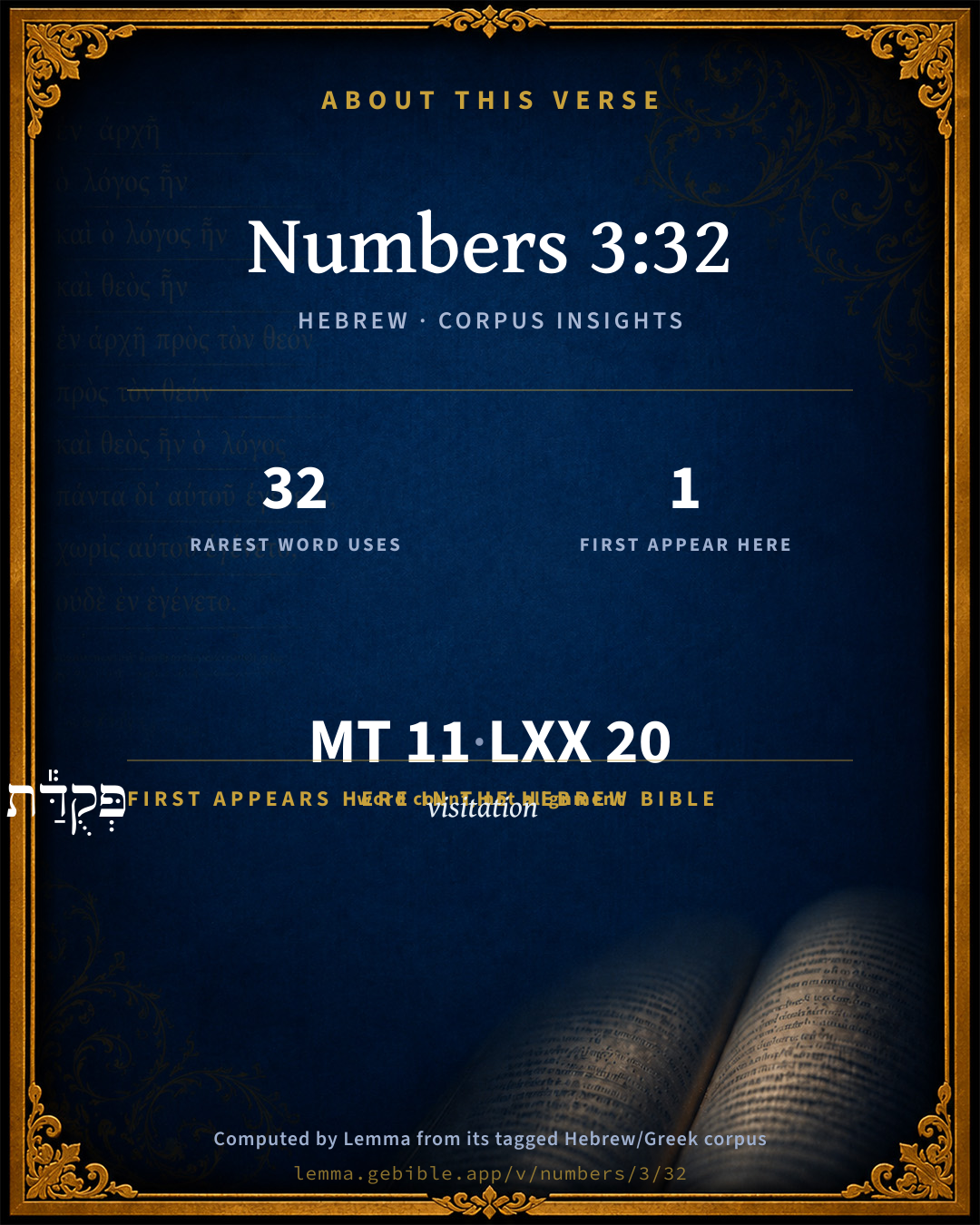
  • 1 first appearance in the Hebrew Bible
Full analysis ↓
Download a study sheet

One document with this verse’s original text, its word-by-word gloss line, the meaning frame, cross-references with their text, attributed commentary, and full source and license credits — printable, and it pastes into notes with its structure intact.

This verse Autodidact and up

Study sheet (.html) Plain text (.txt)

A passage Seminary Student

Up to 50 verses in one chapter. A passage sheet keeps up to 6 commentary sources and 12 cross-references per verse, in the order this page ranks them, and says so on the sheet whenever that leaves anything out. Ask for a single verse and you get the Autodidact verse sheet above.

Everything on this page stays free to read, with no account — the sheet is a download of what is already on screen, not access to it.

Want to remove ads? Support Godless Engineer
Compare translations 3

The same verse in 3 English versions, stacked beneath the original-language interlinear above. Click any original word for its lexicon entry.

Each is an independent rendering of the whole verse — the interlinear is not word-aligned to these translations.

Highlighted words mark where these versions differ — a whole-verse word diff, not a word-by-word alignment.

  • World English Bible Public Domain
    Eleazar the son of Aaron the priest shall be prince of the princes of the Levites, with the oversight of those who keep the charge of the sanctuary.
  • King James Version Public Domain
    And Eleazar the son of Aaron the priest shall be chief over the chief of the Levites, and have the oversight of them that keep the charge of the sanctuary.
  • unfoldingWord Literal Text CC BY-SA 4.0
    And the leader of the leaders of the Levites Eleazar, the son of Aaron the priest, the oversight of the keepers of the keeping of the holy place.

unfoldingWord Literal Text — © unfoldingWord, licensed CC BY-SA 4.0. Word-aligned USFM3 via Door43 (git.door43.org/unfoldingWord/en_ult).

Versions to compare (up to 4)

3 of 4 selected

Show all 18 translations

Every available English version of this verse, each an independent rendering of the whole verse.

  • World English Bible Public Domain
    Eleazar the son of Aaron the priest shall be prince of the princes of the Levites, with the oversight of those who keep the charge of the sanctuary.
  • Berean Standard Bible Public Domain
    The chief of the leaders of the Levites was Eleazar son of Aaron the priest; he oversaw those responsible for the duties of the sanctuary.
  • Majority Standard Bible Public Domain
    The chief of the leaders of the Levites was Eleazar son of Aaron the priest; he oversaw those responsible for the duties of the sanctuary.
  • King James Version Public Domain
    And Eleazar the son of Aaron the priest shall be chief over the chief of the Levites, and have the oversight of them that keep the charge of the sanctuary.
  • American Standard Version (1901) Public Domain
    And Eleazar the son of Aaron the priest shall be prince of the princes of the Levites, `and have' the oversight of them that keep the charge of the sanctuary.
  • Revised Version (1885) Public Domain
    And Eleazar the son of Aaron the priest shall be prince of the princes of the Levites, and have the oversight of them that keep the charge of the sanctuary.
  • Geneva Bible (1599) Public Domain
    And Eleazar the sonne of Aaron the Priest shalbe chiefe captaine of the Leuites, hauing the ouersight of them that haue the charge of the Sanctuarie.
  • Douay-Rheims (1899) Public Domain
    And the prince of the princes of the Levites, Eleazar, the son of Aaron the priest, shall be over them that watch for the guard of the sanctuary.
  • Young's Literal Translation Public Domain
    And `to' the prince of the princes of the Levites, Eleazar son of Aaron the priest, `is' the oversight of the keepers of the charge of the sanctuary.
  • Literal Standard Version CC BY-SA 4.0
    And Eleazar son of Aaron the priest [is] the prince of the princes of the Levites, [with] the oversight of the keepers of the charge of the holy place.
  • Unlocked Literal Bible CC BY-SA 4.0
    Eleazar son of Aaron the priest must lead the men who lead the Levites. He must supervise the men who care for the holy place.
  • unfoldingWord Literal Text CC BY-SA 4.0
    And the leader of the leaders of the Levites Eleazar, the son of Aaron the priest, the oversight of the keepers of the keeping of the holy place.
  • Darby Bible Public Domain
    And the prince of princes of the Levites was Eleazar the son of Aaron the priest: he had the oversight of them that kept the charge of the sanctuary.
  • World Messianic Bible Public Domain
    Eleazar the son of Aaron the priest shall be prince of the princes of the Levites, with the oversight of those who keep the requirements of the sanctuary.
  • Webster's Bible Public Domain
    And Eleazar the son of Aaron the priest shall be chief over the chief of the Levites, and have the oversight of them that keep the charge of the sanctuary.
  • Free Bible Version CC BY-SA 4.0
    The chief of the leaders of the Levites was Eleazar, son of Aaron the priest. He was in charge of those responsible for serving in the sanctuary.
  • Bible in Basic English Public Domain
    Eleazar, the son of Aaron the priest, will be head over all the Levites and overseer of those responsible for the care of the holy place.
  • JPS Tanakh (1917) Public Domain
    Eleazar the son of Aaron the priest being prince of the princes of the Levites, and having the oversight of them that keep the charge of the sanctuary.

Literal Standard Version (2020), Covenant Press — licensed CC BY-SA 4.0. Text via the HelloAO Bible API (eBible.org). Unlocked Literal Bible (unfoldingWord) — licensed CC BY-SA 4.0. Text via the HelloAO Bible API (eBible.org). unfoldingWord Literal Text — © unfoldingWord, licensed CC BY-SA 4.0. Word-aligned USFM3 via Door43 (git.door43.org/unfoldingWord/en_ult). Free Bible Version, Dr. Jonathan Gallagher — licensed CC BY-SA 4.0. Text via the HelloAO Bible API (eBible.org).

Word by word

More ways to search: Search by grammar → Find every occurrence → Compare this word →

Practice this passage: Drill this verse → Learn its vocabulary →

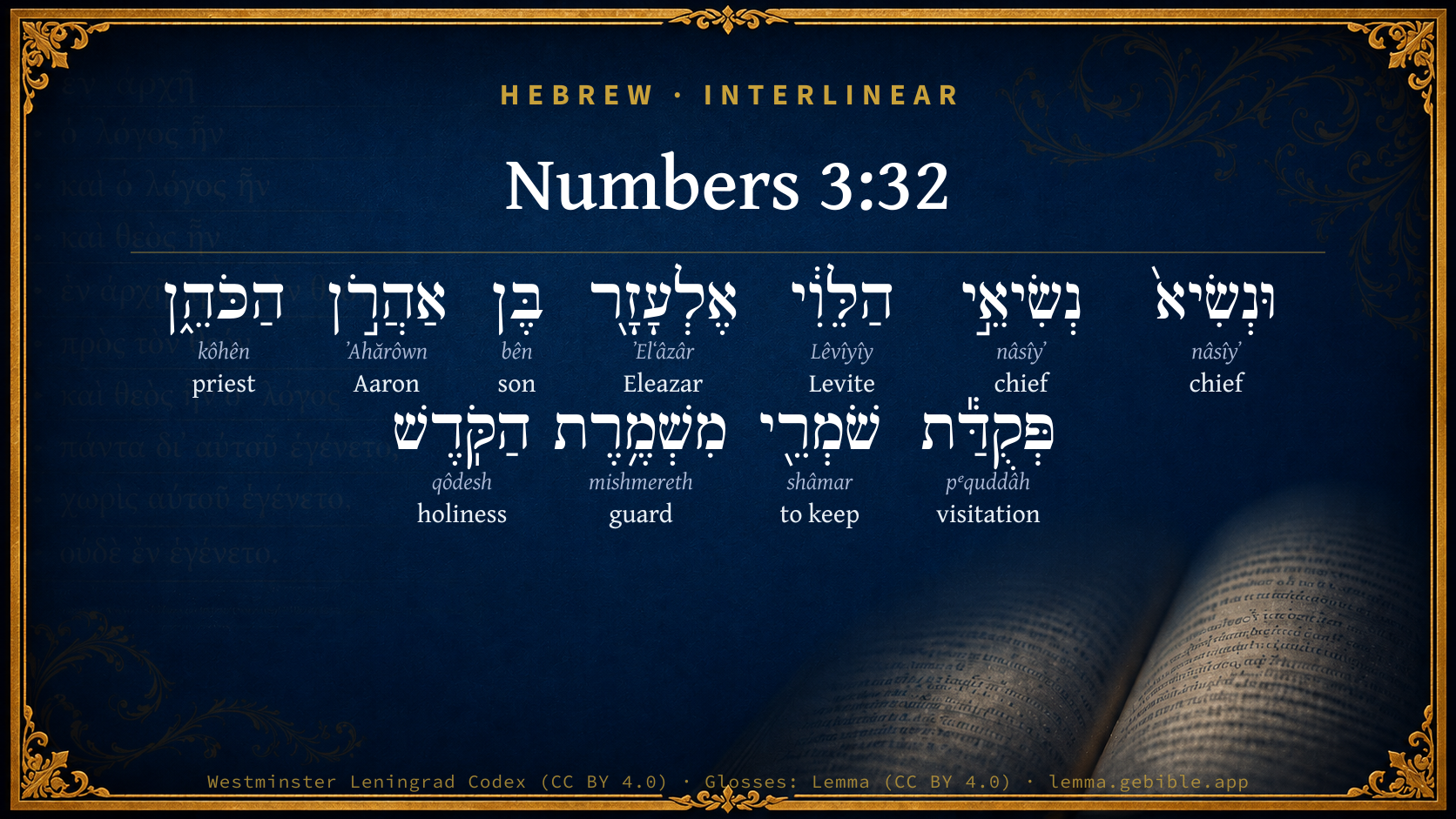
פְּקֻדַּ֕ת
pᵉquddâh
H6486
“visitation of”
Noun, Common, Feminine, Singular, Construct
Part of Speech
Noun
Type
Common
Gender
Feminine
Number
Singular
State
Construct
Full BDB Definition

Origin: pass part of H6485

TWOT: 1802a

oversight, care, custody, mustering, visitation, store - visitation, punishment - oversight, charge, office, overseer, class of officers - mustering - store
  1. וּנְשִׂיא֙ nâsîyʼ H5387 “and · chief of” Conjunction + Noun, Common, Masculine, Singular, Construct
  2. נְשִׂיאֵ֣י nâsîyʼ H5387 “chiefs of” Noun, Common, Masculine, Plural, Construct
  3. הַלֵּוִ֔י Lêvîyîy H3881 “the · Levite” Particle, Definite Article + Noun, Gentilic, Masculine, Singular, Absolute
  4. אֶלְעָזָ֖ר ʼElʻâzâr H499 “Eleazar” Noun, Proper
  5. בֶּן bên H1121 “son of” Noun, Common, Masculine, Singular, Construct
  6. אַהֲרֹ֣ן ʼAhărôwn H175 “Aaron” Noun, Proper
  7. הַכֹּהֵ֑ן kôhên H3548 “the · priest” Particle, Definite Article + Noun, Common, Masculine, Singular, Absolute
  8. שֹׁמְרֵ֖י shâmar H8104 “keeping” Verb, Qal, Participle Active, Masculine, Plural, Construct
  9. מִשְׁמֶ֥רֶת mishmereth H4931 “guard of” Noun, Common, Feminine, Singular, Construct
  10. הַקֹּֽדֶשׁ qôdesh H6944 “the · holiness” Particle, Definite Article + Noun, Common, Masculine, Singular, Absolute

About this verse

These counts appear in no published source. They are computed here, from the morphology-tagged text and Lemma’s own curated glosses. What Lemma adds →

11
words
10
distinct lemmas
Pentateuch
section

First appearance in Scripture

This word makes its first canonical appearance in the Hebrew Bible here:

  • פְּקֻדַּ֕ת visitation H6486

Shared distinctive vocabulary

פְּקֻדַּ֕ת visitation H6486 occurs in 31 verses of the Hebrew Bible. Also found in:

Grammatical profile

  • 1 verb
  • 10 nouns

Verb forms

  • שֹׁמְרֵ֖י Qal · Participle Active

Repetition

A word recurs within this verse — often emphatic in Hebrew:

  • וּנְשִׂיא֙ chief H5387 ×2

Hebrew & Septuagint length

In English translation the verse runs 28 words from the Hebrew and 26 from the Septuagint (LXX English) — closely comparable.

A rough comparison of the two English renderings, which tokenize alike — not a word-level alignment.

Word counts can differ between the Hebrew and the Greek without any difference in meaning — e.g. the Hebrew direct-object marker אֵת has no separate Greek word, and Greek often adds the article ὁ.

In the original languages it is 11 Hebrew tokens and 20 Greek tokens — but the two are counted differently (Hebrew bundles its prefixes and suffixes into one token; the Greek is in lemma form), so that isn’t a like-for-like length.

Cross-references

6

Topical passages linked to Numbers 3:32 in the Treasury of Scripture Knowledge — connected by theme and wording, ordered by reader-vote popularity; previews shown in the World English Bible.

  • Numbers 4:16 "The charge of Eleazar the son of Aaron the priest shall be the oil for the light, the sweet incense, the continual meal offering, and the anointing oil, the charge of all the tabernacle, and of all that is in it, the sanctuary, and its furnishings."
  • Numbers 4:27 At the commandment of Aaron and his sons shall be all the service of the sons of the Gershonites, in all their burden, and in all their service; and you shall appoint to them in charge all their burden.
  • Numbers 20:25–28 Take Aaron and Eleazar his son, and bring them up to Mount Hor;
  • 2 Kings 25:18 The captain of the guard took Seraiah the chief priest, and Zephaniah the second priest, and the three keepers of the threshold:
  • 1 Chronicles 9:14–20 Of the Levites: Shemaiah the son of Hasshub, the son of Azrikam, the son of Hashabiah, of the sons of Merari;
  • 1 Chronicles 26:20–24 Of the Levites, Ahijah was over the treasures of the house of God, and over the treasures of the dedicated things.

Cross-references courtesy of OpenBible.info (CC BY 4.0).

Hebrew and Greek witnesses Masoretic Hebrew ↔ Greek Septuagint

The same verse in the two great witnesses to the Old Testament, shown verse-for-verse.

These are two independent witnesses, not word-aligned to each other, and the Septuagint is shown in lemma (dictionary) form.

Hebrew Numbers 3:32 Masoretic · Westminster Leningrad Codex

וּנְשִׂיא֙ נְשִׂיאֵ֣י הַלֵּוִ֔י אֶלְעָזָ֖ר בֶּן אַהֲרֹ֣ן הַכֹּהֵ֑ן פְּקֻדַּ֕ת שֹׁמְרֵ֖י מִשְׁמֶ֥רֶת הַקֹּֽדֶשׁ

Eleazar the son of Aaron the priest shall be prince of the princes of the Levites, with the oversight of those who keep the charge of the sanctuary.

World English Bible · Public Domain

Greek LXX Numbers 3:32 Septuagint · lemma form

καί ὁ ἄρχων ἐπί ὁ ἄρχων ὁ λευίτης ελεαζαρ ὁ υἱός ἀαρών ὁ ἱερεύς καταἵστημι φυλάσσω ὁ φυλακή ὁ ἅγιος

And the chief over the chief of the Levites, was Eleazar the son of Aaron the priest, appointed to keep the charges of the holy things.

LXX2012 (modern English Septuagint) · Public Domain

Hebrew: Westminster Leningrad Codex (CC BY 4.0). Greek: Septuagint (public domain); English from LXX2012 (modern English Septuagint) (Public Domain). How the Septuagint differs from the Hebrew →

Targum (Aramaic paraphrase)

2

The Targum is the ancient Jewish Aramaic paraphrase of the Hebrew Scriptures — an interpretive translation, not the Hebrew text itself. Onkelos (literal) and Pseudo-Jonathan (expansive) render the Torah, and Jonathan the Prophets. Coverage is partial: where no permissively-licensed English translation exists for a verse, only the Aramaic is shown. This is verse-level text, not a word-by-word alignment to the Hebrew.

  1. Targum Onkelos Torah (Genesis–Deuteronomy)
    וַאֲמַרְכְּלָא דִמְמַנָא עַל רַבְרְבֵי לֵוָאֵי אֶלְעָזָר בַּר אַהֲרֹן כַּהֲנָא דְמִתְּחוֹת יְדוֹהִי מְמַנָן נָטְרֵי מַטְרַת קוּדְשָׁא

    (no public-domain English translation for this verse)

    Targum Onkelos — Aramaic: “Onkelos Genesis” (public domain); “Onkelos Exodus” (public domain); “Onkelos Leviticus” (public domain); “Onkelos Numbers” (public domain); “Onkelos Deuteronomy” (public domain). English: “Sefaria Community Translation” (CC0 1.0 (public-domain dedication)); “J.W. Etheridge. The Targums of Onkelos and Jonathan Ben Uzziel on the Pentateuch. London: Longmans, Green, 1862” (public domain). Text via Sefaria.

  2. Targum Pseudo-Jonathan Torah (Genesis–Deuteronomy)
    וַאֲמַרְכּוֹל דִמְמַנֵי עַל רַבְרְבֵי לֵיוָאֵי אֶלְעָזָר בַּר אַהֲרן כַּהֲנָא הוּא הֲוָה שָׁאִיל בְּאוּרַיָיא וְתוּמַיָא מִתְּחוֹת יְדוֹי מְמַנָן נַטְרֵי מַטְרַת קוּדְשָׁא

    And the Amarkol set over the chiefs of the Levites shall be Elazar bar Aharon the priest, who inquireth by Uraya and Thumaya; and under his hand shall they be appointed who keep the charge of the sanctuary.

    Targum Pseudo-Jonathan — Aramaic: “Targum Jonathan on Genesis” (public domain); “Targum Jonathan on Exodus” (public domain); “Targum Jonathan on Leviticus” (public domain); “Targum Jonathan on Numbers” (public domain); “Targum Jonathan on Deuteronomy” (public domain). English: “The Targum of Jonathan ben Uzziel, trans. J. W. Etheridge, London, 1862” (public domain). Text via Sefaria.

Commentary

Notes on Numbers 3:32 from classic Christian and Jewish commentators (each source and its license shown beneath its notes). The classic Christian expositions comment on the surrounding passage and are grouped to its opening verse, so a note may address several verses; the Jewish commentaries on the Tanakh (Rashi and others) are per-verse, so they appear only where the commentator wrote on this verse.

Lemma curates 59 commentaries, every one of them public domain or Creative Commons licensed, each selected and text-cleaned for this edition rather than reprinted as found. About our sources →

Joseph Benson's Commentary

Num 3:32. Chief — Next under the high-priest; whence he is called the second priest, (2Ki 25:18,) and in case of the high-priest’s absence by sickness or other necessary occasions, he was to perform his work; and he had a superiority over all the rest of the priests and Levites. The chief of the Levites — That is, over those three persons, who were each the chief of their several families, Num 3:24; Num 3:31; Num 3:34.

Joseph Benson's Commentary on the Old and New Testaments (1811–1818) — public domain. Text from a community e-Sword module.

Tyndale Open Study Notes

Tyndale Open Resources

3:32 Eleazar, Aaron’s third son, presided over the Levites as administrator (perhaps as an executive secretary), while his father dealt with other matters; he had special . . . oversight of the Tabernacle (4:16-20). He played an important role in Israel’s wilderness period and later succeeded his father as high priest (see 16:37-39; 19:3-6; 20:25-28; 26:1-3).

Tyndale Open Study Notes — © Tyndale Open Resources, licensed CC BY-SA 4.0. Text via the HelloAO Bible API.

Geneva Bible (1599)

Geneva Bible translators

Or, prince of princes.

Geneva Bible (1599) marginal notes — public domain. Text via Bolls.life.

Jamieson, Fausset & Brown

Robert Jamieson, A. R. Fausset & David Brown

chief--rather, "chiefs" of the Levites. Three persons are mentioned as chiefs of these respective divisions [Num 3:24, Num 3:30, Num 3:35]. And Eleazar presided over them; whence he is called "the second priest" (Kg2 25:18); and in the case of the high priest's absence from illness or other necessary occasions, he performed the duties (Kg1 4:4).

Jamieson, Fausset & Brown — Commentary Critical and Explanatory on the Whole Bible (1871) — public domain (CC PDM 1.0). Text via the HelloAO Bible API.

Ellicott's Commentary for English Readers

(32) And Eleazar the son of Aaron the priest . . . —In virtue, as it should seem, of the descent of Moses and Aaron from Kohath, the Kohathites had the most honourable portion of the service of the Tabernacle assigned to them; and hence, as the priests belonged to the Amramites, one of the four families of the Kohathites, Eleazar, the eldest surviving son of Aaron, was chosen to have the oversight over the whole body of the Levites.

A Bible Commentary for English Readers, edited by Charles John Ellicott (1878–1897) — public domain. Text from a community e-Sword module.

The Cambridge Bible for Schools and Colleges

gen. ed. J. J. S. Perowne

32. Eleazar was himself a Kohathite through his father Aaron and his grandfather Amram (Exo_6:18; Exo_6:20; Exo_6:23).

The Cambridge Bible for Schools and Colleges (gen. ed. J. J. S. Perowne; Cambridge University Press, 1878–1918) — public domain. Text from a community e-Sword module.

John Gill's Exposition

Of Merari were the family of the Mahlites, and the family of the Mushites,.... So called from his two sons Mahli and Mushi, Num 3:20,

these are the families of Merari; the youngest son of Levi, Num 3:17.

John Gill's Exposition of the Whole Bible (1746–1763) — public domain (CC PDM 1.0). Text via the HelloAO Bible API.

Haydock's Catholic Bible Commentary

Eleazar had authority over the Levites, as his father had over the priests also. Thus we find princes of the priests, different from the sovereign pontiff. (Matthew ii. 4.; xvi. 21.; Luke iii. 2.) Eleazar had also a particular charge of the Caathites, (chap. iv. 16,) and was to take care that they handled the sacred vessels with due respect. (Calmet)

George Leo Haydock (1774–1849), Haydock's Catholic Family Bible and Commentary, 1859 edition — public domain. Excludes Psalms (Douay-Rheims chapter numbering differs from Protestant) and Deuterocanonical books (Catholic canon only).

Matthew Poole's English Annotations

Eleazar shall be chief, next under the high priest; whence he is called the second priest, 2Ki 25:18; and in case of the high priest’s absence by sickness or other necessary occasions, he was to perform his work, 1Ki 4:4; and he had a superiority over all the rest of the priests and Levites.

Over the chief of the Levites, i.e. over those three persons, who were each the chief of their several families; of whom see here, Num 3:24,31,35.

Matthew Poole's English Annotations on the Holy Bible (1683–1685) — public domain. Text from a community e-Sword/MySword module.

The Pulpit Commentary

Eleazar. The priests were themselves Kohathites, and therefore their chief is here mentioned as having the oversight over the other overseersipsos custodes custodiens.

The Pulpit Commentary (1880–1919), ed. H.D.M. Spence-Jones & Joseph S. Exell — public domain. Text from a community e-Sword module.

John Wesley's Explanatory Notes

Chief - Next under the high-priest; whence he is called the second priest, 2 Kings xxv, 18, and in case of the high-priest's absence by sickness or other necessary occasions, he was to perform his work, and he had a superiority over all the rest of the priests and Levites. The chief of the Levites - That is, over those three persons, who were each the chief of their several families, ver. 24, 31, 34.

John Wesley, Explanatory Notes Upon the Whole Bible (1754–1765) — public domain. Text via the GEBible commentary corpus.

Keil & Delitzsch

C. F. Keil & F. Delitzsch

As the priests also formed part of the Kohathites, their chief is mentioned as well, viz., Eleazar the eldest son of Aaron the high priest, who was placed over the chiefs of the three Levitical families, and called פּקדּה, oversight of the keepers of the charge of the sanctuary," i.e., authority, superior, of the servants of the sanctuary.

Keil & Delitzsch — Biblical Commentary on the Old Testament (1861–1891) — public domain (CC PDM 1.0). Text via the HelloAO Bible API. (Old Testament only.)

Rashi

Rabbi Shlomo Yitzchaki (Rashi)

ונשיא נשיאי הלוי AND [ELAZAR THE SON OF AARON THE PRIEST WAS] THE PRINCE OVER THE PRINCES OF THE LEVITES — i.e. he was appointed over all of them. And in regard to what was his overship?

פקדת שמרי משמרת THE OVERSIGHT OF THEM THAT KEEP THE CHARGE [OF THE SANCTUARY] — i.e. by him was the appointment of all of these.

Rashi on the Tanakh — English translations: “The Judaica Press complete Tanach with Rashi, translated by A. J. Rosenberg” (CC BY 4.0); “Pentateuch with Rashi's commentary by M. Rosenbaum and A.M. Silbermann, 1929-1934” (public domain); “The Metsudah Tanach series, Lakewood, N.J” (CC BY 4.0); and “The Book of Joshua, Metsudah Publications, 1997” (CC BY 4.0). Text via Sefaria.

Lesson kit

Teaching starters — assembled from the data on this page, not authored interpretation. Every prompt links to the verse data it draws on. Edit before teaching.

Numbers, in the Pentateuch, opens this verse with 11 words (10 distinct Hebrew lemmas). Its most distinctive word is pᵉquddâh (“visitation”). A historical commentator’s framing appears above. Read the whole chapter for the surrounding context.

Discussion questions

  1. How does “visitation” (pᵉquddâh) shape what this verse is saying?
  2. The word “visitation” first appears here in Scripture. What is being introduced at this debut?
  3. Numbers 3:36 shares the word «visitation» with this verse. How do the two illuminate each other?
  4. “chief” occurs 2× in this one verse. What is the effect of the repetition?
  5. These translations render this verse differently; the difference is in the English rendering, not the original. What questions does that raise?
  6. The verb «שֹׁמְרֵ֖י» is Qal Participle Active. How does its form color the action?
  7. Reading how Joseph Benson's Commentary and Tyndale Open Study Notes read this verse, where do the two commentators agree and where do they part?

Things to notice

Reading settings

Reading text

Shown beneath each verse's original-language words.

Old Testament
Old Testament edition

Read the OT as the Masoretic Hebrew (MT) or the Greek Septuagint (LXX).

English shown for the Greek Septuagint (in the Hebrew ↔ Greek comparison).

Comparing translations? Open the Compare panel on any verse page to stack up to four side by side.