
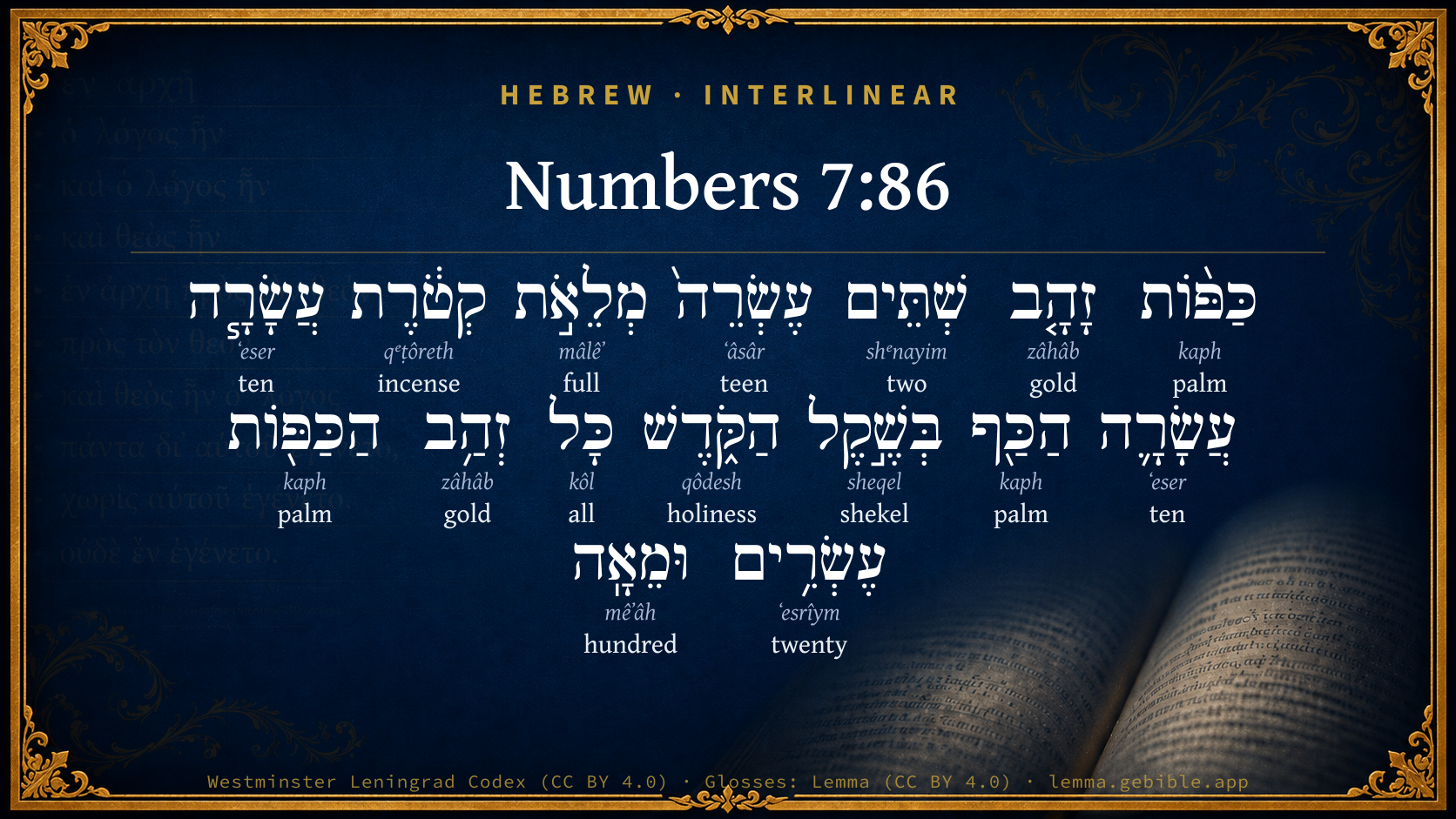
Numbers 7:86

Hebrew (Westminster Leningrad Codex) Numbers 7:86 appears in the Hebrew Old Testament. The text above is from the Westminster Leningrad Codex. Each word links to its Strong’s number, a concise gloss, and parsing drawn from the Open Scriptures Hebrew Bible morphology. Click any word for its full Brown-Driver-Briggs (BDB) entry.
Download image
Cite this verse

Numbers 7:86 (World English Bible). Public Domain. Lemma interlinear Bible study tool, https://lemma.gebible.app/v/numbers/7/86.

Show BibTeX & RIS
BibTeX
RIS
English Translation
the twelve golden ladles, full of incense, weighing ten shekels apiece, after the shekel of the sanctuary; all the gold of the ladles weighed one hundred twenty shekels;
World English Bible · Public Domain
Download a study sheet

One document with this verse’s original text, its word-by-word gloss line, the meaning frame, cross-references with their text, attributed commentary, and full source and license credits — printable, and it pastes into notes with its structure intact.

This verse Autodidact and up

Study sheet (.html) Plain text (.txt)

A passage Seminary Student

Up to 50 verses in one chapter. A passage sheet keeps up to 6 commentary sources and 12 cross-references per verse, in the order this page ranks them, and says so on the sheet whenever that leaves anything out. Ask for a single verse and you get the Autodidact verse sheet above.

Everything on this page stays free to read, with no account — the sheet is a download of what is already on screen, not access to it.

Want to remove ads? Support Godless Engineer
Compare translations 3

The same verse in 3 English versions, stacked beneath the original-language interlinear above. Click any original word for its lexicon entry.

Each is an independent rendering of the whole verse — the interlinear is not word-aligned to these translations.

Highlighted words mark where these versions differ — a whole-verse word diff, not a word-by-word alignment.

  • World English Bible Public Domain
    the twelve golden ladles, full of incense, weighing ten shekels apiece, after the shekel of the sanctuary; all the gold of the ladles weighed one hundred twenty shekels;
  • King James Version Public Domain
    The golden spoons were twelve, full of incense, weighing ten shekels apiece, after the shekel of the sanctuary: all the gold of the spoons was an hundred and twenty shekels.
  • unfoldingWord Literal Text CC BY-SA 4.0
    The palm-sized bowls of gold 12, full of incense. Ten, ten the palm-sized bowl in the shekel of the holy place. All the gold of the palm-sized bowls 120.

unfoldingWord Literal Text — © unfoldingWord, licensed CC BY-SA 4.0. Word-aligned USFM3 via Door43 (git.door43.org/unfoldingWord/en_ult).

Versions to compare (up to 4)

3 of 4 selected

Show all 18 translations

Every available English version of this verse, each an independent rendering of the whole verse.

  • World English Bible Public Domain
    the twelve golden ladles, full of incense, weighing ten shekels apiece, after the shekel of the sanctuary; all the gold of the ladles weighed one hundred twenty shekels;
  • Berean Standard Bible Public Domain
    The twelve gold dishes filled with incense weighed ten shekels each, according to the sanctuary shekel. The total weight of the gold dishes was a hundred and twenty shekels.
  • Majority Standard Bible Public Domain
    The twelve gold dishes filled with incense weighed ten shekels each, according to the sanctuary shekel. The total weight of the gold dishes was a hundred and twenty shekels.
  • King James Version Public Domain
    The golden spoons were twelve, full of incense, weighing ten shekels apiece, after the shekel of the sanctuary: all the gold of the spoons was an hundred and twenty shekels.
  • American Standard Version (1901) Public Domain
    the twelve golden spoons, full of incense, `weighing' ten `shekels' apiece, after the shekel of the sanctuary; all the gold of the spoons a hundred and twenty `shekels';
  • Revised Version (1885) Public Domain
    the twelve golden spoons, full of incense, weighing ten shekels apiece, after the shekel of the sanctuary: all the gold of the spoons an hundred and twenty shekels:
  • Geneva Bible (1599) Public Domain
    Twelue incense cups of gold ful of incense, conteining ten shekels euery cup, after the shekell of the Sanctuarie: all the gold of the incense cups was an hundreth and twentie shekels.
  • Douay-Rheims (1899) Public Domain
    And for sacrifices of peace offerings, two oxen, five rams, five buck goats, five lambs of a year old. This was the offering of Ahira the son of Enan.
  • Young's Literal Translation Public Domain
    Golden spoons `are' twelve, full of perfume; ten `shekels' each spoon, by the shekel of the sanctuary; all the gold of the spoons `is' a hundred and twenty `shekels';
  • Literal Standard Version CC BY-SA 4.0
    twelve golden spoons full of incense, ten [shekels] each spoon, by the shekel of the holy place; all the gold of the spoons [is] one hundred and twenty [shekels];
  • Unlocked Literal Bible CC BY-SA 4.0
    Each of the twelve gold dishes, full of incense, weighed ten shekels by the standard weight of the sanctuary shekel. All the gold dishes weighed 120 shekels.
  • unfoldingWord Literal Text CC BY-SA 4.0
    The palm-sized bowls of gold 12, full of incense. Ten, ten the palm-sized bowl in the shekel of the holy place. All the gold of the palm-sized bowls 120.
  • Darby Bible Public Domain
    twelve golden cups full of incense, each cup of ten [shekels], according to the shekel of the sanctuary: all the gold of the cups, a hundred and twenty [shekels].
  • World Messianic Bible Public Domain
    the twelve golden ladles, full of incense, weighing ten shekels apiece, according to the shekel of the sanctuary; all the gold of the ladles weighed one hundred twenty shekels;
  • Webster's Bible Public Domain
    The golden spoons were twelve, full of incense, weighing ten shekels apiece, after the shekel of the sanctuary: all the gold of the spoons was a hundred and twenty shekels.
  • Free Bible Version CC BY-SA 4.0
    The twelve gold dishes filled with incense each weighed ten shekels (using the sanctuary shekel standard). The total weight of the gold was a hundred and twenty shekels.
  • Bible in Basic English Public Domain
    The weight of the twelve gold spoons of spice for burning was ten shekels for every one, by the scale of the holy place; all the gold of the spoons was a hundred and twenty shekels;
  • JPS Tanakh (1917) Public Domain
    twelve golden pans, full of incense, weighing ten shekels apiece, after the shekel of the sanctuary; all the gold of the pans a hundred and twenty shekels;

Literal Standard Version (2020), Covenant Press — licensed CC BY-SA 4.0. Text via the HelloAO Bible API (eBible.org). Unlocked Literal Bible (unfoldingWord) — licensed CC BY-SA 4.0. Text via the HelloAO Bible API (eBible.org). unfoldingWord Literal Text — © unfoldingWord, licensed CC BY-SA 4.0. Word-aligned USFM3 via Door43 (git.door43.org/unfoldingWord/en_ult). Free Bible Version, Dr. Jonathan Gallagher — licensed CC BY-SA 4.0. Text via the HelloAO Bible API (eBible.org).

Word by word

More ways to search: Search by grammar → Find every occurrence → Compare this word →

Practice this passage: Drill this verse → Learn its vocabulary →

מְלֵאֹ֣ת
mâlêʼ
H4392
“full”
Adjective, Adjective, Feminine, Plural, Absolute
Part of Speech
Adjective
Type
Adjective
Gender
Feminine
Number
Plural
State
Absolute
Full BDB Definition

Origin: from H4390

TWOT: 1195a

full, fulness, that which fills - fully (adverb)
  1. כַּפּ֨וֹת kaph H3709 “palms of” Noun, Common, Feminine, Plural, Construct
  2. זָהָ֤ב zâhâb H2091 “gold” Noun, Common, Masculine, Singular, Absolute
  3. שְׁתֵּים shᵉnayim H8147 “two” Adjective, Cardinal number, Feminine, Dual, Absolute
  4. עֶשְׂרֵה֙ ʻâsâr H6240 “teen” Adjective, Cardinal number, Feminine, Singular, Absolute
  5. קְטֹ֔רֶת qᵉṭôreth H7004 “incense” Noun, Common, Feminine, Singular, Absolute
  6. עֲשָׂרָ֧ה ʻeser H6235 “ten” Adjective, Cardinal number, Masculine, Singular, Absolute
  7. עֲשָׂרָ֛ה ʻeser H6235 “ten” Adjective, Cardinal number, Masculine, Singular, Absolute
  8. הַכַּ֖ף kaph H3709 “the · palm” Particle, Definite Article + Noun, Common, Feminine, Singular, Absolute
  9. בְּשֶׁ֣קֶל sheqel H8255 “in/at · shekel of” Preposition + Noun, Common, Masculine, Singular, Construct
  10. הַקֹּ֑דֶשׁ qôdesh H6944 “the · holiness” Particle, Definite Article + Noun, Common, Masculine, Singular, Absolute
  11. כָּל kôl H3605 “all of” Noun, Common, Masculine, Singular, Construct
  12. זְהַ֥ב zâhâb H2091 “gold of” Noun, Common, Masculine, Singular, Construct
  13. הַכַּפּ֖וֹת kaph H3709 “the · palms” Particle, Definite Article + Noun, Common, Feminine, Plural, Absolute
  14. עֶשְׂרִ֥ים ʻesrîym H6242 “twenty” Adjective, Cardinal number, Both, Plural, Absolute
  15. וּמֵאָֽה mêʼâh H3967 “and · hundred” Conjunction + Adjective, Cardinal number, Both, Singular, Absolute

About this verse

These counts appear in no published source. They are computed here, from the morphology-tagged text and Lemma’s own curated glosses. What Lemma adds →

16
words
12
distinct lemmas
Pentateuch
section

Shared distinctive vocabulary

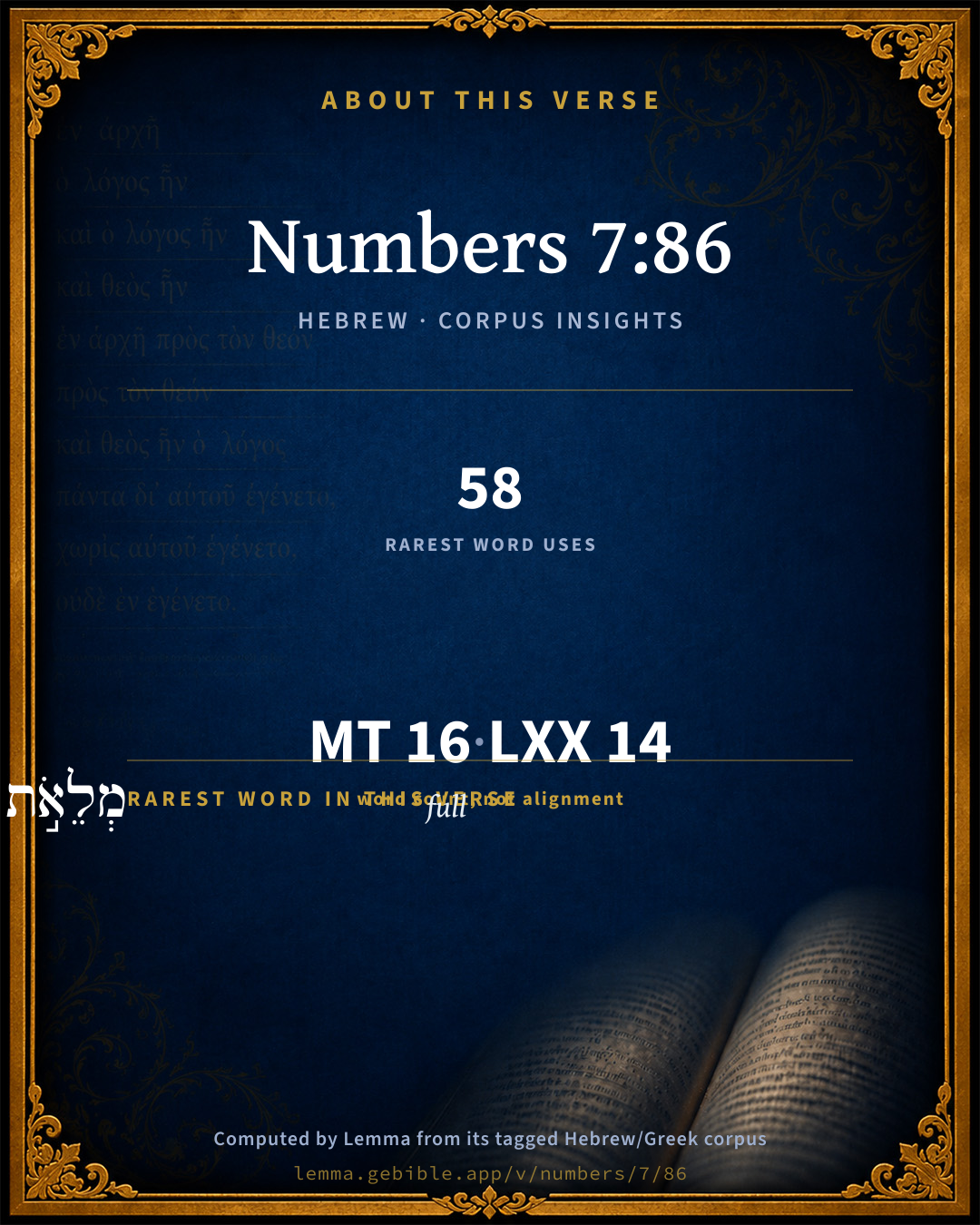
מְלֵאֹ֣ת full H4392 occurs in 57 verses of the Hebrew Bible. Also found in:

Grammatical profile

  • 9 nouns
  • 7 adjectives

Repetition

Words recur within this verse — often emphatic in Hebrew:

  • כַּפּ֨וֹת palm H3709 ×3
  • זָהָ֤ב gold H2091 ×2
  • עֲשָׂרָ֧ה ten H6235 ×2

Hebrew & Septuagint length

In English translation the verse runs 28 words from the Hebrew and 17 from the Septuagint (LXX English) — the Septuagint runs noticeably shorter here. See the side-by-side →

A rough comparison of the two English renderings, which tokenize alike — not a word-level alignment.

Word counts can differ between the Hebrew and the Greek without any difference in meaning — e.g. the Hebrew direct-object marker אֵת has no separate Greek word, and Greek often adds the article ὁ.

In the original languages it is 16 Hebrew tokens and 14 Greek tokens — but the two are counted differently (Hebrew bundles its prefixes and suffixes into one token; the Greek is in lemma form), so that isn’t a like-for-like length.

Hebrew and Greek witnesses Masoretic Hebrew ↔ Greek Septuagint

The same verse in the two great witnesses to the Old Testament, shown verse-for-verse.

Here the Septuagint runs noticeably shorter than the Hebrew — LXX2012 (modern English Septuagint) 17 words vs World English Bible 28. A rough length comparison of the two English translations, not a word-level alignment — read both below.

These are two independent witnesses, not word-aligned to each other, and the Septuagint is shown in lemma (dictionary) form.

Hebrew Numbers 7:86 Masoretic · Westminster Leningrad Codex

כַּפּ֨וֹת זָהָ֤ב שְׁתֵּים עֶשְׂרֵה֙ מְלֵאֹ֣ת קְטֹ֔רֶת עֲשָׂרָ֧ה עֲשָׂרָ֛ה הַכַּ֖ף בְּשֶׁ֣קֶל הַקֹּ֑דֶשׁ כָּל זְהַ֥ב הַכַּפּ֖וֹת עֶשְׂרִ֥ים וּמֵאָֽה

the twelve golden ladles, full of incense, weighing ten shekels apiece, after the shekel of the sanctuary; all the gold of the ladles weighed one hundred twenty shekels;

World English Bible · Public Domain

Greek LXX Numbers 7:86 Septuagint · lemma form

θυΐσκη χρυσοῦς δώδεκα πλήρης θυμίαμα πᾶς ὁ χρυσίον ὁ θυΐσκη εἴκοσι καί ἑκατόν χρυσοῦς

Twelve golden censers full of incense: all the gold of the shekels, one hundred and twenty shekels.

LXX2012 (modern English Septuagint) · Public Domain

Hebrew: Westminster Leningrad Codex (CC BY 4.0). Greek: Septuagint (public domain); English from LXX2012 (modern English Septuagint) (Public Domain). How the Septuagint differs from the Hebrew →

Targum (Aramaic paraphrase)

2

The Targum is the ancient Jewish Aramaic paraphrase of the Hebrew Scriptures — an interpretive translation, not the Hebrew text itself. Onkelos (literal) and Pseudo-Jonathan (expansive) render the Torah, and Jonathan the Prophets. Coverage is partial: where no permissively-licensed English translation exists for a verse, only the Aramaic is shown. This is verse-level text, not a word-by-word alignment to the Hebrew.

  1. Targum Onkelos Torah (Genesis–Deuteronomy)
    בָּזִיכֵי דְדַהֲבָא תַּרְתֵּי עַשְׂרֵי מַלְיָן קְטֹרֶת בּוּסְמַיָא מַתְקַל עֲשַׂר סִלְעִין הֲוָה מַתְקְלָא דְבָזִיכָא בְּסִלְעֵי קוּדְשָׁא כָּל דְהַב בָּזִיכַיָא מְאָה וְעַשְׂרִין

    (no public-domain English translation for this verse)

    Targum Onkelos — Aramaic: “Onkelos Genesis” (public domain); “Onkelos Exodus” (public domain); “Onkelos Leviticus” (public domain); “Onkelos Numbers” (public domain); “Onkelos Deuteronomy” (public domain). English: “Sefaria Community Translation” (CC0 1.0 (public-domain dedication)); “J.W. Etheridge. The Targums of Onkelos and Jonathan Ben Uzziel on the Pentateuch. London: Longmans, Green, 1862” (public domain). Text via Sefaria.

  2. Targum Pseudo-Jonathan Torah (Genesis–Deuteronomy)
    בָּזִיכֵי דְדַהֲבָא תְּרֵי סְרֵי כָּל קֳבֵיל רַבְרְבֵי יִשְרָאֵל מַלְיָן קְטוֹרֶת בּוּסְמִין טָבִין מַתְקַל עֲשַר סִלְעִין הֲוָה מַתְקְלָא דְבָזִיכָא בְּסִלְעֵי בֵּית קוּדְשָׁא כָּל קֳבֵיל עֲשֵירְתָּא דִבְרַיָא כָּל דְהַב בָּזִיכַיָא מְאָה וְעֶשְרִין כָּל קֳבֵיל שְׁנַיָא דְחַיָא בְּהוֹן משֶׁה נְבִיאָה

    The golden pans were twelve, answering to the princes of Israel, full of good sweet incense; the weight of ten shekels was the weight of each pan, answering to the Ten Words; all the gold of the pans, one hundred and and twenty (shekels), answering to the years lived by Mosheh the prophet.

    Targum Pseudo-Jonathan — Aramaic: “Targum Jonathan on Genesis” (public domain); “Targum Jonathan on Exodus” (public domain); “Targum Jonathan on Leviticus” (public domain); “Targum Jonathan on Numbers” (public domain); “Targum Jonathan on Deuteronomy” (public domain). English: “The Targum of Jonathan ben Uzziel, trans. J. W. Etheridge, London, 1862” (public domain). Text via Sefaria.

Commentary

Notes on Numbers 7:86 from classic Christian and Jewish commentators (each source and its license shown beneath its notes). The classic Christian expositions comment on the surrounding passage and are grouped to its opening verse, so a note may address several verses; the Jewish commentaries on the Tanakh (Rashi and others) are per-verse, so they appear only where the commentator wrote on this verse.

Lemma curates 59 commentaries, every one of them public domain or Creative Commons licensed, each selected and text-cleaned for this edition rather than reprinted as found. About our sources →

The Pulpit Commentary

A hundred and twenty shekels. About L138. These values were not very great, nor was the number of the animals very large, as compared with the lavish, and perhaps extravagant, profusion displayed at the dedication of the temple and altar by Solomon; but we may believe they were at least as acceptable. The verb substantive should be removed from verses 86-88, which simply continue the totals of the offerings which formed the dedication.

The Pulpit Commentary (1880–1919), ed. H.D.M. Spence-Jones & Joseph S. Exell — public domain. Text from a community e-Sword module.

Rashi

Rabbi Shlomo Yitzchaki (Rashi)

כפות זהב שתים עשרה THE GOLDEN SPOONS WERE TWELVE — Why is this stated at all, since we have been told that twelve princes brought each one spoon? But because it is stated in each instance: “one spoon עשרה זהב”, I might explain it either as meaning: it was of gold but its weight was ten shekels of silver, or, perhaps, not so, but it means: one spoon of silver and the weight thereof ten gold-shekels — and the gold-shekels have not their weight equal to those of silver-shekels — Scripture therefore states here, “golden spoons” — the spoons themselves were of gold ( Sifrei Bamidbar 55).

Rashi on the Tanakh — English translations: “The Judaica Press complete Tanach with Rashi, translated by A. J. Rosenberg” (CC BY 4.0); “Pentateuch with Rashi's commentary by M. Rosenbaum and A.M. Silbermann, 1929-1934” (public domain); “The Metsudah Tanach series, Lakewood, N.J” (CC BY 4.0); and “The Book of Joshua, Metsudah Publications, 1997” (CC BY 4.0). Text via Sefaria.

Lesson kit

Teaching starters — assembled from the data on this page, not authored interpretation. Every prompt links to the verse data it draws on. Edit before teaching.

Numbers, in the Pentateuch, opens this verse with 16 words (12 distinct Hebrew lemmas). Its most distinctive word is mâlêʼ (“full”). The Greek Septuagint runs shorter here. A historical commentator’s framing appears above. Read the whole chapter for the surrounding context.

Discussion questions

  1. How does “full” (mâlêʼ) shape what this verse is saying?
  2. How does Genesis 23:9, which shares the word «full», read alongside this verse?
  3. What does the repetition of “palm” (3× in this one verse) do in this verse?
  4. The Septuagint runs shorter here than the Hebrew. What might account for the difference?
  5. These translations render this verse differently; the difference is in the English rendering, not the original. What questions does that raise?
  6. Compare how The Pulpit Commentary and Rashi read this verse. Where do they agree or differ?

Things to notice

Reading settings

Reading text

Shown beneath each verse's original-language words.

Old Testament
Old Testament edition

Read the OT as the Masoretic Hebrew (MT) or the Greek Septuagint (LXX).

English shown for the Greek Septuagint (in the Hebrew ↔ Greek comparison).

Comparing translations? Open the Compare panel on any verse page to stack up to four side by side.