
Deuteronomy 26:13

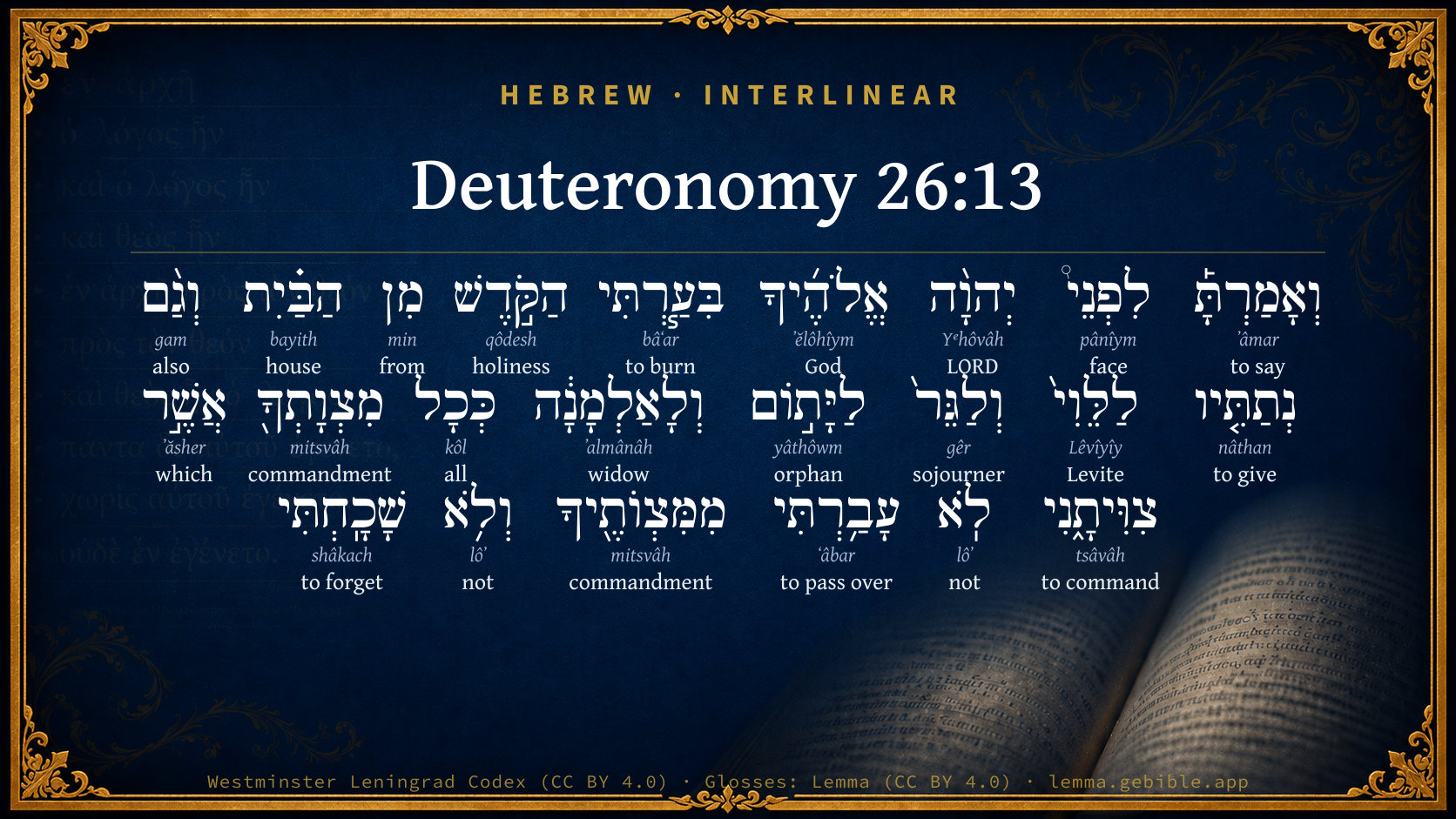
Hebrew (Westminster Leningrad Codex) Deuteronomy 26:13 appears in the Hebrew Old Testament. The text above is from the Westminster Leningrad Codex. Each word links to its Strong’s number, a concise gloss, and parsing drawn from the Open Scriptures Hebrew Bible morphology. Click any word for its full Brown-Driver-Briggs (BDB) entry.
Download image
Cite this verse

Deuteronomy 26:13 (World English Bible). Public Domain. Lemma interlinear Bible study tool, https://lemma.gebible.app/v/deuteronomy/26/13.

Show BibTeX & RIS
BibTeX
RIS
English Translation
You shall say before Yahweh your God, I have put away the holy things out of my house, and also have given them to the Levite, and to the foreigner, to the fatherless, and to the widow, according to all your commandment which you have commanded me: I have not transgressed any of your commandments, neither have I forgotten them:
World English Bible · Public Domain
Download a study sheet

One document with this verse’s original text, its word-by-word gloss line, the meaning frame, cross-references with their text, attributed commentary, and full source and license credits — printable, and it pastes into notes with its structure intact.

This verse Autodidact and up

Study sheet (.html) Plain text (.txt)

A passage Seminary Student

Up to 50 verses in one chapter. A passage sheet keeps up to 6 commentary sources and 12 cross-references per verse, in the order this page ranks them, and says so on the sheet whenever that leaves anything out. Ask for a single verse and you get the Autodidact verse sheet above.

Everything on this page stays free to read, with no account — the sheet is a download of what is already on screen, not access to it.

Want to remove ads? Support Godless Engineer
Compare translations 3

The same verse in 3 English versions, stacked beneath the original-language interlinear above. Click any original word for its lexicon entry.

Each is an independent rendering of the whole verse — the interlinear is not word-aligned to these translations.

Highlighted words mark where these versions differ — a whole-verse word diff, not a word-by-word alignment.

  • World English Bible Public Domain
    You shall say before Yahweh your God, I have put away the holy things out of my house, and also have given them to the Levite, and to the foreigner, to the fatherless, and to the widow, according to all your commandment which you have commanded me: I have not transgressed any of your commandments, neither have I forgotten them:
  • King James Version Public Domain
    Then thou shalt say before the LORD thy God, I have brought away the hallowed things out of mine house, and also have given them unto the Levite, and unto the stranger, to the fatherless, and to the widow, according to all thy commandments which thou hast commanded me: I have not transgressed thy commandments, neither have I forgotten them.
  • unfoldingWord Literal Text CC BY-SA 4.0
    And you shall say to the face of Yahweh your God, ‘I have removed from my house the things set apart, and also have given it to the Levite, and to the foreigner, to the fatherless, and to the widow, according to all your commandments that you have commanded me. I have not transgressed any of your commandments, neither have I forgotten.

unfoldingWord Literal Text — © unfoldingWord, licensed CC BY-SA 4.0. Word-aligned USFM3 via Door43 (git.door43.org/unfoldingWord/en_ult).

Versions to compare (up to 4)

3 of 4 selected

Show all 18 translations

Every available English version of this verse, each an independent rendering of the whole verse.

  • World English Bible Public Domain
    You shall say before Yahweh your God, I have put away the holy things out of my house, and also have given them to the Levite, and to the foreigner, to the fatherless, and to the widow, according to all your commandment which you have commanded me: I have not transgressed any of your commandments, neither have I forgotten them:
  • Berean Standard Bible Public Domain
    Then you shall declare in the presence of the LORD your God, “I have removed from my house the sacred portion and have given it to the Levite, the foreigner, the fatherless, and the widow, according to all the commandments You have given me. I have not transgressed or forgotten Your commandments.
  • Majority Standard Bible Public Domain
    Then you shall declare in the presence of the LORD your God, “I have removed from my house the sacred portion and have given it to the Levite, the foreigner, the fatherless, and the widow, according to all the commandments You have given me. I have not transgressed or forgotten Your commandments.
  • King James Version Public Domain
    Then thou shalt say before the LORD thy God, I have brought away the hallowed things out of mine house, and also have given them unto the Levite, and unto the stranger, to the fatherless, and to the widow, according to all thy commandments which thou hast commanded me: I have not transgressed thy commandments, neither have I forgotten them.
  • American Standard Version (1901) Public Domain
    And thou shalt say before Jehovah thy God, I have put away the hallowed things out of my house, and also have given them unto the Levite, and unto the sojourner, to the fatherless, and to the widow, according to all thy commandment which thou hast commanded me: I have not transgressed any of thy commandments, neither have I forgotten them:
  • Revised Version (1885) Public Domain
    and thou shalt say before the LORD thy God, I have put away the hallowed things out of mine house, and also have given them unto the Levite, and unto the stranger, to the fatherless, and to the widow, according to all thy commandment which thou hast commanded me: I have not transgressed any of thy commandments, neither have I forgotten them:
  • Geneva Bible (1599) Public Domain
    Then thou shalt say before the Lord thy God, I haue brought the halowed thing out of mine house, and also haue giuen it vnto the Leuites and to the strangers, to the fatherlesse, and to the widow, according to all thy comandements which thou hast commanded me: I haue transgressed none of thy comandements, nor forgotten them.
  • Douay-Rheims (1899) Public Domain
    When thou hast made an end of tithing all thy fruits, in the third year of tithes thou shalt give it to the Levite, and to the stranger, and to the fatherless, and to the widow, that they may eat within thy gates, and be filled:
  • Young's Literal Translation Public Domain
    and thou hast said before Jehovah thy God, I have put away the separated thing out of the house, and also have given it to the Levite, and to the sojourner, and to the orphan, and to the widow, according to all Thy command which Thou hast commanded me; I have not passed over from Thy commands, nor have I forgotten.
  • Literal Standard Version CC BY-SA 4.0
    and you have said before your God YHWH, I have put away the separated thing out of the house, and have also given it to the Levite, and to the sojourner, and to the orphan, and to the widow, according to all Your command which You have commanded me; I have not passed over from Your commands, nor have I forgotten.
  • Unlocked Literal Bible CC BY-SA 4.0
    You must say before Yahweh your God, 'I have brought out of my house the things that belong to Yahweh, and have given them to the Levite, to the foreigner, to the fatherless, and to the widow, according to all your commandments that you have given me. I have not transgressed any of your commandments, neither have I forgotten them.
  • unfoldingWord Literal Text CC BY-SA 4.0
    And you shall say to the face of Yahweh your God, ‘I have removed from my house the things set apart, and also have given it to the Levite, and to the foreigner, to the fatherless, and to the widow, according to all your commandments that you have commanded me. I have not transgressed any of your commandments, neither have I forgotten.
  • Darby Bible Public Domain
    and thou shalt say before Jehovah thy God, I have brought away the hallowed things out of the house, and also have given them to the Levite, and to the stranger, to the fatherless, and to the widow, according to all thy commandment which thou hast commanded me; I have not transgressed nor forgotten [any] of thy commandments:
  • World Messianic Bible Public Domain
    You shall say before the LORD your God, “I have put away the holy things out of my house, and also have given them to the Levite, to the foreigner, to the fatherless, and to the widow, according to all your commandment which you have commanded me. I have not transgressed any of your commandments, neither have I forgotten them.
  • Webster's Bible Public Domain
    Then thou shalt say before the LORD thy God, I have brought away the hallowed things out of my house, and also have given them to the Levite, and to the stranger, to the fatherless, and to the widow, according to all thy commandments which thou hast commanded me: I have not transgressed thy commandments, neither have I forgotten them:
  • Free Bible Version CC BY-SA 4.0
    Then you are to make this declaration in the presence of the Lord your God: “I have brought the holy tithe and I have given it to the Levite, the foreigners, the orphans, and the widows as you have ordered me to do. I have not broken or forgotten your commandments.
  • Bible in Basic English Public Domain
    And say before the Lord your God, I have taken all the holy things out of my house and have given them to the Levite, and the man from a strange land, and him who has no father, and the widow, as you have given me orders: I have kept in mind all your orders, in nothing have I gone against them:
  • JPS Tanakh (1917) Public Domain
    then thou shalt say before the LORD thy God: 'I have put away the hallowed things out of my house, and also have given them unto the Levite, and unto the stranger, to the fatherless, and to the widow, according to all Thy commandment which Thou hast commanded me; I have not transgressed any of Thy commandments, neither have I forgotten them.

Literal Standard Version (2020), Covenant Press — licensed CC BY-SA 4.0. Text via the HelloAO Bible API (eBible.org). Unlocked Literal Bible (unfoldingWord) — licensed CC BY-SA 4.0. Text via the HelloAO Bible API (eBible.org). unfoldingWord Literal Text — © unfoldingWord, licensed CC BY-SA 4.0. Word-aligned USFM3 via Door43 (git.door43.org/unfoldingWord/en_ult). Free Bible Version, Dr. Jonathan Gallagher — licensed CC BY-SA 4.0. Text via the HelloAO Bible API (eBible.org).

Word by word

More ways to search: Search by grammar → Find every occurrence → Compare this word →

Practice this passage: Drill this verse → Learn its vocabulary →

לַיָּת֣וֹם
yâthôwm
H3490
“to/for the · orphan”
Preposition, Determined + Noun, Common, Masculine, Singular, Absolute
Part of Speech
Preposition + Noun
Type
Common
Gender
Masculine
Number
Singular
State
Absolute
Full BDB Definition

Origin: from an unused root meaning to be lonely

TWOT: 934a

an orphan, fatherless
  1. וְאָמַרְתָּ֡ ʼâmar H559 “and · to say” Conjunction + Verb, Qal, Sequential Perfect, 2nd Person, Masculine, Singular
  2. לִפְנֵי֩ pânîym H6440 “to/for · face(s) of” Preposition + Noun, Common, Both, Plural, Construct
  3. יְהוָ֨ה Yᵉhôvâh H3068 “LORD” Noun, Proper
  4. אֱלֹהֶ֜יךָ ʼĕlôhîym H430 “God(s) · your” Noun, Common, Masculine, Plural, Construct + Suffix, Personal, 2nd Person, Masculine, Singular
  5. בִּעַ֧רְתִּי bâʻar H1197 “to burn” Verb, Piel, Perfect, 1st Person, Common, Singular
  6. הַקֹּ֣דֶשׁ qôdesh H6944 “the · holiness” Particle, Definite Article + Noun, Common, Masculine, Singular, Absolute
  7. מִן min H4480 “from” Preposition
  8. הַבַּ֗יִת bayith H1004 “the · house” Particle, Definite Article + Noun, Common, Masculine, Singular, Absolute
  9. וְגַ֨ם gam H1571 “and · also” Conjunction + Particle, Accusative
  10. נְתַתִּ֤יו nâthan H5414 “to give · him” Verb, Qal, Perfect, 1st Person, Common, Singular + Suffix, Personal, 3rd Person, Masculine, Singular
  11. לַלֵּוִי֙ Lêvîyîy H3881 “to/for the · Levite” Preposition, Determined + Noun, Gentilic, Masculine, Singular, Absolute
  12. וְלַגֵּר֙ gêr H1616 “and · to/for the · sojourner” Conjunction + Preposition, Determined + Noun, Common, Masculine, Singular, Absolute
  13. וְלָאַלְמָנָ֔ה ʼalmânâh H490 “and · to/for the · widow” Conjunction + Preposition, Determined + Noun, Common, Feminine, Singular, Absolute
  14. כְּכָל kôl H3605 “like/as · all of” Preposition + Noun, Common, Masculine, Singular, Construct
  15. מִצְוָתְךָ֖ mitsvâh H4687 “commandment · your” Noun, Common, Feminine, Singular, Construct + Suffix, Personal, 2nd Person, Masculine, Singular
  16. אֲשֶׁ֣ר ʼăsher H834 “which” Particle, Relative
  17. צִוִּיתָ֑נִי tsâvâh H6680 “to command · me” Verb, Piel, Perfect, 2nd Person, Masculine, Singular + Suffix, Personal, 1st Person, Common, Singular
  18. לֹֽא lôʼ H3808 “not” Particle, Negative
  19. עָבַ֥רְתִּי ʻâbar H5674 “to pass over” Verb, Qal, Perfect, 1st Person, Common, Singular
  20. מִמִּצְוֺתֶ֖יךָ mitsvâh H4687 “from · commandments · your” Preposition + Noun, Common, Feminine, Plural, Construct + Suffix, Personal, 2nd Person, Masculine, Singular
  21. וְלֹ֥א lôʼ H3808 “and · not” Conjunction + Particle, Negative
  22. שָׁכָֽחְתִּי shâkach H7911 “to forget” Verb, Qal, Perfect, 1st Person, Common, Singular

About this verse

These counts appear in no published source. They are computed here, from the morphology-tagged text and Lemma’s own curated glosses. What Lemma adds →

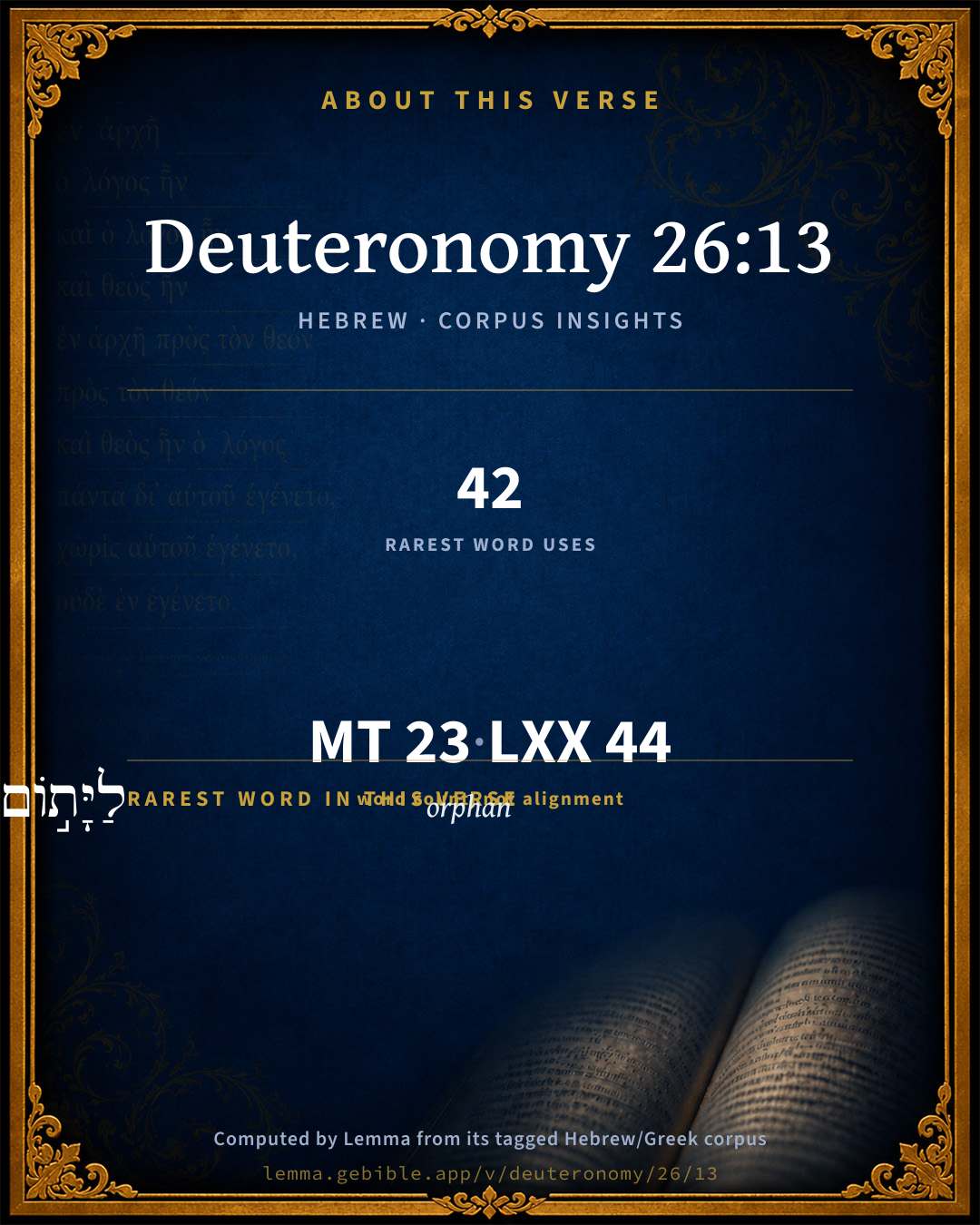
23
words
21
distinct lemmas
Pentateuch
section

Shared distinctive vocabulary

לַיָּת֣וֹם orphan H3490 occurs in 42 verses of the Hebrew Bible. Also found in:

Grammatical profile

  • 6 verbs
  • 12 nouns
  • 1 preposition
  • 4 particles

Verb forms

  • וְאָמַרְתָּ֡ Qal · Sequential Perfect
  • בִּעַ֧רְתִּי Piel · Perfect
  • נְתַתִּ֤יו Qal · Perfect
  • צִוִּיתָ֑נִי Piel · Perfect
  • עָבַ֥רְתִּי Qal · Perfect
  • שָׁכָֽחְתִּי Qal · Perfect

Repetition

Words recur within this verse — often emphatic in Hebrew:

  • מִצְוָתְךָ֖ commandment H4687 ×2
  • לֹֽא not H3808 ×2

Hebrew & Septuagint length

In English translation the verse runs 60 words from the Hebrew and 58 from the Septuagint (LXX English) — closely comparable.

A rough comparison of the two English renderings, which tokenize alike — not a word-level alignment.

Word counts can differ between the Hebrew and the Greek without any difference in meaning — e.g. the Hebrew direct-object marker אֵת has no separate Greek word, and Greek often adds the article ὁ.

In the original languages it is 23 Hebrew tokens and 44 Greek tokens — but the two are counted differently (Hebrew bundles its prefixes and suffixes into one token; the Greek is in lemma form), so that isn’t a like-for-like length.

Cross-references

18

Topical passages linked to Deuteronomy 26:13 in the Treasury of Scripture Knowledge — connected by theme and wording, ordered by reader-vote popularity; previews shown in the World English Bible.

  • Psalms 119:141 I am small and despised. I don't forget your precepts.
  • Psalms 119:153 Consider my affliction, and deliver me, For I don't forget your law.
  • Psalms 119:176 I have gone astray like a lost sheep. Seek your servant, for I don't forget your commandments.
  • Deuteronomy 14:29 and the Levite, because he has no portion nor inheritance with you, and the foreigner living among you, and the fatherless, and the widow, who are within your gates, shall come, and shall eat and be satisfied; that Yahweh your God may bless you in all the work of your hand which you do.
  • Deuteronomy 24:19–21 When you reap your harvest in your field, and have forgot a sheaf in the field, you shall not go again to get it: it shall be for the foreigner, for the fatherless, and for the widow; that Yahweh your God may bless you in all the work of your hands.
  • Deuteronomy 26:12 When you have made an end of tithing all the tithe of your increase in the third year, which is the year of tithing, then you shall give it to the Levite, to the foreigner, to the fatherless, and to the widow, that they may eat within your gates, and be filled.
  • Job 31:16–20 "If I have withheld the poor from their desire, Or have caused the eyes of the widow to fail,
  • Psalms 18:21–24 For I have kept the ways of Yahweh, And have not wickedly departed from my God.
  • Psalms 26:1–3 Judge me, Yahweh, for I have walked in my integrity. I have trusted also in Yahweh without wavering.
  • Psalms 26:6 I will wash my hands in innocence, So I will go about your altar, Yahweh;
  • Psalms 119:93 I will never forget your precepts, For with them, you have revived me.
  • Psalms 119:139 My zeal wears me out, Because my enemies ignore your words.
  • Proverbs 3:1 My son, don't forget my teaching; But let your heart keep my commandments:
  • Acts 24:16 Herein I also practice always having a conscience void of offense toward God and men.
  • 2 Corinthians 1:12 For our boasting is this: the testimony of our conscience, that in holiness and sincerity of God, not in fleshly wisdom but in the grace of God we behaved ourselves in the world, and more abundantly toward you.
  • 2 Corinthians 11:31 The God and Father of the Lord Jesus Christ, he who is blessed forevermore, knows that I don't lie.
  • 1 John 3:17–22 But whoever has the world's goods, and sees his brother in need, and closes his heart of compassion against him, how does the love of God remain in him?
  • 1 Thessalonians 2:10 You are witnesses with God, how holy, righteously, and blamelessly we behaved ourselves toward you who believe.

Cross-references courtesy of OpenBible.info (CC BY 4.0).

Hebrew and Greek witnesses Masoretic Hebrew ↔ Greek Septuagint

The same verse in the two great witnesses to the Old Testament, shown verse-for-verse.

These are two independent witnesses, not word-aligned to each other, and the Septuagint is shown in lemma (dictionary) form.

Hebrew Deuteronomy 26:13 Masoretic · Westminster Leningrad Codex

וְאָמַרְתָּ֡ לִפְנֵי֩ יְהוָ֨ה אֱלֹהֶ֜יךָ בִּעַ֧רְתִּי הַקֹּ֣דֶשׁ מִן הַבַּ֗יִת וְגַ֨ם נְתַתִּ֤יו לַלֵּוִי֙ וְלַגֵּר֙ לַיָּת֣וֹם וְלָאַלְמָנָ֔ה כְּכָל מִצְוָתְךָ֖ אֲשֶׁ֣ר צִוִּיתָ֑נִי לֹֽא עָבַ֥רְתִּי מִמִּצְוֺתֶ֖יךָ וְלֹ֥א שָׁכָֽחְתִּי

You shall say before Yahweh your God, I have put away the holy things out of my house, and also have given them to the Levite, and to the foreigner, to the fatherless, and to the widow, according to all your commandment which you have commanded me: I have not transgressed any of your commandments, neither have I forgotten them:

World English Bible · Public Domain

Greek LXX Deuteronomy 26:13 Septuagint · lemma form

καί εἶπον ἐναντίον κύριος ὁ θεός σύ ἐκ κατααἴρω ὁ ἅγιος ἐκ ὁ οἰκία ἐγώ καί δίδωμι αὐτός ὁ λευίτης καί ὁ προσήλυτος καί ὁ ὀρφανός καί ὁ χήρα κατά πᾶς ὁ ἐντολή ὅς ἐντέλλομαι ἐγώ οὐ παραἔρχομαι ὁ ἐντολή σύ καί οὐ ἐπιλανθάνω

And you shall say before the Lord your God, I have fully collected the holy things out of my house, and I have given them to the Levite, and the stranger, and the orphan, and the widow, according to all commands which you did command me: I did not transgress your command, and I did not forget it.

LXX2012 (modern English Septuagint) · Public Domain

On this verse, The Cambridge Bible for Schools and Colleges discusses the Septuagint’s reading. Read the note in Commentary ↓

Hebrew: Westminster Leningrad Codex (CC BY 4.0). Greek: Septuagint (public domain); English from LXX2012 (modern English Septuagint) (Public Domain). How the Septuagint differs from the Hebrew →

Targum (Aramaic paraphrase)

2

The Targum is the ancient Jewish Aramaic paraphrase of the Hebrew Scriptures — an interpretive translation, not the Hebrew text itself. Onkelos (literal) and Pseudo-Jonathan (expansive) render the Torah, and Jonathan the Prophets. Coverage is partial: where no permissively-licensed English translation exists for a verse, only the Aramaic is shown. This is verse-level text, not a word-by-word alignment to the Hebrew.

  1. Targum Onkelos Torah (Genesis–Deuteronomy)
    וְתֵימַר קֳדָם יְיָ אֱלָהָךְ פַּלֵתִי קֹדֶשׁ מַעְשְׂרָא מִן בֵּיתָא וְאַף יְהָבִתֵּהּ לְלֵוָאֵי וּלְגִיוֹרָא לְיִתַּמָא וּלְאַרְמְלָא כְּכָל פִּקוּדָךְ דִי פַקִדְתַּנִי לָא עֲבָרִית מִפִּקוּדָיךְ וְלָא אִתִּנְשֵׁיתִי

    (no public-domain English translation for this verse)

    Targum Onkelos — Aramaic: “Onkelos Genesis” (public domain); “Onkelos Exodus” (public domain); “Onkelos Leviticus” (public domain); “Onkelos Numbers” (public domain); “Onkelos Deuteronomy” (public domain). English: “Sefaria Community Translation” (CC0 1.0 (public-domain dedication)); “J.W. Etheridge. The Targums of Onkelos and Jonathan Ben Uzziel on the Pentateuch. London: Longmans, Green, 1862” (public domain). Text via Sefaria.

  2. Targum Pseudo-Jonathan Torah (Genesis–Deuteronomy)
    וּמַעֲשַר תְּלִיתָאֵי תֵיסַק וְתֵיכוּל קֳדָם יְיָ אֱלָהָךְ וְתֵימַר הָא אַפְרַשְׁנָן קוּדְשַׁיָא מִן בֵּיתָא וּלְחוֹד יְהַבְנַן מַעֲשְרָא קַמָאָה לְלֵיוָאֵי מַעַשְרָא תִנְיָנָא לְגִיוֹרֵי לְיַתְמָא וּלְאַרְמְלָא הֵי כְּכָל תַּפְקֵידְתָּךְ דְפַקֵידְתָּנִי לָא עָבְרַת חֲדָא מִן פִּקוּדַיִךְ וְלָא אַנְשֵׁיִית

    But the third tenth you shall bring up, and eat before the Lord thy God, and thou shalt say: Behold, we have set apart the consecrations from the house, and have also given the first tenth to the Levites, the second tenth to the strangers, the fatherless, and the widow, according to the commandment which Thou hast commanded me. I have not transgressed one of Thy commandments, nor have I forgotten.

    Targum Pseudo-Jonathan — Aramaic: “Targum Jonathan on Genesis” (public domain); “Targum Jonathan on Exodus” (public domain); “Targum Jonathan on Leviticus” (public domain); “Targum Jonathan on Numbers” (public domain); “Targum Jonathan on Deuteronomy” (public domain). English: “The Targum of Jonathan ben Uzziel, trans. J. W. Etheridge, London, 1862” (public domain). Text via Sefaria.

Commentary

Notes on Deuteronomy 26:13 from classic Christian and Jewish commentators (each source and its license shown beneath its notes). The classic Christian expositions comment on the surrounding passage and are grouped to its opening verse, so a note may address several verses; the Jewish commentaries on the Tanakh (Rashi and others) are per-verse, so they appear only where the commentator wrote on this verse.

Lemma curates 59 commentaries, every one of them public domain or Creative Commons licensed, each selected and text-cleaned for this edition rather than reprinted as found. About our sources →

Trapp's Complete Commentary

John Trapp

Deu 26:13 Then thou shalt say before the LORD thy God, I have brought away the hallowed things out of [mine] house, and also have given them unto the Levite, and unto the stranger, to the fatherless, and to the widow, according to all thy commandments which thou hast commanded me: I have not transgressed thy commandments, neither have I forgotten [them]:

Ver. 13. I have not transgressed.] This is spoken, not by way of Pharisaical boasting or opinion of merit, but public testification of entire obedience.

John Trapp, A Commentary or Exposition upon All the Books of the Old and New Testament (1647–1656) — public domain. Text from a community e-Sword module.

Joseph Benson's Commentary

Deu 26:13. Before the Lord thy God — As this tithe of the third year was to be spent at home, these words must signify either that every man was to make this solemn profession at home in his private addresses to God, or that the next time he went up to the place of the sanctuary he was to make this declaration before the most holy place, where God was supposed to be peculiarly present. At whichever place he made it, it was to be done as before God; that is, solemnly, seriously, and in a religious manner, with due respect to God’s presence, in obedience to his command, and with an eye to his glory.

Joseph Benson's Commentary on the Old and New Testaments (1811–1818) — public domain. Text from a community e-Sword module.

Tyndale Open Study Notes

Tyndale Open Resources

26:13 I have taken (literally burned) the sacred gift: This phrase means that the donor had given his own property to the Levites and to others in need.

Tyndale Open Study Notes — © Tyndale Open Resources, licensed CC BY-SA 4.0. Text via the HelloAO Bible API.

Geneva Bible (1599)

Geneva Bible translators

Without hypocrisy.

Of malice and contempt.

Geneva Bible (1599) marginal notes — public domain. Text via Bolls.life.

Jamieson, Fausset & Brown

Robert Jamieson, A. R. Fausset & David Brown

thou shalt say before the Lord thy God, I have brought away the hallowed things out of mine house--This was a solemn declaration that nothing which should be devoted to the divine service had been secretly reserved for personal use.

Jamieson, Fausset & Brown — Commentary Critical and Explanatory on the Whole Bible (1871) — public domain (CC PDM 1.0). Text via the HelloAO Bible API.

The Cambridge Bible for Schools and Colleges

gen. ed. J. J. S. Perowne

13. then thou shalt say before the Lord thy God] That is (in accordance with Deu_26:5; Deu_26:10, Deu_12:7; Deu_12:12; Deu_12:18, Deu_14:23; Deu_14:25 f., Deu_15:20, Deu_16:11, Deu_19:17) at the sanctuary, and probably during the Feast of Booths (so all recent commentators).

I have put away] The same vb. as, in Deu_13:5 (6), q.v., Deu_17:7, etc., is used for putting away evil things. Equally with them the tithe is taboo, forbidden and dangerous for common use.

the hallowed things] Heb. the ḳodesh, lit. holiness or hallowedness (see above on Deu_7:6), but applied also to the concrete objects or persons set apart for the Deity or (as here) by His command, e.g. the Temple and its contents, the Holy City, sacrifices, etc.; in Deu_12:26 parallel to vows, here the tithes for the poor, an interesting extension of the idea of ceremonial sacredness; not without its ethical meaning for ourselves. ‘We are commanded to give alms of such things as we have; and then, and not otherwise, all things are clean to us’ (M. Henry).

out of mine house] where they had been stored, Deu_14:28.

all thy commandments] So Sam., LXX. The anxiety to keep these ritual laws, with a great ethical purpose behind them—viz. the relief of the poor—is very striking. The laws are now detailed:—

The Cambridge Bible for Schools and Colleges (gen. ed. J. J. S. Perowne; Cambridge University Press, 1878–1918) — public domain. Text from a community e-Sword module.

John Gill's Exposition

Then thou shalt say before the Lord thy God,.... Make the following declaration as in his presence; for this was not made in the tabernacle or temple at, Jerusalem, since the tithe was to be eaten with the poor in the gates of the owner, as in Deu 26:12,

I have brought away the hallowed things out of mine house: which Aben Ezra and Onkelos interpret of the tithe; but it seems, besides that, to take in everything devoted to all holy uses, be they what they will, which were at this time to be separated from a man's own common goods, and applied to the purposes for which they were designed and devoted, and particularly what was to be given to the poor:

and also have, given them unto the Levite, and unto the stranger, to the fatherless, and to the widow, according to all thy commandments which thou hast commanded me; giving to each according as the law directs; which the Targum of Jonathan and Jarchi interpret as before, giving the first tithe to the Levites, and the second tithe to the rest:

I have not transgressed thy commandments, neither have I forgotten them: neither broken them wilfully, nor omitted them through carelessness, negligence, and forgetfulness, but was mindful to observe them punctually and exactly.

John Gill's Exposition of the Whole Bible (1746–1763) — public domain (CC PDM 1.0). Text via the HelloAO Bible API.

Haydock's Catholic Bible Commentary

Taken. Hebrew, "burnt." (Calmet) --- I have brought all that was due, (Tirinus) so that no more can be found in my house than what the fire would have spared, if it had been thrown into it.

George Leo Haydock (1774–1849), Haydock's Catholic Family Bible and Commentary, 1859 edition — public domain. Excludes Psalms (Douay-Rheims chapter numbering differs from Protestant) and Deuterocanonical books (Catholic canon only).

Matthew Poole's English Annotations

Before the Lord, i.e. either before the tabernacle or temple; or rather, in thy private and domestic addresses to God; for this is to be said presently upon the distribution of these tithes, which was not done at Jerusalem, but

in their own private gates or dwellings; except we will suppose that after he had given away these tithes at home he should go up to Jerusalem merely to make this acknowledgment, which seems improbable. And this is to be spoken before the Lord, i.e. solemnly, seriously, and in a religious manner, with due respect to God’s presence and will and glory, which is a sufficient ground for that phrase. I have brought away, or, separated, or, removed, to wit, from my own proper and private fruits. The hallowed things, i.e. the tithes which have been sanctified and set apart for these uses.

Matthew Poole's English Annotations on the Holy Bible (1683–1685) — public domain. Text from a community e-Sword/MySword module.

Whedon's Commentary on the Bible

Daniel D. Whedon

13. The hallowed things — Any thing that was set apart to be bestowed in accordance with the law to the Levite, the stranger, the fatherless, the widow. “Every consecrated present bore the brief appellation, ‘Sacred thing.’” — EWALD’S Antiquities of Israel, p. 75.

Daniel D. Whedon (gen. ed.), Commentary on the Old and New Testaments (1874–1909) — public domain. Text from a community e-Sword module.

The Pulpit Commentary

Say before the Lord; i.e. address him as present and ready to hear. The expression, "before the Lord," does not necessarily imply that it was in the sanctuary that the prayer was to be offered. Isaac proposed to bless his son "before the Lord," i.e. within his own house or tent; (Gen_27:7) and so the Israelite here might in his own home make his prayer to the Omnipresent Jehovah. I have not transgressed thy commandments, etc. This is not a self-righteous boast; it is rather a solemn profession of attention to duties which might have been neglected, and refers, not to the keeping of every commandment, but to the having faithfully done all that the Law required in respect of tithes.

The Pulpit Commentary (1880–1919), ed. H.D.M. Spence-Jones & Joseph S. Exell — public domain. Text from a community e-Sword module.

John Wesley's Explanatory Notes

Before the Lord - In thy private addresses to God; for this is to be said presently upon the distribution of these tithes, which was not done at Jerusalem, but in their own private gates or dwellings. And this is to be spoken before the Lord, that is, solemnly, seriously, and in a religious manner, with due respect to God's presence, and will, and glory.

John Wesley, Explanatory Notes Upon the Whole Bible (1754–1765) — public domain. Text via the GEBible commentary corpus.

Rashi

Rabbi Shlomo Yitzchaki (Rashi)

ואמרת לפני ה' אלהיך THEN THOU SHALT SAY BEFORE THE LORD THY GOD — Make the declaration (lit., confess) that you have given your tithes (Sifrei Devarim 303:5).

בערתי הקדש מן הבית I HAVE REMOVED THE HALLOWED THINGS FROM THE HOUSE — this refers to the “Second Tithe” which is termed קדש (cf. Leviticus 27:30 and Rashi thereon) and the “fruit of the vineyard in the fourth year of its growth” (נטע רבעי which is also termed קדש; cf. Leviticus 19:24) (Sifrei Devarim 303:6; Mishnah Maaser Sheni 5:10). Scripture teaches you that if he has delayed his “Second Tithes” of the first two years of the Shemitta period and has not taken them up to Jerusalem he must bring them up now (Mishnah Maaser Sheni 5:10).

וגם נתתיו ללוי AND I HAVE ALSO GIVEN THEM TO THE LEVITE — this refers to the “First Tithe”. וגם AND ALSO — the redundant word וגם serves also to include “Terumah” and the first-fruits that one has failed to give to the priests (Sifrei Devarim 303:7; Mishnah Maaser Sheni 5:10).

ולגר ליתום ולאלמנה AND [I ALSO HAVE GIVEN] … UNTO THE STRANGER, THE FATHERLESS, AND THE WIDOW — this refers to the “Tithe of the Poor” (Sifrei Devarim 303:8).

ככל מצותך ACCORDING TO ALL THY COMMANDMENTS — i.e. I have given them (all the sacred gifts mentioned) in the sequence prescribed for them: I have not set aside the heave-offering before the first-fruits, nor the tithe before the heave-offering, nor the “second” tithe before the “first”. This would indeed have meant altering the sequence, for the heave-offering is (after the first-fruits which are naturally the first of all sacred gifts) termed ראשית “firstling״ (in its relation to the tithes) because it is the first gift due after it (the crop) has become (bears the name of) corn (i.e. after it has been winnowed), and it states, (Exodus 22:28) “Thou shalt not delay to offer from thy fulness and thy liquids”, which means (see Rashi on that verse and Note thereon): Thou shalt not alter the prescribed order (cf. Sifrei Devarim 303:11; Mishnah Maaser Sheni 5:11).

לא עברתי ממצותיך I HAVE NOT TRANSGRESSED THY COMMANDMENTS — i.e. I have not set apart as a sacred gift grain from one species as a substitute for what was due from another species, nor have I separated grain from the new crop as a substitute for what was due from the old one (Sifrei Devarim 303:13; cf. Mishnah Maaser Sheni 5:11).

ולא שכחתי NOR HAVE I FORGOTTEN — i.e. forgotten to bless you on the occasion of setting the tithes apart (Sifrei Devarim 303:14; Mishnah Maaser Sheni 5:11; cf. Berachot 40b).

Rashi on the Tanakh — English translations: “The Judaica Press complete Tanach with Rashi, translated by A. J. Rosenberg” (CC BY 4.0); “Pentateuch with Rashi's commentary by M. Rosenbaum and A.M. Silbermann, 1929-1934” (public domain); “The Metsudah Tanach series, Lakewood, N.J” (CC BY 4.0); and “The Book of Joshua, Metsudah Publications, 1997” (CC BY 4.0). Text via Sefaria.

Lesson kit

Teaching starters — assembled from the data on this page, not authored interpretation. Every prompt links to the verse data it draws on. Edit before teaching.

Deuteronomy, in the Pentateuch, opens this verse with 23 words (21 distinct Hebrew lemmas). Its most distinctive word is yâthôwm (“orphan”). A historical commentator’s framing appears above. Read the whole chapter for the surrounding context.

Discussion questions

  1. The word yâthôwm carries the sense “orphan.” How does it shape the verse?
  2. How does Exodus 22:22, which shares the word «orphan», read alongside this verse?
  3. What does the repetition of “commandment” (2× in this one verse) do in this verse?
  4. The translations on this page render this verse differently — a whole-verse word diff, not a word-by-word alignment. What might account for the different wordings?
  5. «וְאָמַרְתָּ֡» is a Qal Sequential Perfect verb. How does that grammatical form shape the action described?
  6. Compare how Trapp's Complete Commentary and Joseph Benson's Commentary read this verse. Where do they agree or differ?

Things to notice

Reading settings

Reading text

Shown beneath each verse's original-language words.

Old Testament
Old Testament edition

Read the OT as the Masoretic Hebrew (MT) or the Greek Septuagint (LXX).

English shown for the Greek Septuagint (in the Hebrew ↔ Greek comparison).

Comparing translations? Open the Compare panel on any verse page to stack up to four side by side.