Numbers 18:5

Hebrew (Westminster Leningrad Codex) Numbers 18:5 appears in the Hebrew Old Testament. The text above is from the Westminster Leningrad Codex. Each word links to its Strong’s number, a concise gloss, and parsing drawn from the Open Scriptures Hebrew Bible morphology. Click any word for its full Brown-Driver-Briggs (BDB) entry.
Download image
Cite this verse

Numbers 18:5 (World English Bible). Public Domain. Lemma interlinear Bible study tool, https://lemma.gebible.app/v/numbers/18/5.

Show BibTeX & RIS
BibTeX
RIS
English Translation
You shall keep the charge of the sanctuary, and the charge of the altar; that there be wrath no more on the children of Israel.
World English Bible · Public Domain
Download a study sheet

One document with this verse’s original text, its word-by-word gloss line, the meaning frame, cross-references with their text, attributed commentary, and full source and license credits — printable, and it pastes into notes with its structure intact.

This verse Autodidact and up

Study sheet (.html) Plain text (.txt)

A passage Seminary Student

Up to 50 verses in one chapter. A passage sheet keeps up to 6 commentary sources and 12 cross-references per verse, in the order this page ranks them, and says so on the sheet whenever that leaves anything out. Ask for a single verse and you get the Autodidact verse sheet above.

Everything on this page stays free to read, with no account — the sheet is a download of what is already on screen, not access to it.

Want to remove ads? Support Godless Engineer
Compare translations 3

The same verse in 3 English versions, stacked beneath the original-language interlinear above. Click any original word for its lexicon entry.

Each is an independent rendering of the whole verse — the interlinear is not word-aligned to these translations.

Highlighted words mark where these versions differ — a whole-verse word diff, not a word-by-word alignment.

  • World English Bible Public Domain
    You shall keep the charge of the sanctuary, and the charge of the altar; that there be wrath no more on the children of Israel.
  • King James Version Public Domain
    And ye shall keep the charge of the sanctuary, and the charge of the altar: that there be no wrath any more upon the children of Israel.
  • unfoldingWord Literal Text CC BY-SA 4.0
    And you shall keep the keeping of the holy place and the keeping of the altar, and there shall not be again wrath against the sons of Israel.

unfoldingWord Literal Text — © unfoldingWord, licensed CC BY-SA 4.0. Word-aligned USFM3 via Door43 (git.door43.org/unfoldingWord/en_ult).

Versions to compare (up to 4)

3 of 4 selected

Show all 18 translations

Every available English version of this verse, each an independent rendering of the whole verse.

  • World English Bible Public Domain
    You shall keep the charge of the sanctuary, and the charge of the altar; that there be wrath no more on the children of Israel.
  • Berean Standard Bible Public Domain
    And you shall attend to the duties of the sanctuary and of the altar, so that wrath may not fall on the Israelites again.
  • Majority Standard Bible Public Domain
    And you shall attend to the duties of the sanctuary and of the altar, so that wrath may not fall on the Israelites again.
  • King James Version Public Domain
    And ye shall keep the charge of the sanctuary, and the charge of the altar: that there be no wrath any more upon the children of Israel.
  • American Standard Version (1901) Public Domain
    And ye shall keep the charge of the sanctuary, and the charge of the altar; that there be wrath no more upon the children of Israel.
  • Revised Version (1885) Public Domain
    And ye shall keep the charge of the sanctuary, and the charge of the altar: that there be wrath no more upon the children of Israel.
  • Geneva Bible (1599) Public Domain
    Therefore shall ye keepe the charge of the Sanctuarie, and the charge of the altar: so there shall fall no more wrath vpon the children of Israel.
  • Douay-Rheims (1899) Public Domain
    Watch ye in the charge of the sanctuary, and in the ministry of the altar: lest indignation rise upon the children of Israel.
  • Young's Literal Translation Public Domain
    and ye have kept the charge of the sanctuary, and the charge of the altar, and there is no more wrath against the sons of Israel.
  • Literal Standard Version CC BY-SA 4.0
    and you have kept the charge of the holy place and the charge of the altar, and there is no more wrath against the sons of Israel.
  • Unlocked Literal Bible CC BY-SA 4.0
    You must take responsibility for the holy place and for the altar so that my anger does not come on the people of Israel again.
  • unfoldingWord Literal Text CC BY-SA 4.0
    And you shall keep the keeping of the holy place and the keeping of the altar, and there shall not be again wrath against the sons of Israel.
  • Darby Bible Public Domain
    And ye shall keep the charge of the sanctuary, and the charge of the altar; that there come no wrath any more upon the children of Israel.
  • World Messianic Bible Public Domain
    “You shall perform the duty of the sanctuary and the duty of the altar, that there be no more wrath on the children of Israel.
  • Webster's Bible Public Domain
    And ye shall keep the charge of the sanctuary, and the charge of the altar: that there be no wrath any more upon the children of Israel.
  • Free Bible Version CC BY-SA 4.0
    You are to carry out the responsibilities relating to the sanctuary and the altar, so that my anger will not fall on the Israelites again.
  • Bible in Basic English Public Domain
    You are to be responsible for the holy place and the altar, so that wrath may never again come on the children of Israel.
  • JPS Tanakh (1917) Public Domain
    And ye shall keep the charge of the holy things, and the charge of the altar, that there be wrath no more upon the children of Israel.

Literal Standard Version (2020), Covenant Press — licensed CC BY-SA 4.0. Text via the HelloAO Bible API (eBible.org). Unlocked Literal Bible (unfoldingWord) — licensed CC BY-SA 4.0. Text via the HelloAO Bible API (eBible.org). unfoldingWord Literal Text — © unfoldingWord, licensed CC BY-SA 4.0. Word-aligned USFM3 via Door43 (git.door43.org/unfoldingWord/en_ult). Free Bible Version, Dr. Jonathan Gallagher — licensed CC BY-SA 4.0. Text via the HelloAO Bible API (eBible.org).

Word by word

More ways to search: Search by grammar → Find every occurrence → Compare this word →

Practice this passage: Drill this verse → Learn its vocabulary →

קֶ֖צֶף
qetseph
H7110
“wrath”
Noun, Common, Masculine, Singular, Absolute
Part of Speech
Noun
Type
Common
Gender
Masculine
Number
Singular
State
Absolute
Full BDB Definition

Origin: from H7107

TWOT: 2058a , 2059b

wrath, anger - of God - of man - splinter, twig, broken twig - meaning dubious
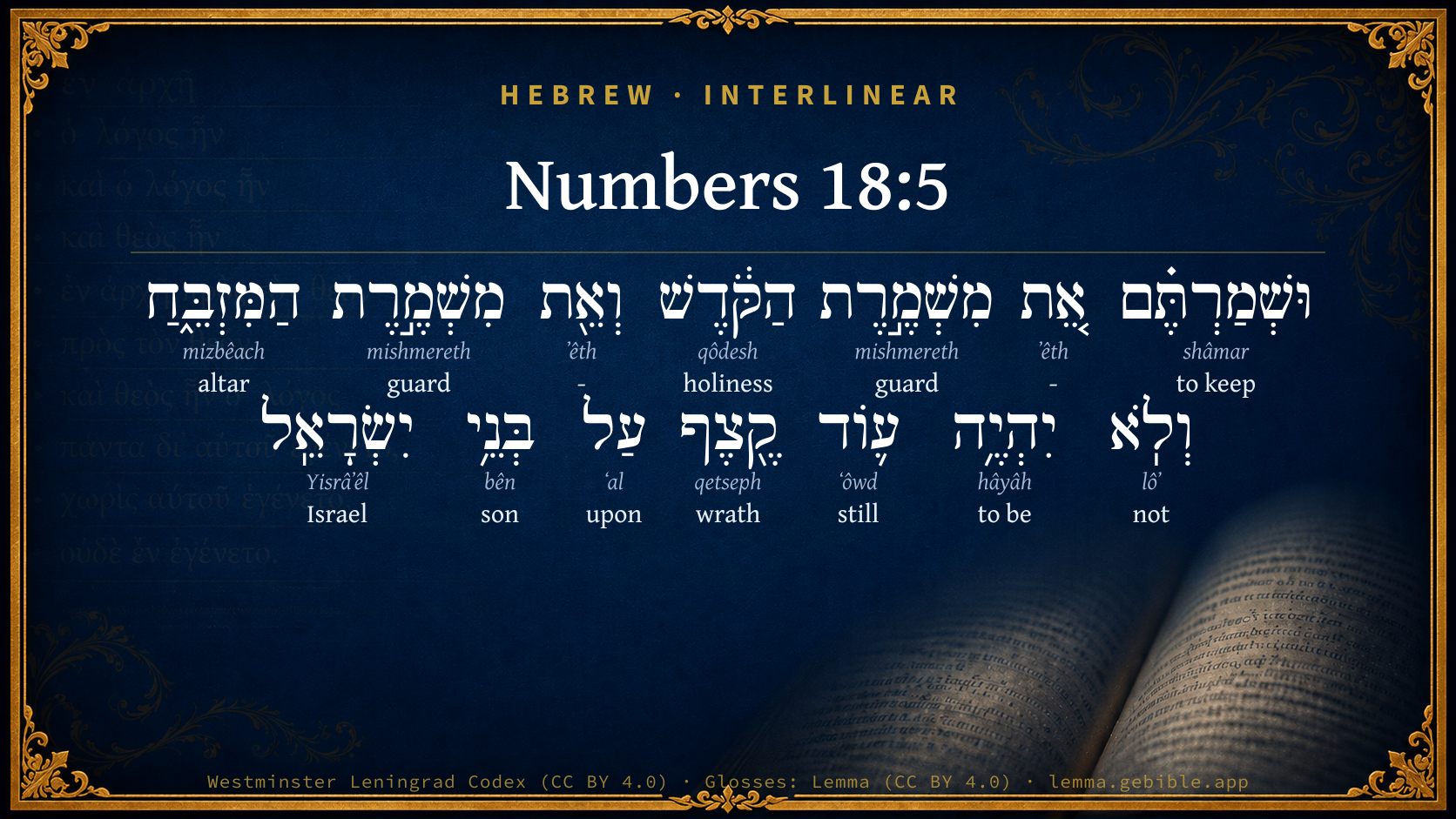
  1. וּשְׁמַרְתֶּ֗ם shâmar H8104 “and · to keep” Conjunction + Verb, Qal, Sequential Perfect, 2nd Person, Masculine, Plural
  2. אֵ֚ת ʼêth H853 “-” Particle, Direct Object
  3. מִשְׁמֶ֣רֶת mishmereth H4931 “guard of” Noun, Common, Feminine, Singular, Construct
  4. הַקֹּ֔דֶשׁ qôdesh H6944 “the · holiness” Particle, Definite Article + Noun, Common, Masculine, Singular, Absolute
  5. וְאֵ֖ת ʼêth H853 “and · -” Conjunction + Particle, Direct Object
  6. מִשְׁמֶ֣רֶת mishmereth H4931 “guard of” Noun, Common, Feminine, Singular, Construct
  7. הַמִּזְבֵּ֑חַ mizbêach H4196 “the · altar” Particle, Definite Article + Noun, Common, Masculine, Singular, Absolute
  8. וְלֹֽא lôʼ H3808 “and · not” Conjunction + Particle, Negative
  9. יִהְיֶ֥ה hâyâh H1961 “to be” Verb, Qal, Imperfect, 3rd Person, Masculine, Singular
  10. ע֛וֹד ʻôwd H5750 “still” Adverb
  11. עַל ʻal H5921 “upon” Preposition
  12. בְּנֵ֥י bên H1121 “sons of” Noun, Common, Masculine, Plural, Construct
  13. יִשְׂרָאֵֽל Yisrâʼêl H3478 “Israel” Noun, Proper

About this verse

These counts appear in no published source. They are computed here, from the morphology-tagged text and Lemma’s own curated glosses. What Lemma adds →

14
words
12
distinct lemmas
Pentateuch
section

Shared distinctive vocabulary

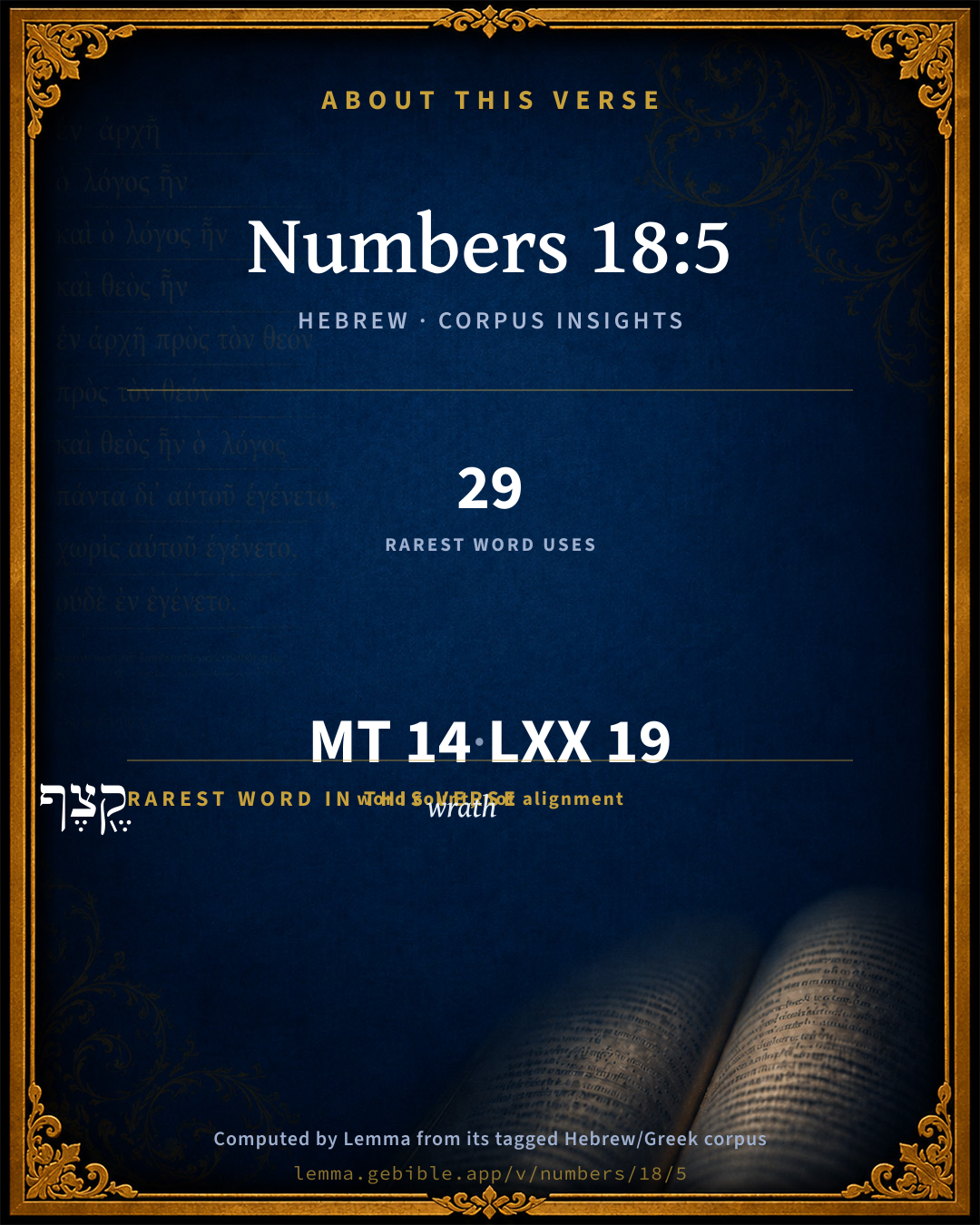
קֶ֖צֶף wrath H7110 occurs in 29 verses of the Hebrew Bible. Also found in:

Grammatical profile

  • 2 verbs
  • 7 nouns
  • 1 preposition
  • 1 adverb
  • 3 particles

Verb forms

  • וּשְׁמַרְתֶּ֗ם Qal · Sequential Perfect
  • יִהְיֶ֥ה Qal · Imperfect

Repetition

A word recurs within this verse — often emphatic in Hebrew:

  • מִשְׁמֶ֣רֶת guard H4931 ×2

Hebrew & Septuagint length

In English translation the verse runs 25 words from the Hebrew and 28 from the Septuagint (LXX English) — closely comparable.

A rough comparison of the two English renderings, which tokenize alike — not a word-level alignment.

Word counts can differ between the Hebrew and the Greek without any difference in meaning — e.g. the Hebrew direct-object marker אֵת has no separate Greek word, and Greek often adds the article ὁ.

In the original languages it is 14 Hebrew tokens and 19 Greek tokens — but the two are counted differently (Hebrew bundles its prefixes and suffixes into one token; the Greek is in lemma form), so that isn’t a like-for-like length.

Cross-references

17

Topical passages linked to Numbers 18:5 in the Treasury of Scripture Knowledge — connected by theme and wording, ordered by reader-vote popularity; previews shown in the World English Bible.

  • Exodus 27:21 In the tent of meeting, outside the veil which is before the testimony, Aaron and his sons shall keep it in order from evening to morning before Yahweh: it shall be a statute forever throughout their generations on the behalf of the children of Israel.
  • Leviticus 24:3 Outside of the veil of the Testimony, in the Tent of Meeting, shall Aaron keep it in order from evening to morning before Yahweh continually: it shall be a statute forever throughout your generations.
  • Numbers 16:46 Moses said to Aaron, Take your censer, and put fire therein from off the altar, and lay incense thereon, and carry it quickly to the congregation, and make atonement for them: for there is wrath gone out from Yahweh; the plague is begun.
  • Exodus 30:7–10 Aaron shall burn incense of sweet spices on it every morning. When he tends the lamps, he shall burn it.
  • Leviticus 10:6 Moses said to Aaron, and to Eleazar and to Ithamar, his sons, "Don't let the hair of your heads go loose, neither tear your clothes; that you don't die, and that he not be angry with all the congregation: but let your brothers, the whole house of Israel, bewail the burning which Yahweh has kindled.
  • Numbers 8:2 "Speak to Aaron, and tell him, 'When you light the lamps, the seven lamps shall give light in front of the lampstand.'"
  • Numbers 8:19 I have given the Levites as a gift to Aaron and to his sons from among the children of Israel, to do the service of the children of Israel in the Tent of Meeting, and to make atonement for the children of Israel; that there be no plague among the children of Israel, when the children of Israel come near to the sanctuary."
  • 1 Chronicles 9:19 Shallum the son of Kore, the son of Ebiasaph, the son of Korah, and his brothers, of his father's house, the Korahites, were over the work of the service, keepers of the thresholds of the tent: and their fathers had been over the camp of Yahweh, keepers of the entry.
  • 1 Chronicles 9:23 So they and their children had the oversight of the gates of the house of Yahweh, even the house of the tent, by wards.
  • 1 Chronicles 9:33 These are the singers, heads of fathers' [houses] of the Levites, [who lived] in the chambers [and were] free [from other service]; for they were employed in their work day and night.
  • 1 Chronicles 24:5 Thus were they divided impartially by drawing lots; for there were princes of the sanctuary, and princes of God, both of the sons of Eleazar, and of the sons of Ithamar.
  • Jeremiah 23:15 Therefore thus says Yahweh of Hosts concerning the prophets: Behold, I will feed them with wormwood, and make them drink the water of gall; for from the prophets of Jerusalem is ungodliness gone forth into all the land.
  • Zechariah 10:3 My anger is kindled against the shepherds, And I will punish the male goats; For Yahweh of Hosts has visited his flock, the house of Judah, And will make them as his horse in the battle that he is proud of.
  • 1 Timothy 1:18 This charge I commit to you, my child Timothy, according to the prophecies which led the way to you, that by them you may wage the good warfare;
  • 1 Timothy 3:15 but if I wait long, that you may know how men ought to behave themselves in the house of God, which is the assembly of the living God, the pillar and ground of the truth.
  • 1 Timothy 5:21 I charge you in the sight of God, and Christ Jesus, and the chosen angels, that you observe these things without prejudice, doing nothing by partiality.
  • 1 Timothy 6:20 Timothy, guard that which is committed to you, turning away from the empty chatter and oppositions of the knowledge which is falsely so called;

Cross-references courtesy of OpenBible.info (CC BY 4.0).

Hebrew and Greek witnesses Masoretic Hebrew ↔ Greek Septuagint

The same verse in the two great witnesses to the Old Testament, shown verse-for-verse.

These are two independent witnesses, not word-aligned to each other, and the Septuagint is shown in lemma (dictionary) form.

Hebrew Numbers 18:5 Masoretic · Westminster Leningrad Codex

וּשְׁמַרְתֶּ֗ם אֵ֚ת מִשְׁמֶ֣רֶת הַקֹּ֔דֶשׁ וְאֵ֖ת מִשְׁמֶ֣רֶת הַמִּזְבֵּ֑חַ וְלֹֽא יִהְיֶ֥ה ע֛וֹד קֶ֖צֶף עַל בְּנֵ֥י יִשְׂרָאֵֽל

You shall keep the charge of the sanctuary, and the charge of the altar; that there be wrath no more on the children of Israel.

World English Bible · Public Domain

Greek LXX Numbers 18:5 Septuagint · lemma form

καί φυλάσσω ὁ φυλακή ὁ ἅγιος καί ὁ φυλακή ὁ θυσιαστήριον καί οὐ εἰμί θυμός ἐν ὁ υἱός ἰσραήλ

And you⌃ shall keep the charges of the holy things, and the charges of the altar, and so there shall not be anger among the children of Israel.

LXX2012 (modern English Septuagint) · Public Domain

Hebrew: Westminster Leningrad Codex (CC BY 4.0). Greek: Septuagint (public domain); English from LXX2012 (modern English Septuagint) (Public Domain). How the Septuagint differs from the Hebrew →

Targum (Aramaic paraphrase)

2

The Targum is the ancient Jewish Aramaic paraphrase of the Hebrew Scriptures — an interpretive translation, not the Hebrew text itself. Onkelos (literal) and Pseudo-Jonathan (expansive) render the Torah, and Jonathan the Prophets. Coverage is partial: where no permissively-licensed English translation exists for a verse, only the Aramaic is shown. This is verse-level text, not a word-by-word alignment to the Hebrew.

  1. Targum Onkelos Torah (Genesis–Deuteronomy)
    וְתִטְרוּן יָת מַטְרַת קוּדְשָׁא וְיָת מַטְרַת מַדְבְּחָא וְלָא יְהֵי עוֹד רוּגְזָא עַל בְּנֵי יִשְׂרָאֵל

    (no public-domain English translation for this verse)

    Targum Onkelos — Aramaic: “Onkelos Genesis” (public domain); “Onkelos Exodus” (public domain); “Onkelos Leviticus” (public domain); “Onkelos Numbers” (public domain); “Onkelos Deuteronomy” (public domain). English: “Sefaria Community Translation” (CC0 1.0 (public-domain dedication)); “J.W. Etheridge. The Targums of Onkelos and Jonathan Ben Uzziel on the Pentateuch. London: Longmans, Green, 1862” (public domain). Text via Sefaria.

  2. Targum Pseudo-Jonathan Torah (Genesis–Deuteronomy)
    וְתִטְרוּן יַת מַטְרַת קוּדְשָׁא וְיַת מַטְרַת מַדְבְּחָא וְלָא יְהֵי תוּב רוּגְזָא דַהֲוָה עַל בְּנֵי יִשְרָאֵל

    And you shall keep the charge of the sanctuary and of the altar, that there may be no more the wrath that hath been upon the children of Israel.

    Targum Pseudo-Jonathan — Aramaic: “Targum Jonathan on Genesis” (public domain); “Targum Jonathan on Exodus” (public domain); “Targum Jonathan on Leviticus” (public domain); “Targum Jonathan on Numbers” (public domain); “Targum Jonathan on Deuteronomy” (public domain). English: “The Targum of Jonathan ben Uzziel, trans. J. W. Etheridge, London, 1862” (public domain). Text via Sefaria.

Commentary

Notes on Numbers 18:5 from classic Christian and Jewish commentators (each source and its license shown beneath its notes). The classic Christian expositions comment on the surrounding passage and are grouped to its opening verse, so a note may address several verses; the Jewish commentaries on the Tanakh (Rashi and others) are per-verse, so they appear only where the commentator wrote on this verse.

Lemma curates 59 commentaries, every one of them public domain or Creative Commons licensed, each selected and text-cleaned for this edition rather than reprinted as found. About our sources →

Tyndale Open Study Notes

Tyndale Open Resources

18:5-7 Only the priests (Aaron and his descendants) could perform sacred duties inside the sanctuary proper or approach the altar, a sacred space that deserved special reverence. Only the high priest could serve in the Most Holy Place. The Levites were to serve only in the courtyard, away from the altar, except when it was time to assemble or disassemble the Tabernacle (ch 4).

18:5 Aaron and the priests were the people’s representatives before the Lord, so their actions had consequences for all of Israel (cp. 16:18-21).

Tyndale Open Study Notes — © Tyndale Open Resources, licensed CC BY-SA 4.0. Text via the HelloAO Bible API.

Ellicott's Commentary for English Readers

(5, 6) And ye shall keep the charge of the sanctuary . . . —See Num_8:19.

A Bible Commentary for English Readers, edited by Charles John Ellicott (1878–1897) — public domain. Text from a community e-Sword module.

The Cambridge Bible for Schools and Colleges

gen. ed. J. J. S. Perowne

5. ye shall keep the charge &c.] It ye includes both priests and Levites, then ‘the sanctuary’ is used in its widest sense to include the tent and the court and everything contained in them, which are to be guarded from the approach of laymen. But on the other hand ye may denote the priests only, and ‘the sanctuary’ will in that case mean everything from which the Levites were debarred; cf. Num_18:3; Num_18:7.

The Cambridge Bible for Schools and Colleges (gen. ed. J. J. S. Perowne; Cambridge University Press, 1878–1918) — public domain. Text from a community e-Sword module.

John Gill's Exposition

And ye shall keep the charge of the sanctuary,.... That is, the priests, Aaron and his sons; the high priest was to keep the charge of the most holy place particularly, and do what was to be done in that on the day of atonement; and the common priests to keep the charge of the holy place, and do everything relating to the altar of incense, the shewbread table, and candlestick:

and the charge of the altar; of burnt offering, which stood in the court of the tabernacle:

that there be no wrath any more upon the children of Israel: as had been upon Korah and his company, Num 16:32, and as afterwards came on Uzziah, Ch2 26:19.

John Gill's Exposition of the Whole Bible (1746–1763) — public domain (CC PDM 1.0). Text via the HelloAO Bible API.

Matthew Poole's English Annotations

Of the sanctuary, i.e. of the holy, and of the most holy, place.

Upon the children of Israel, for coming too near the holy place, or for usurping any part of your sacred function, or for any other miscarriage which they may be guilty of through your carelessness or remissness, in which case they shall perish for their error, but their blood will I require at your hands, who should have advised them better, or overruled them.

Matthew Poole's English Annotations on the Holy Bible (1683–1685) — public domain. Text from a community e-Sword/MySword module.

The Pulpit Commentary

That there be no wrath any more upon the children of Israel. As there had been ill the case of Korah and his company, and of the many thousands who had fallen in consequence.

The Pulpit Commentary (1880–1919), ed. H.D.M. Spence-Jones & Joseph S. Exell — public domain. Text from a community e-Sword module.

John Wesley's Explanatory Notes

The sanctuary - Of the holy, and of the most holy place.

John Wesley, Explanatory Notes Upon the Whole Bible (1754–1765) — public domain. Text via the GEBible commentary corpus.

Rashi

Rabbi Shlomo Yitzchaki (Rashi)

ולא יהיה עוד קצף THAT THERE BE NO ANGER ANY MORE as there has been already, as it is said, (Numbers 17:11) “For there is anger gone [forth from the Lord]” (Sifrei Bamidbar 116:1).

Rashi on the Tanakh — English translations: “The Judaica Press complete Tanach with Rashi, translated by A. J. Rosenberg” (CC BY 4.0); “Pentateuch with Rashi's commentary by M. Rosenbaum and A.M. Silbermann, 1929-1934” (public domain); “The Metsudah Tanach series, Lakewood, N.J” (CC BY 4.0); and “The Book of Joshua, Metsudah Publications, 1997” (CC BY 4.0). Text via Sefaria.

Lesson kit

Teaching starters — assembled from the data on this page, not authored interpretation. Every prompt links to the verse data it draws on. Edit before teaching.

Numbers, in the Pentateuch, opens this verse with 14 words (12 distinct Hebrew lemmas). Its most distinctive word is qetseph (“wrath”). A historical commentator’s framing appears above. Read the whole chapter for the surrounding context.

Discussion questions

  1. What does “wrath” (qetseph) contribute to the verse as a whole?
  2. Numbers 1:53 shares the word «wrath» with this verse. How do the two illuminate each other?
  3. “guard” occurs 2× in this one verse. What is the effect of the repetition?
  4. The translations on this page render this verse differently — a whole-verse word diff, not a word-by-word alignment. What might account for the different wordings?
  5. The verb «וּשְׁמַרְתֶּ֗ם» is Qal Sequential Perfect. How does its form color the action?
  6. Reading how Tyndale Open Study Notes and Ellicott's Commentary for English Readers read this verse, where do the two commentators agree and where do they part?

Things to notice

Reading settings

Reading text

Shown beneath each verse's original-language words.

Old Testament
Old Testament edition

Read the OT as the Masoretic Hebrew (MT) or the Greek Septuagint (LXX).

English shown for the Greek Septuagint (in the Hebrew ↔ Greek comparison).

Comparing translations? Open the Compare panel on any verse page to stack up to four side by side.