
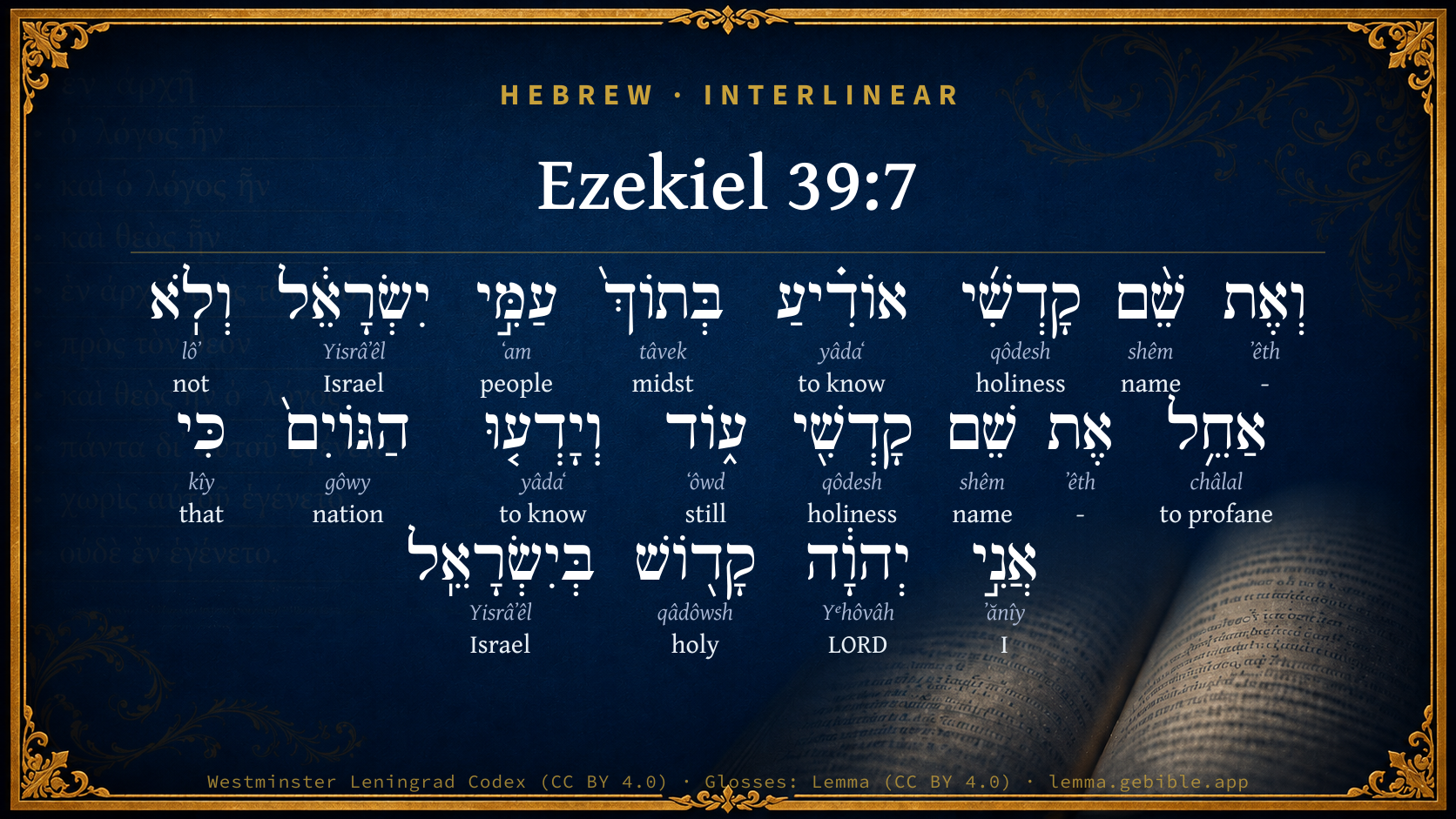
Ezekiel 39:7

Hebrew (Westminster Leningrad Codex) Ezekiel 39:7 appears in the Hebrew Old Testament. The text above is from the Westminster Leningrad Codex. Each word links to its Strong’s number, a concise gloss, and parsing drawn from the Open Scriptures Hebrew Bible morphology. Click any word for its full Brown-Driver-Briggs (BDB) entry.
Download image
Cite this verse

Ezekiel 39:7 (World English Bible). Public Domain. Lemma interlinear Bible study tool, https://lemma.gebible.app/v/ezekiel/39/7.

Show BibTeX & RIS
BibTeX
RIS
English Translation
My holy name will I make known in the midst of my people Israel; neither will I allow my holy name to be profaned any more: and the nations shall know that I am Yahweh, the Holy One in Israel.
World English Bible · Public Domain
Download a study sheet

One document with this verse’s original text, its word-by-word gloss line, the meaning frame, cross-references with their text, attributed commentary, and full source and license credits — printable, and it pastes into notes with its structure intact.

This verse Autodidact and up

Study sheet (.html) Plain text (.txt)

A passage Seminary Student

Up to 50 verses in one chapter. A passage sheet keeps up to 6 commentary sources and 12 cross-references per verse, in the order this page ranks them, and says so on the sheet whenever that leaves anything out. Ask for a single verse and you get the Autodidact verse sheet above.

Everything on this page stays free to read, with no account — the sheet is a download of what is already on screen, not access to it.

Want to remove ads? Support Godless Engineer
Compare translations 3

The same verse in 3 English versions, stacked beneath the original-language interlinear above. Click any original word for its lexicon entry.

Each is an independent rendering of the whole verse — the interlinear is not word-aligned to these translations.

Highlighted words mark where these versions differ — a whole-verse word diff, not a word-by-word alignment.

  • World English Bible Public Domain
    My holy name will I make known in the midst of my people Israel; neither will I allow my holy name to be profaned any more: and the nations shall know that I am Yahweh, the Holy One in Israel.
  • King James Version Public Domain
    So will I make my holy name known in the midst of my people Israel; and I will not let them pollute my holy name any more: and the heathen shall know that I am the LORD, the Holy One in Israel.
  • unfoldingWord Literal Text CC BY-SA 4.0
    For I will make my holy name known in the midst of my people Israel, and I will no longer allow my holy name to be profaned; the nations will know that I am Yahweh, the Holy One in Israel.

unfoldingWord Literal Text — © unfoldingWord, licensed CC BY-SA 4.0. Word-aligned USFM3 via Door43 (git.door43.org/unfoldingWord/en_ult).

Versions to compare (up to 4)

3 of 4 selected

Show all 18 translations

Every available English version of this verse, each an independent rendering of the whole verse.

  • World English Bible Public Domain
    My holy name will I make known in the midst of my people Israel; neither will I allow my holy name to be profaned any more: and the nations shall know that I am Yahweh, the Holy One in Israel.
  • Berean Standard Bible Public Domain
    So I will make My holy name known among My people Israel and will no longer allow it to be profaned. Then the nations will know that I am the LORD, the Holy One in Israel.
  • Majority Standard Bible Public Domain
    So I will make My holy name known among My people Israel and will no longer allow it to be profaned. Then the nations will know that I am the LORD, the Holy One in Israel.
  • King James Version Public Domain
    So will I make my holy name known in the midst of my people Israel; and I will not let them pollute my holy name any more: and the heathen shall know that I am the LORD, the Holy One in Israel.
  • American Standard Version (1901) Public Domain
    And my holy name will I make known in the midst of my people Israel; neither will I suffer my holy name to be profaned any more: and the nations shall know that I am Jehovah, the Holy One in Israel.
  • Revised Version (1885) Public Domain
    And my holy name will I make known in the midst of my people Israel; neither will I suffer my holy name to be profaned any more: and the nations shall know that I am the LORD, the Holy One in Israel.
  • Geneva Bible (1599) Public Domain
    So will I make mine holy Name knowen in the middes of my people Israel, and I will not suffer them to pollute mine holy Name any more, and the heathen shall knowe that I am the Lord, the holy one of Israel.
  • Douay-Rheims (1899) Public Domain
    And I will make my holy name known in the midst of my people Israel, and my holy name shall be profaned no more: and the Gentiles shall know that I am the Lord, the Holy One of Israel.
  • Young's Literal Translation Public Domain
    And My holy name I make known in the midst of My people Israel, And I pollute not My holy name any more, And known have the nations that I, Jehovah, the Holy One, `am' in Israel.
  • Literal Standard Version CC BY-SA 4.0
    And I make My holy Name known in the midst of My people Israel, || And I do not defile My holy Name anymore, || And the nations have known that I, YHWH, the Holy One, [am] in Israel.
  • Unlocked Literal Bible CC BY-SA 4.0
    For I will make my holy name known in the midst of my people Israel, and I will no longer allow my holy name to be profaned; the nations will know that I am Yahweh, the Holy One in Israel.
  • unfoldingWord Literal Text CC BY-SA 4.0
    For I will make my holy name known in the midst of my people Israel, and I will no longer allow my holy name to be profaned; the nations will know that I am Yahweh, the Holy One in Israel.
  • Darby Bible Public Domain
    And my holy name will I make known in the midst of my people Israel; and I will not suffer my holy name to be profaned any more: and the nations shall know that I [am] Jehovah, the Holy One in Israel.
  • World Messianic Bible Public Domain
    “‘“I will make my holy name known among my people Israel. I won’t allow my holy name to be profaned any more. Then the nations will know that I am the LORD, the Holy One in Israel.
  • Webster's Bible Public Domain
    So will I make my holy name known in the midst of my people Israel; and I will not let them profane my holy name any more: and the heathen shall know that I am the LORD, the Holy One in Israel.
  • Free Bible Version CC BY-SA 4.0
    In this way I will make my reputation for holiness known among my people Israel and won't allow it to be ruined anymore. Then the nations will acknowledge that I am the Lord, the Holy One of Israel.
  • Bible in Basic English Public Domain
    And I will make clear my holy name among my people Israel; I will no longer let my holy name be made unclean: and the nations will be certain that I am the Lord, the Holy One in Israel.
  • JPS Tanakh (1917) Public Domain
    And My holy name will I make known in the midst of My people Israel; neither will I suffer My holy name to be profaned any more; and the nations shall know that I am the LORD, the Holy One in Israel.

Literal Standard Version (2020), Covenant Press — licensed CC BY-SA 4.0. Text via the HelloAO Bible API (eBible.org). Unlocked Literal Bible (unfoldingWord) — licensed CC BY-SA 4.0. Text via the HelloAO Bible API (eBible.org). unfoldingWord Literal Text — © unfoldingWord, licensed CC BY-SA 4.0. Word-aligned USFM3 via Door43 (git.door43.org/unfoldingWord/en_ult). Free Bible Version, Dr. Jonathan Gallagher — licensed CC BY-SA 4.0. Text via the HelloAO Bible API (eBible.org).

Word by word

More ways to search: Search by grammar → Find every occurrence → Compare this word →

Practice this passage: Drill this verse → Learn its vocabulary →

קָד֖וֹשׁ
qâdôwsh
H6918
“holy”
Adjective, Adjective, Masculine, Singular, Absolute
Part of Speech
Adjective
Type
Adjective
Gender
Masculine
Number
Singular
State
Absolute
Full BDB Definition

Origin: from H6942

TWOT: 1990b

sacred, holy, Holy One, saint, set apart
  1. וְאֶת ʼêth H853 “and · -” Conjunction + Particle, Direct Object
  2. שֵׁ֨ם shêm H8034 “name of” Noun, Common, Masculine, Singular, Construct
  3. קָדְשִׁ֜י qôdesh H6944 “holiness · my” Noun, Common, Masculine, Singular, Construct + Suffix, Personal, 1st Person, Common, Singular
  4. אוֹדִ֗יעַ yâdaʻ H3045 “to know” Verb, Hiphil, Imperfect, 1st Person, Common, Singular
  5. בְּתוֹךְ֙ tâvek H8432 “in/at · midst of” Preposition + Noun, Common, Masculine, Singular, Construct
  6. עַמִּ֣י ʻam H5971 “people · my” Noun, Common, Masculine, Singular, Construct + Suffix, Personal, 1st Person, Common, Singular
  7. יִשְׂרָאֵ֔ל Yisrâʼêl H3478 “Israel” Noun, Proper
  8. וְלֹֽא lôʼ H3808 “and · not” Conjunction + Particle, Negative
  9. אַחֵ֥ל châlal H2490 “to profane” Verb, Hiphil, Imperfect, 1st Person, Common, Singular
  10. אֶת ʼêth H853 “-” Particle, Direct Object
  11. שֵׁם shêm H8034 “name of” Noun, Common, Masculine, Singular, Construct
  12. קָדְשִׁ֖י qôdesh H6944 “holiness · my” Noun, Common, Masculine, Singular, Construct + Suffix, Personal, 1st Person, Common, Singular
  13. ע֑וֹד ʻôwd H5750 “still” Adverb
  14. וְיָדְע֤וּ yâdaʻ H3045 “and · to know” Conjunction + Verb, Qal, Sequential Perfect, 3rd Person, Common, Plural
  15. הַגּוֹיִם֙ gôwy H1471 “the · nations” Particle, Definite Article + Noun, Common, Masculine, Plural, Absolute
  16. כִּי kîy H3588 “that” Conjunction
  17. אֲנִ֣י ʼănîy H589 “I” Pronoun, Personal, 1st Person, Common, Singular
  18. יְהוָ֔ה Yᵉhôvâh H3068 “LORD” Noun, Proper
  19. בְּיִשְׂרָאֵֽל Yisrâʼêl H3478 “in/at · Israel” Preposition + Noun, Proper

About this verse

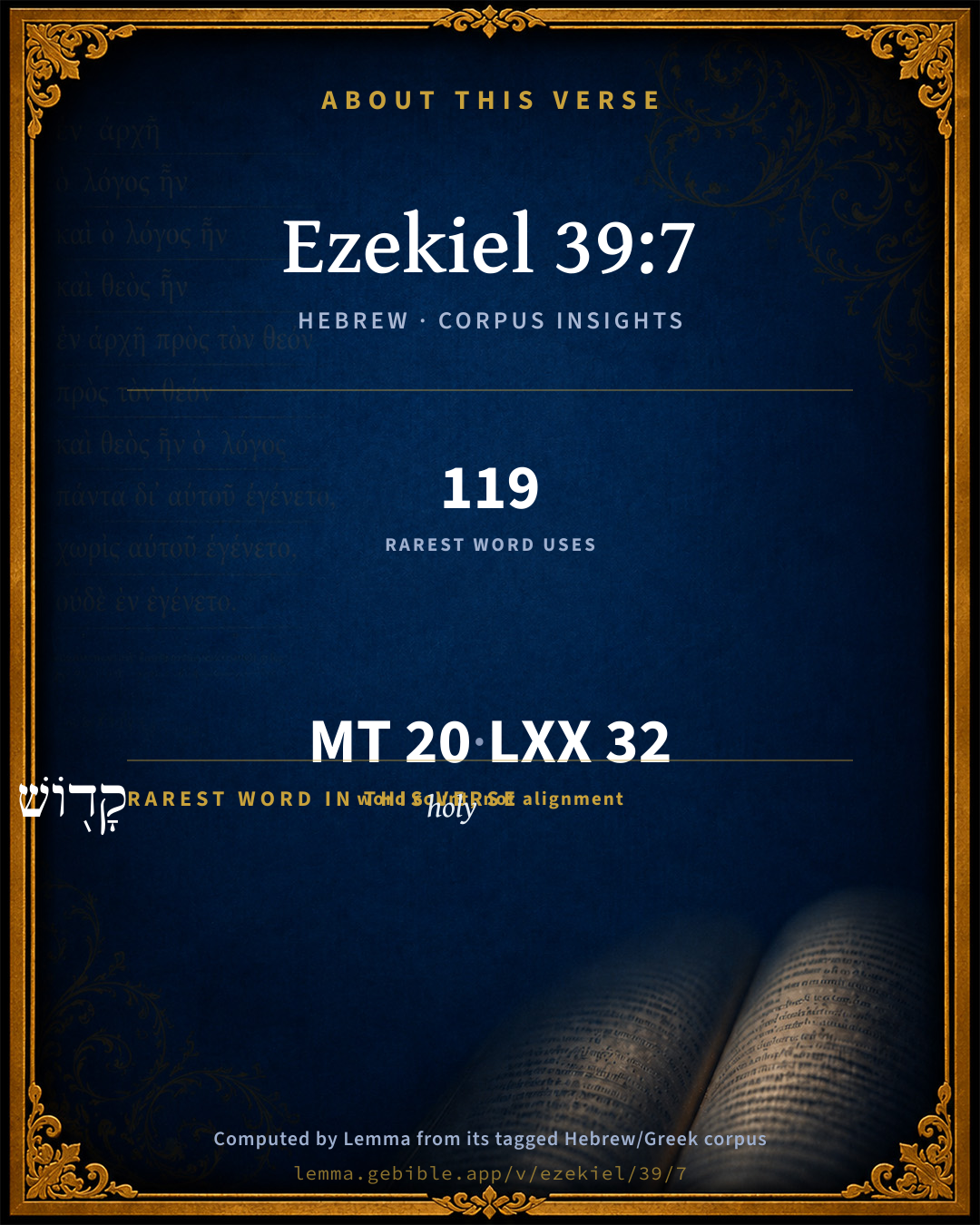
These counts appear in no published source. They are computed here, from the morphology-tagged text and Lemma’s own curated glosses. What Lemma adds →

20
words
15
distinct lemmas
Prophets
section

Grammatical profile

  • 3 verbs
  • 10 nouns
  • 1 adjective
  • 1 pronoun
  • 1 conjunction
  • 1 adverb
  • 3 particles

Verb forms

  • אוֹדִ֗יעַ Hiphil · Imperfect
  • אַחֵ֥ל Hiphil · Imperfect
  • וְיָדְע֤וּ Qal · Sequential Perfect

Repetition

Words recur within this verse — often emphatic in Hebrew:

  • שֵׁ֨ם name H8034 ×2
  • קָדְשִׁ֜י holiness H6944 ×2
  • אוֹדִ֗יעַ to know H3045 ×2
  • יִשְׂרָאֵ֔ל Israel H3478 ×2

Hebrew & Septuagint length

In English translation the verse runs 40 words from the Hebrew and 38 from the Septuagint (LXX English) — closely comparable.

A rough comparison of the two English renderings, which tokenize alike — not a word-level alignment.

Word counts can differ between the Hebrew and the Greek without any difference in meaning — e.g. the Hebrew direct-object marker אֵת has no separate Greek word, and Greek often adds the article ὁ.

In the original languages it is 20 Hebrew tokens and 32 Greek tokens — but the two are counted differently (Hebrew bundles its prefixes and suffixes into one token; the Greek is in lemma form), so that isn’t a like-for-like length.

Cross-references

17

Topical passages linked to Ezekiel 39:7 in the Treasury of Scripture Knowledge — connected by theme and wording, ordered by reader-vote popularity; previews shown in the World English Bible.

  • Ezekiel 38:16 and you shall come up against my people Israel, as a cloud to cover the land: it shall happen in the latter days, that I will bring you against my land, that the nations may know me, when I shall be sanctified in you, Gog, before their eyes.
  • Ezekiel 38:23 I will magnify myself, and sanctify myself, and I will make myself known in the eyes of many nations; and they shall know that I am Yahweh.
  • Exodus 20:7 "You shall not take the name of Yahweh your God in vain, for Yahweh will not hold him guiltless who takes his name in vain.
  • Isaiah 12:6 Cry aloud and shout, you inhabitant of Zion; for great in the midst of you is the Holy One of Israel!"
  • Ezekiel 20:14 But I worked for my name's sake, that it should not be profaned in the sight of the nations, in whose sight I brought them out.
  • Ezekiel 20:39 As for you, house of Israel, thus says the Lord Yahweh: Go you, serve everyone his idols, and hereafter also, if you will not listen to me; but my holy name shall you no more profane with your gifts, and with your idols.
  • Isaiah 43:3 For I am Yahweh your God, the Holy One of Israel, your Savior; I have given Egypt as your ransom, Ethiopia and Seba in your place.
  • Isaiah 43:14 Thus says Yahweh, your Redeemer, the Holy One of Israel: For your sake I have sent to Babylon, and I will bring down all of them as fugitives, even the Chaldeans, in the ships of their rejoicing.
  • Isaiah 55:5 Behold, you shall call a nation that you don't know; and a nation that didn't know you shall run to you, because of Yahweh your God, and for the Holy One of Israel; for he has glorified you.
  • Isaiah 60:9 Surely the isles shall wait for me, and the ships of Tarshish first, to bring your sons from far, their silver and their gold with them, for the name of Yahweh your God, and for the Holy One of Israel, because he has glorified you.
  • Isaiah 60:14 The sons of those who afflicted you shall come bending to you; and all those who despised you shall bow themselves down at the soles of your feet; and they shall call you The city of Yahweh, The Zion of the Holy One of Israel.
  • Ezekiel 20:9 But I worked for my name's sake, that it should not be profaned in the sight of the nations, among which they were, in whose sight I made myself known to them, in bringing them forth out of the land of Egypt.
  • Ezekiel 36:23 I will sanctify my great name, which has been profaned among the nations, which you have profaned in the midst of them; and the nations shall know that I am Yahweh, says the Lord Yahweh, when I shall be sanctified in you before their eyes.
  • Ezekiel 39:22 So the house of Israel shall know that I am Yahweh their God, from that day and forward.
  • Leviticus 18:21 "'You shall not give any of your children to sacrifice to Molech; neither shall you profane the name of your God: I am Yahweh.
  • Ezekiel 36:20–21 When they came to the nations, where they went, they profaned my holy name; in that men said of them, These are the people of Yahweh, and are gone forth out of his land.
  • Ezekiel 36:36 Then the nations that are left round about you shall know that I, Yahweh, have built the ruined places, and planted that which was desolate: I, Yahweh, have spoken it, and I will do it.

Cross-references courtesy of OpenBible.info (CC BY 4.0).

Hebrew and Greek witnesses Masoretic Hebrew ↔ Greek Septuagint

The same verse in the two great witnesses to the Old Testament, shown verse-for-verse.

These are two independent witnesses, not word-aligned to each other, and the Septuagint is shown in lemma (dictionary) form.

Hebrew Ezekiel 39:7 Masoretic · Westminster Leningrad Codex

וְאֶת שֵׁ֨ם קָדְשִׁ֜י אוֹדִ֗יעַ בְּתוֹךְ֙ עַמִּ֣י יִשְׂרָאֵ֔ל וְלֹֽא אַחֵ֥ל אֶת שֵׁם קָדְשִׁ֖י ע֑וֹד וְיָדְע֤וּ הַגּוֹיִם֙ כִּי אֲנִ֣י יְהוָ֔ה קָד֖וֹשׁ בְּיִשְׂרָאֵֽל

My holy name will I make known in the midst of my people Israel; neither will I allow my holy name to be profaned any more: and the nations shall know that I am Yahweh, the Holy One in Israel.

World English Bible · Public Domain

Greek LXX Ezekiel 39:7 Septuagint · lemma form

καί ὁ ὄνομα ἐγώ ὁ ἅγιος γιγνώσκω ἐν μέσος λαός ἐγώ ἰσραήλ καί οὐ βεβηλόω ὁ ὄνομα ἐγώ ὁ ἅγιος οὐκέτι καί γιγνώσκω ὁ ἔθνος ὅτι ἐγώ εἰμί κύριος ἅγιος ἐν ἰσραήλ

And my holy name shall be known in the midst of my people Israel; and my holy name shall no more be profaned: and the nations shall know that I am the Lord, the Holy One in Israel.

LXX2012 (modern English Septuagint) · Public Domain

Hebrew: Westminster Leningrad Codex (CC BY 4.0). Greek: Septuagint (public domain); English from LXX2012 (modern English Septuagint) (Public Domain). How the Septuagint differs from the Hebrew →

Targum (Aramaic paraphrase)

1

The Targum is the ancient Jewish Aramaic paraphrase of the Hebrew Scriptures — an interpretive translation, not the Hebrew text itself. Onkelos (literal) and Pseudo-Jonathan (expansive) render the Torah, and Jonathan the Prophets. Coverage is partial: where no permissively-licensed English translation exists for a verse, only the Aramaic is shown. This is verse-level text, not a word-by-word alignment to the Hebrew.

  1. Targum Jonathan Prophets (Joshua–Malachi)
    וְיַת שְׁמָא דְקוּדְשִׁי אֲגַלֵי בְּגוֹ עַמִי יִשְׂרָאֵל וְלָא אָחֵיל יַת שְׁמָא דְקוּדְשִׁי עוֹד וְיֵדְעוּן עַמְמַיָא אֲרֵי אֲנָא יְיָ קַדִישָׁא אַשְׁרֵיתִי שְׁכִנְתִּי בְּיִשְׂרָאֵל:

    (no public-domain English translation for this verse)

    Targum Jonathan — Aramaic: “Mikraot Gedolot” (public domain). English: “Sefaria Community Translation” (CC0 1.0 (public-domain dedication)); “London "Chaldee Paraphrase," 1871” (public domain). Text via Sefaria.

Commentary

Notes on Ezekiel 39:7 from classic Christian and Jewish commentators (each source and its license shown beneath its notes). The classic Christian expositions comment on the surrounding passage and are grouped to its opening verse, so a note may address several verses; the Jewish commentaries on the Tanakh (Rashi and others) are per-verse, so they appear only where the commentator wrote on this verse.

Lemma curates 59 commentaries, every one of them public domain or Creative Commons licensed, each selected and text-cleaned for this edition rather than reprinted as found. About our sources →

Trapp's Complete Commentary

John Trapp

Eze 39:7 So will I make my holy name known in the midst of my people Israel; and I will not [let them] pollute my holy name any more: and the heathen shall know that I [am] the LORD, the Holy One in Israel.

Ver. 7. I will not let them pollute my holy name.] As if I were less able to deliver my people, or less mindful of my promises.

John Trapp, A Commentary or Exposition upon All the Books of the Old and New Testament (1647–1656) — public domain. Text from a community e-Sword module.

Tyndale Open Study Notes

Tyndale Open Resources

39:7-8 God’s judgment on Gog would make known his holy name. Just as he once judged his own people for their sins for the sake of his reputation (36:16-20), now he would defend his restored people and judge their enemies.

Tyndale Open Study Notes — © Tyndale Open Resources, licensed CC BY-SA 4.0. Text via the HelloAO Bible API.

Jamieson, Fausset & Brown

Robert Jamieson, A. R. Fausset & David Brown

not let them pollute my holy name--by their sins bringing down judgments which made the heathen think that I was unable or unwilling to save My people.

Jamieson, Fausset & Brown — Commentary Critical and Explanatory on the Whole Bible (1871) — public domain (CC PDM 1.0). Text via the HelloAO Bible API.

Adam Clarke's Commentary

Verse 7. In the midst of my people Israel] This defeat of Gog is to be in Israel: and it was there according to this prophecy, that the immense army of Antiochus was so completely defeated.

And I will not let them pollute my holy name any more] See on 1Macc 1:11, c., how Antiochus had profaned the temple, insulted Jehovah and his worship, &c. God permitted that as a scourge to his disobedient people but now the scourger shall be scourged, and he shall pollute the sanctuary no more.

Adam Clarke's Commentary on the Bible (1810–1826) — public domain. Text from a community e-Sword/MySword module.

The Cambridge Bible for Schools and Colleges

gen. ed. J. J. S. Perowne

7. will not let them pollute] will not let my holy name be profaned, lit. I will not profane. Jehovah’s holy or divine name was profaned,—his majesty and power were detracted from—when Israel his people were subjected by the heathen and dispersed abroad from their own land (Eze_36:20). Israel’s sins constrained Jehovah to cast them out of his land, and thus to profane his holy name. Now they are another people, a new heart has been given them, and his signal protection of them in their defenceless condition (Eze_38:11) from so extreme a danger (Eze_38:4-6) will reveal both to Israel and the nations what Jehovah is, and what are the principles on which he rules his people (Eze_39:23). Thus shall his name be sanctified—he shall be known to be God alone, all powerful and righteous.—While Isaiah says “Holy One of Israel,” Ezek. says in Israel, a usage which shews that the element “of Israel” forms no part of the conception of “holiness.”

The Cambridge Bible for Schools and Colleges (gen. ed. J. J. S. Perowne; Cambridge University Press, 1878–1918) — public domain. Text from a community e-Sword module.

John Gill's Exposition

So will I make my holy name known in the midst of my people Israel,.... That is, his perfections; his holiness and justice in punishing their enemies; his truth and faithfulness in fulfilling his promises to them; his power in inflicting judgments on Gog and his army; and his goodness in their preservation and protection:

and I will not let them pollute my holy name any more: either the Heathens round about who before blasphemed it, saying that God was not able to deliver his people from such a potent enemy; but now their mouth will be stopped, and they will not dare to speak any more after this manner: or else the Israelites, who shall be so influenced by the grace and goodness of God unto them, as to fear the Lord and his goodness, and not dare to commit the sins they formerly did, whereby his name was polluted and blasphemed among the Heathens:

and the Heathen shall know that I am the Lord, the Holy One in Israel; they shall know, by these judgments and providences, that he is the true God, and they shall acknowledge and confess it; and that he is a holy and just God, and dwells in Israel, and grants his gracious as well as powerful presence to his people; nor shall they dare to molest them any more.

John Gill's Exposition of the Whole Bible (1746–1763) — public domain (CC PDM 1.0). Text via the HelloAO Bible API.

Matthew Poole's English Annotations

In Eze 39:6, the judgments executed on Gog make God known in the midst of the heathen, here they make him known among his own people; in both glorious.

My holy name; the destruction threatened against the wicked for their enmity against holiness, being executed, manifest that God is holy, and the protection of such. Or, holy name, for that he does in his oath swear by his holiness.

So his faithfulness is here commended and illustrated. I will not let them pollute my holy name any more; will give them that new spirit, that due sense of my mercy; they shall not, as formerly, profane my name among the heathen, Eze 20:9. See Eze 38:23.

Matthew Poole's English Annotations on the Holy Bible (1683–1685) — public domain. Text from a community e-Sword/MySword module.

The Pulpit Commentary

HOMILIES BY J.R. THOMSON Ver. 7. The Lord"s care for His own Name.

In several passages of his prophecies, Ezekiel lays stress upon the honor shown to the Name of Jehovah. He does this especially in connection with the predictions of Israel"s deliverance, and of the defeat and humiliation of the foes of Israel and of God. The idiom is a Hebrew one, and deserves attention; while the broad moral lessons conveyed are of a nature to strengthen our faith in the providential government of God.

I WHAT IS GOD"S NAME? An examination of the passages in Old Testament Scripture in which the expression occurs will convince the student that by the Name we are to understand the attributes and the character of God. It is generally held that the name Jehovah signifies the self-existing Being; and it might be argued that all Divine perfections are involved in and may be developed from the very definition. But it will be found that when "the Name" of God is used, as in this passage, it calls attention to these two attributes of Deity.

1. He is righteous in his judgments.

2. He is faithful to his promises.

II AMONG WHOM WOULD GOD MAKE HIS NAME KNOWN? To whom would he have his attributes and the characteristics of his moral government revealed with clearness and unmistakable power? The text gives an explicit answer to this question.

1. Among the Hebrews: "In the midst of my people Israel." These, his people, had been prone to forget or to misunderstand his Name, and needed that their attention should be recalled to the revelation which Jehovah had given of himself.

2. Among the heathen: "The heathen shall know that I am the Lord, the Holy One in Israel." In this case it was not a revival of knowledge that had lapsed or grown dim; it was a fresh communication. Those who had trusted in their false gods should have their foolish confidence shaken; those who had thought lightly of Jehovah should learn to revere his power, and (better still) should learn to contemplate the moral attributes of the Supreme Power, and thus receive a special illumination, which might be for their spiritual good.

III HOW WOULD GOD EFFECT THIS END, AND MAKE HIS NAME KNOWN?

1. By delivering his people. The dangers threatening Israel were great, and their foes were formidable. All the more marvelous was the interposition wrought upon their behalf. The Name of God, as the great Deliverer, was manifested and glorified by the experience of the rescued and saved.

2. By destroying the enemies of his people. In this manner the fame of the Most High, the God of hosts, was spread abroad, so that distant nations were impressed by the revelation of his power, by the proof of his universal sway.

APPLICATION. The preacher and teacher of religion should never lose sight of the fact that his one great aim is the honor and exaltation of the Name of God. This is often utterly misrepresented, either through the childishness or the malice of the enemies of religion, and it is affirmed to involve an unworthy conception of the Deity, as though in vanity God delighted in the adulations of men. This is anthropomorphism indeed. The Name of God is truth, righteousness, holiness, and love. To manifest and extol his Name is to display the supremacy of his glorious attributes. And than this man can have no higher object at which to aim. If man"s chief end is to glorify God, if human life does not find its law and its aim in itself, then it is evident that the exaltation of the Divine Name is a worthy and most noble end for the Christian man, and for the Christian minister, to set before him. T.

The Pulpit Commentary (1880–1919), ed. H.D.M. Spence-Jones & Joseph S. Exell — public domain. Text from a community e-Sword module.

unfoldingWord translationNotes

Door43 World Missions Community

Connecting Statement:

Yahweh continues giving Ezekiel his message to Gog.

I will make my holy name known in the midst of my people Israel

Here the metonym "my holy name" refers to Yahweh's character. This can be stated in active form. AT: "I will make my people, Israel, know that I am holy" (See: Metonymy and Active or Passive)

Behold!

This tells the reader to pay special attention to what follows. AT: "Look!" or "Listen!" or "Pay attention to what I am about to tell you!"

is coming ... will take place

These two phrases have similar meaning and emphasize the fact that this will really happen. AT: "is surely going to happen" (See: Doublet)

translationWords

holy

name

people of God

profane

nation

Holy One

unfoldingWord translationNotes — © Distant Shores Media and the Door43 World Missions Community, licensed CC BY-SA 4.0. Source: git.door43.org/Door43/en_tn.

Rashi

Rabbi Shlomo Yitzchaki (Rashi)

and I will no longer cause My Holy Name to be profaned For Israel’s degradation is a profanation of His Name, “inasmuch as it is said of them, ‘these are the people of the Lord’” (above 36:20), and He is unable to save them.

Rashi on the Tanakh — English translations: “The Judaica Press complete Tanach with Rashi, translated by A. J. Rosenberg” (CC BY 4.0); “Pentateuch with Rashi's commentary by M. Rosenbaum and A.M. Silbermann, 1929-1934” (public domain); “The Metsudah Tanach series, Lakewood, N.J” (CC BY 4.0); and “The Book of Joshua, Metsudah Publications, 1997” (CC BY 4.0). Text via Sefaria.

Lesson kit

Teaching starters — assembled from the data on this page, not authored interpretation. Every prompt links to the verse data it draws on. Edit before teaching.

Ezekiel, in the Prophets, opens this verse with 20 words (15 distinct Hebrew lemmas). Its most distinctive word is qâdôwsh (“holy”). A historical commentator’s framing appears above. Read the whole chapter for the surrounding context.

Discussion questions

  1. How does “holy” (qâdôwsh) shape what this verse is saying?
  2. Ezekiel 38:16 shares this passage’s theme. How do the two illuminate each other?
  3. “name” occurs 2× in this one verse. What is the effect of the repetition?
  4. The translations on this page render this verse differently — a whole-verse word diff, not a word-by-word alignment. What might account for the different wordings?
  5. The verb «אוֹדִ֗יעַ» is Hiphil Imperfect. How does its form color the action?
  6. Reading how Trapp's Complete Commentary and Tyndale Open Study Notes read this verse, where do the two commentators agree and where do they part?

Things to notice

Reading settings

Reading text

Shown beneath each verse's original-language words.

Old Testament
Old Testament edition

Read the OT as the Masoretic Hebrew (MT) or the Greek Septuagint (LXX).

English shown for the Greek Septuagint (in the Hebrew ↔ Greek comparison).

Comparing translations? Open the Compare panel on any verse page to stack up to four side by side.