
1 Kings 6:16

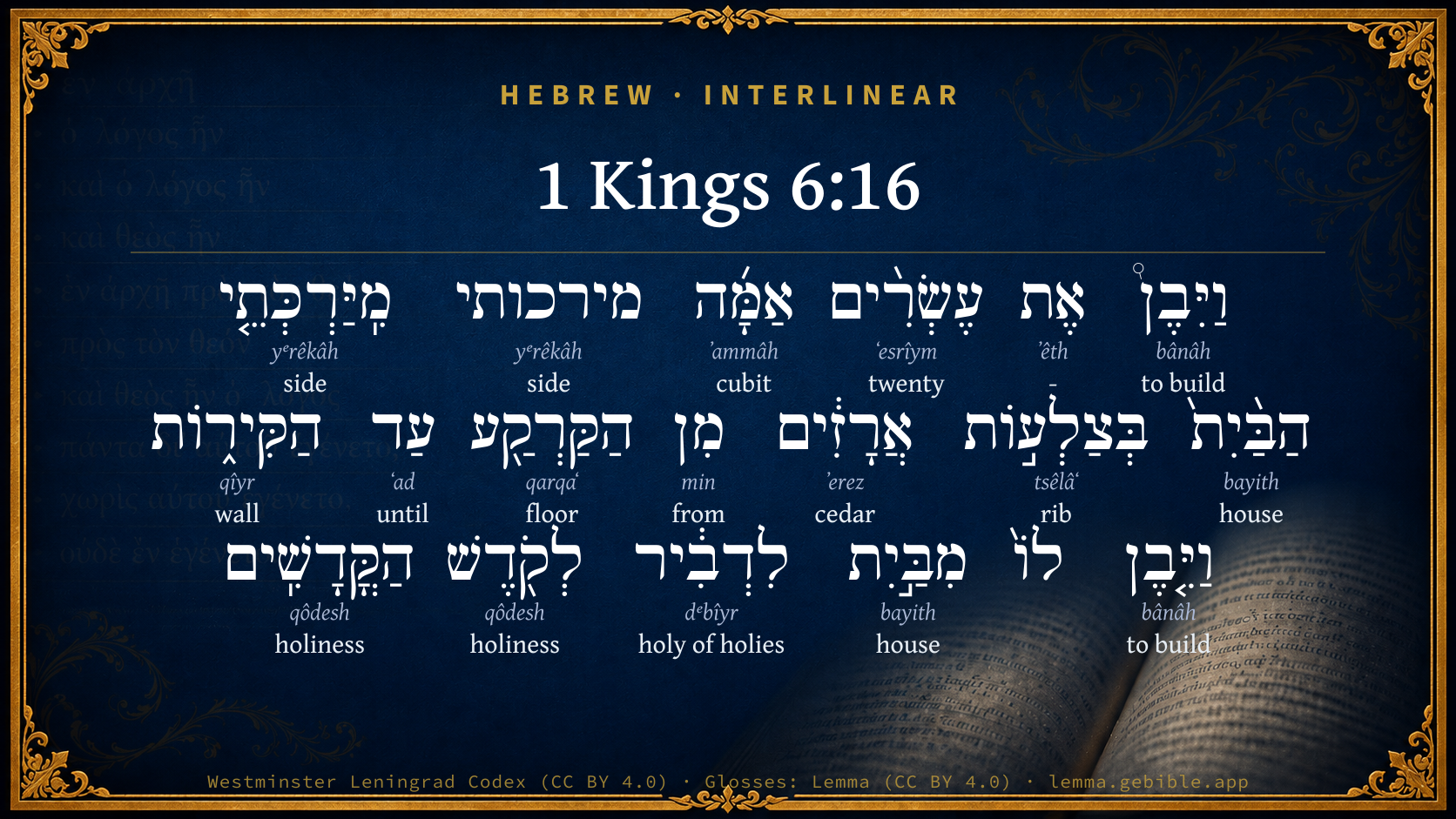
Hebrew (Westminster Leningrad Codex) 1 Kings 6:16 appears in the Hebrew Old Testament. The text above is from the Westminster Leningrad Codex. Each word links to its Strong’s number, a concise gloss, and parsing drawn from the Open Scriptures Hebrew Bible morphology. Click any word for its full Brown-Driver-Briggs (BDB) entry.
Download image
Cite this verse

1 Kings 6:16 (World English Bible). Public Domain. Lemma interlinear Bible study tool, https://lemma.gebible.app/v/1-kings/6/16.

Show BibTeX & RIS
BibTeX
RIS
English Translation
He built twenty cubits on the hinder part of the house with boards of cedar from the floor to the walls [of the ceiling]: he built [them] for it within, for an oracle, even for the most holy place.
World English Bible · Public Domain
Download a study sheet

One document with this verse’s original text, its word-by-word gloss line, the meaning frame, cross-references with their text, attributed commentary, and full source and license credits — printable, and it pastes into notes with its structure intact.

This verse Autodidact and up

Study sheet (.html) Plain text (.txt)

A passage Seminary Student

Up to 50 verses in one chapter. A passage sheet keeps up to 6 commentary sources and 12 cross-references per verse, in the order this page ranks them, and says so on the sheet whenever that leaves anything out. Ask for a single verse and you get the Autodidact verse sheet above.

Everything on this page stays free to read, with no account — the sheet is a download of what is already on screen, not access to it.

Want to remove ads? Support Godless Engineer
Compare translations 3

The same verse in 3 English versions, stacked beneath the original-language interlinear above. Click any original word for its lexicon entry.

Each is an independent rendering of the whole verse — the interlinear is not word-aligned to these translations.

Highlighted words mark where these versions differ — a whole-verse word diff, not a word-by-word alignment.

  • World English Bible Public Domain
    He built twenty cubits on the hinder part of the house with boards of cedar from the floor to the walls [of the ceiling]: he built [them] for it within, for an oracle, even for the most holy place.
  • King James Version Public Domain
    And he built twenty cubits on the sides of the house, both the floor and the walls with boards of cedar: he even built them for it within, even for the oracle, even for the most holy place.
  • unfoldingWord Literal Text CC BY-SA 4.0
    And he built 20 cubits from the recesses of the house with boards of cedar from the floor to the walls. And he built for it on the inside as an inner sanctuary, as the Holy of Holies.

unfoldingWord Literal Text — © unfoldingWord, licensed CC BY-SA 4.0. Word-aligned USFM3 via Door43 (git.door43.org/unfoldingWord/en_ult).

Versions to compare (up to 4)

3 of 4 selected

Show all 18 translations

Every available English version of this verse, each an independent rendering of the whole verse.

  • World English Bible Public Domain
    He built twenty cubits on the hinder part of the house with boards of cedar from the floor to the walls [of the ceiling]: he built [them] for it within, for an oracle, even for the most holy place.
  • Berean Standard Bible Public Domain
    He partitioned off the twenty cubits at the rear of the temple with cedar boards from floor to ceiling to form within the temple an inner sanctuary, the Most Holy Place.
  • Majority Standard Bible Public Domain
    He partitioned off the twenty cubits at the rear of the temple with cedar boards from floor to ceiling to form within the temple an inner sanctuary, the Most Holy Place.
  • King James Version Public Domain
    And he built twenty cubits on the sides of the house, both the floor and the walls with boards of cedar: he even built them for it within, even for the oracle, even for the most holy place.
  • American Standard Version (1901) Public Domain
    And he built twenty cubits on the hinder part of the house with boards of cedar from the floor unto the walls `of the ceiling': he built `them' for it within, for an oracle, even for the most holy place.
  • Revised Version (1885) Public Domain
    And he built twenty cubits on the hinder part of the house with boards of cedar from the floor unto the walls: he even built them for it within, for an oracle, even for the most holy place.
  • Geneva Bible (1599) Public Domain
    And he built twentie cubites in the sides of the house with boards of cedar, from the floore to the walles, and he prepared a place within it for the oracle, euen the most holy place.
  • Douay-Rheims (1899) Public Domain
    And he built up twenty cubits with boards of cedar at the hinder part of the temple, from the floor to the top: and made the inner house of the oracle to be the holy of holies.
  • Young's Literal Translation Public Domain
    And he buildeth the twenty cubits on the sides of the house with ribs of cedar, from the floor unto the walls; and he buildeth for it within, for the oracle, for the holy of holies.
  • Literal Standard Version CC BY-SA 4.0
    And he builds the twenty cubits on the sides of the house with ribs of cedar, from the floor to the walls; and he builds for it within, for the oracle, for the Holy of Holies.
  • Unlocked Literal Bible CC BY-SA 4.0
    He built twenty cubits onto the rear of the house with boards of cedar from the floor to the ceiling. He built this room to be the inner room, the most holy place.
  • unfoldingWord Literal Text CC BY-SA 4.0
    And he built 20 cubits from the recesses of the house with boards of cedar from the floor to the walls. And he built for it on the inside as an inner sanctuary, as the Holy of Holies.
  • Darby Bible Public Domain
    And he built twenty cubits of the innermost part of the house, both floor and walls, with boards of cedar; and he built [them] for it within, to [be] the oracle, the most holy place.
  • World Messianic Bible Public Domain
    He built twenty cubits of the back part of the house with boards of cedar from the floor to the ceiling. He built this within, for an inner sanctuary, even for the most holy place.
  • Webster's Bible Public Domain
    And he built twenty cubits on the sides of the house, both the floor and the walls with boards of cedar: he even built them for it within, even for the oracle, even for the most holy place.
  • Free Bible Version CC BY-SA 4.0
    He sectioned off twenty cubits at the rear of the Temple with boards of cedar from floor to ceiling, making an inner sanctuary as the Most Holy Place.
  • Bible in Basic English Public Domain
    And at the back of the house a further space of twenty cubits was shut in with boards of cedar-wood, for the inmost room.
  • JPS Tanakh (1917) Public Domain
    And he built twenty cubits on the hinder part of the house with boards of cedar from the floor unto the joists; he even built them for himself within, for a Sanctuary, even for the most holy place.

Literal Standard Version (2020), Covenant Press — licensed CC BY-SA 4.0. Text via the HelloAO Bible API (eBible.org). Unlocked Literal Bible (unfoldingWord) — licensed CC BY-SA 4.0. Text via the HelloAO Bible API (eBible.org). unfoldingWord Literal Text — © unfoldingWord, licensed CC BY-SA 4.0. Word-aligned USFM3 via Door43 (git.door43.org/unfoldingWord/en_ult). Free Bible Version, Dr. Jonathan Gallagher — licensed CC BY-SA 4.0. Text via the HelloAO Bible API (eBible.org).

Word by word

More ways to search: Search by grammar → Find every occurrence → Compare this word →

Practice this passage: Drill this verse → Learn its vocabulary →

הַקַּרְקַ֖ע
qarqaʻ
H7172
“the · floor”
Particle, Definite Article + Noun, Common, Masculine, Singular, Absolute
Part of Speech
Particle + Noun
Type
Common
Gender
Masculine
Number
Singular
State
Absolute
Full BDB Definition

Origin: from H7167

TWOT: 2076

floor, bottom
  1. וַיִּבֶן֩ bânâh H1129 “and · to build” Conjunction + Verb, Qal, Sequential Imperfect, 3rd Person, Masculine, Singular
  2. אֶת ʼêth H853 “-” Particle, Direct Object
  3. עֶשְׂרִ֨ים ʻesrîym H6242 “twenty” Adjective, Cardinal number, Both, Plural, Absolute
  4. אַמָּ֜ה ʼammâh H520 “cubit” Noun, Common, Feminine, Singular, Absolute
  5. מירכותי yᵉrêkâh H3411 “from · sides of” Preposition + Noun, Common, Feminine, Dual, Construct
  6. מִֽיַּרְכְּתֵ֤י yᵉrêkâh H3411 “from · sides of” Preposition + Noun, Common, Feminine, Dual, Construct
  7. הַבַּ֨יִת֙ bayith H1004 “the · house” Particle, Definite Article + Noun, Common, Masculine, Singular, Absolute
  8. בְּצַלְע֣וֹת tsêlâʻ H6763 “in/at · ribs of” Preposition + Noun, Common, Both, Plural, Construct
  9. אֲרָזִ֔ים ʼerez H730 “cedars” Noun, Common, Masculine, Plural, Absolute
  10. מִן min H4480 “from” Preposition
  11. עַד ʻad H5704 “until” Preposition
  12. הַקִּיר֑וֹת qîyr H7023 “the · walls” Particle, Definite Article + Noun, Common, Masculine, Plural, Absolute
  13. וַיִּ֤בֶן bânâh H1129 “and · to build” Conjunction + Verb, Qal, Sequential Imperfect, 3rd Person, Masculine, Singular
  14. מִבַּ֣יִת bayith H1004 “from · house” Preposition + Noun, Common, Masculine, Singular, Absolute
  15. לִדְבִ֔יר dᵉbîyr H1687 “to/for · holy of holies” Preposition + Noun, Common, Masculine, Singular, Absolute
  16. לְקֹ֖דֶשׁ qôdesh H6944 “to/for · holiness of” Preposition + Noun, Common, Masculine, Singular, Construct
  17. הַקֳּדָשִֽׁים qôdesh H6944 “the · holy things” Particle, Definite Article + Noun, Common, Masculine, Plural, Absolute

About this verse

These counts appear in no published source. They are computed here, from the morphology-tagged text and Lemma’s own curated glosses. What Lemma adds →

19
words
14
distinct lemmas
Historical
section

Notable vocabulary

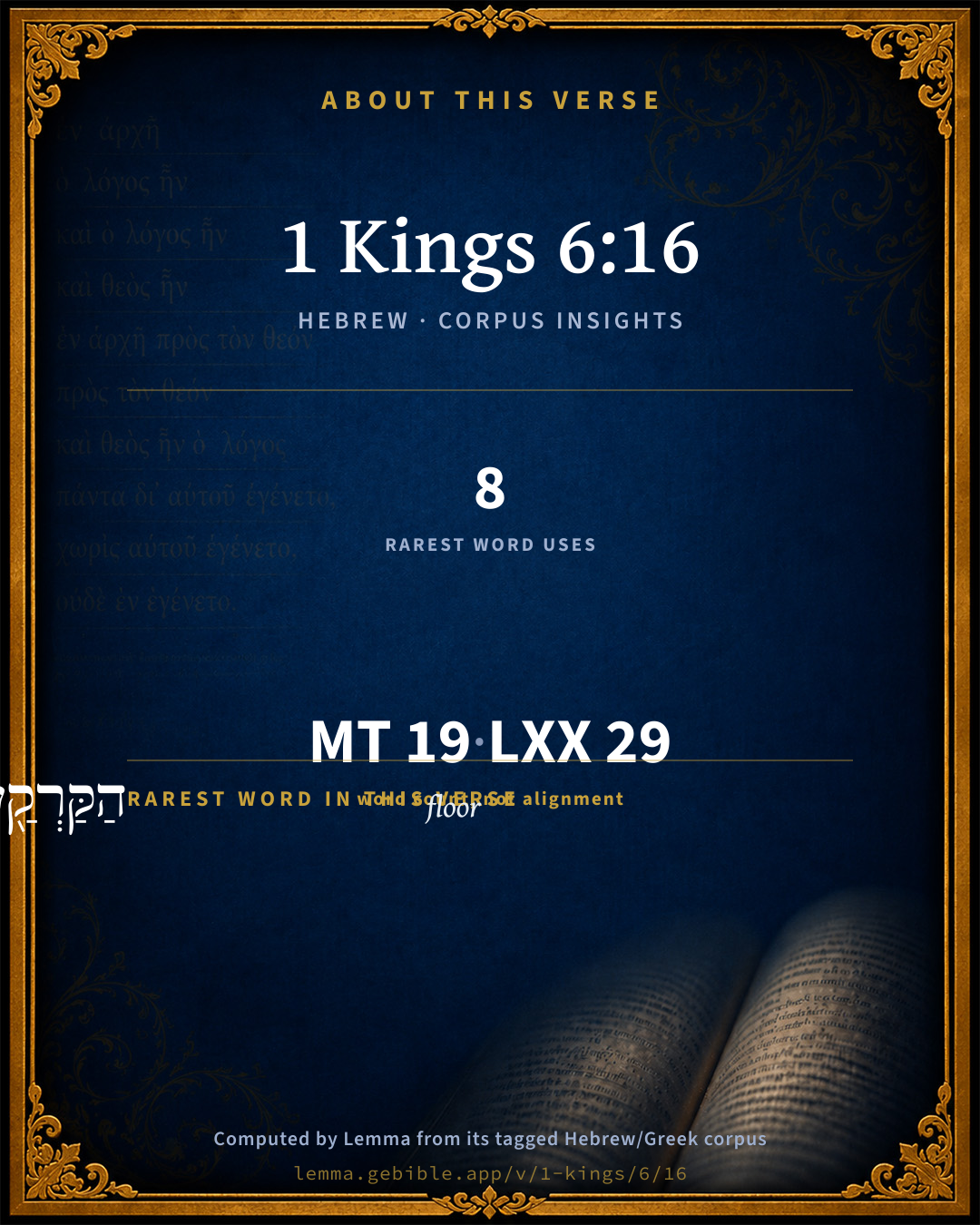
The rarest word here is הַקַּרְקַ֖ע floor H7172 — appearing just 8 times in the whole Hebrew Bible.

Shared distinctive vocabulary

הַקַּרְקַ֖ע floor H7172 occurs in 6 verses of the Hebrew Bible. Also found in:

Grammatical profile

  • 2 verbs
  • 12 nouns
  • 1 adjective
  • 3 prepositions
  • 1 particle

Verb forms

  • וַיִּבֶן֩ Qal · Sequential Imperfect
  • וַיִּ֤בֶן Qal · Sequential Imperfect

Repetition

Words recur within this verse — often emphatic in Hebrew:

  • וַיִּבֶן֩ to build H1129 ×2
  • מירכותי side H3411 ×2
  • הַבַּ֨יִת֙ house H1004 ×2
  • לְקֹ֖דֶשׁ holiness H6944 ×2

Hebrew & Septuagint length

In English translation the verse runs 39 words from the Hebrew and 32 from the Septuagint (LXX English) — closely comparable.

A rough comparison of the two English renderings, which tokenize alike — not a word-level alignment.

Word counts can differ between the Hebrew and the Greek without any difference in meaning — e.g. the Hebrew direct-object marker אֵת has no separate Greek word, and Greek often adds the article ὁ.

In the original languages it is 19 Hebrew tokens and 29 Greek tokens — but the two are counted differently (Hebrew bundles its prefixes and suffixes into one token; the Greek is in lemma form), so that isn’t a like-for-like length.

Cross-references

10

Topical passages linked to 1 Kings 6:16 in the Treasury of Scripture Knowledge — connected by theme and wording, ordered by reader-vote popularity; previews shown in the World English Bible.

  • 1 Kings 8:6 The priests brought in the ark of the covenant of Yahweh to its place, into the oracle of the house, to the most holy place, even under the wings of the cherubim.
  • 2 Chronicles 3:8 He made the most holy house: the length of it, according to the breadth of the house, was twenty cubits, and the breadth of it twenty cubits; and he overlaid it with fine gold, amounting to six hundred talents.
  • Leviticus 16:2 and Yahweh said to Moses, "Tell Aaron your brother, not to come at all times into the Most Holy Place within the veil, before the mercy seat which is on the ark; lest he die: for I will appear in the cloud on the mercy seat.
  • Hebrews 9:3 After the second veil was the tabernacle which is called the Holy of Holies,
  • Ezekiel 45:3 Of this measure shall you measure a length of twenty-five thousand, and a breadth of ten thousand: and in it shall be the sanctuary, which is most holy.
  • Exodus 25:21–22 You shall put the mercy seat on top of the ark, and in the ark you shall put the testimony that I will give you.
  • Exodus 26:23 Two boards shall you make for the corners of the tent in the far part.
  • Exodus 26:33–34 You shall hang up the veil under the clasps, and shall bring the ark of the testimony in there within the veil: and the veil shall separate the holy place from the most holy for you.
  • 1 Kings 6:5 Against the wall of the house he built stories round about, against the walls of the house round about, both of the temple and of the oracle; and he made side-chambers round about.
  • 1 Kings 6:19–20 He prepared an oracle in the midst of the house within, to set there the ark of the covenant of Yahweh.

Cross-references courtesy of OpenBible.info (CC BY 4.0).

Hebrew and Greek witnesses Masoretic Hebrew ↔ Greek Septuagint

The same verse in the two great witnesses to the Old Testament, shown verse-for-verse.

These are two independent witnesses, not word-aligned to each other, and the Septuagint is shown in lemma (dictionary) form.

Hebrew 1 Kings 6:16 Masoretic · Westminster Leningrad Codex

וַיִּבֶן֩ אֶת עֶשְׂרִ֨ים אַמָּ֜ה מירכותי מִֽיַּרְכְּתֵ֤י הַבַּ֨יִת֙ בְּצַלְע֣וֹת אֲרָזִ֔ים מִן הַקַּרְקַ֖ע עַד הַקִּיר֑וֹת וַיִּ֤בֶן לוֹ֙ מִבַּ֣יִת לִדְבִ֔יר לְקֹ֖דֶשׁ הַקֳּדָשִֽׁים

He built twenty cubits on the hinder part of the house with boards of cedar from the floor to the walls [of the ceiling]: he built [them] for it within, for an oracle, even for the most holy place.

World English Bible · Public Domain

Greek LXX 1 Kings 6:16 Septuagint · lemma form

καί οἰκοδομέω ὁ εἴκοσι πῆχυς ἀπό ἄκρος ὁ οἶκος ὁ πλευρόν ὁ εἷς ἀπό ὁ ἔδαφος ἕως ὁ δοκός καί ποιέω ἐκ ὁ δαβιρ εἰς ὁ ἅγιος ὁ ἅγιος

And he built the twenty cubits from the top of the wall, one side from the floor to the beams, and he made it from the oracle to the most holy place.

LXX2012 (modern English Septuagint) · Public Domain

On this verse, The Cambridge Bible for Schools and Colleges discusses the Septuagint’s reading. Read the note in Commentary ↓

Hebrew: Westminster Leningrad Codex (CC BY 4.0). Greek: Septuagint (public domain); English from LXX2012 (modern English Septuagint) (Public Domain). How the Septuagint differs from the Hebrew →

Targum (Aramaic paraphrase)

1

The Targum is the ancient Jewish Aramaic paraphrase of the Hebrew Scriptures — an interpretive translation, not the Hebrew text itself. Onkelos (literal) and Pseudo-Jonathan (expansive) render the Torah, and Jonathan the Prophets. Coverage is partial: where no permissively-licensed English translation exists for a verse, only the Aramaic is shown. This is verse-level text, not a word-by-word alignment to the Hebrew.

  1. Targum Jonathan Prophets (Joshua–Malachi)
    וּבְנָא יַת עַסְרִין אַמִין מִסְיָפֵי בֵיתָא בֵמְחִיצַת אַרְזַיָא מִן אוּשַׁיָא עַד כָּתְלַיָא וּבְנָא לֵיהּ מִלְגָיו לְבֵית כֵּפּוֹרֵי לְקוֹדֶשׁ קוּדְשַׁיָא:

    (no public-domain English translation for this verse)

    Targum Jonathan — Aramaic: “Mikraot Gedolot” (public domain). English: “Sefaria Community Translation” (CC0 1.0 (public-domain dedication)); “London "Chaldee Paraphrase," 1871” (public domain). Text via Sefaria.

Commentary

Notes on 1 Kings 6:16 from classic Christian and Jewish commentators (each source and its license shown beneath its notes). The classic Christian expositions comment on the surrounding passage and are grouped to its opening verse, so a note may address several verses; the Jewish commentaries on the Tanakh (Rashi and others) are per-verse, so they appear only where the commentator wrote on this verse.

Lemma curates 59 commentaries, every one of them public domain or Creative Commons licensed, each selected and text-cleaned for this edition rather than reprinted as found. About our sources →

Trapp's Complete Commentary

John Trapp

1Ki 6:16 And he built twenty cubits on the sides of the house, both the floor and the walls with boards of cedar: he even built [them] for it within, [even] for the oracle, [even] for the most holy [place].

Ver. 16. Even for the oracle.] {a} So the Holy of Holies is called, because there God used to deliver divine answers, or oracles. {Lev 16:2 Exo 30:6}

{a} Loquutorium Adytum.

John Trapp, A Commentary or Exposition upon All the Books of the Old and New Testament (1647–1656) — public domain. Text from a community e-Sword module.

Joseph Benson's Commentary

1Ki 6:16. He built twenty cubits on the sides of the house — He speaks here of the most holy place, which contained in length twenty cubits, and might be said to be on the sides of the house, because it took off twenty cubits in length from each side of the house, and was also twenty cubits from side to side, so it was twenty cubits every way. He built them for it within, even for the oracle, the most holy place — The last words are added to explain what he means by the word oracle, which he had not used before: this was the most important of all the parts of the house, because here the divine glory was present, and from hence God gave answers when he was consulted, on which account it is termed the oracle.

Joseph Benson's Commentary on the Old and New Testaments (1811–1818) — public domain. Text from a community e-Sword module.

Ellicott's Commentary for English Readers

(16, 17) These verses describe the division of the Temple, by a partition from floor to ceiling of cedar wood, into “the Oracle,” or Holy of Holies, occupying twenty cubits of the length, and the rest of the house, exclusive of the porch, occupying forty cubits. The cedar panelling was carved throughout with (see margin) “gourds and open flowers,” probably festooned, as usual in ancient architecture. In all this the influence of the Tyrian architects was probably felt.

A Bible Commentary for English Readers, edited by Charles John Ellicott (1878–1897) — public domain. Text from a community e-Sword module.

The Cambridge Bible for Schools and Colleges

gen. ed. J. J. S. Perowne

16. And he built twenty cubits on the sides of the house] This rendering does not make very clear what is intended. The word translated ‘sides’ is often used for the innermost part of anything, as of a cave (1Sa_24:4), and of the recesses of a forest, as Lebanon (Isa_37:24). So here it signifies the innermost part of the Temple building as you looked from the porch, i.e. toward the farthest wall of the most holy place. The sense then becomes more manifest. He built at twenty cubits from this extreme end something with boards of cedar. Thus he made a separation of the most holy place, which was twenty cubits long, from the holy place. The R.V. gives this more clearly: ‘He built twenty cubits on the hinder part of the house’ with boards of cedar from the floor unto the walls (‘beams’ LXX.), i.e. these twenty cubits were thus shut off and made into a separate room (cf. 2Ch_3:8). There was a doorway for access in this cedarwood partition (see 1Ki_6:31), and before this probably were put the ‘chains of gold’ spoken of in 1Ki_6:21. From 2Ch_3:14 it seems that there was a vail in front of the whole of this woodwork, though no mention of it is made here.

It is very difficult to come to a clear idea about the room here provided. It seems certain that it was enclosed on three sides by the chambers built round about, so that there could have been no windows in it, nor any mode of escape for the smoke of the incense, except by openings under the eaves. It appears not to have been as high as the roof of the ‘holy place’. We must remember that it was to be entered by one person only, and that but once a year.

he even built them for it within] i.e. He prepared this space of twenty cubits in the innermost part of the house, to be a separate room.

even for the oracle] The Hebrew says merely ‘for an oracle.’ This name for the most holy place is taken from the Vulgate ‘oraculum.’ The LXX. merely transliterates the Hebrew δαβίρ. The word is connected with the verb דבר (davar), usually rendered ‘to speak,’ and hence the notion of ‘oracle’ as the place where God revealed Himself. So Aquila and Symmachus rendered it sometimes by χρηματιστήριον, and Jerome gives λαλητήριον as an explanation. But the root, or its Arabic cognate, has a sense from which the meaning ‘hinder portion’ might come. Hence some consider the name merely as signifying the innermost part of the Temple building.

the most holy place] Described in the same words in the account of the Tabernacle (Exo_26:33-34; Num_4:4; Num_4:19).

The Cambridge Bible for Schools and Colleges (gen. ed. J. J. S. Perowne; Cambridge University Press, 1878–1918) — public domain. Text from a community e-Sword module.

John Gill's Exposition

And the house, that is, the temple before it,.... The holy place, which was before the of holies:

was forty cubits long; and which, with the most holy place, being twenty cubits, as in the preceding verse, made the length of the whole house sixty cubits, as in Kg1 6:2.

John Gill's Exposition of the Whole Bible (1746–1763) — public domain (CC PDM 1.0). Text via the HelloAO Bible API.

Albert Barnes' Notes on the Bible

The meaning is, that at the distance of 20 cubits, measured along the side walls of the house from the end wall, Solomon constructed a partition, which reached from the floor to the ceiling and had a doorway in it. He thus made within the house, a sanctuary for a holy of holies.

Albert Barnes' Notes on the Bible (1834–1885) — public domain. Text from a community e-Sword/MySword module.

Haydock's Catholic Bible Commentary

The inner house of the oracle. That is, the sanctuary, which he separated from the other part of the temple, with this partition of cedar, instead of the veil, which in the tabernacle of Moses hung before the sanctuary. (Challoner) --- It was a square of 20 cubits, extending from the western end. (Haydock) --- Hither none but the high priest was allowed to enter, and he but once a year. (Calmet)

George Leo Haydock (1774–1849), Haydock's Catholic Family Bible and Commentary, 1859 edition — public domain. Excludes Psalms (Douay-Rheims chapter numbering differs from Protestant) and Deuterocanonical books (Catholic canon only).

Matthew Poole's English Annotations

Twenty cubits on the sides of the house, i.e. the most holy place, which contained in the length of the house twenty cubits, by comparing this with 1Ki 6:2,17, which may be said to be on the sides of the house because this part took off twenty cubits in length from each side of the house, and was also twenty cubits from side to side; so it was twenty cubits every way. Or, on the sides (i.e. on all the sides, as indeed it was) of the house, or of that house, to wit, the most holy place, as it here follows. Or, from the sides of the house, i.e. from one side to the other. And so this is meant only of the partitionwall, which was between the holy and the most holy place.

Both the floor and the walls, or rather, as 1Ki 6:15, from the floor to the wall, or ceiling, or roof. So it is not necessary, at least by virtue of these words, to understand this, as they generally do, that the floor itself was built with cedar; but only all the sides of it from the bottom twenty cubits upward. If it be said that the whole house, and consequently the most holy place, was thirty cubits high, 1Ki 6:2, it may be replied, either that that is true only of the greater house, or the holy place, which is called the house, 1Ki 6:17, and that the lesser, or the most holy place, was but twenty cubits high, as divers think; or that the ten cubits at the top were covered with some other wood or thing, or were left open, that it might thereby receive both light from the candlesticks, and smoke from the altar of incense.

For the oracle, even for the most holy place, i. e. that it might be the oracle, or the most holy place. Or, on the inner side (whereby he might imply that the outside of the partition-wall which looked towards the holy place was not so covered) of (for the Hebrew lamed is very oft a note of the genitive case) the oracle, even of the most holy place; which last words are added to explain what he means by the word oracle, which he had not used before.

Matthew Poole's English Annotations on the Holy Bible (1683–1685) — public domain. Text from a community e-Sword/MySword module.

Whedon's Commentary on the Bible

Daniel D. Whedon

16. Twenty cubits on the sides — Rather, From the two hinder sides, ירכותי, “the hindmost, last extreme space, which is conceived of as two hinder sides.” — Furst. The inner sanctuary was a perfect cube. See on 1Ki_6:20.

Both the floor and the walls — Here again it should be rendered from the floor to the walls; but the expression seems to imply that all the walls, (קירות) both of the sides and of the ceiling were covered with cedar boards.

The oracle — דבר, the interior place, called also the most holy or holy of belies. The place of greatest sanctity, where the presence and glory of Jehovah were supposed to have their central throne on earth. (C in plan.) See on Exo_26:33-34. Here in the temple, as in the tabernacle, was set the ark. 1Ki_6:19.

Daniel D. Whedon (gen. ed.), Commentary on the Old and New Testaments (1874–1909) — public domain. Text from a community e-Sword module.

The Pulpit Commentary

And he built twenty cubits on Heb. from the sides of the house both the floor and the walls Heb. as in ver. 15, "from the floor to the walls" (or beams). If twOryqi is a copyist"s error, it is repeated here with boards of cedar He is now speaking of the wooden partition which separated the oracle from the temple of the house. At a distance of 20 cubits, measured along the sides from the west end of the house, he erected a cedar wall which reached from the floor to the cieling he even built them i.e., the 20 cubits for it the house) within The meaning is clear, though the construction is somewhat involved, viz., that he reared this partition inside the house to separate a portion for the oracle even for the oracle Heb. an oracle even for the most holy place Heb. for the holy of holies.

The Pulpit Commentary (1880–1919), ed. H.D.M. Spence-Jones & Joseph S. Exell — public domain. Text from a community e-Sword module.

John Wesley's Explanatory Notes

House - That is, the most holy place, which contained in length twenty cubits, which may be said to be on the sides Of the house, because this part took off twenty cubits in length from each side of the house, and was also twenty cubits from side to side, so it was twenty cubits every way. The oracle-the most holy place - The last words are added, to explain what he means by the word oracle, which he had not used before.

John Wesley, Explanatory Notes Upon the Whole Bible (1754–1765) — public domain. Text via the GEBible commentary corpus.

unfoldingWord translationNotes

Door43 World Missions Community

He built twenty cubits ... He built this room

Solomon would have commanded his workers to do the building. AT: "He commanded them to build twenty cubits ... He had them build this room" (See: Metonymy)

He built twenty cubits

"He built a room twenty cubits long"

twenty cubits ... forty cubits

A cubit is 46 centimeters. AT: "9.2 meters ... 18.4 meters" (See: Biblical Distance)

main hall

"main room"

gourds

a type of hard, round vegetable that grows on a vine on the ground

open flowers

"blooming flowers" or "flowers that were open"

translationWords

holy place

unfoldingWord translationNotes — © Distant Shores Media and the Door43 World Missions Community, licensed CC BY-SA 4.0. Source: git.door43.org/Door43/en_tn.

Rashi

Rabbi Shlomo Yitzchaki (Rashi)

The twenty amohs at the end of the Beis Hamikdosh. The twenty [amohs] which were at the end of the Sanctuary and beyond, and the twenty [amohs] which were at the end of the building, they are the house containing the Ark cover (i.e., the Holy of Holies).

To the ceiling. He made the walls of cedar until the ceiling to cover the walls of stone in order to coat it with gold.

He built it. Those twenty amohs.

On the inner side of the partition. Inward of the “Amma Traksin” [partition], which separated between the forty [amohs] and the twenty [amohs], and that partition is called “Dvir.”

For the Holy of Holies. He designated those twenty amohs.

Rashi on the Tanakh — English translations: “The Judaica Press complete Tanach with Rashi, translated by A. J. Rosenberg” (CC BY 4.0); “Pentateuch with Rashi's commentary by M. Rosenbaum and A.M. Silbermann, 1929-1934” (public domain); “The Metsudah Tanach series, Lakewood, N.J” (CC BY 4.0); and “The Book of Joshua, Metsudah Publications, 1997” (CC BY 4.0). Text via Sefaria.

Lesson kit

Teaching starters — assembled from the data on this page, not authored interpretation. Every prompt links to the verse data it draws on. Edit before teaching.

1 Kings, in the Historical, opens this verse with 19 words (14 distinct Hebrew lemmas). Its most distinctive word is qarqaʻ (“floor”). A historical commentator’s framing appears above. Read the whole chapter for the surrounding context.

Discussion questions

  1. The word qarqaʻ carries the sense “floor.” How does it shape the verse?
  2. Numbers 5:17 shares the word «floor» with this verse. How do the two illuminate each other?
  3. “to build” occurs 2× in this one verse. What is the effect of the repetition?
  4. These translations render this verse differently. What is at stake in choosing one wording over another?
  5. The verb «וַיִּבֶן֩» is Qal Sequential Imperfect. How does its form color the action?
  6. Reading how Trapp's Complete Commentary and Joseph Benson's Commentary read this verse, where do the two commentators agree and where do they part?

Things to notice

Reading settings

Reading text

Shown beneath each verse's original-language words.

Old Testament
Old Testament edition

Read the OT as the Masoretic Hebrew (MT) or the Greek Septuagint (LXX).

English shown for the Greek Septuagint (in the Hebrew ↔ Greek comparison).

Comparing translations? Open the Compare panel on any verse page to stack up to four side by side.