Leviticus 27:30

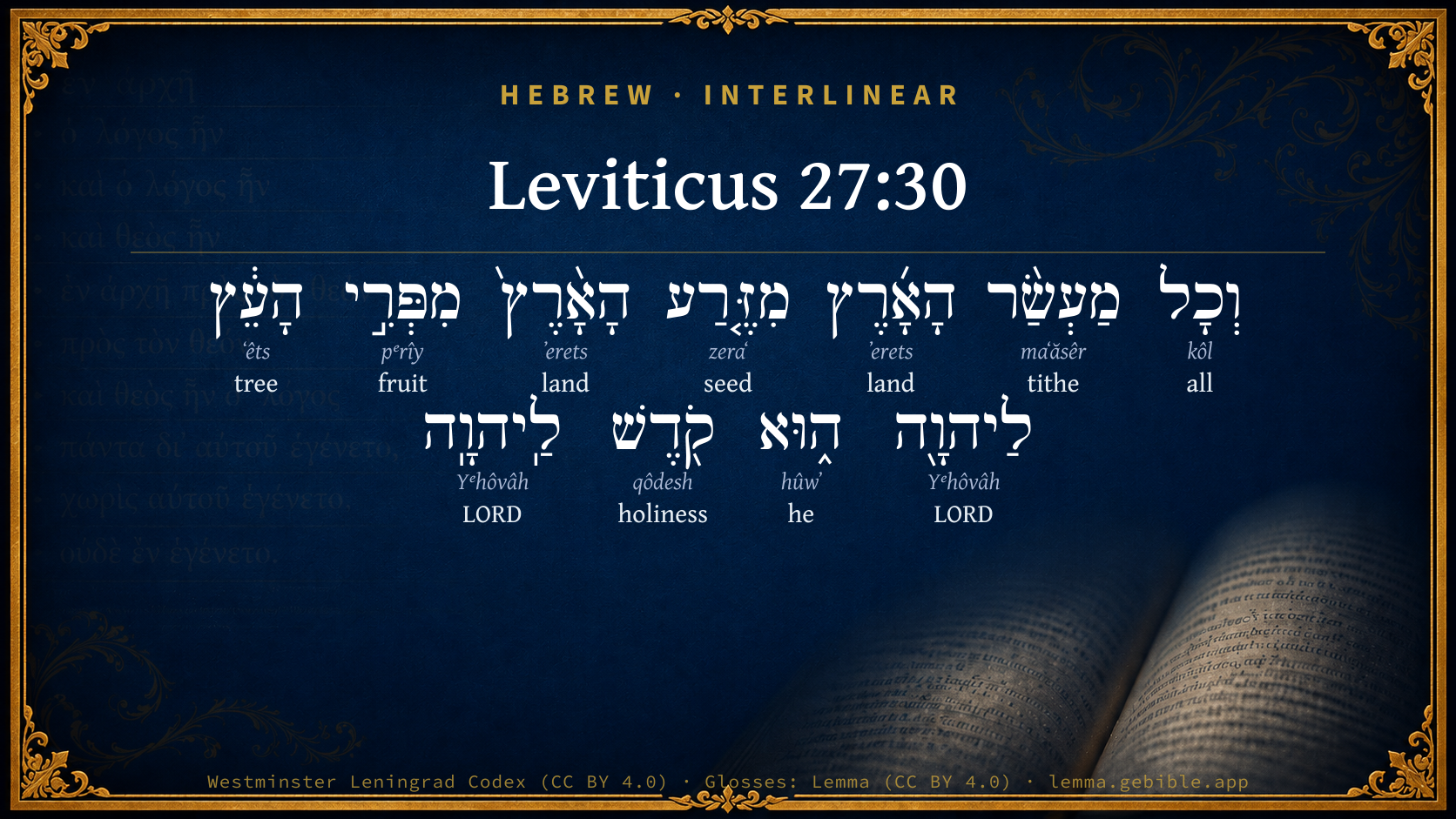
Hebrew (Westminster Leningrad Codex) Leviticus 27:30 appears in the Hebrew Old Testament. The text above is from the Westminster Leningrad Codex. Each word links to its Strong’s number, a concise gloss, and parsing drawn from the Open Scriptures Hebrew Bible morphology. Click any word for its full Brown-Driver-Briggs (BDB) entry.
Download image
Cite this verse

Leviticus 27:30 (World English Bible). Public Domain. Lemma interlinear Bible study tool, https://lemma.gebible.app/v/leviticus/27/30.

Show BibTeX & RIS
BibTeX
RIS
English Translation
"'All the tithe of the land, whether of the seed of the land or of the fruit of the trees, is Yahweh's. It is holy to Yahweh.
World English Bible · Public Domain
Download a study sheet

One document with this verse’s original text, its word-by-word gloss line, the meaning frame, cross-references with their text, attributed commentary, and full source and license credits — printable, and it pastes into notes with its structure intact.

This verse Autodidact and up

Study sheet (.html) Plain text (.txt)

A passage Seminary Student

Up to 50 verses in one chapter. A passage sheet keeps up to 6 commentary sources and 12 cross-references per verse, in the order this page ranks them, and says so on the sheet whenever that leaves anything out. Ask for a single verse and you get the Autodidact verse sheet above.

Everything on this page stays free to read, with no account — the sheet is a download of what is already on screen, not access to it.

Want to remove ads? Support Godless Engineer
Compare translations 3

The same verse in 3 English versions, stacked beneath the original-language interlinear above. Click any original word for its lexicon entry.

Each is an independent rendering of the whole verse — the interlinear is not word-aligned to these translations.

Highlighted words mark where these versions differ — a whole-verse word diff, not a word-by-word alignment.

  • World English Bible Public Domain
    "'All the tithe of the land, whether of the seed of the land or of the fruit of the trees, is Yahweh's. It is holy to Yahweh.
  • King James Version Public Domain
    And all the tithe of the land, whether of the seed of the land, or of the fruit of the tree, is the LORD's: it is holy unto the LORD.
  • unfoldingWord Literal Text CC BY-SA 4.0
    And all tithe of the land from the seed of the land, from the fruit of the tree, to Yahweh. It holy to Yahweh.

unfoldingWord Literal Text — © unfoldingWord, licensed CC BY-SA 4.0. Word-aligned USFM3 via Door43 (git.door43.org/unfoldingWord/en_ult).

Versions to compare (up to 4)

3 of 4 selected

Show all 18 translations

Every available English version of this verse, each an independent rendering of the whole verse.

  • World English Bible Public Domain
    "'All the tithe of the land, whether of the seed of the land or of the fruit of the trees, is Yahweh's. It is holy to Yahweh.
  • Berean Standard Bible Public Domain
    Thus any tithe from the land, whether from the seed of the land or the fruit of the trees, belongs to the LORD; it is holy to the LORD.
  • Majority Standard Bible Public Domain
    Thus any tithe from the land, whether from the seed of the land or the fruit of the trees, belongs to the LORD; it is holy to the LORD.
  • King James Version Public Domain
    And all the tithe of the land, whether of the seed of the land, or of the fruit of the tree, is the LORD's: it is holy unto the LORD.
  • American Standard Version (1901) Public Domain
    And all the tithe of the land, whether of the seed of the land, or of the fruit of the tree, is Jehovah's: it is holy unto Jehovah.
  • Revised Version (1885) Public Domain
    And all the tithe of the land, whether of the seed of the land, or of the fruit of the tree, is the LORD’S: it is holy unto the LORD.
  • Geneva Bible (1599) Public Domain
    Also all the tithe of the lande both of the seede of the ground, and of the fruite of the trees is the Lords: it is holy to the Lord.
  • Douay-Rheims (1899) Public Domain
    All tithes of the land, whether of corn, or of the fruits of trees, are the Lord's, and are sanctified to him.
  • Young's Literal Translation Public Domain
    And all tithe of the land, of the seed of the land, of the fruit of the tree, is Jehovah's -- holy to Jehovah.
  • Literal Standard Version CC BY-SA 4.0
    And all tithe of the land, of the seed of the land, of the fruit of the tree, is YHWH’s; [it is] holy to YHWH.
  • Unlocked Literal Bible CC BY-SA 4.0
    All the tithe of the land, whether grain grown on the land or fruit from the trees, is Yahweh's. It is holy to Yahweh.
  • unfoldingWord Literal Text CC BY-SA 4.0
    And all tithe of the land from the seed of the land, from the fruit of the tree, to Yahweh. It holy to Yahweh.
  • Darby Bible Public Domain
    And as to every tithe of the land, of the seed of the land, and of the fruit of the tree, it is Jehovah's: it is holy to Jehovah.
  • World Messianic Bible Public Domain
    “‘All the tithe of the land, whether of the seed of the land or of the fruit of the trees, is the LORD’s. It is holy to the LORD.
  • Webster's Bible Public Domain
    And all the tithe of the land, whether of the seed of the land, or of the fruit of the tree, is the LORD'S: it is holy to the LORD.
  • Free Bible Version CC BY-SA 4.0
    Tithe from your crops or fruit belongs to the Lord; it is holy to the Lord.
  • Bible in Basic English Public Domain
    And every tenth part of the land, of the seed planted, or of the fruit of trees, is holy to the Lord.
  • JPS Tanakh (1917) Public Domain
    And all the tithe of the land, whether of the seed of the land, or of the fruit of the tree, is the LORD'S; it is holy unto the LORD.

Literal Standard Version (2020), Covenant Press — licensed CC BY-SA 4.0. Text via the HelloAO Bible API (eBible.org). Unlocked Literal Bible (unfoldingWord) — licensed CC BY-SA 4.0. Text via the HelloAO Bible API (eBible.org). unfoldingWord Literal Text — © unfoldingWord, licensed CC BY-SA 4.0. Word-aligned USFM3 via Door43 (git.door43.org/unfoldingWord/en_ult). Free Bible Version, Dr. Jonathan Gallagher — licensed CC BY-SA 4.0. Text via the HelloAO Bible API (eBible.org).

Word by word

More ways to search: Search by grammar → Find every occurrence → Compare this word →

Practice this passage: Drill this verse → Learn its vocabulary →

מַעְשַׂ֨ר
maʻăsêr
H4643
“tithe of”
Noun, Common, Masculine, Singular, Construct
Part of Speech
Noun
Type
Common
Gender
Masculine
Number
Singular
State
Construct
Full BDB Definition

Origin: from H6240

TWOT: 1711h

tithe, tenth part - tenth part - tithe, payment of a tenth part
  1. וְכָל kôl H3605 “and · all of” Conjunction + Noun, Common, Masculine, Singular, Construct
  2. הָאָ֜רֶץ ʼerets H776 “the · land” Particle, Definite Article + Noun, Common, Both, Singular, Absolute
  3. מִזֶּ֤רַע zeraʻ H2233 “from · seed of” Preposition + Noun, Common, Masculine, Singular, Construct
  4. הָאָ֨רֶץ֙ ʼerets H776 “the · land” Particle, Definite Article + Noun, Common, Both, Singular, Absolute
  5. מִפְּרִ֣י pᵉrîy H6529 “from · fruit of” Preposition + Noun, Common, Masculine, Singular, Construct
  6. הָעֵ֔ץ ʻêts H6086 “the · tree” Particle, Definite Article + Noun, Common, Masculine, Singular, Absolute
  7. לַיהוָ֖ה Yᵉhôvâh H3068 “to/for · LORD” Preposition + Noun, Proper
  8. ה֑וּא hûwʼ H1931 “he” Pronoun, Personal, 3rd Person, Masculine, Singular
  9. קֹ֖דֶשׁ qôdesh H6944 “holiness” Noun, Common, Masculine, Singular, Absolute
  10. לַֽיהוָֽה Yᵉhôvâh H3068 “to/for · LORD” Preposition + Noun, Proper

About this verse

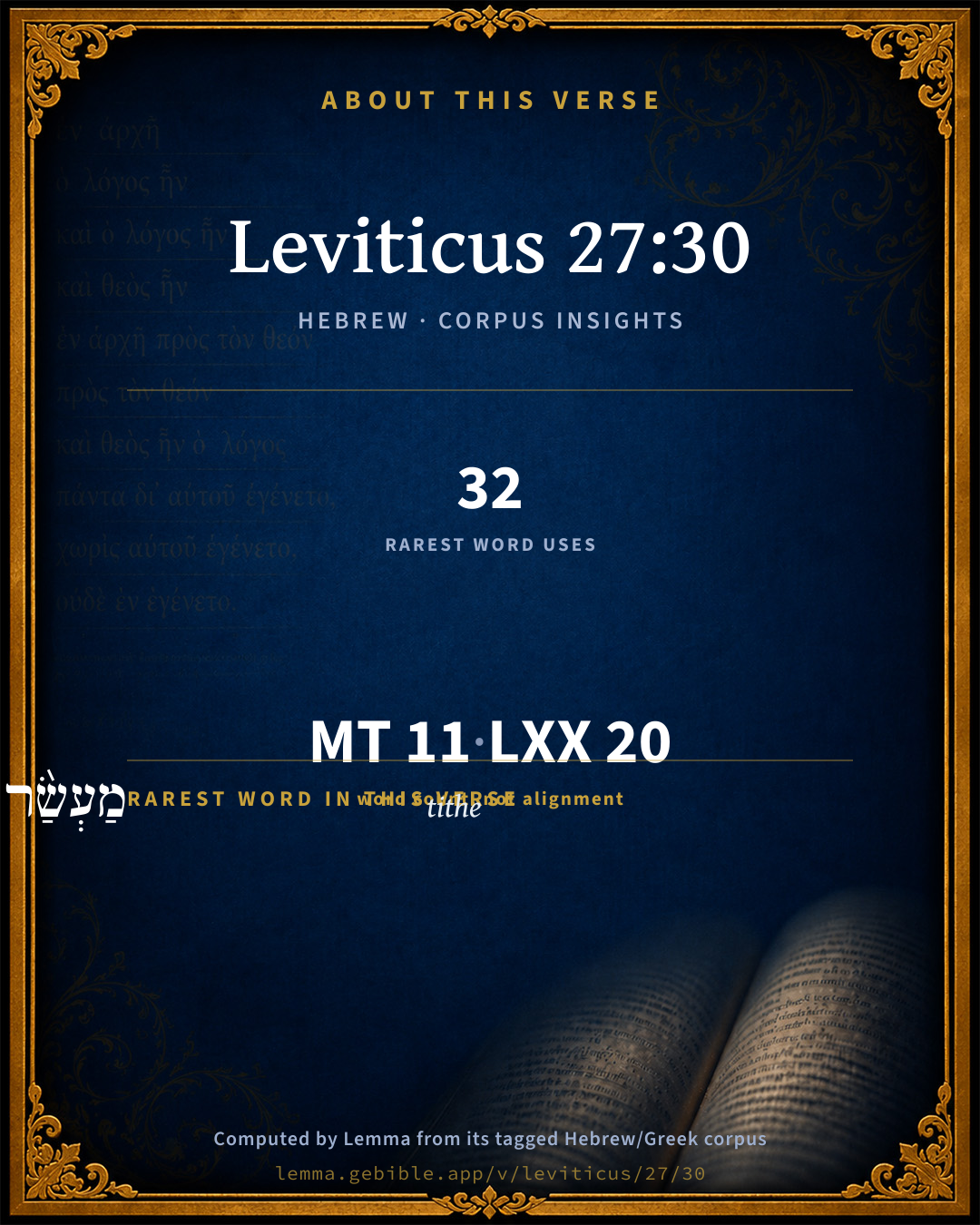
These counts appear in no published source. They are computed here, from the morphology-tagged text and Lemma’s own curated glosses. What Lemma adds →

11
words
9
distinct lemmas
Pentateuch
section

Shared distinctive vocabulary

מַעְשַׂ֨ר tithe H4643 occurs in 27 verses of the Hebrew Bible. Also found in:

Grammatical profile

  • 10 nouns
  • 1 pronoun

Repetition

Words recur within this verse — often emphatic in Hebrew:

  • הָאָ֜רֶץ land H776 ×2
  • לַיהוָ֖ה LORD H3068 ×2

Hebrew & Septuagint length

In English translation the verse runs 27 words from the Hebrew and 25 from the Septuagint (LXX English) — closely comparable.

A rough comparison of the two English renderings, which tokenize alike — not a word-level alignment.

Word counts can differ between the Hebrew and the Greek without any difference in meaning — e.g. the Hebrew direct-object marker אֵת has no separate Greek word, and Greek often adds the article ὁ.

In the original languages it is 11 Hebrew tokens and 20 Greek tokens — but the two are counted differently (Hebrew bundles its prefixes and suffixes into one token; the Greek is in lemma form), so that isn’t a like-for-like length.

Cross-references

16

Topical passages linked to Leviticus 27:30 in the Treasury of Scripture Knowledge — connected by theme and wording, ordered by reader-vote popularity; previews shown in the World English Bible.

  • Matthew 23:23 "Woe to you, scribes and Pharisees, hypocrites! For you tithe mint, dill, and cumin, and have left undone the weightier matters of the law: justice, mercy, and faith. But you ought to have done these, and not to have left the other undone.
  • Genesis 28:22 then this stone, which I have set up for a pillar, will be God's house. Of all that you will give me I will surely give the tenth to you."
  • Nehemiah 10:37–38 and that we should bring the first fruits of our dough, and our heave-offerings, and the fruit of all manner of trees, the new wine and the oil, to the priests, to the chambers of the house of our God; and the tithes of our ground to the Levites; for they, the Levites, take the tithes in all the cities of our tillage.
  • Nehemiah 13:12 Then brought all Judah the tithe of the grain and the new wine and the oil to the treasuries.
  • Genesis 14:20 and blessed be God Most High, who has delivered your enemies into your hand." Abram gave him a tenth of all.
  • 2 Chronicles 31:5–6 As soon as the commandment came abroad, the children of Israel gave in abundance the first fruits of grain, new wine, and oil, and honey, and of all the increase of the field; and the tithe of all things brought they in abundantly.
  • 2 Chronicles 31:12 They brought in the offerings and the tithes and the dedicated things faithfully: and over them Conaniah the Levite was ruler, and Shimei his brother was second.
  • Malachi 3:8–10 Will a man rob God? Yet you rob me! But you say, 'How have we robbed you?' In tithes and offerings.
  • Luke 18:12 I fast twice a week. I give tithes of all that I get.'
  • Luke 11:42 But woe to you Pharisees! For you tithe mint and rue and every herb, but you bypass justice and the love of God. You ought to have done these, and not to have left the other undone.
  • Hebrews 7:5–9 They indeed of the sons of Levi who receive the priest's office have a commandment to take tithes of the people according to the law, that is, of their brothers, though these have come out of the loins of Abraham,
  • Numbers 18:21–24 To the children of Levi, behold, I have given all the tithe in Israel for an inheritance, in return for their service which they serve, even the service of the tent of meeting.
  • Deuteronomy 12:5–6 But to the place which Yahweh your God shall choose out of all your tribes, to put his name there, even to his habitation shall you seek, and there you shall come;
  • Deuteronomy 14:22–23 You shall surely tithe all the increase of your seed, that which comes forth from the field year by year.
  • Nehemiah 12:44 On that day were men appointed over the chambers for the treasures, for the heave-offerings, for the first fruits, and for the tithes, to gather into them, according to the fields of the cities, the portions appointed by the law for the priests and Levites: for Judah rejoiced for the priests and for the Levites who waited.
  • Nehemiah 13:5 had prepared for him a great chamber, where before they laid the meal-offerings, the frankincense, and the vessels, and the tithes of the grain, the new wine, and the oil, which were given by commandment to the Levites, and the singers, and the porters; and the heave-offerings for the priests.

Cross-references courtesy of OpenBible.info (CC BY 4.0).

Hebrew and Greek witnesses Masoretic Hebrew ↔ Greek Septuagint

The same verse in the two great witnesses to the Old Testament, shown verse-for-verse.

These are two independent witnesses, not word-aligned to each other, and the Septuagint is shown in lemma (dictionary) form.

Hebrew Leviticus 27:30 Masoretic · Westminster Leningrad Codex

וְכָל מַעְשַׂ֨ר הָאָ֜רֶץ מִזֶּ֤רַע הָאָ֨רֶץ֙ מִפְּרִ֣י הָעֵ֔ץ לַיהוָ֖ה ה֑וּא קֹ֖דֶשׁ לַֽיהוָֽה

"'All the tithe of the land, whether of the seed of the land or of the fruit of the trees, is Yahweh's. It is holy to Yahweh.

World English Bible · Public Domain

Greek LXX Leviticus 27:30 Septuagint · lemma form

πᾶς δέκατος ὁ γῆ ἀπό ὁ σπέρμα ὁ γῆ καί ὁ καρπός ὁ ξύλινος ὁ κύριος εἰμί ἅγιος ὁ κύριος

Every tithe of the land, both of the seed of the land, and of the fruit of trees, is the Lord's, holy to the Lord.

LXX2012 (modern English Septuagint) · Public Domain

Hebrew: Westminster Leningrad Codex (CC BY 4.0). Greek: Septuagint (public domain); English from LXX2012 (modern English Septuagint) (Public Domain). How the Septuagint differs from the Hebrew →

Targum (Aramaic paraphrase)

2

The Targum is the ancient Jewish Aramaic paraphrase of the Hebrew Scriptures — an interpretive translation, not the Hebrew text itself. Onkelos (literal) and Pseudo-Jonathan (expansive) render the Torah, and Jonathan the Prophets. Coverage is partial: where no permissively-licensed English translation exists for a verse, only the Aramaic is shown. This is verse-level text, not a word-by-word alignment to the Hebrew.

  1. Targum Onkelos Torah (Genesis–Deuteronomy)
    וְכָל מַעְשְׂרָא דְאַרְעָא מִזַרְעָא דְאַרְעָא מִפֵּירֵי אִילָנָא דַיְיָ הוּא קוּדְשָׁא קֳדָם יְיָ

    (no public-domain English translation for this verse)

    Targum Onkelos — Aramaic: “Onkelos Genesis” (public domain); “Onkelos Exodus” (public domain); “Onkelos Leviticus” (public domain); “Onkelos Numbers” (public domain); “Onkelos Deuteronomy” (public domain). English: “Sefaria Community Translation” (CC0 1.0 (public-domain dedication)); “J.W. Etheridge. The Targums of Onkelos and Jonathan Ben Uzziel on the Pentateuch. London: Longmans, Green, 1862” (public domain). Text via Sefaria.

  2. Targum Pseudo-Jonathan Torah (Genesis–Deuteronomy)
    וְכָל מַעַשְרָא דְאַרְעָא מִזַרְעָא דְאַרְעָא וּמִפֵּירֵי אִילָנָא דַיְיָ הוּא קוֹדֶשׁ קוּדְשִׁין הוּא קֳדָם יְיָ

    And all the tythe of the land, of the seed of the ground, or the fruits of the tree, is the Lord's, and is most sacred before the Lord.

    Targum Pseudo-Jonathan — Aramaic: “Targum Jonathan on Genesis” (public domain); “Targum Jonathan on Exodus” (public domain); “Targum Jonathan on Leviticus” (public domain); “Targum Jonathan on Numbers” (public domain); “Targum Jonathan on Deuteronomy” (public domain). English: “The Targum of Jonathan ben Uzziel, trans. J. W. Etheridge, London, 1862” (public domain). Text via Sefaria.

Commentary

Notes on Leviticus 27:30 from classic Christian and Jewish commentators (each source and its license shown beneath its notes). The classic Christian expositions comment on the surrounding passage and are grouped to its opening verse, so a note may address several verses; the Jewish commentaries on the Tanakh (Rashi and others) are per-verse, so they appear only where the commentator wrote on this verse.

Lemma curates 59 commentaries, every one of them public domain or Creative Commons licensed, each selected and text-cleaned for this edition rather than reprinted as found. About our sources →

Trapp's Complete Commentary

John Trapp

Lev 27:30 And all the tithe of the land, [whether] of the seed of the land, [or] of the fruit of the tree, [is] the LORD’S: [it is] holy unto the LORD.

Ver. 30. And all the tithe.] See here in this chapter what a liberal maintenance God allowed the priests: (1.) Various votive oblations, or their redemptions; (2.) All the firstborn, or their redemptions; (3.) Every devoted thing, unless devoted to some particular use; (4.) All the tithes of what kind soever: besides firstfruits, oblations, portions of sacrifices, &c. And I see not, saith a reverend man, {a} but that tithes at least, or some better thing, should be due to the ministers of the gospel by Divine ordinance: and that those that take them from us should give us a better thing, as those here that had a mind to redeem their tithe, were bound by the law to add to the price every fifth penny above the true value.

{a} Mr Wilkinson’s Debt Book.

John Trapp, A Commentary or Exposition upon All the Books of the Old and New Testament (1647–1656) — public domain. Text from a community e-Sword module.

The Biblical Illustrator

Joseph S. Exell

Lev_27:30-33

All the tithes of the land . . . is the Lords.

The history of tithes

I. The scripture records concerning the law of tithes.

1. Antecedent to the Mosaic legislation. The principle of dedicating a tenth to God was recognised in the act of Abraham, who paid tithes of his spoils to Melchizedek in his sacerdotal rather than his sovereign capacity (Gen_14:20; Heb_7:6). Later, in Jacobs vow (Gen_28:22), the dedication of a tenth presupposes a sacred enactment, or a custom in existence which fixed that proportion rather than any other proportion, such as a seventh or twelfth.

2. The Mosaic statutes. These given in this section lay claim in Gods name to the tenth of produce and cattle. An after enactment fixed that these tithes were to be paid to the Levites for their services (Num_18:21-24), who were to give a tithe of what they received to the priests (Lev_27:26-28). The sacred festivals were later made occasion for a further tithe (Deu_12:5-6; Deu_12:11; Deu_12:17; Deu_14:22-23); which was allowed to come in money value rather than in kind (Deu_14:24-26).

3. Hezekiahs reformation. This was signalised by the eagerness with which the people came with their tithes (2Ch_31:5-6).

4. After the Captivity. Nehemiah made marked and emphatic arrangements concerning the tithing (Neh_10:37; Neh_12:44).

5. Prophets teachings. Both Amos (4:4) and Malachi (3:10) enforce this as a duty, by severely rebuking the nation for its neglect-as robbing God.

6. In Christs day. Our Lord exposed and denounced the ostentatious punctiliousness of the Pharisees over their tithing (Mat_23:23).

7. Teaching of the New Testament. The fact of the existence of ministers as a distinct Mass, assumes provision made for their maintenance. The necessity for such provision, and the right on which it is founded, are recognised in such texts as Mat_10:10; Luk_10:7; Rom_15:27; 1Co_9:7-14.

II. The ecclesiastical development of the demand for tithes.

1. The Fathers urged the obligation of tithing on the earliest Christians. The Apostolical Canons, the Apostolical Constitutions, St. Cyprian on The Unity of the Church, and the writings of Ambrose, Chrysostom, Augustine, and other Fathers of both divisions of the early Church, abound with allusions to this as a duty; and the response was made, not in enforced tithing, but by voluntary offerings.

2. The legislation of the first Christian emperors recognised the obligation of maintaining the ministers of Christ. But while they assigned lands and other property to their support, they enacted no general payment of the tenth of the produce of the lands.

3. Ancient Church councils favoured tithings of land and produce, e.g., the Councils of Tours, A.D. 567; the second Council of Macon, A.D. 585; the Council of Rouen, A.D. 650; of Nantes, A.D. 660; of Metz, 756.

4. Its first imperial enactment. Charlemagne (king of the Franks, A.D. 768-814, and Roman Emperor, A.D. 800-814) originated the enactment of tithes as a public law, and by his capitularies formally established the practice over the Roman Empire which his rule swayed. From this start it extended itself over Western Christendom; and it became general for a tenth to be paid to the Church.

5. Introduction of tithes into England. Offa, king of Mercia, is credited with its assertion here, at the close of the eighth century. It spread over other divisions of Saxon England, until Ethelwulf made it a law for the whole English realm. It remained optional with those who were compelled to pay tithes to determine to what Church they should be devoted, until Innocent III. addressed to the Archbishop of Canterbury, A.D. 1200, a decretal requiring tithes to be paid to the clergy of the parish to which payees belonged. About this time also, tithes, which had originally been confined to those called praedial, or the fruits of the earth, was extended to every species of profit and to the wages of every kind of labour.

6. The great and small tithe. The great tithe was made upon the main products of the soil, corn, hay, wood, &c.; the small on the less important growths. To the rector the great tithes of a parish are assigned, and to the vicar the small.

7. Tithes paid in kind. These claim the tenth portion of the product itself (verses 30-33). This is varied by a payment of an annual valuation; or an average taken over seven years; or by a composition, which, in a bulk sum, redeems the land from all future impost, rendering it henceforth tithe flee. (W. H. Jellie.)

Tithes

I know of two men who started business with this view: We will give to God one-tenth of our profits. The first year the profits were considerable; the tithe was consequently considerable. The next year there was increase in the profits, and, of course, increase in the tithe. In a few years the profits became very, very large indeed, so that the partners said one to another: Is not a tenth of this rather too much to give away? Suppose we say we will give a twentieth? And they gave a twentieth; and the next year the profits had fallen down; the year after they fell down again, and the men said to one another, as Christians should say in such a case, Have not we broken our vow? Have we not robbed God? And in no spirit of selfish calculation, but with humility of soul, self-reproach and bitter contrition they went back to God and told Him how the matter stood, prayed His forgiveness, renewed their vow, and God opened the windows of heaven and gave back to them all the old prosperity. (Joseph Parker, D. D.)

Giving to God

What Abraham gave to Melchizedek, and Jacob vowed at Bethel, has ever appeared most natural for men to set aside for the Lord regularly--the tenth of all. Among the Israelites, there were several kinds of tithe, and yet all cheerfully paid; the tenth for the Lord, paid to the Levites (Num_18:21), and the next tenth, consecrated and feasted on at Jerusalem, or given away to the poor (Deu_12:6; Deu_28:29). Seed or fruit might be redeemed; and there might be good reasons for a man wishing to redeem this part of the tithe. He might require to sow his field, and be in need of the seed of dates or pomegranates to replenish his orchard. Therefore permission is given to redeem these, though still with the addition of a fifth, in order to show that the Lord is jealous, and marks anything that might be a retraction, on the mans part, of what was due to the Lord. He may redeem this tithe, but it is done cum nota As to the tithe of herd and flock, this is not allowed. Whatever passes under the rod, good or bad, is tithed and taken, inalienably. The Lord does not seek a good animal, where the rod, in numbering, lighted on a bad as the tenth passed by; neither does He admit of the substitution of an inferior animal, if the rod has lighted on the best in the whole flock. He seeks just what is His due, teaching us strict and holy disregard of bye-ends and selfish interests. And thus this book--this Gospel of the Old Testament--ends with stating Gods claims on us, and His expectation of our service and willing devotedness. As the first believers at Pentecost, rejoicing in pardon and the love of God, counted nothing dear to them, nor said that aught they possessed was their own, so ought we to live. We must sit loose from earth; and true love to our Redeemer will set us loose. This giving up of our possessions at Gods call, teaches us to live a pilgrim life, and that is an Abrahamic life--nay, it is the life of faith in opposition to sight. The whole of this concluding chapter has been leading us to the idea of giving to the Lord all we have. It has been making us familiar with the idea, and by example inculcating the practice of like devotedness. God should be all in all to us; he is God all-sufficient. Let us part even with common, lawful comforts, and try if He alone be not better than all. Like the child with the stalk of grapes, who picked one grape after another from the cluster, and held it out to her father, till, as affection waxed warm and self faded, she gaily flung the whole into her fathers bosom, and smiled in his face with triumphant delight; so let us do, until, loosening from every comfort, and independent of the help of broken cisterns, we can say, I am not my own! Whom have I in heaven but Thee? and there is none upon earth whom I desire besides. Thou art to me, as Thou wert to David at the gates of death, All my salvation and all my desire. After so much love on Gods part to us, displayed in rich variety of type and shadow, shall we count any sacrifice hard? (A. A. Bonar.)

Are tithes binding on Christians

In attempting to settle for ourselves this question, it is to be observed, in order to clear thinking on this subject, that in the law of tithe as here declared there are two elements--the one moral, the other legal--which should be carefully distinguished. First and fundamental is the principle that it is our duty to set apart to God a certain fixed proportion of our income. The other and--technically speaking--positive element in the law is that which declares that the proportion to be given to the Lord is precisely one-tenth. Now, of these two, the first principle is distinctly recognised and reaffirmed in the New Testament, as of continued validity in this dispensation; while, on the other hand, as to the precise proportion of our income to be thus set apart for the Lord, the New Testament writers are everywhere silent. As regards the first principle, St. Paul, writing to the Corinthians, orders that on the first day of the week--the day of the primitive Christian worship--every one shall lay by him in store as God hath prospered him. He adds that he had given the same command also to the churches of Galatia (1Co_16:1-2). This most clearly gives apostolic sanction to the fundamental principle of the tithe, namely, that a definite portion of our income should be set apart for God. While, on the other hand, neither in this connection, where a mention of the law of the tithe might naturally have been expected, if it had been still binding as to the letter, nor in any other place does either St. Paul or any other New Testament writer intimate that the Levitical law, requiring the precise proportion of a tenth, was still in force--a fact which is the more noteworthy that so much is said of the duty of Christian benevolence. To this general statement with regard to the testimony of the New Testament on this subject, the words of our Lord to the Pharisees (Mat_23:23), regarding their tithing of mint and anise and cummin--these ye ought to have done--cannot be taken as an exception, or as proving that the law is binding for this dispensation; for the simple reason that the present dispensation had not at that time yet begun, and those to whom He spoke were still under the Levitical law, the authority of which He there reaffirms. From these facts we conclude that the law of these verses, in so far as it requires the setting apart to God of a certain definite proportion of our income, is doubtless of continued and lasting obligation; but that, in so far as it requires from all alike the exact proportion of one-tenth, it is binding on the conscience no longer. Nor is it difficult to see why the New Testament should not lay down this or any other precise proportion of giving to income as a universal law. It is only according to the characteristic usage of the New Testament law to leave to the individual conscience very much regarding the details of worship and conduct, which under the Levitical law was regulated by specific rules: which St. Paul explains (Gal_4:1-5) by reference to the fact that the earlier method was intended for and adapted to a lower and more immature stage of religious development; even as a child, during his minority, is kept under guardians and stewards, from whose authority, when he becomes of age, he is free. But, still further, it seems to be forgotten by those who argue for the present and permanent obligation of this law, that it was here for the first time formally appointed by God as a binding law, in connection with a certain Divinely instituted system of theocratic government, which, if carried out, would effectively prevent excessive accumulations of wealth in the hands of individuals, and thus secure for the Israelites, in a degree the world has never seen, an equal distribution of property. In such a system it is evident that it would be possible to exact a certain fixed and definite proportion of income for sacred purposes, with the certainty that the requirement would work with perfect justice and fairness to all. But with us social and economic conditions are so very different, wealth is so very unequally distributed, that no such law as that of the tithe could be made to work otherwise than unequally and unfairly. To the very poor it must often be a heavy burden; to the very rich, a proportion so small as to be a practical exemption. While, for the former, the law, if insisted on, would sometimes require a poor man to take bread out of the mouth of wife and children, it would still leave the millionaire with thousands to spend on needless luxuries. The latter might often more easily give nine-tenths of his income than the former could give one-twentieth. It is thus no surprising thing that the inspired men who laid the foundations of the New Testament Church did not reaffirm the law of the tithe as to the latter. And yet, on the other hand, let us not forget that the law of the tithe, as regards the moral element of the law, is still in force. It forbids the Christian to leave, as so often, the amount he will give for the Lords work, to impulse and caprice. Statedly and conscientiously he is to lay by him in store as the Lord hath prospered him. If any ask how much should the proportion be, one might say that by fair inference the tenth might safely be taken as an average minimum of giving, counting rich and poor together (see 2Co_8:7-9). (S. H. Kellogg, D. D.)

The Biblical Illustrator, edited by Joseph S. Exell (c. 1880s–1900s) — public domain. Text from a community e-Sword module.

Joseph Benson's Commentary

Lev 27:30. The tithe — There were divers sorts of tithes, but this seems to be understood only of the ordinary and yearly tithes belonging to the Levites, as the very expression intimates, and the addition of the fifth part in case of the redemption thereof implies.

Joseph Benson's Commentary on the Old and New Testaments (1811–1818) — public domain. Text from a community e-Sword module.

Tyndale Open Study Notes

Tyndale Open Resources

27:30 One-tenth (the “tithe”) of the harvest belonged to the Lord (Deut 14:22-26; cp. Lev 23:10-14). Members of the tribe of Levi, the priests and Levites, received no tribal lands. Accordingly, they were allotted one tenth of all produce from those who did own land (Num 18:21-29). This tithe was set aside every year (Deut 14:22) and was taken to the sanctuary; part of it was eaten there in a ritual meal (Deut 14:23-26). A second tithe was paid locally every third year to the local Levites and the poor (Deut 14:27-29; 26:12; contrast Amos 4:4). The Levites then paid a tithe of what they received to the Tabernacle priests (Num 18:26), who used it to support themselves and maintain the sanctuary. Some interpreters think there were three tithes, the first paid to the Levites, the second consumed at the sanctuary, and the third paid every third year for the poor. Others suggest that there was just one tithe, paid at the sanctuary for two years, then paid locally every third year.

Tyndale Open Study Notes — © Tyndale Open Resources, licensed CC BY-SA 4.0. Text via the HelloAO Bible API.

Jamieson, Fausset & Brown

Robert Jamieson, A. R. Fausset & David Brown

all the tithe of the land, whether of the seed of the land--This law gave the sanction of divine authority to an ancient usage (Gen 14:20; Gen 28:22). The whole produce of the land was subjected to the tithe tribute--it was a yearly rent which the Israelites, as tenants, paid to God, the owner of the land, and a thank offering they rendered to Him for the bounties of His providence. (See Pro 3:9; Co1 9:11; Gal 6:6).

Jamieson, Fausset & Brown — Commentary Critical and Explanatory on the Whole Bible (1871) — public domain (CC PDM 1.0). Text via the HelloAO Bible API.

Adam Clarke's Commentary

Verse 30. All the tithe of the land] This God claims as his own; and it is spoken of here as being a point perfectly settled, and concerning which there was neither doubt nor difficulty. See my view of this subject "Ge 28:22", to which I do not see the necessity of adding any thing.

Adam Clarke's Commentary on the Bible (1810–1826) — public domain. Text from a community e-Sword/MySword module.

Ellicott's Commentary for English Readers

(30) And all the tithe of the land.—That is, of the soil, or what grows on it, in contradistinction to the tithes of the land mentioned in Lev_27:32. The last things mentioned which cannot be dedicated to the Lord by a vow are tithes. Like the firstborn of Animals (see Lev_27:26), they already belong to God by another statute. A man, therefore, cannot vow to God what is not his own.

Whether of the seed of the land.—That is, what the seed when sown produced in the soil (Num_18:21-24; Deu_14:22-29).

A Bible Commentary for English Readers, edited by Charles John Ellicott (1878–1897) — public domain. Text from a community e-Sword module.

The Cambridge Bible for Schools and Colleges

gen. ed. J. J. S. Perowne

30–33. Laws concerning tithes

A distinction is here made between the tithe on the yield of the land or of fruit trees, and that on animals. The former according to this passage may be redeemed on payment of 1 1/5th of the estimation. In Num_18:21-24 there is no such permission given. See McNeile (C.B.) there for comparison of the two passages. The tithe on cattle here imposed is, as he points out, a fresh demand, found nowhere else in O.T. except 2Ch_31:6.

The Cambridge Bible for Schools and Colleges (gen. ed. J. J. S. Perowne; Cambridge University Press, 1878–1918) — public domain. Text from a community e-Sword module.

John Gill's Exposition

And if a man, will redeem ought of his tithes,.... Of his own, and not his neighbour's, as Jarchi observes; for if he redeemed the tithes of his neighbour, but did not add a fifth part, which he was obliged to do if he redeemed his own, as follows:

he shall add thereunto the fifth part thereof; besides giving the value for what part of his tithes he redeemed, he gave a fifth part of that sum over and above; as, supposing the tithe was worth fifty shillings, then he gave that, and ten shillings more, and so in proportion. The use of this redemption, as Jarchi suggests, was, that he might have liberty of eating it in any place: for he understands it of the second tithe, as before observed, and which was to be eaten at Jerusalem.

John Gill's Exposition of the Whole Bible (1746–1763) — public domain (CC PDM 1.0). Text via the HelloAO Bible API.

Haydock's Catholic Bible Commentary

Tithes. Abraham and Jacob paid tithes, out of devotion, Genesis xiv., and xxviii. 22. Moses first made a law on this subject, which began to be in force when the Hebrews had obtained quiet possession of Chanaan. The people paid them more exactly when they were determined to keep God’s law, and had pious princes at their head, 2 Paralipomenon xxxi. 5. At other times they were very negligent, Malachias iii. 10. This forced Esdras to appoint inspectors, Namnim, to collect them. The Pharisees affected a decree of exactitude in this respect, (Luke xi. 42., and Matthew xxiii. 23,) paying what some Jews do not suppose to be necessary, though our Saviour says it was. Since the destruction of the temple the Jews pay none. The first-fruits and tithes of wheat, barley, figs, raisins, olives, pomegranates, and dates, were required, though it be not certain what quantity of the first-fruits was given; some say between the 40th and the 60th part of the produce. Wine and wool were also to be offered. The tithes were taken after the first-fruits and the heaved oblations (thorume) were paid. They belonged to the Levites, and these gave a tithe to the priests, Numbers xviii. 28. See chap. xix. 24. The Eastern kings required a tithe of their subjects, for the support of their families, 1 Kings viii. 15. God does the like, Malachias iii. 10. The Persians, Carthaginians, Greeks, Romans, and even the Arabs and Scythians, religiously paid their tithes in honour of their false gods. See Cyrop. iv. and Q. Curtius iv. 2.; Herod. ii. 135.; Pliny, [Natural History?] xii. 14.; Mela. ii. 5, &c. The Romans often consecrate the tithes of their spoils to Hercules, as the Carthaginians did also. The Scythians sent them to Apollo. (Solin 27, &c.) (Calmet) --- Scaliger and Amama dispose the tithes, and the oblations of the Hebrews, in the following order. Supposing a person’s annual produce amount to 6000 bushels, an oblation (thorume) of at least 100 was to be made to the priests: out of the remaining 5900, a first tithe of 590 belonged to the Levites, out of which they paid 59 to the priests. The residue, of 5310 bushels, paid a second tithe of 531, to be consumed in feasts in the temple, (a custom which the ancient Christians imitated in their love-feasts, called agape; Calmet) The original produce was thus reduced to 4779 bushels; and both the tithes amounted to 1121 and the oblation to 100. The thorume consisted of flour dressed, and of oil, wine (Amama) and wool, (Calmet) to be given to the priests on the feast of Pentecost, chap. xxiii. 15. It could not be less than the 60th part of the produce, (Ezechiel xlv. 13.) and it was necessary to pay it before any could be used in the family. Hence these oblations are often called first-fruits, and have been confounded with those sheaves which were to be offered at the beginning of harvest. (Amama)

George Leo Haydock (1774–1849), Haydock's Catholic Family Bible and Commentary, 1859 edition — public domain. Excludes Psalms (Douay-Rheims chapter numbering differs from Protestant) and Deuterocanonical books (Catholic canon only).

Matthew Poole's English Annotations

There are divers sorts of tithes, but this seems to be understood only of the ordinary and yearly tithes belonging to the Levites, &c., as the very expression intimates, and the addition of the fifth part in case of redemption thereof implies.

Matthew Poole's English Annotations on the Holy Bible (1683–1685) — public domain. Text from a community e-Sword/MySword module.

Whedon's Commentary on the Bible

Daniel D. Whedon

30. All the tithe — This already was the Lord’s, and could not be the object of an acceptable vow. Yet if for any reason it was desirable to redeem it, it could be done by adding a fifth. In reckoning the tithes, the firstfruits were first set aside. Lev_2:12, note. Out of the rest the tithes were taken for the Levites. Num_18:21. Another tenth was to be eaten by the owner in Jerusalem. Deu_12:6-7. Every third year it was distributed to the poor.

Of the land — This law gave the sanction of divine authority to an ancient usage. The whole produce of the land was subjected to the tithe tribute — it was a kind of yearly rent which the Israelites, as tenants, paid to God as owner of the land.

Daniel D. Whedon (gen. ed.), Commentary on the Old and New Testaments (1874–1909) — public domain. Text from a community e-Sword module.

The Pulpit Commentary

Vers. 30-32. Tithes, like the cherem, are introduced as things well known. Abraham gave tithes to Melchizedek. (Gen_14:20 Heb_7:4) Jacob vowed the tenth to the Lord, (Gen_28:22) whence we see that the practice of the payment of tithes was not of Mosaic institution, but immemorial. The duty was, however, commanded afresh for the Israelites. "I have given the children of Levi all the tenth in Israel for an inheritance, for their service which they serve, even the service of the tabernacle", (Num_18:21) and of this tithe they were to pay a tenth to the priests. (Num_18:26) Being already the Lord"s, the tithe of the corn and fruits could not be vowed to the Lord, but it could be redeemed, or commuted, by the owner paying one-fifth more than the price at which it was valued.

The Pulpit Commentary (1880–1919), ed. H.D.M. Spence-Jones & Joseph S. Exell — public domain. Text from a community e-Sword module.

John Wesley's Explanatory Notes

The tithe - There are divers sorts of tithes, but this seems to be understood only of the ordinary and yearly tithes belonging to the Levites, as the very expression intimates, and the addition of the fifth part in case of redemption thereof implies.

John Wesley, Explanatory Notes Upon the Whole Bible (1754–1765) — public domain. Text via the GEBible commentary corpus.

Keil & Delitzsch

C. F. Keil & F. Delitzsch

Lastly, the tenth of the land, both of the seed of the land - i.e., not of what was sown, but of what was yielded, the produce of the seed (Deu 14:22), the harvest reaped, or "corn of the threshing-floor," Num 18:27 - and also of the fruit of the tree, i.e., "the fulness of the press" (Num 18:27), the wine and oil (Deu 14:23), belonged to the Lord, were holy to Him, and could not be dedicated to Him by a vow. At the same time they could be redeemed by the addition of a fifth beyond the actual amount.

Keil & Delitzsch — Biblical Commentary on the Old Testament (1861–1891) — public domain (CC PDM 1.0). Text via the HelloAO Bible API. (Old Testament only.)

Scofield Reference Notes

C. I. Scofield

tithe

(See Scofield "2Co 8:1").

The Scofield Reference Bible (1917 edition), notes by C. I. Scofield — public domain. Text from a community e-Sword module.

unfoldingWord translationNotes

Door43 World Missions Community

If a man redeems any of his tithe

"If a man wants to buy back any of his tithe"

translationWords

tenth

grain

fruit

redeem

unfoldingWord translationNotes — © Distant Shores Media and the Door43 World Missions Community, licensed CC BY-SA 4.0. Source: git.door43.org/Door43/en_tn.

Rashi

Rabbi Shlomo Yitzchaki (Rashi)

‎ ‎וכל מעשר הארץ AND ANY TITHE OF THE LAND… [BELONGETH TO THE LORD] — Scripture is speaking here of the “second tithe”.

מזרע הארץ OF THE SEED OF THE EARTH — i. e. of grain,

מפרי העץ OF THE FRUIT OF THE TREE — i. e. wine and oil,

לה' הוא BELONGETH TO THE LORD — the Lord has acquired it (it is His possession) and it is from His table that He bids you to carry up (להעלות = לעלות) and to eat in Jerusalem (Kiddushin 53b), as it is said, (Deuteronomy 14:23) “And thou shalt eat before the Lord, thy God,… the tithe of thy corn, of thy wine, etc.”.

Rashi on the Tanakh — English translations: “The Judaica Press complete Tanach with Rashi, translated by A. J. Rosenberg” (CC BY 4.0); “Pentateuch with Rashi's commentary by M. Rosenbaum and A.M. Silbermann, 1929-1934” (public domain); “The Metsudah Tanach series, Lakewood, N.J” (CC BY 4.0); and “The Book of Joshua, Metsudah Publications, 1997” (CC BY 4.0). Text via Sefaria.

Lesson kit

Teaching starters — assembled from the data on this page, not authored interpretation. Every prompt links to the verse data it draws on. Edit before teaching.

Leviticus, in the Pentateuch, opens this verse with 11 words (9 distinct Hebrew lemmas). Its most distinctive word is maʻăsêr (“tithe”). A historical commentator’s framing appears above. Read the whole chapter for the surrounding context.

Discussion questions

  1. The word maʻăsêr carries the sense “tithe.” How does it shape the verse?
  2. Genesis 14:20 shares the word «tithe» with this verse. How do the two illuminate each other?
  3. “land” occurs 2× in this one verse. What is the effect of the repetition?
  4. These translations render this verse differently. What is at stake in choosing one wording over another?
  5. Reading how Trapp's Complete Commentary and The Biblical Illustrator read this verse, where do the two commentators agree and where do they part?

Things to notice

Reading settings

Reading text

Shown beneath each verse's original-language words.

Old Testament
Old Testament edition

Read the OT as the Masoretic Hebrew (MT) or the Greek Septuagint (LXX).

English shown for the Greek Septuagint (in the Hebrew ↔ Greek comparison).

Comparing translations? Open the Compare panel on any verse page to stack up to four side by side.