
1 Kings 8:4

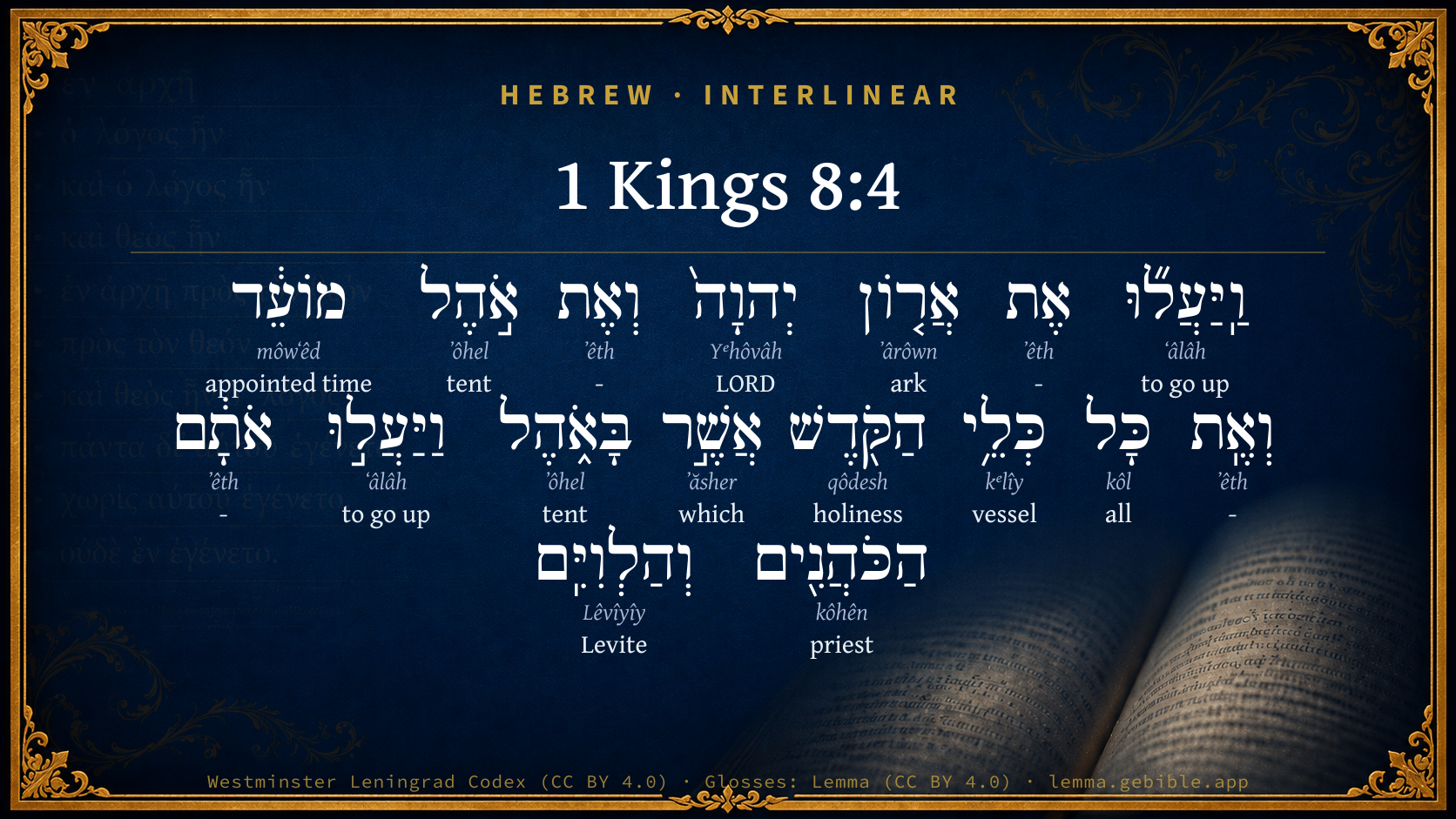
Hebrew (Westminster Leningrad Codex) 1 Kings 8:4 appears in the Hebrew Old Testament. The text above is from the Westminster Leningrad Codex. Each word links to its Strong’s number, a concise gloss, and parsing drawn from the Open Scriptures Hebrew Bible morphology. Click any word for its full Brown-Driver-Briggs (BDB) entry.
Download image
Cite this verse

1 Kings 8:4 (World English Bible). Public Domain. Lemma interlinear Bible study tool, https://lemma.gebible.app/v/1-kings/8/4.

Show BibTeX & RIS
BibTeX
RIS
English Translation
They brought up the ark of Yahweh, and the tent of meeting, and all the holy vessels that were in the Tent; even these did the priests and the Levites bring up.
World English Bible · Public Domain
Download a study sheet

One document with this verse’s original text, its word-by-word gloss line, the meaning frame, cross-references with their text, attributed commentary, and full source and license credits — printable, and it pastes into notes with its structure intact.

This verse Autodidact and up

Study sheet (.html) Plain text (.txt)

A passage Seminary Student

Up to 50 verses in one chapter. A passage sheet keeps up to 6 commentary sources and 12 cross-references per verse, in the order this page ranks them, and says so on the sheet whenever that leaves anything out. Ask for a single verse and you get the Autodidact verse sheet above.

Everything on this page stays free to read, with no account — the sheet is a download of what is already on screen, not access to it.

Want to remove ads? Support Godless Engineer
Compare translations 3

The same verse in 3 English versions, stacked beneath the original-language interlinear above. Click any original word for its lexicon entry.

Each is an independent rendering of the whole verse — the interlinear is not word-aligned to these translations.

Highlighted words mark where these versions differ — a whole-verse word diff, not a word-by-word alignment.

  • World English Bible Public Domain
    They brought up the ark of Yahweh, and the tent of meeting, and all the holy vessels that were in the Tent; even these did the priests and the Levites bring up.
  • King James Version Public Domain
    And they brought up the ark of the LORD, and the tabernacle of the congregation, and all the holy vessels that were in the tabernacle, even those did the priests and the Levites bring up.
  • unfoldingWord Literal Text CC BY-SA 4.0
    And they brought up the Box of Yahweh and the tent of meeting and all of the vessels of holiness that in the tent. And the priests and the Levites brought them up.

unfoldingWord Literal Text — © unfoldingWord, licensed CC BY-SA 4.0. Word-aligned USFM3 via Door43 (git.door43.org/unfoldingWord/en_ult).

Versions to compare (up to 4)

3 of 4 selected

Show all 18 translations

Every available English version of this verse, each an independent rendering of the whole verse.

  • World English Bible Public Domain
    They brought up the ark of Yahweh, and the tent of meeting, and all the holy vessels that were in the Tent; even these did the priests and the Levites bring up.
  • Berean Standard Bible Public Domain
    and they brought up the ark of the LORD and the Tent of Meeting with all its sacred furnishings. So the priests and Levites carried them up.
  • Majority Standard Bible Public Domain
    and they brought up the ark of the LORD and the Tent of Meeting with all its sacred furnishings. So the priests and Levites carried them up.
  • King James Version Public Domain
    And they brought up the ark of the LORD, and the tabernacle of the congregation, and all the holy vessels that were in the tabernacle, even those did the priests and the Levites bring up.
  • American Standard Version (1901) Public Domain
    And they brought up the ark of Jehovah, and the tent of meeting, and all the holy vessels that were in the Tent; even these did the priests and the Levites bring up.
  • Revised Version (1885) Public Domain
    And they brought up the ark of the LORD, and the tent of meeting, and all the holy vessels that were in the Tent; even these did the priests and the Levites bring up.
  • Geneva Bible (1599) Public Domain
    They bare the Arke of the Lord, and they bare the Tabernacle of the Congregation, and all the holy vessels that were in the Tabernacle: those did the Priestes and Leuites bring vp.
  • Douay-Rheims (1899) Public Domain
    And carried the ark of the Lord, and the tabernacle of the covenant, and all the vessels of the sanctuary, that were in the tabernacle: and the priests and the Levites carried them.
  • Young's Literal Translation Public Domain
    and bring up the ark of Jehovah, and the tent of meeting, and all the holy vessels that `are' in the tent, yea, the priests and the Levites bring them up.
  • Literal Standard Version CC BY-SA 4.0
    and bring up the Ark of YHWH, and the Tent of Meeting, and all the holy vessels that [are] in the tent, indeed, the priests and the Levites bring them up.
  • Unlocked Literal Bible CC BY-SA 4.0
    They brought up the ark of Yahweh, the tent of meeting, and all the holy furnishings that were in the tent. The priests and the Levites brought these things up.
  • unfoldingWord Literal Text CC BY-SA 4.0
    And they brought up the Box of Yahweh and the tent of meeting and all of the vessels of holiness that in the tent. And the priests and the Levites brought them up.
  • Darby Bible Public Domain
    And they brought up the ark of Jehovah, and the tent of meeting, and all the holy vessels that were in the tent: the priests and the Levites brought them up.
  • World Messianic Bible Public Domain
    They brought up the LORD’s ark, the Tent of Meeting, and all the holy vessels that were in the Tent. The priests and the Levites brought these up.
  • Webster's Bible Public Domain
    And they brought the ark of the LORD, and the tabernacle of the congregation, and all the holy vessels that were in the tabernacle, even those did the priests and the Levites bring.
  • Free Bible Version CC BY-SA 4.0
    The priests and Levites carried them up.
  • Bible in Basic English Public Domain
    They took up the ark of the Lord, and the Tent of meeting, and all the holy vessels which were in the Tent; all these the priests and the Levites took up.
  • JPS Tanakh (1917) Public Domain
    And they brought up the ark of the LORD, and the tent of meeting, and all the holy vessels that were in the Tent; even these did the priests and the Levites bring up.

Literal Standard Version (2020), Covenant Press — licensed CC BY-SA 4.0. Text via the HelloAO Bible API (eBible.org). Unlocked Literal Bible (unfoldingWord) — licensed CC BY-SA 4.0. Text via the HelloAO Bible API (eBible.org). unfoldingWord Literal Text — © unfoldingWord, licensed CC BY-SA 4.0. Word-aligned USFM3 via Door43 (git.door43.org/unfoldingWord/en_ult). Free Bible Version, Dr. Jonathan Gallagher — licensed CC BY-SA 4.0. Text via the HelloAO Bible API (eBible.org).

Word by word

More ways to search: Search by grammar → Find every occurrence → Compare this word →

Practice this passage: Drill this verse → Learn its vocabulary →

אֲר֤וֹן
ʼârôwn
H727
“ark of”
Noun, Common, Both, Singular, Construct
Part of Speech
Noun
Type
Common
Gender
Both
Number
Singular
State
Construct
Full BDB Definition

Origin: from H717 (in the sense of gathering)

TWOT: 166a

chest, ark - money chest - Ark of the Covenant - (TWOT)coffin
  1. וַֽיַּעֲל֞וּ ʻâlâh H5927 “and · to go up” Conjunction + Verb, Hiphil, Sequential Imperfect, 3rd Person, Masculine, Plural
  2. אֶת ʼêth H853 “-” Particle, Direct Object
  3. יְהוָה֙ Yᵉhôvâh H3068 “LORD” Noun, Proper
  4. וְאֶת ʼêth H853 “and · -” Conjunction + Particle, Direct Object
  5. אֹ֣הֶל ʼôhel H168 “tent of” Noun, Common, Masculine, Singular, Construct
  6. מוֹעֵ֔ד môwʻêd H4150 “appointed time” Noun, Common, Masculine, Singular, Absolute
  7. וְאֶֽת ʼêth H853 “and · -” Conjunction + Particle, Direct Object
  8. כָּל kôl H3605 “all of” Noun, Common, Masculine, Singular, Construct
  9. כְּלֵ֥י kᵉlîy H3627 “vessels of” Noun, Common, Masculine, Plural, Construct
  10. הַקֹּ֖דֶשׁ qôdesh H6944 “the · holiness” Particle, Definite Article + Noun, Common, Masculine, Singular, Absolute
  11. אֲשֶׁ֣ר ʼăsher H834 “which” Particle, Relative
  12. בָּאֹ֑הֶל ʼôhel H168 “in/at the · tent” Preposition, Determined + Noun, Common, Masculine, Singular, Absolute
  13. וַיַּעֲל֣וּ ʻâlâh H5927 “and · to go up” Conjunction + Verb, Hiphil, Sequential Imperfect, 3rd Person, Masculine, Plural
  14. אֹתָ֔ם ʼêth H853 “- · them” Particle, Direct Object + Suffix, Personal, 3rd Person, Masculine, Plural
  15. הַכֹּהֲנִ֖ים kôhên H3548 “the · priests” Particle, Definite Article + Noun, Common, Masculine, Plural, Absolute
  16. וְהַלְוִיִּֽם Lêvîyîy H3881 “and · the · Levites” Conjunction + Particle, Definite Article + Noun, Gentilic, Masculine, Plural, Absolute

About this verse

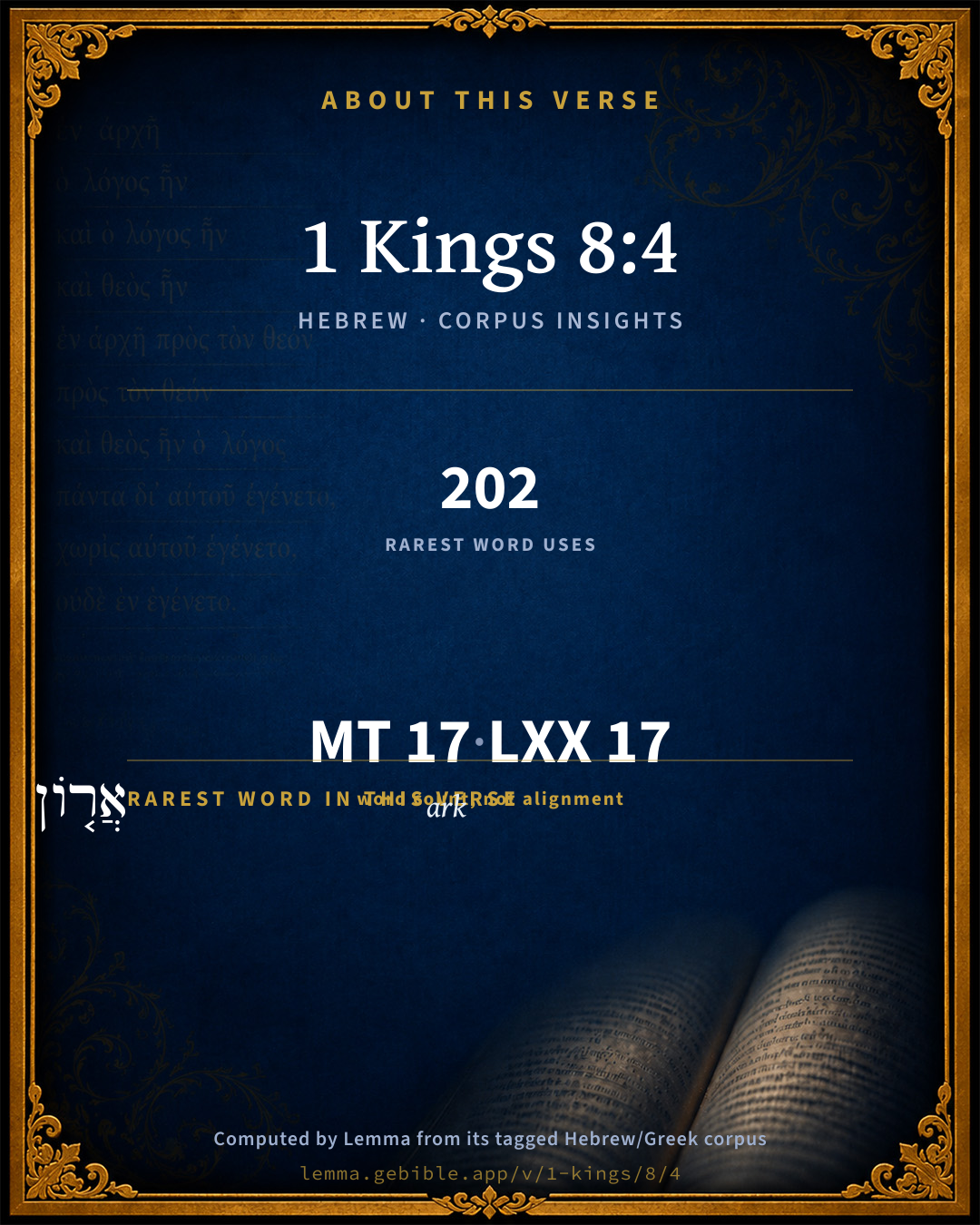
These counts appear in no published source. They are computed here, from the morphology-tagged text and Lemma’s own curated glosses. What Lemma adds →

17
words
12
distinct lemmas
Historical
section

Grammatical profile

  • 2 verbs
  • 10 nouns
  • 5 particles

Verb forms

  • וַֽיַּעֲל֞וּ Hiphil · Sequential Imperfect
  • וַיַּעֲל֣וּ Hiphil · Sequential Imperfect

Repetition

Words recur within this verse — often emphatic in Hebrew:

  • וַֽיַּעֲל֞וּ to go up H5927 ×2
  • אֹ֣הֶל tent H168 ×2

Hebrew & Septuagint length

In English translation the verse runs 32 words from the Hebrew and 16 from the Septuagint (LXX English) — the Septuagint runs noticeably shorter here. See the side-by-side →

A rough comparison of the two English renderings, which tokenize alike — not a word-level alignment.

Word counts can differ between the Hebrew and the Greek without any difference in meaning — e.g. the Hebrew direct-object marker אֵת has no separate Greek word, and Greek often adds the article ὁ.

In the original languages it is 17 Hebrew tokens and 17 Greek tokens — but the two are counted differently (Hebrew bundles its prefixes and suffixes into one token; the Greek is in lemma form), so that isn’t a like-for-like length.

Cross-references

3

Topical passages linked to 1 Kings 8:4 in the Treasury of Scripture Knowledge — connected by theme and wording, ordered by reader-vote popularity; previews shown in the World English Bible.

  • 1 Kings 3:4 The king went to Gibeon to sacrifice there; for that was the great high place: a thousand burnt offerings did Solomon offer on that altar.
  • 2 Chronicles 1:3 So Solomon, and all the assembly with him, went to the high place that was at Gibeon; for there was the tent of meeting of God, which Moses the servant of Yahweh had made in the wilderness.
  • Exodus 40:2–33 "On the first day of the first month you shall raise up the tent of the Tent of Meeting.

Cross-references courtesy of OpenBible.info (CC BY 4.0).

Hebrew and Greek witnesses Masoretic Hebrew ↔ Greek Septuagint

The same verse in the two great witnesses to the Old Testament, shown verse-for-verse.

Here the Septuagint runs noticeably shorter than the Hebrew — LXX2012 (modern English Septuagint) 16 words vs World English Bible 32. A rough length comparison of the two English translations, not a word-level alignment — read both below.

These are two independent witnesses, not word-aligned to each other, and the Septuagint is shown in lemma (dictionary) form.

Hebrew 1 Kings 8:4 Masoretic · Westminster Leningrad Codex

וַֽיַּעֲל֞וּ אֶת אֲר֤וֹן יְהוָה֙ וְאֶת אֹ֣הֶל מוֹעֵ֔ד וְאֶֽת כָּל כְּלֵ֥י הַקֹּ֖דֶשׁ אֲשֶׁ֣ר בָּאֹ֑הֶל וַיַּעֲל֣וּ אֹתָ֔ם הַכֹּהֲנִ֖ים וְהַלְוִיִּֽם

They brought up the ark of Yahweh, and the tent of meeting, and all the holy vessels that were in the Tent; even these did the priests and the Levites bring up.

World English Bible · Public Domain

Greek LXX 1 Kings 8:4 Septuagint · lemma form

καί ὁ σκήνωμα ὁ μαρτύριον καί πᾶς ὁ σκεῦος ὁ ἅγιος ὁ ἐν ὁ σκήνωμα ὁ μαρτύριον

and the tabernacle of testimony, and the holy furniture that was in the tabernacle of testimony.

LXX2012 (modern English Septuagint) · Public Domain

On this verse, The Cambridge Bible for Schools and Colleges discusses the Septuagint’s reading. Read the note in Commentary ↓

Hebrew: Westminster Leningrad Codex (CC BY 4.0). Greek: Septuagint (public domain); English from LXX2012 (modern English Septuagint) (Public Domain). How the Septuagint differs from the Hebrew →

Targum (Aramaic paraphrase)

1

The Targum is the ancient Jewish Aramaic paraphrase of the Hebrew Scriptures — an interpretive translation, not the Hebrew text itself. Onkelos (literal) and Pseudo-Jonathan (expansive) render the Torah, and Jonathan the Prophets. Coverage is partial: where no permissively-licensed English translation exists for a verse, only the Aramaic is shown. This is verse-level text, not a word-by-word alignment to the Hebrew.

  1. Targum Jonathan Prophets (Joshua–Malachi)
    וְאַסִיקוּ יַת אֲרוֹנָא דַייָ וְיַת מַשְׁכַּן זִמְנָא וְיַת כָּל מָנֵי קוּדְשָׁא דִי בְמַשְׁכְּנָא וְאַסִיקוּ יַתְהוֹן כַּהֲנַיָא וְלֵיוָאֵי:

    (no public-domain English translation for this verse)

    Targum Jonathan — Aramaic: “Mikraot Gedolot” (public domain). English: “Sefaria Community Translation” (CC0 1.0 (public-domain dedication)); “London "Chaldee Paraphrase," 1871” (public domain). Text via Sefaria.

Commentary

Notes on 1 Kings 8:4 from classic Christian and Jewish commentators (each source and its license shown beneath its notes). The classic Christian expositions comment on the surrounding passage and are grouped to its opening verse, so a note may address several verses; the Jewish commentaries on the Tanakh (Rashi and others) are per-verse, so they appear only where the commentator wrote on this verse.

Lemma curates 59 commentaries, every one of them public domain or Creative Commons licensed, each selected and text-cleaned for this edition rather than reprinted as found. About our sources →

The Cambridge Bible for Schools and Colleges

gen. ed. J. J. S. Perowne

4. and the tabernacle of the congregation] Better, as in other places, the Tent of meeting. This consecrated tent, which had up to this time stood in Gibeon, was now taken down, and the curtains and poles of which it consisted seem to have been brought to the Temple to be preserved. There was probably room enough for their bestowal in the ‘side chambers’ which enclosed the Temple on three sides. Others have suggested a chamber above the most holy place. We have nothing to guide us to a conclusion either in history or tradition. A tradition which points to the preservation of the Tent is found 2Ma_2:4.

those did the priests and the Levites bring up] In the parallel passage in 1Ch_5:5, the conjunction ‘and’ is omitted and special attention is called to Deu_17:18, where, and in subsequent places of the same book ‘the priests the Levites’ are spoken of. It is noteworthy that Josephus speaks only of the Levites, until the ark is to be brought within the most holy place. Then, he says, all the rest withdrew and the priests carried it to its resting-place. He also describes the procession, and how the road was drenched with libations and with the blood of many sacrifices, while the abundant burning of incense filled all the air with fragrance so that people at a great distance could note that God was, as men would judge, changing His abode and coming to dwell in the house which had been newly built and dedicated to Him. The LXX. (Vat.) omits nearly the whole of 1Ki_8:2-3, and also a portion of 1Ki_8:4.

The Cambridge Bible for Schools and Colleges (gen. ed. J. J. S. Perowne; Cambridge University Press, 1878–1918) — public domain. Text from a community e-Sword module.

Trapp's Complete Commentary

John Trapp

1Ki 8:4 And they brought up the ark of the LORD, and the tabernacle of the congregation, and all the holy vessels that [were] in the tabernacle, even those did the priests and the Levites bring up.

Ver. 4. And the tabenacle of the congregation.] Made by Moses, and hitherto transportative, and for many years severed from the ark, but now to be reunited and settled in the temple; as the saints, here tossed up and down, shall one day be in heaven, that habitation of God’s holiness.

John Trapp, A Commentary or Exposition upon All the Books of the Old and New Testament (1647–1656) — public domain. Text from a community e-Sword module.

Joseph Benson's Commentary

1Ki 8:4. And the tabernacle of the congregation — That made by Moses, which doubtless before this time had been removed from Gibeon to Zion. And all the holy vessels — Namely, the altar of incense, the table of show- bread, the candlestick, and every thing belonging to them; all these were now carried into the temple, and laid up there, to prevent all idolatrous and superstitious use of them, and to oblige the people to come up to Jerusalem, as the only place where sacrifices were now to be offered, and the various ceremonies of public worship performed.

Joseph Benson's Commentary on the Old and New Testaments (1811–1818) — public domain. Text from a community e-Sword module.

Adam Clarke's Commentary

Verse 4. They brought up - the tabernacle] It is generally agreed that there were now two tabernacles at Gibeon, and the other in the city of David, which one David had constructed as a temporary residence for the ark, in the event of a temple being built. Which of these tabernacles was brought into the temple at this time, is not well known; some think both were brought in, in order to prevent the danger of idolatry. I should rather suppose that the tabernacle from Gibeon was brought in, and that the temporary one erected by David was demolished.

Adam Clarke's Commentary on the Bible (1810–1826) — public domain. Text from a community e-Sword/MySword module.

Ellicott's Commentary for English Readers

(4) The tabernacle of the congregation (see 1Ch_16:39-40; 2Ch_1:3) was still at Gibeon; and the priests and Levites had hitherto been divided between it and the lesser tabernacle over the ark on Mount Zion. Probably each section of the priests and Levites now brought up in solemn procession the sacred things entrusted to them. According to the order of the Mosaic law (Num_3:25-37), the Kohathites had charge on the march of the ark and the vessels, the Gershonites of the Tabernacle and its hangings, and the Merarites of the boards and pillars of the Tabernacle and the outer court. This order, no doubt, was followed, as far as possible, on this its last journey. What became of the Tabernacle and its furniture (so far as this was disused), we are not told; but all was probably deposited, as a sacred relic of antiquity, somewhere in the precincts of the Temple. This seems to be implied in the famous Jewish tradition (see 2Ma_2:4-6), that Jeremiah was enabled to hide by miracle “the Tabernacle and the ark and the altar of incense” on the destruction of the Temple.

A Bible Commentary for English Readers, edited by Charles John Ellicott (1878–1897) — public domain. Text from a community e-Sword module.

John Gill's Exposition

And they brought up the ark of the Lord,.... From the city of David to the temple:

and the tabernacle of the congregation; not the tent David made for the ark, though that might be brought also, but the tabernacle of Moses, which had been many years at Gibeon; but now removed to Zion, and from thence to the temple, where it was laid up, as having been a sacred thing; that it might not be put to common or superstitious uses, and to prevent the being of more places than one for worship:

and all the holy vessels that were in the tabernacle; as the candlestick, shewbread table, incense altar, &c.

even those did the priests and the Levites bring up; some brought one, and some another; the priests brought the ark, and the Levites the vessels.

John Gill's Exposition of the Whole Bible (1746–1763) — public domain (CC PDM 1.0). Text via the HelloAO Bible API.

Albert Barnes' Notes on the Bible

And the tabernacle of the congregation - Not the tented structure erected for the ark on Mount Zion 2Sa 6:17 by David, but the original tabernacle made by Moses, which had hitherto remained at Gibeon (margin reference). The tabernacle and its holy vessels were probably placed in the treasury.

Albert Barnes' Notes on the Bible (1834–1885) — public domain. Text from a community e-Sword/MySword module.

Haydock's Catholic Bible Commentary

Ark, from the city of David, along with the tabernacle, (Salien) which had been made for it in the palace, ver. 1. They also (Haydock) brought the Mosaic tabernacle from Gaboan, (Calmet; Josephus, &c.) and reposited both (Haydock) in the treasury of the temple, as they were now of no other service. Jeremias was authorized to take the ark, the tabernacle, and the altar of incense, in order to prevent their falling into the hands of the Chaldeans. He placed them in a cave, where they have never, perhaps, been discovered, 2 Machabees ii. 4.

George Leo Haydock (1774–1849), Haydock's Catholic Family Bible and Commentary, 1859 edition — public domain. Excludes Psalms (Douay-Rheims chapter numbering differs from Protestant) and Deuterocanonical books (Catholic canon only).

Matthew Poole's English Annotations

The tabernacle of the congregation; that made by Moses, which doubtless before this time had been translated from Gibeon to Zion, and now, together with other things, was put into the treasuries of the Lord’s house, to prevent all the superstitious use and profane abuse of it, and to oblige the people to come up to Jerusalem, as the only place where God would now be worshipped.

The priests and Levites; the priests carrying some, and the Levites others.

Matthew Poole's English Annotations on the Holy Bible (1683–1685) — public domain. Text from a community e-Sword/MySword module.

Whedon's Commentary on the Bible

Daniel D. Whedon

4. Brought up the ark — From Zion to Moriah; from the tabernacle of David to the most holy place of the temple. This is spoken of as an ascent, or going up, of the ark, though Moriah was lower than Zion; for the Israelite conceived the mountain of the temple as the highest of all mountains, (Psa_68:15; Mic_4:1,) and spoke of going up to it as they did of going up to Jerusalem. So in this same verse the tabernacle is spoken of as brought up to the temple from Gibeon, though Gibeon is higher than any mountain of Jerusalem.

Tabernacle of the congregation — This old structure, a sacred relic of Moses and the elder fathers, but doubtless bearing many marks of the ravages of time, had been standing for a long time on the high place of Gibeon. 2Ch_1:3. But not containing the ark, it had lost much of its sanctity in the eyes of the people, and only served to divide and distract the public worship. It was time to put an end to such confusion; and so the old tabernacle was brought up and stored away among the sacred treasures of the new and glorious temple.

All the holy vessels — The golden altar, the golden candlestick, the table of show-bread, and probably other shrines. Josephus says that “they set the candlestick, the table, and the golden altar in the temple before the most secret place, in the very same places wherein they stood till that time in the tabernacle.” But this may be reasonably doubted in view of the fact that Solomon made altar, tables, and candlesticks all new for this purpose. See notes on 1Ki_7:48-49. Still the old ones may have been placed near the new. Among the sacred relics the brazen serpent was preserved until the days of Hezekiah. 2Ki_18:4.

Daniel D. Whedon (gen. ed.), Commentary on the Old and New Testaments (1874–1909) — public domain. Text from a community e-Sword module.

The Pulpit Commentary

And they brought up the ark of the Lord which had now been for nearly 40 years "in the tabernacle that David had pitched for it" on the Mount Zion, (2Sa_6:17) and the tabernacle of the congregation Heb, "the tabernacle of meeting". (Exo_29:42, Exo_29:46. See Dict. Bib. 2. p. 1414; Bahr, Symbolik, 1:80, 81) This had been for many years at Gibeon. (Cf. ch. 3:4 2Ch_1:8 1Ch_16:8. See note on 1Ki_3:4) The tabernacle of Mount Zion is never called"the tabernacle of the congregation indeed, it is expressly distingnished from it, 2Ch_1:3, 2Ch_1:4. The ark and the tabernacle were now reunited in the temple of Solomon, thus "marking the identity and continuity of the life and ritual of the Hebrew Church" (Wordsworth), and all the holy vessels that were in the tabernacle. Perhaps the brazen altar. Certainly the altar of incense, the table of shewbread, the candlestick, and also the brazen serpent (Stanley), even those did the priests and Levites bring up. We are hardly justified in saying (as Keil, al.) that the Levites carried all but the ark. The text rather favours the view that the priests assisted in bringing up the tabernacle and its furniture. 2Ch_5:5. Neither the tabernacle nor its vessels were designed for further use in the temple; the latter had been replaced by vessels better suited to the enlarged sanctuary they were simply preserved, so far as we know, as relics of the past. in the treasury or side chambers.

The Pulpit Commentary (1880–1919), ed. H.D.M. Spence-Jones & Joseph S. Exell — public domain. Text from a community e-Sword module.

John Wesley's Explanatory Notes

The tabernacle - That made by Moses, which doubtless before this time had been translated from Gibeon to Zion, and now together with other things, was put into the treasuries of the Lord's house, to prevent all superstitious use of it, and to oblige the people to come up to Jerusalem, as the only place where God would now be worshipped.

John Wesley, Explanatory Notes Upon the Whole Bible (1754–1765) — public domain. Text via the GEBible commentary corpus.

Rashi

Rabbi Shlomo Yitzchaki (Rashi)

The Tent of Meeting. Which Moshe made and Shlomo stored this away as soon as the first Beis [Hamikdosh] was built, as we have learned in the Tosefta of Maseches Sotah.

That were in the Tent. Which Dovid pitched for the Ark.

Rashi on the Tanakh — English translations: “The Judaica Press complete Tanach with Rashi, translated by A. J. Rosenberg” (CC BY 4.0); “Pentateuch with Rashi's commentary by M. Rosenbaum and A.M. Silbermann, 1929-1934” (public domain); “The Metsudah Tanach series, Lakewood, N.J” (CC BY 4.0); and “The Book of Joshua, Metsudah Publications, 1997” (CC BY 4.0). Text via Sefaria.

Lesson kit

Teaching starters — assembled from the data on this page, not authored interpretation. Every prompt links to the verse data it draws on. Edit before teaching.

1 Kings, in the Historical, opens this verse with 17 words (12 distinct Hebrew lemmas). Its most distinctive word is ʼârôwn (“ark”). The Greek Septuagint runs shorter here. A historical commentator’s framing appears above. Read the whole chapter for the surrounding context.

Discussion questions

  1. What does “ark” (ʼârôwn) contribute to the verse as a whole?
  2. How does 1 Kings 3:4, which shares this passage’s theme, read alongside this verse?
  3. What does the repetition of “to go up” (2× in this one verse) do in this verse?
  4. The Septuagint runs shorter here than the Hebrew. What might account for the difference?
  5. These translations render this verse differently; the difference is in the English rendering, not the original. What questions does that raise?
  6. «וַֽיַּעֲל֞וּ» is a Hiphil Sequential Imperfect verb. How does that grammatical form shape the action described?
  7. Compare how The Cambridge Bible for Schools and Colleges and Trapp's Complete Commentary read this verse. Where do they agree or differ?

Things to notice

Reading settings

Reading text

Shown beneath each verse's original-language words.

Old Testament
Old Testament edition

Read the OT as the Masoretic Hebrew (MT) or the Greek Septuagint (LXX).

English shown for the Greek Septuagint (in the Hebrew ↔ Greek comparison).

Comparing translations? Open the Compare panel on any verse page to stack up to four side by side.