
1 Kings 7:51

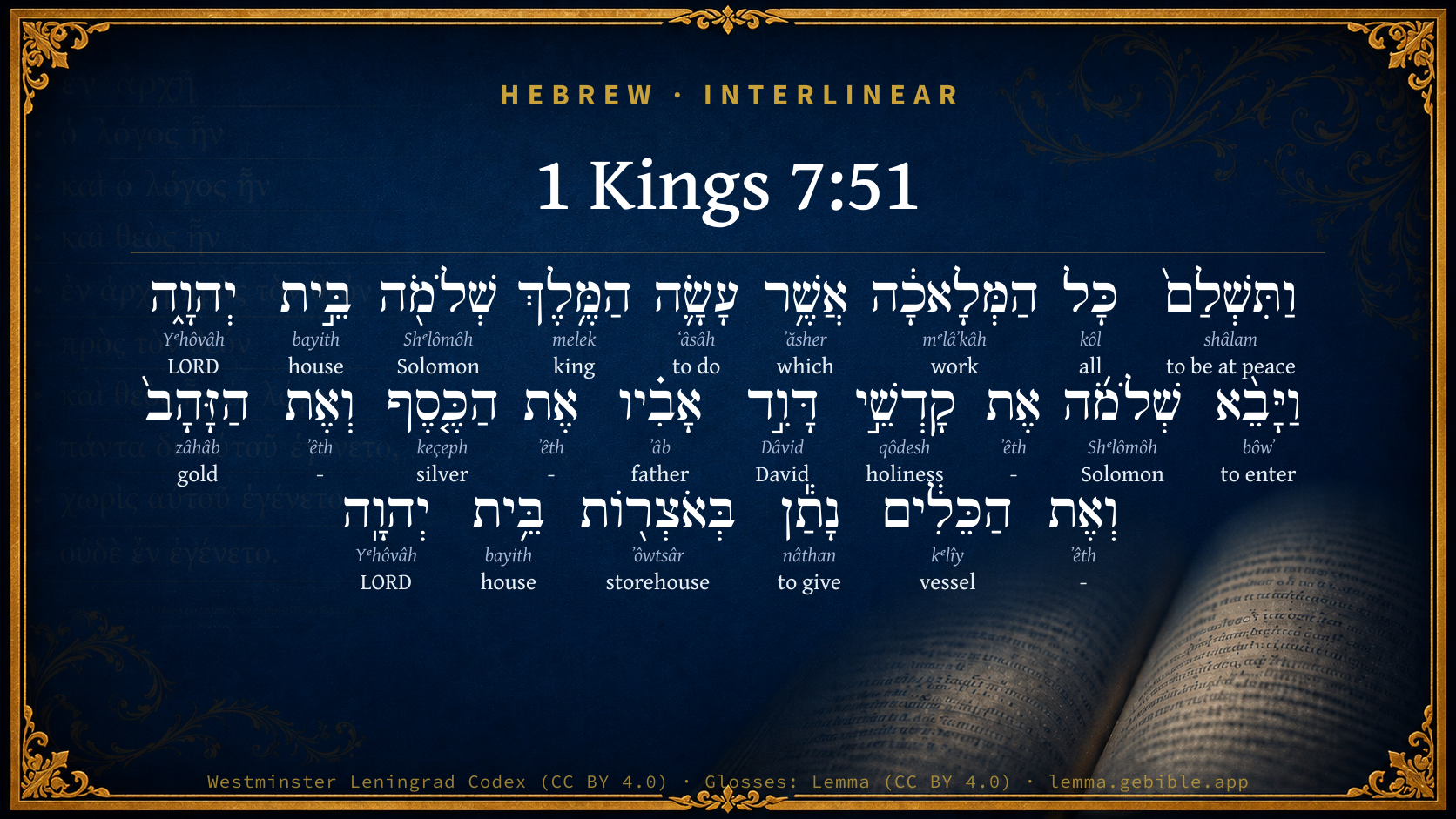
Hebrew (Westminster Leningrad Codex) 1 Kings 7:51 appears in the Hebrew Old Testament. The text above is from the Westminster Leningrad Codex. Each word links to its Strong’s number, a concise gloss, and parsing drawn from the Open Scriptures Hebrew Bible morphology. Click any word for its full Brown-Driver-Briggs (BDB) entry.
Download image
Cite this verse

1 Kings 7:51 (World English Bible). Public Domain. Lemma interlinear Bible study tool, https://lemma.gebible.app/v/1-kings/7/51.

Show BibTeX & RIS
BibTeX
RIS
English Translation
Thus all the work that king Solomon worked in the house of Yahweh was finished. Solomon brought in the things which David his father had dedicated, [even] the silver, and the gold, and the vessels, and put them in the treasuries of the house of Yahweh.
World English Bible · Public Domain
Download a study sheet

One document with this verse’s original text, its word-by-word gloss line, the meaning frame, cross-references with their text, attributed commentary, and full source and license credits — printable, and it pastes into notes with its structure intact.

This verse Autodidact and up

Study sheet (.html) Plain text (.txt)

A passage Seminary Student

Up to 50 verses in one chapter. A passage sheet keeps up to 6 commentary sources and 12 cross-references per verse, in the order this page ranks them, and says so on the sheet whenever that leaves anything out. Ask for a single verse and you get the Autodidact verse sheet above.

Everything on this page stays free to read, with no account — the sheet is a download of what is already on screen, not access to it.

Want to remove ads? Support Godless Engineer
Compare translations 3

The same verse in 3 English versions, stacked beneath the original-language interlinear above. Click any original word for its lexicon entry.

Each is an independent rendering of the whole verse — the interlinear is not word-aligned to these translations.

Highlighted words mark where these versions differ — a whole-verse word diff, not a word-by-word alignment.

  • World English Bible Public Domain
    Thus all the work that king Solomon worked in the house of Yahweh was finished. Solomon brought in the things which David his father had dedicated, [even] the silver, and the gold, and the vessels, and put them in the treasuries of the house of Yahweh.
  • King James Version Public Domain
    So was ended all the work that king Solomon made for the house of the LORD. And Solomon brought in the things which David his father had dedicated; even the silver, and the gold, and the vessels, did he put among the treasures of the house of the LORD.
  • unfoldingWord Literal Text CC BY-SA 4.0
    And all of the work that King Solomon did the house of Yahweh was complete. And Solomon brought in the holy things of David, his father. The silver and the gold and the vessels, he put in the storerooms of the house of Yahweh.

unfoldingWord Literal Text — © unfoldingWord, licensed CC BY-SA 4.0. Word-aligned USFM3 via Door43 (git.door43.org/unfoldingWord/en_ult).

Versions to compare (up to 4)

3 of 4 selected

Show all 18 translations

Every available English version of this verse, each an independent rendering of the whole verse.

  • World English Bible Public Domain
    Thus all the work that king Solomon worked in the house of Yahweh was finished. Solomon brought in the things which David his father had dedicated, [even] the silver, and the gold, and the vessels, and put them in the treasuries of the house of Yahweh.
  • Berean Standard Bible Public Domain
    So all the work that King Solomon had performed for the house of the LORD was completed. Then Solomon brought in the items his father David had dedicated—the silver, the gold, and the furnishings—and he placed them in the treasuries of the house of the LORD.
  • Majority Standard Bible Public Domain
    So all the work that King Solomon had performed for the house of the LORD was completed. Then Solomon brought in the items his father David had dedicated—the silver, the gold, and the furnishings—and he placed them in the treasuries of the house of the LORD.
  • King James Version Public Domain
    So was ended all the work that king Solomon made for the house of the LORD. And Solomon brought in the things which David his father had dedicated; even the silver, and the gold, and the vessels, did he put among the treasures of the house of the LORD.
  • American Standard Version (1901) Public Domain
    Thus all the work that king Solomon wrought in the house of Jehovah was finished. And Solomon brought in the things which David his father had dedicated, `even' the silver, and the gold, and the vessels, and put them in the treasuries of the house of Jehovah.
  • Revised Version (1885) Public Domain
    Thus all the work that king Solomon wrought in the house of the LORD was finished. And Solomon brought in the things which David his father had dedicated, even the silver, and the gold, and the vessels, and put them in the treasuries of the house of the LORD.
  • Geneva Bible (1599) Public Domain
    So was finished all the worke that King Salomon made for the house of the Lord, and Salomon brought in the things which Dauid his father had dedicated: the siluer and the golde and the vessels, and layed them among the treasures of the house of the Lord.
  • Douay-Rheims (1899) Public Domain
    And Solomon finished all the work that he made in the house of the Lord, and brought in the things that David his father had dedicated, the silver and the gold, and the vessels, and laid them up in the treasures of the house of the Lord.
  • Young's Literal Translation Public Domain
    And it is complete -- all the work that king Solomon hath made `for' the house of Jehovah, and Solomon bringeth in the sanctified things of David his father; the silver, and the gold, and the vessels he hath put in the treasuries of the house of Jehovah.
  • Literal Standard Version CC BY-SA 4.0
    And it is complete—all the work that King Solomon has made [for] the house of YHWH, and Solomon brings in the sanctified things of his father David; he has put the silver, and the gold, and the vessels in the treasuries of the house of YHWH.
  • Unlocked Literal Bible CC BY-SA 4.0
    In this way, all the work that King Solomon directed for the house of Yahweh was finished. So Solomon brought in the things that were set apart by David, his father, and the silver, the gold, and the furnishings, and put them into the storerooms of the house of Yahweh.
  • unfoldingWord Literal Text CC BY-SA 4.0
    And all of the work that King Solomon did the house of Yahweh was complete. And Solomon brought in the holy things of David, his father. The silver and the gold and the vessels, he put in the storerooms of the house of Yahweh.
  • Darby Bible Public Domain
    And all the work was finished that king Solomon made for the house of Jehovah. And Solomon brought in the things that David his father had dedicated; the silver and the gold and the vessels he put among the treasures of the house of Jehovah.
  • World Messianic Bible Public Domain
    Thus all the work that King Solomon did in the LORD’s house was finished. Solomon brought in the things which David his father had dedicated—the silver, the gold, and the vessels—and put them in the treasuries of the LORD’s house.
  • Webster's Bible Public Domain
    So was ended all the work that king Solomon made for the house of the LORD. And Solomon brought in the things which David his father had dedicated; even the silver, and the gold, and the vessels, he placed among the treasures of the house of the LORD.
  • Free Bible Version CC BY-SA 4.0
    In this way all King Solomon's work for the Temple of the Lord was completed. Then Solomon brought in the items his father David had dedicated, the special objects made of silver, the gold, and the Temple furnishings, and he placed them in the treasuries of the Temple of the Lord.
  • Bible in Basic English Public Domain
    So all the work King Solomon had done in the house of the Lord was complete. Then Solomon took the holy things which David his father had given, the silver and the gold and all the vessels, and put them in the store-houses of the house of the Lord.
  • JPS Tanakh (1917) Public Domain
    Thus all the work that king Solomon wrought in the house of the LORD was finished. And Solomon brought in the things which David his father had dedicated, the silver, and the gold, and the vessels, and put them in the treasuries of the house of the LORD.

Literal Standard Version (2020), Covenant Press — licensed CC BY-SA 4.0. Text via the HelloAO Bible API (eBible.org). Unlocked Literal Bible (unfoldingWord) — licensed CC BY-SA 4.0. Text via the HelloAO Bible API (eBible.org). unfoldingWord Literal Text — © unfoldingWord, licensed CC BY-SA 4.0. Word-aligned USFM3 via Door43 (git.door43.org/unfoldingWord/en_ult). Free Bible Version, Dr. Jonathan Gallagher — licensed CC BY-SA 4.0. Text via the HelloAO Bible API (eBible.org).

Word by word

More ways to search: Search by grammar → Find every occurrence → Compare this word →

Practice this passage: Drill this verse → Learn its vocabulary →

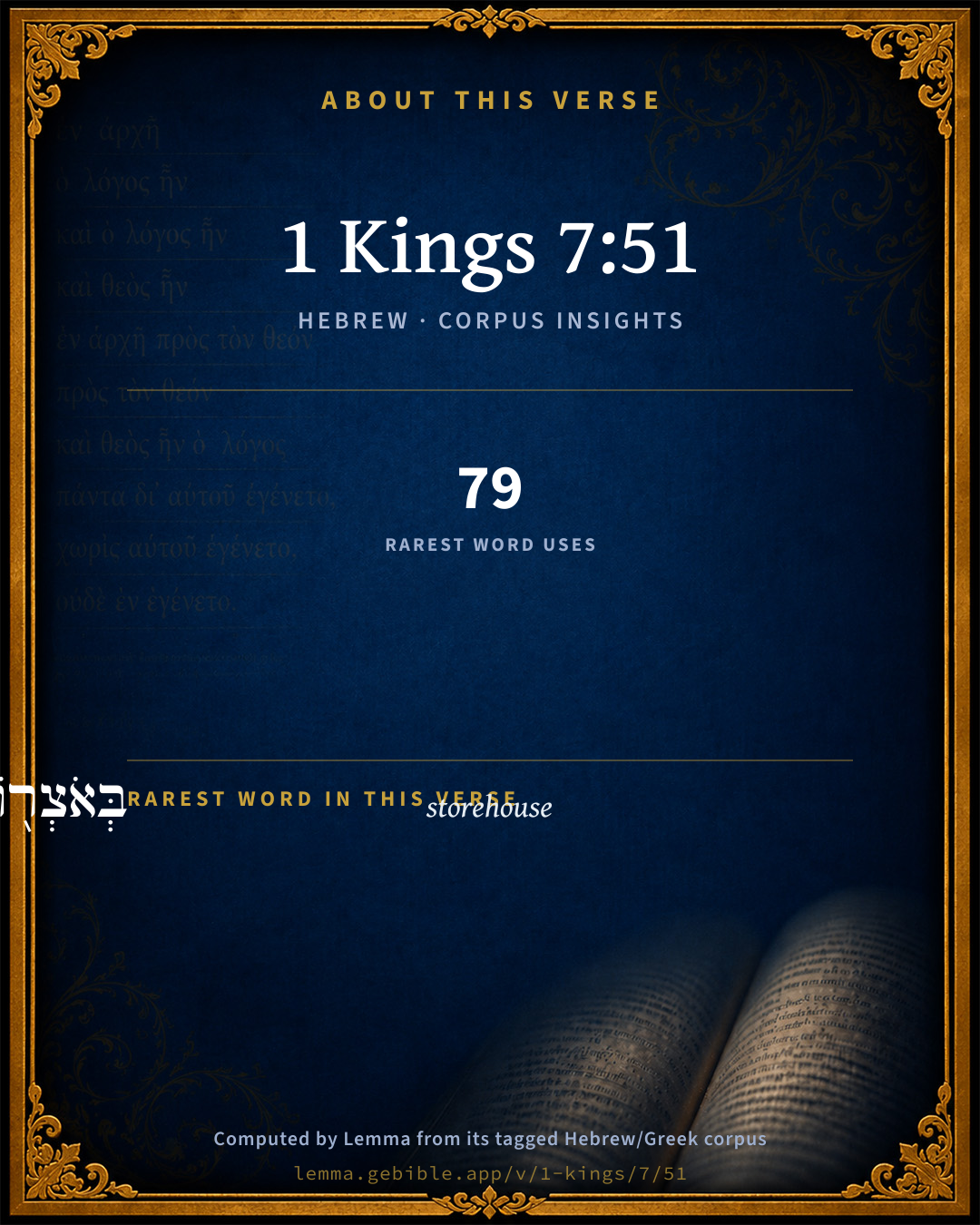
בְּאֹצְר֖וֹת
ʼôwtsâr
H214
“in/at · storehouses of”
Preposition + Noun, Common, Masculine, Plural, Construct
Part of Speech
Preposition + Noun
Type
Common
Gender
Masculine
Number
Plural
State
Construct
Full BDB Definition

Origin: from H686

TWOT: 154a

treasure, storehouse - treasure (gold, silver, etc) - store, supplies of food or drink - treasure-house, treasury - treasure-house - storehouse, magazine - treasury - magazine of weapons (figuratively of God's armoury) - storehouses (of God for rain, snow, hail, wind, sea)
  1. וַתִּשְׁלַם֙ shâlam H7999 “and · to be at peace” Conjunction + Verb, Qal, Sequential Imperfect, 3rd Person, Feminine, Singular
  2. כָּל kôl H3605 “all of” Noun, Common, Masculine, Singular, Construct
  3. הַמְּלָאכָ֔ה mᵉlâʼkâh H4399 “the · work” Particle, Definite Article + Noun, Common, Feminine, Singular, Absolute
  4. אֲשֶׁ֥ר ʼăsher H834 “which” Particle, Relative
  5. עָשָׂ֛ה ʻâsâh H6213 “to do” Verb, Qal, Perfect, 3rd Person, Masculine, Singular
  6. הַמֶּ֥לֶךְ melek H4428 “the · king” Particle, Definite Article + Noun, Common, Masculine, Singular, Absolute
  7. שְׁלֹמֹ֖ה Shᵉlômôh H8010 “Solomon” Noun, Proper
  8. בֵּ֣ית bayith H1004 “house of” Noun, Common, Masculine, Singular, Construct
  9. יְהוָ֑ה Yᵉhôvâh H3068 “LORD” Noun, Proper
  10. וַיָּבֵ֨א bôwʼ H935 “and · to enter” Conjunction + Verb, Hiphil, Sequential Imperfect, 3rd Person, Masculine, Singular
  11. שְׁלֹמֹ֜ה Shᵉlômôh H8010 “Solomon” Noun, Proper
  12. אֶת ʼêth H853 “-” Particle, Direct Object
  13. קָדְשֵׁ֣י qôdesh H6944 “holy things of” Noun, Common, Masculine, Plural, Construct
  14. דָּוִ֣ד Dâvid H1732 “David” Noun, Proper
  15. אָבִ֗יו ʼâb H1 “father · his” Noun, Common, Masculine, Singular, Construct + Suffix, Personal, 3rd Person, Masculine, Singular
  16. אֶת ʼêth H853 “-” Particle, Direct Object
  17. הַכֶּ֤סֶף keçeph H3701 “the · silver” Particle, Definite Article + Noun, Common, Masculine, Singular, Absolute
  18. וְאֶת ʼêth H853 “and · -” Conjunction + Particle, Direct Object
  19. הַזָּהָב֙ zâhâb H2091 “the · gold” Particle, Definite Article + Noun, Common, Masculine, Singular, Absolute
  20. וְאֶת ʼêth H853 “and · -” Conjunction + Particle, Direct Object
  21. הַכֵּלִ֔ים kᵉlîy H3627 “the · vessels” Particle, Definite Article + Noun, Common, Masculine, Plural, Absolute
  22. נָתַ֕ן nâthan H5414 “to give” Verb, Qal, Perfect, 3rd Person, Masculine, Singular
  23. בֵּ֥ית bayith H1004 “house of” Noun, Common, Masculine, Singular, Construct
  24. יְהוָֽה Yᵉhôvâh H3068 “LORD” Noun, Proper

About this verse

These counts appear in no published source. They are computed here, from the morphology-tagged text and Lemma’s own curated glosses. What Lemma adds →

25
words
19
distinct lemmas
Historical
section

Grammatical profile

  • 4 verbs
  • 16 nouns
  • 5 particles

Verb forms

  • וַתִּשְׁלַם֙ Qal · Sequential Imperfect
  • עָשָׂ֛ה Qal · Perfect
  • וַיָּבֵ֨א Hiphil · Sequential Imperfect
  • נָתַ֕ן Qal · Perfect

Repetition

Words recur within this verse — often emphatic in Hebrew:

  • שְׁלֹמֹ֖ה Solomon H8010 ×2
  • בֵּ֣ית house H1004 ×2
  • יְהוָ֑ה LORD H3068 ×2

Hebrew & Septuagint length

In English translation the verse runs 46 words from the Hebrew and 344 from the Septuagint (LXX English) — the Septuagint runs noticeably longer here. See the side-by-side →

A rough comparison of the two English renderings, which tokenize alike — not a word-level alignment.

Word counts can differ between the Hebrew and the Greek without any difference in meaning — e.g. the Hebrew direct-object marker אֵת has no separate Greek word, and Greek often adds the article ὁ.

Cross-references

10

Topical passages linked to 1 Kings 7:51 in the Treasury of Scripture Knowledge — connected by theme and wording, ordered by reader-vote popularity; previews shown in the World English Bible.

  • 2 Chronicles 5:1 Thus all the work that Solomon did for the house of Yahweh was finished. Solomon brought in the things that David his father had dedicated, even the silver, and the gold, and all the vessels, and put them in the treasuries of the house of God.
  • 2 Samuel 8:7–11 David took the shields of gold that were on the servants of Hadadezer, and brought them to Jerusalem.
  • Exodus 40:33 He raised up the court around the tent and the altar, and set up the screen of the gate of the court. So Moses finished the work.
  • 1 Chronicles 18:7–8 David took the shields of gold that were on the servants of Hadarezer, and brought them to Jerusalem.
  • 1 Chronicles 18:10–11 he sent Hadoram his son to king David, to Greet him, and to bless him, because he had fought against Hadarezer and struck him; (for Hadarezer had wars with Tou;) and [he had with him] all manner of vessels of gold and silver and brass.
  • 1 Chronicles 26:26–28 This Shelomoth and his brothers were over all the treasures of the dedicated things, which David the king, and the heads of the fathers' [houses], the captains over thousands and hundreds, and the captains of the host, had dedicated.
  • 1 Chronicles 28:11–18 Then David gave to Solomon his son the pattern of the porch [of the temple], and of the houses of it, and of the treasuries of it, and of the upper rooms of it, and of the inner chambers of it, and of the place of the mercy seat;
  • 1 Chronicles 29:2–8 Now I have prepared with all my might for the house of my God the gold for the [things of] gold, and the silver for the [things of] silver, and the brass for the [things of] brass, the iron for the [things of] iron, and wood for the [things of] wood; onyx stones, and [stones] to be set, stones for inlaid work, and of various colors, and all manner of precious stones, and marble stones in abundance.
  • Ezra 6:15 This house was finished on the third day of the month Adar, which was in the sixth year of the reign of Darius the king.
  • Zechariah 4:9 "The hands of Zerubbabel have laid the foundation of this house. His hands shall also finish it; and you will know that Yahweh of Hosts has sent me to you.

Cross-references courtesy of OpenBible.info (CC BY 4.0).

Hebrew and Greek witnesses Masoretic Hebrew ↔ Greek Septuagint

The same verse in the two great witnesses to the Old Testament, shown verse-for-verse.

Here the Septuagint runs noticeably longer than the Hebrew — LXX2012 (modern English Septuagint) 344 words vs World English Bible 46. A rough length comparison of the two English translations, not a word-level alignment — read both below.

These are two independent witnesses, not word-aligned to each other, and the Septuagint is shown in lemma (dictionary) form.

Hebrew 1 Kings 7:51 Masoretic · Westminster Leningrad Codex

וַתִּשְׁלַם֙ כָּל הַמְּלָאכָ֔ה אֲשֶׁ֥ר עָשָׂ֛ה הַמֶּ֥לֶךְ שְׁלֹמֹ֖ה בֵּ֣ית יְהוָ֑ה וַיָּבֵ֨א שְׁלֹמֹ֜ה אֶת קָדְשֵׁ֣י דָּוִ֣ד אָבִ֗יו אֶת הַכֶּ֤סֶף וְאֶת הַזָּהָב֙ וְאֶת הַכֵּלִ֔ים נָתַ֕ן בְּאֹצְר֖וֹת בֵּ֥ית יְהוָֽה

Thus all the work that king Solomon worked in the house of Yahweh was finished. Solomon brought in the things which David his father had dedicated, [even] the silver, and the gold, and the vessels, and put them in the treasuries of the house of Yahweh.

World English Bible · Public Domain

Greek LXX 1 Kings 7:51 Septuagint · lemma form
So the work of the house of the Lord which Solomon wrought was finished; and Solomon brought in the holy things of David his father, and all the holy things of Solomon; he put the silver, and the gold, and the furniture, into the treasures of the house of the Lord. 1) And Solomon built a house for himself in thirteen years. 2) And he built the house with the wood of Libanus; its length was one hundred cubits, and its breadth was fifty cubits, and its height was of thirty cubits, and it was made with three rows of cedar pillars, and the pillars had side-pieces of cedar. 3) And he formed the house with chambers above on the sides of the pillars, and the number of the pillars was each row forty and five, 4) and there were three chambers, and space against space in three rows. 5) And all the doors and spaces formed like chambers were square, and from door to door was a correspondence in three rows. 6) And he made the porch of the pillars, they were fifty cubits long and fifty broad, the porch joining them in front; and the other pillars and the thick beam were in front of the house by the porches. 7) And there was the Porch of seats where he would judge, the porch of judgment. 8) And their house where he would dwell, had one court communicating with these according to this work; and he built the house for the daughter of Pharao whom Solomon had taken, according to this porch. 9) All these were of costly stones, sculptured at intervals within even from the foundation even to the top, and outward to the great court, 10) founded with large costly stones, stones of ten cubits and eight cubits long. 11) And above with costly stones, according to the measure of hewn stones, and with cedars. 12) There were three rows of hewn stones round about the great hall, and a row of sculptured cedar: and Solomon finished all his house.

LXX2012 (modern English Septuagint) · Public Domain

Hebrew: Westminster Leningrad Codex (CC BY 4.0). Greek: Septuagint (public domain); English from LXX2012 (modern English Septuagint) (Public Domain). How the Septuagint differs from the Hebrew →

Targum (Aramaic paraphrase)

1

The Targum is the ancient Jewish Aramaic paraphrase of the Hebrew Scriptures — an interpretive translation, not the Hebrew text itself. Onkelos (literal) and Pseudo-Jonathan (expansive) render the Torah, and Jonathan the Prophets. Coverage is partial: where no permissively-licensed English translation exists for a verse, only the Aramaic is shown. This is verse-level text, not a word-by-word alignment to the Hebrew.

  1. Targum Jonathan Prophets (Joshua–Malachi)
    וּשְׁלִימַת כָּל עִבִידְתָּא דַעֲבַד שְׁלֹמֹה מַלְכָּא בֵּית מַקְדְשָׁא דַייָ וְאַיְתֵי שְׁלֹמֹה יַת קוּדְשֵׁי דָוִד אֲבוּהִי יַת כַּסְפָּא וְיַת דַהֲבָא וְיַת מָנַיָא יְהַב בְּאוֹצְרַיָא בֵּית מַקְדְשָׁא דַיָי:

    (no public-domain English translation for this verse)

    Targum Jonathan — Aramaic: “Mikraot Gedolot” (public domain). English: “Sefaria Community Translation” (CC0 1.0 (public-domain dedication)); “London "Chaldee Paraphrase," 1871” (public domain). Text via Sefaria.

Commentary

Notes on 1 Kings 7:51 from classic Christian and Jewish commentators (each source and its license shown beneath its notes). The classic Christian expositions comment on the surrounding passage and are grouped to its opening verse, so a note may address several verses; the Jewish commentaries on the Tanakh (Rashi and others) are per-verse, so they appear only where the commentator wrote on this verse.

Lemma curates 59 commentaries, every one of them public domain or Creative Commons licensed, each selected and text-cleaned for this edition rather than reprinted as found. About our sources →

Trapp's Complete Commentary

John Trapp

1Ki 7:51 So was ended all the work that king Solomon made for the house of the LORD. And Solomon brought in the things which David his father had dedicated; [even] the silver, and the gold, and the vessels, did he put among the treasures of the house of the LORD.

Ver. 51. So was ended all the work.] Solomon’s temple was finished in the year of the world three thousand. Hence some gather that the spiritual temple shall be consummated in three thousand more. Christ was born in the four thousandth year of the world. The temple was destroyed together with the city by the Romans, in the year of the world exactly four thousand and seventy-three. {a}

The things which David his father had dedicated.] Partita factas partita infectas, quae ex opere superfuerant. For that of the Rabbis is not likely to be true - viz., that Solomon made no use of the treasure gathered by his father, as not worthy, but only of that which himseff had gotten together in those four years.

{a} Ussher.

John Trapp, A Commentary or Exposition upon All the Books of the Old and New Testament (1647–1656) — public domain. Text from a community e-Sword module.

Joseph Benson's Commentary

1Ki 7:51. Solomon brought in the things which David his father had dedicated — The silver and gold, and other things which David had provided for erecting this temple, and which had not been expended in the house itself, or its furniture, Solomon laid up in the treasury belonging to it, for repairs, exigences, and the constant charge of the temple-service. Although this splendid edifice had cost him immense sums, besides what David had prepared for building it, he would not repay himself in any degree by diverting from their intended purpose, and transferring to his own secular use, these devoted, or, as they are termed in the margin, holy things of David. “What parents have dedicated to God,” says Henry, here, “the children ought by no means to alienate or recall; but cheerfully confirm what was intended for pious and charitable uses, that they may with their estates inherit the blessing.” And the vessels did he put among the treasures of, &c. — With those which David had dedicated, he laid up the altar of Moses, and some other of the old utensils which belonged to the tabernacle, as being of no further use, far better being provided in their room. Indeed, the tabernacle itself was thus laid up, for which, as the temple was now built, there was no further occasion; and yet it was proper to preserve the parts of so sacred a structure, which had been formed, in all respects, by divine direction, and had long been holy to the Lord.

So was ended all the work — “Concerning this temple, we may observe, upon the whole, that the glory of it did not consist in its bulk or largeness, (for in itself it was but a small pile of building, no more than one hundred and fifty feet in length, and one hundred and five in breadth, taking the whole together, and is exceeded by many of our parish churches,) but its chief grandeur and excellence lay in its out-buildings and ornaments, in its workmanship, which was everywhere very curious, and in its overlayings, which were vast and prodigious. The overlaying of the holy of holies only, which was a room but thirty feet square and twenty high, amounted to six hundred talents of gold, which comes to four millions three hundred and twenty thousand pounds of our sterling money. ‘The whole frame,’ says Josephus, ‘was raised upon stones, polished to the highest degree of perfection, and so artificially put together, that there was no joint to be discerned, no sign of any working-tools having been upon them, but the whole looked more like the work of providence and nature, than the product of art and human invention. And as for the inside, what carving, gilding, embroidery, rich silks, and fine linen could do, of these there was the greatest profusion. The very floor of the temple was overlaid with beaten gold; the doors were large, and proportioned to the height of the walls, twenty cubits broad, and still gold upon gold.’ Antiq., lib. 8. chap. 2. In a word, it was gold all over, and nothing was wanting, either within or without, that might contribute to the glory and magnificence of the work.” — Dr. Dodd. Some have intimated, that one principal reason why Solomon bestowed all this outward splendour and glory on the temple of the one living and true God, probably was that he might keep the people from idolatry, knowing how much they were taken with such things. Certainly none of the idol temples were to be compared to it for riches and magnificence. Indeed, there was nothing like it in the whole world. But if this were any part of his design, the event showed how far it was from being answered thereby, and how little the expedient availed. Multitudes of the Israelites, and those not only of the more distant tribes, but even of the tribe of Judah itself, in the very midst of whom this most splendid and sumptuous fabric stood, soon relapsed into that most unreasonable and stupid of all sins. Nearly the whole Hebrew nation, even, became idolatrous. Nay, what is more astonishing, Solomon himself, who erected this most costly and superb edifice, was drawn away from the worship of that God to whose honour he had raised it, and was turned in his heart after other gods, 1Ki 11:4; so true it is, that nothing merely external, whether in the place or ceremonies of God’s worship, however sumptuous or dazzling, can engage or secure the attachment of fallen man to him and his service. An acquaintance with his spiritual and holy nature and infinite perfections, and his love shed abroad in our hearts by the Holy Ghost given unto us, can only effect this; which blessings if we would receive and retain, we must keep our hearts with all diligence, and not suffer their desires to wander after vain things, which cannot profit. Had Solomon continued to attend to this, his own advice, the glory of his youth would not have suffered so dreadful an eclipse in his declining years; but the bright example of his wisdom and piety would have continued to shine with undiminished, nay, with increasing lustre, to the credit of the true religion, and the edification of millions, while he himself, in soul and body would have remained a temple of the living God, a habitation of Jehovah through the Spirit, a fabric unspeakably more glorious than that which, with such immense expense of treasure, time, and labour, he had erected in Jerusalem.

Joseph Benson's Commentary on the Old and New Testaments (1811–1818) — public domain. Text from a community e-Sword module.

Adam Clarke's Commentary

Verse 51. Solomon brought in the things] It has been a question whether Solomon, in the structure of the temple, used any of the gold and silver which David had provided? And here it seems answered in the negative; for after the house was finished, with all its utensils and ornaments, with its immense profusion of gold, it is here said that Solomon brought in the silver, and the gold, and the vessels, which David his father had dedicated. It appears therefore that Solomon had employed four years to make preparation for the work before it was begun. During the whole time of the building, he was no doubt still appropriating a part of the public revenue for this purpose; and the provision made by his father he placed among the treasures of the house; but the temple was truly Solomon's, as he had provided all its materials, and borne every expense.

As the temple was built in some measure on the model of the tabernacle, and dedicated to the same use, I wish to refer the reader to the description of the former, in Exod. 25-27, and 35-39, and the notes there.

Adam Clarke's Commentary on the Bible (1810–1826) — public domain. Text from a community e-Sword/MySword module.

Ellicott's Commentary for English Readers

(51) The things which David his father had dedicated.—For the account of the dedication of various treasures, by David and by the princes of Israel, for the House of the Lord, see 1Ch_18:8; 1Ch_18:10-11; 1Ch_22:3-5; 1Ch_22:14-16; 1Ch_28:14-18; 1Ch_29:2-5. The accumulation was enormous. It had evidently been the work of years to gather it out of the spoils of many victories, offered in that spirit of thankful devotion which is expressed in David’s own words: “Both riches and honour come of thee . . . and of thine own have we given unto thee” (1Ch_29:12; 1Ch_29:14). The words used in the text seem to indicate that besides the vessels of gold, silver, and brass, gold and silver, in money or in ingots, were brought into the sacred treasury.

A Bible Commentary for English Readers, edited by Charles John Ellicott (1878–1897) — public domain. Text from a community e-Sword module.

The Cambridge Bible for Schools and Colleges

gen. ed. J. J. S. Perowne

51. So was ended, &c.] The changes of order and words in this verse made by R.V. (viz. Thus all the work that king Solomon wrought in the house of the Lord was finished.) are such as to bring as nearly as possible this passage and 2Ch_5:1 into accord. Where the Hebrew words are the same there seems a gain in representing them in such a recital as the present by the same translation. On ‘in the house of the Lord,’ cf. above on 1Ki_7:45.

among the treasures] R.V. ‘in the treasuries.’ The word is used rather of the place than of the things kept in it. Thus Joe_1:17, it is rendered ‘garners,’ and in 1Ch_27:25 ‘storehouses,’ and two verses later in the same chapter ‘cellars’ for wine. It is noteworthy that in Kings nothing is said of the treasures amassed by David, while in Chronicles (1Ch_29:1-8) they are dwelt on at some length.

The Cambridge Bible for Schools and Colleges (gen. ed. J. J. S. Perowne; Cambridge University Press, 1878–1918) — public domain. Text from a community e-Sword module.

Albert Barnes' Notes on the Bible

The things which David had dedicated - Not only the things described in 1Ch 28:14-18, but also the spoil of the nations which he had subdued (margin reference), and also the vessels of gold, silver, and brass, sent him by Toi king of Hamath, on his victory over Hadadezer. Solomon now brought these into the temple treasury. A sacred treasury had been established at least as early as the time of Saul, to which Saul himself, Abner, Joab, and others, had contributed 1Ch 26:28.

Albert Barnes' Notes on the Bible (1834–1885) — public domain. Text from a community e-Sword/MySword module.

Haydock's Catholic Bible Commentary

Dedicated. Literally, "sanctified," (Haydock) or set apart. (Worthington) --- Gold, unwrought. (Menochius)

George Leo Haydock (1774–1849), Haydock's Catholic Family Bible and Commentary, 1859 edition — public domain. Excludes Psalms (Douay-Rheims chapter numbering differs from Protestant) and Deuterocanonical books (Catholic canon only).

Matthew Poole's English Annotations

The silver and the gold; either, first, all of it; and so Solomon built it wholly at his own charge; or, secondly, so much of it its was left.

The vessels; those which David had dedicated, and with them the altar of Moses, and some other of the old utensils which were now laid aside, far better being put in the room of them.

Matthew Poole's English Annotations on the Holy Bible (1683–1685) — public domain. Text from a community e-Sword/MySword module.

The Pulpit Commentary

So was ended all the work that king Solomon made for the house of the Lord. And Solomon brought in the things which David his father had dedicated marg. holy things of David (2Sa_8:8, 2Sa_8:10, 2Sa_8:11; 1Ch_22:3, 1Ch_22:14, 16 28:14-18) (Cf. 1Ch_26:26-28) ; even the surer, and the gold, and the vessels, did he put among the treasures of the house of the Lord. So that all the store of precious metal and the brass that David had prepared was not absorbed in the decoration and furniture of the temple. There would seem to have been a considerable overplus, which was stored in the temple treasury.

The Pulpit Commentary (1880–1919), ed. H.D.M. Spence-Jones & Joseph S. Exell — public domain. Text from a community e-Sword module.

John Wesley's Explanatory Notes

Silver and gold - So much of it as was left. And vessels - Those which David had dedicated, and with them the altar of Moses, and some other of the old utensils which were now laid aside, far better being put in the room of them.

John Wesley, Explanatory Notes Upon the Whole Bible (1754–1765) — public domain. Text via the GEBible commentary corpus.

unfoldingWord translationNotes

Door43 World Missions Community

the work that King Solomon directed for the house of Yahweh was finished

This can be stated in active form. AT: "the workers finished the work that King Solomon had them do for the house of Yahweh" (See: Active or Passive)

translationWords

works

king

Solomon

house

Yahweh

set apart

David

silver

gold

unfoldingWord translationNotes — © Distant Shores Media and the Door43 World Missions Community, licensed CC BY-SA 4.0. Source: git.door43.org/Door43/en_tn.

Rashi

Rabbi Shlomo Yitzchaki (Rashi)

The sacred of his father Dovid. That which remained of the silver and gold dedicated by his father. But the Midrash explains that Shlomo did not wish to use any of those dedicated materials for the construction of the Beis [Hamikdosh]. And I heard from [Torah] scholars of Yisroel who said, because Dovid knew eventually it would be destroyed; so that the idol worshiping [nations] should not say that their idols are mightier for they took their revenge upon the Beis [Hamikdosh] which was built of the plunder and destruction which Dovid plundered from them. And others say, Shlomo said that there was a famine in the days of his father for three consecutive years, and he should have squandered these dedicated materials to sustain Yisroel’s poor.

Rashi on the Tanakh — English translations: “The Judaica Press complete Tanach with Rashi, translated by A. J. Rosenberg” (CC BY 4.0); “Pentateuch with Rashi's commentary by M. Rosenbaum and A.M. Silbermann, 1929-1934” (public domain); “The Metsudah Tanach series, Lakewood, N.J” (CC BY 4.0); and “The Book of Joshua, Metsudah Publications, 1997” (CC BY 4.0). Text via Sefaria.

Lesson kit

Teaching starters — assembled from the data on this page, not authored interpretation. Every prompt links to the verse data it draws on. Edit before teaching.

1 Kings, in the Historical, opens this verse with 25 words (19 distinct Hebrew lemmas). Its most distinctive word is ʼôwtsâr (“storehouse”). The Greek Septuagint runs longer here. A historical commentator’s framing appears above. Read the whole chapter for the surrounding context.

Discussion questions

  1. What does “storehouse” (ʼôwtsâr) contribute to the verse as a whole?
  2. 2 Chronicles 5:1 shares this passage’s theme. How do the two illuminate each other?
  3. “Solomon” occurs 2× in this one verse. What is the effect of the repetition?
  4. Compared with the Hebrew, the Septuagint runs longer here. What questions does that raise?
  5. The translations on this page render this verse differently — a whole-verse word diff, not a word-by-word alignment. What might account for the different wordings?
  6. The verb «וַתִּשְׁלַם֙» is Qal Sequential Imperfect. How does its form color the action?
  7. Reading how Trapp's Complete Commentary and Joseph Benson's Commentary read this verse, where do the two commentators agree and where do they part?

Things to notice

Reading settings

Reading text

Shown beneath each verse's original-language words.

Old Testament
Old Testament edition

Read the OT as the Masoretic Hebrew (MT) or the Greek Septuagint (LXX).

English shown for the Greek Septuagint (in the Hebrew ↔ Greek comparison).

Comparing translations? Open the Compare panel on any verse page to stack up to four side by side.