
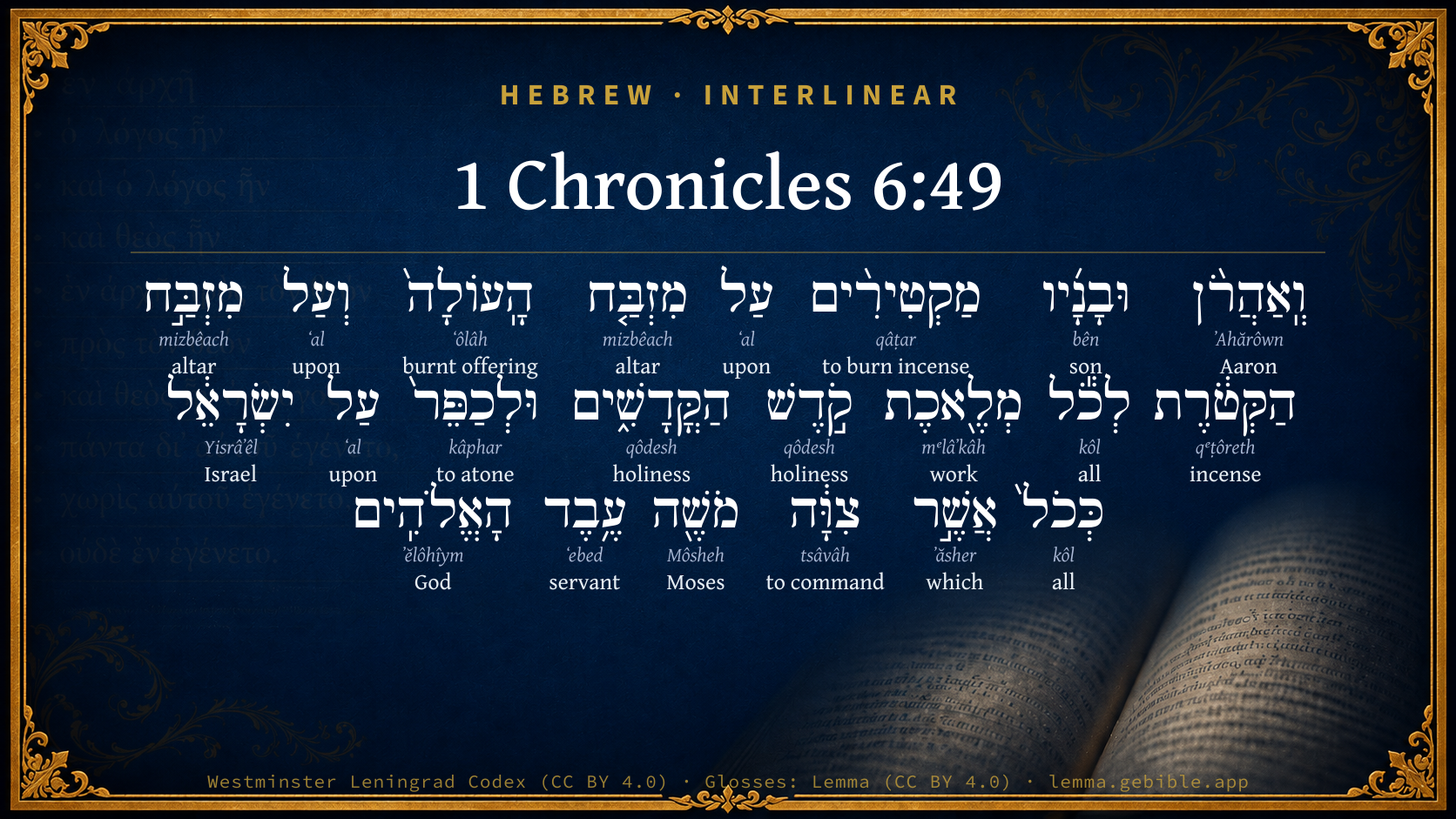
1 Chronicles 6:49

Hebrew (Westminster Leningrad Codex) 1 Chronicles 6:49 appears in the Hebrew Old Testament. The text above is from the Westminster Leningrad Codex. Each word links to its Strong’s number, a concise gloss, and parsing drawn from the Open Scriptures Hebrew Bible morphology. Click any word for its full Brown-Driver-Briggs (BDB) entry.
Download image
Cite this verse

1 Chronicles 6:49 (World English Bible). Public Domain. Lemma interlinear Bible study tool, https://lemma.gebible.app/v/1-chronicles/6/49.

Show BibTeX & RIS
BibTeX
RIS
English Translation
But Aaron and his sons offered on the altar of burnt offering, and on the altar of incense, for all the work of the most holy place, and to make atonement for Israel, according to all that Moses the servant of God had commanded.
World English Bible · Public Domain
Download a study sheet

One document with this verse’s original text, its word-by-word gloss line, the meaning frame, cross-references with their text, attributed commentary, and full source and license credits — printable, and it pastes into notes with its structure intact.

This verse Autodidact and up

Study sheet (.html) Plain text (.txt)

A passage Seminary Student

Up to 50 verses in one chapter. A passage sheet keeps up to 6 commentary sources and 12 cross-references per verse, in the order this page ranks them, and says so on the sheet whenever that leaves anything out. Ask for a single verse and you get the Autodidact verse sheet above.

Everything on this page stays free to read, with no account — the sheet is a download of what is already on screen, not access to it.

Want to remove ads? Support Godless Engineer
Compare translations 3

The same verse in 3 English versions, stacked beneath the original-language interlinear above. Click any original word for its lexicon entry.

Each is an independent rendering of the whole verse — the interlinear is not word-aligned to these translations.

Highlighted words mark where these versions differ — a whole-verse word diff, not a word-by-word alignment.

  • World English Bible Public Domain
    But Aaron and his sons offered on the altar of burnt offering, and on the altar of incense, for all the work of the most holy place, and to make atonement for Israel, according to all that Moses the servant of God had commanded.
  • King James Version Public Domain
    But Aaron and his sons offered upon the altar of the burnt offering, and on the altar of incense, and were appointed for all the work of the place most holy, and to make an atonement for Israel, according to all that Moses the servant of God had commanded.
  • unfoldingWord Literal Text CC BY-SA 4.0
    And Aaron and his sons were offering on the altar of burnt offering and on the altar of incense for all of the work of the Holy of Holies and to cover over Israel, according to all that Moses the servant of God had commanded.

unfoldingWord Literal Text — © unfoldingWord, licensed CC BY-SA 4.0. Word-aligned USFM3 via Door43 (git.door43.org/unfoldingWord/en_ult).

Versions to compare (up to 4)

3 of 4 selected

Show all 18 translations

Every available English version of this verse, each an independent rendering of the whole verse.

  • World English Bible Public Domain
    But Aaron and his sons offered on the altar of burnt offering, and on the altar of incense, for all the work of the most holy place, and to make atonement for Israel, according to all that Moses the servant of God had commanded.
  • Berean Standard Bible Public Domain
    But Aaron and his sons did all the work of the Most Holy Place. They presented the offerings on the altar of burnt offering and on the altar of incense to make atonement for Israel, according to all that Moses the servant of God had commanded.
  • Majority Standard Bible Public Domain
    But Aaron and his sons did all the work of the Most Holy Place. They presented the offerings on the altar of burnt offering and on the altar of incense to make atonement for Israel, according to all that Moses the servant of God had commanded.
  • King James Version Public Domain
    But Aaron and his sons offered upon the altar of the burnt offering, and on the altar of incense, and were appointed for all the work of the place most holy, and to make an atonement for Israel, according to all that Moses the servant of God had commanded.
  • American Standard Version (1901) Public Domain
    But Aaron and his sons offered upon the altar of burnt-offering, and upon the altar of incense, for all the work of the most holy place, and to make atonement for Israel, according to all that Moses the servant of God had commanded.
  • Revised Version (1885) Public Domain
    But Aaron and his sons offered upon the altar of burnt offering, and upon the altar of incense, for all the work of the most holy place, and to make atonement for Israel, according to all that Moses the servant of God had commanded.
  • Geneva Bible (1599) Public Domain
    But Aaron and his sonnes burnt incense vpon the altar of burnt offering, and on the altar of incense, for all that was to do in the most holy place, and to make an atonement for Israel, according to all that Moses the seruant of God had commanded.
  • Douay-Rheims (1899) Public Domain
    But Aaron and his sons offered burnt offerings upon the altar of holocausts, and upon the altar of incense, for very work of the holy of holies: and to pray for Israel according to all that Moses the servant of God had commanded.
  • Young's Literal Translation Public Domain
    And Aaron and his sons are making perfume on the altar of the burnt-offering, and on the altar of the perfume, for all the work of the holy of holies, and to make atonement for Israel, according to all that Moses servant of God commanded.
  • Literal Standard Version CC BY-SA 4.0
    And Aaron and his sons are making incense on the altar of the burnt-offering, and on the altar of the incense, for all the work of the Holy of Holies, and to make atonement for Israel, according to all that Moses servant of God commanded.
  • Unlocked Literal Bible CC BY-SA 4.0
    Aaron and his sons made the offerings on the altar for burnt offerings; and the offering on the incense altar for all the work on the most holy place. These offerings made atonement for Israel, according to all that Moses the servant of God had commanded.
  • unfoldingWord Literal Text CC BY-SA 4.0
    And Aaron and his sons were offering on the altar of burnt offering and on the altar of incense for all of the work of the Holy of Holies and to cover over Israel, according to all that Moses the servant of God had commanded.
  • Darby Bible Public Domain
    And Aaron and his sons offered upon the altar of the burnt-offering, and on the altar of incense, for all the work of the most holy place, and to make atonement for Israel, according to all that Moses the servant of God had commanded.
  • World Messianic Bible Public Domain
    But Aaron and his sons offered on the altar of burnt offering, and on the altar of incense, for all the work of the most holy place, and to make atonement for Israel, according to all that Moses the servant of God had commanded.
  • Webster's Bible Public Domain
    But Aaron and his sons offered upon the altar of the burnt-offering, and on the altar of incense, and were appointed for all the work of the place most holy, and to make an atonement for Israel, according to all that Moses the servant of God had commanded.
  • Free Bible Version CC BY-SA 4.0
    However, it was Aaron and his descendants who were the ones who gave offerings on the altar of burnt offering and on the altar of incense and did all the work in the Most Holy Place, making atonement for Israel according to everything Moses the servant of God had commanded.
  • Bible in Basic English Public Domain
    But Aaron and his sons made offerings on the altar of burned offering, and on the altar of perfume, for all the work of the most holy place, and to take away the sin of Israel, doing everything ordered by Moses, the servant of God.
  • JPS Tanakh (1917) Public Domain
    (6-34) But Aaron and his sons offered upon the altar of burnt-offering, and upon the altar of incense, for all the work of the most holy place, and to make atonement for Israel, according to all that Moses the servant of God had commanded.

Literal Standard Version (2020), Covenant Press — licensed CC BY-SA 4.0. Text via the HelloAO Bible API (eBible.org). Unlocked Literal Bible (unfoldingWord) — licensed CC BY-SA 4.0. Text via the HelloAO Bible API (eBible.org). unfoldingWord Literal Text — © unfoldingWord, licensed CC BY-SA 4.0. Word-aligned USFM3 via Door43 (git.door43.org/unfoldingWord/en_ult). Free Bible Version, Dr. Jonathan Gallagher — licensed CC BY-SA 4.0. Text via the HelloAO Bible API (eBible.org).

Word by word

More ways to search: Search by grammar → Find every occurrence → Compare this word →

Practice this passage: Drill this verse → Learn its vocabulary →

הַקְּטֹ֔רֶת
qᵉṭôreth
H7004
“the · incense”
Particle, Definite Article + Noun, Common, Feminine, Singular, Absolute
Part of Speech
Particle + Noun
Type
Common
Gender
Feminine
Number
Singular
State
Absolute
Full BDB Definition

Origin: from H6999

TWOT: 2011a

incense, smoke, odour of (burning) sacrifice - sweet smoke of sacrifice - incense - perfume
  1. וְֽאַהֲרֹ֨ן ʼAhărôwn H175 “and · Aaron” Conjunction + Noun, Proper
  2. וּבָנָ֜יו bên H1121 “and · sons · his” Conjunction + Noun, Common, Masculine, Plural, Construct + Suffix, Personal, 3rd Person, Masculine, Singular
  3. מַקְטִירִ֨ים qâṭar H6999 “burning incense” Verb, Hiphil, Participle Active, Masculine, Plural, Absolute
  4. עַל ʻal H5921 “upon” Preposition
  5. מִזְבַּ֤ח mizbêach H4196 “altar of” Noun, Common, Masculine, Singular, Construct
  6. הָֽעוֹלָה֙ ʻôlâh H5930 “the · burnt offering” Particle, Definite Article + Noun, Common, Feminine, Singular, Absolute
  7. וְעַל ʻal H5921 “and · upon” Conjunction + Preposition
  8. מִזְבַּ֣ח mizbêach H4196 “altar of” Noun, Common, Masculine, Singular, Construct
  9. לְכֹ֕ל kôl H3605 “to/for · all of” Preposition + Noun, Common, Masculine, Singular, Construct
  10. מְלֶ֖אכֶת mᵉlâʼkâh H4399 “work of” Noun, Common, Feminine, Singular, Construct
  11. קֹ֣דֶשׁ qôdesh H6944 “holiness of” Noun, Common, Masculine, Singular, Construct
  12. הַקֳּדָשִׁ֑ים qôdesh H6944 “the · holy things” Particle, Definite Article + Noun, Common, Masculine, Plural, Absolute
  13. וּלְכַפֵּר֙ kâphar H3722 “and · to atone” Conjunction + Preposition + Verb, Piel, Infinitive Construct
  14. עַל ʻal H5921 “upon” Preposition
  15. יִשְׂרָאֵ֔ל Yisrâʼêl H3478 “Israel” Noun, Proper
  16. כְּכֹל֙ kôl H3605 “like/as · all” Preposition + Noun, Common, Masculine, Singular, Absolute
  17. אֲשֶׁ֣ר ʼăsher H834 “which” Particle, Relative
  18. צִוָּ֔ה tsâvâh H6680 “to command” Verb, Piel, Perfect, 3rd Person, Masculine, Singular
  19. מֹשֶׁ֖ה Môsheh H4872 “Moses” Noun, Proper
  20. עֶ֥בֶד ʻebed H5650 “servant of” Noun, Common, Masculine, Singular, Construct
  21. הָאֱלֹהִֽים ʼĕlôhîym H430 “the · God(s)” Particle, Definite Article + Noun, Common, Masculine, Plural, Absolute

About this verse

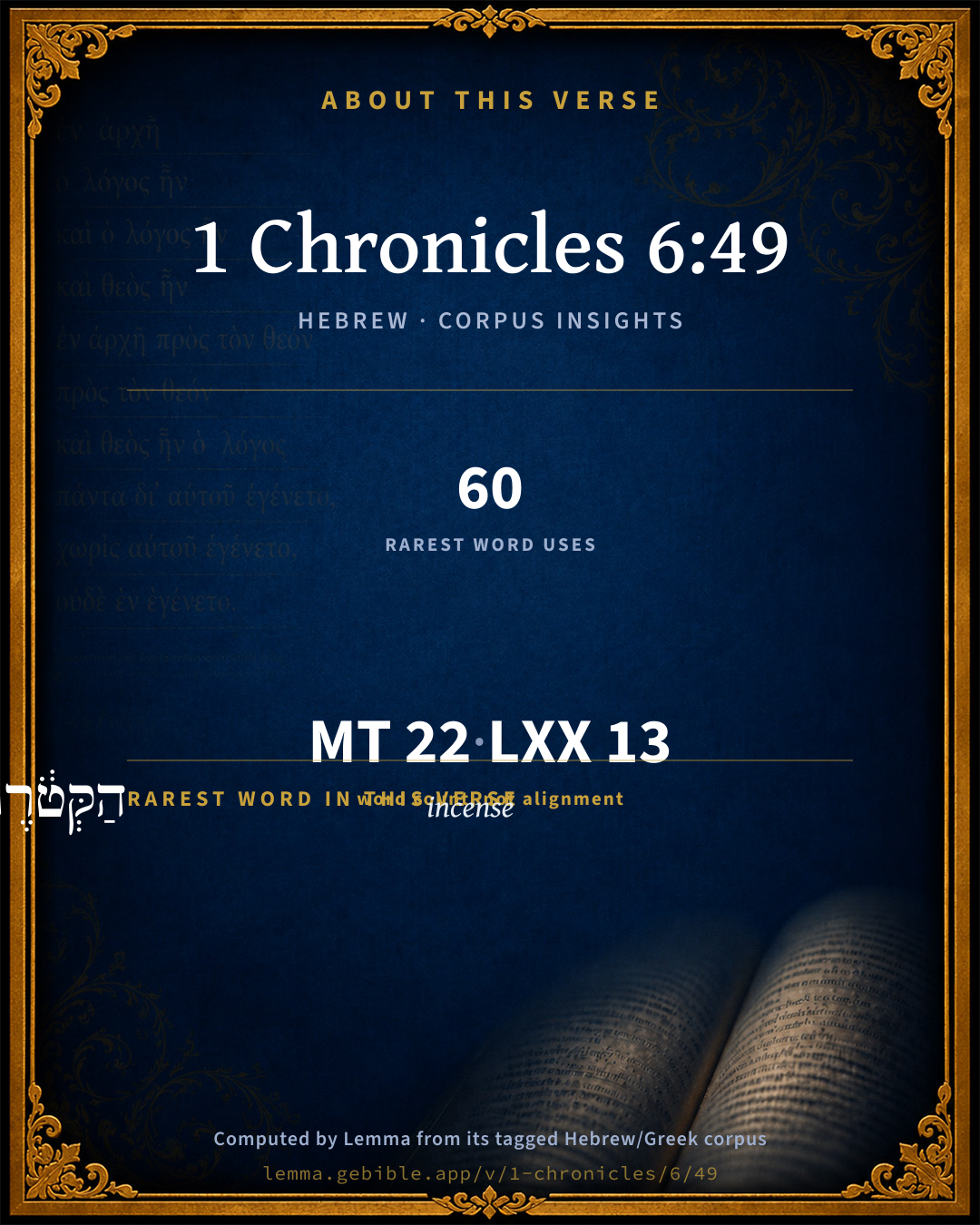
These counts appear in no published source. They are computed here, from the morphology-tagged text and Lemma’s own curated glosses. What Lemma adds →

22
words
17
distinct lemmas
Historical
section

Shared distinctive vocabulary

הַקְּטֹ֔רֶת incense H7004 occurs in 58 verses of the Hebrew Bible. Also found in:

Grammatical profile

  • 3 verbs
  • 15 nouns
  • 3 prepositions
  • 1 particle

Verb forms

  • מַקְטִירִ֨ים Hiphil · Participle Active
  • וּלְכַפֵּר֙ Piel · Infinitive Construct
  • צִוָּ֔ה Piel · Perfect

Repetition

Words recur within this verse — often emphatic in Hebrew:

  • עַל upon H5921 ×3
  • מִזְבַּ֤ח altar H4196 ×2
  • לְכֹ֕ל all H3605 ×2
  • קֹ֣דֶשׁ holiness H6944 ×2

Hebrew & Septuagint length

In English translation the verse runs 44 words from the Hebrew and 49 from the Septuagint (LXX English) — closely comparable.

A rough comparison of the two English renderings, which tokenize alike — not a word-level alignment.

Word counts can differ between the Hebrew and the Greek without any difference in meaning — e.g. the Hebrew direct-object marker אֵת has no separate Greek word, and Greek often adds the article ὁ.

In the original languages it is 22 Hebrew tokens and 13 Greek tokens — but the two are counted differently (Hebrew bundles its prefixes and suffixes into one token; the Greek is in lemma form), so that isn’t a like-for-like length.

Cross-references

17

Topical passages linked to 1 Chronicles 6:49 in the Treasury of Scripture Knowledge — connected by theme and wording, ordered by reader-vote popularity; previews shown in the World English Bible.

  • Leviticus 4:20 Thus shall he do with the bull; as he did with the bull of the sin offering, so shall he do with this; and the priest shall make atonement for them, and they shall be forgiven.
  • Exodus 27:1–8 "You shall make the altar of acacia wood, five cubits long, and five cubits broad; the altar shall be foursquare: and its height shall be three cubits.
  • Exodus 30:1–7 "You shall make an altar to burn incense on. You shall make it of acacia wood.
  • Exodus 30:10–16 Aaron shall make atonement on its horns once in the year; with the blood of the sin offering of atonement once in the year he shall make atonement for it throughout your generations. It is most holy to Yahweh."
  • Exodus 29:33 They shall eat those things with which atonement was made, to consecrate and sanctify them: but a stranger shall not eat of it, because they are holy.
  • Job 33:24 Then God is gracious to him, and says, 'Deliver him from going down to the pit, I have found a ransom.'
  • Hebrews 7:11–14 Now if there was perfection through the Levitical priesthood (for under it the people have received the law), what further need was there for another priest to arise after the order of Melchizedek, and not be called after the order of Aaron?
  • Exodus 29:36–37 Every day shall you offer the bull of sin-offering for atonement: and you shall cleanse the altar, when you make atonement for it; and you shall anoint it, to sanctify it.
  • Leviticus 1:5 He shall kill the bull before Yahweh. Aaron's sons, the priests, shall present the blood and sprinkle the blood around on the altar that is at the door of the Tent of Meeting.
  • Leviticus 1:7–9 The sons of Aaron the priest shall put fire on the altar, and lay wood in order on the fire;
  • Leviticus 8:1–10 Yahweh spoke to Moses, saying,
  • Leviticus 21:1–22 Yahweh said to Moses, "Speak to the priests, the sons of Aaron, and say to them, 'A priest shall not defile himself for the dead among his people;
  • Numbers 15:25 The priest shall make atonement for all the congregation of the children of Israel, and they shall be forgiven; for it was an error, and they have brought their offering, an offering made by fire to Yahweh, and their sin-offering before Yahweh, for their error:
  • Numbers 16:16–17:13 Moses said to Korah, You and all your company go before Yahweh, you, and they, and Aaron, tomorrow:
  • Deuteronomy 18:1–8 The priests the Levites, [even] all the tribe of Levi, shall have no portion nor inheritance with Israel: they shall eat the offerings of Yahweh made by fire, and his inheritance.
  • Deuteronomy 34:5 So Moses the servant of Yahweh died there in the land of Moab, according to the word of Yahweh.
  • Joshua 1:1 Now it happened after the death of Moses the servant of Yahweh, that Yahweh spoke to Joshua the son of Nun, Moses' minister, saying,

Cross-references courtesy of OpenBible.info (CC BY 4.0).

Hebrew and Greek witnesses Masoretic Hebrew ↔ Greek Septuagint

The same verse in the two great witnesses to the Old Testament, shown verse-for-verse.

These are two independent witnesses, not word-aligned to each other, and the Septuagint is shown in lemma (dictionary) form.

Hebrew 1 Chronicles 6:49 Masoretic · Westminster Leningrad Codex

וְֽאַהֲרֹ֨ן וּבָנָ֜יו מַקְטִירִ֨ים עַל מִזְבַּ֤ח הָֽעוֹלָה֙ וְעַל מִזְבַּ֣ח הַקְּטֹ֔רֶת לְכֹ֕ל מְלֶ֖אכֶת קֹ֣דֶשׁ הַקֳּדָשִׁ֑ים וּלְכַפֵּר֙ עַל יִשְׂרָאֵ֔ל כְּכֹל֙ אֲשֶׁ֣ר צִוָּ֔ה מֹשֶׁ֖ה עֶ֥בֶד הָאֱלֹהִֽים

But Aaron and his sons offered on the altar of burnt offering, and on the altar of incense, for all the work of the most holy place, and to make atonement for Israel, according to all that Moses the servant of God had commanded.

World English Bible · Public Domain

Greek LXX 1 Chronicles 6:49 Septuagint · lemma form

καί δίδωμι ὁ υἱός ἰσραήλ ὁ λευίτης ὁ πόλις καί ὁ περισπόριον αὐτός

And Aaron and his sons were to burn incense on the altar of whole burnt offerings, and on the altar of incense, for all the ministry in the holy of holies, and to make atonement for Israel, according to all things that Moses the servant of the Lord commanded.

LXX2012 (modern English Septuagint) · Public Domain

Hebrew: Westminster Leningrad Codex (CC BY 4.0). Greek: Septuagint (public domain); English from LXX2012 (modern English Septuagint) (Public Domain). How the Septuagint differs from the Hebrew →

Commentary

Notes on 1 Chronicles 6:49 from classic Christian and Jewish commentators (each source and its license shown beneath its notes). The classic Christian expositions comment on the surrounding passage and are grouped to its opening verse, so a note may address several verses; the Jewish commentaries on the Tanakh (Rashi and others) are per-verse, so they appear only where the commentator wrote on this verse.

Lemma curates 59 commentaries, every one of them public domain or Creative Commons licensed, each selected and text-cleaned for this edition rather than reprinted as found. About our sources →

Jamieson, Fausset & Brown

Robert Jamieson, A. R. Fausset & David Brown

OFFICE OF AARON AND HIS SONS. (1Ch. 6:49-81)

But Aaron and his sons offered, &c.--The office and duties of the high priests having been already described, the names of those who successively filled that important office are recorded.

Jamieson, Fausset & Brown — Commentary Critical and Explanatory on the Whole Bible (1871) — public domain (CC PDM 1.0). Text via the HelloAO Bible API.

Joseph Benson's Commentary

1Ch 6:49. But Aaron and his sons offered upon the altar — The noblest part of the ministry was reserved for them. Aaron alone, and his successors in the high-priesthood, made atonement and ministered in the most holy place. But his sons, the other priests, offered on the altars of burnt- offering, and of incense.

Joseph Benson's Commentary on the Old and New Testaments (1811–1818) — public domain. Text from a community e-Sword module.

Tyndale Open Study Notes

Tyndale Open Resources

6:49 This explanation of the priests’ prerogatives introduces the list that follows.

Tyndale Open Study Notes — © Tyndale Open Resources, licensed CC BY-SA 4.0. Text via the HelloAO Bible API.

Ellicott's Commentary for English Readers

(49) But Aaron and his sons offered.—Literally, And Aaron and his sons were offering. The participle denotes unintermitted action. “Aaron and his sons” is a technical name for the priests, to whom, according to this passage, three functions pertained: (1) sacrifice on the altars of burnt-offering and inconse; (2) the work of the most holy place (Holy of holies); (3) atonement for Israel by special rites of sacrifice and purification.

According to all that Moses . . . commanded.—This refers to the entire ministry of the priests. The time in question is the Davidic age.

The servant of God.—Comp. Deu_34:5; Jos_1:1; Jos_1:13. After his death, Moses is thrice called “servant of Jehovah,” in whose earthly household he had been faithful as a servant (Heb_3:5). He fore-figures in grand if imperfect outline that other servant of Jehovah, of whom the second half of Isaiah has so much discourse. “Servant of God” (Elohîm) the chronicler writes, because in his day the NAME was held in ever-increasing awe.

A Bible Commentary for English Readers, edited by Charles John Ellicott (1878–1897) — public domain. Text from a community e-Sword module.

The Cambridge Bible for Schools and Colleges

gen. ed. J. J. S. Perowne

49. the altar of the burnt offering] Exo_27:1-8.

the altar of incense] Exo_30:1-10.

to make an atonement] R.V. to make atonement; Exo_30:10; Leviticus 16.

The Cambridge Bible for Schools and Colleges (gen. ed. J. J. S. Perowne; Cambridge University Press, 1878–1918) — public domain. Text from a community e-Sword module.

Haydock's Catholic Bible Commentary

Offerings, which is here the meaning of incensum; as "incense" was not burnt on this altar, but only victims, Exodus xxix. 13.

George Leo Haydock (1774–1849), Haydock's Catholic Family Bible and Commentary, 1859 edition — public domain. Excludes Psalms (Douay-Rheims chapter numbering differs from Protestant) and Deuterocanonical books (Catholic canon only).

Matthew Poole's English Annotations

Having mentioned the work and employment of the high priests, he briefly rehearseth the names of the persons who successively performed it.

Matthew Poole's English Annotations on the Holy Bible (1683–1685) — public domain. Text from a community e-Sword/MySword module.

The Pulpit Commentary

Vers. 49-53. These verses allude to the more special functions of "Aaron and his sons," as they are here called, i.e. , his lineal descendants (vers. 4-15; Ezr_7:2-5) whose names, stopping at Ahimaaz, the eleventh generation, are the same with those of vers. 3-8. The manifest inference is that the present enumeration, stopping with the name of one contemporary with David, (2Sa_15:27) was borrowed from tables of the date of David, and not of the date of the Captivity (ver. 15).

The altar of the burnt offering. (Lev_1:3-17) The altar of incense (Exo_25:6 Exo_30:1-7, Exo_30:7-9, Exo_30:34-38; Lev_16:12) Most holy. (Lev_16:12, Lev_16:14, Lev_16:15, Lev_16:17, Lev_16:20) An atonement for Israel. (Lev_16:3-19 Lev_23:26-32 Num_29:7-11)

The constant work of atonement.

It is only to the atonements of the Mosaic system and the general truths which they suggest that we propose here to direct attention. The subject of the Divine atonement for sin is too large and many-sided for efficient treatment in any one homily or sermon; and yet there is the danger of producing an imperfect or erroneous impression when any piece or portion of the great subject is isolated for consideration. The word "atonement" in the Old Testament means a "covering over," and "hiding from view;" and it is applied to some sacrifice whose acceptableness covers over and hides from view the unworthiness and transgression of him who brings it, or to some act, such as that of Phinehas, which, because it vindicates the Divine honour, Law, and righteousness, is regarded as covering over iniquity, and making possible the pardon of the transgressors. But some changes passed in the connotation of the term, so that the New Testament Greek equivalent became the word "reconciliation," which appears to regard the word as at-one-merit, but does not carry over the idea of covering transgression by a sacrifice or a loyal act. The appointment of Aaron and his sons for this particular work emphasizes the fact that, under the older dispensation, there was constant need for atonement. Every individual needed that it should be made for him again and again, and every year a great public atonement was made for the sins of the people. The reason appears to be this: every fresh act of wilfulness and sin imperilled the standing of the individual and the nation as within the Divine covenant, and brought down upon them all the penalties of the broken covenant penalties involving even the surrender of life. It would help greatly to clearness of view if we recognized that atonement always bears relation to mans standing before God, and not to man"s personal cleanness or cleansing. The constant atonement covered the sin which broke the covenant-relations, and restored, for the individual and the nation, the old covenant-conditions. The daily burnt offering was a daily atonement, or vindicatory act, which covered the people"s sin and set them again in full covenant-standing. The private burnt offerings did the same thing for the individual. And the "day of atonement" did it, in a sublime way, as a grand national spectacle, for the due impression of the entire nation. As carried over into Christianity, and gaining its moral and spiritual aspects, we must duly conserve the features illustrated in the Old Testament atonements. These are:

1. Mans lost standing with God by reason of his transgressions. This is fully argued by St. Paul in the earlier chapters of the Epistle to the Romans. Beyond and besides other effects of human sin, this must be fully recognized it sets us all out of our true standing with God, out of the covenant-relation which is conditioned by our obedience and faithfulness.

2. Mans standing recovered on the ground of something offered to God that is infinitely acceptable to him. In Judaic symbol, the spotlessly pure and absolutely complete animal presented entire. In Christian history, the offering of the person of the Son of God and Son of man, the Lamb without blemish or spot, on the altar of the Divine will.

3. The full acceptance of the atoning sacrifice, by the offerer, as the representation to God of his own will and purpose. This declared the sincerity of a Mosaic atonement; this makes Christ"s offering to be for us. There is, however, for us no need of a constantly renewed atonement. The writer of the Epistle to the Hebrews argues this from the surpassing dignity and worth of the atonement offered by Christ, and from the relation in which he, the Divine Son and Divine man, stands both to God and to us. But that one sacrifice is our constant daily pledge to God that we will keep in the covenant of holy service to him. Every morning to name Christ"s Name is to do, in effect, what the Jew did every morning by sharing in the burnt offering. It is to declare our standing within the new covenant, and to pledge ourselves afresh that we will be true and faithful to all its responsibilities and claims. R.T.

The Pulpit Commentary (1880–1919), ed. H.D.M. Spence-Jones & Joseph S. Exell — public domain. Text from a community e-Sword module.

unfoldingWord translationNotes

Door43 World Missions Community

These offerings made atonement for Israel

"They offered these things to make atonement for the sins of the people of Israel"

translationWords

Aaron

son

sacrifice

altar

burnt offering

altar of incense

holy place

atonement

Israel

Moses

servant

God

command

unfoldingWord translationNotes — © Distant Shores Media and the Door43 World Missions Community, licensed CC BY-SA 4.0. Source: git.door43.org/Door43/en_tn.

Lesson kit

Teaching starters — assembled from the data on this page, not authored interpretation. Every prompt links to the verse data it draws on. Edit before teaching.

1 Chronicles, in the Historical, opens this verse with 22 words (17 distinct Hebrew lemmas). Its most distinctive word is qᵉṭôreth (“incense”). A historical commentator’s framing appears above. Read the whole chapter for the surrounding context.

Discussion questions

  1. The word qᵉṭôreth carries the sense “incense.” How does it shape the verse?
  2. Exodus 25:6 shares the word «incense» with this verse. How do the two illuminate each other?
  3. “upon” occurs 3× in this one verse. What is the effect of the repetition?
  4. These translations render this verse differently. What is at stake in choosing one wording over another?
  5. The verb «מַקְטִירִ֨ים» is Hiphil Participle Active. How does its form color the action?
  6. Reading how Jamieson, Fausset & Brown and Joseph Benson's Commentary read this verse, where do the two commentators agree and where do they part?

Things to notice

Reading settings

Reading text

Shown beneath each verse's original-language words.

Old Testament
Old Testament edition

Read the OT as the Masoretic Hebrew (MT) or the Greek Septuagint (LXX).

English shown for the Greek Septuagint (in the Hebrew ↔ Greek comparison).

Comparing translations? Open the Compare panel on any verse page to stack up to four side by side.