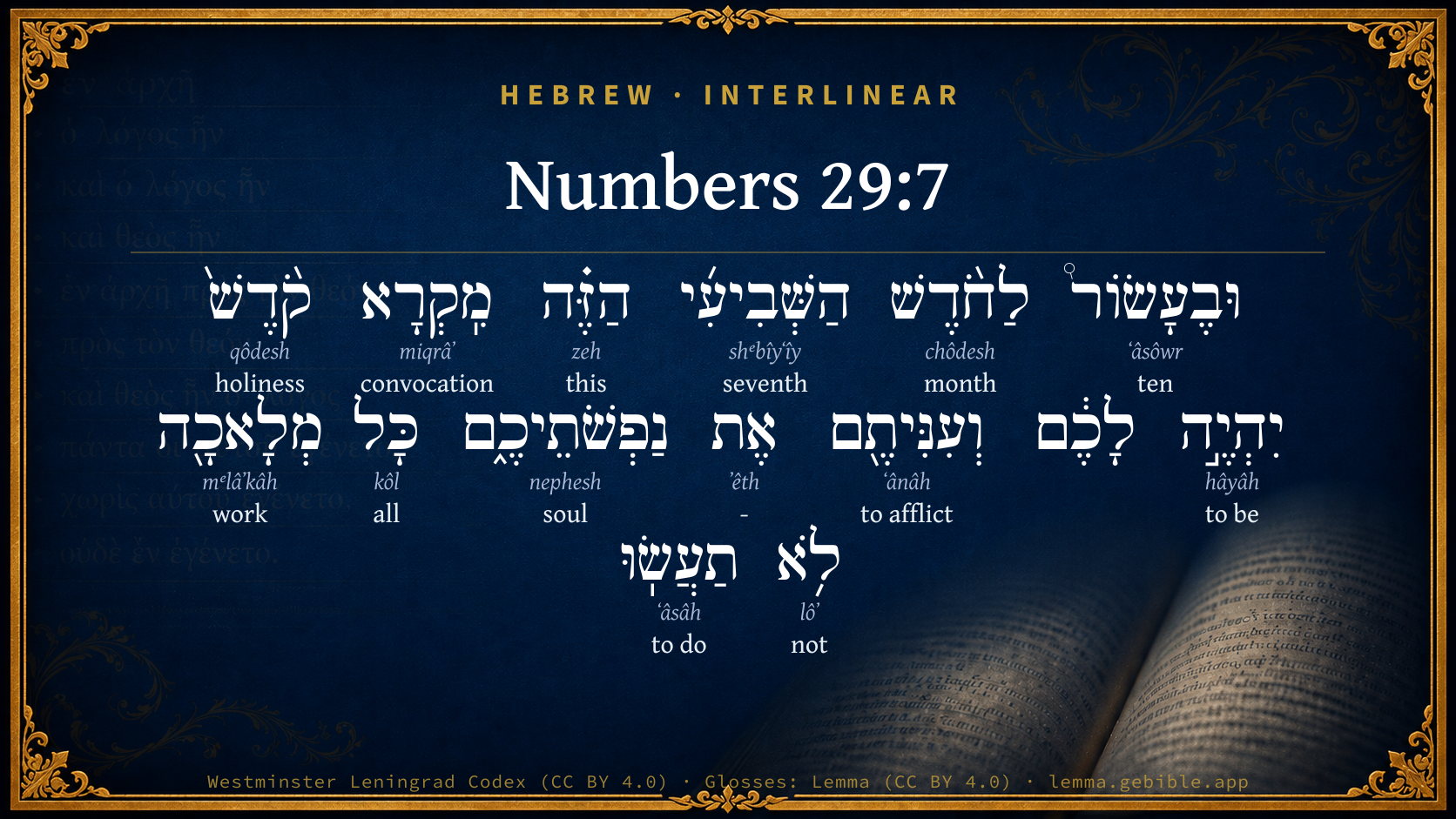
Numbers 29:7

Hebrew (Westminster Leningrad Codex) Numbers 29:7 appears in the Hebrew Old Testament. The text above is from the Westminster Leningrad Codex. Each word links to its Strong’s number, a concise gloss, and parsing drawn from the Open Scriptures Hebrew Bible morphology. Click any word for its full Brown-Driver-Briggs (BDB) entry.
Download image
Cite this verse

Numbers 29:7 (World English Bible). Public Domain. Lemma interlinear Bible study tool, https://lemma.gebible.app/v/numbers/29/7.

Show BibTeX & RIS
BibTeX
RIS
English Translation
On the tenth day of this seventh month you shall have a holy convocation; and you shall afflict your souls: you shall do no manner of work;
World English Bible · Public Domain
Download a study sheet

One document with this verse’s original text, its word-by-word gloss line, the meaning frame, cross-references with their text, attributed commentary, and full source and license credits — printable, and it pastes into notes with its structure intact.

This verse Autodidact and up

Study sheet (.html) Plain text (.txt)

A passage Seminary Student

Up to 50 verses in one chapter. A passage sheet keeps up to 6 commentary sources and 12 cross-references per verse, in the order this page ranks them, and says so on the sheet whenever that leaves anything out. Ask for a single verse and you get the Autodidact verse sheet above.

Everything on this page stays free to read, with no account — the sheet is a download of what is already on screen, not access to it.

Want to remove ads? Support Godless Engineer
Compare translations 3

The same verse in 3 English versions, stacked beneath the original-language interlinear above. Click any original word for its lexicon entry.

Each is an independent rendering of the whole verse — the interlinear is not word-aligned to these translations.

Highlighted words mark where these versions differ — a whole-verse word diff, not a word-by-word alignment.

  • World English Bible Public Domain
    On the tenth day of this seventh month you shall have a holy convocation; and you shall afflict your souls: you shall do no manner of work;
  • King James Version Public Domain
    And ye shall have on the tenth day of this seventh month an holy convocation; and ye shall afflict your souls: ye shall not do any work therein:
  • unfoldingWord Literal Text CC BY-SA 4.0
    And on the tenth of this seventh month there shall be a convocation of holiness for you. And you shall afflict your lives. You shall not do any work.

unfoldingWord Literal Text — © unfoldingWord, licensed CC BY-SA 4.0. Word-aligned USFM3 via Door43 (git.door43.org/unfoldingWord/en_ult).

Versions to compare (up to 4)

3 of 4 selected

Show all 18 translations

Every available English version of this verse, each an independent rendering of the whole verse.

  • World English Bible Public Domain
    On the tenth day of this seventh month you shall have a holy convocation; and you shall afflict your souls: you shall do no manner of work;
  • Berean Standard Bible Public Domain
    On the tenth day of this seventh month, you are to hold a sacred assembly, and you shall humble yourselves; you must not do any work.
  • Majority Standard Bible Public Domain
    On the tenth day of this seventh month, you are to hold a sacred assembly, and you shall humble yourselves; you must not do any work.
  • King James Version Public Domain
    And ye shall have on the tenth day of this seventh month an holy convocation; and ye shall afflict your souls: ye shall not do any work therein:
  • American Standard Version (1901) Public Domain
    And on the tenth day of this seventh month ye shall have a holy convocation; and ye shall afflict your souls: ye shall do no manner of work;
  • Revised Version (1885) Public Domain
    And on the tenth day of this seventh month ye shall have an holy convocation; and ye shall afflict your souls; ye shall do no manner of work:
  • Geneva Bible (1599) Public Domain
    And ye shall haue in ye tenth day of the seuenth moneth, an holy conuocation: and ye shall humble your soules, and shall not doe any worke therein:
  • Douay-Rheims (1899) Public Domain
    The tenth day also of this seventh month shall be holy and venerable unto you, and you shall afflict your souls: you shall do no servile work therein.
  • Young's Literal Translation Public Domain
    `And on the tenth of this seventh month a holy convocation ye have, and ye have humbled your souls; ye do no work;
  • Literal Standard Version CC BY-SA 4.0
    And on the tenth of this seventh month you have a holy convocation, and you have humbled your souls; you do no work;
  • Unlocked Literal Bible CC BY-SA 4.0
    On the tenth day of the seventh month you must have a holy assembly to honor Yahweh. You must humble yourselves and do no work.
  • unfoldingWord Literal Text CC BY-SA 4.0
    And on the tenth of this seventh month there shall be a convocation of holiness for you. And you shall afflict your lives. You shall not do any work.
  • Darby Bible Public Domain
    And on the tenth of this seventh month ye shall have a holy convocation; and ye shall afflict your souls; no manner of work shall ye do.
  • World Messianic Bible Public Domain
    “‘On the tenth day of this seventh month you shall have a holy convocation. You shall afflict your souls. You shall do no kind of work;
  • Webster's Bible Public Domain
    And ye shall have on the tenth day of this seventh month a holy convocation; and ye shall afflict your souls: in it ye shall not do any work.
  • Free Bible Version CC BY-SA 4.0
    Hold a holy meeting on the tenth day of this seventh month, and practice self-denial. Don't do any of your normal work.
  • Bible in Basic English Public Domain
    And on the tenth day of this seventh month there will be a holy meeting; keep yourselves from pleasure, and do no sort of work;
  • JPS Tanakh (1917) Public Domain
    And on the tenth day of this seventh month ye shall have a holy convocation; and ye shall afflict your souls; ye shall do no manner of work;

Literal Standard Version (2020), Covenant Press — licensed CC BY-SA 4.0. Text via the HelloAO Bible API (eBible.org). Unlocked Literal Bible (unfoldingWord) — licensed CC BY-SA 4.0. Text via the HelloAO Bible API (eBible.org). unfoldingWord Literal Text — © unfoldingWord, licensed CC BY-SA 4.0. Word-aligned USFM3 via Door43 (git.door43.org/unfoldingWord/en_ult). Free Bible Version, Dr. Jonathan Gallagher — licensed CC BY-SA 4.0. Text via the HelloAO Bible API (eBible.org).

Word by word

More ways to search: Search by grammar → Find every occurrence → Compare this word →

Practice this passage: Drill this verse → Learn its vocabulary →

וּבֶעָשׂוֹר֩
ʻâsôwr
H6218
“and · in/at the · ten”
Conjunction + Preposition, Determined + Noun, Common, Masculine, Singular, Absolute
Part of Speech
Conjunction + Preposition + Noun
Type
Common
Gender
Masculine
Number
Singular
State
Absolute
Full BDB Definition

Origin: from H6235

TWOT: 1711d

ten, decade - ten, tenth - ten-stringed, harp
  1. לַחֹ֨דֶשׁ chôdesh H2320 “to/for the · month” Preposition, Determined + Noun, Common, Masculine, Singular, Absolute
  2. הַשְּׁבִיעִ֜י shᵉbîyʻîy H7637 “the · seventh” Particle, Definite Article + Adjective, Ordinal number, Masculine, Singular, Absolute
  3. הַזֶּ֗ה zeh H2088 “the · this” Particle, Definite Article + Pronoun, Demonstrative, Masculine, Singular
  4. מִֽקְרָא miqrâʼ H4744 “convocation of” Noun, Common, Masculine, Singular, Construct
  5. קֹ֨דֶשׁ֙ qôdesh H6944 “holiness” Noun, Common, Masculine, Singular, Absolute
  6. יִהְיֶ֣ה hâyâh H1961 “to be” Verb, Qal, Imperfect, 3rd Person, Masculine, Singular
  7. וְעִנִּיתֶ֖ם ʻânâh H6031 “and · to afflict” Conjunction + Verb, Piel, Sequential Perfect, 2nd Person, Masculine, Plural
  8. אֶת ʼêth H853 “-” Particle, Direct Object
  9. נַפְשֹׁתֵיכֶ֑ם nephesh H5315 “souls · your” Noun, Common, Both, Plural, Construct + Suffix, Personal, 2nd Person, Masculine, Plural
  10. כָּל kôl H3605 “all of” Noun, Common, Masculine, Singular, Construct
  11. מְלָאכָ֖ה mᵉlâʼkâh H4399 “work” Noun, Common, Feminine, Singular, Absolute
  12. לֹ֥א lôʼ H3808 “not” Particle, Negative
  13. תַעֲשֽׂוּ ʻâsâh H6213 “to do” Verb, Qal, Imperfect, 2nd Person, Masculine, Plural

About this verse

These counts appear in no published source. They are computed here, from the morphology-tagged text and Lemma’s own curated glosses. What Lemma adds →

15
words
14
distinct lemmas
Pentateuch
section

Notable vocabulary

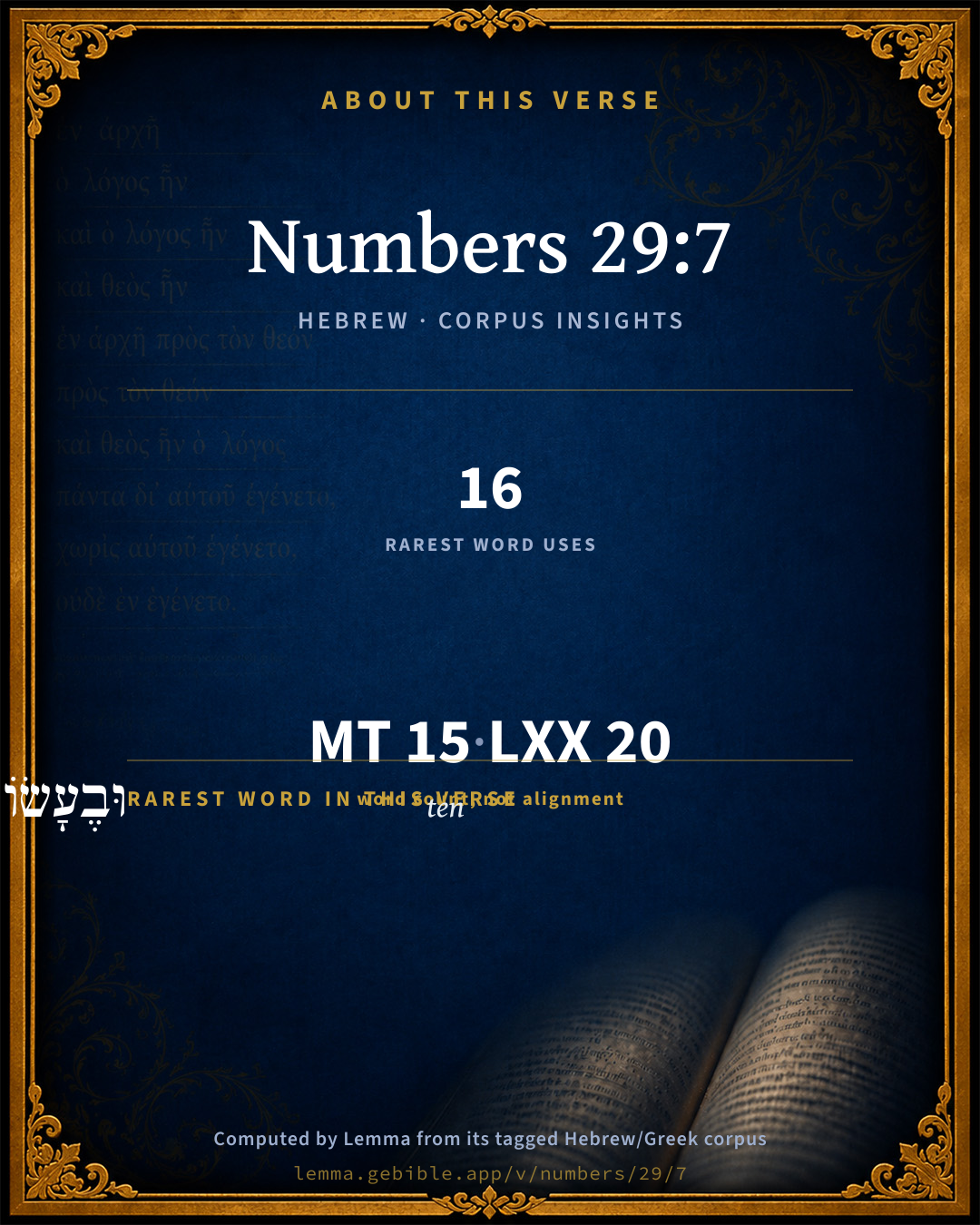
The rarest word here is וּבֶעָשׂוֹר֩ ten H6218 — appearing just 16 times in the whole Hebrew Bible.

Shared distinctive vocabulary

וּבֶעָשׂוֹר֩ ten H6218 occurs in 16 verses of the Hebrew Bible. Also found in:

Grammatical profile

  • 3 verbs
  • 7 nouns
  • 1 adjective
  • 1 pronoun
  • 1 preposition
  • 2 particles

Verb forms

  • יִהְיֶ֣ה Qal · Imperfect
  • וְעִנִּיתֶ֖ם Piel · Sequential Perfect
  • תַעֲשֽׂוּ Qal · Imperfect

Hebrew & Septuagint length

In English translation the verse runs 27 words from the Hebrew and 27 from the Septuagint (LXX English) — the same length.

A rough comparison of the two English renderings, which tokenize alike — not a word-level alignment.

Word counts can differ between the Hebrew and the Greek without any difference in meaning — e.g. the Hebrew direct-object marker אֵת has no separate Greek word, and Greek often adds the article ὁ.

In the original languages it is 15 Hebrew tokens and 20 Greek tokens — but the two are counted differently (Hebrew bundles its prefixes and suffixes into one token; the Greek is in lemma form), so that isn’t a like-for-like length.

Cross-references

17

Topical passages linked to Numbers 29:7 in the Treasury of Scripture Knowledge — connected by theme and wording, ordered by reader-vote popularity; previews shown in the World English Bible.

  • Leviticus 16:29–31 "It shall be a statute to you forever: in the seventh month, on the tenth day of the month, you shall afflict your souls, and shall do no manner of work, the native-born, or the stranger who lives as a foreigner among you:
  • Matthew 5:4 Blessed are those who mourn, For they shall be comforted.
  • Zechariah 12:10 I will pour on the house of David, and on the inhabitants of Jerusalem, the spirit of grace and of supplication; and they will look to me whom they have pierced; and they shall mourn for him, as one mourns for his only son, and will grieve bitterly for him, as one grieves for his firstborn.
  • Romans 6:6 knowing this, that our old man was crucified with him, that the body of sin might be done away with, so that we would no longer be in bondage to sin.
  • James 4:8–10 Draw near to God, and he will draw near to you. Cleanse your hands, you sinners; and purify your hearts, you double-minded.
  • Leviticus 23:26–32 Yahweh spoke to Moses, saying,
  • Ezra 8:21 Then I proclaimed a fast there, at the river Ahava, that we might humble ourselves before our God, to seek of him a straight way for us, and for our little ones, and for all our substance.
  • Psalms 126:5–6 Those who sow in tears will reap in joy.
  • Isaiah 22:12 In that day did the Lord, Yahweh of Hosts, call to weeping, and to mourning, and to baldness, and to girding with sackcloth:
  • Isaiah 58:3–5 Why have we fasted, [say they], and you don't see? [why] have we afflicted our soul, and you take no knowledge? Behold, in the day of your fast you find [your own] pleasure, and exact all your labors.
  • 2 Corinthians 7:9–11 I now rejoice, not that you were made sorry, but that you were made sorry to repentance. For you were made sorry in a godly way, that you might suffer loss by us in nothing.
  • Psalms 35:13 But as for me, when they were sick, my clothing was sackcloth. I afflicted my soul with fasting. My prayer returned into my own bosom.
  • Luke 13:3 I tell you, no, but, unless you repent, you will all perish in the same way.
  • Luke 13:5 I tell you, no, but, unless you repent, you will all perish in the same way."
  • 1 Corinthians 9:27 but I beat my body and bring it into submission, lest by any means, after I have preached to others, I myself should be rejected.
  • Zechariah 7:3 and to speak to the priests of the house of Yahweh of Hosts, and to the prophets, saying, "Should I weep in the fifth month, separating myself, as I have done these so many years?"
  • Acts 27:9 When much time had passed and the voyage was now dangerous, because the Fast had now already gone by, Paul admonished them,

Cross-references courtesy of OpenBible.info (CC BY 4.0).

Hebrew and Greek witnesses Masoretic Hebrew ↔ Greek Septuagint

The same verse in the two great witnesses to the Old Testament, shown verse-for-verse.

These are two independent witnesses, not word-aligned to each other, and the Septuagint is shown in lemma (dictionary) form.

Hebrew Numbers 29:7 Masoretic · Westminster Leningrad Codex

וּבֶעָשׂוֹר֩ לַחֹ֨דֶשׁ הַשְּׁבִיעִ֜י הַזֶּ֗ה מִֽקְרָא קֹ֨דֶשׁ֙ יִהְיֶ֣ה לָכֶ֔ם וְעִנִּיתֶ֖ם אֶת נַפְשֹׁתֵיכֶ֑ם כָּל מְלָאכָ֖ה לֹ֥א תַעֲשֽׂוּ

On the tenth day of this seventh month you shall have a holy convocation; and you shall afflict your souls: you shall do no manner of work;

World English Bible · Public Domain

Greek LXX Numbers 29:7 Septuagint · lemma form

καί ὁ δέκατος ὁ μήν οὗτος ἐπίκλητος ἅγιος εἰμί σύ καί κακόω ὁ ψυχή σύ καί πᾶς ἔργον οὐ ποιέω

And on the tenth of this month there shall be to you a holy convocation; and you⌃ shall afflict your souls, and you⌃ shall do no work.

LXX2012 (modern English Septuagint) · Public Domain

Hebrew: Westminster Leningrad Codex (CC BY 4.0). Greek: Septuagint (public domain); English from LXX2012 (modern English Septuagint) (Public Domain). How the Septuagint differs from the Hebrew →

Targum (Aramaic paraphrase)

2

The Targum is the ancient Jewish Aramaic paraphrase of the Hebrew Scriptures — an interpretive translation, not the Hebrew text itself. Onkelos (literal) and Pseudo-Jonathan (expansive) render the Torah, and Jonathan the Prophets. Coverage is partial: where no permissively-licensed English translation exists for a verse, only the Aramaic is shown. This is verse-level text, not a word-by-word alignment to the Hebrew.

  1. Targum Onkelos Torah (Genesis–Deuteronomy)
    וּבְעַשְׂרָא לְיַרְחָא שְׁבִיעָאָה הָדֵין מְעָרַע קַדִישׁ יְהֵי לְכוֹן וּתְעַנוּן יָת נַפְשָׁתֵיכוֹן כָּל עִבִידְתָּא לָא תַעַבְדוּן

    (no public-domain English translation for this verse)

    Targum Onkelos — Aramaic: “Onkelos Genesis” (public domain); “Onkelos Exodus” (public domain); “Onkelos Leviticus” (public domain); “Onkelos Numbers” (public domain); “Onkelos Deuteronomy” (public domain). English: “Sefaria Community Translation” (CC0 1.0 (public-domain dedication)); “J.W. Etheridge. The Targums of Onkelos and Jonathan Ben Uzziel on the Pentateuch. London: Longmans, Green, 1862” (public domain). Text via Sefaria.

  2. Targum Pseudo-Jonathan Torah (Genesis–Deuteronomy)
    וּבְעַשְרָא יוֹמִין לְיַרְחָא שְׁבִיעָאָה הוּא יַרְחָא דְתִשְׁרֵי מְאָרַע קַדִישׁ יְהֵי לְכוֹן וּתְסַגְפוּן יַת נַפְשָׁתֵיכוֹן מִן מֵיכְלָא וּמִשְׁתַּיָא מִבֵּי בַּנֵי וְתַמְרוֹקָא מִסַנְדְלָא וְתַשְׁמִישׁ דְעָרִיס כָּל עִיבִידַת פּוּלְחָנָא לָא תַעַבְדוּן

    And on the tenth of the seventh month, the month of Tishri, you shall have a holy convocation, and chasten your souls (by abstaining) from food and drink, the bath, friction, sandals, and the marriage bed; and you shall do no servile labour,

    Targum Pseudo-Jonathan — Aramaic: “Targum Jonathan on Genesis” (public domain); “Targum Jonathan on Exodus” (public domain); “Targum Jonathan on Leviticus” (public domain); “Targum Jonathan on Numbers” (public domain); “Targum Jonathan on Deuteronomy” (public domain). English: “The Targum of Jonathan ben Uzziel, trans. J. W. Etheridge, London, 1862” (public domain). Text via Sefaria.

Commentary

Notes on Numbers 29:7 from classic Christian and Jewish commentators (each source and its license shown beneath its notes). The classic Christian expositions comment on the surrounding passage and are grouped to its opening verse, so a note may address several verses; the Jewish commentaries on the Tanakh (Rashi and others) are per-verse, so they appear only where the commentator wrote on this verse.

Lemma curates 59 commentaries, every one of them public domain or Creative Commons licensed, each selected and text-cleaned for this edition rather than reprinted as found. About our sources →

Trapp's Complete Commentary

John Trapp

Num 29:7 And ye shall have on the tenth [day] of this seventh month an holy convocation; and ye shall afflict your souls: ye shall not do any work [therein]:

Ver. 7. And ye shall have.] See Lev 16:19, {See Trapp on "Lev 16:19"}

John Trapp, A Commentary or Exposition upon All the Books of the Old and New Testament (1647–1656) — public domain. Text from a community e-Sword module.

Joseph Benson's Commentary

Num 29:7. And — on the tenth day — a holy convocation — On this day was offered annually their seventh national sacrifice. It was the great day of atonement, a day of special humiliation, fasting, and prayer; concerning the particular ceremonies whereof, see on Lev 16:29; and Lev 23:27. Afflict your souls — Yourselves, by abstinence from all delightful things, and by compunction for your sins, and the judgments of God, either deserved by you, or inflicted upon you.

Joseph Benson's Commentary on the Old and New Testaments (1811–1818) — public domain. Text from a community e-Sword module.

Whedon's Commentary on the Bible

Daniel D. Whedon

OFFERINGS ON THE DAY OF ATONEMENT, Num_29:7-11.

7-11. On this day the sacrifices were the same as on the day of new moon of the seventh month, in addition to the sin offering peculiar to the yom kippur, the day of atonement, which is minutely described in Leviticus 16 and Lev_23:26-32, notes. This atonement was a lively figure of reconciliation to God by the death of Christ.

Ye shall afflict your souls — This betokens repentance and humiliation for sins, and prefigures our fellowship in the afflictions of Christ. Rom_6:3-4; Rom_6:6.

Daniel D. Whedon (gen. ed.), Commentary on the Old and New Testaments (1874–1909) — public domain. Text from a community e-Sword module.

Tyndale Open Study Notes

Tyndale Open Resources

29:7-11 The Day of Atonement was a solemn occasion, a day of fasting (see also Lev 16; 23:26-32; Rom 3:23-25; Heb 9:7-12, 23-28).

29:7 Ten days later, on the tenth day of the same month: It is celebrated today as Yom Kippur (from Hebrew yom hakkippurim, Lev 23:27).

Tyndale Open Study Notes — © Tyndale Open Resources, licensed CC BY-SA 4.0. Text via the HelloAO Bible API.

Geneva Bible (1599)

Geneva Bible translators

Which is the feast of reconciliation.

Geneva Bible (1599) marginal notes — public domain. Text via Bolls.life.

Jamieson, Fausset & Brown

Robert Jamieson, A. R. Fausset & David Brown

ye shall have on the tenth day of this seventh month an holy convocation--This was the great day of atonement. Its institution, together with the observance to which that day was devoted, was described (Lev 16:29-30). But additional offerings seem to be noticed, namely, the large animal sacrifice for a general expiation, which was a sweet savor unto the Lord, and the sin offering to atone for the sins that mingled with that day's services. The prescriptions in this passage appear supplementary to the former statement in Leviticus.

Jamieson, Fausset & Brown — Commentary Critical and Explanatory on the Whole Bible (1871) — public domain (CC PDM 1.0). Text via the HelloAO Bible API.

Adam Clarke's Commentary

Verse 7. On the tenth day] See Clarke on Le 16:29; and "Le 23:24".

Adam Clarke's Commentary on the Bible (1810–1826) — public domain. Text from a community e-Sword/MySword module.

Ellicott's Commentary for English Readers

(7) The tenth day of this seventh month . . . —The law respecting the observance of the great Day of Atonement is contained in Leviticus 16 and Lev_23:26-32. The sacrifices prescribed in Num_29:8-11, which are the same as those prescribed for the first day of the seventh month, were to be offered in addition to the sin offerings of atonement prescribed in Leviticus 16 and to the daily burnt offerings. (See Notes on Leviticus 16; Lev_23:26-32.)

And ye shall afflict your souls.—See Lev_16:29. This affliction or humiliation appears to have included in it fasting (comp. Act_27:9), although the word which denotes fasting is not employed, nor is there any express injunction respecting fasting in the Pentateuch.

A Bible Commentary for English Readers, edited by Charles John Ellicott (1878–1897) — public domain. Text from a community e-Sword module.

The Cambridge Bible for Schools and Colleges

gen. ed. J. J. S. Perowne

7. ye shall afflict your souls] An expression which denoted fasting; cf. Num_30:13, Psa_35:13, Isa_58:3; Isa_58:5. Here it is the great annual fast, still strictly observed by orthodox Jews, on the Day of Atonement; cf. Lev_16:29; Lev_23:27-29; Lev_23:32.

The Cambridge Bible for Schools and Colleges (gen. ed. J. J. S. Perowne; Cambridge University Press, 1878–1918) — public domain. Text from a community e-Sword module.

John Gill's Exposition

But ye shall offer a burnt offering unto the Lord,.... Which is the same as ordered to be offered on the first day, Num 29:2. Aben Ezra is of opinion that the ram here is different from those in Lev 16:3.

.

Numbers 29:9

num 29:9

num 29:9

num 29:9And their meat offering,.... Which was of the same quantity of flour and oil, for a bullock, a ram, and a lamb, as for the meat offering on the first day of the month.

John Gill's Exposition of the Whole Bible (1746–1763) — public domain (CC PDM 1.0). Text via the HelloAO Bible API.

Albert Barnes' Notes on the Bible

The offering on the great Day of Atonement was the same with that just specified. The great ceremonies of the day are described in Lev. 16.

Albert Barnes' Notes on the Bible (1834–1885) — public domain. Text from a community e-Sword/MySword module.

Haydock's Catholic Bible Commentary

Tenth. The feast of expiation, on which see Leviticus xvi. 29., and xxiii. 24, where we have also explained what relates to the feast of tabernacles, ver. 34.

George Leo Haydock (1774–1849), Haydock's Catholic Family Bible and Commentary, 1859 edition — public domain. Excludes Psalms (Douay-Rheims chapter numbering differs from Protestant) and Deuterocanonical books (Catholic canon only).

Matthew Poole's English Annotations

Your souls, i.e. yourselves, by fasting and abstinence from all delightful things, and by compunction and bitter sorrow for your sins, and the judgments of God either deserved by you, or inflicted upon you for your sins. See Lev 16:29,30; 23:27.

Matthew Poole's English Annotations on the Holy Bible (1683–1685) — public domain. Text from a community e-Sword/MySword module.

The Pulpit Commentary

On the tenth day. The great day of atonement. (Lev_16:29 Lev_23:27 sq. )

HOMILIES BY E.S. PROUT Vers. 7, 12. A solemn fast and a joyous feast.

Lessons may be drawn from the dates and the order of these two annual solemnities, viz.,

(1) the day of atonement, on the tenth day of the seventh month;

(2) the feast of tabernacles, on the fifteenth day of the same month.

I God"s order is first an atonement; secondly, a festival. The expiation of the nation"s sins on the most solemn day of the year was God"s preparation for the most joyous season of the year. (cf. Lev_25:9 the trumpet of Jubilee was sounded on the day of atonement) The world"s great atonement must precede the world"s feast of tabernacles. The feast of tabernacles was

1. A commemoration of the nation"s low estate during its life in the wilderness. The booths ordered probably lest they should, in their prosperity, forget the lowliness of their past condition. (Deu_8:2-18)

2. A thanksgiving for harvest blessings. ("feast of ingathering," Exo_23:16) We too may "keep the feast" (1Co_5:8) of the Christian life as

(1) A grateful commemoration of the low estate out of which God called us. (Illustrate from Deu_26:1-11; cf. Psa_40:1-3 Eph_2:4-7)

(2) A joyous feast of ingathering of spiritual harvest, of blessings for ourselves and others through the atonement of Christ. (Eph_1:3, 7-13 1Pe_1:3-5)

II The knowledge of personal reconciliation with God prepares for the joys of life. Each Israelite who was penitently confiding in God"s mercy could appropriate the blessings of the day of atonement. (cf. Rom_5:1, 11 Gal_2:20) (Illustrate from 2Ch_29:27) An accepted sacrifice brings songs to the offerer"s lips. Humiliation precedes exaltation in Christ (Php_2:7-11) and in Christians. (Luk_1:52Jo Luk_16:20 Jam_4:10) Those who "sow in tears" of genuine humiliation and "afflicting of the soul" on the tenth day shall "reap in joy" on the fifteenth. Many seek to reverse this order; e.g., Isa_22:12, Isa_22:13.

III Days of rejoicing are yet to be days of sacrifice. More sacrifices were offered at the feast of tabernacles than at either of the other great festivals. So the joys of life and the greater joys of salvation are to be the occasion of the more entire dedication of ourselves to God, and of cheerful service to others. P. (Neh_8:9-12 Heb_13:10-16)

The Pulpit Commentary (1880–1919), ed. H.D.M. Spence-Jones & Joseph S. Exell — public domain. Text from a community e-Sword module.

John Wesley's Explanatory Notes

Afflict your souls - Yourselves, by fasting and abstinence from all delightful things, and by compunction for your sins, and the judgments of God, either deserved by you or inflicted upon you.

John Wesley, Explanatory Notes Upon the Whole Bible (1754–1765) — public domain. Text via the GEBible commentary corpus.

Keil & Delitzsch

C. F. Keil & F. Delitzsch

On the day of atonement, on the tenth of the seventh month, a similar festal sacrifice was to be offered to the one presented on the seventh new moon's day (a burnt-offering and sin-offering), in addition to the sin-offering of atonement prescribed at Lev 16, and the daily burnt-offerings. For a more minute description of this festival, see at Lev 16 and Lev 23:26-32.

Keil & Delitzsch — Biblical Commentary on the Old Testament (1861–1891) — public domain (CC PDM 1.0). Text via the HelloAO Bible API. (Old Testament only.)

Kretzmann's Popular Commentary

Paul E. Kretzmann

On the day of Atonement

v. 7. And ye shall have on the tenth day of this seventh month, on the great Day of Atonement, an holy convocation, for this was the most solemn day in the entire year, a day of deep humiliation and fasting: and ye shall afflict your souls. Ye shall not do any work therein,

v. 8. but ye shall offer a burnt offering unto the Lord for a sweet savor: one young bullock, one ram, and seven lambs of the first year; they shall be unto you without blemish;

v. 9. and their meat offering shall be of flour mingled with oil, three-tenth deals to a bullock, and two-tenth deals to one ram,

v. 10. a several tenth deal for one lamb, throughout the seven lambs;

v. 11. one kid of the goats for a sin-offering; beside the sin-offering of atonement, the special yearly sacrifice, Leviticus 16, and the continual burnt offering, and the meat-offering of it, and their drink-offerings, as they were brought daily. Cf Lev 23:26-32.

Paul E. Kretzmann, Popular Commentary of the Bible (1921–1924) — public domain. Text from a community e-Sword module.

unfoldingWord translationNotes

Door43 World Missions Community

General Information:

Yahweh continues telling Moses what the people must do.

the tenth day of the seventh month

"day 10 of month 7" The word "month" refers to those in the Hebrew calendar. (See: Hebrew Months and Ordinal Numbers)

have a holy assembly to honor Yahweh

"gather together to worship and honor Yahweh." The phrase "a holy assembly" means the people gather together to worship Yahweh. Worshiping Yahweh is a holy event.

translationWords

day

holy

assembly

honor

Yahweh

cow

ewe

lamb

year

blemish

unfoldingWord translationNotes — © Distant Shores Media and the Door43 World Missions Community, licensed CC BY-SA 4.0. Source: git.door43.org/Door43/en_tn.

Lesson kit

Teaching starters — assembled from the data on this page, not authored interpretation. Every prompt links to the verse data it draws on. Edit before teaching.

Numbers, in the Pentateuch, opens this verse with 15 words (14 distinct Hebrew lemmas). Its most distinctive word is ʻâsôwr (“ten”). A historical commentator’s framing appears above. Read the whole chapter for the surrounding context.

Discussion questions

  1. What does “ten” (ʻâsôwr) contribute to the verse as a whole?
  2. Genesis 24:55 shares the word «ten» with this verse. How do the two illuminate each other?
  3. These translations render this verse differently; the difference is in the English rendering, not the original. What questions does that raise?
  4. The verb «יִהְיֶ֣ה» is Qal Imperfect. How does its form color the action?
  5. Reading how Trapp's Complete Commentary and Joseph Benson's Commentary read this verse, where do the two commentators agree and where do they part?

Things to notice

Reading settings

Reading text

Shown beneath each verse's original-language words.

Old Testament
Old Testament edition

Read the OT as the Masoretic Hebrew (MT) or the Greek Septuagint (LXX).

English shown for the Greek Septuagint (in the Hebrew ↔ Greek comparison).

Comparing translations? Open the Compare panel on any verse page to stack up to four side by side.