
Numbers 6:20

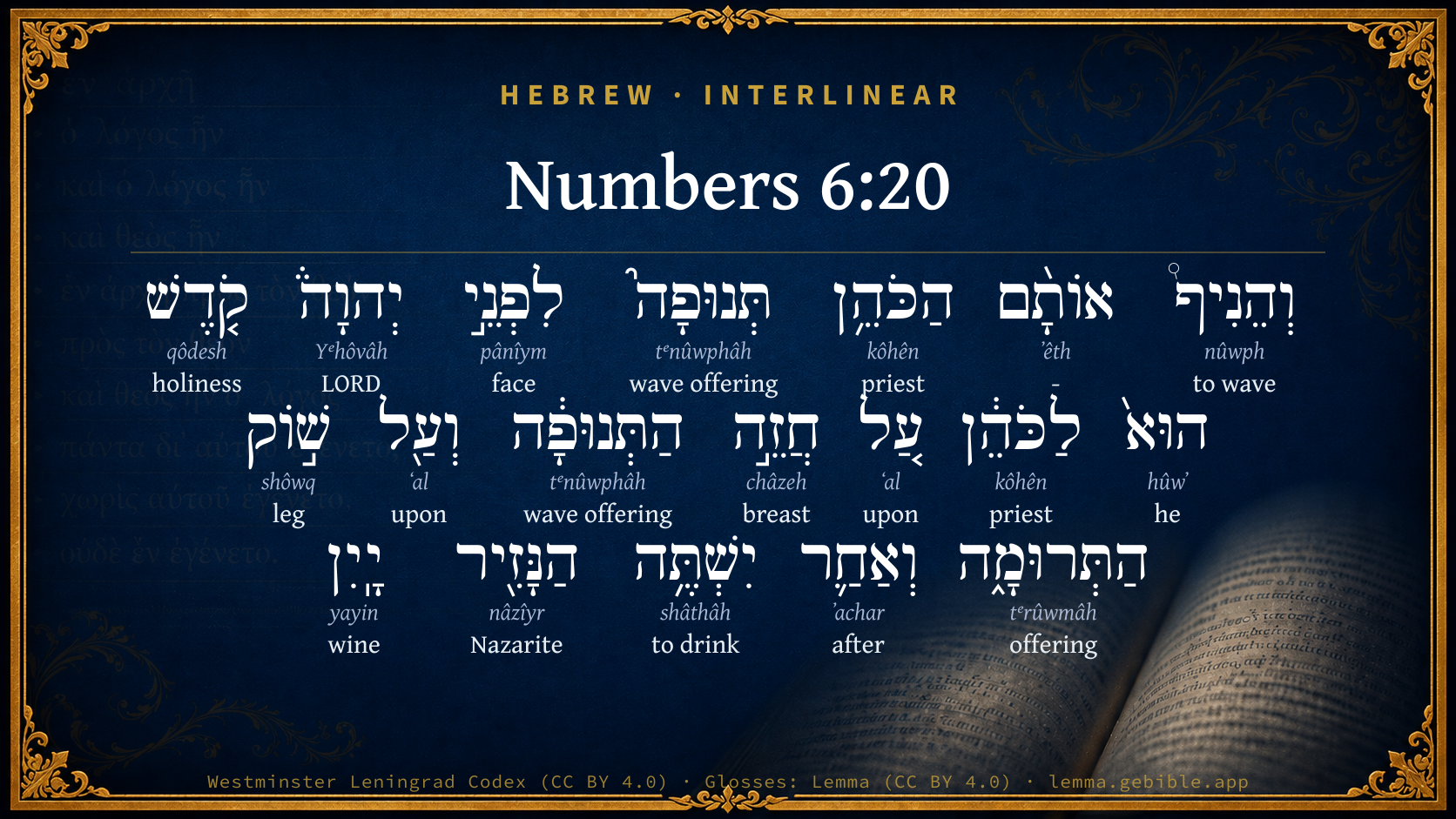
Hebrew (Westminster Leningrad Codex) Numbers 6:20 appears in the Hebrew Old Testament. The text above is from the Westminster Leningrad Codex. Each word links to its Strong’s number, a concise gloss, and parsing drawn from the Open Scriptures Hebrew Bible morphology. Click any word for its full Brown-Driver-Briggs (BDB) entry.
Download image
Cite this verse

Numbers 6:20 (World English Bible). Public Domain. Lemma interlinear Bible study tool, https://lemma.gebible.app/v/numbers/6/20.

Show BibTeX & RIS
BibTeX
RIS
English Translation
and the priest shall wave them for a wave offering before Yahweh. This is holy for the priest, together with the breast that is waved and the thigh that is offered. After that the Nazirite may drink wine.
World English Bible · Public Domain
Download a study sheet

One document with this verse’s original text, its word-by-word gloss line, the meaning frame, cross-references with their text, attributed commentary, and full source and license credits — printable, and it pastes into notes with its structure intact.

This verse Autodidact and up

Study sheet (.html) Plain text (.txt)

A passage Seminary Student

Up to 50 verses in one chapter. A passage sheet keeps up to 6 commentary sources and 12 cross-references per verse, in the order this page ranks them, and says so on the sheet whenever that leaves anything out. Ask for a single verse and you get the Autodidact verse sheet above.

Everything on this page stays free to read, with no account — the sheet is a download of what is already on screen, not access to it.

Want to remove ads? Support Godless Engineer
Compare translations 3

The same verse in 3 English versions, stacked beneath the original-language interlinear above. Click any original word for its lexicon entry.

Each is an independent rendering of the whole verse — the interlinear is not word-aligned to these translations.

Highlighted words mark where these versions differ — a whole-verse word diff, not a word-by-word alignment.

  • World English Bible Public Domain
    and the priest shall wave them for a wave offering before Yahweh. This is holy for the priest, together with the breast that is waved and the thigh that is offered. After that the Nazirite may drink wine.
  • King James Version Public Domain
    And the priest shall wave them for a wave offering before the LORD: this is holy for the priest, with the wave breast and heave shoulder: and after that the Nazarite may drink wine.
  • unfoldingWord Literal Text CC BY-SA 4.0
    And the priest shall raise them a raised offering to the face of Yahweh. It a holy thing for the priest upon the breast of the raised offering and upon the thigh of the contribution. And after, the Nazirite will drink wine.

unfoldingWord Literal Text — © unfoldingWord, licensed CC BY-SA 4.0. Word-aligned USFM3 via Door43 (git.door43.org/unfoldingWord/en_ult).

Versions to compare (up to 4)

3 of 4 selected

Show all 18 translations

Every available English version of this verse, each an independent rendering of the whole verse.

  • World English Bible Public Domain
    and the priest shall wave them for a wave offering before Yahweh. This is holy for the priest, together with the breast that is waved and the thigh that is offered. After that the Nazirite may drink wine.
  • Berean Standard Bible Public Domain
    The priest shall then wave them as a wave offering before the LORD. This is a holy portion for the priest, in addition to the breast of the wave offering and the thigh that was presented. After that, the Nazirite may drink wine.
  • Majority Standard Bible Public Domain
    The priest shall then wave them as a wave offering before the LORD. This is a holy portion for the priest, in addition to the breast of the wave offering and the thigh that was presented. After that, the Nazirite may drink wine.
  • King James Version Public Domain
    And the priest shall wave them for a wave offering before the LORD: this is holy for the priest, with the wave breast and heave shoulder: and after that the Nazarite may drink wine.
  • American Standard Version (1901) Public Domain
    and the priest shall wave them for a wave-offering before Jehovah; this is holy for the priest, together with the wave-breast and heave-thigh: and after that the Nazirite may drink wine.
  • Revised Version (1885) Public Domain
    and the priest shall wave them for a wave offering before the LORD; this is holy for the priest, together with the wave breast and heave thigh: and after that the Nazirite may drink wine.
  • Geneva Bible (1599) Public Domain
    And the Priest shall shake them to and from before the Lord: this is an holy thing for the Priest besides the shaken breast, and besides the heaue shoulder: so afterwarde the Nazarite may drinke wine.
  • Douay-Rheims (1899) Public Domain
    And receiving them again from him, he shall elevate them in the sight of the Lord: and they being sanctified shall belong to the priest, as the breast, which was commanded to be separated, and the shoulder. After this the Nazarite may drink wine.
  • Young's Literal Translation Public Domain
    and the priest hath waved them, a wave-offering before Jehovah; it `is' holy to the priest, besides the breast of the wave-offering, and besides the leg of the heave-offering; and afterwards doth the Nazarite drink wine.
  • Literal Standard Version CC BY-SA 4.0
    and the priest has waved them [as] a wave-offering before YHWH; it [is] holy to the priest, besides the breast of the wave-offering, and besides the leg of the raised-offering; and afterward the Nazarite drinks wine.
  • Unlocked Literal Bible CC BY-SA 4.0
    The priest must wave them as an offering before Yahweh, a holy portion for the priest, together with the breast that was waved and the thigh that was presented for the priest. After that, the Nazirite may drink wine.
  • unfoldingWord Literal Text CC BY-SA 4.0
    And the priest shall raise them a raised offering to the face of Yahweh. It a holy thing for the priest upon the breast of the raised offering and upon the thigh of the contribution. And after, the Nazirite will drink wine.
  • Darby Bible Public Domain
    And the priest shall wave them as wave-offering before Jehovah; it is holy for the priest, with the breast of the wave-offering and with the shoulder of the heave-offering; and afterwards the Nazarite may drink wine.
  • World Messianic Bible Public Domain
    and the priest shall wave them for a wave offering before the LORD. They are holy for the priest, together with the breast that is waved and the thigh that is offered. After that the Nazirite may drink wine.
  • Webster's Bible Public Domain
    And the priest shall wave them for a wave-offering before the LORD: this is holy for the priest, with the wave-breast, and heave-shoulder: and after that, the Nazarite may drink wine.
  • Free Bible Version CC BY-SA 4.0
    The priest will wave them as a wave offering before the Lord. These items are holy and belong to the priest, as well as the breast of the wave offering and the thigh that was offered. Once this is finished, Nazirites may drink wine.
  • Bible in Basic English Public Domain
    Waving them for a wave offering before the Lord; this is holy for the priest, together with the waved breast and the leg which is lifted up; after that, the man may take wine.
  • JPS Tanakh (1917) Public Domain
    And the priest shall wave them for a wave-offering before the LORD; this is holy for the priest, together with the breast of waving and the thigh of heaving; and after that the Nazirite may drink wine.

Literal Standard Version (2020), Covenant Press — licensed CC BY-SA 4.0. Text via the HelloAO Bible API (eBible.org). Unlocked Literal Bible (unfoldingWord) — licensed CC BY-SA 4.0. Text via the HelloAO Bible API (eBible.org). unfoldingWord Literal Text — © unfoldingWord, licensed CC BY-SA 4.0. Word-aligned USFM3 via Door43 (git.door43.org/unfoldingWord/en_ult). Free Bible Version, Dr. Jonathan Gallagher — licensed CC BY-SA 4.0. Text via the HelloAO Bible API (eBible.org).

Word by word

More ways to search: Search by grammar → Find every occurrence → Compare this word →

Practice this passage: Drill this verse → Learn its vocabulary →

חֲזֵ֣ה
châzeh
H2373
“breast of”
Noun, Common, Masculine, Singular, Construct
Part of Speech
Noun
Type
Common
Gender
Masculine
Number
Singular
State
Construct
Full BDB Definition

Origin: from H2372

TWOT: 634a

breast (of animals), breast of an animal sacrifice
  1. וְהֵנִיף֩ nûwph H5130 “and · to wave” Conjunction + Verb, Hiphil, Sequential Perfect, 3rd Person, Masculine, Singular
  2. אוֹתָ֨ם ʼêth H853 “- · them” Particle, Direct Object + Suffix, Personal, 3rd Person, Masculine, Plural
  3. הַכֹּהֵ֥ן kôhên H3548 “the · priest” Particle, Definite Article + Noun, Common, Masculine, Singular, Absolute
  4. תְּנוּפָה֮ tᵉnûwphâh H8573 “wave offering” Noun, Common, Feminine, Singular, Absolute
  5. לִפְנֵ֣י pânîym H6440 “to/for · face(s) of” Preposition + Noun, Common, Both, Plural, Construct
  6. יְהוָה֒ Yᵉhôvâh H3068 “LORD” Noun, Proper
  7. קֹ֤דֶשׁ qôdesh H6944 “holiness” Noun, Common, Masculine, Singular, Absolute
  8. הוּא֙ hûwʼ H1931 “he” Pronoun, Personal, 3rd Person, Masculine, Singular
  9. לַכֹּהֵ֔ן kôhên H3548 “to/for the · priest” Preposition, Determined + Noun, Common, Masculine, Singular, Absolute
  10. עַ֚ל ʻal H5921 “upon” Preposition
  11. הַתְּנוּפָ֔ה tᵉnûwphâh H8573 “the · wave offering” Particle, Definite Article + Noun, Common, Feminine, Singular, Absolute
  12. וְעַ֖ל ʻal H5921 “and · upon” Conjunction + Preposition
  13. שׁ֣וֹק shôwq H7785 “leg of” Noun, Common, Feminine, Singular, Construct
  14. הַתְּרוּמָ֑ה tᵉrûwmâh H8641 “the · offering” Particle, Definite Article + Noun, Common, Feminine, Singular, Absolute
  15. וְאַחַ֛ר ʼachar H310 “and · after” Conjunction + Adverb
  16. יִשְׁתֶּ֥ה shâthâh H8354 “to drink” Verb, Qal, Imperfect, 3rd Person, Masculine, Singular
  17. הַנָּזִ֖יר nâzîyr H5139 “the · Nazarite” Particle, Definite Article + Noun, Common, Masculine, Singular, Absolute
  18. יָֽיִן yayin H3196 “wine” Noun, Common, Masculine, Singular, Absolute

About this verse

These counts appear in no published source. They are computed here, from the morphology-tagged text and Lemma’s own curated glosses. What Lemma adds →

19
words
16
distinct lemmas
Pentateuch
section

Notable vocabulary

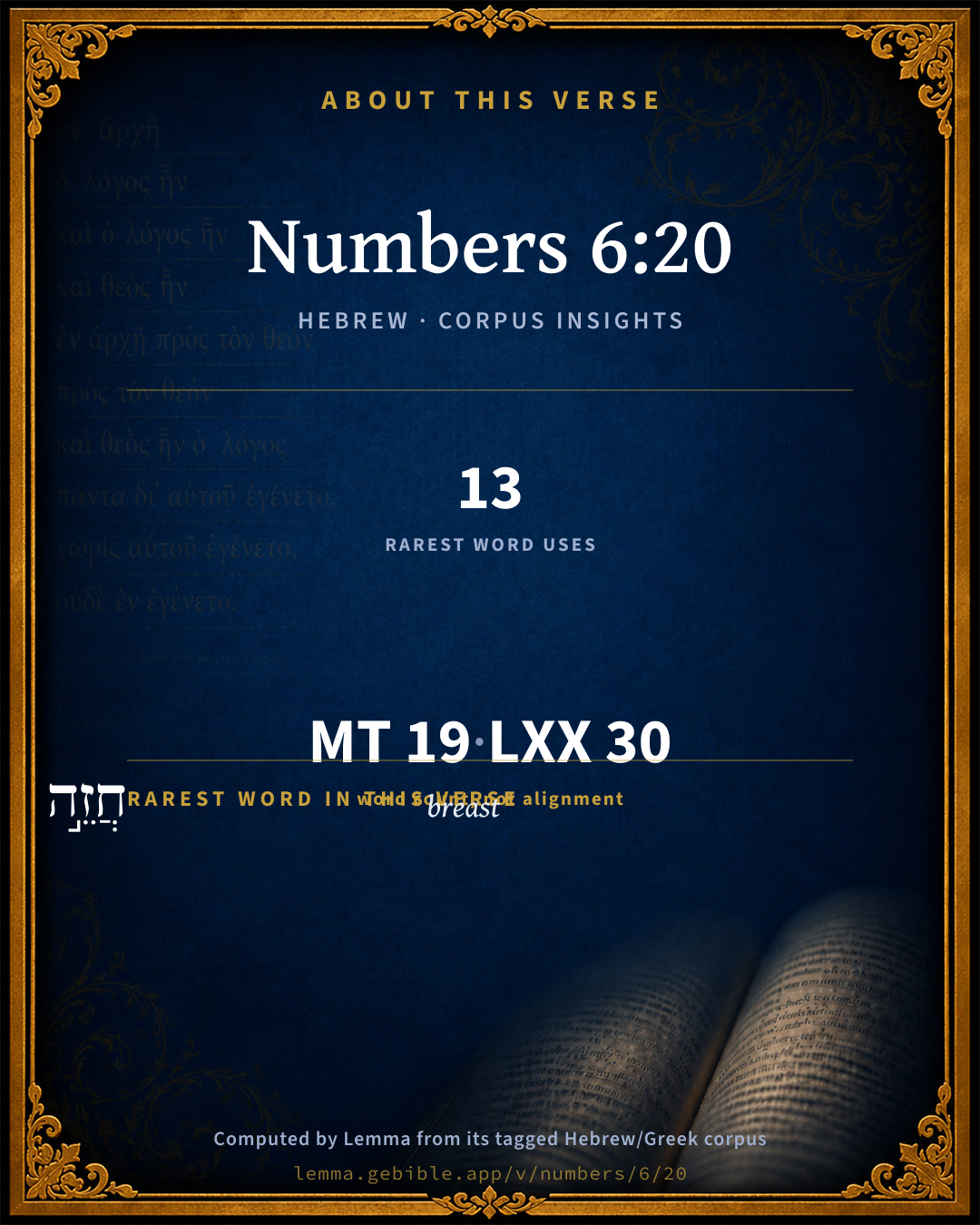
The rarest word here is חֲזֵ֣ה breast H2373 — appearing just 13 times in the whole Hebrew Bible.

Shared distinctive vocabulary

חֲזֵ֣ה breast H2373 occurs in 12 verses of the Hebrew Bible. Also found in:

Grammatical profile

  • 2 verbs
  • 12 nouns
  • 1 pronoun
  • 2 prepositions
  • 1 adverb
  • 1 particle

Verb forms

  • וְהֵנִיף֩ Hiphil · Sequential Perfect
  • יִשְׁתֶּ֥ה Qal · Imperfect

Repetition

Words recur within this verse — often emphatic in Hebrew:

  • הַכֹּהֵ֥ן priest H3548 ×2
  • תְּנוּפָה֮ wave offering H8573 ×2
  • עַ֚ל upon H5921 ×2

Hebrew & Septuagint length

In English translation the verse runs 38 words from the Hebrew and 41 from the Septuagint (LXX English) — closely comparable.

A rough comparison of the two English renderings, which tokenize alike — not a word-level alignment.

Word counts can differ between the Hebrew and the Greek without any difference in meaning — e.g. the Hebrew direct-object marker אֵת has no separate Greek word, and Greek often adds the article ὁ.

In the original languages it is 19 Hebrew tokens and 30 Greek tokens — but the two are counted differently (Hebrew bundles its prefixes and suffixes into one token; the Greek is in lemma form), so that isn’t a like-for-like length.

Cross-references

21

Topical passages linked to Numbers 6:20 in the Treasury of Scripture Knowledge — connected by theme and wording, ordered by reader-vote popularity; previews shown in the World English Bible.

  • Ecclesiastes 9:7 Go your way--eat your bread with joy, and drink your wine with a merry heart; for God has already accepted your works.
  • Exodus 29:27–28 You shall sanctify the breast of the wave-offering, and the thigh of the heave-offering, which is waved, and which is heaved up, of the ram of consecration, even of that which is for Aaron, and of that which is for his sons:
  • Numbers 5:25 The priest shall take the meal offering of jealousy out of the woman's hand, and shall wave the meal offering before Yahweh, and bring it to the altar.
  • Leviticus 7:31 The priest shall burn the fat on the altar, but the breast shall be Aaron's and his sons'.
  • Leviticus 7:34 For the waved breast and the heaved thigh I have taken from the children of Israel out of the sacrifices of their peace offerings, and have given them to Aaron the priest and to his sons as their portion forever from the children of Israel.'"
  • Leviticus 9:21 and the breasts and the right thigh Aaron waved for a wave offering before Yahweh, as Moses commanded.
  • Leviticus 10:15 The heaved thigh and the waved breast they shall bring with the offerings made by fire of the fat, to wave it for a wave offering before Yahweh: and it shall be yours, and your sons' with you, as a portion forever; as Yahweh has commanded."
  • Leviticus 23:11 and he shall wave the sheaf before Yahweh, to be accepted for you. On the next day after the Sabbath the priest shall wave it.
  • Numbers 18:18 The flesh of them shall be your, as the wave-breast and as the right thigh, it shall be yours.
  • Psalms 16:10–11 For you will not leave my soul in Sheol, Neither will you allow your holy one to see corruption.
  • Isaiah 25:6 In this mountain will Yahweh of Hosts make to all peoples a feast of fat things, a feast of wines on the lees, of fat things full of marrow, of wines on the lees well refined.
  • Isaiah 35:10 and the ransomed of Yahweh shall return, and come with singing to Zion; and everlasting joy shall be on their heads: they shall obtain gladness and joy, and sorrow and sighing shall flee away.
  • Isaiah 53:10–12 Yet it pleased Yahweh to bruise him; he has put him to grief: when you shall make his soul an offering for sin, he shall see [his] seed, he shall prolong his days, and the pleasure of Yahweh shall prosper in his hand.
  • Zechariah 9:15 Yahweh of Hosts will defend them; And they will destroy and overcome with sling-stones; And they will drink, and roar as through wine; And they will be filled like bowls, Like the corners of the altar.
  • Zechariah 9:17 For how great is his goodness, And how great is his beauty! Grain will make the young men flourish, And new wine the virgins.
  • Zechariah 10:7 Ephraim will be like a mighty man, And their heart will rejoice as through wine; Yes, their children will see it, and rejoice. Their heart will be glad in Yahweh.
  • Matthew 26:29 But I tell you that I will not drink of this fruit of the vine from now on, until that day when I drink it anew with you in my Father's Kingdom."
  • Mark 14:25 Most assuredly I tell you, I will no more drink of the fruit of the vine, until that day when I drink it anew in the Kingdom of God."
  • John 17:4–5 I glorified you on the earth. I have accomplished the work which you have given me to do.
  • John 19:30 When Jesus therefore had received the vinegar, he said, "It is finished." He bowed his head, and gave up his spirit.
  • 2 Timothy 4:7–8 I have fought the good fight. I have finished the course. I have kept the faith.

Cross-references courtesy of OpenBible.info (CC BY 4.0).

Hebrew and Greek witnesses Masoretic Hebrew ↔ Greek Septuagint

The same verse in the two great witnesses to the Old Testament, shown verse-for-verse.

These are two independent witnesses, not word-aligned to each other, and the Septuagint is shown in lemma (dictionary) form.

Hebrew Numbers 6:20 Masoretic · Westminster Leningrad Codex

וְהֵנִיף֩ אוֹתָ֨ם הַכֹּהֵ֥ן תְּנוּפָה֮ לִפְנֵ֣י יְהוָה֒ קֹ֤דֶשׁ הוּא֙ לַכֹּהֵ֔ן עַ֚ל חֲזֵ֣ה הַתְּנוּפָ֔ה וְעַ֖ל שׁ֣וֹק הַתְּרוּמָ֑ה וְאַחַ֛ר יִשְׁתֶּ֥ה הַנָּזִ֖יר יָֽיִן

and the priest shall wave them for a wave offering before Yahweh. This is holy for the priest, together with the breast that is waved and the thigh that is offered. After that the Nazirite may drink wine.

World English Bible · Public Domain

Greek LXX Numbers 6:20 Septuagint · lemma form

καί προςφέρω αὐτός ὁ ἱερεύς ἐπίθεμα ἔναντι κύριος ἅγιος εἰμί ὁ ἱερεύς ἐπί ὁ στηθύνιον ὁ ἐπίθεμα καί ἐπί ὁ βραχίων ὁ ἀφαίρεμα καί μετά οὗτος πίνω ὁ εὔχομαι οἶνος

And the priest shall present them as an offering before the Lord; it shall be the holy portion for the priest beside the breast of the heave-offering and beside the shoulder of the wave-offering: and afterwards the votary shall drink wine.

LXX2012 (modern English Septuagint) · Public Domain

Hebrew: Westminster Leningrad Codex (CC BY 4.0). Greek: Septuagint (public domain); English from LXX2012 (modern English Septuagint) (Public Domain). How the Septuagint differs from the Hebrew →

Targum (Aramaic paraphrase)

2

The Targum is the ancient Jewish Aramaic paraphrase of the Hebrew Scriptures — an interpretive translation, not the Hebrew text itself. Onkelos (literal) and Pseudo-Jonathan (expansive) render the Torah, and Jonathan the Prophets. Coverage is partial: where no permissively-licensed English translation exists for a verse, only the Aramaic is shown. This is verse-level text, not a word-by-word alignment to the Hebrew.

  1. Targum Onkelos Torah (Genesis–Deuteronomy)
    וִירִים יָתְהוֹן כַּהֲנָא אֲרָמָא קֳדָם יְיָ קוּדְשָׁא הוּא לְכַהֲנָא עַל חַדְיָא דַאֲרָמוּתָא וְעַל שַׁקָא דְאַפְרָשׁוּתָא וּבָתַר כֵּן יִשְׁתֵּי נְזִירָא חַמְרָא

    (no public-domain English translation for this verse)

    Targum Onkelos — Aramaic: “Onkelos Genesis” (public domain); “Onkelos Exodus” (public domain); “Onkelos Leviticus” (public domain); “Onkelos Numbers” (public domain); “Onkelos Deuteronomy” (public domain). English: “Sefaria Community Translation” (CC0 1.0 (public-domain dedication)); “J.W. Etheridge. The Targums of Onkelos and Jonathan Ben Uzziel on the Pentateuch. London: Longmans, Green, 1862” (public domain). Text via Sefaria.

  2. Targum Pseudo-Jonathan Torah (Genesis–Deuteronomy)
    וְיָרִים יַתְהוֹן כַּהֲנָא אֲרָמָא קוּדְשָׁא הוּא לְכַהֲנָא עַל חַדְיָא דַאֲרָמוּתָא וְעַל שׁוֹקָא דְאַפְרָשׁוּתָא וּמִבָּתַר כְּדֵין יִשְׁתֵּי נְזִירָא חַמְרָא

    And the priest shall uplift them for an elevation. It is sacred; it belongeth to the priest, with the breast of the elevation, and the separated shoulder. And after that the Nazirite may drink wine.

    Targum Pseudo-Jonathan — Aramaic: “Targum Jonathan on Genesis” (public domain); “Targum Jonathan on Exodus” (public domain); “Targum Jonathan on Leviticus” (public domain); “Targum Jonathan on Numbers” (public domain); “Targum Jonathan on Deuteronomy” (public domain). English: “The Targum of Jonathan ben Uzziel, trans. J. W. Etheridge, London, 1862” (public domain). Text via Sefaria.

Commentary

Notes on Numbers 6:20 from classic Christian and Jewish commentators (each source and its license shown beneath its notes). The classic Christian expositions comment on the surrounding passage and are grouped to its opening verse, so a note may address several verses; the Jewish commentaries on the Tanakh (Rashi and others) are per-verse, so they appear only where the commentator wrote on this verse.

Lemma curates 59 commentaries, every one of them public domain or Creative Commons licensed, each selected and text-cleaned for this edition rather than reprinted as found. About our sources →

Trapp's Complete Commentary

John Trapp

Num 6:20 And the priest shall wave them [for] a wave offering before the LORD: this [is] holy for the priest, with the wave breast and heave shoulder: and after that the Nazarite may drink wine.

Ver. 20. The Nazarite may drink wine.] The Popish votaries will needs fetch colour and approbation for their superstitious vows, from this order of Nazarites. But the abolishing of this ordinance is declared in Act 21:25, and they are so far from the abstinence of Nazarites, that they eat of the best, and drink of the sweetest: the most generous wine in Louvain and Paris is known by the name of Vinum Theologicum, the divines, those Sorbonists, do so whiff it off.

John Trapp, A Commentary or Exposition upon All the Books of the Old and New Testament (1647–1656) — public domain. Text from a community e-Sword module.

Joseph Benson's Commentary

Num 6:20-21. May drink wine — And return to his former manner of living. That his hand shall get — Besides what he shall voluntarily give according to his ability.

Joseph Benson's Commentary on the Old and New Testaments (1811–1818) — public domain. Text from a community e-Sword module.

Geneva Bible (1599)

Geneva Bible translators

Or, with the breast.

Geneva Bible (1599) marginal notes — public domain. Text via Bolls.life.

The Cambridge Bible for Schools and Colleges

gen. ed. J. J. S. Perowne

20. shall wave them] The portions of a peace-offering which fell to the priest were not appropriated by him until a peculiar ritual had been performed. The breast—and in the present case the boiled shoulder and part of the meal-offering also—were waved or swung, that is, apparently, moved towards the altar and back, as a symbol that the priest first gave them to God, and that God then gave them back to him for his own use (cf. Num_5:25, Exo_29:27). The word ‘wave,’ however, is sometimes employed more loosely, and denotes simply ‘to offer’; see Num_8:11; Num_8:13; Num_8:15; Num_8:21.

heave thigh] thigh of contribution. See on Num_5:9.

The Cambridge Bible for Schools and Colleges (gen. ed. J. J. S. Perowne; Cambridge University Press, 1878–1918) — public domain. Text from a community e-Sword module.

John Gill's Exposition

This is the law of the Nazarite, who hath vowed,.... The vow of a Nazarite; what he is obliged to do when his Nazariteship is up:

and of his offering unto the Lord for his separation; of the several offerings required of him, to offer to the Lord, for and upon his going through his Nazariteship, his burnt offering, sin offering, sacrifice of peace offerings, his meat offering and drink offering; together with the basket of unleavened bread, cakes and wafers:

besides that that his hands shall get; the above offerings were what he was obliged unto by the law of God, even though a poor man; but, besides these, it was expected of a man of substance, that he would voluntarily of himself offer more, according to his ability and the length of the time of his Nazariteship:

according to the vow which he hath vowed, so he must do after the law of his separation; there were some things he was obliged to do by his vow, and as he had vowed, there was a necessity upon him to fulfil it; as to abstain from the things he vowed so to do, and that as long a time as he fixed by his vow, and when finished to offer the sacrifices required of him.

John Gill's Exposition of the Whole Bible (1746–1763) — public domain (CC PDM 1.0). Text via the HelloAO Bible API.

Haydock's Catholic Bible Commentary

Priest, contrary to what was required in other sacrifices. (Jospehus, [Antiquities?] iv. 4. Both the priest and the Nazarite waved the sacrifice towards the four quarters of the world.

George Leo Haydock (1774–1849), Haydock's Catholic Family Bible and Commentary, 1859 edition — public domain. Excludes Psalms (Douay-Rheims chapter numbering differs from Protestant) and Deuterocanonical books (Catholic canon only).

Matthew Poole's English Annotations

And return to his former freedom and manner of living; he is discharged from his vow. Of the wave-offering and heave-offering, see Lev 7:30,32.

Matthew Poole's English Annotations on the Holy Bible (1683–1685) — public domain. Text from a community e-Sword/MySword module.

Whedon's Commentary on the Bible

Daniel D. Whedon

20. Wave offering — See Lev_7:30, note.

After that the Nazarite may drink wine — The Hebrew yayin is the most general term for wine which intoxicates. It is an open question whether the strong condemnation pronounced by the Bible against the effects of wine is not rather directed against intoxication and excess than against the substance itself. He who quotes the Nazarite as an example of total abstinence should also quote this permission of wine drinking after the period of his vow. The Pauline reason for abstinence, the removal of all stumbling-blocks from the path of the weak brother, is the only unanswerable, scriptural argument. Rom_14:21, note. This removes the question from the sphere of immutable morality, into which extremists have wrongfully thrust it, to the sphere of prudential morality, where it belongs.

Daniel D. Whedon (gen. ed.), Commentary on the Old and New Testaments (1874–1909) — public domain. Text from a community e-Sword module.

The Pulpit Commentary

Shall wave them. By putting his hands under the hands of the Nazirite. On the symbolism of this see Le 7. Drink wine. Perhaps at the sacrificial feast.

The Pulpit Commentary (1880–1919), ed. H.D.M. Spence-Jones & Joseph S. Exell — public domain. Text from a community e-Sword module.

John Wesley's Explanatory Notes

May drink wine - And return to his former manner of living.

John Wesley, Explanatory Notes Upon the Whole Bible (1754–1765) — public domain. Text via the GEBible commentary corpus.

Rashi

Rabbi Shlomo Yitzchaki (Rashi)

קדש הוא לכהן IT IS HOLY FOR THE PRIEST — The cake, the wafer and the shoulder are a heave-offering for the priest.

על חזה התנופה means: BESIDES THE BREAST AND THE SHOULDER which are due to him (the priest) from all feast-offerings, there is to be added to the portions assigned to the priest in the case of the Nazarite’s feast-offerings, this shoulder. Because the feast-offerings of the Nazarite are included in the general rule governing feast-offerings but were excepted to become subject to a new matter — the setting apart of the shoulder for the priest — it became necessary to restore them to the general rule of שלמים by expressly stating that they are subjected also to the setting apart of the breast and thigh as are שלמים in general (Sifrei Bamidbar 37).

Rashi on the Tanakh — English translations: “The Judaica Press complete Tanach with Rashi, translated by A. J. Rosenberg” (CC BY 4.0); “Pentateuch with Rashi's commentary by M. Rosenbaum and A.M. Silbermann, 1929-1934” (public domain); “The Metsudah Tanach series, Lakewood, N.J” (CC BY 4.0); and “The Book of Joshua, Metsudah Publications, 1997” (CC BY 4.0). Text via Sefaria.

Lesson kit

Teaching starters — assembled from the data on this page, not authored interpretation. Every prompt links to the verse data it draws on. Edit before teaching.

Numbers, in the Pentateuch, opens this verse with 19 words (16 distinct Hebrew lemmas). Its most distinctive word is châzeh (“breast”). A historical commentator’s framing appears above. Read the whole chapter for the surrounding context.

Discussion questions

  1. What does “breast” (châzeh) contribute to the verse as a whole?
  2. Exodus 29:26 shares the word «breast» with this verse. How do the two illuminate each other?
  3. “priest” occurs 2× in this one verse. What is the effect of the repetition?
  4. These translations render this verse differently; the difference is in the English rendering, not the original. What questions does that raise?
  5. The verb «וְהֵנִיף֩» is Hiphil Sequential Perfect. How does its form color the action?
  6. Reading how Trapp's Complete Commentary and Joseph Benson's Commentary read this verse, where do the two commentators agree and where do they part?

Things to notice

Reading settings

Reading text

Shown beneath each verse's original-language words.

Old Testament
Old Testament edition

Read the OT as the Masoretic Hebrew (MT) or the Greek Septuagint (LXX).

English shown for the Greek Septuagint (in the Hebrew ↔ Greek comparison).

Comparing translations? Open the Compare panel on any verse page to stack up to four side by side.