
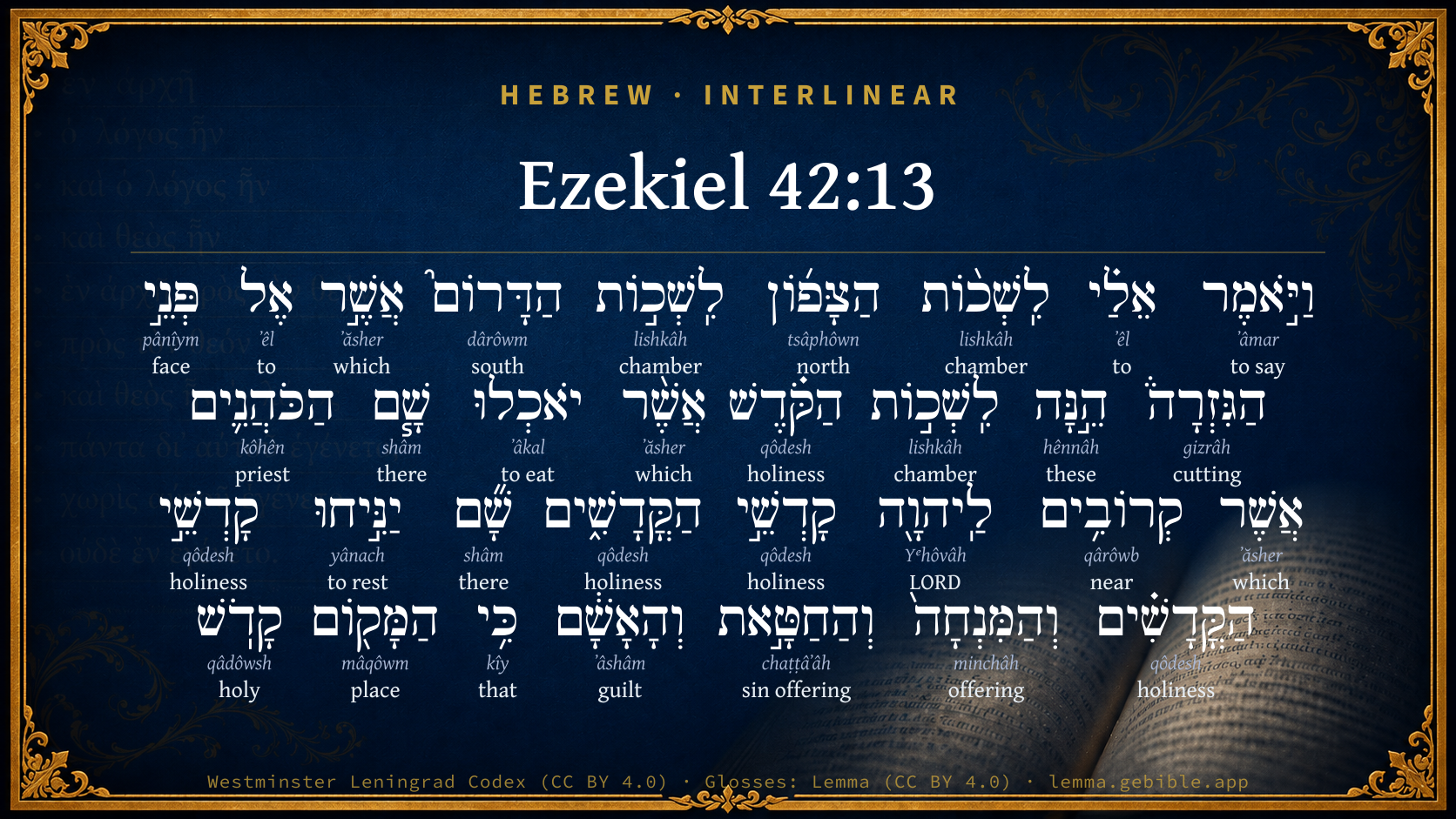
Ezekiel 42:13

Hebrew (Westminster Leningrad Codex) Ezekiel 42:13 appears in the Hebrew Old Testament. The text above is from the Westminster Leningrad Codex. Each word links to its Strong’s number, a concise gloss, and parsing drawn from the Open Scriptures Hebrew Bible morphology. Click any word for its full Brown-Driver-Briggs (BDB) entry.
Download image
Cite this verse

Ezekiel 42:13 (World English Bible). Public Domain. Lemma interlinear Bible study tool, https://lemma.gebible.app/v/ezekiel/42/13.

Show BibTeX & RIS
BibTeX
RIS
English Translation
Then said he to me, The north chambers and the south chambers, which are before the separate place, they are the holy chambers, where the priests who are near to Yahweh shall eat the most holy things: there shall they lay the most holy things, and the meal-offering, and the sin-offering, and the trespass-offering; for the place is holy.
World English Bible · Public Domain
Download a study sheet

One document with this verse’s original text, its word-by-word gloss line, the meaning frame, cross-references with their text, attributed commentary, and full source and license credits — printable, and it pastes into notes with its structure intact.

This verse Autodidact and up

Study sheet (.html) Plain text (.txt)

A passage Seminary Student

Up to 50 verses in one chapter. A passage sheet keeps up to 6 commentary sources and 12 cross-references per verse, in the order this page ranks them, and says so on the sheet whenever that leaves anything out. Ask for a single verse and you get the Autodidact verse sheet above.

Everything on this page stays free to read, with no account — the sheet is a download of what is already on screen, not access to it.

Want to remove ads? Support Godless Engineer
Compare translations 3

The same verse in 3 English versions, stacked beneath the original-language interlinear above. Click any original word for its lexicon entry.

Each is an independent rendering of the whole verse — the interlinear is not word-aligned to these translations.

Highlighted words mark where these versions differ — a whole-verse word diff, not a word-by-word alignment.

  • World English Bible Public Domain
    Then said he to me, The north chambers and the south chambers, which are before the separate place, they are the holy chambers, where the priests who are near to Yahweh shall eat the most holy things: there shall they lay the most holy things, and the meal-offering, and the sin-offering, and the trespass-offering; for the place is holy.
  • King James Version Public Domain
    Then said he unto me, The north chambers and the south chambers, which are before the separate place, they be holy chambers, where the priests that approach unto the LORD shall eat the most holy things: there shall they lay the most holy things, and the meat offering, and the sin offering, and the trespass offering; for the place is holy.
  • unfoldingWord Literal Text CC BY-SA 4.0
    Then the man said to me, “The northern rooms and the southern rooms that are in front of the outer courtyard are holy rooms where the priests who work nearest to Yahweh may eat the most holy food. They will put the most holy things there—the food offering, the sin offering, and the guilt offering—for this is a holy place.

unfoldingWord Literal Text — © unfoldingWord, licensed CC BY-SA 4.0. Word-aligned USFM3 via Door43 (git.door43.org/unfoldingWord/en_ult).

Versions to compare (up to 4)

3 of 4 selected

Show all 18 translations

Every available English version of this verse, each an independent rendering of the whole verse.

  • World English Bible Public Domain
    Then said he to me, The north chambers and the south chambers, which are before the separate place, they are the holy chambers, where the priests who are near to Yahweh shall eat the most holy things: there shall they lay the most holy things, and the meal-offering, and the sin-offering, and the trespass-offering; for the place is holy.
  • Berean Standard Bible Public Domain
    Then the man said to me, “The north and south chambers facing the temple courtyard are the holy chambers where the priests who approach the LORD will eat the most holy offerings. There they will place the most holy offerings—the grain offerings, the sin offerings, and the guilt offerings—for the place is holy.
  • Majority Standard Bible Public Domain
    Then the man said to me, “The north and south chambers facing the temple courtyard are the holy chambers where the priests who approach the LORD will eat the most holy offerings. There they will place the most holy offerings—the grain offerings, the sin offerings, and the guilt offerings—for the place is holy.
  • King James Version Public Domain
    Then said he unto me, The north chambers and the south chambers, which are before the separate place, they be holy chambers, where the priests that approach unto the LORD shall eat the most holy things: there shall they lay the most holy things, and the meat offering, and the sin offering, and the trespass offering; for the place is holy.
  • American Standard Version (1901) Public Domain
    Then said he unto me, The north chambers and the south chambers, which are before the separate place, they are the holy chambers, where the priests that are near unto Jehovah shall eat the most holy things: there shall they lay the most holy things, and the meal-offering, and the sin-offering, and the trespass-offering; for the place is holy.
  • Revised Version (1885) Public Domain
    Then said he unto me, The north chambers and the south chambers, which are before the separate place, they be the holy chambers, where the priests that are near unto the LORD shall eat the most holy things: there shall they lay the most holy things, and the meal offering, and the sin offering, and the guilt offering; for the place is holy.
  • Geneva Bible (1599) Public Domain
    The said he vnto me, The North chambers and ye South chambers which are before ye separate place, they be holy chambers, wherein the Priests that approch vnto ye Lord, shall eat the most holy things: there shall they lay the most holy things, and the meate offering, and the sinne offering, and the trespasse offring: for the place is holy.
  • Douay-Rheims (1899) Public Domain
    And he said to me: The chambers of the north, and the chambers of the south, which are before the separate building: they are holy chambers, in which the priests shall eat, that approach to the Lord into the holy of holies: there they shall lay the most holy things, and the offering for sin, and for trespass: for it is a holy place.
  • Young's Literal Translation Public Domain
    And he saith unto me, `The north chambers, the south chambers, that `are' at the front of the separate place, they `are' holy chambers, where the priests (who `are' near to Jehovah) eat the most holy things, there they place the most holy things, and the present, and the sin-offering, and the guilt-offering, for the place `is' holy.
  • Literal Standard Version CC BY-SA 4.0
    And he says to me, “The north chambers, the south chambers, that [are] at the front of the separate place, they [are] holy chambers, where the priests (who [are] near to YHWH) eat the most holy things, there they place the most holy things, and the present, and the sin-offering, and the guilt-offering, for the place [is] holy.
  • Unlocked Literal Bible CC BY-SA 4.0
    Then the man said to me, “The northern rooms and the southern rooms that are in front of the outer courtyard are holy rooms where the priests who work nearest to Yahweh may eat the most holy food. They will put the most holy things there—the food offering, the sin offering, and the guilt offering—for this is a holy place.
  • unfoldingWord Literal Text CC BY-SA 4.0
    Then the man said to me, “The northern rooms and the southern rooms that are in front of the outer courtyard are holy rooms where the priests who work nearest to Yahweh may eat the most holy food. They will put the most holy things there—the food offering, the sin offering, and the guilt offering—for this is a holy place.
  • Darby Bible Public Domain
    And he said unto me, The north cells [and] the south cells, which are before the separate place, they are holy cells, where the priests that come near unto Jehovah shall eat the most holy things; there shall they lay the most holy things, both the oblation and the sin-offering and the trespass-offering: for the place is holy.
  • World Messianic Bible Public Domain
    Then he said to me, “The north rooms and the south rooms, which are opposite the separate place, are the holy rooms, where the priests who are near to the LORD shall eat the most holy things. There they shall lay the most holy things, with the meal offering, the sin offering, and the trespass offering; for the place is holy.
  • Webster's Bible Public Domain
    Then said he to me, The north chambers and the south chambers which are before the separate place, they are holy chambers, where the priests that approach to the LORD shall eat the most holy things: there shall they lay the most holy things, and the meat-offering, and the sin-offering, and the trespass-offering; for the place is holy.
  • Free Bible Version CC BY-SA 4.0
    The man told me, “The north and south rooms that face the Temple courtyard are holy rooms where the priests who go before the Lord will eat the most holy offerings. They will place the most holy offerings there because the place is holy, and include the grain offerings, the sin offerings, and the guilt offerings.
  • Bible in Basic English Public Domain
    And he said to me, The north rooms and the south rooms in front of the separate place are the holy rooms, where the priests who come near the Lord take the most holy things for their food: there the most holy things are placed, with the meal offering and the sin-offering and the offering for error; for the place is holy.
  • JPS Tanakh (1917) Public Domain
    Then said he unto me: 'The north chambers and the south chambers, which are before the separate place, they are the holy chambers, where the priests that are near unto the LORD shall eat the most holy things; there shall they lay the most holy things, and the meal-offering, and the sin-offering, and the guilt-offering; for the place is holy.

Literal Standard Version (2020), Covenant Press — licensed CC BY-SA 4.0. Text via the HelloAO Bible API (eBible.org). Unlocked Literal Bible (unfoldingWord) — licensed CC BY-SA 4.0. Text via the HelloAO Bible API (eBible.org). unfoldingWord Literal Text — © unfoldingWord, licensed CC BY-SA 4.0. Word-aligned USFM3 via Door43 (git.door43.org/unfoldingWord/en_ult). Free Bible Version, Dr. Jonathan Gallagher — licensed CC BY-SA 4.0. Text via the HelloAO Bible API (eBible.org).

Word by word

More ways to search: Search by grammar → Find every occurrence → Compare this word →

Practice this passage: Drill this verse → Learn its vocabulary →

הַגִּזְרָה֒
gizrâh
H1508
“the · cutting”
Particle, Definite Article + Noun, Common, Feminine, Singular, Absolute
Part of Speech
Particle + Noun
Type
Common
Gender
Feminine
Number
Singular
State
Absolute
Full BDB Definition

Origin: from H1506

TWOT: 340c

a cutting, polishing, separation - cutting, polishing - separation, separate place
  1. וַיֹּ֣אמֶר ʼâmar H559 “and · to say” Conjunction + Verb, Qal, Sequential Imperfect, 3rd Person, Masculine, Singular
  2. אֵלַ֗י ʼêl H413 “to · me” Preposition + Suffix, Personal, 1st Person, Common, Singular
  3. לִֽשְׁכ֨וֹת lishkâh H3957 “chambers of” Noun, Common, Feminine, Plural, Construct
  4. הַצָּפ֜וֹן tsâphôwn H6828 “the · north” Particle, Definite Article + Noun, Common, Feminine, Singular, Absolute
  5. לִֽשְׁכ֣וֹת lishkâh H3957 “chambers of” Noun, Common, Feminine, Plural, Construct
  6. הַדָּרוֹם֮ dârôwm H1864 “the · south” Particle, Definite Article + Noun, Common, Masculine, Singular, Absolute
  7. אֲשֶׁ֣ר ʼăsher H834 “which” Particle, Relative
  8. אֶל ʼêl H413 “to” Preposition
  9. פְּנֵ֣י pânîym H6440 “face(s) of” Noun, Common, Both, Plural, Construct
  10. הֵ֣נָּה hênnâh H2007 “these” Pronoun, Personal, 3rd Person, Feminine, Plural
  11. לִֽשְׁכ֣וֹת lishkâh H3957 “chambers of” Noun, Common, Feminine, Plural, Construct
  12. הַקֹּ֗דֶשׁ qôdesh H6944 “the · holiness” Particle, Definite Article + Noun, Common, Masculine, Singular, Absolute
  13. אֲשֶׁ֨ר ʼăsher H834 “which” Particle, Relative
  14. יֹאכְלוּ ʼâkal H398 “to eat” Verb, Qal, Imperfect, 3rd Person, Masculine, Plural
  15. שָׁ֧ם shâm H8033 “there” Adverb
  16. הַכֹּהֲנִ֛ים kôhên H3548 “the · priests” Particle, Definite Article + Noun, Common, Masculine, Plural, Absolute
  17. אֲשֶׁר ʼăsher H834 “which” Particle, Relative
  18. קְרוֹבִ֥ים qârôwb H7138 “near” Adjective, Adjective, Masculine, Plural, Absolute
  19. לַֽיהוָ֖ה Yᵉhôvâh H3068 “to/for · LORD” Preposition + Noun, Proper
  20. קָדְשֵׁ֣י qôdesh H6944 “holy things of” Noun, Common, Masculine, Plural, Construct
  21. הַקֳּדָשִׁ֑ים qôdesh H6944 “the · holy things” Particle, Definite Article + Noun, Common, Masculine, Plural, Absolute
  22. שָׁ֞ם shâm H8033 “there” Adverb
  23. יַנִּ֣יחוּ yânach H3240 “to rest” Verb, Hiphil, Imperfect, 3rd Person, Masculine, Plural
  24. קָדְשֵׁ֣י qôdesh H6944 “holy things of” Noun, Common, Masculine, Plural, Construct
  25. הַקֳּדָשִׁ֗ים qôdesh H6944 “the · holy things” Particle, Definite Article + Noun, Common, Masculine, Plural, Absolute
  26. וְהַמִּנְחָה֙ minchâh H4503 “and · the · offering” Conjunction + Particle, Definite Article + Noun, Common, Feminine, Singular, Absolute
  27. וְהַחַטָּ֣את chaṭṭâʼâh H2403 “and · the · sin offering” Conjunction + Particle, Definite Article + Noun, Common, Feminine, Singular, Absolute
  28. וְהָאָשָׁ֔ם ʼâshâm H817 “and · the · guilt” Conjunction + Particle, Definite Article + Noun, Common, Masculine, Singular, Absolute
  29. כִּ֥י kîy H3588 “that” Conjunction
  30. הַמָּק֖וֹם mâqôwm H4725 “the · place” Particle, Definite Article + Noun, Common, Masculine, Singular, Absolute
  31. קָדֹֽשׁ qâdôwsh H6918 “holy” Adjective, Adjective, Masculine, Singular, Absolute

About this verse

These counts appear in no published source. They are computed here, from the morphology-tagged text and Lemma’s own curated glosses. What Lemma adds →

32
words
22
distinct lemmas
Prophets
section

Notable vocabulary

The rarest word here is הַגִּזְרָה֒ cutting H1508 — appearing just 8 times in the whole Hebrew Bible.

Shared distinctive vocabulary

הַגִּזְרָה֒ cutting H1508 occurs in 8 verses of the Hebrew Bible. Also found in:

Grammatical profile

  • 3 verbs
  • 18 nouns
  • 2 adjectives
  • 1 pronoun
  • 2 prepositions
  • 1 conjunction
  • 2 adverbs
  • 3 particles

Verb forms

  • וַיֹּ֣אמֶר Qal · Sequential Imperfect
  • יֹאכְלוּ Qal · Imperfect
  • יַנִּ֣יחוּ Hiphil · Imperfect

Repetition

Words recur within this verse — often emphatic in Hebrew:

  • הַקֹּ֗דֶשׁ holiness H6944 ×5
  • לִֽשְׁכ֨וֹת chamber H3957 ×3
  • שָׁ֧ם there H8033 ×2
  • אֲשֶׁ֣ר which H834 ×3
  • אֵלַ֗י to H413 ×2

Hebrew & Septuagint length

In English translation the verse runs 59 words from the Hebrew and 71 from the Septuagint (LXX English) — closely comparable.

A rough comparison of the two English renderings, which tokenize alike — not a word-level alignment.

Word counts can differ between the Hebrew and the Greek without any difference in meaning — e.g. the Hebrew direct-object marker אֵת has no separate Greek word, and Greek often adds the article ὁ.

Cross-references

23

Topical passages linked to Ezekiel 42:13 in the Treasury of Scripture Knowledge — connected by theme and wording, ordered by reader-vote popularity; previews shown in the World English Bible.

  • Leviticus 7:6 Every male among the priests may eat of it. It shall be eaten in a holy place. It is most holy.
  • Leviticus 10:17 "Why haven't you eaten the sin offering in the place of the sanctuary, seeing it is most holy, and he has given it you to bear the iniquity of the congregation, to make atonement for them before Yahweh?
  • Ezekiel 40:46 and the chamber whose prospect is toward the north is for the priests, the keepers of the charge of the altar: these are the sons of Zadok, who from among the sons of Levi come near to Yahweh to minister to him.
  • Exodus 29:31 "You shall take the ram of consecration, and boil its flesh in a holy place.
  • Leviticus 6:29 Every male among the priests shall eat of it: it is most holy.
  • Leviticus 14:13 He shall kill the male lamb in the place where they kill the sin offering and the burnt offering, in the place of the sanctuary; for as the sin offering is the priest's, so is the trespass offering. It is most holy.
  • Numbers 18:9–10 This shall be your of the most holy things, [reserved] from the fire: every offering of theirs, even every meal-offering of theirs, and every sin-offering of theirs, and every trespass-offering of theirs, which they shall render to me, shall be most holy for you and for your sons.
  • Leviticus 6:25–26 "Speak to Aaron and to his sons, saying, 'This is the law of the sin offering: in the place where the burnt offering is killed, the sin offering shall be killed before Yahweh. It is most holy.
  • Leviticus 10:3 Then Moses said to Aaron, "This is what Yahweh spoke of, saying, "'I will show myself holy to those who come near me, And before all the people I will be glorified.'" Aaron held his peace.
  • Leviticus 10:13–14 and you shall eat it in a holy place, because it is your portion, and your sons' portion, of the offerings of Yahweh made by fire: for so I am commanded.
  • Leviticus 24:9 It shall be for Aaron and his sons; and they shall eat it in a holy place: for it is most holy to him of the offerings of Yahweh made by fire by a perpetual statute."
  • Deuteronomy 21:5 The priests the sons of Levi shall come near; for them Yahweh your God has chosen to minister to him, and to bless in the name of Yahweh; and according to their word shall every controversy and every stroke be.
  • Leviticus 2:3 That which is left of the meal offering shall be Aaron's and his sons'. It is a most holy thing of the offerings of Yahweh made by fire.
  • Leviticus 2:10 That which is left of the meal offering shall be Aaron's and his sons'. It is a thing most holy of the offerings of Yahweh made by fire.
  • Leviticus 6:14–17 "'This is the law of the meal offering: the sons of Aaron shall offer it before Yahweh, before the altar.
  • Leviticus 7:1 "'This is the law of the trespass offering. It is most holy.
  • Leviticus 21:22 He shall eat the bread of his God, both of the most holy, and of the holy.
  • Numbers 1:9–10 Of Zebulun: Eliab the son of Helon.
  • Numbers 16:5 and he spoke to Korah and to all his company, saying, In the morning Yahweh will show who are his, and who is holy, and will cause him to come near to him: even him whom he shall choose will he cause to come near to him.
  • Numbers 16:40 to be a memorial to the children of Israel, to the end that no stranger, who isn't of the seed of Aaron, comes near to burn incense before Yahweh; that he not be as Korah, and as his company: as Yahweh spoke to him by Moses.
  • Numbers 18:7 You and your sons with you shall keep your priesthood for everything of the altar, and for that within the veil; and you shall serve: I give you the priesthood as a service of gift: and the stranger who comes near shall be put to death.
  • Nehemiah 13:5 had prepared for him a great chamber, where before they laid the meal-offerings, the frankincense, and the vessels, and the tithes of the grain, the new wine, and the oil, which were given by commandment to the Levites, and the singers, and the porters; and the heave-offerings for the priests.
  • Ezekiel 42:10 In the thickness of the wall of the court toward the east, before the separate place, and before the building, there were chambers.

Cross-references courtesy of OpenBible.info (CC BY 4.0).

Hebrew and Greek witnesses Masoretic Hebrew ↔ Greek Septuagint

The same verse in the two great witnesses to the Old Testament, shown verse-for-verse.

These are two independent witnesses, not word-aligned to each other, and the Septuagint is shown in lemma (dictionary) form.

Hebrew Ezekiel 42:13 Masoretic · Westminster Leningrad Codex

וַיֹּ֣אמֶר אֵלַ֗י לִֽשְׁכ֨וֹת הַצָּפ֜וֹן לִֽשְׁכ֣וֹת הַדָּרוֹם֮ אֲשֶׁ֣ר אֶל פְּנֵ֣י הַגִּזְרָה֒ הֵ֣נָּה לִֽשְׁכ֣וֹת הַקֹּ֗דֶשׁ אֲשֶׁ֨ר יֹאכְלוּ שָׁ֧ם הַכֹּהֲנִ֛ים אֲשֶׁר קְרוֹבִ֥ים לַֽיהוָ֖ה קָדְשֵׁ֣י הַקֳּדָשִׁ֑ים שָׁ֞ם יַנִּ֣יחוּ קָדְשֵׁ֣י הַקֳּדָשִׁ֗ים וְהַמִּנְחָה֙ וְהַחַטָּ֣את וְהָאָשָׁ֔ם כִּ֥י הַמָּק֖וֹם קָדֹֽשׁ

Then said he to me, The north chambers and the south chambers, which are before the separate place, they are the holy chambers, where the priests who are near to Yahweh shall eat the most holy things: there shall they lay the most holy things, and the meal-offering, and the sin-offering, and the trespass-offering; for the place is holy.

World English Bible · Public Domain

Greek LXX Ezekiel 42:13 Septuagint · lemma form

καί εἶπον πρός ἐγώ ὁ ἐξέδρα ὁ πρός βορέας καί ὁ ἐξέδρα ὁ πρός νότος ὁ εἰμί κατά πρόσωπον ὁ διάστημα οὗτος εἰμί ὁ ἐξέδρα ὁ ἅγιος ἐν ὅς ἐσθίω ἐκεῖ ὁ ἱερεύς υἱός σαδδουκ ὁ ἐγγίζω πρός κύριος ὁ ἅγιος ὁ ἅγιος καί ἐκεῖ τίθημι ὁ ἅγιος ὁ ἅγιος καί ὁ θυσία καί ὁ περί ἁμαρτία καί ὁ περί ἄγνοια διότι ὁ τόπος ἅγιος

And he said to me, The chambers toward the north, and the chambers toward the south, in front of the void spaces, these are the chambers of the sanctuary, wherein the priests the sons of Sadduc, who draw near to the Lord, shall eat the most holy things: and there shall they lay the most holy things, and the meat-offering, and the sin-offerings, and the trespass-offerings; because the place is holy.

LXX2012 (modern English Septuagint) · Public Domain

Hebrew: Westminster Leningrad Codex (CC BY 4.0). Greek: Septuagint (public domain); English from LXX2012 (modern English Septuagint) (Public Domain). How the Septuagint differs from the Hebrew →

Targum (Aramaic paraphrase)

1

The Targum is the ancient Jewish Aramaic paraphrase of the Hebrew Scriptures — an interpretive translation, not the Hebrew text itself. Onkelos (literal) and Pseudo-Jonathan (expansive) render the Torah, and Jonathan the Prophets. Coverage is partial: where no permissively-licensed English translation exists for a verse, only the Aramaic is shown. This is verse-level text, not a word-by-word alignment to the Hebrew.

  1. Targum Jonathan Prophets (Joshua–Malachi)
    וַאֲמַר לִי לִשְׁכַּת צִפּוּנָא לִשְׁכַּת דְרוֹמָא דִקֳדָם בְּצוּרְתָּא אִינּוּן לִשְׁכָּת קוּדְשָׁא דְיֵכְלוּן תַּמָן כַּהֲנַיָא דְקָרִיבִין לְשַׁמָשָׁא קֳדָם יְיָ קוֹדֶשׁ קוּדְשַׁיָא תַּמָן יֵיחֲתוּן קוֹדֶשׁ קוּדְשַׁיָא וּמִנְחָתָא וְחַטָאתָא וַאֲשָׁמָא אֲרֵי אַתְרָא קַדִישׁ:

    (no public-domain English translation for this verse)

    Targum Jonathan — Aramaic: “Mikraot Gedolot” (public domain). English: “Sefaria Community Translation” (CC0 1.0 (public-domain dedication)); “London "Chaldee Paraphrase," 1871” (public domain). Text via Sefaria.

Commentary

Notes on Ezekiel 42:13 from classic Christian and Jewish commentators (each source and its license shown beneath its notes). The classic Christian expositions comment on the surrounding passage and are grouped to its opening verse, so a note may address several verses; the Jewish commentaries on the Tanakh (Rashi and others) are per-verse, so they appear only where the commentator wrote on this verse.

Lemma curates 59 commentaries, every one of them public domain or Creative Commons licensed, each selected and text-cleaned for this edition rather than reprinted as found. About our sources →

Trapp's Complete Commentary

John Trapp

Eze 42:13 Then said he unto me, The north chambers [and] the south chambers, which [are] before the separate place, they [be] holy chambers, where the priests that approach unto the LORD shall eat the most holy things: there shall they lay the most holy things, and the meat offering, and the sin offering, and the trespass offering; for the place [is] holy.

Ver. 13. They be holy chambers.] Or, Cells of the sanctuary, belonging to those that serve in the sanctuary. God appointeth his ministers their various stations, together with the bounds of their habitations,

Shall eat the most holy things.] Ministers must eat as well as others; they are not of the chameleon kind - cannot live upon air; and the Lord Christ "hath ordained that," as "they which waited at the altar were partakers of the altar," "so also should they that preach the gospel live of the gospel," {1Co 9:13-14}

And the meat offering and the sin offering,] i.e., The priests’ share out of them; for, besides they tithes and glebe, or suburbs, the priests had many rich revenues, and were far better provided for than today’s gospel ministers are, however begrudged that little that is allowed them.

John Trapp, A Commentary or Exposition upon All the Books of the Old and New Testament (1647–1656) — public domain. Text from a community e-Sword module.

Joseph Benson's Commentary

Eze 42:13-14. The north chambers, and the south chambers — Namely, those described in the foregoing part of the chapter; they be holy chambers, where the priests shall eat the most holy things — The show- bread, the remainder of the meat-offering, sin-offering, and trespass- offering, are expressly called the most holy things, Lev 6:14; Lev 6:17; Lev 24:9; and are distinguished from the holy things, such as the peace- offerings, first-fruits, and tithes, Lev 21:22. These were to be eaten within the precincts of the temple, by the direction of the Levitical law. There shall they lay the most holy things — These rooms were likewise set apart for laying up the remainder of the sacrifices, till they were eaten by the priests and their families, Lev 10:13; Lev 22:13. When the priests enter therein — Within the inner court; then shall they not go out of the holy place, &c., but there they shall lay their garments, &c. — They shall not go into the court of the people, in their priestly vestments, but shall lay them up in some of these chambers. The priestly garments were only to be used in the time of their ministration, as appears from Exo 28:43. And shall put on other garments, and shall approach, &c. — The words should rather be translated, and shall come into the court belonging to the people; the outer court, mentioned at the beginning of the verse.

Joseph Benson's Commentary on the Old and New Testaments (1811–1818) — public domain. Text from a community e-Sword module.

Tyndale Open Study Notes

Tyndale Open Resources

42:13-14 The priests would store the sacred offerings and eat the most holy offerings in these rooms. The clothes that the priests wore while ministering in the Lord’s presence would be stored there, and the priests would put on other clothes because these clothes were holy. All of these regulations represent a significant increase in the care taken to separate the holy from the profane, as compared to the similar laws in Leviticus (cp. Lev 6).

Tyndale Open Study Notes — © Tyndale Open Resources, licensed CC BY-SA 4.0. Text via the HelloAO Bible API.

Ellicott's Commentary for English Readers

(13) Shall eat the most holy things.—In the next clause it is said, “There shall they lay the most holy things,” both clauses referring to the priests’ portion of the sacrifices. We cannot think of their laying the uncooked flesh of the sacrifice in the same room where they ate (the cooking was done in another room west of this, Eze_46:19-20); but the great size of this building—166 ft. long and half as broad—allowed of its division into several separate rooms. It is noticeable that there is no mention of the peace offerings, for it was not required in the law that they should be eaten in a holy place. For the others, see Lev_6:16; Lev_6:26; Lev_7:6. The “meat offering” is the unbloody oblation usually accompanying the animal sacrifices.

A Bible Commentary for English Readers, edited by Charles John Ellicott (1878–1897) — public domain. Text from a community e-Sword module.

The Cambridge Bible for Schools and Colleges

gen. ed. J. J. S. Perowne

13, 14. Uses to which the chambers were put.

These cells serve two purposes: the priests shall eat in them the most holy things; and they shall deposit there the sacred garments when they put them off to go into the outer court among the people. The “most holy things” were the portion of the meal-offering not consumed on the altar (Lev_2:3; Lev_2:10; Lev_7:9-11; Lev_10:12), and the flesh of the sin and trespass offerings, except the flesh of the sin-offering for the high-priest and congregation, which was burnt outside the sacred buildings (Lev_6:30; Lev_7:6).

before the separate place] over against, as Eze_42:1; Eze_42:10, i.e. the longer wing on the N. and on the S. Nothing specially is said as to the uses of the shorter wing.

lay the most holy things] Naturally the meal-offering had to be baked before being eaten, and the flesh of the sacrifices boiled. Being most holy things they must be kept in a holy place.

The Cambridge Bible for Schools and Colleges (gen. ed. J. J. S. Perowne; Cambridge University Press, 1878–1918) — public domain. Text from a community e-Sword module.

John Gill's Exposition

Then said he unto me,.... The divine Person that measured and described these chambers, and brought the prophet to take a view of them, said to him, as follows:

the north chambers, and the south chambers, which are before the separate place, they be holy chambers; these are the two rows of chambers before described, which were southward and northward to each other, though both in the northern part of the outward court; these were for holy persons to dwell in, and for holy things to be done in, as the churches of Christ are; they consist of holy persons, men called with a holy calling, and in them the holy word of God is preached, and holy ordinances administered:

where the priests that approach unto the Lord shall eat the most holy things; which is to be understood not of the ministers of the Gospel, for whom a proper maintenance is to be provided, and who should live of the Gospel they preach; but of all the saints, who are made priests to God by Christ; and who approach unto the Lord by him, in his name and righteousness, and by the faith of him, with true hearts, in a spiritual manner; and which is profitable to themselves, and acceptable to God; for whom spiritual provisions are made in his house: these have most holy things to eat of, the holy word of God, the law part of which is holy, just, and good; and the Gospel part is our most holy faith, which is food for faith, savoury and salutary, milk for babes, and meat for strong men; and which is found and eaten, and digested by them: also our Lord Jesus Christ, who is the most holy, and is the sum and substance of the word and ordinances, and the food of believers, the bread of life, the hidden manna, the Lamb of God, and fatted calf; whose flesh and blood are meat and drink indeed, and are eaten and fed upon by faith.

There shall they lay the most holy things; lay up the word of God in their minds and memories, and remember the love of God, his sufferings and death, and the benefits arising from them, particularly in the ordinance of the supper:

and the meat offering; the "minchah", or bread offering, made of fine flour, typical of Christ, the bread of life:

and the sin, offering, and the trespass offering; both typical of Christ, made sin for his people; and who, by one sacrifice of himself, has made atonement for it, and an end of it; See Gill on Eze 40:39, these were called the most holy things, and were laid up in the sanctuary for the priests and their families to live upon, Lev 6:17,

for the place is holy: the place of these chambers holy, as the temple itself, where these most holy things and holy persons were.

John Gill's Exposition of the Whole Bible (1746–1763) — public domain (CC PDM 1.0). Text via the HelloAO Bible API.

Albert Barnes' Notes on the Bible

In Lev 10:13 it was prescribed that the priests should eat of the sacrifices in the “holy place.” This was originally before the altar in the inner court - now separate chambers are assigned, and these become “the holy place” for this purpose. Of the “trespass-offering” and “meat-offering” what was not consumed was eaten Lev 7:6, but the “sin-offering” was burned without the camp Eze 43:21. Probably the carcass was brought from the altar to the chamber before being carried out.

Albert Barnes' Notes on the Bible (1834–1885) — public domain. Text from a community e-Sword/MySword module.

Haydock's Catholic Bible Commentary

Holies. Hebrew, "who are very holy," and (Haydock) on duty. See Leviticus vi. 25.

George Leo Haydock (1774–1849), Haydock's Catholic Family Bible and Commentary, 1859 edition — public domain. Excludes Psalms (Douay-Rheims chapter numbering differs from Protestant) and Deuterocanonical books (Catholic canon only).

Matthew Poole's English Annotations

Then said he; the measurer, Christ, man in appearance at that time.

The separate place: see Eze 42:1.

Holy chambers; set apart, consecrated to holy services and uses, as vessels, garments, and days may be holy.

The priests, and Levites too,

that approach; that were then in waiting, according to their courses; for this approach is not only mentioned as distinguished from the distance the people were kept at, but as including the present actual approaches of the priests, in their ministering before the Lord.

Shall eat together, as in a public refectory.

The most holy things; things devoted to God were these most holy, some parts whereof God gave to the priests to live on. In some of these chambers the holy things that might be eat were laid up as in a storehouse, and those which were not for present use were here to be reserved till they were to be used; and whether it were more or less that was allowed to the priests out of the offerings, here it was to be kept till used.

The meat-offering: see what this was, Lev 2:1-12; 6:14-16.

The sin-offering: see what this, Lev 6:26,29,30.

The trespass-offering: see Lev 7:2,3, &c.

Matthew Poole's English Annotations on the Holy Bible (1683–1685) — public domain. Text from a community e-Sword/MySword module.

Whedon's Commentary on the Bible

Daniel D. Whedon

13, 14. In these holy chambers the priests were to eat the most holy things, the holiest which have not been burnt in sacrifice (Lev_2:3; Lev_2:10; Lev_6:16-18; Lev_6:29-30; Lev_7:9-11; Lev_10:12). There also they must leave their holy vestments (Lev_16:23) when they entered the inner court. All this signified the sacredness of the priestly service and the increasing holiness of the temple as they drew nearer to the central abode of Jehovah.

Daniel D. Whedon (gen. ed.), Commentary on the Old and New Testaments (1874–1909) — public domain. Text from a community e-Sword module.

The Pulpit Commentary

Vers. 13, 14 These state the uses of the chambers just described, and now named holy chambers, to denote their separation and dedication to sacred purposes. Those purposes, again, are defined as two. The chambers were to serve as dining-halls and robing rooms for the priests when they officiated in the temple. The most holy things; literally, the holy of the holies (comp. Eze_41:4 Eze_43:12 Eze_45:3 Eze_48:12; Lev_2:3 Lev_6:17, Lev_6:25, 29 7:1, 6 10:12, 17 14:13 24:9 27:28; Num_18:9) signified those portions of the different sacrificial offerings which were to be eaten by the priests as the servants and representatives of Jehovah (see Keil"s "Biblische Archaologie," 1. or of the people (see Kurtz"s " Sacrificial Worship of the Old Testament," p. 240, Eng. transl.). Under the Law these were appointed to be eaten in the holy place beside the altar (Lev_10:12, Lev_10:13; Num_18:10) in Ezekiel"s temple, a special quarter in the near vicinity of the house should be reserved for this purpose. There those portions of the sacrifices that could be eaten were to be consumed; as e.g. the flesh of the sin and trespass offerings, and the meal of the meat offering; but as these could not be at once used, they were to be deposited there until they were prepared for eating, the flesh by being boiled and the meal by being mixed with oil. The obvious intention of this was to convey an idea of the special sanctity of the worship in which the priests were engaged; and just for this reason also they were required to array themselves in other garments (Lev_16:23) when they entered on their priestly functions. The putting on and off of these holy clothes took place in the chambers now referred to.

Holy places.

In a Protestant reaction against the superstition that attaches magical sanctity to certain sites, we have perhaps lost hold of the truths of which that superstition was a perversion.

I THERE IS A SANCTITY OF ASSOCIATION. We may own to a revulsion for a man who would botanize on his mother"s grave. Every Englishman must feel a thrill of national pride when he visits the field of Waterloo, as every Greek must have done when treading the plain of Marathon. Though a man may have traveled far and have acquired wealth that has raised him above his humble origin, it is but natural that he should look back to the cottage home of his childhood with tender affection as to the most sacred shrine on earth. It may be from superstition, or it may be from sentiment; but whichever be the cause, it is surely no strange thing to confess that the house of God in which a man has worshipped for years gathers to itself a peculiar consecration. There his burdened soul has been cheered; there the light has pierced his darkness; there he has sat side by side with the loved and lost, and if the place that once knew them now knows them no more, does not the very sense of change and the very pain of the vacancy add a new sacredness to the place, while dear memories of a beautiful past cling to its very walls and drape them with a sweet, sad sanctity?

II THERE IS A SANCTITY OF USE. The sacred chambers were to be used by the priests, and in them sacrificial meals were to be eaten. Thus the sanctity of sacred usage was to be attached to these rooms. The commonest thing becomes holy when it is consecrated to a holy purpose. The shop may be a temple, the counter an altar, and the wares sacrifices, when the business is carried on for the glory of God in quiet obedience to his will of righteousness. Thus the very bells on the horses may have "Holiness to the Lord" inscribed upon them. It is in this direction that we should move when we would abolish too narrow distinctions between the secular and the sacred. We should lose the distinction, not by making religion earthly, but by making earth religious; not by desecrating the spiritual functions, but by consecrating things of the outer world.

III THERE IS A SANCTITY OF LIFE. This is the only true sanctity. The other forms of sanctity are its reflections and results. True holiness resides in the heart, and there alone. That is the holy place in which the holy man dwells. The presence of the priest sanctifies the temple-chambers. But it is not the "linen ephod" or any badge of office that makes the true priest. Every man who has habitual access to the presence of God is a true priest of God. He who walks with God treads holy ground. A halo of sanctity surrounds the heavenly life. Whether this life be spent in a temple court, a hermit"s cell, a Christian home, or in the hard, fierce world, it is encircled with holiness, and it weaves about it its own sacred tabernacle.

HOMILIES BY J.R. THOMSON

Vers. 13, 14. Sacerdotal sanctity.

If the Jews were a peculiar, a consecrated, a holy people, it may be said that their sanctity was concentrated in the temple the building which was "holiness unto the Lord," and in the holy priesthood, set apart for the ministrations of the sanctuary. The angel who showed Ezekiel the temple of vision laid great stress upon this characteristic of the marvelous and symmetrical building.

I CEREMONIAL HOLINESS. This is exhibited as affecting:

1. The priests, who were set apart from the rest of the people. How should they be clean who bear the vessels of the Lord!

2. Their residences. During the period of their officiation in the temple services and sacrifices, they had their dwelling in certain chambers within the precincts, and these chambers were deemed holy places,

3. Their food. They are said to "eat the most holy things;" i.e. there were certain regulations as to food which were prescribed for them that had no reference to the people generally.

4. Their garments. The priests were provided with raiment which they were required to wear when ministering before the Lord. Holy functions necessitated holy vestments.

5. Their offerings. As the reader of this passage is reminded, it was the duty of the priests to present meal offerings, sin offering, and guilt offerings. As these were offered upon the holy altar to the holy God, they themselves were holy. It thus appears that everything connected with the position, the life, the ministrations, of the priests was marked by ceremonial sanctity.

II THE SPIRITUAL SIGNIFICANCE OF CEREMONIAL HOLINESS. What was the purpose of all the arrangements described in this and other passages of Old Testament Scripture? Why was this artificial separation introduced into the religion and life of the Hebrew people? A complete answer to these questions is perhaps not possible. But it is evident that it was intended to convey to Israel and to mankind:

1. A conception of the holy nature of God. Very different was the character claimed for himself by Jehovah from the character attributed to the deities of the heathen nations around. Whilst these deities were disfigured by selfishness, cruelty, and lust, Jehovah"s attributes were righteousness, holiness, and benevolence. Everything connected with the worship of God, as practiced in the temple at Jerusalem, was adapted to convey to men"s minds the idea of God"s infinite and spotless holiness.

2. A conception of the holy character of acceptable worship. Concerning idolatrous worship, we know that it was distinguished by perfunctoriness and superstition, and in some cases by impurity. Religious rites among the heathen are usually corrupt, or else mechanical and spiritually valueless. On the contrary, the worship of the true Hebrew, as is evident to the attentive reader of the Book of Psalms and of the prophets, was a sincere, holy, and spiritual worship. It was well understood that no other worship could be acceptable to the holy and heart-searching King of kings. And the arrangements described in this passage of the Book of Ezekiel were evidently adapted to produce and to deepen this impression.

3. A conception of the holy services of obedience and praise. Sacrifices were enjoined and required of the pious Hebrew; but sacrifices were not the only or the chief services to be presented by the devout worshipper. In connection with these, and beyond these, were the offerings which God ever delights to accept from his own people spiritual offerings of devotion and of active services. And if these are distinguished by one characteristic above another, that characteristic is true holiness. T.

The Pulpit Commentary (1880–1919), ed. H.D.M. Spence-Jones & Joseph S. Exell — public domain. Text from a community e-Sword module.

John Wesley's Explanatory Notes

Shall they lay - In some of these chambers the holy things that might be eat, were laid up as in a store-house; and those which were not for present use, were reserved, 'till they were to be used.

John Wesley, Explanatory Notes Upon the Whole Bible (1754–1765) — public domain. Text via the GEBible commentary corpus.

unfoldingWord translationNotes

Door43 World Missions Community

the food offering

the grain or flour that the people offered to show that they were thankful to God

translationWords

holy

priest

Yahweh

sin offering

guilt offering

unfoldingWord translationNotes — © Distant Shores Media and the Door43 World Missions Community, licensed CC BY-SA 4.0. Source: git.door43.org/Door43/en_tn.

Lesson kit

Teaching starters — assembled from the data on this page, not authored interpretation. Every prompt links to the verse data it draws on. Edit before teaching.

Ezekiel, in the Prophets, opens this verse with 32 words (22 distinct Hebrew lemmas). Its most distinctive word is gizrâh (“cutting”). A historical commentator’s framing appears above. Read the whole chapter for the surrounding context.

Discussion questions

  1. What does “cutting” (gizrâh) contribute to the verse as a whole?
  2. How does Lamentations 4:7, which shares the word «cutting», read alongside this verse?
  3. What does the repetition of “holiness” (5× in this one verse) do in this verse?
  4. These translations render this verse differently. What is at stake in choosing one wording over another?
  5. «וַיֹּ֣אמֶר» is a Qal Sequential Imperfect verb. How does that grammatical form shape the action described?
  6. Compare how Trapp's Complete Commentary and Joseph Benson's Commentary read this verse. Where do they agree or differ?

Things to notice

Reading settings

Reading text

Shown beneath each verse's original-language words.

Old Testament
Old Testament edition

Read the OT as the Masoretic Hebrew (MT) or the Greek Septuagint (LXX).

English shown for the Greek Septuagint (in the Hebrew ↔ Greek comparison).

Comparing translations? Open the Compare panel on any verse page to stack up to four side by side.