
Exodus 12:16

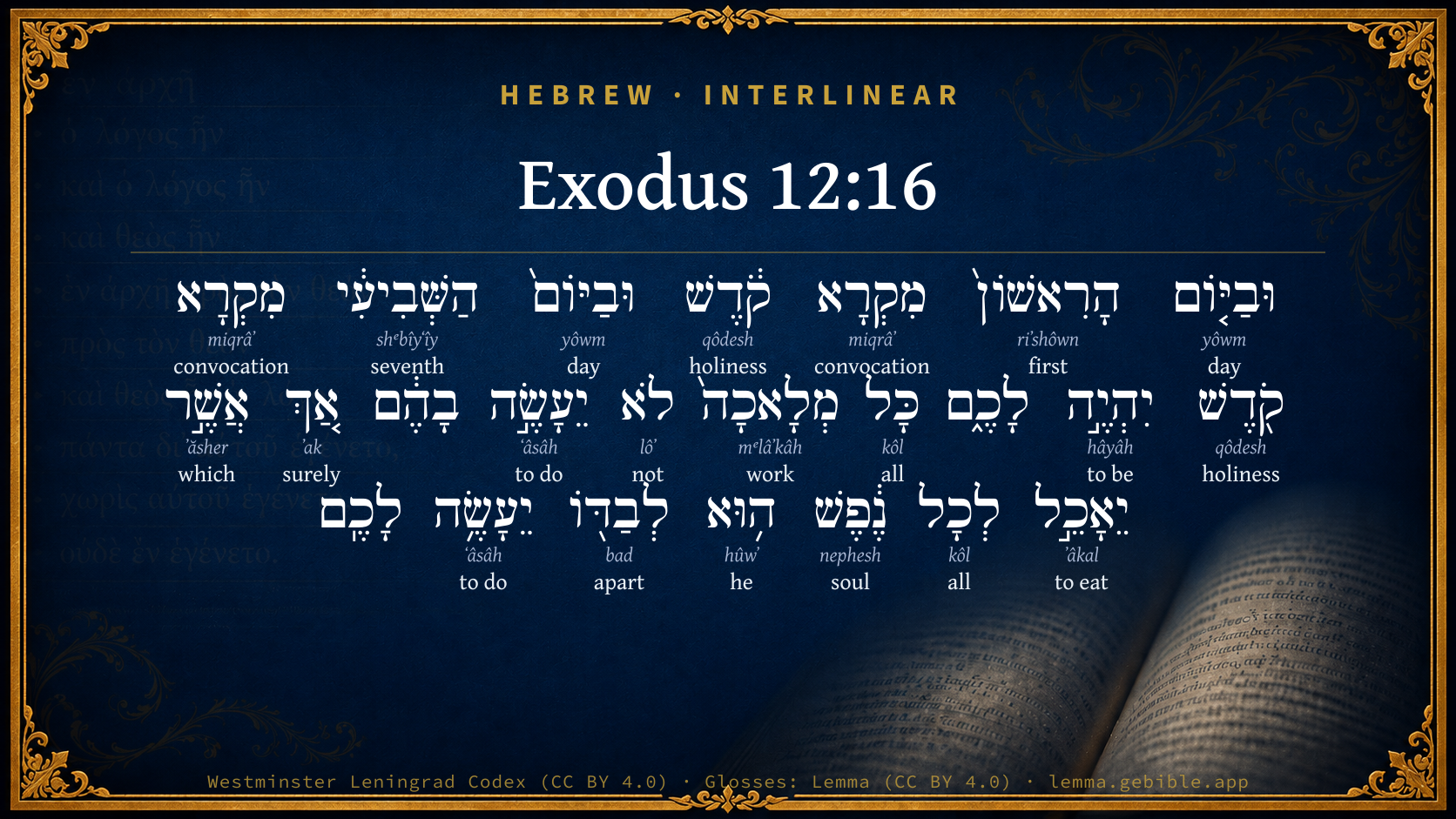
Hebrew (Westminster Leningrad Codex) Exodus 12:16 appears in the Hebrew Old Testament. The text above is from the Westminster Leningrad Codex. Each word links to its Strong’s number, a concise gloss, and parsing drawn from the Open Scriptures Hebrew Bible morphology. Click any word for its full Brown-Driver-Briggs (BDB) entry.
Download image
Cite this verse

Exodus 12:16 (World English Bible). Public Domain. Lemma interlinear Bible study tool, https://lemma.gebible.app/v/exodus/12/16.

Show BibTeX & RIS
BibTeX
RIS
English Translation
In the first day there shall be to you a holy convocation, and in the seventh day a holy convocation; no manner of work shall be done in them, except that which every man must eat, that only may be done by you.
World English Bible · Public Domain
Highlights
  • 1 first appearance in the Hebrew Bible
Full analysis ↓
Download a study sheet

One document with this verse’s original text, its word-by-word gloss line, the meaning frame, cross-references with their text, attributed commentary, and full source and license credits — printable, and it pastes into notes with its structure intact.

This verse Autodidact and up

Study sheet (.html) Plain text (.txt)

A passage Seminary Student

Up to 50 verses in one chapter. A passage sheet keeps up to 6 commentary sources and 12 cross-references per verse, in the order this page ranks them, and says so on the sheet whenever that leaves anything out. Ask for a single verse and you get the Autodidact verse sheet above.

Everything on this page stays free to read, with no account — the sheet is a download of what is already on screen, not access to it.

Want to remove ads? Support Godless Engineer
Compare translations 3

The same verse in 3 English versions, stacked beneath the original-language interlinear above. Click any original word for its lexicon entry.

Each is an independent rendering of the whole verse — the interlinear is not word-aligned to these translations.

Highlighted words mark where these versions differ — a whole-verse word diff, not a word-by-word alignment.

  • World English Bible Public Domain
    In the first day there shall be to you a holy convocation, and in the seventh day a holy convocation; no manner of work shall be done in them, except that which every man must eat, that only may be done by you.
  • King James Version Public Domain
    And in the first day there shall be an holy convocation, and in the seventh day there shall be an holy convocation to you; no manner of work shall be done in them, save that which every man must eat, that only may be done of you.
  • unfoldingWord Literal Text CC BY-SA 4.0
    And on the first day an assembly of holiness, and on the seventh day an assembly of holiness shall be for you. All work shall not be done in these, except what each person eats, that alone may be done by you.

unfoldingWord Literal Text — © unfoldingWord, licensed CC BY-SA 4.0. Word-aligned USFM3 via Door43 (git.door43.org/unfoldingWord/en_ult).

Versions to compare (up to 4)

3 of 4 selected

Show all 18 translations

Every available English version of this verse, each an independent rendering of the whole verse.

  • World English Bible Public Domain
    In the first day there shall be to you a holy convocation, and in the seventh day a holy convocation; no manner of work shall be done in them, except that which every man must eat, that only may be done by you.
  • Berean Standard Bible Public Domain
    On the first day you are to hold a sacred assembly, and another on the seventh day. You must not do any work on those days, except to prepare the meals—that is all you may do.
  • Majority Standard Bible Public Domain
    On the first day you are to hold a sacred assembly, and another on the seventh day. You must not do any work on those days, except to prepare the meals—that is all you may do.
  • King James Version Public Domain
    And in the first day there shall be an holy convocation, and in the seventh day there shall be an holy convocation to you; no manner of work shall be done in them, save that which every man must eat, that only may be done of you.
  • American Standard Version (1901) Public Domain
    And in the first day there shall be to you a holy convocation, and in the seventh day a holy convocation; no manner of work shall be done in them, save that which every man must eat, that only may be done by you.
  • Revised Version (1885) Public Domain
    And in the first day there shall be to you an holy convocation, and in the seventh day an holy convocation; no manner of work shall be done in them, save that which every man must eat, that only may be done of you.
  • Geneva Bible (1599) Public Domain
    And in the first day shalbe an holie assemblie: also in the seuenth day shalbe an holy assemblie vnto you: no worke shalbe done in them, saue about that which euery man must eate: that onely may ye do.
  • Douay-Rheims (1899) Public Domain
    The first day shall be holy and solemn, and the seventh day shall be kept with the like solemnity: you shall do no work in them, except those things that belong to eating.
  • Young's Literal Translation Public Domain
    `And in the first day `is' a holy convocation, and in the seventh day ye have a holy convocation; any work is not done in them, only that which is eaten by any person -- it alone is done by you,
  • Literal Standard Version CC BY-SA 4.0
    And in the first day [is] a holy convocation, and in the seventh day you have a holy convocation; any work is not done in them, only that which is eaten by any person—it alone is done by you,
  • Unlocked Literal Bible CC BY-SA 4.0
    On the first day there will be an assembly that is set apart to me, and on the seventh day there will be another such gathering. No work will be done on these days, except the cooking for everyone to eat. That must be the only work that may be done by you.
  • unfoldingWord Literal Text CC BY-SA 4.0
    And on the first day an assembly of holiness, and on the seventh day an assembly of holiness shall be for you. All work shall not be done in these, except what each person eats, that alone may be done by you.
  • Darby Bible Public Domain
    And on the first day ye shall have a holy convocation, and on the seventh day a holy convocation: no manner of work shall be done on them, save what is eaten by every person -- that only shall be done by you.
  • World Messianic Bible Public Domain
    In the first day there shall be to you a holy convocation, and in the seventh day a holy convocation; no kind of work shall be done in them, except that which every man must eat, only that may be done by you.
  • Webster's Bible Public Domain
    And in the first day there shall be a holy convocation, and in the seventh day there shall be a holy convocation to you: no manner of work shall be done in them, save that which every man must eat, that only may be done by you.
  • Free Bible Version CC BY-SA 4.0
    On both the first day and on the seventh day you are to have a holy meeting. You must not work on those days, except to prepare food. That is all you are allowed to do.
  • Bible in Basic English Public Domain
    And on the first day there is to be a holy meeting and on the seventh day a holy meeting; no sort of work may be done on those days but only to make ready what is necessary for everyone's food.
  • JPS Tanakh (1917) Public Domain
    And in the first day there shall be to you a holy convocation, and in the seventh day a holy convocation; no manner of work shall be done in them, save that which every man must eat, that only may be done by you.

Literal Standard Version (2020), Covenant Press — licensed CC BY-SA 4.0. Text via the HelloAO Bible API (eBible.org). Unlocked Literal Bible (unfoldingWord) — licensed CC BY-SA 4.0. Text via the HelloAO Bible API (eBible.org). unfoldingWord Literal Text — © unfoldingWord, licensed CC BY-SA 4.0. Word-aligned USFM3 via Door43 (git.door43.org/unfoldingWord/en_ult). Free Bible Version, Dr. Jonathan Gallagher — licensed CC BY-SA 4.0. Text via the HelloAO Bible API (eBible.org).

Word by word

More ways to search: Search by grammar → Find every occurrence → Compare this word →

Practice this passage: Drill this verse → Learn its vocabulary →

מִקְרָא
miqrâʼ
H4744
“convocation of”
Noun, Common, Masculine, Singular, Construct
Part of Speech
Noun
Type
Common
Gender
Masculine
Number
Singular
State
Construct
Full BDB Definition

Origin: from H7121

TWOT: 2063d

convocation, convoking, reading, a calling together - convocation, sacred assembly - convoking - reading
  1. וּבַיּ֤וֹם yôwm H3117 “and · in/at the · day” Conjunction + Preposition, Determined + Noun, Common, Masculine, Singular, Absolute
  2. הָרִאשׁוֹן֙ riʼshôwn H7223 “the · first” Particle, Definite Article + Adjective, Ordinal number, Masculine, Singular, Absolute
  3. קֹ֔דֶשׁ qôdesh H6944 “holiness” Noun, Common, Masculine, Singular, Absolute
  4. וּבַיּוֹם֙ yôwm H3117 “and · in/at the · day” Conjunction + Preposition, Determined + Noun, Common, Masculine, Singular, Absolute
  5. הַשְּׁבִיעִ֔י shᵉbîyʻîy H7637 “the · seventh” Particle, Definite Article + Adjective, Ordinal number, Masculine, Singular, Absolute
  6. מִקְרָא miqrâʼ H4744 “convocation of” Noun, Common, Masculine, Singular, Construct
  7. קֹ֖דֶשׁ qôdesh H6944 “holiness” Noun, Common, Masculine, Singular, Absolute
  8. יִהְיֶ֣ה hâyâh H1961 “to be” Verb, Qal, Imperfect, 3rd Person, Masculine, Singular
  9. כָּל kôl H3605 “all of” Noun, Common, Masculine, Singular, Construct
  10. מְלָאכָה֙ mᵉlâʼkâh H4399 “work” Noun, Common, Feminine, Singular, Absolute
  11. לֹא lôʼ H3808 “not” Particle, Negative
  12. יֵעָשֶׂ֣ה ʻâsâh H6213 “to do” Verb, Niphal, Imperfect, 3rd Person, Masculine, Singular
  13. אַ֚ךְ ʼak H389 “surely” Particle, Accusative
  14. אֲשֶׁ֣ר ʼăsher H834 “which” Particle, Relative
  15. יֵאָכֵ֣ל ʼâkal H398 “to eat” Verb, Niphal, Imperfect, 3rd Person, Masculine, Singular
  16. לְכָל kôl H3605 “to/for · all of” Preposition + Noun, Common, Masculine, Singular, Construct
  17. נֶ֔פֶשׁ nephesh H5315 “soul” Noun, Common, Both, Singular, Absolute
  18. ה֥וּא hûwʼ H1931 “he” Pronoun, Personal, 3rd Person, Masculine, Singular
  19. לְבַדּ֖וֹ bad H905 “to/for · apart · his” Preposition + Noun, Common, Masculine, Singular, Construct + Suffix, Personal, 3rd Person, Masculine, Singular
  20. יֵעָשֶׂ֥ה ʻâsâh H6213 “to do” Verb, Niphal, Imperfect, 3rd Person, Masculine, Singular

About this verse

These counts appear in no published source. They are computed here, from the morphology-tagged text and Lemma’s own curated glosses. What Lemma adds →

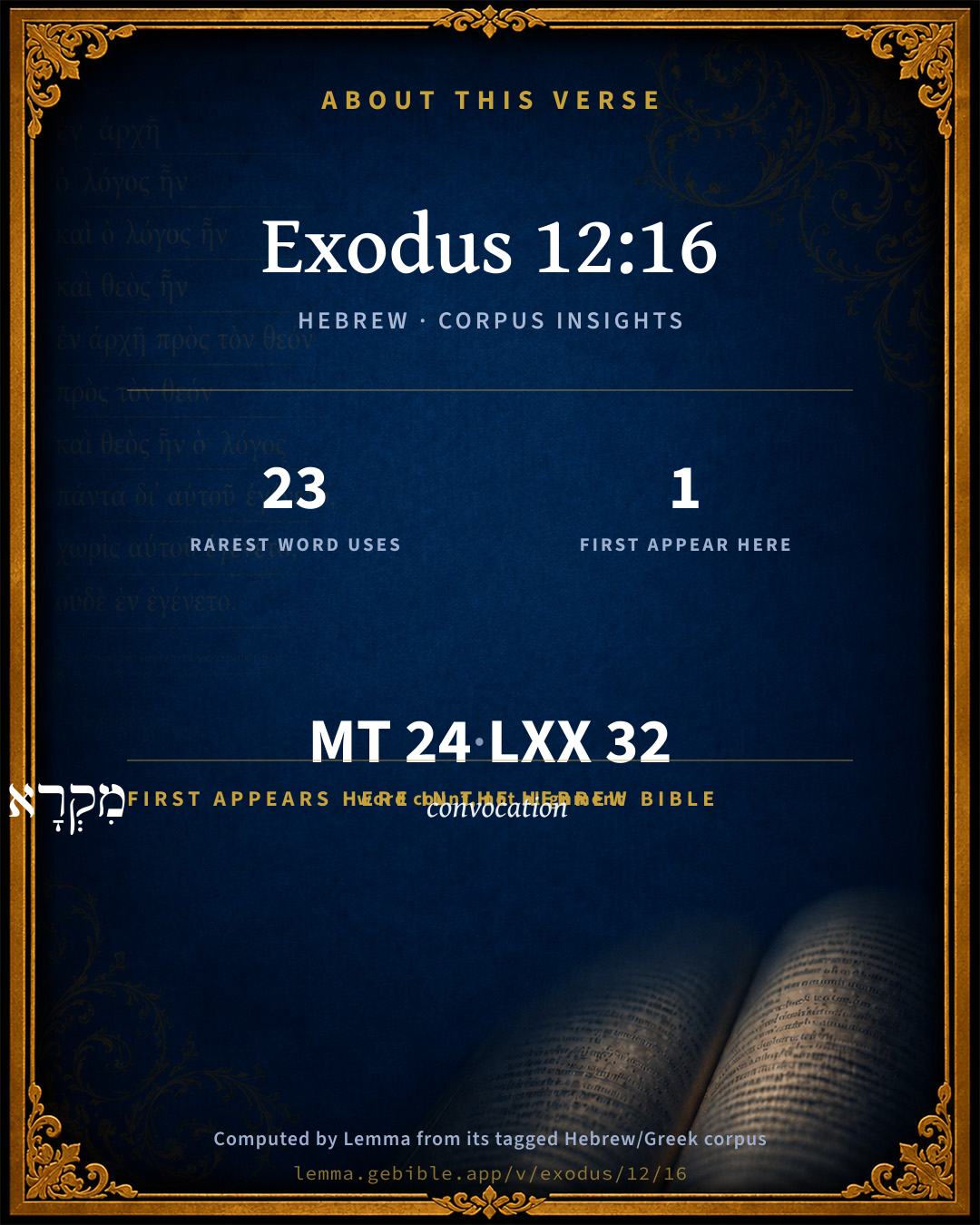
24
words
16
distinct lemmas
Pentateuch
section

Notable vocabulary

The rarest word here is מִקְרָא convocation H4744 — appearing just 23 times in the whole Hebrew Bible.

First appearance in Scripture

This word makes its first canonical appearance in the Hebrew Bible here:

  • מִקְרָא convocation H4744

Shared distinctive vocabulary

מִקְרָא convocation H4744 occurs in 22 verses of the Hebrew Bible. Also found in:

Grammatical profile

  • 4 verbs
  • 11 nouns
  • 2 adjectives
  • 1 pronoun
  • 3 prepositions
  • 3 particles

Verb forms

  • יִהְיֶ֣ה Qal · Imperfect
  • יֵעָשֶׂ֣ה Niphal · Imperfect
  • יֵאָכֵ֣ל Niphal · Imperfect
  • יֵעָשֶׂ֥ה Niphal · Imperfect

Repetition

Words recur within this verse — often emphatic in Hebrew:

  • וּבַיּ֤וֹם day H3117 ×2
  • מִקְרָא convocation H4744 ×2
  • קֹ֔דֶשׁ holiness H6944 ×2
  • כָּל all H3605 ×2
  • יֵעָשֶׂ֣ה to do H6213 ×2

Hebrew & Septuagint length

In English translation the verse runs 43 words from the Hebrew and 46 from the Septuagint (LXX English) — closely comparable.

A rough comparison of the two English renderings, which tokenize alike — not a word-level alignment.

Word counts can differ between the Hebrew and the Greek without any difference in meaning — e.g. the Hebrew direct-object marker אֵת has no separate Greek word, and Greek often adds the article ὁ.

In the original languages it is 24 Hebrew tokens and 32 Greek tokens — but the two are counted differently (Hebrew bundles its prefixes and suffixes into one token; the Greek is in lemma form), so that isn’t a like-for-like length.

Cross-references

16

Topical passages linked to Exodus 12:16 in the Treasury of Scripture Knowledge — connected by theme and wording, ordered by reader-vote popularity; previews shown in the World English Bible.

  • Leviticus 23:7–8 In the first day you shall have a holy convocation. You shall do no regular work.
  • Numbers 28:18 In the first day shall be a holy convocation: you shall do no servile work;
  • Exodus 16:23 He said to them, "This is that which Yahweh has spoken, 'Tomorrow is a solemn rest, a holy Sabbath to Yahweh. Bake that which you want to bake, and boil that which you want to boil; and all that remains over lay up for yourselves to be kept until the morning."
  • Numbers 28:25 On the seventh day you shall have a holy convocation: you shall do no servile work.
  • Exodus 16:5 It shall come to pass on the sixth day, that they shall prepare that which they bring in, and it shall be twice as much as they gather daily."
  • Exodus 16:29 Behold, because Yahweh has given you the Sabbath, therefore he gives you on the sixth day the bread of two days. Everyone stay in his place. Let no one go out of his place on the seventh day."
  • Exodus 20:10 but the seventh day is a Sabbath to Yahweh your God. You shall not do any work in it, you, nor your son, nor your daughter, your man-servant, nor your maid-servant, nor your cattle, nor your stranger who is within your gates;
  • Exodus 35:2–3 'Six days shall work be done, but on the seventh day there shall be a holy day for you, a Sabbath of solemn rest to Yahweh: whoever does any work in it shall be put to death.
  • Leviticus 23:2–3 "Speak to the children of Israel, and tell them, 'The set feasts of Yahweh, which you shall proclaim to be holy convocations, even these are my set feasts.
  • Leviticus 23:21 You shall make proclamation on the same day: there shall be a holy convocation to you; you shall do no regular work. This is a statute forever in all your dwellings throughout your generations.
  • Leviticus 23:27 "However on the tenth day of this seventh month is the day of atonement: it shall be a holy convocation to you, and you shall afflict yourselves; and you shall offer an offering made by fire to Yahweh.
  • Leviticus 23:35 On the first day shall be a holy convocation: you shall do no regular work.
  • Numbers 29:1 In the seventh month, on the first day of the month, you shall have a holy convocation; you shall do no servile work: it is a day of blowing of trumpets to you.
  • Numbers 29:12 On the fifteenth day of the seventh month you shall have a holy convocation; you shall do no servile work, and you shall keep a feast to Yahweh seven days:
  • Jeremiah 17:21–22 Thus says Yahweh, Take heed to yourselves, and bear no burden on the Sabbath day, nor bring it in by the gates of Jerusalem;
  • Leviticus 23:24–25 "Speak to the children of Israel, saying, 'In the seventh month, on the first day of the month, shall be a solemn rest to you, a memorial of blowing of trumpets, a holy convocation.

Cross-references courtesy of OpenBible.info (CC BY 4.0).

Hebrew and Greek witnesses Masoretic Hebrew ↔ Greek Septuagint

The same verse in the two great witnesses to the Old Testament, shown verse-for-verse.

These are two independent witnesses, not word-aligned to each other, and the Septuagint is shown in lemma (dictionary) form.

Hebrew Exodus 12:16 Masoretic · Westminster Leningrad Codex

וּבַיּ֤וֹם הָרִאשׁוֹן֙ מִקְרָא קֹ֔דֶשׁ וּבַיּוֹם֙ הַשְּׁבִיעִ֔י מִקְרָא קֹ֖דֶשׁ יִהְיֶ֣ה לָכֶ֑ם כָּל מְלָאכָה֙ לֹא יֵעָשֶׂ֣ה בָהֶ֔ם אַ֚ךְ אֲשֶׁ֣ר יֵאָכֵ֣ל לְכָל נֶ֔פֶשׁ ה֥וּא לְבַדּ֖וֹ יֵעָשֶׂ֥ה לָכֶֽם

In the first day there shall be to you a holy convocation, and in the seventh day a holy convocation; no manner of work shall be done in them, except that which every man must eat, that only may be done by you.

World English Bible · Public Domain

Greek LXX Exodus 12:16 Septuagint · lemma form

καί ὁ ἡμέρα ὁ πρῶτος καλέω ἅγιος καί ὁ ἡμέρα ὁ ἕβδομος κλητός ἅγιος εἰμί σύ πᾶς ἔργον λατρευτός οὐ ποιέω ἐν αὐτός πλήν ὅσος ποιέω πᾶς ψυχή οὗτος μόνον ποιέω σύ

And the first day shall be called holy, and the seventh day shall be a holy convocation to you: you⌃ shall do no servile work on them, only as many things as will necessarily be done by every soul, this only shall be done by you.

LXX2012 (modern English Septuagint) · Public Domain

Hebrew: Westminster Leningrad Codex (CC BY 4.0). Greek: Septuagint (public domain); English from LXX2012 (modern English Septuagint) (Public Domain). How the Septuagint differs from the Hebrew →

Targum (Aramaic paraphrase)

2

The Targum is the ancient Jewish Aramaic paraphrase of the Hebrew Scriptures — an interpretive translation, not the Hebrew text itself. Onkelos (literal) and Pseudo-Jonathan (expansive) render the Torah, and Jonathan the Prophets. Coverage is partial: where no permissively-licensed English translation exists for a verse, only the Aramaic is shown. This is verse-level text, not a word-by-word alignment to the Hebrew.

  1. Targum Onkelos Torah (Genesis–Deuteronomy)
    וּבְיוֹמָא קַדְמָאָה מְעָרַע קַדִישׁ וּבְיוֹמָא שְׁבִיעָאָה מְעָרַע קַדִישׁ יְהֵי לְכוֹן כָּל עִיבִידָא לָא יִתְעֲבֵד בְּהוֹן בְּרַם דִי מִתְאֲכֵל לְכָל נְפַשׁ הוּא בִלְחוֹדוֹהִי יִתְעֲבֵד לְכוֹן:

    On the first day, from the holy summons, and on the seventh day, from the holy summons, it will be for them: all of their service, they will not serve in them; though, that which is for every being to eat, they alone will serve themselves.

    Targum Onkelos — Aramaic: “Onkelos Genesis” (public domain); “Onkelos Exodus” (public domain); “Onkelos Leviticus” (public domain); “Onkelos Numbers” (public domain); “Onkelos Deuteronomy” (public domain). English: “Sefaria Community Translation” (CC0 1.0 (public-domain dedication)); “J.W. Etheridge. The Targums of Onkelos and Jonathan Ben Uzziel on the Pentateuch. London: Longmans, Green, 1862” (public domain). Text via Sefaria.

  2. Targum Pseudo-Jonathan Torah (Genesis–Deuteronomy)
    וּבְיוֹמָא קַדְמָאָה מְעָרַע קַדִּישׁ וּבְיוֹמָא שְׁבִיעָאָה מְעָרַע קַדִּישׁ יְהֵי לְכוֹן כָּל עֲבִידְתָּא לָא יִתְעֲבֵיד בְּהוֹן לְחוֹד מִן דְּיִתְעֲבֵד לְמֵיכַל כָּל נֶפֶשׁ אִיהוּ בִּלְחוֹדוֹי יִתְעֲבֵיד לְכוֹן

    And on the first day there shall be a holy congregation, and on the seventh day there shall be to you a holy congregation. No work shall be done among you, only that which must be done for every one's eating may be done by you.

    Targum Pseudo-Jonathan — Aramaic: “Targum Jonathan on Genesis” (public domain); “Targum Jonathan on Exodus” (public domain); “Targum Jonathan on Leviticus” (public domain); “Targum Jonathan on Numbers” (public domain); “Targum Jonathan on Deuteronomy” (public domain). English: “The Targum of Jonathan ben Uzziel, trans. J. W. Etheridge, London, 1862” (public domain). Text via Sefaria.

Commentary

Notes on Exodus 12:16 from classic Christian and Jewish commentators (each source and its license shown beneath its notes). The classic Christian expositions comment on the surrounding passage and are grouped to its opening verse, so a note may address several verses; the Jewish commentaries on the Tanakh (Rashi and others) are per-verse, so they appear only where the commentator wrote on this verse.

Lemma curates 59 commentaries, every one of them public domain or Creative Commons licensed, each selected and text-cleaned for this edition rather than reprinted as found. About our sources →

Trapp's Complete Commentary

John Trapp

Exo 12:16 And in the first day [there shall be] an holy convocation, and in the seventh day there shall be an holy convocation to you; no manner of work shall be done in them, save [that] which every man must eat, that only may be done of you.

Ver. 16. A holy convocation.] This same word, in the Hebrew, signifieth the Holy Scripture; to teach us, saith one, that the Scriptures ought to be read in the congregation and holy assemblies. {Neh 8:9}

John Trapp, A Commentary or Exposition upon All the Books of the Old and New Testament (1647–1656) — public domain. Text from a community e-Sword module.

Geneva Bible (1599)

Geneva Bible translators

Or, calling together of the people to serve God.

Geneva Bible (1599) marginal notes — public domain. Text via Bolls.life.

Jamieson, Fausset & Brown

Robert Jamieson, A. R. Fausset & David Brown

there shall be an holy convocation--literally, calling of the people, which was done by sound of trumpets (Num 10:2), a sacred assembly--for these days were to be regarded as Sabbaths--excepting only that meat might be cooked on them (Exo 16:23).

Jamieson, Fausset & Brown — Commentary Critical and Explanatory on the Whole Bible (1871) — public domain (CC PDM 1.0). Text via the HelloAO Bible API.

Adam Clarke's Commentary

Verse 16. In the first day and in the seventh day there shall be a holy convocation] This is the first place where we meet with the account of an assembly collected for the mere purpose of religious worship. Such assemblies are called holy convocations, which is a very appropriate appellation for a religious assembly; they were called together by the express command of God, and were to be employed in a work of holiness. מקרא mikra, convocation, is a word of similar import with the Greek εκκλησια, which we commonly translate Church, and which properly signifies an assembly convened by public call.

Adam Clarke's Commentary on the Bible (1810–1826) — public domain. Text from a community e-Sword/MySword module.

Ellicott's Commentary for English Readers

(16) In the first day there shall be an holy convocation.—The Passover was to be kept on the fourteenth day of Abib, at even. The seven following days were to be “days of unleavened bread.” On the first of these, the fifteenth of Abib (Lev_23:6), there was to be a “holy convocation,” i.e., a general gathering of the people to the door of the sanctuary for sacrifice, worship, and perhaps instruction. (Comp. Neh_8:1.) The term “convocation” implies that the people were summoned to attend; and the actual summons appears to have been made by the blowing of the silver trumpets (Num_10:2). On the seventh day, the twenty-first of Abib, was to be another similar meeting. “No manner of work” was to be done on either of these two days; or rather, as explained in Lev_23:7-8, “no servile work.”

A Bible Commentary for English Readers, edited by Charles John Ellicott (1878–1897) — public domain. Text from a community e-Sword module.

The Cambridge Bible for Schools and Colleges

gen. ed. J. J. S. Perowne

16. On the first and seventh day there was also to be a ‘holy convocation,’ i.e. an assembly at the sanctuary for religious purposes. The expression occurs besides only in the two calendars of P, Lev_23:2-4; Lev_23:7-8; Lev_23:21; Lev_23:24; Lev_23:27; Lev_23:35-37, Num_28:18; Num_28:25-26; Num_29:1; Num_29:7; Num_29:12; and, without ‘holy,’ Isa_1:13; Isa_4:5 (EVV., each time, ‘assemblies’). The assembly was ‘called’ together by silver trumpets (see Num_10:2 [where ‘calling’ is in the Heb. the same as ‘convocation’ here], Num_10:3; Num_10:7, cf. Num_10:10): Kalisch reminds us how in Mohammedan countries festivals are announced by heralds from conspicuous places, especially the towers of mosques.

save that which, &c.] The prohibition of work was thus not as strict as for the sabbath (Exo_16:23, Exo_35:3), or the day of atonement (Lev_23:28). Cf. Lev_23:7-8.

The Cambridge Bible for Schools and Colleges (gen. ed. J. J. S. Perowne; Cambridge University Press, 1878–1918) — public domain. Text from a community e-Sword module.

John Gill's Exposition

And in the first day there shall be an holy convocation,.... An holy day, in which the people be called to holy exercises, and wholly abstain from worldly business, done on other days:

and in the seventh day there shall be an holy convocation unto you; observed in a festival way, and in the like religious manner the first day was, the day of their going out of Egypt; and the seventh was the day in which Pharaoh and his host were drowned in the Red sea, as Aben Ezra observes; for which reason those days are distinguished from the rest, and appointed to be holy convocations, and which appear from the journeying of the children of Israel, as computed by Junius: they came to Succoth on the fifteenth, to Etham the seventeenth, to Pihahiroth the eighteenth, where they were ordered to stay, and wait the coming of their enemies, on the twentieth the army of Pharaoh came up to them, and the night following the Israelites passed through the sea and the Egyptians were drowned:

no manner of work shall be done in them; as used to be done on other days, and as were on the other five days of this festival: the Jewish canons are,"it is forbidden to do any work on the evening of the passover, from the middle of the day and onward, and whoever does work from the middle of the day and onward, they excommunicate him; even though, he does it for nothing, it is forbidden (n): R. Meir says, whatever work anyone begins before the fourteenth (of Nisan) he may finish it on the fourteenth, but he may not begin it on the beginning of the fourteenth, though he could finish it: the wise men say, three workmen may work on the evening of the passover unto the middle of the day, and they are these, tailors, barbers, and fullers: R. Jose bar Judah says, also shoemakers (o),''but in the text no exception is made but the following:

save that which every man must eat, that only may be done of you; so that kindling fire and preparing food might be done on those days, which might not be done on sabbath days; and the prohibition of work was not so strict on those days as on that.

(n) Lebush, par. 1. No. 468. sect. 1. Schulcan Aruch, par. 1. No. 468. sect. 1. (o) Misn. Pesach. c. 4. sect. 6.

John Gill's Exposition of the Whole Bible (1746–1763) — public domain (CC PDM 1.0). Text via the HelloAO Bible API.

Albert Barnes' Notes on the Bible

An holy convocation - An assembly called by proclamation for a religious solemnity. See Lev 23:2; Num 10:2-3. In the East the proclamation is made by the Muezzins from the minarets of the mosques.

Save that ... - In this the observance of the festival differed from the Sabbath, when the preparation of food was prohibited. The same word for “work” is used here and in the fourth commandment: it is very general, and includes all laborious occupation.

Albert Barnes' Notes on the Bible (1834–1885) — public domain. Text from a community e-Sword/MySword module.

Haydock's Catholic Bible Commentary

Eating. On the sabbath, meat was not even to be prepared, chap. xvi. 23. During the five intermediate days, any work might be done.

George Leo Haydock (1774–1849), Haydock's Catholic Family Bible and Commentary, 1859 edition — public domain. Excludes Psalms (Douay-Rheims chapter numbering differs from Protestant) and Deuterocanonical books (Catholic canon only).

Matthew Poole's English Annotations

An holy convocation; a solemn day for the people to assemble together, and to attend upon the public worship and service of God in hearing his word, prayers, praises, and sacrifices.

And in the seventh day, because then Pharaoh and his host were drowned in the sea. As on the first day the first-born were killed; so their deliverance was begun on the first, and completed on the seventh day, and therefore those days deserved a special character of honour. And indeed that there were seven days between those two miracles, the Jews unanimously affirm, and it seems probable from the account of their journeys.

No manner of work, i.e. of servile work, Lev 23:7.

Save that which every man must eat: herein, as many think, these days were inferior to the sabbath, in which that was forbidden. But of this See Poole on "Exo 16:23". See Poole on Exo 35:3.

Matthew Poole's English Annotations on the Holy Bible (1683–1685) — public domain. Text from a community e-Sword/MySword module.

Whedon's Commentary on the Bible

Daniel D. Whedon

16. Holy convocation — The first and seventh days were to be days of general assembly, in which no work but that of necessity should be done — sabbaths, when all the people should gather to hear the law, and to adore Jehovah, their Saviour, while they recounted to each other his mighty delivering mercies. This was the origin of the Jewish synagogue.

Daniel D. Whedon (gen. ed.), Commentary on the Old and New Testaments (1874–1909) — public domain. Text from a community e-Sword module.

The Pulpit Commentary

On the first day there shall be a holy convocation. After the Paschal meal on the evening of the 14th of Abib, there was to be a solemn assembly of the people on the next day for religions worship. The name "convocation;" applied to these gatherings, seems to show that originally the people were summoned to such meetings, as they still are by the muezzin from the minarets of mosques in Mahommedan countries, and by bells from the steeples of churches in Christian ones. And on the seventh day. On the 22nd of Abib the seventh day after the first holy convocation on the 15th. (see Lev_23:4-8) Only two of the Jewish festivals were of this duration the feast of unleavened bread, and the feast of tabernacles (ib. 39-42). The Christian Church has adopted the usage for Christmas, Easter, Ascension, and Whitsuntide, where the last day of the week is known technically as "the octave." No manner of work shall be done in them. Festival-days were in all countries days of abstention from the ordinary business of life, which could not conveniently be carried on conjointly with attendance at the services, meetings, processions, etc., wherein the festival consisted. But absolute cessation from all work was nowhere strictly commanded except among the Hebrews, where it appears to have been connected with the belief in God"s absolute rest after the six days of creation. The command here given was solemnly repeated in the law. (Lev_23:6-8)

The Pulpit Commentary (1880–1919), ed. H.D.M. Spence-Jones & Joseph S. Exell — public domain. Text from a community e-Sword module.

John Wesley's Explanatory Notes

An holy convocation - A solemn day for the people to assemble together.

John Wesley, Explanatory Notes Upon the Whole Bible (1754–1765) — public domain. Text via the GEBible commentary corpus.

Rashi

Rabbi Shlomo Yitzchaki (Rashi)

מקרא קדש — The word מקרא is an infinitive and the translation is, “And on the first day there shall be “a calling it holy”, which implies: call it holy in regard to eating and drinking and raiment (Mekhilta).

לא יעשה בהם NO WORK SHALL BE DONE ON THEM, even by the agency of others (cf. Mekhilta).

הוא לבדו THAT ALONE — that and not such acts preliminary to it (to the preparation of food) as it was possible to do on the eve of the Festival (Beitzah 28b).

לכל נפש BY EVERY BEING — even by cattle. One might think that also food may be prepared for non-Israelites! Scripture however states, (in this verse) לכם (i. e. לכל נפש לכם) for every being that belongs to you (the responsibility for feeding which belongs to you) (Mekhilta).

Rashi on the Tanakh — English translations: “The Judaica Press complete Tanach with Rashi, translated by A. J. Rosenberg” (CC BY 4.0); “Pentateuch with Rashi's commentary by M. Rosenbaum and A.M. Silbermann, 1929-1934” (public domain); “The Metsudah Tanach series, Lakewood, N.J” (CC BY 4.0); and “The Book of Joshua, Metsudah Publications, 1997” (CC BY 4.0). Text via Sefaria.

Ramban (Nachmanides)

Rabbi Moshe ben Nachman (Ramban / Nachmanides)

NO MANNER OF WORK SHALL BE DONE IN THEM. Rashi commented: “Even by the agency of others.”I do not understand this. If these “others” are Israelites, they themselves are commanded not to work on the Festival, and I am not bound to ensure that my work is not done through them. It is only where one deceives another in a matter which is prohibited — whether it be in the deceiver’s work or in that of the deceived that the deceiver transgresses the prohibition, Before the blind do not put a stumbling-block. And if these “others” are non-Israelites, we are by law of the Torah not admonished at all against their working either on a Festival or on a Sabbath, except that there is a prohibition by the Rabbis if we tell him [the non-Israelite] to do the work, just as the Rabbis have said: “Telling a non-Israelite [to do work on the Sabbath or Festival] is prohibited by law of the Rabbis,” and this is a principle clearly established in the Gemara. [How then could Rashi derive this principle of prohibiting telling a non-Israelite to do work for us on a Festival from a verse in the Torah, when it is only prohibited by Rabbinic law?]However, I have found this text in the Mechilta: “No manner of work shall be done in them. This means that neither you nor your fellow-Israelite shall do any work, nor shall a non-Israelite do your work. You so interpret it to mean that neither you nor your fellow-Israelite shall do any work, nor shall a non-Israelite do your work, but perhaps it rather means that neither you nor your fellow-Israelite shall do any work, and the non-Israelite shall not do even his own work! Scripture therefore says, Six days shall work be done.. See my Hebrew commentary, p. 330, for a detailed explanation of how the principle discussed is derived from the language of the verse. This teaches that neither you nor your fellow-Israelite shall do any work [on the Sabbath], but the non-Israelite may do his own work. These are the words of Rabbi Yashiya. Rabbi Yonathan says that there is no need for this proof. Has it not already been said, Six days shalt thou labour, and do all thy work? Now by the syllogism of kal vachomer, we proceed as follows: If on the Sabbath, in regard to which the Torah is so strict, you are not admonished against a non-Israelite’s work as you are against your own work, [it is logical to assume that on a Festival-day, in regard to which the Torah is not so strict — inasmuch as preparation of food is permitted on a Festival-day but not on the Sabbath — you are surely not admonished against a non-Israelite’s work as you are against your own work].” Thus far extends the text of this Beraitha. Now surely this is but a case of a mere asmachta, [a Scriptural text used as a mere support for a Rabbinical enactment]. Since they aimed to prohibit, by law of the Rabbis, telling a non-Israelite to do our work [on a Sabbath or Festival], they used this verse as a support, [but it is actually a Rabbinical law]. It is however permissible for a non-Israelite to do his own work. And thus we incidentally learn that the Rabbinical enactment against telling a non-Israelite to do work applies only to doing our work, but one may tell him to do his own work and he may do it. So did Rashi explain it in the Gemara of [Tractate] Baba Metzia. There in the Mechilta it further says: “I know only that work which can be regarded as labor is prohibited. Whence do we learn that activities which are prohibited by Rabbinical enactment [are also forbidden]? Scripture therefore says, And ye shall observe this day, including all activities prohibited by Rabbinical law.” Now Beraithoth like these, [if not accompanied by a proper interpretation], may lead one into a mistaken opinion and should not be quoted literally, for this Beraitha too apparently is a mere asmachta, and I have a correct interpretation thereof. I will yet discuss it, with the help of G-d. (Leviticus 23:24). Ramban’s interpretation there of this topic has been called by the Ritba (see Vol. I, Preface, x), “a gem which has come down to us from the teachings of our master Rabbi Moshe ben Nachman.”

SAVE THAT WHICH MAY BE EATEN BY EVERY BEING, [THAT ONLY MAY BE DONE FOR YOU]. “Even [the food eaten] by cattle [may be prepared on the Festival-day]. One might think that [food may be prepared] for non-Israelites too. Scripture therefore states, for you: [you are permitted to prepare food only for that which belongs to you and for which you have the responsibility of feeding].” Thus the language of Rashi. This too is not in accordance with the final decision of the law. Rather, [the word lachem (for you) signifies]: for you and not for non-Israelites, for you and not for cattle.

Ramban (Nachmanides) on the Tanakh — English translation: “Commentary on the Torah by Ramban (Nachmanides). Translated and annotated by Charles B. Chavel. New York, Shilo Pub. House, 1971-1976” (CC BY 4.0). Text via Sefaria.

Lesson kit

Teaching starters — assembled from the data on this page, not authored interpretation. Every prompt links to the verse data it draws on. Edit before teaching.

Exodus, in the Pentateuch, opens this verse with 24 words (16 distinct Hebrew lemmas). Its most distinctive word is miqrâʼ (“convocation”). A historical commentator’s framing appears above. Read the whole chapter for the surrounding context.

Discussion questions

  1. The word miqrâʼ carries the sense “convocation.” How does it shape the verse?
  2. The word “convocation” first appears here in Scripture. What is being introduced at this debut?
  3. Leviticus 23:2 shares the word «convocation» with this verse. How do the two illuminate each other?
  4. “day” occurs 2× in this one verse. What is the effect of the repetition?
  5. These translations render this verse differently. What is at stake in choosing one wording over another?
  6. The verb «יִהְיֶ֣ה» is Qal Imperfect. How does its form color the action?
  7. Reading how Trapp's Complete Commentary and Geneva Bible (1599) read this verse, where do the two commentators agree and where do they part?

Things to notice

Reading settings

Reading text

Shown beneath each verse's original-language words.

Old Testament
Old Testament edition

Read the OT as the Masoretic Hebrew (MT) or the Greek Septuagint (LXX).

English shown for the Greek Septuagint (in the Hebrew ↔ Greek comparison).

Comparing translations? Open the Compare panel on any verse page to stack up to four side by side.