
Leviticus 16:17

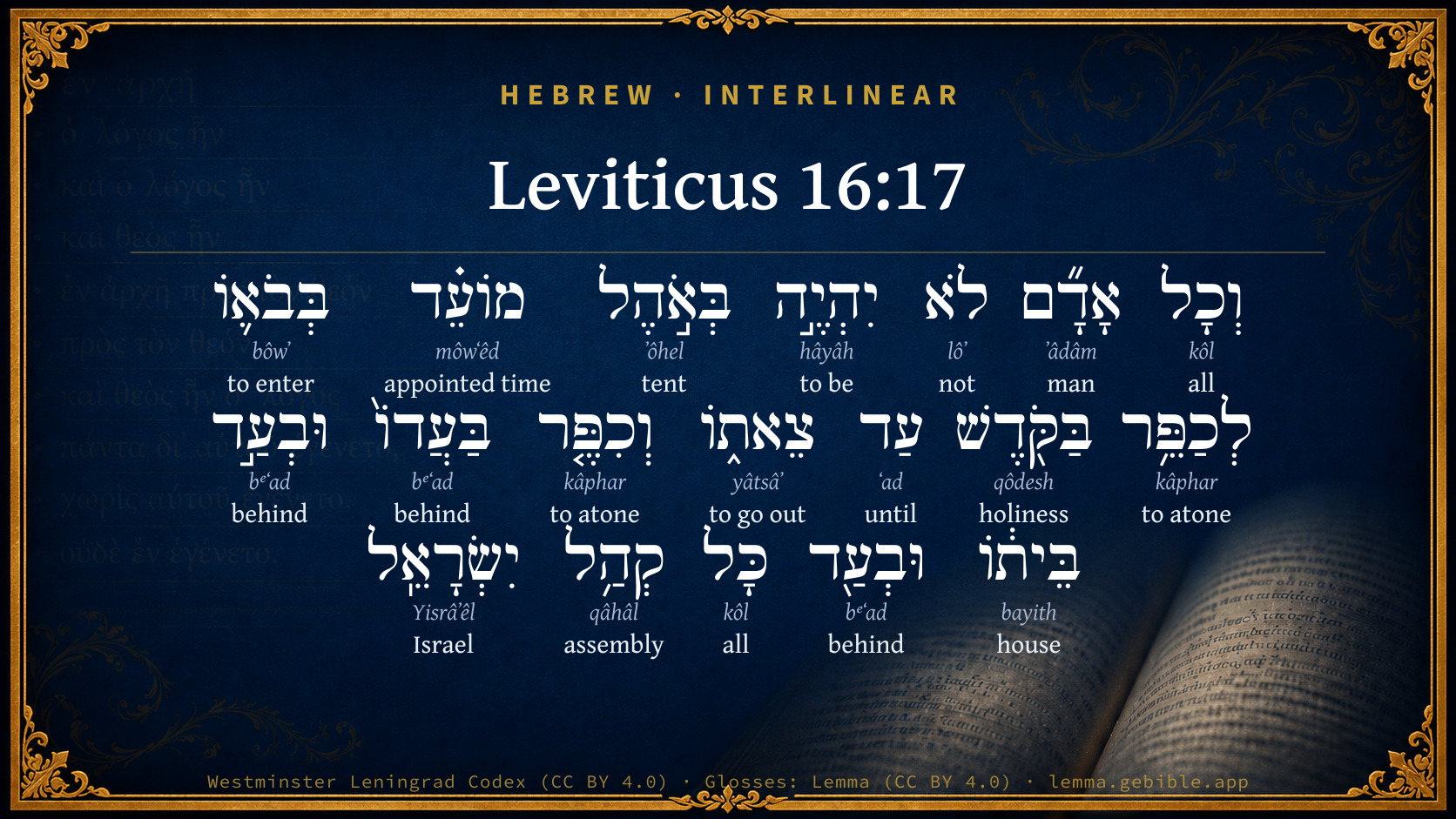
Hebrew (Westminster Leningrad Codex) Leviticus 16:17 appears in the Hebrew Old Testament. The text above is from the Westminster Leningrad Codex. Each word links to its Strong’s number, a concise gloss, and parsing drawn from the Open Scriptures Hebrew Bible morphology. Click any word for its full Brown-Driver-Briggs (BDB) entry.
Download image
Cite this verse

Leviticus 16:17 (World English Bible). Public Domain. Lemma interlinear Bible study tool, https://lemma.gebible.app/v/leviticus/16/17.

Show BibTeX & RIS
BibTeX
RIS
English Translation
There shall be no one in the Tent of Meeting when he enters to make atonement in the Holy Place, until he comes out, and has made atonement for himself and for his household, and for all the assembly of Israel.
World English Bible · Public Domain
Download a study sheet

One document with this verse’s original text, its word-by-word gloss line, the meaning frame, cross-references with their text, attributed commentary, and full source and license credits — printable, and it pastes into notes with its structure intact.

This verse Autodidact and up

Study sheet (.html) Plain text (.txt)

A passage Seminary Student

Up to 50 verses in one chapter. A passage sheet keeps up to 6 commentary sources and 12 cross-references per verse, in the order this page ranks them, and says so on the sheet whenever that leaves anything out. Ask for a single verse and you get the Autodidact verse sheet above.

Everything on this page stays free to read, with no account — the sheet is a download of what is already on screen, not access to it.

Want to remove ads? Support Godless Engineer
Compare translations 3

The same verse in 3 English versions, stacked beneath the original-language interlinear above. Click any original word for its lexicon entry.

Each is an independent rendering of the whole verse — the interlinear is not word-aligned to these translations.

Highlighted words mark where these versions differ — a whole-verse word diff, not a word-by-word alignment.

  • World English Bible Public Domain
    There shall be no one in the Tent of Meeting when he enters to make atonement in the Holy Place, until he comes out, and has made atonement for himself and for his household, and for all the assembly of Israel.
  • King James Version Public Domain
    And there shall be no man in the tabernacle of the congregation when he goeth in to make an atonement in the holy place, until he come out, and have made an atonement for himself, and for his household, and for all the congregation of Israel.
  • unfoldingWord Literal Text CC BY-SA 4.0
    And every man shall not be in the tent of meeting when he enters to make atonement in the Holy Place until his going out. And he shall make atonement on his behalf and on behalf of his house and on behalf of the whole congregation of Israel.

unfoldingWord Literal Text — © unfoldingWord, licensed CC BY-SA 4.0. Word-aligned USFM3 via Door43 (git.door43.org/unfoldingWord/en_ult).

Versions to compare (up to 4)

3 of 4 selected

Show all 18 translations

Every available English version of this verse, each an independent rendering of the whole verse.

  • World English Bible Public Domain
    There shall be no one in the Tent of Meeting when he enters to make atonement in the Holy Place, until he comes out, and has made atonement for himself and for his household, and for all the assembly of Israel.
  • Berean Standard Bible Public Domain
    No one may be in the Tent of Meeting from the time Aaron goes in to make atonement in the Most Holy Place until he leaves, after he has made atonement for himself, his household, and the whole assembly of Israel.
  • Majority Standard Bible Public Domain
    No one may be in the Tent of Meeting from the time Aaron goes in to make atonement in the Most Holy Place until he leaves, after he has made atonement for himself, his household, and the whole assembly of Israel.
  • King James Version Public Domain
    And there shall be no man in the tabernacle of the congregation when he goeth in to make an atonement in the holy place, until he come out, and have made an atonement for himself, and for his household, and for all the congregation of Israel.
  • American Standard Version (1901) Public Domain
    And there shall be no man in the tent of meeting when he goeth in to make atonement in the holy place, until he come out, and have made atonement for himself, and for his household, and for all the assembly of Israel.
  • Revised Version (1885) Public Domain
    And there shall be no man in the tent of meeting when he goeth in to make atonement in the holy place, until he come out, and have made atonement for himself, and for his household, and for all the assembly of Israel.
  • Geneva Bible (1599) Public Domain
    And there shalbe no man in the Tabernacle of the Congregation, when he goeth in to make an atonement in the Holy place, vntill hee come out, and haue made an atonement for himselfe, and for his housholde, and for all the Congregation of Israel.
  • Douay-Rheims (1899) Public Domain
    Let no man be in the tabernacle when the high priest goeth into the sanctuary, to pray for himself and his house, and for the whole congregation of Israel, until he come out.
  • Young's Literal Translation Public Domain
    `And no man is in the tent of meeting in his going in to make atonement in the sanctuary, till his coming out; and he hath made atonement for himself, and for his house, and for all the assembly of Israel.
  • Literal Standard Version CC BY-SA 4.0
    And no man is in the Tent of Meeting in his going in to make atonement in the holy place, until his coming out; and he has made atonement for himself, and for his house, and for all the assembly of Israel.
  • Unlocked Literal Bible CC BY-SA 4.0
    No one must be in the tent of meeting when Aaron enters it to make atonement in the most holy place, and until he comes out and has finished making atonement for himself and for his family, and for all the assembly of Israel.
  • unfoldingWord Literal Text CC BY-SA 4.0
    And every man shall not be in the tent of meeting when he enters to make atonement in the Holy Place until his going out. And he shall make atonement on his behalf and on behalf of his house and on behalf of the whole congregation of Israel.
  • Darby Bible Public Domain
    And there shall be no man in the tent of meeting when he goeth in to make atonement in the sanctuary until he come out; and he shall make atonement for himself, and for his house, and for the whole congregation of Israel.
  • World Messianic Bible Public Domain
    No one shall be in the Tent of Meeting when he enters to make atonement in the Holy Place, until he comes out, and has made atonement for himself and for his household, and for all the assembly of Israel.
  • Webster's Bible Public Domain
    And there shall be no man in the tabernacle of the congregation when he goeth in to make an atonement in the holy place, until he shall come out, and shall have made an atonement for himself, and for his household, and for all the congregation of Israel.
  • Free Bible Version CC BY-SA 4.0
    No one can be in the Tent of Meeting from the time Aaron enters to purify the Most Holy Place until he leaves, after he has made things right for himself, his household, and all the Israelites.
  • Bible in Basic English Public Domain
    And no man may be in the Tent of meeting from the time when Aaron goes in to take away sin in the holy place till he comes out, having made himself and his house and all the people of Israel free from sin.
  • JPS Tanakh (1917) Public Domain
    And there shall be no man in the tent of meeting when he goeth in to make atonement in the holy place, until he come out, and have made atonement for himself, and for his household, and for all the assembly of Israel.

Literal Standard Version (2020), Covenant Press — licensed CC BY-SA 4.0. Text via the HelloAO Bible API (eBible.org). Unlocked Literal Bible (unfoldingWord) — licensed CC BY-SA 4.0. Text via the HelloAO Bible API (eBible.org). unfoldingWord Literal Text — © unfoldingWord, licensed CC BY-SA 4.0. Word-aligned USFM3 via Door43 (git.door43.org/unfoldingWord/en_ult). Free Bible Version, Dr. Jonathan Gallagher — licensed CC BY-SA 4.0. Text via the HelloAO Bible API (eBible.org).

Word by word

More ways to search: Search by grammar → Find every occurrence → Compare this word →

Practice this passage: Drill this verse → Learn its vocabulary →

לְכַפֵּ֥ר
kâphar
H3722
“to atone”
Preposition + Verb, Piel, Infinitive Construct
Part of Speech
Preposition + Verb
Stem
Piel
Form
Infinitive Construct
Full BDB Definition

Origin: a primitive root

TWOT: 1023 , 1024 , 1025 , 1026

to cover, purge, make an atonement, make reconciliation, cover over with pitch - (Qal) to coat or cover with pitch - (Piel) - to cover over, pacify, propitiate - to cover over, atone for sin, make atonement for - to cover over, atone for sin and persons by legal rites - (Pual) - to be covered over - to make atonement for - (Hithpael) to be covered
  1. וְכָל kôl H3605 “and · all of” Conjunction + Noun, Common, Masculine, Singular, Construct
  2. אָדָ֞ם ʼâdâm H120 “man” Noun, Common, Masculine, Singular, Absolute
  3. לֹא lôʼ H3808 “not” Particle, Negative
  4. יִהְיֶ֣ה hâyâh H1961 “to be” Verb, Qal, Imperfect, 3rd Person, Masculine, Singular
  5. בְּאֹ֣הֶל ʼôhel H168 “in/at · tent of” Preposition + Noun, Common, Masculine, Singular, Construct
  6. מוֹעֵ֗ד môwʻêd H4150 “appointed time” Noun, Common, Masculine, Singular, Absolute
  7. בְּבֹא֛וֹ bôwʼ H935 “in/at · to enter · him” Preposition + Verb, Qal, Infinitive Construct + Suffix, Personal, 3rd Person, Masculine, Singular
  8. בַּקֹּ֖דֶשׁ qôdesh H6944 “in/at the · holiness” Preposition, Determined + Noun, Common, Masculine, Singular, Absolute
  9. עַד ʻad H5704 “until” Preposition
  10. צֵאת֑וֹ yâtsâʼ H3318 “to go out · him” Verb, Qal, Infinitive Construct + Suffix, Personal, 3rd Person, Masculine, Singular
  11. וְכִפֶּ֤ר kâphar H3722 “and · to atone” Conjunction + Verb, Piel, Sequential Perfect, 3rd Person, Masculine, Singular
  12. בַּעֲדוֹ֙ bᵉʻad H1157 “behind · him” Preposition + Suffix, Personal, 3rd Person, Masculine, Singular
  13. וּבְעַ֣ד bᵉʻad H1157 “and · behind” Conjunction + Preposition
  14. בֵּית֔וֹ bayith H1004 “house · his” Noun, Common, Masculine, Singular, Construct + Suffix, Personal, 3rd Person, Masculine, Singular
  15. וּבְעַ֖ד bᵉʻad H1157 “and · behind” Conjunction + Preposition
  16. כָּל kôl H3605 “all of” Noun, Common, Masculine, Singular, Construct
  17. קְהַ֥ל qâhâl H6951 “assembly of” Noun, Common, Masculine, Singular, Construct
  18. יִשְׂרָאֵֽל Yisrâʼêl H3478 “Israel” Noun, Proper

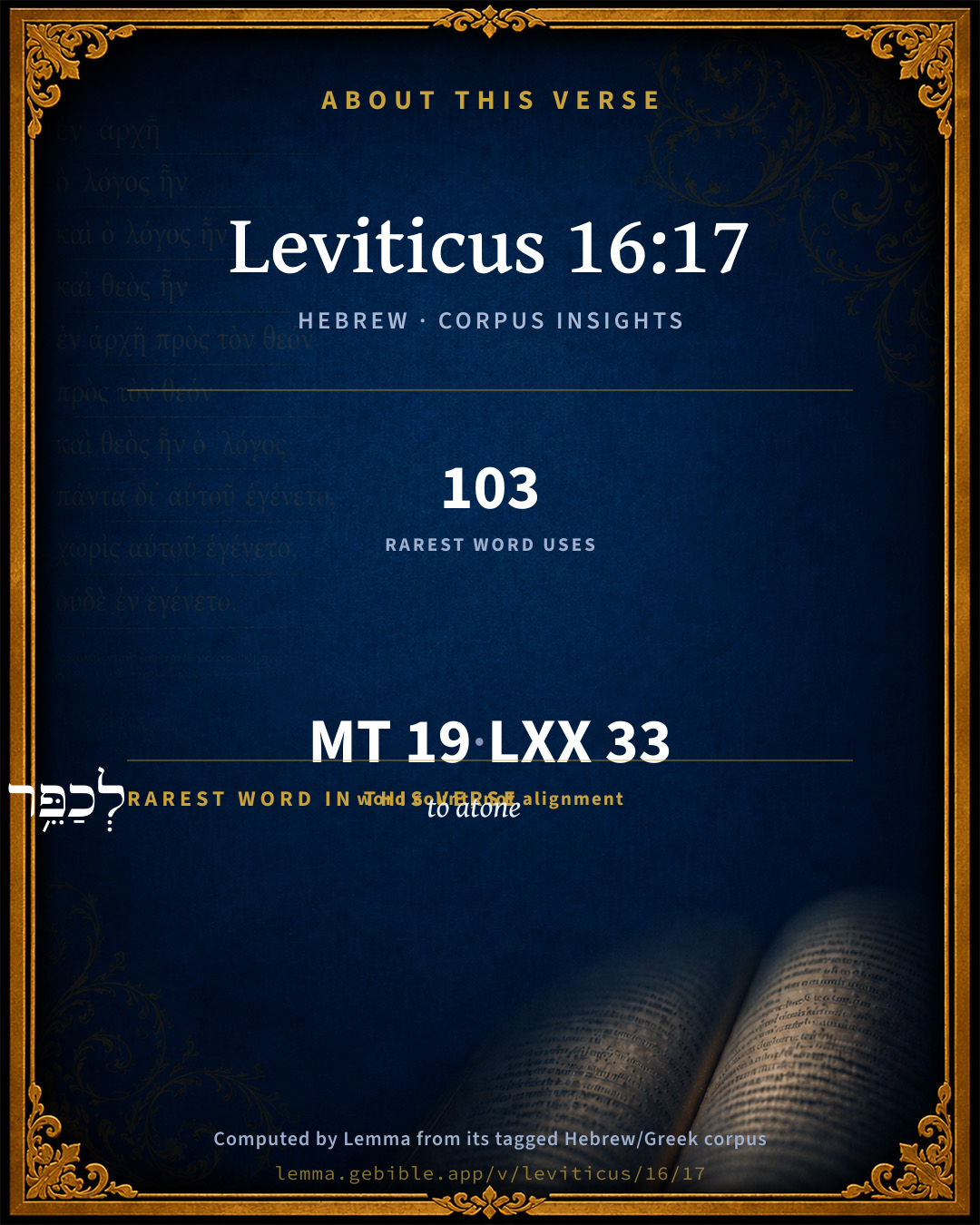
About this verse

These counts appear in no published source. They are computed here, from the morphology-tagged text and Lemma’s own curated glosses. What Lemma adds →

19
words
15
distinct lemmas
Pentateuch
section

Grammatical profile

  • 5 verbs
  • 9 nouns
  • 4 prepositions
  • 1 particle

Verb forms

  • יִהְיֶ֣ה Qal · Imperfect
  • בְּבֹא֛וֹ Qal · Infinitive Construct
  • לְכַפֵּ֥ר Piel · Infinitive Construct
  • צֵאת֑וֹ Qal · Infinitive Construct
  • וְכִפֶּ֤ר Piel · Sequential Perfect

Repetition

Words recur within this verse — often emphatic in Hebrew:

  • בַּעֲדוֹ֙ behind H1157 ×3
  • וְכָל all H3605 ×2
  • לְכַפֵּ֥ר to atone H3722 ×2

Hebrew & Septuagint length

In English translation the verse runs 41 words from the Hebrew and 49 from the Septuagint (LXX English) — closely comparable.

A rough comparison of the two English renderings, which tokenize alike — not a word-level alignment.

Word counts can differ between the Hebrew and the Greek without any difference in meaning — e.g. the Hebrew direct-object marker אֵת has no separate Greek word, and Greek often adds the article ὁ.

In the original languages it is 19 Hebrew tokens and 33 Greek tokens — but the two are counted differently (Hebrew bundles its prefixes and suffixes into one token; the Greek is in lemma form), so that isn’t a like-for-like length.

Cross-references

11

Topical passages linked to Leviticus 16:17 in the Treasury of Scripture Knowledge — connected by theme and wording, ordered by reader-vote popularity; previews shown in the World English Bible.

  • Exodus 34:3 No one shall come up with you; neither let anyone be seen throughout all the mountain; neither let the flocks nor herds feed before that mountain."
  • Leviticus 16:10–11 But the goat, on which the lot fell for the scapegoat, shall be presented alive before Yahweh, to make atonement for him, to send him away for the scapegoat into the wilderness.
  • Isaiah 53:6 All we like sheep have gone astray; everyone has turned to his own way; and Yahweh has laid on him the iniquity of us all.
  • Luke 1:10 The whole multitude of the people were praying outside at the hour of incense.
  • Daniel 9:24 Seventy weeks are decreed on your people and on your holy city, to finish disobedience, and to make an end of sins, and to make reconciliation for iniquity, and to bring in everlasting righteousness, and to seal up vision and prophecy, and to anoint the most holy.
  • Acts 4:12 There is salvation in none other, for neither is there any other name under heaven, that is given among men, by which we must be saved!"
  • 1 Timothy 2:5 For there is one God, and one mediator between God and men, the man Christ Jesus,
  • Hebrews 1:3 His Son is the radiance of his glory, the very image of his substance, and upholding all things by the word of his power, when he had by himself made purification for our sins, sat down on the right hand of the Majesty on high;
  • Hebrews 9:7 but into the second the high priest alone, once in the year, not without blood, which he offers for himself, and for the errors of the people.
  • 1 Peter 2:24 who his own self bore our sins in his body on the tree, that we, having died to sins, might live to righteousness; by whose stripes you were healed.
  • 1 Peter 3:18 Because Christ also suffered for sins once, the righteous for the unrighteous, that he might bring you to God; being put to death in the flesh, but made alive in the spirit;

Cross-references courtesy of OpenBible.info (CC BY 4.0).

Hebrew and Greek witnesses Masoretic Hebrew ↔ Greek Septuagint

The same verse in the two great witnesses to the Old Testament, shown verse-for-verse.

These are two independent witnesses, not word-aligned to each other, and the Septuagint is shown in lemma (dictionary) form.

Hebrew Leviticus 16:17 Masoretic · Westminster Leningrad Codex

וְכָל אָדָ֞ם לֹא יִהְיֶ֣ה בְּאֹ֣הֶל מוֹעֵ֗ד בְּבֹא֛וֹ לְכַפֵּ֥ר בַּקֹּ֖דֶשׁ עַד צֵאת֑וֹ וְכִפֶּ֤ר בַּעֲדוֹ֙ וּבְעַ֣ד בֵּית֔וֹ וּבְעַ֖ד כָּל קְהַ֥ל יִשְׂרָאֵֽל

There shall be no one in the Tent of Meeting when he enters to make atonement in the Holy Place, until he comes out, and has made atonement for himself and for his household, and for all the assembly of Israel.

World English Bible · Public Domain

Greek LXX Leviticus 16:17 Septuagint · lemma form

καί πᾶς ἄνθρωπος οὐ εἰμί ἐν ὁ σκηνή ὁ μαρτύριον εἰςπορεύομαι αὐτός ἐκἱλάσκομαι ἐν ὁ ἅγιος ἕως ἄν ἐκἔρχομαι καί ἐκἱλάσκομαι περί αὐτός καί ὁ οἶκος αὐτός καί περί πᾶς συναγωγή υἱός ἰσραήλ

and there shall be no man in the tabernacle of witness, when he goes in to make atonement in the holy place, until he shall have come out; and he shall make atonement for himself, and for his house, and for all the congregation of the children of Israel.

LXX2012 (modern English Septuagint) · Public Domain

Hebrew: Westminster Leningrad Codex (CC BY 4.0). Greek: Septuagint (public domain); English from LXX2012 (modern English Septuagint) (Public Domain). How the Septuagint differs from the Hebrew →

Targum (Aramaic paraphrase)

2

The Targum is the ancient Jewish Aramaic paraphrase of the Hebrew Scriptures — an interpretive translation, not the Hebrew text itself. Onkelos (literal) and Pseudo-Jonathan (expansive) render the Torah, and Jonathan the Prophets. Coverage is partial: where no permissively-licensed English translation exists for a verse, only the Aramaic is shown. This is verse-level text, not a word-by-word alignment to the Hebrew.

  1. Targum Onkelos Torah (Genesis–Deuteronomy)
    וְכָל אֱנַשׁ לָא יְהֵי בְּמַשְׁכַּן זִמְנָא בְּמֵעֲלֵהּ לְכַפָּרָא בְקוּדְשָׁא עַד מִפְּקֵהּ וִיכַפֵּר עֲלוֹהִי וְעַל אֱנַשׁ בֵּיתֵהּ וְעַל כָּל קְהָלָא דְיִשְׂרָאֵל

    (no public-domain English translation for this verse)

    Targum Onkelos — Aramaic: “Onkelos Genesis” (public domain); “Onkelos Exodus” (public domain); “Onkelos Leviticus” (public domain); “Onkelos Numbers” (public domain); “Onkelos Deuteronomy” (public domain). English: “Sefaria Community Translation” (CC0 1.0 (public-domain dedication)); “J.W. Etheridge. The Targums of Onkelos and Jonathan Ben Uzziel on the Pentateuch. London: Longmans, Green, 1862” (public domain). Text via Sefaria.

  2. Targum Pseudo-Jonathan Torah (Genesis–Deuteronomy)
    וְכָל אֵינַשׁ לָא יְהֵי בְמַשְׁכַּן זִמְנָא בִּזְמַן מֵיעֲלֵיהּ לְכַפָּרָא בְּקוּדְשָׁא עַל חוֹבֵיהוֹן דְיִשְרָאֵל עַד זְמַן מִפְקֵיהּ וִיכַפֵּר עֲלוֹי וְעַל אֱנַשׁ בַּיְיתֵיהּ וְעַל כָּל קְהָלָא דְיִשְרָאֵל

    But let no one be in the tabernacle of ordinance at the time of his going in to make atonement in the holy place for the sins of Israel, until the time of his coming out; and so shall he make atonement for himself, and for the men of his house, and for all the congregation of Israel.

    Targum Pseudo-Jonathan — Aramaic: “Targum Jonathan on Genesis” (public domain); “Targum Jonathan on Exodus” (public domain); “Targum Jonathan on Leviticus” (public domain); “Targum Jonathan on Numbers” (public domain); “Targum Jonathan on Deuteronomy” (public domain). English: “The Targum of Jonathan ben Uzziel, trans. J. W. Etheridge, London, 1862” (public domain). Text via Sefaria.

Commentary

Notes on Leviticus 16:17 from classic Christian and Jewish commentators (each source and its license shown beneath its notes). The classic Christian expositions comment on the surrounding passage and are grouped to its opening verse, so a note may address several verses; the Jewish commentaries on the Tanakh (Rashi and others) are per-verse, so they appear only where the commentator wrote on this verse.

Lemma curates 59 commentaries, every one of them public domain or Creative Commons licensed, each selected and text-cleaned for this edition rather than reprinted as found. About our sources →

Trapp's Complete Commentary

John Trapp

Lev 16:17 And there shall be no man in the tabernacle of the congregation when he goeth in to make an atonement in the holy [place], until he come out, and have made an atonement for himself, and for his household, and for all the congregation of Israel.

Ver. 17. And there shall be no man.] Christ will have no partner, and he needs no assistant. {Heb 7:25 Isa 63:3}

John Trapp, A Commentary or Exposition upon All the Books of the Old and New Testament (1647–1656) — public domain. Text from a community e-Sword module.

Joseph Benson's Commentary

Lev 16:17. There shall be no man in the tabernacle — In the holy place, where the priests and Levites were at other times. This was commanded for the greater reverence to the divine majesty, then in a more special manner appearing, and that none of them might cast an eye into the holy of holies, as the high-priest went in or came out.

Joseph Benson's Commentary on the Old and New Testaments (1811–1818) — public domain. Text from a community e-Sword module.

Ellicott's Commentary for English Readers

(17) And there shall be no man.—Whilst the high priest was performing this process of cleansing, no one, whether priest or Israelite, was permitted to be present, thus precluding the possibility of anyone being within the precincts who had unwittingly contracted defilement. The fact that the high priest was thus alone in the sanctuary, with no one to see how he conducted the ritual, gave rise to the practice of his being sworn, on the eve of the Day of Atonement, by the chief priests and the elders of the Sanhedrin that he would make no change whatever in the traditional ceremonies of the day, as follows :—“We adjure thee, by Him who hath caused His name to dwell in this house, that thou shalt not alter anything of all that we do say unto thee.” This had especial reference to the points at issue between the Pharisees and Sadducees, as some of the high priests held the Sadducaic views. (See Lev_16:2.)

A Bible Commentary for English Readers, edited by Charles John Ellicott (1878–1897) — public domain. Text from a community e-Sword module.

John Gill's Exposition

And there shall be no man in the tabernacle of the congregation,.... Not any of the priests, as Aben Ezra, no, not in the holy place where they ministered, nor in the court of the tabernacle, nor in any of the courts, nor indeed any of the people: all places were cleared

when he, the high priest:

goeth in to make an atonement in the holy place until he come out; this in the mystery of it was to signify, that atonement for sin is made only by Christ our high priest; he himself, and no other, bore our sins, and he himself purged them away, or by his sacrifice alone expiated them; his own arm wrought salvation, and of the people there were none with him to help and assist him; when he the Shepherd was smitten by the sword of justice, the sheep were scattered, all his disciples forsook him and fled; there were none to appear for him, or stand by him, or in the least to lend an assisting hand in the great work in which he was engaged; he is the only Mediator, between God and man, both of redemption and of intercession; he is the alone Saviour, to him only are sinners to look for salvation, and he is to have all the glory; he had no partner in the work, and he will have no rival in the honour of it:

and have made an atonement for himself, and for his household; his whole family, and all the priests, by the bullock of his sin offering, as Aben Ezra observes, and by carrying in the blood of it within the vail, and sprinkling it there:

and for all the congregation of Israel; by the goat of their sin offering, as the same writer notes, and doing with the blood of that as with the blood of the bullock; all typical of the atonement of Christ for his mystical self the church; for the whole family and household of God; for the general assembly and church of the firstborn, whose names are written in heaven.

John Gill's Exposition of the Whole Bible (1746–1763) — public domain (CC PDM 1.0). Text via the HelloAO Bible API.

Haydock's Catholic Bible Commentary

Out. Even the other priests were excluded from the tabernacle. The high priest placed incense on the censer as soon as he entered within the veil, and prayed for all blessings, in few words, that the people might not be uneasy, fearing lest something had befallen him. This was the form: "Be pleased to grant, O Lord our God, that this year may be warm and rainy, that the sovereign power may abide in the house of Juda, that thy people may not be deprived of any of the necessaries of life; and hear not the petitions of travellers," (which are commonly vain and selfish) of "of sinners," as others translate. (Calmet) --- Those who were forbidden to be present this occasion, might have made the same objections as Protestants do against the law of the Church which prescribes a language not commonly understood by all, in the administration of her sacraments. Have either any reason to be offended? (Haydock)

George Leo Haydock (1774–1849), Haydock's Catholic Family Bible and Commentary, 1859 edition — public domain. Excludes Psalms (Douay-Rheims chapter numbering differs from Protestant) and Deuterocanonical books (Catholic canon only).

Matthew Poole's English Annotations

In the tabernacle of the congregation, i.e. in the holy place, where the priests and Levites were at other times. This was commanded for the greater reverence to the Divine Majesty, then in a more special manner appearing, and that none of them might cast an eye into the holy of holies as the high priest went in or came out.

Matthew Poole's English Annotations on the Holy Bible (1683–1685) — public domain. Text from a community e-Sword/MySword module.

Whedon's Commentary on the Bible

Daniel D. Whedon

17. There shall be no man in the tabernacle — The entire tabernacle must be vacant. The priests must leave their place and mingle with the Levites on guard around the sacred abode of Jehovah. The penitent people stand in silence and awe while their solitary representative, with trembling, approaches the presence of the holy God. How strikingly this prefigures the fact that there is but one Mediator, the man Jesus Christ. He must ever be solitary in his office. No virgin mother, no saint, no angel can be associated with him in making his atonement and in pleading its merits on high. To thrust an imaginary associate into the office of Intercessor, where Jesus stands alone, is to degrade and vilify him. Heb_1:3; Heb_9:7. See concluding note, (6.)

For all the congregation — Every penitent Israelite had a share in the benefits of that atonement, as every penitent believer in Jesus Christ receives pardoning grace through his atoning blood. The conditional repentance, though not expressed, is evidently implied; for the notion that the mere mechanical performance of the high priest, irrespective of the state of heart of the sinner, resulted in a reconciliation, is even in the Talmud itself mentioned only to be forthwith rejected. The universality of the atonement is here clearly fore-shadowed.

Daniel D. Whedon (gen. ed.), Commentary on the Old and New Testaments (1874–1909) — public domain. Text from a community e-Sword module.

The Pulpit Commentary

There shall be no man in the tabernacle of the congregation. From the first entry until the work of atonement was completed, both for the holy of holies and for the tabernacle, no one but the high priest was to be allowed within the door of the tabernacle, not only that there might be no witness of the withdrawal of the awful vail, but also that the rite of purification might not be interfered with by an impure presence. Even on the Day of Atonement the dwelling-place of God, typical of heaven, was closed to the eye and foot of man, "the way into the holiest of all being not yet made manifest", (Heb_9:8) until the Divine High Priest opened the way for his people by his own entrance.

The Pulpit Commentary (1880–1919), ed. H.D.M. Spence-Jones & Joseph S. Exell — public domain. Text from a community e-Sword module.

John Wesley's Explanatory Notes

In the tabernacle - ln the holy place, where the priests and Levites were at other times. This was commanded for the greater reverence to the Divine Majesty then in a more special manner appearing, and that none of them might cast an eye into the holy of holies, as the high-priest went in or came out.

John Wesley, Explanatory Notes Upon the Whole Bible (1754–1765) — public domain. Text via the GEBible commentary corpus.

Keil & Delitzsch

C. F. Keil & F. Delitzsch

There was to be no one in the ohel moed when Aaron went into it to make expiation in the most holy place, until he came out (of the tabernacle) again; not because no one but the chief servant of Jehovah was worthy to be near or present either as spectator or assistant at this sacred act before Jehovah (Knobel), but because no unholy person was to defile by his presence the sanctuary, which had just been cleansed; just as no layman at all was allowed to enter the holy place, or could go with impunity into the presence of the holy God.

Keil & Delitzsch — Biblical Commentary on the Old Testament (1861–1891) — public domain (CC PDM 1.0). Text via the HelloAO Bible API. (Old Testament only.)

unfoldingWord translationNotes

Door43 World Missions Community

He must go out to the altar that is before Yahweh

This is the altar of sacrifice just inside the courtyard of the tabernacle.

make atonement for it

Like the holy place and tent of meeting, the altar is unclean because of the sins of the people.

horns of the altar

"the projections at the corners of the altar." This refers to the corners of the altar. They are shaped like the horns of an ox. See how you translated this in Leviticus 4:7.

to cleanse it

The altar being fit to be used for God's purposes is spoken of as if it were physically clean. (See: Metaphor)

set it apart to Yahweh, away from the unclean actions of the people of Israel

The altar being dedicated to Yahweh is spoken of as if it were physically separated from the sins of the people. (See: Metaphor)

the unclean actions

Sinful actions which make people unacceptable to Yahweh are spoken of as if they were physically unclean actions. (See: Metaphor)

translationWords

Aaron

atonement

holy place

assembly

altar

clean

set apart

unfoldingWord translationNotes — © Distant Shores Media and the Door43 World Missions Community, licensed CC BY-SA 4.0. Source: git.door43.org/Door43/en_tn.

Lesson kit

Teaching starters — assembled from the data on this page, not authored interpretation. Every prompt links to the verse data it draws on. Edit before teaching.

Leviticus, in the Pentateuch, opens this verse with 19 words (15 distinct Hebrew lemmas). Its most distinctive word is kâphar (“to atone”). A historical commentator’s framing appears above. Read the whole chapter for the surrounding context.

Discussion questions

  1. The word kâphar carries the sense “to atone.” How does it shape the verse?
  2. How does Exodus 34:3, which shares this passage’s theme, read alongside this verse?
  3. What does the repetition of “behind” (3× in this one verse) do in this verse?
  4. These translations render this verse differently. What is at stake in choosing one wording over another?
  5. «יִהְיֶ֣ה» is a Qal Imperfect verb. How does that grammatical form shape the action described?
  6. Compare how Trapp's Complete Commentary and Joseph Benson's Commentary read this verse. Where do they agree or differ?

Things to notice

Reading settings

Reading text

Shown beneath each verse's original-language words.

Old Testament
Old Testament edition

Read the OT as the Masoretic Hebrew (MT) or the Greek Septuagint (LXX).

English shown for the Greek Septuagint (in the Hebrew ↔ Greek comparison).

Comparing translations? Open the Compare panel on any verse page to stack up to four side by side.