Leviticus 27:9

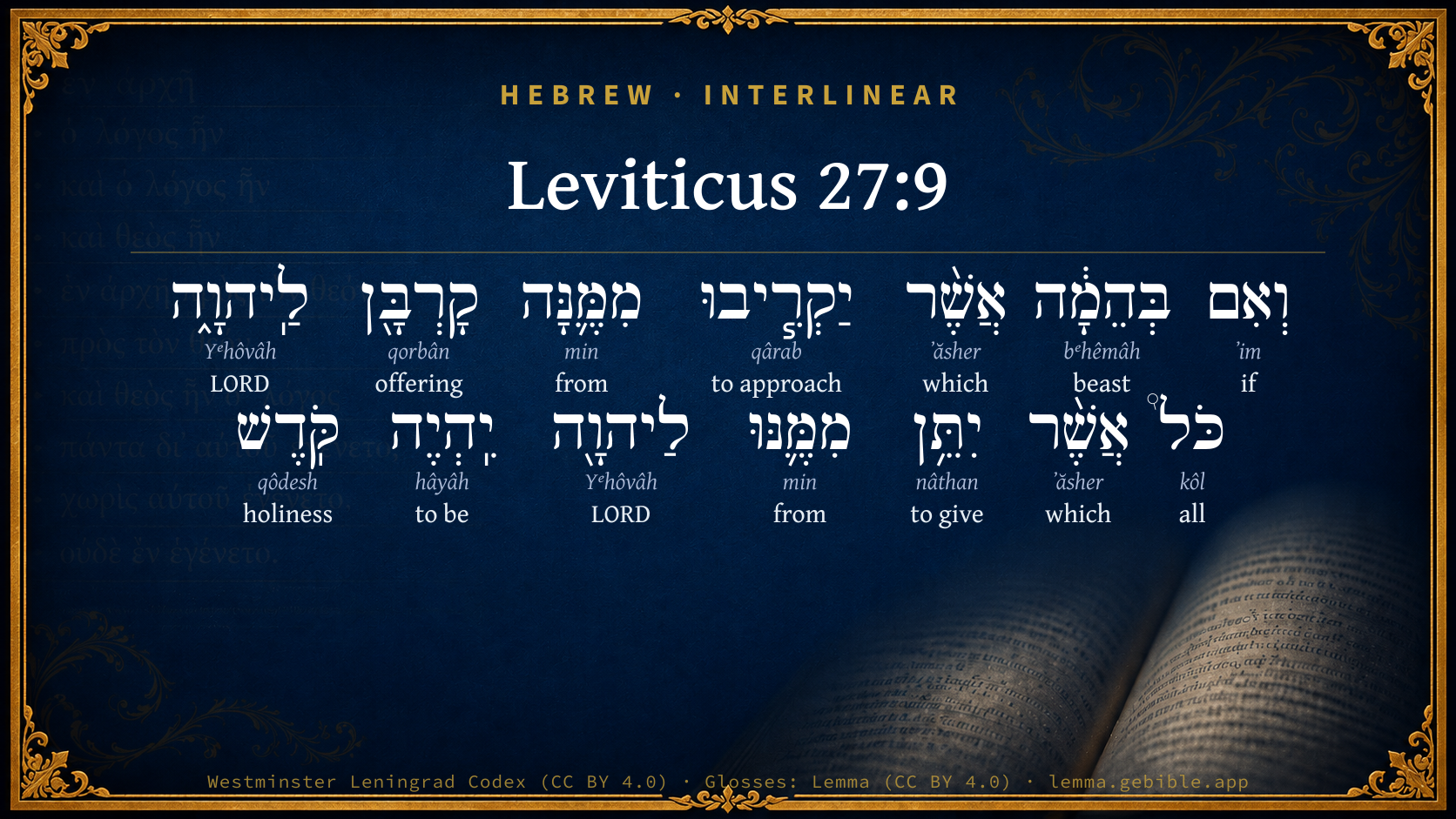
Hebrew (Westminster Leningrad Codex) Leviticus 27:9 appears in the Hebrew Old Testament. The text above is from the Westminster Leningrad Codex. Each word links to its Strong’s number, a concise gloss, and parsing drawn from the Open Scriptures Hebrew Bible morphology. Click any word for its full Brown-Driver-Briggs (BDB) entry.
Download image
Cite this verse

Leviticus 27:9 (World English Bible). Public Domain. Lemma interlinear Bible study tool, https://lemma.gebible.app/v/leviticus/27/9.

Show BibTeX & RIS
BibTeX
RIS
English Translation
"'If it is an animal, of which men offer an offering to Yahweh, all that any man gives of such to Yahweh becomes holy.
World English Bible · Public Domain
Download a study sheet

One document with this verse’s original text, its word-by-word gloss line, the meaning frame, cross-references with their text, attributed commentary, and full source and license credits — printable, and it pastes into notes with its structure intact.

This verse Autodidact and up

Study sheet (.html) Plain text (.txt)

A passage Seminary Student

Up to 50 verses in one chapter. A passage sheet keeps up to 6 commentary sources and 12 cross-references per verse, in the order this page ranks them, and says so on the sheet whenever that leaves anything out. Ask for a single verse and you get the Autodidact verse sheet above.

Everything on this page stays free to read, with no account — the sheet is a download of what is already on screen, not access to it.

Want to remove ads? Support Godless Engineer
Compare translations 3

The same verse in 3 English versions, stacked beneath the original-language interlinear above. Click any original word for its lexicon entry.

Each is an independent rendering of the whole verse — the interlinear is not word-aligned to these translations.

Highlighted words mark where these versions differ — a whole-verse word diff, not a word-by-word alignment.

  • World English Bible Public Domain
    "'If it is an animal, of which men offer an offering to Yahweh, all that any man gives of such to Yahweh becomes holy.
  • King James Version Public Domain
    And if it be a beast, whereof men bring an offering unto the LORD, all that any man giveth of such unto the LORD shall be holy.
  • unfoldingWord Literal Text CC BY-SA 4.0
    And if an animal which they will present from it an offering to Yahweh, all which he will give from it to Yahweh will be holy.

unfoldingWord Literal Text — © unfoldingWord, licensed CC BY-SA 4.0. Word-aligned USFM3 via Door43 (git.door43.org/unfoldingWord/en_ult).

Versions to compare (up to 4)

3 of 4 selected

Show all 18 translations

Every available English version of this verse, each an independent rendering of the whole verse.

  • World English Bible Public Domain
    "'If it is an animal, of which men offer an offering to Yahweh, all that any man gives of such to Yahweh becomes holy.
  • Berean Standard Bible Public Domain
    If he vows an animal that may be brought as an offering to the LORD, any such animal given to the LORD shall be holy.
  • Majority Standard Bible Public Domain
    If he vows an animal that may be brought as an offering to the LORD, any such animal given to the LORD shall be holy.
  • King James Version Public Domain
    And if it be a beast, whereof men bring an offering unto the LORD, all that any man giveth of such unto the LORD shall be holy.
  • American Standard Version (1901) Public Domain
    And if it be a beast, whereof men offer an oblation unto Jehovah, all that any man giveth of such unto Jehovah shall be holy.
  • Revised Version (1885) Public Domain
    And if it be a beast, whereof men offer an oblation unto the LORD, all that any man giveth of such unto the LORD shall be holy.
  • Geneva Bible (1599) Public Domain
    And if it be a beast, whereof men bring an offering vnto the Lord, all that one giueth of such vnto the Lord, shalbe holy.
  • Douay-Rheims (1899) Public Domain
    But a beast that may be sacrificed to the Lord, if ally one shall vow, shall be holy,
  • Young's Literal Translation Public Domain
    `And if `it is' a beast of which they bring near an offering to Jehovah, all that `one' giveth of it to Jehovah is holy;
  • Literal Standard Version CC BY-SA 4.0
    And if [it is] a beast of which they bring near [as] an offering to YHWH, all that [one] gives of it to YHWH is holy;
  • Unlocked Literal Bible CC BY-SA 4.0
    If someone wants to sacrifice an animal to Yahweh, and if Yahweh accepts it, then that animal will be set apart to him.
  • unfoldingWord Literal Text CC BY-SA 4.0
    And if an animal which they will present from it an offering to Yahweh, all which he will give from it to Yahweh will be holy.
  • Darby Bible Public Domain
    And if it be a beast whereof men bring an offering unto Jehovah, all that they give of such unto Jehovah shall be holy.
  • World Messianic Bible Public Domain
    “‘If it is an animal of which men offer an offering to the LORD, all that any man gives of such to the LORD becomes holy.
  • Webster's Bible Public Domain
    And if it shall be a beast of which men bring an offering to the LORD, all that any man giveth of such to the LORD shall be holy.
  • Free Bible Version CC BY-SA 4.0
    If when you fulfill your promise you bring an animal that is permitted as an offering to the Lord, the animal given to the Lord shall be considered holy.
  • Bible in Basic English Public Domain
    And if it is a beast of which men make offerings to the Lord, whatever any man gives of such to the Lord will be holy.
  • JPS Tanakh (1917) Public Domain
    And if it be a beast, whereof men bring an offering unto the LORD, all that any man giveth of such unto the LORD shall be holy.

Literal Standard Version (2020), Covenant Press — licensed CC BY-SA 4.0. Text via the HelloAO Bible API (eBible.org). Unlocked Literal Bible (unfoldingWord) — licensed CC BY-SA 4.0. Text via the HelloAO Bible API (eBible.org). unfoldingWord Literal Text — © unfoldingWord, licensed CC BY-SA 4.0. Word-aligned USFM3 via Door43 (git.door43.org/unfoldingWord/en_ult). Free Bible Version, Dr. Jonathan Gallagher — licensed CC BY-SA 4.0. Text via the HelloAO Bible API (eBible.org).

Word by word

More ways to search: Search by grammar → Find every occurrence → Compare this word →

Practice this passage: Drill this verse → Learn its vocabulary →

קָרְבָּ֖ן
qorbân
H7133
“offering”
Noun, Common, Masculine, Singular, Absolute
Part of Speech
Noun
Type
Common
Gender
Masculine
Number
Singular
State
Absolute
Full BDB Definition

Origin: from H7126

TWOT: 2065e

offering, oblation
  1. וְאִם ʼim H518 “and · if” Conjunction + Conjunction
  2. בְּהֵמָ֔ה bᵉhêmâh H929 “beast” Noun, Common, Feminine, Singular, Absolute
  3. אֲשֶׁ֨ר ʼăsher H834 “which” Particle, Relative
  4. יַקְרִ֧יבוּ qârab H7126 “to approach” Verb, Hiphil, Imperfect, 3rd Person, Masculine, Plural
  5. מִמֶּ֛נָּה min H4480 “from · her” Preposition + Suffix, Personal, 3rd Person, Feminine, Singular
  6. לַֽיהוָ֑ה Yᵉhôvâh H3068 “to/for · LORD” Preposition + Noun, Proper
  7. כֹּל֩ kôl H3605 “all” Noun, Common, Masculine, Singular, Absolute
  8. אֲשֶׁ֨ר ʼăsher H834 “which” Particle, Relative
  9. יִתֵּ֥ן nâthan H5414 “to give” Verb, Qal, Imperfect, 3rd Person, Masculine, Singular
  10. מִמֶּ֛נּוּ min H4480 “from · us” Preposition + Suffix, Personal, 1st Person, Common, Plural
  11. לַיהוָ֖ה Yᵉhôvâh H3068 “to/for · LORD” Preposition + Noun, Proper
  12. יִֽהְיֶה hâyâh H1961 “to be” Verb, Qal, Imperfect, 3rd Person, Masculine, Singular
  13. קֹּֽדֶשׁ qôdesh H6944 “holiness” Noun, Common, Masculine, Singular, Absolute

About this verse

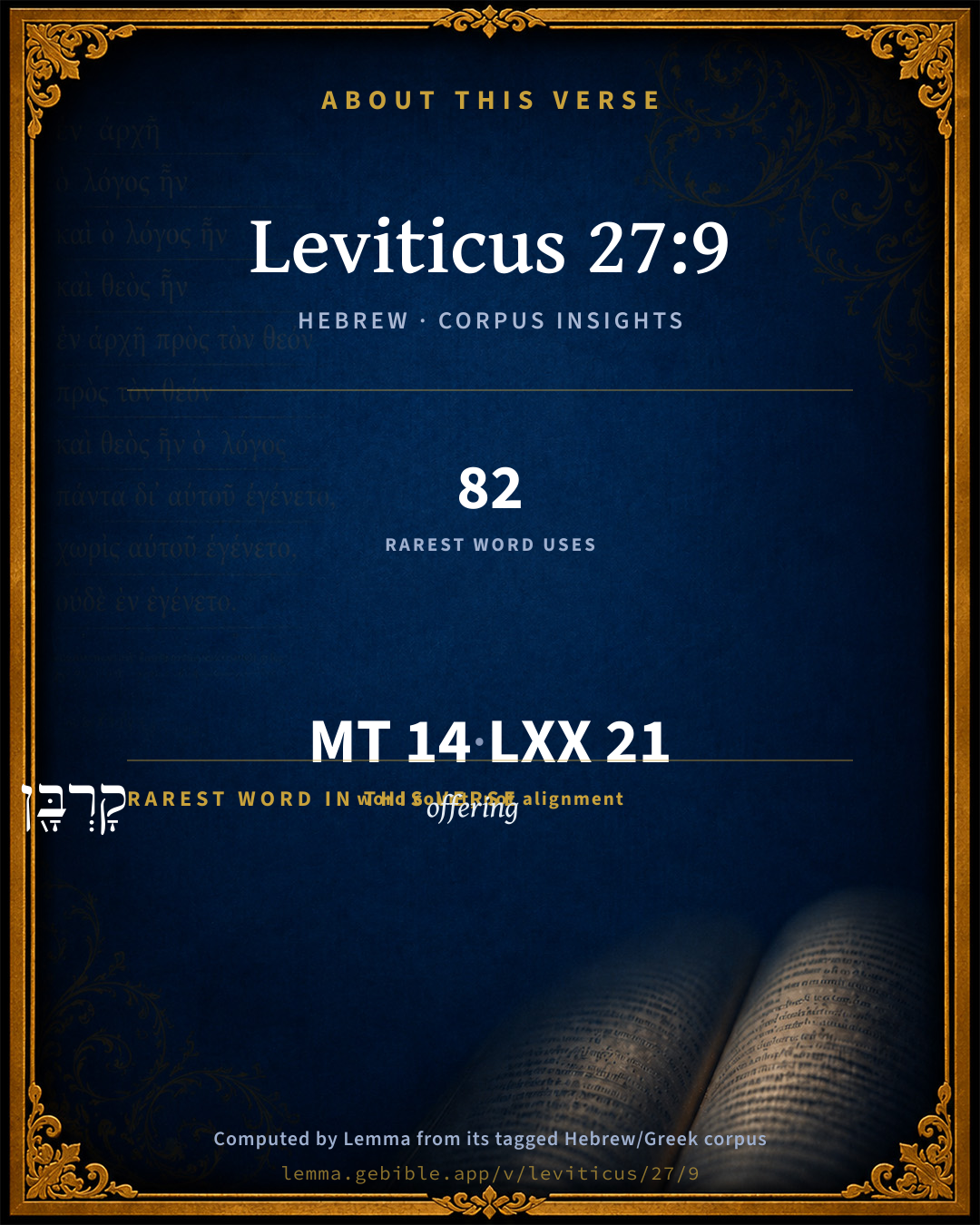
These counts appear in no published source. They are computed here, from the morphology-tagged text and Lemma’s own curated glosses. What Lemma adds →

14
words
11
distinct lemmas
Pentateuch
section

Grammatical profile

  • 3 verbs
  • 6 nouns
  • 2 prepositions
  • 1 conjunction
  • 2 particles

Verb forms

  • יַקְרִ֧יבוּ Hiphil · Imperfect
  • יִתֵּ֥ן Qal · Imperfect
  • יִֽהְיֶה Qal · Imperfect

Repetition

Words recur within this verse — often emphatic in Hebrew:

  • לַֽיהוָ֑ה LORD H3068 ×2
  • אֲשֶׁ֨ר which H834 ×2
  • מִמֶּ֛נָּה from H4480 ×2

Hebrew & Septuagint length

In English translation the verse runs 24 words from the Hebrew and 29 from the Septuagint (LXX English) — closely comparable.

A rough comparison of the two English renderings, which tokenize alike — not a word-level alignment.

Word counts can differ between the Hebrew and the Greek without any difference in meaning — e.g. the Hebrew direct-object marker אֵת has no separate Greek word, and Greek often adds the article ὁ.

In the original languages it is 14 Hebrew tokens and 21 Greek tokens — but the two are counted differently (Hebrew bundles its prefixes and suffixes into one token; the Greek is in lemma form), so that isn’t a like-for-like length.

Hebrew and Greek witnesses Masoretic Hebrew ↔ Greek Septuagint

The same verse in the two great witnesses to the Old Testament, shown verse-for-verse.

These are two independent witnesses, not word-aligned to each other, and the Septuagint is shown in lemma (dictionary) form.

Hebrew Leviticus 27:9 Masoretic · Westminster Leningrad Codex

וְאִם בְּהֵמָ֔ה אֲשֶׁ֨ר יַקְרִ֧יבוּ מִמֶּ֛נָּה קָרְבָּ֖ן לַֽיהוָ֑ה כֹּל֩ אֲשֶׁ֨ר יִתֵּ֥ן מִמֶּ֛נּוּ לַיהוָ֖ה יִֽהְיֶה קֹּֽדֶשׁ

"'If it is an animal, of which men offer an offering to Yahweh, all that any man gives of such to Yahweh becomes holy.

World English Bible · Public Domain

Greek LXX Leviticus 27:9 Septuagint · lemma form

ἐάν δέ ἀπό ὁ κτῆνος ὁ προςφέρω ἀπό αὐτός δῶρον ὁ κύριος ὅς ἄν δίδωμι ἀπό οὗτος ὁ κύριος εἰμί ἅγιος

And if it be from the cattle that are offered as a gift to the Lord, whoever shall offer one of these to the Lord, it shall be holy.

LXX2012 (modern English Septuagint) · Public Domain

Hebrew: Westminster Leningrad Codex (CC BY 4.0). Greek: Septuagint (public domain); English from LXX2012 (modern English Septuagint) (Public Domain). How the Septuagint differs from the Hebrew →

Targum (Aramaic paraphrase)

2

The Targum is the ancient Jewish Aramaic paraphrase of the Hebrew Scriptures — an interpretive translation, not the Hebrew text itself. Onkelos (literal) and Pseudo-Jonathan (expansive) render the Torah, and Jonathan the Prophets. Coverage is partial: where no permissively-licensed English translation exists for a verse, only the Aramaic is shown. This is verse-level text, not a word-by-word alignment to the Hebrew.

  1. Targum Onkelos Torah (Genesis–Deuteronomy)
    וְאִם בְּעִירָא דִי יְקָרְבוּן מִנַהּ קֻרְבָּנָא קֳדָם יְיָ כָּל דִי יִתֵּן מִנֵהּ קֳדָם יְיָ יְהֵי קוּדְשָׁא

    (no public-domain English translation for this verse)

    Targum Onkelos — Aramaic: “Onkelos Genesis” (public domain); “Onkelos Exodus” (public domain); “Onkelos Leviticus” (public domain); “Onkelos Numbers” (public domain); “Onkelos Deuteronomy” (public domain). English: “Sefaria Community Translation” (CC0 1.0 (public-domain dedication)); “J.W. Etheridge. The Targums of Onkelos and Jonathan Ben Uzziel on the Pentateuch. London: Longmans, Green, 1862” (public domain). Text via Sefaria.

  2. Targum Pseudo-Jonathan Torah (Genesis–Deuteronomy)
    וְאִין בְּעִירָא דִיקַרְבוּן מִינָהּ קוּרְבָּנָא קֳדָם יְיָ כָּל דְיִתֵּן מִינֵיהּ קֳדָם יְיָ יְהֵי קוּדְשָׁא

    And if it be an animal, of such as are offered as an oblation before the Lord, whatever he giveth of it before the Lord shall be sacred.

    Targum Pseudo-Jonathan — Aramaic: “Targum Jonathan on Genesis” (public domain); “Targum Jonathan on Exodus” (public domain); “Targum Jonathan on Leviticus” (public domain); “Targum Jonathan on Numbers” (public domain); “Targum Jonathan on Deuteronomy” (public domain). English: “The Targum of Jonathan ben Uzziel, trans. J. W. Etheridge, London, 1862” (public domain). Text via Sefaria.

Commentary

Notes on Leviticus 27:9 from classic Christian and Jewish commentators (each source and its license shown beneath its notes). The classic Christian expositions comment on the surrounding passage and are grouped to its opening verse, so a note may address several verses; the Jewish commentaries on the Tanakh (Rashi and others) are per-verse, so they appear only where the commentator wrote on this verse.

Lemma curates 59 commentaries, every one of them public domain or Creative Commons licensed, each selected and text-cleaned for this edition rather than reprinted as found. About our sources →

Trapp's Complete Commentary

John Trapp

Lev 27:9 And if [it be] a beast, whereof men bring an offering unto the LORD, all that [any man] giveth of such unto the LORD shall be holy.

Ver. 9. Giveth,] i.e., Consecrateth unto God by his vow; and so, giveth him of his own. {1Ch 29:14}

John Trapp, A Commentary or Exposition upon All the Books of the Old and New Testament (1647–1656) — public domain. Text from a community e-Sword module.

Joseph Benson's Commentary

Lev 27:9. If it be a beast — it shall be holy, &c. — A second sort of things vowed to God are beasts. With respect to which the law is, that the very individual beast was to be disposed of by the owner according to the first intention of his vow, whether to be sacrificed upon the altar, or given to the priests, or sold for the use of the sanctuary, the price to be applied to the repairs of the house of God, or to purchase the usual sacrifices. This is what we are to understand by its being holy, as appears from Lev 27:10. The design of this law was to preserve a reverence toward things once consecrated, that they might not return to common uses.

Joseph Benson's Commentary on the Old and New Testaments (1811–1818) — public domain. Text from a community e-Sword module.

Whedon's Commentary on the Bible

Daniel D. Whedon

ANIMALS VOWED, Lev_27:9-13.

9. A beast of the sacrificial kinds, if unblemished, (Lev_22:23,) was not redeemable, but was holy unto the Lord. But if it was not fit for the altar, because of some blemish, it became a perquisite of the priests like the firstborn of cattle, Lev_27:33.

Daniel D. Whedon (gen. ed.), Commentary on the Old and New Testaments (1874–1909) — public domain. Text from a community e-Sword module.

Keil & Delitzsch

C. F. Keil & F. Delitzsch

When animals were vowed, of the cattle that were usually offered in sacrifice, everything that was given to Jehovah of these (i.e., dedicated to Him by vowing) was to be holy and not changed, i.e., exchanged, a good animal for a bad, or a bad one for a good. But if such an exchange should be made, the animal first dedicated and the one substituted were both to be holy (Lev 27:9, Lev 27:10). The expression "it shall be holy" unquestionably implies that an animal of this kind could not be redeemed; but if it was free from faults, it was offered in sacrifice: if, however, it was not fit for sacrifice on account of some blemish, it fell to the portion of the priests for their maintenance like the first-born of cattle (cf. Lev 27:33).

Keil & Delitzsch — Biblical Commentary on the Old Testament (1861–1891) — public domain (CC PDM 1.0). Text via the HelloAO Bible API. (Old Testament only.)

The Expositor's Bible

OF THE VOWING OF DOMESTIC ANIMALS

Lev_27:9-13

"And if it be a beast, whereof men offer an oblation unto the Lord, all that any man giveth of such unto the Lord shall be holy. He shall not alter it, nor change it, a good for a bad, or a bad for a good: and if he shall at all change beast for beast, then both it and that for which it is changed shall be holy. And if it be any unclean beast of which they do not offer an oblation unto the Lord, then lie shall set the beast before the priest: and the priest shall value it, whether it be good or bad: as thou the priest valuest it, so shall it be. But if he will indeed redeem it, then he shall add the fifth part thereof unto thy estimation."

This next section concerns the vowing to the Lord of domestic animals (Lev_27:9-13). If the animal thus dedicated to the Lord were such as could be used in sacrifice, then the animal itself was taken for the sanctuary, service, and the vow was unalterable and irrevocable. If, however, the animal vowed was "any unclean beast," then the priest (Lev_27:12) was to set a price upon it, according to its value; for which, we may infer, it was to be sold and the proceeds devoted to the sanctuary.

In this case, the person who had vowed the animal was allowed to redeem it to himself again (Lev_27:13) by payment of this estimated price and one-fifth additional, a provision which was evidently intended to be of the nature of a fine, and to be a check upon the making of rash vows.

William Robertson Nicoll, ed., The Expositor's Bible (London: Hodder & Stoughton, 1887–1910) — public domain. 65 of 66 books (1 Corinthians is not separately keyed, as that volume carries no machine-parseable verse references); section-level commentary keyed to the opening verse. Introductory and overview sections not keyed to a specific passage are excluded.

Tyndale Open Study Notes

Tyndale Open Resources

27:9-10 Once an acceptable animal had been vowed and the priest at the sanctuary had accepted it on God’s behalf, the animal became holy and belonged to God.

Tyndale Open Study Notes — © Tyndale Open Resources, licensed CC BY-SA 4.0. Text via the HelloAO Bible API.

Geneva Bible (1599)

Geneva Bible translators

Which is clean, Lev. 11:2.

Geneva Bible (1599) marginal notes — public domain. Text via Bolls.life.

Jamieson, Fausset & Brown

Robert Jamieson, A. R. Fausset & David Brown

if it be a beast, whereof men bring an offering unto the Lord--a clean beast. After it had been vowed, it could neither be employed in common purposes nor exchanged for an equivalent--it must be sacrificed--or if, through some discovered blemish, it was unsuitable for the altar, it might be sold, and the money applied for the sacred service. If an unclean beast--such as an ass or camel, for instance, had been vowed, it was to be appropriated to the use of the priest at the estimated value, or it might be redeemed by the person vowing on payment of that value, and the additional fine of a fifth more.

Jamieson, Fausset & Brown — Commentary Critical and Explanatory on the Whole Bible (1871) — public domain (CC PDM 1.0). Text via the HelloAO Bible API.

Ellicott's Commentary for English Readers

(9) And if it be a beast, whereof men bring an offering.—That is, if what a man vows consists of sacrificial quadrupeds, viz., bullocks, sheep, or goats.

Shall be holy.—That is, must not be redeemed at all. They were delivered to the sanctuary: they were sold by the priests to those Israelites who required them as sacrifices for the altar, and the money expended in the maintenance of the service.

A Bible Commentary for English Readers, edited by Charles John Ellicott (1878–1897) — public domain. Text from a community e-Sword module.

The Cambridge Bible for Schools and Colleges

gen. ed. J. J. S. Perowne

9–13. The case of cattle

Such an animal, when presented as a vow, must not be changed, a bad for a good. Otherwise both animals became dedicated. If the animal so presented was ‘unclean,’ and as such could not lawfully be offered to God, the priest was to set upon it a value in proportion to its worth, whereupon the owner might sell it for that sum and pay over the amount. If, however, he desired to have it back, he must pay in addition one-fifth of the price which the priest had adjudged.

The Cambridge Bible for Schools and Colleges (gen. ed. J. J. S. Perowne; Cambridge University Press, 1878–1918) — public domain. Text from a community e-Sword module.

John Gill's Exposition

He shall not alter it nor change it,.... Some think these two words signify the same, but Abarbinel (s) makes them different; according to him, to "alter" is for one of another kind, as one of the herd for one of the flock, or the contrary; and to "change" for one of the same kind:

a good for a bad, or a bad for a good; or, as the Targum of Jonathan,"that which is perfect for that which has a blemish in it, or what has a blemish in it for that which is perfect;''a change might not be made neither for the better nor for the worse, but the creature devoted was to be taken as it was; if not fit for sacrifice it was to be sold, and its price put to other uses; for, as Abarbinel (t) observes, whatsoever was devoted to sacred use was never to be put to any profane one; and this was also to teach men not to be hasty and fickle in such things, but to consider well what they did, and abide by it; for if such alterations and changes could be admitted of, a man after he had vowed might through covetousness repent, and bring a bad one instead of a good one, or, under pretence of bringing a good one instead of a bad one, might bring a bad one and say it was good, as Bechai (u) observes; even one worse than he had brought, thinking to impose upon the ignorance of the priest; and indeed if he was sincere in it, and had a mind to bring a better than what he had vowed, it was not allowed of; if he made any change, though it was for the better, he was to be beaten, as Maimonides (w) affirms:

and if he shall at all change beast for beast; whether of the same or of a different kind, or whether for better or worse:

then it and the exchange thereof shall be holy: both of them were to be the Lord's, and appropriated to sacred use, of one sort or another, either for sacrifice or for the priests family, or the price of it for the repairs of the sanctuary.

(s) Apud Muis. in loc. (t) Ibid. (u) Apud Muis. ib. (w) Hilchot Temurah, c. 1. sect. 1.

John Gill's Exposition of the Whole Bible (1746–1763) — public domain (CC PDM 1.0). Text via the HelloAO Bible API.

Matthew Poole's English Annotations

Whereof men bring, to wit, usually and according to God’s appointment. Giveth, i.e. voweth to give.

Shall be holy, i.e. consecrated to God, either to be sacrificed, or to be given to the priest according to the manner of the vow, and the intention of him that voweth.

Matthew Poole's English Annotations on the Holy Bible (1683–1685) — public domain. Text from a community e-Sword/MySword module.

The Pulpit Commentary

Vers. 9, 10. In case a clean animal is vowed to the Lord, it is not to be exchanged for another on the plea of not being good enough or being too good for sacrifice. If any such attempt is made, both animals are to be given up and sacrificed, or, if blemished, added to the herd of the sanctuary.

The Pulpit Commentary (1880–1919), ed. H.D.M. Spence-Jones & Joseph S. Exell — public domain. Text from a community e-Sword module.

John Wesley's Explanatory Notes

Whereof men bring an offering - That is, a clean beast. Giveth - Voweth to give: Shall be holy - Consecrated to God, either to be sacrificed, or to be given to the priest, according to the manner of the vow, and the intention of him that voweth.

John Wesley, Explanatory Notes Upon the Whole Bible (1754–1765) — public domain. Text via the GEBible commentary corpus.

unfoldingWord translationNotes

Door43 World Missions Community

General Information:

Yahweh continues telling Moses what the people must do.

set apart to him

"set apart to Yahweh"

both it and the one for which it is exchanged

This can be stated in active form. AT: "both it and the one he exchanges it for" or the animals can be referred to simply as "both animals" (See: Active or Passive)

translationWords

sacrifice

set apart

holy

unfoldingWord translationNotes — © Distant Shores Media and the Door43 World Missions Community, licensed CC BY-SA 4.0. Source: git.door43.org/Door43/en_tn.

Rashi

Rabbi Shlomo Yitzchaki (Rashi)

כל אשר יתן ממנו EVERYTHING THAT A MAN GIVE implies even the case when he said, “the foot of this animal shall be a burnt offering” his words have binding force). It (the animal) is therefore sold for the purpose of a burnt-offering to one who has to bring such an offering and the monies realized by its sale are חולין (non-holy) and are returned to the owner with the exception of the value of that limb (Sifra, Bechukotai, Chapter 9 1; Arakhin 5a; Temurah 11b; Chullin 69b).

Rashi on the Tanakh — English translations: “The Judaica Press complete Tanach with Rashi, translated by A. J. Rosenberg” (CC BY 4.0); “Pentateuch with Rashi's commentary by M. Rosenbaum and A.M. Silbermann, 1929-1934” (public domain); “The Metsudah Tanach series, Lakewood, N.J” (CC BY 4.0); and “The Book of Joshua, Metsudah Publications, 1997” (CC BY 4.0). Text via Sefaria.

Lesson kit

Teaching starters — assembled from the data on this page, not authored interpretation. Every prompt links to the verse data it draws on. Edit before teaching.

Leviticus, in the Pentateuch, opens this verse with 14 words (11 distinct Hebrew lemmas). Its most distinctive word is qorbân (“offering”). A historical commentator’s framing appears above. Read the whole chapter for the surrounding context.

Discussion questions

  1. The word qorbân carries the sense “offering.” How does it shape the verse?
  2. “LORD” occurs 2× in this one verse. What is the effect of the repetition?
  3. The translations on this page render this verse differently — a whole-verse word diff, not a word-by-word alignment. What might account for the different wordings?
  4. The verb «יַקְרִ֧יבוּ» is Hiphil Imperfect. How does its form color the action?
  5. Reading how Trapp's Complete Commentary and Joseph Benson's Commentary read this verse, where do the two commentators agree and where do they part?

Things to notice

Reading settings

Reading text

Shown beneath each verse's original-language words.

Old Testament
Old Testament edition

Read the OT as the Masoretic Hebrew (MT) or the Greek Septuagint (LXX).

English shown for the Greek Septuagint (in the Hebrew ↔ Greek comparison).

Comparing translations? Open the Compare panel on any verse page to stack up to four side by side.