Numbers 28:7

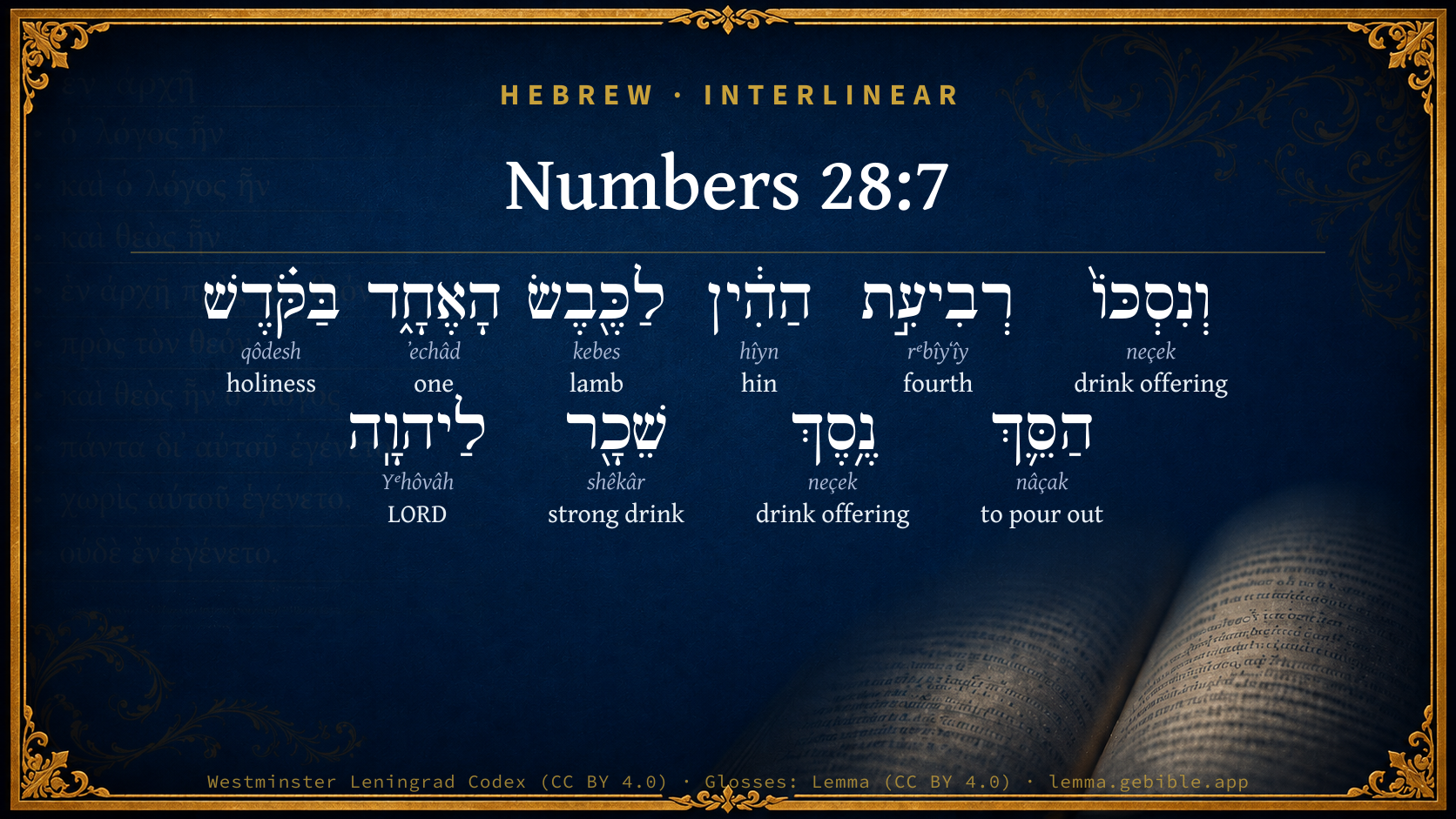
Hebrew (Westminster Leningrad Codex) Numbers 28:7 appears in the Hebrew Old Testament. The text above is from the Westminster Leningrad Codex. Each word links to its Strong’s number, a concise gloss, and parsing drawn from the Open Scriptures Hebrew Bible morphology. Click any word for its full Brown-Driver-Briggs (BDB) entry.
Download image
Cite this verse

Numbers 28:7 (World English Bible). Public Domain. Lemma interlinear Bible study tool, https://lemma.gebible.app/v/numbers/28/7.

Show BibTeX & RIS
BibTeX
RIS
English Translation
The drink-offering of it shall be the fourth part of a hin for the one lamb: in the holy place shall you pour out a drink-offering of strong drink to Yahweh.
World English Bible · Public Domain
Download a study sheet

One document with this verse’s original text, its word-by-word gloss line, the meaning frame, cross-references with their text, attributed commentary, and full source and license credits — printable, and it pastes into notes with its structure intact.

This verse Autodidact and up

Study sheet (.html) Plain text (.txt)

A passage Seminary Student

Up to 50 verses in one chapter. A passage sheet keeps up to 6 commentary sources and 12 cross-references per verse, in the order this page ranks them, and says so on the sheet whenever that leaves anything out. Ask for a single verse and you get the Autodidact verse sheet above.

Everything on this page stays free to read, with no account — the sheet is a download of what is already on screen, not access to it.

Want to remove ads? Support Godless Engineer
Compare translations 3

The same verse in 3 English versions, stacked beneath the original-language interlinear above. Click any original word for its lexicon entry.

Each is an independent rendering of the whole verse — the interlinear is not word-aligned to these translations.

Highlighted words mark where these versions differ — a whole-verse word diff, not a word-by-word alignment.

  • World English Bible Public Domain
    The drink-offering of it shall be the fourth part of a hin for the one lamb: in the holy place shall you pour out a drink-offering of strong drink to Yahweh.
  • King James Version Public Domain
    And the drink offering thereof shall be the fourth part of an hin for the one lamb: in the holy place shalt thou cause the strong wine to be poured unto the LORD for a drink offering.
  • unfoldingWord Literal Text CC BY-SA 4.0
    And its drink offering shall be the fourth of a hin for one male lamb. You shall pour out in the holy place a drink offering of intoxicating drink to Yahweh.

unfoldingWord Literal Text — © unfoldingWord, licensed CC BY-SA 4.0. Word-aligned USFM3 via Door43 (git.door43.org/unfoldingWord/en_ult).

Versions to compare (up to 4)

3 of 4 selected

Show all 18 translations

Every available English version of this verse, each an independent rendering of the whole verse.

  • World English Bible Public Domain
    The drink-offering of it shall be the fourth part of a hin for the one lamb: in the holy place shall you pour out a drink-offering of strong drink to Yahweh.
  • Berean Standard Bible Public Domain
    The drink offering accompanying each lamb shall be a quarter hin. Pour out the offering of fermented drink to the LORD in the sanctuary area.
  • Majority Standard Bible Public Domain
    The drink offering accompanying each lamb shall be a quarter hin. Pour out the offering of fermented drink to the LORD in the sanctuary area.
  • King James Version Public Domain
    And the drink offering thereof shall be the fourth part of an hin for the one lamb: in the holy place shalt thou cause the strong wine to be poured unto the LORD for a drink offering.
  • American Standard Version (1901) Public Domain
    And the drink-offering thereof shall be the fourth part of a hin for the one lamb: in the holy place shalt thou pour out a drink-offering of strong drink unto Jehovah.
  • Revised Version (1885) Public Domain
    And the drink offering thereof shall be the fourth part of an hin for the one lamb: in the holy place shalt thou pour out a drink offering of strong drink unto the LORD.
  • Geneva Bible (1599) Public Domain
    And the drinke offring thereof the fourth part of an Hin for one lambe: in the holy place cause to powre the drinke offring vnto the Lord.
  • Douay-Rheims (1899) Public Domain
    And for a libation you shall offer of wine the fourth part of a hin for every lamb in the sanctuary of the Lord.
  • Young's Literal Translation Public Domain
    and its libation, a fourth of the hin for the one lamb; in the sanctuary cause thou a libation of strong drink to be poured out to Jehovah.
  • Literal Standard Version CC BY-SA 4.0
    And its drink-offering [is] a fourth of the hin for one lamb; pour out a drink-offering of strong drink to YHWH in the holy place.
  • Unlocked Literal Bible CC BY-SA 4.0
    The drink offering with it must be one-fourth of a hin for one of the lambs. You must pour out in the holy place a drink offering of strong drink to Yahweh.
  • unfoldingWord Literal Text CC BY-SA 4.0
    And its drink offering shall be the fourth of a hin for one male lamb. You shall pour out in the holy place a drink offering of intoxicating drink to Yahweh.
  • Darby Bible Public Domain
    And the drink-offering thereof shall be a fourth part of a hin for one lamb; in the sanctuary shall the drink-offering of strong drink be poured out to Jehovah.
  • World Messianic Bible Public Domain
    Its drink offering shall be the fourth part of a hin for each lamb. You shall pour out a drink offering of strong drink to the LORD in the holy place.
  • Webster's Bible Public Domain
    And the drink-offering of it shall be the fourth part of a hin for the one lamb: in the holy place shalt thou cause the strong wine to be poured to the LORD for a drink-offering.
  • Free Bible Version CC BY-SA 4.0
    The drink offering that accompanies each lamb is to be a quarter of a hin. Pour out the offering of fermented drink to the Lord in the sanctuary.
  • Bible in Basic English Public Domain
    And for its drink offering take the fourth part of a hin for one lamb: in the holy place let the wine be drained out for a drink offering for the Lord.
  • JPS Tanakh (1917) Public Domain
    And the drink-offering thereof shall be the fourth part of a hin for the one lamb; in the holy place shalt thou pour out a drink-offering of strong drink unto the LORD.

Literal Standard Version (2020), Covenant Press — licensed CC BY-SA 4.0. Text via the HelloAO Bible API (eBible.org). Unlocked Literal Bible (unfoldingWord) — licensed CC BY-SA 4.0. Text via the HelloAO Bible API (eBible.org). unfoldingWord Literal Text — © unfoldingWord, licensed CC BY-SA 4.0. Word-aligned USFM3 via Door43 (git.door43.org/unfoldingWord/en_ult). Free Bible Version, Dr. Jonathan Gallagher — licensed CC BY-SA 4.0. Text via the HelloAO Bible API (eBible.org).

Word by word

More ways to search: Search by grammar → Find every occurrence → Compare this word →

Practice this passage: Drill this verse → Learn its vocabulary →

הַהִ֔ין
hîyn
H1969
“the · hin”
Particle, Definite Article + Noun, Common, Masculine, Singular, Absolute
Part of Speech
Particle + Noun
Type
Common
Gender
Masculine
Number
Singular
State
Absolute
Full BDB Definition

Origin: probably of Egyptian origin

TWOT: 494

hin - a unit of measure, about 5 quarts (6 liters) - a vessel holding a hin of liquid
  1. וְנִסְכּוֹ֙ neçek H5262 “and · drink offering · his” Conjunction + Noun, Common, Masculine, Singular, Construct + Suffix, Personal, 3rd Person, Masculine, Singular
  2. רְבִיעִ֣ת rᵉbîyʻîy H7243 “fourth” Adjective, Ordinal number, Feminine, Singular, Construct
  3. לַכֶּ֖בֶשׂ kebes H3532 “to/for the · lamb” Preposition, Determined + Noun, Common, Masculine, Singular, Absolute
  4. הָאֶחָ֑ד ʼechâd H259 “the · one” Particle, Definite Article + Adjective, Cardinal number, Masculine, Singular, Absolute
  5. בַּקֹּ֗דֶשׁ qôdesh H6944 “in/at the · holiness” Preposition, Determined + Noun, Common, Masculine, Singular, Absolute
  6. הַסֵּ֛ךְ nâçak H5258 “to pour out” Verb, Hiphil, Infinitive Absolute
  7. נֶ֥סֶךְ neçek H5262 “drink offering of” Noun, Common, Masculine, Singular, Construct
  8. שֵׁכָ֖ר shêkâr H7941 “strong drink” Noun, Common, Masculine, Singular, Absolute
  9. לַיהוָֽה Yᵉhôvâh H3068 “to/for · LORD” Preposition + Noun, Proper

About this verse

These counts appear in no published source. They are computed here, from the morphology-tagged text and Lemma’s own curated glosses. What Lemma adds →

10
words
9
distinct lemmas
Pentateuch
section

Notable vocabulary

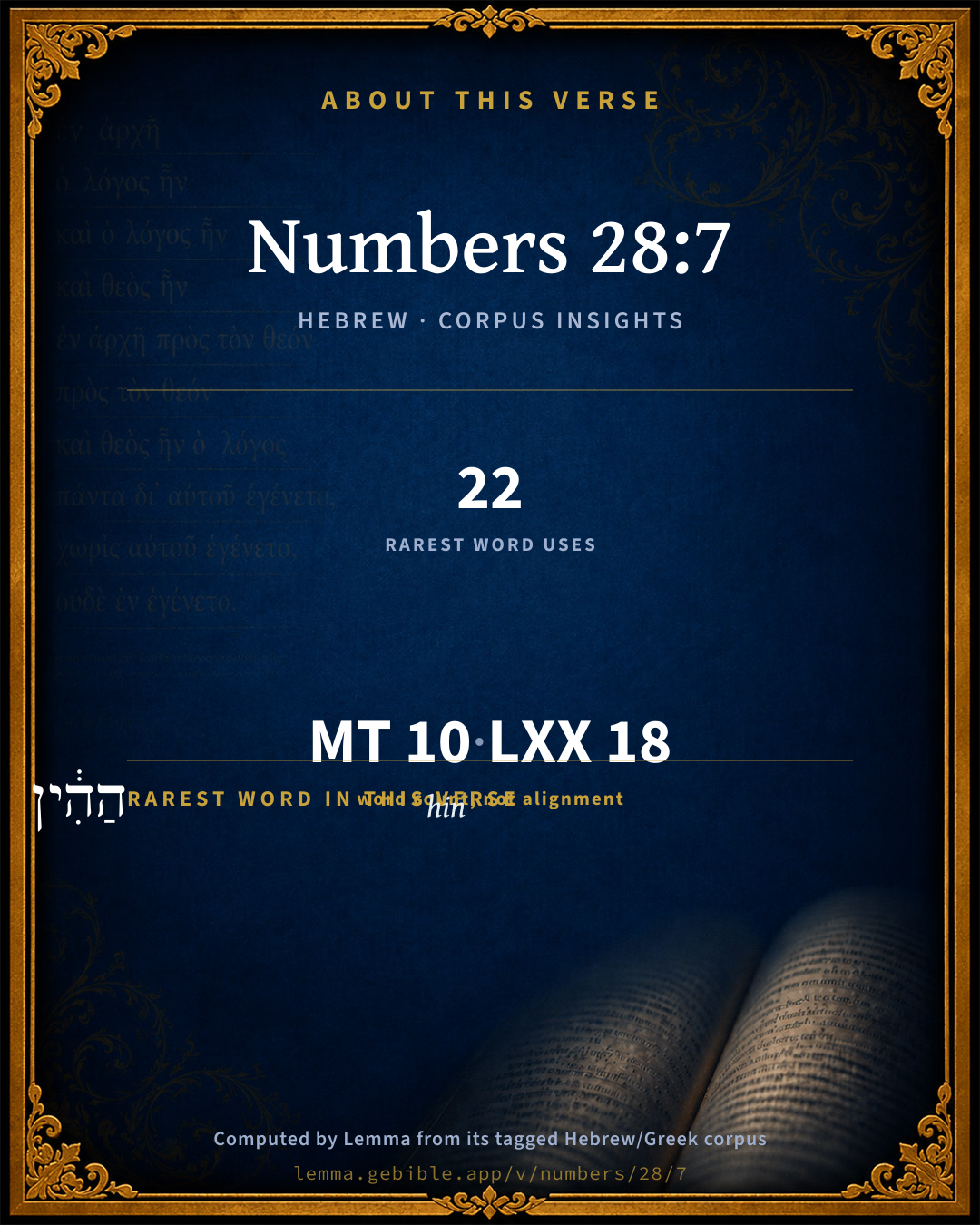
The rarest word here is הַהִ֔ין hin H1969 — appearing just 22 times in the whole Hebrew Bible.

Shared distinctive vocabulary

הַהִ֔ין hin H1969 occurs in 19 verses of the Hebrew Bible. Also found in:

Grammatical profile

  • 1 verb
  • 7 nouns
  • 2 adjectives

Verb forms

  • הַסֵּ֛ךְ Hiphil · Infinitive Absolute

Repetition

A word recurs within this verse — often emphatic in Hebrew:

  • וְנִסְכּוֹ֙ drink offering H5262 ×2

Hebrew & Septuagint length

In English translation the verse runs 31 words from the Hebrew and 27 from the Septuagint (LXX English) — closely comparable.

A rough comparison of the two English renderings, which tokenize alike — not a word-level alignment.

Word counts can differ between the Hebrew and the Greek without any difference in meaning — e.g. the Hebrew direct-object marker אֵת has no separate Greek word, and Greek often adds the article ὁ.

In the original languages it is 10 Hebrew tokens and 18 Greek tokens — but the two are counted differently (Hebrew bundles its prefixes and suffixes into one token; the Greek is in lemma form), so that isn’t a like-for-like length.

Cross-references

14

Topical passages linked to Numbers 28:7 in the Treasury of Scripture Knowledge — connected by theme and wording, ordered by reader-vote popularity; previews shown in the World English Bible.

  • Exodus 29:42 It shall be a continual burnt offering throughout your generations at the door of the tent of meeting before Yahweh, where I will meet with you, to speak there to you.
  • Exodus 29:40 and with the one lamb a tenth part of an ephah of fine flour mixed with the fourth part of a hin of beaten oil, and the fourth part of a hin of wine for a drink-offering.
  • Exodus 30:9 You shall offer no strange incense on it, nor burnt offering, nor meal-offering; and you shall pour no drink-offering on it.
  • Leviticus 23:13 The meal offering with it shall be two tenth parts of an ephah of fine flour mingled with oil, an offering made by fire to Yahweh for a sweet savor; and the drink offering with it shall be of wine, the fourth part of a hin.
  • Numbers 15:5 and wine for the drink-offering, the fourth part of a hin, shall you prepare with the burnt offering, or for the sacrifice, for each lamb.
  • Numbers 15:7 and for the drink-offering you shall offer the third part of a hin of wine, of a sweet savor to Yahweh.
  • Numbers 15:10 and you shall offer for the drink-offering half a hin of wine, for an offering made by fire, of a sweet savor to Yahweh.
  • Numbers 28:14 Their drink-offerings shall be half a hin of wine for a bull, and the third part of a hin for the ram, and the fourth part of a hin for a lamb: this is the burnt offering of every month throughout the months of the year.
  • Numbers 28:31 Besides the continual burnt offering, and the meal-offering of it, you shall offer them (they shall be to you without blemish), and their drink-offerings.
  • Isaiah 57:6 Among the smooth [stones] of the valley is your portion; they, they are your lot; even to them have you poured a drink-offering, you have offered an offering. Shall I be appeased for these things?
  • Joel 1:9 The meal offering and the drink offering are cut off from Yahweh's house. The priests, Yahweh's ministers, mourn.
  • Joel 1:13 Put on sackcloth and mourn, you priests! Wail, you ministers of the altar. Come, lie all night in sackcloth, you ministers of my God, For the meal offering and the drink offering are withheld from your God's house.
  • Joel 2:14 Who knows? He may turn and relent, And leave a blessing behind him, Even a meal offering and a drink offering to Yahweh, your God.
  • Philippians 2:17 Yes, and if I am poured out on the sacrifice and service of your faith, I rejoice, and rejoice with you all.

Cross-references courtesy of OpenBible.info (CC BY 4.0).

Hebrew and Greek witnesses Masoretic Hebrew ↔ Greek Septuagint

The same verse in the two great witnesses to the Old Testament, shown verse-for-verse.

These are two independent witnesses, not word-aligned to each other, and the Septuagint is shown in lemma (dictionary) form.

Hebrew Numbers 28:7 Masoretic · Westminster Leningrad Codex

וְנִסְכּוֹ֙ רְבִיעִ֣ת הַהִ֔ין לַכֶּ֖בֶשׂ הָאֶחָ֑ד בַּקֹּ֗דֶשׁ הַסֵּ֛ךְ נֶ֥סֶךְ שֵׁכָ֖ר לַיהוָֽה

The drink-offering of it shall be the fourth part of a hin for the one lamb: in the holy place shall you pour out a drink-offering of strong drink to Yahweh.

World English Bible · Public Domain

Greek LXX Numbers 28:7 Septuagint · lemma form

καί σπονδή αὐτός ὁ τέταρτος ὁ ιν ὁ ἀμνός ὁ εἷς ἐν ὁ ἅγιος σπένδω σπονδή σίκερα κύριος

And its drink-offering, the fourth part of a hin to each lamb; in the holy place shall you pour strong drink as a drink-offering to the Lord.

LXX2012 (modern English Septuagint) · Public Domain

On this verse, The Pulpit Commentary discusses the Septuagint’s reading. Read the note in Commentary ↓

Hebrew: Westminster Leningrad Codex (CC BY 4.0). Greek: Septuagint (public domain); English from LXX2012 (modern English Septuagint) (Public Domain). How the Septuagint differs from the Hebrew →

Targum (Aramaic paraphrase)

2

The Targum is the ancient Jewish Aramaic paraphrase of the Hebrew Scriptures — an interpretive translation, not the Hebrew text itself. Onkelos (literal) and Pseudo-Jonathan (expansive) render the Torah, and Jonathan the Prophets. Coverage is partial: where no permissively-licensed English translation exists for a verse, only the Aramaic is shown. This is verse-level text, not a word-by-word alignment to the Hebrew.

  1. Targum Onkelos Torah (Genesis–Deuteronomy)
    וְנִסְכֵּיהּ רַבְעוּת הִינָא לְאִמְרָא חָד בְּקוּדְשָׁא יִתְנַסַךְ נִסוּךְ דַחֲמַר עַתִּיק קֳדָם יְיָ

    (no public-domain English translation for this verse)

    Targum Onkelos — Aramaic: “Onkelos Genesis” (public domain); “Onkelos Exodus” (public domain); “Onkelos Leviticus” (public domain); “Onkelos Numbers” (public domain); “Onkelos Deuteronomy” (public domain). English: “Sefaria Community Translation” (CC0 1.0 (public-domain dedication)); “J.W. Etheridge. The Targums of Onkelos and Jonathan Ben Uzziel on the Pentateuch. London: Longmans, Green, 1862” (public domain). Text via Sefaria.

  2. Targum Pseudo-Jonathan Torah (Genesis–Deuteronomy)
    וְנִסוּכֵיהּ רַבְעוּת הִינָא לְאִימַר חַד בְּמָאנֵי בֵּית קוּדְשָׁא יִתְנְסַךְ נִיסוּךְ חֲמַר עַתִּיק וְאִין לָא מַשְׁכַּח חֲמַר עַתִּיק מַיְיתֵי חֲמַר בַּר אַרְבְּעִין יוֹמִין לִמְנַסְכָא קֳדָם יְיָ

    And its libation shall be the fourth of a hin for one lamb; from the vessels of the house of the sanctuary shall it be outpoured, a libation of old wine. But if old wine may not be found, bring wine of forty days to pour out before the Lord.

    Targum Pseudo-Jonathan — Aramaic: “Targum Jonathan on Genesis” (public domain); “Targum Jonathan on Exodus” (public domain); “Targum Jonathan on Leviticus” (public domain); “Targum Jonathan on Numbers” (public domain); “Targum Jonathan on Deuteronomy” (public domain). English: “The Targum of Jonathan ben Uzziel, trans. J. W. Etheridge, London, 1862” (public domain). Text via Sefaria.

Commentary

Notes on Numbers 28:7 from classic Christian and Jewish commentators (each source and its license shown beneath its notes). The classic Christian expositions comment on the surrounding passage and are grouped to its opening verse, so a note may address several verses; the Jewish commentaries on the Tanakh (Rashi and others) are per-verse, so they appear only where the commentator wrote on this verse.

Lemma curates 59 commentaries, every one of them public domain or Creative Commons licensed, each selected and text-cleaned for this edition rather than reprinted as found. About our sources →

Joseph Benson's Commentary

Num 28:7. In the holy place — Upon the altar of burnt-offerings, which was in the court of the priests, nigh to the entrance into the sanctuary, (Exo 29:42,) and was, with respect to those places of the camp, which were more remote from the tabernacle, the holy place. Strong wine to be poured unto the Lord — The original word signifies any strong drink: it was not necessary it should be wine of grapes; it might be made of dates, or other fruits. But it behooved that it should be the best of the kind; it being but reasonable that the best should be offered to God.

Joseph Benson's Commentary on the Old and New Testaments (1811–1818) — public domain. Text from a community e-Sword module.

Adam Clarke's Commentary

Verse 7. Strong wine] Sikera; See Clarke on Le 10:9, where this is largely explained.

Adam Clarke's Commentary on the Bible (1810–1826) — public domain. Text from a community e-Sword/MySword module.

Ellicott's Commentary for English Readers

(7) Shalt thou cause the strong wine to be poured . . . —Better, pour out the drink offering of strong drink. The word shecar, which is here rendered “strong wine,” denotes any kind of intoxicating drink, whether made from grapes, honey, or grain; but it is more frequently used to denote a drink which is not made from grapes, as, e.g., in Lev_10:9, where the command is given to Aaron and his sons not to drink “wine nor strong drink” (shecar) when they went into the tent of meeting. In the parallel passage in Exodus, the drink offering was to consist of “the fourth part of an hin of wine” (Num_29:40). (Comp. Num_15:5.) In Exo_30:9 it is forbidden to pour any drink offering upon the altar of incense, from which passage it has been inferred that the drink offerings were poured upon the altar of burnt sacrifice.

A Bible Commentary for English Readers, edited by Charles John Ellicott (1878–1897) — public domain. Text from a community e-Sword module.

John Gill's Exposition

And the drink offering thereof shall be the fourth part of an hin for the one lamb,.... For the lamb offered in the morning, along with the meat offering of which went a drink offering, which was of wine, and strong wine too, as the next clause expresses it; the quantity of which was the fourth part of an hin, which was about a quart and half a pint of our measure:

in the holy place shalt thou cause the strong wine to be poured unto the Lord for a drink offering; that is, in the court of the tabernacle upon the altar of burnt offering, which stood there: the Targums of Jonathan and Jerusalem interpret it of old choice wine, old wine being reckoned best, see Luk 5:39, and though this wine was poured out on the altar, and not properly drank by any, yet it was to be the strongest, best, and choicest that could be got, as it was reasonable it should; since it was poured out as a libation or drink offering to the Lord, which was his way of drinking it, as the burning of the sacrifice was his way of eating that; all which was typical of the sufferings, sacrifice, and bloodshed of Christ, which are well pleasing and acceptable to the Lord; see Isa 53:10.

John Gill's Exposition of the Whole Bible (1746–1763) — public domain (CC PDM 1.0). Text via the HelloAO Bible API.

Albert Barnes' Notes on the Bible

The original of the word “strong wine” שׁכר shêkār is a term usually employed to describe strong drink other than wine (Lev 10:9 note). The Israelites in the wilderness had, in their lack of wine, substituted shechar made from barley for it. They had thus observed the spirit, though not the letter of the ordinance. The drink-offering was either poured round the foot of the altar; or on the altar, and so upon the flesh of the sacrifice by which the altar was covered (compare Exo 30:9).

Albert Barnes' Notes on the Bible (1834–1885) — public domain. Text from a community e-Sword/MySword module.

Haydock's Catholic Bible Commentary

In the. Hebrew, "in the holy thou shalt cause the shecar to be poured out unto the Lord, a drink-offering." See chap. iv. 8, on the meaning of shecar. (Haydock) --- Some believe, that artificial wine of palm-trees, &c., might serve for libations. In this sacrifice, the priests furnished the liquor; so that all was to be poured out on the altar of holocausts, which stood in the court. (Calmet)

George Leo Haydock (1774–1849), Haydock's Catholic Family Bible and Commentary, 1859 edition — public domain. Excludes Psalms (Douay-Rheims chapter numbering differs from Protestant) and Deuterocanonical books (Catholic canon only).

Matthew Poole's English Annotations

In the holy place, i.e. upon the altar of burnt-offerings, which was in the court of the priests nigh to the entrance into the sanctuary. See Exo 29:42; 2Ch 29:7.

Strong wine, Heb. shecar, which though it signify in the general all kinds of strong drink, yet is here put for the most famous of that kind, to wit, for wine, which alone was used in offerings, as appears below, Num 28:14; Exo 29:40.

Matthew Poole's English Annotations on the Holy Bible (1683–1685) — public domain. Text from a community e-Sword/MySword module.

Whedon's Commentary on the Bible

Daniel D. Whedon

7. The drink offering — Lev_23:13, note.

In the holy place — Not in the priests’ apartment, the so called holy place, but, as Josephus says, “about the altar.”

Strong wine — Hebrew, shecar, does not here mean intoxicating drink, but strong drink in distinction from water. Lev_10:9, note.

Daniel D. Whedon (gen. ed.), Commentary on the Old and New Testaments (1874–1909) — public domain. Text from a community e-Sword module.

The Pulpit Commentary

In the holy place. vdQoB. Septuagint, en tw agiw . Josephus paraphrases this by peri ton ("Ant.," 3:10), and so the Targum of Onkelos; Jonathan and the Targum of Palestine render, "from the vessels of the sanctuary." The former would seem to be the real meaning of the original. There is nowhere any specific direction as to the ritual of the drink offering, (see on Le 23, and Num_15:7, Num_15:10) nor is it certain whether it was poured at the foot of the altar (as apparently stated in Ecclus. 1. 15) or poured upon the flesh of the sacrifice on the altar. (as seems to be implied in Php_2:17) The strong wine. rkve.

Septuagint, sikera . The Targums render it "old wine," because the drink offering was in every other instance ordered to be made with wine. (Exo_29:40, &c.); Shecar, however, was not wine, but strong drink other than wine (such as we call "spirits"), and it is invariably used in that sense in contradistinction to wine. (see on Lev_10:9 Num_6:3, &c.); It can only be supposed that the difficulty of procuring wine in the wilderness had caused the coarser and commoner liquor to be substituted for it. It is certainly remarkable that the mention of shecar should be retained at a time when wine must have been easily obtainable, and was about to become abundant. (Deu_8:8) As it would seem impossible that shecar should have been substituted for wine after the settlement in Canaan, its mention here may be accepted as evidence of the wilderness-origin of this particular ordinance. The quantity ordained (about a quart for each lamb) was very considerable.

The Pulpit Commentary (1880–1919), ed. H.D.M. Spence-Jones & Joseph S. Exell — public domain. Text from a community e-Sword module.

John Wesley's Explanatory Notes

In the holy place - Upon the altar of burnt offerings, which was in the court of the priests, nigh to the entrance into the sanctuary.

John Wesley, Explanatory Notes Upon the Whole Bible (1754–1765) — public domain. Text via the GEBible commentary corpus.

Keil & Delitzsch

C. F. Keil & F. Delitzsch

"In the sanctuary," i.e., περὶ τὸν βωμόν (round about the altar), as Josephus paraphrases it (Ant. iii. 10); not "with (in) holy vessels," as Jonathan and others interpret it. "Pour out a drink-offering, as שׁכר for Jehovah." Shecar does not mean intoxicating drink here (see at Lev 10:9), but strong drink, in distinction from water as simple drink. The drink-offering consisted of wine only (see at Num 15:5.); and hence Onkelos paraphrases it, "of old wine."

Keil & Delitzsch — Biblical Commentary on the Old Testament (1861–1891) — public domain (CC PDM 1.0). Text via the HelloAO Bible API. (Old Testament only.)

Rashi

Rabbi Shlomo Yitzchaki (Rashi)

ונסכו (more lit., its pouring forth — i.e. its offering that was poured forth) — wine (cf. Numbers 15:5).

בקדש הסך CAUSING IT TO BE POURED FORTH ON THE HOLY SPOT — upon the altar they shall be poured out.

נסך שכר A POURING FORTH OF STRONG DRINK — wine that has intoxicating power. This excludes wine straight out of its vine press (new wine which is non-intoxicating) (Bava Batra 97a).

Rashi on the Tanakh — English translations: “The Judaica Press complete Tanach with Rashi, translated by A. J. Rosenberg” (CC BY 4.0); “Pentateuch with Rashi's commentary by M. Rosenbaum and A.M. Silbermann, 1929-1934” (public domain); “The Metsudah Tanach series, Lakewood, N.J” (CC BY 4.0); and “The Book of Joshua, Metsudah Publications, 1997” (CC BY 4.0). Text via Sefaria.

Ramban (Nachmanides)

Rabbi Moshe ben Nachman (Ramban / Nachmanides)

AND THE DRINK-OFFERING THEREOF — “of wine. IN THE HOLY PLACE THOU SHALT POUR — upon the altar they shall be poured out. A POURING FORTH OF STRONG DRINK — wine which has an intoxicating power. This excludes wine straight from the [wine-]press.” This is the language of Rashi. But it is not correct, for the Rabbis have already said: “Wine straight from the wine-press one may not bring [for the drink-offering, since it is non-intoxicating], but if one did bring [such wine], it is valid” [and there is no need to bring other wine]. Thus [we see that] wine straight from the wine-press is not excluded on the basis of a [Scriptural] verse [for in that case, he would have to bring other wine instead of it], but it is merely a prohibition of the Rabbis to be observed as a rule directly [but if not observed, it does not invalidate the drink-offering]. However, [the correct interpretation is]: 143. “Strong drink, to exclude wine which is diluted [with water],” which is invalid even if already brought [so that one must bring other wine which is undiluted]. And this is how it is interpreted in the Sifre. 143. And there they [furthermore] said: “In the holy place thou shalt pour — it was to be poured in the holy place, and in the holy place it was absorbed.” Now Scripture mentions in the [case of the] Daily Whole-offering and [the Additional Offerings of] your New Moons the amount of fine flour in the meal-offering [which accompanied them], and the amount of wine in the drink-offerings [which accompanied them], but in the [case of the Additional Offerings of the] Sabbath, the Festival[s] of Unleavened Bread, Weeks, the New Year, the Day of Atonement, and the first day of the Festival of Tabernacles, He mentioned the amount of the meal-offering, but did not specify the amount of the drink-offerings. The reason for this is that although in the section [dealing with] the drink-offerings He commanded how much the meal-offerings and the drink-offerings should be for the bullocks, for the rams, and for the lambs, in vow-offerings, freewill offerings, and [the offerings of] the festivals, we find a double meal-offering for the lamb brought with the sheaf [of barley], and on the day of Atzereth. — Ibid., Verse 17. [they brought] two tenth-parts of an ephah [baked] with leaven,. — Ibid., Verse 17. and so also we find [unleavened cakes, wafers, and cakes of leavened bread] in a thanks-offering, which were a meal-offering., 7:12-13. Therefore Scripture had to specify [here] in the case of all the festivals that their meal-offering does not change, as it changed in these [above-mentioned cases]. But the drink-offerings never varied; therefore He mentioned them at first in [the case of the] Daily Whole-offering, and did not refer to them afterwards in the case of [the Additional Offering of] the Sabbath. He did refer to them again [when speaking] of the New Moon, in order to mention also the drink-offerings of the bullocks and the rams, but afterwards He did not have to mention them at all. [Likewise] He mentioned on the first day of Tabernacles the amount of the meal-offering, 29:14. and it was [therefore] no longer necessary to mention it in connection with the other days of the festival, except [to state], and their meal-offering and their drink-offerings … according to their number, after their ordinance, meaning to say: “after their ordinance on the first day [of the festival] as mentioned [previously].”

Ramban (Nachmanides) on the Tanakh — English translation: “Commentary on the Torah by Ramban (Nachmanides). Translated and annotated by Charles B. Chavel. New York, Shilo Pub. House, 1971-1976” (CC BY 4.0). Text via Sefaria.

Lesson kit

Teaching starters — assembled from the data on this page, not authored interpretation. Every prompt links to the verse data it draws on. Edit before teaching.

Numbers, in the Pentateuch, opens this verse with 10 words (9 distinct Hebrew lemmas). Its most distinctive word is hîyn (“hin”). A historical commentator’s framing appears above. Read the whole chapter for the surrounding context.

Discussion questions

  1. What does “hin” (hîyn) contribute to the verse as a whole?
  2. How does Exodus 29:40, which shares the word «hin», read alongside this verse?
  3. What does the repetition of “drink offering” (2× in this one verse) do in this verse?
  4. These translations render this verse differently. What is at stake in choosing one wording over another?
  5. «הַסֵּ֛ךְ» is a Hiphil Infinitive Absolute verb. How does that grammatical form shape the action described?
  6. Compare how Joseph Benson's Commentary and Adam Clarke's Commentary read this verse. Where do they agree or differ?

Things to notice

Reading settings

Reading text

Shown beneath each verse's original-language words.

Old Testament
Old Testament edition

Read the OT as the Masoretic Hebrew (MT) or the Greek Septuagint (LXX).

English shown for the Greek Septuagint (in the Hebrew ↔ Greek comparison).

Comparing translations? Open the Compare panel on any verse page to stack up to four side by side.