Leviticus 22:6

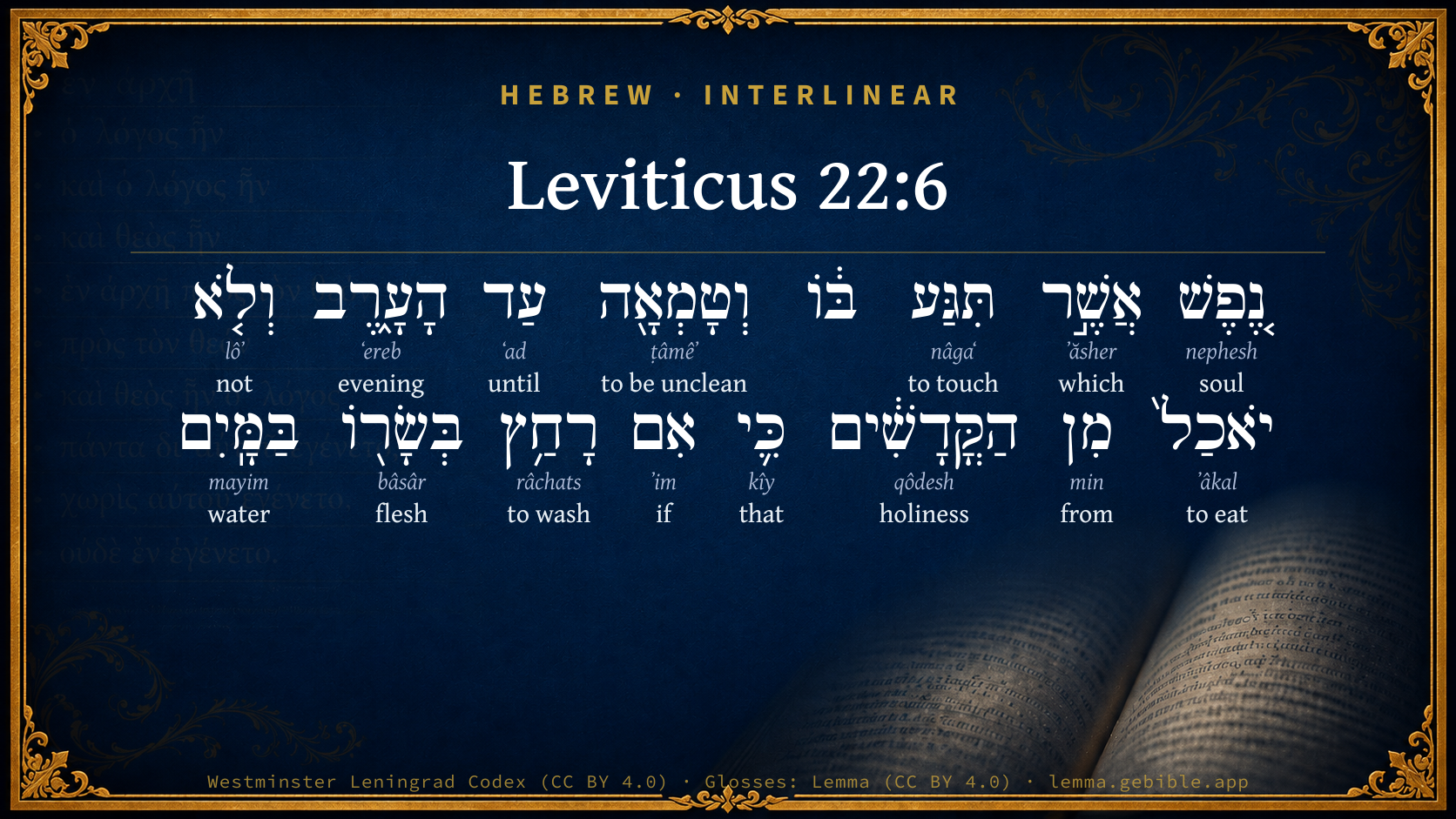
Hebrew (Westminster Leningrad Codex) Leviticus 22:6 appears in the Hebrew Old Testament. The text above is from the Westminster Leningrad Codex. Each word links to its Strong’s number, a concise gloss, and parsing drawn from the Open Scriptures Hebrew Bible morphology. Click any word for its full Brown-Driver-Briggs (BDB) entry.
Download image
Cite this verse

Leviticus 22:6 (World English Bible). Public Domain. Lemma interlinear Bible study tool, https://lemma.gebible.app/v/leviticus/22/6.

Show BibTeX & RIS
BibTeX
RIS
English Translation
the person that touches any such shall be unclean until the evening, and shall not eat of the holy things, unless he bathe his body in water.
World English Bible · Public Domain
Download a study sheet

One document with this verse’s original text, its word-by-word gloss line, the meaning frame, cross-references with their text, attributed commentary, and full source and license credits — printable, and it pastes into notes with its structure intact.

This verse Autodidact and up

Study sheet (.html) Plain text (.txt)

A passage Seminary Student

Up to 50 verses in one chapter. A passage sheet keeps up to 6 commentary sources and 12 cross-references per verse, in the order this page ranks them, and says so on the sheet whenever that leaves anything out. Ask for a single verse and you get the Autodidact verse sheet above.

Everything on this page stays free to read, with no account — the sheet is a download of what is already on screen, not access to it.

Want to remove ads? Support Godless Engineer
Compare translations 3

The same verse in 3 English versions, stacked beneath the original-language interlinear above. Click any original word for its lexicon entry.

Each is an independent rendering of the whole verse — the interlinear is not word-aligned to these translations.

Highlighted words mark where these versions differ — a whole-verse word diff, not a word-by-word alignment.

  • World English Bible Public Domain
    the person that touches any such shall be unclean until the evening, and shall not eat of the holy things, unless he bathe his body in water.
  • King James Version Public Domain
    The soul which hath touched any such shall be unclean until even, and shall not eat of the holy things, unless he wash his flesh with water.
  • unfoldingWord Literal Text CC BY-SA 4.0
    the person who touches it will be unclean until the evening. And he shall not eat from the holy things unless he washes his body with the water.

unfoldingWord Literal Text — © unfoldingWord, licensed CC BY-SA 4.0. Word-aligned USFM3 via Door43 (git.door43.org/unfoldingWord/en_ult).

Versions to compare (up to 4)

3 of 4 selected

Show all 18 translations

Every available English version of this verse, each an independent rendering of the whole verse.

  • World English Bible Public Domain
    the person that touches any such shall be unclean until the evening, and shall not eat of the holy things, unless he bathe his body in water.
  • Berean Standard Bible Public Domain
    the man who touches any of these will remain unclean until evening. He must not eat from the sacred offerings unless he has bathed himself with water.
  • Majority Standard Bible Public Domain
    the man who touches any of these will remain unclean until evening. He must not eat from the sacred offerings unless he has bathed himself with water.
  • King James Version Public Domain
    The soul which hath touched any such shall be unclean until even, and shall not eat of the holy things, unless he wash his flesh with water.
  • American Standard Version (1901) Public Domain
    the soul that toucheth any such shall be unclean until the even, and shall not eat of the holy things, unless he bathe his flesh in water.
  • Revised Version (1885) Public Domain
    the soul which toucheth any such shall be unclean until the even, and shall not eat of the holy things, unless he bathe his flesh in water.
  • Geneva Bible (1599) Public Domain
    The person that hath touched such, shall therefore be vncleane vntill the euen, and shall not eat of ye holy things, except he haue washed his flesh with water.
  • Douay-Rheims (1899) Public Domain
    Shall be unclean until the evening, and shall not eat those things that are sanctified: but when he hath washed his flesh with water,
  • Young's Literal Translation Public Domain
    the person who cometh against it -- hath even been unclean till the evening, and doth not eat of the holy things, but hath bathed his flesh with water,
  • Literal Standard Version CC BY-SA 4.0
    the person who comes against it has even been unclean until the evening, and does not eat of the holy things, but has bathed his flesh with water,
  • Unlocked Literal Bible CC BY-SA 4.0
    then the priest who touches anything unclean will be unclean until evening. He must not eat any of the holy things, unless he has bathed his body in water.
  • unfoldingWord Literal Text CC BY-SA 4.0
    the person who touches it will be unclean until the evening. And he shall not eat from the holy things unless he washes his body with the water.
  • Darby Bible Public Domain
    -- a person that toucheth any such shall be unclean until even, and shall not eat of the holy things; but he shall bathe his flesh with water,
  • World Messianic Bible Public Domain
    the person that touches any such shall be unclean until the evening, and shall not eat of the holy things unless he bathes his body in water.
  • Webster's Bible Public Domain
    The soul which hath touched any such shall be unclean until evening, and shall not eat of the holy things, unless he shall wash his flesh with water.
  • Free Bible Version CC BY-SA 4.0
    anyone who touches anything like this will remain unclean until evening. He is not allowed to eat from the holy offerings unless he has washed himself with water.
  • Bible in Basic English Public Domain
    Any person touching any such unclean thing will be unclean till evening, and may not take of the holy food till his flesh has been bathed in water;
  • JPS Tanakh (1917) Public Domain
    the soul that toucheth any such shall be unclean until the even, and shall not eat of the holy things, unless he bathe his flesh in water.

Literal Standard Version (2020), Covenant Press — licensed CC BY-SA 4.0. Text via the HelloAO Bible API (eBible.org). Unlocked Literal Bible (unfoldingWord) — licensed CC BY-SA 4.0. Text via the HelloAO Bible API (eBible.org). unfoldingWord Literal Text — © unfoldingWord, licensed CC BY-SA 4.0. Word-aligned USFM3 via Door43 (git.door43.org/unfoldingWord/en_ult). Free Bible Version, Dr. Jonathan Gallagher — licensed CC BY-SA 4.0. Text via the HelloAO Bible API (eBible.org).

Word by word

More ways to search: Search by grammar → Find every occurrence → Compare this word →

Practice this passage: Drill this verse → Learn its vocabulary →

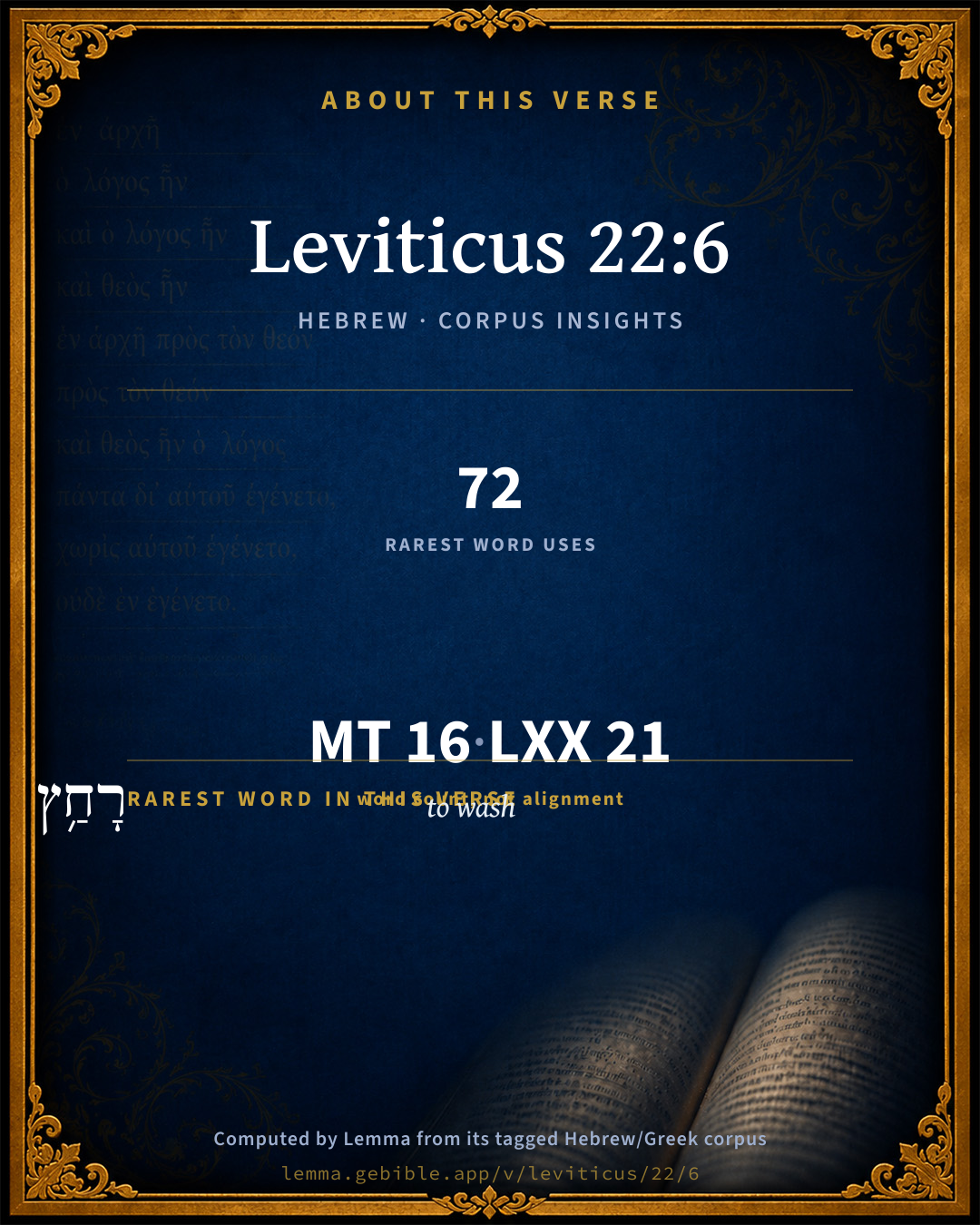
רָחַ֥ץ
râchats
H7364
“to wash”
Verb, Qal, Perfect, 3rd Person, Masculine, Singular
Part of Speech
Verb
Stem
Qal
Form
Perfect
Person
3rd Person
Gender
Masculine
Number
Singular
Full BDB Definition

Origin: a primitive root

TWOT: 2150

to wash, wash off, wash away, bathe - (Qal) - to wash, wash off, wash away - to wash, bathe (oneself) - (Pual) to be washed - (Hithpael) to wash oneself
  1. נֶ֚פֶשׁ nephesh H5315 “soul” Noun, Common, Both, Singular, Absolute
  2. אֲשֶׁ֣ר ʼăsher H834 “which” Particle, Relative
  3. תִּגַּע nâgaʻ H5060 “to touch” Verb, Qal, Imperfect, 3rd Person, Feminine, Singular
  4. וְטָמְאָ֖ה ṭâmêʼ H2930 “and · to be unclean” Conjunction + Verb, Qal, Sequential Perfect, 3rd Person, Feminine, Singular
  5. עַד ʻad H5704 “until” Preposition
  6. הָעָ֑רֶב ʻereb H6153 “the · evening” Particle, Definite Article + Noun, Common, Masculine, Singular, Absolute
  7. וְלֹ֤א lôʼ H3808 “and · not” Conjunction + Particle, Negative
  8. יֹאכַל֙ ʼâkal H398 “to eat” Verb, Qal, Imperfect, 3rd Person, Masculine, Singular
  9. מִן min H4480 “from” Preposition
  10. הַקֳּדָשִׁ֔ים qôdesh H6944 “the · holy things” Particle, Definite Article + Noun, Common, Masculine, Plural, Absolute
  11. כִּ֛י kîy H3588 “that” Conjunction
  12. אִם ʼim H518 “if” Conjunction
  13. בְּשָׂר֖וֹ bâsâr H1320 “flesh · his” Noun, Common, Masculine, Singular, Construct + Suffix, Personal, 3rd Person, Masculine, Singular
  14. בַּמָּֽיִם mayim H4325 “in/at the · water(s)” Preposition, Determined + Noun, Common, Masculine, Plural, Absolute

About this verse

These counts appear in no published source. They are computed here, from the morphology-tagged text and Lemma’s own curated glosses. What Lemma adds →

16
words
15
distinct lemmas
Pentateuch
section

Grammatical profile

  • 4 verbs
  • 5 nouns
  • 3 prepositions
  • 2 conjunctions
  • 2 particles

Verb forms

  • תִּגַּע Qal · Imperfect
  • וְטָמְאָ֖ה Qal · Sequential Perfect
  • יֹאכַל֙ Qal · Imperfect
  • רָחַ֥ץ Qal · Perfect

Hebrew & Septuagint length

In English translation the verse runs 27 words from the Hebrew and 25 from the Septuagint (LXX English) — closely comparable.

A rough comparison of the two English renderings, which tokenize alike — not a word-level alignment.

Word counts can differ between the Hebrew and the Greek without any difference in meaning — e.g. the Hebrew direct-object marker אֵת has no separate Greek word, and Greek often adds the article ὁ.

In the original languages it is 16 Hebrew tokens and 21 Greek tokens — but the two are counted differently (Hebrew bundles its prefixes and suffixes into one token; the Greek is in lemma form), so that isn’t a like-for-like length.

Cross-references

7

Topical passages linked to Leviticus 22:6 in the Treasury of Scripture Knowledge — connected by theme and wording, ordered by reader-vote popularity; previews shown in the World English Bible.

  • Leviticus 15:5 Whoever touches his bed shall wash his clothes, and bathe himself in water, and be unclean until the evening.
  • Hebrews 10:22 let's draw near with a true heart in fullness of faith, having our hearts sprinkled from an evil conscience, and having our body washed with pure water,
  • Leviticus 11:24–25 "'By these you will become unclean: whoever touches the carcass of them shall be unclean until the evening.
  • Leviticus 16:24–28 Then he shall bathe himself in water in a holy place, and put on his garments, and come out and offer his burnt offering and the burnt offering of the people, and make atonement for himself and for the people.
  • Numbers 19:7–10 Then the priest shall wash his clothes, and he shall bathe his flesh in water, and afterward he shall come into the camp, and the priest shall be unclean until the even.
  • Haggai 2:13 Then Haggai said, "If one who is unclean by reason of a dead body touch any of these, will it be unclean?" The priests answered, "It will be unclean."
  • 1 Corinthians 6:11 Such were some of you, but you were washed. But you were sanctified. But you were justified in the name of the Lord Jesus, and in the Spirit of our God.

Cross-references courtesy of OpenBible.info (CC BY 4.0).

Hebrew and Greek witnesses Masoretic Hebrew ↔ Greek Septuagint

The same verse in the two great witnesses to the Old Testament, shown verse-for-verse.

These are two independent witnesses, not word-aligned to each other, and the Septuagint is shown in lemma (dictionary) form.

Hebrew Leviticus 22:6 Masoretic · Westminster Leningrad Codex

נֶ֚פֶשׁ אֲשֶׁ֣ר תִּגַּע בּ֔וֹ וְטָמְאָ֖ה עַד הָעָ֑רֶב וְלֹ֤א יֹאכַל֙ מִן הַקֳּדָשִׁ֔ים כִּ֛י אִם רָחַ֥ץ בְּשָׂר֖וֹ בַּמָּֽיִם

the person that touches any such shall be unclean until the evening, and shall not eat of the holy things, unless he bathe his body in water.

World English Bible · Public Domain

Greek LXX Leviticus 22:6 Septuagint · lemma form

ψυχή ὅστις ἄν ἅπτομαι αὐτός ἀκάθαρτος εἰμί ἕως ἑσπέρα οὐ ἐσθίω ἀπό ὁ ἅγιος ἐάν μή λούω ὁ σῶμα αὐτός ὕδωρ

whatever soul shall touch them shall be unclean until evening; he shall not eat of the holy things, unless he bathe his body in water,

LXX2012 (modern English Septuagint) · Public Domain

Hebrew: Westminster Leningrad Codex (CC BY 4.0). Greek: Septuagint (public domain); English from LXX2012 (modern English Septuagint) (Public Domain). How the Septuagint differs from the Hebrew →

Targum (Aramaic paraphrase)

2

The Targum is the ancient Jewish Aramaic paraphrase of the Hebrew Scriptures — an interpretive translation, not the Hebrew text itself. Onkelos (literal) and Pseudo-Jonathan (expansive) render the Torah, and Jonathan the Prophets. Coverage is partial: where no permissively-licensed English translation exists for a verse, only the Aramaic is shown. This is verse-level text, not a word-by-word alignment to the Hebrew.

  1. Targum Onkelos Torah (Genesis–Deuteronomy)
    אֱנַשׁ דִי יִקְרַב בֵּהּ וִיהֵי מְסָאָב עַד רַמְשָׁא וְלָא יֵיכוּל מִן קוּדְשַׁיָא אֱלָהֵן אַסְחֵי בִשׂרֵהּ בְּמַיָא

    (no public-domain English translation for this verse)

    Targum Onkelos — Aramaic: “Onkelos Genesis” (public domain); “Onkelos Exodus” (public domain); “Onkelos Leviticus” (public domain); “Onkelos Numbers” (public domain); “Onkelos Deuteronomy” (public domain). English: “Sefaria Community Translation” (CC0 1.0 (public-domain dedication)); “J.W. Etheridge. The Targums of Onkelos and Jonathan Ben Uzziel on the Pentateuch. London: Longmans, Green, 1862” (public domain). Text via Sefaria.

  2. Targum Pseudo-Jonathan Torah (Genesis–Deuteronomy)
    בַּר נַשׁ כּהֵן דְיִקְרַב בֵּיהּ יְהֵי מְסָאָב עַד רַמְשָׁא וְלָא יֵיכוּל מִן קוּדְשַׁיָא אֱלָהֵן אִין אַסְחֵי בִּישְרֵיהּ בְּאַרְבְּעִין סָוִוין דְמוֹי

    the man being a priest who toucheth such shall be unclean until the evening, and may not eat of the holy things, except that he wash his flesh in forty seahs of water.

    Targum Pseudo-Jonathan — Aramaic: “Targum Jonathan on Genesis” (public domain); “Targum Jonathan on Exodus” (public domain); “Targum Jonathan on Leviticus” (public domain); “Targum Jonathan on Numbers” (public domain); “Targum Jonathan on Deuteronomy” (public domain). English: “The Targum of Jonathan ben Uzziel, trans. J. W. Etheridge, London, 1862” (public domain). Text via Sefaria.

Commentary

Notes on Leviticus 22:6 from classic Christian and Jewish commentators (each source and its license shown beneath its notes). The classic Christian expositions comment on the surrounding passage and are grouped to its opening verse, so a note may address several verses; the Jewish commentaries on the Tanakh (Rashi and others) are per-verse, so they appear only where the commentator wrote on this verse.

Lemma curates 59 commentaries, every one of them public domain or Creative Commons licensed, each selected and text-cleaned for this edition rather than reprinted as found. About our sources →

Trapp's Complete Commentary

John Trapp

Lev 22:6 The soul which hath touched any such shall be unclean until even, and shall not eat of the holy things, unless he wash his flesh with water.

Ver. 6. Unless he wash his face with water.] Whereby he was led to the laver of Christ’s blood, which is opposed to legal washings. {Heb 9:9} Run we to that open fountain, {Zec 13:1} and be every day washing and cleansing ourselves therein from all filthiness of flesh and spirit. Every Jew had his water pots for daily purification. {Joh 2:6} We have a far better bath.

John Trapp, A Commentary or Exposition upon All the Books of the Old and New Testament (1647–1656) — public domain. Text from a community e-Sword module.

Geneva Bible (1599)

Geneva Bible translators

Or, until.

Geneva Bible (1599) marginal notes — public domain. Text via Bolls.life.

Ellicott's Commentary for English Readers

(6) The soul which hath touched.—Better, the man who hath, that is, the priest for whom these laws are here enacted. Hence the ancient Chaldee version renders it “the man a priest.”

Shall be unclean until even.—When the day ends and another begins (see Lev_11:24-32), and when he had to immerse his body in water.

A Bible Commentary for English Readers, edited by Charles John Ellicott (1878–1897) — public domain. Text from a community e-Sword module.

John Gill's Exposition

The soul which hath touched any such shall be unclean until even,.... Which is the time fixed by the several laws for such uncleannesses, see Lev 11:31,

and shall not eat of the holy things, unless he wash his flesh with water; in forty seahs of water, as the Targum of Jonathan; yea, when the evening is come, he may not eat of the heave or wave offerings, until he has dipped himself all over in water; nor should any eat of the Lord's supper under the New Testament, but such as are first baptized in water.

John Gill's Exposition of the Whole Bible (1746–1763) — public domain (CC PDM 1.0). Text via the HelloAO Bible API.

Albert Barnes' Notes on the Bible

The soul - Rather, the person. Compare the use of the word “body” in the Prayer Book version of Psa 53:1, and in the compounds “somebody, nobody”.

Albert Barnes' Notes on the Bible (1834–1885) — public domain. Text from a community e-Sword/MySword module.

Rashi

Rabbi Shlomo Yitzchaki (Rashi)

נפש אשר תגע בו THE SOUL WHICH HATH TOUCHED IT — i. e. who touches any one of these unclean persons or things (enumerated in the second half of v. 4 and in v. 5).

Rashi on the Tanakh — English translations: “The Judaica Press complete Tanach with Rashi, translated by A. J. Rosenberg” (CC BY 4.0); “Pentateuch with Rashi's commentary by M. Rosenbaum and A.M. Silbermann, 1929-1934” (public domain); “The Metsudah Tanach series, Lakewood, N.J” (CC BY 4.0); and “The Book of Joshua, Metsudah Publications, 1997” (CC BY 4.0). Text via Sefaria.

Lesson kit

Teaching starters — assembled from the data on this page, not authored interpretation. Every prompt links to the verse data it draws on. Edit before teaching.

Leviticus, in the Pentateuch, opens this verse with 16 words (15 distinct Hebrew lemmas). Its most distinctive word is râchats (“to wash”). A historical commentator’s framing appears above. Read the whole chapter for the surrounding context.

Discussion questions

  1. What does “to wash” (râchats) contribute to the verse as a whole?
  2. Leviticus 15:5 shares this passage’s theme. How do the two illuminate each other?
  3. The translations on this page render this verse differently — a whole-verse word diff, not a word-by-word alignment. What might account for the different wordings?
  4. The verb «תִּגַּע» is Qal Imperfect. How does its form color the action?
  5. Reading how Trapp's Complete Commentary and Geneva Bible (1599) read this verse, where do the two commentators agree and where do they part?

Things to notice

Reading settings

Reading text

Shown beneath each verse's original-language words.

Old Testament
Old Testament edition

Read the OT as the Masoretic Hebrew (MT) or the Greek Septuagint (LXX).

English shown for the Greek Septuagint (in the Hebrew ↔ Greek comparison).

Comparing translations? Open the Compare panel on any verse page to stack up to four side by side.