Ezra 2:63

Hebrew (Westminster Leningrad Codex) Ezra 2:63 appears in the Hebrew Old Testament. The text above is from the Westminster Leningrad Codex. Each word links to its Strong’s number, a concise gloss, and parsing drawn from the Open Scriptures Hebrew Bible morphology. Click any word for its full Brown-Driver-Briggs (BDB) entry.
Download image
Cite this verse

Ezra 2:63 (World English Bible). Public Domain. Lemma interlinear Bible study tool, https://lemma.gebible.app/v/ezra/2/63.

Show BibTeX & RIS
BibTeX
RIS
English Translation
The governor said to them, that they should not eat of the most holy things, until there stood up a priest with Urim and with Thummim.
World English Bible · Public Domain
Highlights
  • 1 first appearance in the Hebrew Bible
Full analysis ↓
Download a study sheet

One document with this verse’s original text, its word-by-word gloss line, the meaning frame, cross-references with their text, attributed commentary, and full source and license credits — printable, and it pastes into notes with its structure intact.

This verse Autodidact and up

Study sheet (.html) Plain text (.txt)

A passage Seminary Student

Up to 50 verses in one chapter. A passage sheet keeps up to 6 commentary sources and 12 cross-references per verse, in the order this page ranks them, and says so on the sheet whenever that leaves anything out. Ask for a single verse and you get the Autodidact verse sheet above.

Everything on this page stays free to read, with no account — the sheet is a download of what is already on screen, not access to it.

Want to remove ads? Support Godless Engineer
Compare translations 3

The same verse in 3 English versions, stacked beneath the original-language interlinear above. Click any original word for its lexicon entry.

Each is an independent rendering of the whole verse — the interlinear is not word-aligned to these translations.

Highlighted words mark where these versions differ — a whole-verse word diff, not a word-by-word alignment.

  • World English Bible Public Domain
    The governor said to them, that they should not eat of the most holy things, until there stood up a priest with Urim and with Thummim.
  • King James Version Public Domain
    And the Tirshatha said unto them, that they should not eat of the most holy things, till there stood up a priest with Urim and with Thummim.
  • unfoldingWord Literal Text CC BY-SA 4.0
    And the Tirshatha said to them that they must not eat from the holiest holy food until a priest stood with Urim and with Thummim.

unfoldingWord Literal Text — © unfoldingWord, licensed CC BY-SA 4.0. Word-aligned USFM3 via Door43 (git.door43.org/unfoldingWord/en_ult).

Versions to compare (up to 4)

3 of 4 selected

Show all 18 translations

Every available English version of this verse, each an independent rendering of the whole verse.

  • World English Bible Public Domain
    The governor said to them, that they should not eat of the most holy things, until there stood up a priest with Urim and with Thummim.
  • Berean Standard Bible Public Domain
    The governor ordered them not to eat the most holy things until there was a priest to consult the Urim and Thummim.
  • Majority Standard Bible Public Domain
    The governor ordered them not to eat the most holy things until there was a priest to consult the Urim and Thummim.
  • King James Version Public Domain
    And the Tirshatha said unto them, that they should not eat of the most holy things, till there stood up a priest with Urim and with Thummim.
  • American Standard Version (1901) Public Domain
    And the governor said unto them, that they should not eat of the most holy things, till there stood up a priest with Urim and with Thummim.
  • Revised Version (1885) Public Domain
    And the Tirshatha said unto them, that they should not eat of the most holy things till there stood up a priest with Urim and with Thummim.
  • Geneva Bible (1599) Public Domain
    And Tirshatha saide vnto them, that they should not eate of the most holy thing, tell there rose vp a Priest with Vrim and Thummim.
  • Douay-Rheims (1899) Public Domain
    And Athersatha said to them, that they should not eat of the holy of holies, till there arose a priest learned and perfect.
  • Young's Literal Translation Public Domain
    and the Tirshatha saith to them, that they eat not of the most holy things till the standing up of a priest with Urim and with Thummim.
  • Literal Standard Version CC BY-SA 4.0
    and the Tirshatha says to them that they do not eat of the most holy things until the standing up of a priest with [the] Lights and with [the] Perfections.
  • Unlocked Literal Bible CC BY-SA 4.0
    So the governor told them they must not eat any of the holy sacrifices until a priest with Urim and Thummim approved.
  • unfoldingWord Literal Text CC BY-SA 4.0
    And the Tirshatha said to them that they must not eat from the holiest holy food until a priest stood with Urim and with Thummim.
  • Darby Bible Public Domain
    And the Tirshatha said to them that they should not eat of the most holy things, till there stood up a priest with Urim and with Thummim.
  • World Messianic Bible Public Domain
    The governor told them that they should not eat of the most holy things until a priest stood up to serve with Urim and with Thummim.
  • Webster's Bible Public Domain
    And the Tirshatha said to them, that they should not eat of the most holy things, till there stood up a priest with Urim and with Thummim.
  • Free Bible Version CC BY-SA 4.0
    The governor instructed them not to eat anything from the sanctuary sacrifices until a priest could ask the Lord about the issue by using the Urim and Thummim.
  • Bible in Basic English Public Domain
    And the Tirshatha said that they were not to have the most holy things for their food, till a priest came to give decision by Urim and Thummim.
  • JPS Tanakh (1917) Public Domain
    And the Tirshatha said unto them, that they should not eat of the most holy things, till there stood up a priest with Urim and with Thummim.

Literal Standard Version (2020), Covenant Press — licensed CC BY-SA 4.0. Text via the HelloAO Bible API (eBible.org). Unlocked Literal Bible (unfoldingWord) — licensed CC BY-SA 4.0. Text via the HelloAO Bible API (eBible.org). unfoldingWord Literal Text — © unfoldingWord, licensed CC BY-SA 4.0. Word-aligned USFM3 via Door43 (git.door43.org/unfoldingWord/en_ult). Free Bible Version, Dr. Jonathan Gallagher — licensed CC BY-SA 4.0. Text via the HelloAO Bible API (eBible.org).

Word by word

More ways to search: Search by grammar → Find every occurrence → Compare this word →

Practice this passage: Drill this verse → Learn its vocabulary →

הַתִּרְשָׁ֨תָא֙
Tirshâthâʼ
H8660
“the · Tirshatha”
Particle, Definite Article + Noun, Common, Masculine, Singular, Absolute
Part of Speech
Particle + Noun
Type
Common
Gender
Masculine
Number
Singular
State
Absolute
Full BDB Definition

Origin: of foreign derivation

TWOT: 2548

Tirshatha - governor - a title used by the Persian governor in Judea - Nehemiah used this title
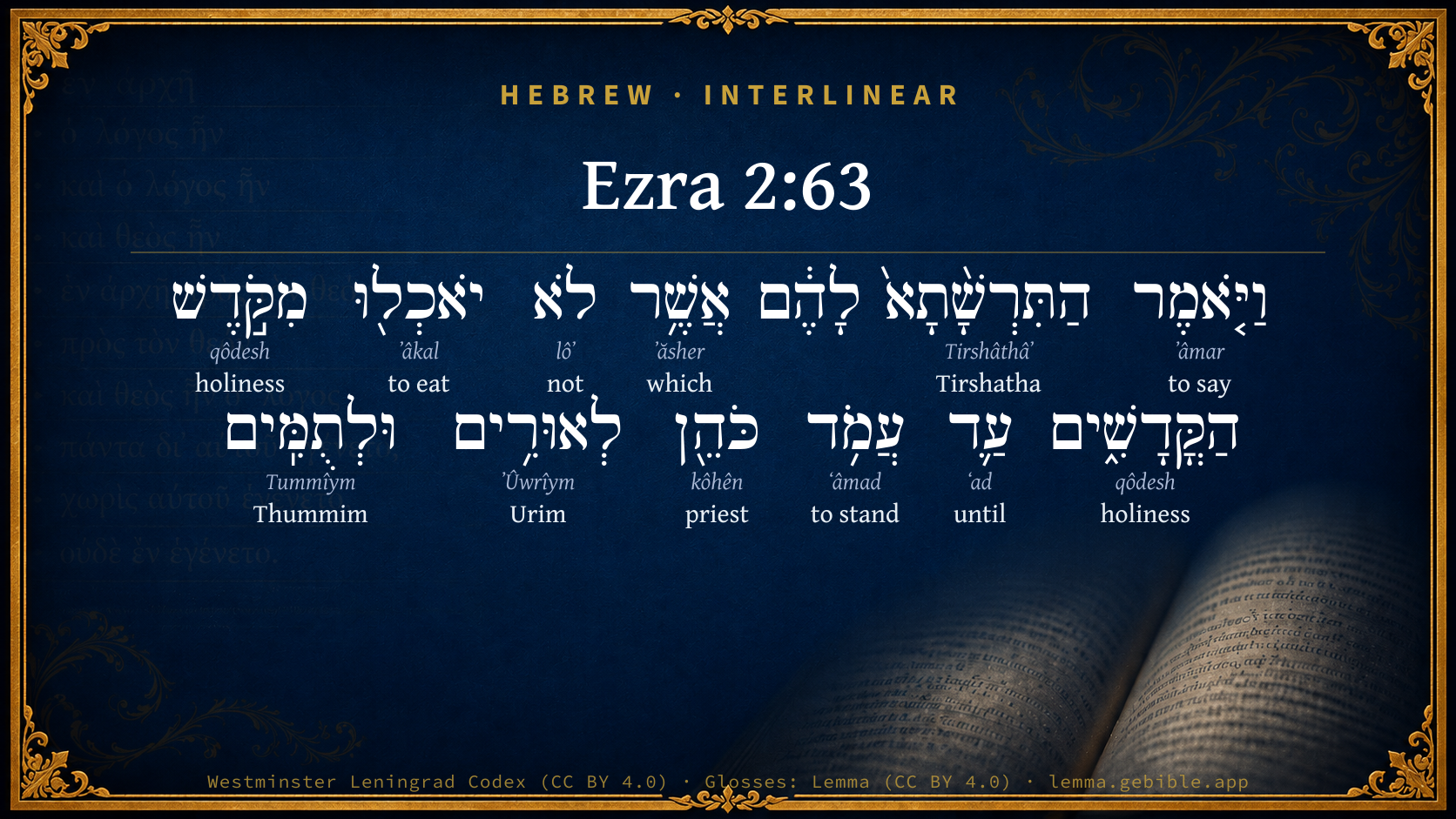
  1. וַיֹּ֤אמֶר ʼâmar H559 “and · to say” Conjunction + Verb, Qal, Sequential Imperfect, 3rd Person, Masculine, Singular
  2. אֲשֶׁ֥ר ʼăsher H834 “which” Particle, Relative
  3. לֹא lôʼ H3808 “not” Particle, Negative
  4. יֹאכְל֖וּ ʼâkal H398 “to eat” Verb, Qal, Imperfect, 3rd Person, Masculine, Plural
  5. מִקֹּ֣דֶשׁ qôdesh H6944 “from · holiness of” Preposition + Noun, Common, Masculine, Singular, Construct
  6. הַקֳּדָשִׁ֑ים qôdesh H6944 “the · holy things” Particle, Definite Article + Noun, Common, Masculine, Plural, Absolute
  7. עַ֛ד ʻad H5704 “until” Preposition
  8. עֲמֹ֥ד ʻâmad H5975 “to stand” Verb, Qal, Infinitive Construct
  9. כֹּהֵ֖ן kôhên H3548 “priest” Noun, Common, Masculine, Singular, Absolute
  10. לְאוּרִ֥ים ʼÛwrîym H224 “to/for · Urim” Preposition + Noun, Common, Masculine, Plural, Absolute
  11. וּלְתֻמִּֽים Tummîym H8550 “and · to/for · Thummim” Conjunction + Preposition + Noun, Common, Masculine, Plural, Absolute

About this verse

These counts appear in no published source. They are computed here, from the morphology-tagged text and Lemma’s own curated glosses. What Lemma adds →

13
words
11
distinct lemmas
Historical
section

Notable vocabulary

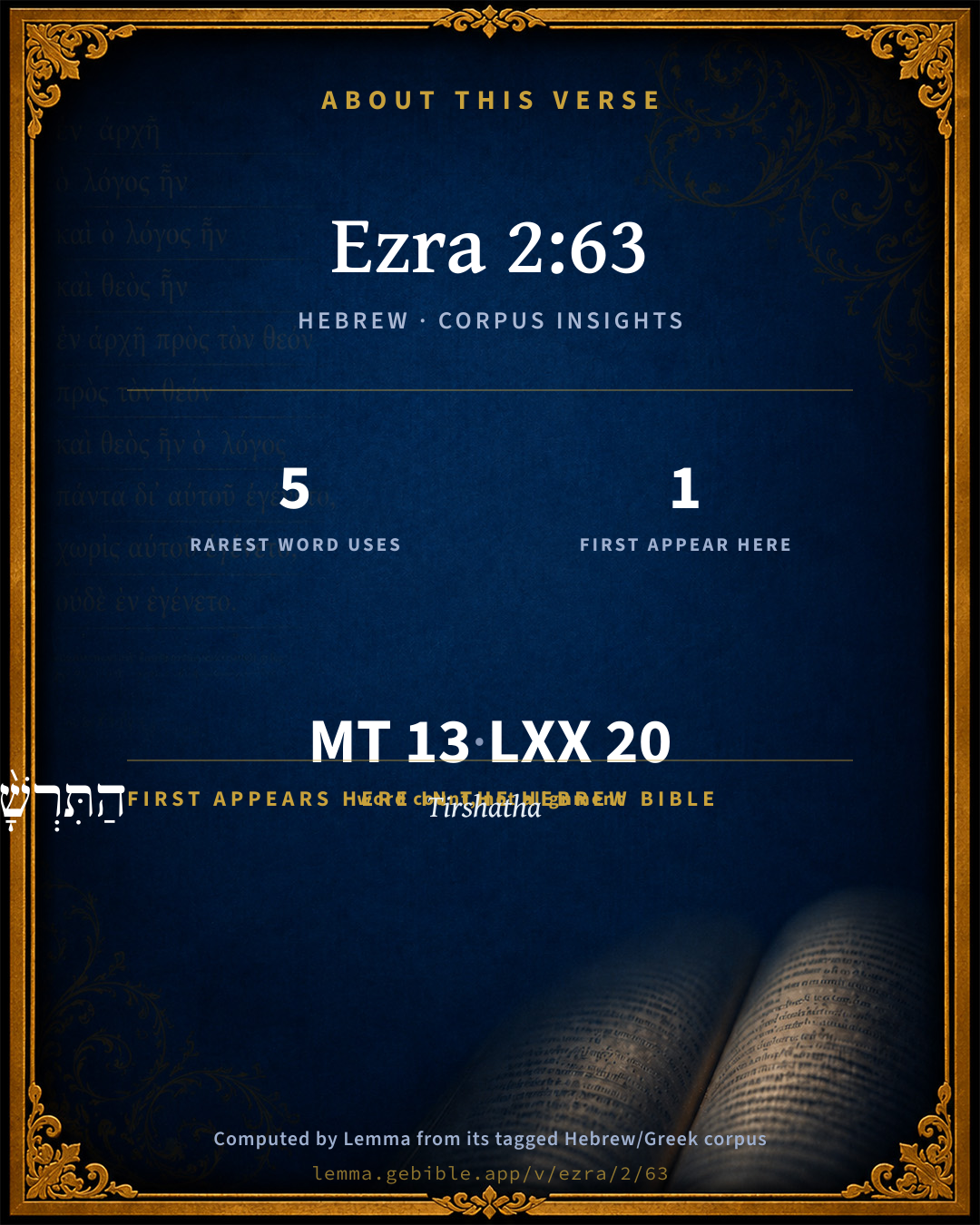
The rarest word here is הַתִּרְשָׁ֨תָא֙ Tirshatha H8660 — appearing just 5 times in the whole Hebrew Bible.

First appearance in Scripture

This word makes its first canonical appearance in the Hebrew Bible here:

  • הַתִּרְשָׁ֨תָא֙ Tirshatha H8660

Shared distinctive vocabulary

הַתִּרְשָׁ֨תָא֙ Tirshatha H8660 occurs in 5 verses of the Hebrew Bible. Also found in:

Grammatical profile

  • 3 verbs
  • 6 nouns
  • 2 prepositions
  • 2 particles

Verb forms

  • וַיֹּ֤אמֶר Qal · Sequential Imperfect
  • יֹאכְל֖וּ Qal · Imperfect
  • עֲמֹ֥ד Qal · Infinitive Construct

Repetition

A word recurs within this verse — often emphatic in Hebrew:

  • מִקֹּ֣דֶשׁ holiness H6944 ×2

Hebrew & Septuagint length

In English translation the verse runs 26 words from the Hebrew and 24 from the Septuagint (LXX English) — closely comparable.

A rough comparison of the two English renderings, which tokenize alike — not a word-level alignment.

Word counts can differ between the Hebrew and the Greek without any difference in meaning — e.g. the Hebrew direct-object marker אֵת has no separate Greek word, and Greek often adds the article ὁ.

In the original languages it is 13 Hebrew tokens and 20 Greek tokens — but the two are counted differently (Hebrew bundles its prefixes and suffixes into one token; the Greek is in lemma form), so that isn’t a like-for-like length.

Cross-references

20

Topical passages linked to Ezra 2:63 in the Treasury of Scripture Knowledge — connected by theme and wording, ordered by reader-vote popularity; previews shown in the World English Bible.

  • Exodus 28:30 You shall put in the breastplate of judgment the Urim and the Thummim; and they shall be on Aaron's heart, when he goes in before Yahweh: and Aaron shall bear the judgment of the children of Israel on his heart before Yahweh continually.
  • Leviticus 2:3 That which is left of the meal offering shall be Aaron's and his sons'. It is a most holy thing of the offerings of Yahweh made by fire.
  • Leviticus 2:10 That which is left of the meal offering shall be Aaron's and his sons'. It is a thing most holy of the offerings of Yahweh made by fire.
  • Numbers 27:21 He shall stand before Eleazar the priest, who shall inquire for him by the judgment of the Urim before Yahweh: at his word shall they go out, and at his word they shall come in, both he, and all the children of Israel with him, even all the congregation.
  • Leviticus 22:10 "'No stranger shall eat of the holy thing: a foreigner living with the priests, or a hired servant, shall not eat of the holy thing.
  • Nehemiah 8:9 Nehemiah, who was the governor, and Ezra the priest the scribe, and the Levites who taught the people, said to all the people, This day is holy to Yahweh your God; don't mourn, nor weep. For all the people wept, when they heard the words of the law.
  • Leviticus 6:17 It shall not be baked with yeast. I have given it as their portion of my offerings made by fire. It is most holy, as the sin offering, and as the trespass offering.
  • Leviticus 6:29 Every male among the priests shall eat of it: it is most holy.
  • Leviticus 7:16 "'But if the sacrifice of his offering is a vow, or a freewill offering, it shall be eaten on the day that he offers his sacrifice; and on the next day what remains of it shall be eaten:
  • Leviticus 8:8 He placed the breastplate on him; and in the breastplate he put the Urim and the Thummim.
  • Leviticus 10:17–18 "Why haven't you eaten the sin offering in the place of the sanctuary, seeing it is most holy, and he has given it you to bear the iniquity of the congregation, to make atonement for them before Yahweh?
  • Leviticus 22:2–3 "Tell Aaron and his sons to separate themselves from the holy things of the children of Israel, which they make holy to me, and that they not profane my holy name. I am Yahweh.
  • Leviticus 22:14–16 "'If a man eats something holy unwittingly, then he shall add the fifth part of its value to it, and shall give the holy thing to the priest.
  • Numbers 18:9–11 This shall be your of the most holy things, [reserved] from the fire: every offering of theirs, even every meal-offering of theirs, and every sin-offering of theirs, and every trespass-offering of theirs, which they shall render to me, shall be most holy for you and for your sons.
  • Numbers 18:19 All the heave-offerings of the holy things, which the children of Israel offer to Yahweh, have I given you, and your sons and your daughters with you, as a portion forever: it is a covenant of salt forever before Yahweh to you and to your seed with you.
  • Numbers 18:32 You shall bear no sin by reason of it, when you have heaved from it the best of it: and you shall not profane the holy things of the children of Israel, that you not die.
  • Deuteronomy 33:8 Of Levi he said, Your Thummim and your Urim are with your godly one, Whom you did prove at Massah, With whom you did strive at the waters of Meribah;
  • 1 Samuel 28:6 When Saul inquired of Yahweh, Yahweh didn't answer him, neither by dreams, nor by Urim, nor by prophets.
  • Nehemiah 7:65 The governor said to them, that they should not eat of the most holy things, until there stood up a priest with Urim and Thummim.
  • Nehemiah 10:1 Now those who sealed were: Nehemiah the governor, the son of Hacaliah, and Zedekiah,

Cross-references courtesy of OpenBible.info (CC BY 4.0).

Hebrew and Greek witnesses Masoretic Hebrew ↔ Greek Septuagint

The same verse in the two great witnesses to the Old Testament, shown verse-for-verse.

These are two independent witnesses, not word-aligned to each other, and the Septuagint is shown in lemma (dictionary) form.

Hebrew Ezra 2:63 Masoretic · Westminster Leningrad Codex

וַיֹּ֤אמֶר הַתִּרְשָׁ֨תָא֙ לָהֶ֔ם אֲשֶׁ֥ר לֹא יֹאכְל֖וּ מִקֹּ֣דֶשׁ הַקֳּדָשִׁ֑ים עַ֛ד עֲמֹ֥ד כֹּהֵ֖ן לְאוּרִ֥ים וּלְתֻמִּֽים

The governor said to them, that they should not eat of the most holy things, until there stood up a priest with Urim and with Thummim.

World English Bible · Public Domain

Greek LXX Ezra 2:63 Septuagint · lemma form

καί εἶπον αθερσαθα αὐτός ὁ μή ἐσθίω ἀπό ὁ ἅγιος ὁ ἅγιος ἕως ἀναἵστημι ἱερεύς ὁ φωτίζω καί ὁ τέλειος

And the Athersastha told them that they should not eat of the most holy things, until a priest should arise with Lights and Perfections.

LXX2012 (modern English Septuagint) · Public Domain

In the Septuagint this is one book — Esdras B (2 Esdras): Ezra is chapters 1–10, Nehemiah 11–23.

On this verse, Adam Clarke's Commentary discusses the Septuagint’s reading. Read the note in Commentary ↓

Hebrew: Westminster Leningrad Codex (CC BY 4.0). Greek: Septuagint (public domain); English from LXX2012 (modern English Septuagint) (Public Domain). How the Septuagint differs from the Hebrew →

Commentary

Notes on Ezra 2:63 from classic Christian and Jewish commentators (each source and its license shown beneath its notes). The classic Christian expositions comment on the surrounding passage and are grouped to its opening verse, so a note may address several verses; the Jewish commentaries on the Tanakh (Rashi and others) are per-verse, so they appear only where the commentator wrote on this verse.

Lemma curates 59 commentaries, every one of them public domain or Creative Commons licensed, each selected and text-cleaned for this edition rather than reprinted as found. About our sources →

Trapp's Complete Commentary

John Trapp

Ezr 2:63 And the Tirshatha said unto them, that they should not eat of the most holy things, till there stood up a priest with Urim and with Thummim.

Ver. 63. And the Tirshatha said unto them] i.e. Zerubbabel, the chief magistrate, a man of great power and no less courage, who would not be guilty of passive injustice.

That they should not eat of the most holy things] Make a gain of the priesthood, which they had slighted when nothing was to be obtained by it. Now they should neither do the work nor have the means. Caietan commenting upon Matthew, then when the French soldiers brake into Rome, and made a scorn and prey of the Popish clergy, acknowledged that it was a just hand of God upon them, because they were grown unsavoury salt, good for little else but to look after the rights and revenues of the Church.

Till there stood up a priest with Urim and Thummim] That is, never, or not in haste. Some faint hopes the governor might have that such an ephod with Urim and Thummim, as was now burnt or otherwise lost, might be had again, but it seemed not very likely. The great High Priest was now at hand, and the ceremonials to cease shortly.

John Trapp, A Commentary or Exposition upon All the Books of the Old and New Testament (1647–1656) — public domain. Text from a community e-Sword module.

Joseph Benson's Commentary

Ezr 2:63. The Tirshatha — The governor or king’s commissioner, namely, Zerubbabel: whence Nehemiah is so called, Neh 8:9; Neh 10:2. That they should not eat of the most holy things — That they should not partake of the sacrifices offered for sin, nor of the right shoulder of peace- offerings, nor of the show-bread; which were all most holy, and the portion of the priests alone. Till there stood up a priest with Urim and Thummim — Till the Lord himself should show, by an answer given to some high- priest, inquiring of him by Urim and Thummim, as had been anciently done, whether they were of the line of Aaron or not. But as God had ceased to give an answer this way long before this time, therefore, it was as much as to say, that as their names were not found in the authentic genealogical registers of the priests, they should for ever be excluded, till some divine oracle pronounced them to have a right to the priesthood. Hereby it appears, that the Urim and Thummim were lost in the destruction of the city and temple, though the Jews fed themselves with hopes of recovering them, but in vain. And by the want of that oracle, they were taught to expect the great oracle, the Messiah.

Joseph Benson's Commentary on the Old and New Testaments (1811–1818) — public domain. Text from a community e-Sword module.

Geneva Bible (1599)

Geneva Bible translators

Read Exod. 28:30.

This is a Chaldean name, and signifieth him that hath authority over others.

Geneva Bible (1599) marginal notes — public domain. Text via Bolls.life.

Jamieson, Fausset & Brown

Robert Jamieson, A. R. Fausset & David Brown

Tirshatha--a title borne by the Persian governors of Judea (see also Neh 7:65-70; Neh 8:9; Neh 10:1). It is derived from the Persian torsh ("severe"), and is equivalent to "your severity," "your awfulness."

Jamieson, Fausset & Brown — Commentary Critical and Explanatory on the Whole Bible (1871) — public domain (CC PDM 1.0). Text via the HelloAO Bible API.

Adam Clarke's Commentary

Verse 63. The Tirshatha] This is generally supposed to be Nehemiah, or the person who was the commandant; see Neh 8:9; Neh 10:1, for the word appears to be the name of an office. The Vulgate and Septuagint write it Atershatha, the Syriac and Arabic render it the princes of Judah. Some suppose the word to be Persian, but nothing like it of the same import occurs in that language at present. If, as Castel supposed, it signifies austerity, or that fear which is unpressed by the authority of a governor, it may come from [Persian] ters, FEAR, or [Persian] tersh, ACID, the former from [Persian] tarsidan, to FEAR or DREAD.

Should not eat of the most holy things] There was a high priest then, but no Urim and Thummim, these having been lost in the captivity.

Adam Clarke's Commentary on the Bible (1810–1826) — public domain. Text from a community e-Sword/MySword module.

Ellicott's Commentary for English Readers

(63) Tirshatha.—Interchangeable with Pechah, or governor, as Zerubbabel is called in chapter 5:14 and always in Haggai. It is probably an old Persian term, signifying “The Feared.”

With Urim and with Thummim.—See Exo_28:30. They were pronounced to be excluded from priestly functions. Without ark or temple, the people had not as yet that special presence of Jehovah before which the high priest could “inquire of the Lord by Urim and Thummim.” Zerubbabel might hope that this privilege would return, and thought the official purity of the priestly line of sufficient importance for such an inquiry. But the holy of holies in the new temple never had in it the ancient “tokens “; and by Urim and Thummim Jehovah was never again inquired of.

A Bible Commentary for English Readers, edited by Charles John Ellicott (1878–1897) — public domain. Text from a community e-Sword module.

The Cambridge Bible for Schools and Colleges

gen. ed. J. J. S. Perowne

63. the Tirshatha] This title is here and in Neh_7:65; Neh_7:70 apparently applied to Zerubbabel: Haggai his contemporary calls him ‘Pekhah’ (= Governor), see Hag_1:1; Hag_1:14; Hag_2:2; Hag_2:21. In the same way Nehemiah, who is called the Tirshatha, Neh_8:9; Neh_10:1, is also spoken of as ‘Pekhah’ in Neh_12:26. ‘Pekhah’ was the Babylonian, ‘Tirshatha’ the Persian title for a local or provincial governor. The governors were subject to the satraps, the satraps were responsible to the king.

The word ‘Tirshatha’ is said to be the same as the Persian ‘tarsâta’, from ‘tars’ to fear, and to denote complimentarily the awe which the office inspired.

That the ‘Tirshatha’ here mentioned was Zerubbabel is rendered probable by the nature of the prohibition contained in this verse, which none but a native Governor or the High-priest himself would have issued.

that they should not eat of the most holy things] The priests were especially required to eat of the ‘meal-offering’ (Lev_2:3; Lev_2:10; Lev_6:18), the sin offering (Lev_6:26), the guilt offering (Lev_7:6), and of the peace offering (Lev_7:31-34). Certain portions were set aside for the sons of Aaron. The prohibition therefore refers to the ceremonial rules already in force. ‘The most holy things’ is a phrase which can best be illustrated from Num_18:9-11.

The consecration of a priest was accompanied by the sacrifice of a ram which Aaron and his sons should eat. Exo_29:33-37.

A priest excluded from eating of ‘the most holy things’ was therefore only a priest by title and lineage. He could not be consecrated (see Exodus 29), he could not offer sacrifices, he could not enter the holy place.

He was excluded apparently more rigidly than the priest ‘that hath a blemish’, who was forbidden to ‘come nigh to offer the bread of his God. He shall eat the bread of his God, both of the most holy, and of the holy. Only he shall not go in unto the veil, nor come nigh unto the altar’ (Lev_21:21-23).

The distinction here made between the ‘most holy’ and the ‘holy’ is important. ‘The most holy’ included the shewbread, the incense, the sin and guilt offering, the drink offering. ‘The holy’ comprised the thank-offering, the firstlings of herd and flock, the first-fruits, the tithe. Of ‘the holy’ things members of the priests’ families might partake. But ceremonial cleanness was in all cases needed.

The declaration of ‘defilement’ excluded those who were defiled from a source of priestly income as well as from the dignity of priestly occupation.

till there stood up a priest with Urim and with Thummim] In former times the High-priest had enquired of the Lord by Urim and Thummim. After the Captivity, the High-priest had no Urim and Thummim. The Urim and Thummim, along with the Ark, the Shechinah, the Holy Fire, the Spirit of Prophecy, the Oil of Anointing constituted the chief points, for the absence of which the Jews of later times deplored the deficiency of Zerubbabel’s Temple as compared with that of Solomon.

The passages in which enquiry by Urim and Thummim is mentioned are Exo_28:30; Lev_8:8; Num_27:21; Deu_33:8; 1Sa_28:6. In none of these do we find any explanation of what the Urim and Thummim were. They have been identified with (a) stones in the High-priest’s breastplate, (b) sacred dice, (c) little images of ‘truth’ and ‘justice’ such as are found hung round the neck of an Egyptian priest’s mummy.

The writers of the Scriptures have abstained from explanation either because they shrank from making generally known what was regarded with mystery and awe, or because they presupposed their readers’ familiarity with the thing referred to.

The want of Urim and Thummim is not, as Ewald supposed, due to any technical defect in Jeshua’s claim to High-priestly dignity (such as that he was not his father’s eldest son). And this passage tacitly contradicts the assertion of Josephus, that the Urim and Thummim only first failed in the Maccabean era.

The Tirshatha indefinitely postponed the decision. Where documentary proofs were wanting, none but one favoured with Divine perception could pronounce sentence. The words are of importance because they testify to the feeling that the people felt the need of revelation from God, and that they looked forward to the coming of some great High-priest to whom God should make Himself known. They point forward to the coming of the High-Priest ‘full of grace and truth’.

Compare 1Ma_4:46 ‘Until there should come a prophet to show what should be done with them’, 1Ma_14:41 ‘Until there should arise a faithful prophet.’

The words ‘Urim’ and ‘Thummim’ mean ‘Light’ and ‘Perfection.’ The LXX renders them in this passage by τοῖς φωτίζουσιν καὶ τοῖς τελείοις; more generally by δήλωσις or δῆλοι and ἀλήθεια.

The Cambridge Bible for Schools and Colleges (gen. ed. J. J. S. Perowne; Cambridge University Press, 1878–1918) — public domain. Text from a community e-Sword module.

John Gill's Exposition

So that the far greatest part of them must walk on foot, since these can be thought to be little more than sufficient to carry their goods or baggage; some copies of the Vulgate Latin read six hundred and thirty six horses (c).

(c) Ed. of Sixtus V. and the Lovain in James's Contrariety of Popish Bibles, p. 295.

John Gill's Exposition of the Whole Bible (1746–1763) — public domain (CC PDM 1.0). Text via the HelloAO Bible API.

Albert Barnes' Notes on the Bible

The Tirshatha - i. e., Zerubbabel. See margin. The word is probably old Persian, though it does not occur in the cuneiform inscriptions. Some derive it from a root “to fear.” See the introduction to the Book of Ezra, first note.

A priest with Urim and with Thummim - See Exo 28:30 note. According to the rabbinical writers, the second temple permanently lacked this glory of the first. Zerubbabel, it would seem by the present passage (compare Neh 7:65), expected that the loss would be only temporary.

Albert Barnes' Notes on the Bible (1834–1885) — public domain. Text from a community e-Sword/MySword module.

Haydock's Catholic Bible Commentary

Athersatha. Protestants’ marginal note, "the governor," (Haydock) in the Persian language. (Du Hamel) --- Nehemias had this title, 2 Esdras viii. 9. (Haydock) --- It means "a cup-bearer." (Calmet) (Menochius) --- 3 Esdras, "And Nehemias, who is also Atharias, said unto them, that they should not partake of the holy things, till a high priest, clothed with manifestation and truth, should arise." (Haydock) --- Learned. Hebrew, "with Urim and Thummim." We do not find that God had been consulted, in this manner, since the time of David: and the Jews inform us that the ornament was not used after the captivity, (Calmet) as it had been, perhaps, concealed with the ark, by Jeremias, 2 Machabees ii. 4. (Tirinus) --- Nehemias hoped that it would be soon recovered. In the mean time, he followed the spirit of the law, but with additional rigour, as it permitted such priests to eat consecrated meats, Leviticus xxi. 22. It seems that this decision is out of its proper place, since Nehemias came 80 years after Zorobabel. (Calmet) --- But he might have been present on this occasion, (Haydock) though he returned afterwards to Babylon, where he officiated as cup-bearer to the king. (Tirinus)

George Leo Haydock (1774–1849), Haydock's Catholic Family Bible and Commentary, 1859 edition — public domain. Excludes Psalms (Douay-Rheims chapter numbering differs from Protestant) and Deuterocanonical books (Catholic canon only).

Matthew Poole's English Annotations

The Tirshatha, i.e. the governor, to wit, Zerubbabel; whence Nehemiah also is so called, Neh 8:9; 10:1.

Till there stood up a priest with Urim and with Thummim; that this point, which could not be found out by any human skill or industry, might be determined by Divine direction. Hereby it appears that the Urim and Thummim were lost in the destruction of the city and temple, though the Jews fed themselves with hopes of recovering them, but in vain. Of the Urim and Thummim, see Exo 28:30 Num 27:21; 1Sa 23:9.

Matthew Poole's English Annotations on the Holy Bible (1683–1685) — public domain. Text from a community e-Sword/MySword module.

Whedon's Commentary on the Bible

Daniel D. Whedon

63. The Tirshatha — A Persian title of the governor of a district, and, according to Gesenius: equivalent to Your Severity, or Dread Sovereign. Nehemiah is called Tirshatha, (Neh_8:9; Neh_10:1,) and this title is sometimes interchanged with פחה, governor. Comp. especially Neh_12:26. In our text the title Tirshatha is to be understood of Zerubbabel, not, as some have supposed, of Nehemiah.

Not eat of the most holy things — For strangers could no more lawfully eat of the hallowed things, such as the remnant of the meat offering, (Lev_2:3,) than they could minister at the altar. Compare marginal references.

A priest with Urim — By whom the uncertain genealogy might be settled, and the divine will in the matter be determined. In the former times such matters had been settled by inquiring through those Urim and Thummim on the ephod of the high priest. See 1Sa_30:7-8, and notes on Exo_28:30, and Jos_1:1. From this verse it appears that these sacred media of learning the divine counsel had been lost during the captivity, and we have no reliable record that they were ever replaced.

Daniel D. Whedon (gen. ed.), Commentary on the Old and New Testaments (1874–1909) — public domain. Text from a community e-Sword module.

The Pulpit Commentary

The Tirshatha. As "Shesh-bazzar" was the Babylonian name of Zerub-babel, (Ezr_1:8) so "the Tirshatha" seems to have been his Persian title. The word is probably a participial form from tars or tarsa, to fear," and means literally "the Feared." It is used only by Ezra and Nehemiah. (Neh_7:65 Neh_8:9) Haggai calls Zerubbabel uniformly pechah, "governor. (Hag_1:1, 14 2:2, 21) They should not eat of the most holy things. The priests" portion of the offerings, called "most holy" in Lev_2:2, Lev_2:10, is intended. Of this no "stranger" might eat (ibid. 22:10). Till there stood up a priest with Urim and Thummim. Zerubbabel evidently expected that the power of obtaining direct answers from God by means of the Urim and Thummim, whatever they were, (see note on Exo_28:30) which had existed in the pre-captivity Church, would be restored when the Church was re-established in its ancient home. The doubt whether the families of Habaiah and Coz (or Haccoz) belonged to the priestly class or no might then be resolved. But Zerubbabel"s expectation was disappointed. The gift of Urim and Thum-mira, forfeited by disobedience, was never recovered.

The Pulpit Commentary (1880–1919), ed. H.D.M. Spence-Jones & Joseph S. Exell — public domain. Text from a community e-Sword module.

John Wesley's Explanatory Notes

Tirshatha - The governor, Zerubbabel. With Urim, &c. - That this point which could not be found out by human skill, might be determined by Divine direction. Hereby it appears that the Urim and Thummim were lost in the destruction of the city and temple, tho' the Jews fed themselves with hopes of recovering them, but in vain. And by the want of that oracle, they were taught to expect the great oracle, the Messiah.

John Wesley, Explanatory Notes Upon the Whole Bible (1754–1765) — public domain. Text via the GEBible commentary corpus.

Keil & Delitzsch

C. F. Keil & F. Delitzsch

The Tirshatha, the secular governor of the community, i.e., as is obvious from a comparison of Neh 7:65 with Neh 7:70, Zerubbabel, called Hag 1:1 יהוּדה פּחת. תּרשׁתא, always used with the article, is undoubtedly the Persian designation of the governor or viceroy. Nehemiah is also so called in Neh 8:9 and Neh 10:2, and likewise הפּחה, Neh 12:26. The meaning of the word is still matter of dispute. Some derive it from the Persian trsı̂dn, to fear, and trs, fear = the feared or respected one (Meier, Wurzelb. p. 714); others from Persian trš, acer, auster, the strict ruler; others, again (with Benfey, die Monatsnamen, p. 196), from the Zend. thvôrestar (nom. thvôresta), i.e., praefectus, penes quem est imperium: comp. Gesenius, thes. p. 1521. The Tirshatha decided that they were not to eat of the most holy things till there should arise a priest with Urim and Thummim, i.e., to give a final decision by means of Urim and Thummim. עמד, according to the later usage of the language, is equivalent to קוּם, comp. Dan 8:3; Dan 11:2, and other places. The prohibition to eat of the most holy things (comp. on Lev 2:3) involved the prohibition to approach the most holy objects, e.g., the altar of burnt-offering (Exo 29:37; Exo 30:10), and to enter the most holy place, and thus excludes from specific priestly acts: without, however, denying a general inclusion among the priestly order, or abolishing a claim to the priestly revenues, so far as these were not directly connected with priestly functions. On Urim and Thummim, see on Exo 28:30. From the words, "till a priest shall arise," etc., it is evident that the then high priest was not in a position to entreat, and to pronounce, the divine decision by Urim and Thummim. The reason of this, however, need not be sought in the personality of Joshua (Ewald, Gesch. iv. 95), nor supposed to exist in such a fact as that he might not perhaps have been the eldest son of his father, and therefore not have had full right to the priesthood. This conjecture rests upon utterly erroneous notions of the Urim and Thummim, upon a subjectivistic view, which utterly evaporates the objective reality of the grace with which the high priest was in virtue of his office endowed. The obtainment of the divine decision by Urim and Thummim presupposes the gracious presence of Jahve in the midst of His people Israel. And this had been connected by the Lord Himself with the ark of the covenant, and with its cherubim-overshadowed mercy-seat, from above which He communed with His people (Exo 25:22). The high priest, bearing upon his breast the breastplate with the Urim and Thummim, was to appear before Jahve, and, bringing before Him the judgment of Israel, to entreat the divine decision (Exo 28:30; Num 27:21). The ark of the covenant with the mercy-seat was thus, in virtue of the divine promise, the place of judgment, where the high priest was to inquire of the Lord by means of the Urim and Thummim. This ark, however, was no longer in existence, having been destroyed when Solomon's temple was burned by the Chaldeans. Those who returned with Zerubbabel were without the ark, and at first without a temple. In such a state of affairs the high priest could not appear before Jahve with the breastplate and the Urim and Thummim to entreat His decision. The books of Samuel, indeed, relate cases in which the divine will was consulted by Urim and Thummim, when the ark of the covenant was not present for the high priest to appear before (comp. Sa1 23:4, Sa1 23:6, Sa1 23:9, etc., Sa1 14:18); whence it appears that the external or local presence of the ark was not absolutely requisite for this purpose. Still these cases occurred at a time when the congregation of Israel as yet possessed the ark with the Lord's cherubim-covered mercy-seat, though this was temporarily separated from the holy of holies of the tabernacle. Matters were in a different state at the return from the captivity. Then, not only were they without either ark or temple, but the Lord had not as yet re-manifested His gracious presence in the congregation; and till this should take place, the high priest could not inquire of the Lord by Urim and Thummim. In the hope that with the restoration of the altar and temple the Lord would again vouchsafe His presence to the returned congregation, Zerubbabel expected that a high priest would arise with Urim and Thummim to pronounce a final decision with regard to those priests who could not prove their descent from Aaron's posterity. This expectation, however, was unfulfilled. Zerubbabel's temple remained unconsecrated by any visible token of Jahve's presence, as the place where His name should dwell. The ark of the covenant with the cherubim, and the Shechinah in the cloud over the cherubim, were wanting in the holy of holies of this temple. Hence, too, we find no single notice of any declaration of the divine will or the divine decision by Urim and Thummim in the period subsequent to the captivity; but have, on the contrary, the unanimous testimony of the Rabbis, that after the Babylonian exile God no longer manifested His will by Urim and Thummim, this kind of divine revelation being reckoned by them among the five things which were wanting in the second temple. Comp. Buxtorf, exercitat. ad historiam Urim et Thummim, c. 5; and Vitringa, observat. ss. Lib. vi. c. 6, p. 324f.

Keil & Delitzsch — Biblical Commentary on the Old Testament (1861–1891) — public domain (CC PDM 1.0). Text via the HelloAO Bible API. (Old Testament only.)

Scofield Reference Notes

C. I. Scofield

Urim

(See Scofield "Exo 28:30").

The Scofield Reference Bible (1917 edition), notes by C. I. Scofield — public domain. Text from a community e-Sword module.

Rashi

Rabbi Shlomo Yitzchaki (Rashi)

Hattirshatha That is Nehemiah, the son of Hachaliah (Neh. 8:9), and our Rabbis said (Yerushalmi Kid. 4:1) that he was named Hattirshatha because the Sages permitted him (הָתֵּר) to drink (שָּׁתָּא) wine of gentiles because he was the king’s butler.

of the most holy sacrifices sin-offerings and guilt-offerings, like the other priests.

until a priest arises, etc. like a person who says to his friend, “Until the Messiah comes, this matter will not come about.” I cannot interpret it to mean: until a priest arises for the Urim and Tumim in the Second Temple, because we find in Yoma, chapter 1 (21b) that the Urim and Tumim were missing in the Second Temple.

Rashi on the Tanakh — English translations: “The Judaica Press complete Tanach with Rashi, translated by A. J. Rosenberg” (CC BY 4.0); “Pentateuch with Rashi's commentary by M. Rosenbaum and A.M. Silbermann, 1929-1934” (public domain); “The Metsudah Tanach series, Lakewood, N.J” (CC BY 4.0); and “The Book of Joshua, Metsudah Publications, 1997” (CC BY 4.0). Text via Sefaria.

Lesson kit

Teaching starters — assembled from the data on this page, not authored interpretation. Every prompt links to the verse data it draws on. Edit before teaching.

Ezra, in the Historical, opens this verse with 13 words (11 distinct Hebrew lemmas). Its most distinctive word is Tirshâthâʼ (“Tirshatha”). A historical commentator’s framing appears above. Read the whole chapter for the surrounding context.

Discussion questions

  1. What does “Tirshatha” (Tirshâthâʼ) contribute to the verse as a whole?
  2. This is the first place “Tirshatha” appears in Scripture (first appears here). What does its debut here establish?
  3. How does Nehemiah 7:65, which shares the word «Tirshatha», read alongside this verse?
  4. What does the repetition of “holiness” (2× in this one verse) do in this verse?
  5. These translations render this verse differently. What is at stake in choosing one wording over another?
  6. «וַיֹּ֤אמֶר» is a Qal Sequential Imperfect verb. How does that grammatical form shape the action described?
  7. Compare how Trapp's Complete Commentary and Joseph Benson's Commentary read this verse. Where do they agree or differ?

Things to notice

Reading settings

Reading text

Shown beneath each verse's original-language words.

Old Testament
Old Testament edition

Read the OT as the Masoretic Hebrew (MT) or the Greek Septuagint (LXX).

English shown for the Greek Septuagint (in the Hebrew ↔ Greek comparison).

Comparing translations? Open the Compare panel on any verse page to stack up to four side by side.