1 Chronicles 26:20

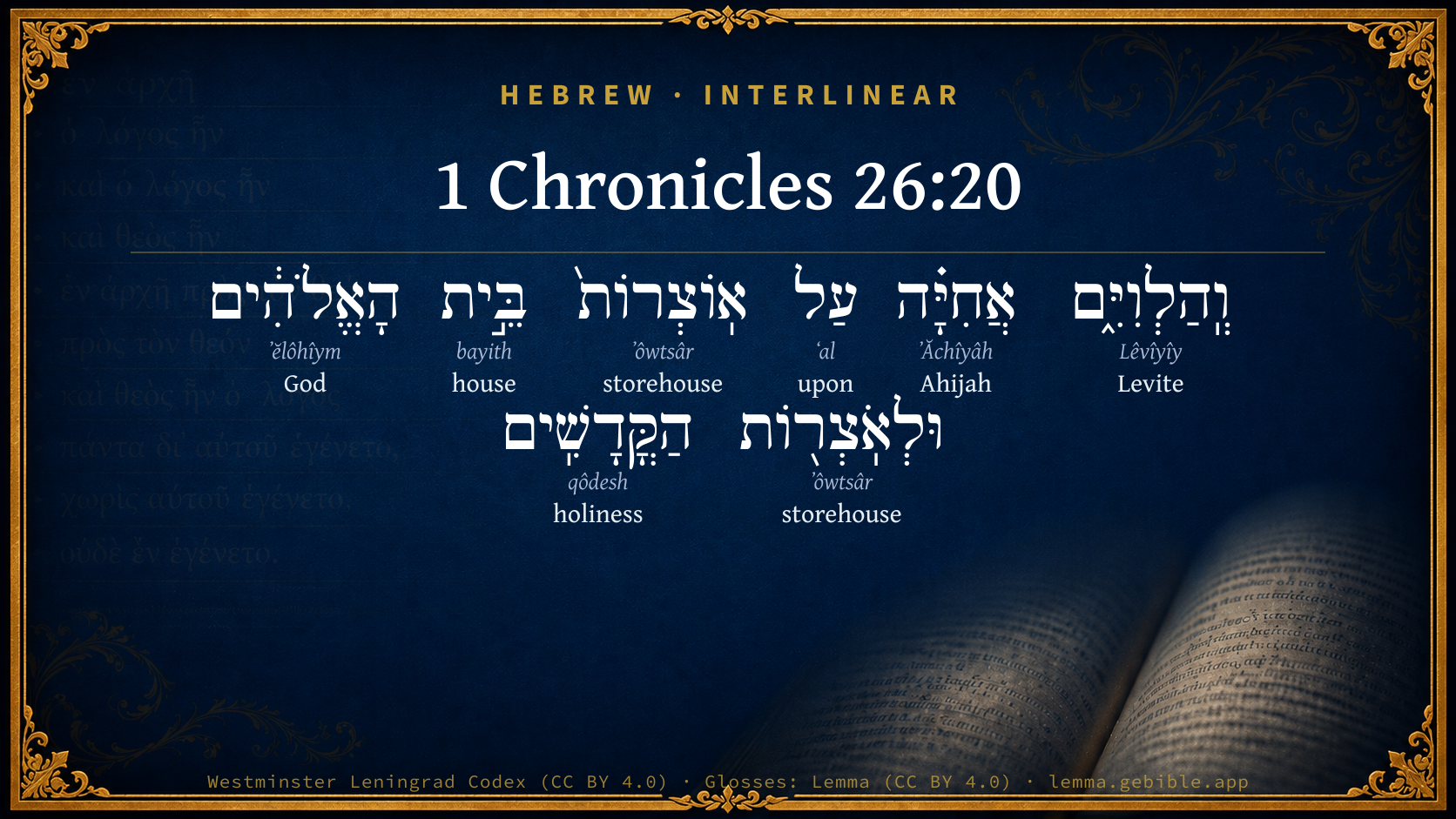
Hebrew (Westminster Leningrad Codex) 1 Chronicles 26:20 appears in the Hebrew Old Testament. The text above is from the Westminster Leningrad Codex. Each word links to its Strong’s number, a concise gloss, and parsing drawn from the Open Scriptures Hebrew Bible morphology. Click any word for its full Brown-Driver-Briggs (BDB) entry.
Download image
Cite this verse

1 Chronicles 26:20 (World English Bible). Public Domain. Lemma interlinear Bible study tool, https://lemma.gebible.app/v/1-chronicles/26/20.

Show BibTeX & RIS
BibTeX
RIS
English Translation
Of the Levites, Ahijah was over the treasures of the house of God, and over the treasures of the dedicated things.
World English Bible · Public Domain
Download a study sheet

One document with this verse’s original text, its word-by-word gloss line, the meaning frame, cross-references with their text, attributed commentary, and full source and license credits — printable, and it pastes into notes with its structure intact.

This verse Autodidact and up

Study sheet (.html) Plain text (.txt)

A passage Seminary Student

Up to 50 verses in one chapter. A passage sheet keeps up to 6 commentary sources and 12 cross-references per verse, in the order this page ranks them, and says so on the sheet whenever that leaves anything out. Ask for a single verse and you get the Autodidact verse sheet above.

Everything on this page stays free to read, with no account — the sheet is a download of what is already on screen, not access to it.

Want to remove ads? Support Godless Engineer
Compare translations 3

The same verse in 3 English versions, stacked beneath the original-language interlinear above. Click any original word for its lexicon entry.

Each is an independent rendering of the whole verse — the interlinear is not word-aligned to these translations.

Highlighted words mark where these versions differ — a whole-verse word diff, not a word-by-word alignment.

  • World English Bible Public Domain
    Of the Levites, Ahijah was over the treasures of the house of God, and over the treasures of the dedicated things.
  • King James Version Public Domain
    And of the Levites, Ahijah was over the treasures of the house of God, and over the treasures of the dedicated things.
  • unfoldingWord Literal Text CC BY-SA 4.0
    And the Levites, Ahijah over the treasuries of the house of God and for the treasuries of the holy.

unfoldingWord Literal Text — © unfoldingWord, licensed CC BY-SA 4.0. Word-aligned USFM3 via Door43 (git.door43.org/unfoldingWord/en_ult).

Versions to compare (up to 4)

3 of 4 selected

Show all 18 translations

Every available English version of this verse, each an independent rendering of the whole verse.

  • World English Bible Public Domain
    Of the Levites, Ahijah was over the treasures of the house of God, and over the treasures of the dedicated things.
  • Berean Standard Bible Public Domain
    Now their fellow Levites were in charge of the treasuries of the house of God and the treasuries of the dedicated things.
  • Majority Standard Bible Public Domain
    Now their fellow Levites were in charge of the treasuries of the house of God and the treasuries of the dedicated things.
  • King James Version Public Domain
    And of the Levites, Ahijah was over the treasures of the house of God, and over the treasures of the dedicated things.
  • American Standard Version (1901) Public Domain
    And of the Levites, Ahijah was over the treasures of the house of God, and over the treasures of the dedicated things.
  • Revised Version (1885) Public Domain
    And of the Levites, Ahijah was over the treasuries of the house of God, and over the treasuries of the dedicated things.
  • Geneva Bible (1599) Public Domain
    And of the Leuites. Ahiiah was ouer the treasures of the house of God, and ouer the treasures of the dedicate things.
  • Douay-Rheims (1899) Public Domain
    Now Achias was over the treasures of the house of God, and the holy vessels.
  • Young's Literal Translation Public Domain
    And of the Levites, Ahijah `is' over the treasures of the house of God, even for the treasures of the holy things.
  • Literal Standard Version CC BY-SA 4.0
    And of the Levites, Ahijah [is] over the treasures of the house of God, even for the treasures of the holy things.
  • Unlocked Literal Bible CC BY-SA 4.0
    Among the Levites, Ahijah was in charge of the treasures of God's house, and of the treasures of the things that belong to Yahweh.
  • unfoldingWord Literal Text CC BY-SA 4.0
    And the Levites, Ahijah over the treasuries of the house of God and for the treasuries of the holy.
  • Darby Bible Public Domain
    And the Levites: Ahijah was over the treasures of the house of God, and over the treasures of the dedicated things.
  • World Messianic Bible Public Domain
    Of the Levites, Ahijah was over the treasures of God’s house and over the treasures of the dedicated things.
  • Webster's Bible Public Domain
    And of the Levites, Ahijah was over the treasures of the house of God, and over the treasures of the dedicated things.
  • Free Bible Version CC BY-SA 4.0
    Other Levites under Ahijah were in charge of the treasuries of the house of God and the treasuries of what had been dedicated to God.
  • Bible in Basic English Public Domain
    And the Levites their brothers were responsible for the stores of the house of God and the holy things.
  • JPS Tanakh (1917) Public Domain
    And of the Levites, Ahijah was over the treasuries of the house of God, and over the treasuries of the hallowed things.

Literal Standard Version (2020), Covenant Press — licensed CC BY-SA 4.0. Text via the HelloAO Bible API (eBible.org). Unlocked Literal Bible (unfoldingWord) — licensed CC BY-SA 4.0. Text via the HelloAO Bible API (eBible.org). unfoldingWord Literal Text — © unfoldingWord, licensed CC BY-SA 4.0. Word-aligned USFM3 via Door43 (git.door43.org/unfoldingWord/en_ult). Free Bible Version, Dr. Jonathan Gallagher — licensed CC BY-SA 4.0. Text via the HelloAO Bible API (eBible.org).

Word by word

More ways to search: Search by grammar → Find every occurrence → Compare this word →

Practice this passage: Drill this verse → Learn its vocabulary →

אֲחִיָּ֗ה
ʼĂchîyâh
H281
“Ahijah”
Noun, Proper
Part of Speech
Noun
Type
Proper
Full BDB Definition

Origin: from H251 and H3050

TWOT: None

Ahiah or Ahijah = "brother of Jehovah (Yahu)" - grandson of Phinehas - scribe of Solomon - a prophet who predicted the revolt of the Northern tribes - father of Baasha, who usurped the Northern throne - grandson of Hezron (or mother of 1-4 above) - a Benjamite, son of Ehud - one of David's heroes - a Levite during David's time - a chief man under Nehemiah
  1. וְֽהַלְוִיִּ֑ם Lêvîyîy H3881 “and · the · Levites” Conjunction + Particle, Definite Article + Noun, Gentilic, Masculine, Plural, Absolute
  2. עַל ʻal H5921 “upon” Preposition
  3. אֽוֹצְרוֹת֙ ʼôwtsâr H214 “storehouses of” Noun, Common, Masculine, Plural, Construct
  4. בֵּ֣ית bayith H1004 “house of” Noun, Common, Masculine, Singular, Construct
  5. הָאֱלֹהִ֔ים ʼĕlôhîym H430 “the · God(s)” Particle, Definite Article + Noun, Common, Masculine, Plural, Absolute
  6. וּלְאֹֽצְר֖וֹת ʼôwtsâr H214 “and · to/for · storehouses of” Conjunction + Preposition + Noun, Common, Masculine, Plural, Construct
  7. הַקֳּדָשִֽׁים qôdesh H6944 “the · holy things” Particle, Definite Article + Noun, Common, Masculine, Plural, Absolute

About this verse

These counts appear in no published source. They are computed here, from the morphology-tagged text and Lemma’s own curated glosses. What Lemma adds →

8
words
7
distinct lemmas
Historical
section

Notable vocabulary

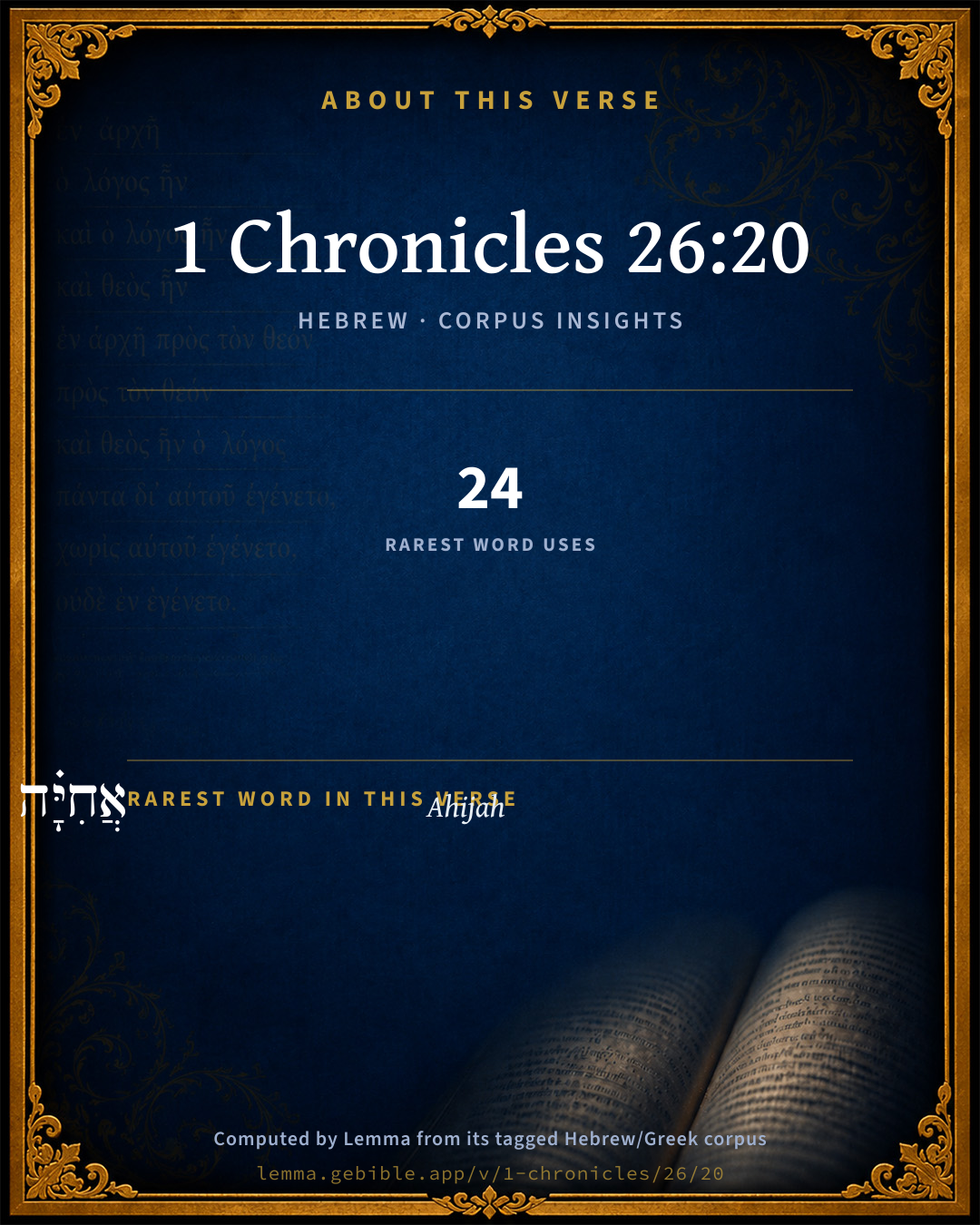
The rarest word here is אֲחִיָּ֗ה Ahijah H281 — appearing just 24 times in the whole Hebrew Bible.

Shared distinctive vocabulary

אֲחִיָּ֗ה Ahijah H281 occurs in 23 verses of the Hebrew Bible. Also found in:

Grammatical profile

  • 7 nouns
  • 1 preposition

Repetition

A word recurs within this verse — often emphatic in Hebrew:

  • אֽוֹצְרוֹת֙ storehouse H214 ×2

Hebrew & Septuagint length

In English translation the verse runs 21 words from the Hebrew and 23 from the Septuagint (LXX English) — closely comparable.

A rough comparison of the two English renderings, which tokenize alike — not a word-level alignment.

Word counts can differ between the Hebrew and the Greek without any difference in meaning — e.g. the Hebrew direct-object marker אֵת has no separate Greek word, and Greek often adds the article ὁ.

Cross-references

15

Topical passages linked to 1 Chronicles 26:20 in the Treasury of Scripture Knowledge — connected by theme and wording, ordered by reader-vote popularity; previews shown in the World English Bible.

  • 1 Chronicles 26:22 The sons of Jehieli: Zetham, and Joel his brother, over the treasures of the house of Yahweh.
  • 1 Kings 7:51 Thus all the work that king Solomon worked in the house of Yahweh was finished. Solomon brought in the things which David his father had dedicated, [even] the silver, and the gold, and the vessels, and put them in the treasuries of the house of Yahweh.
  • 1 Kings 14:26 and he took away the treasures of the house of Yahweh, and the treasures of the king's house; he even took away all: and he took away all the shields of gold which Solomon had made.
  • 1 Kings 15:18 Then Asa took all the silver and the gold that were left in the treasures of the house of Yahweh, and the treasures of the king's house, and delivered them into the hand of his servants; and king Asa sent them to Ben Hadad, the son of Tabrimmon, the son of Hezion, king of Syria, who lived at Damascus, saying,
  • 1 Chronicles 9:26–30 for the four chief porters, who were Levites, were in an office of trust, and were over the chambers and over the treasuries in the house of God.
  • 1 Chronicles 18:11 These also did king David dedicate to Yahweh, with the silver and the gold that he carried away from all the nations; from Edom, and from Moab, and from the children of Ammon, and from the Philistines, and from Amalek.
  • 1 Chronicles 22:3–4 David prepared iron in abundance for the nails for the doors of the gates, and for the couplings; and brass in abundance without weight;
  • 1 Chronicles 22:14–16 Now, behold, in my affliction I have prepared for the house of Yahweh one hundred thousand talents of gold, and one thousand thousand talents of silver, and of brass and iron without weight; for it is in abundance: timber also and stone have I prepared; and you may add to them.
  • 1 Chronicles 26:24 and Shebuel the son of Gershom, the son of Moses, was ruler over the treasures.
  • 1 Chronicles 26:26–28 This Shelomoth and his brothers were over all the treasures of the dedicated things, which David the king, and the heads of the fathers' [houses], the captains over thousands and hundreds, and the captains of the host, had dedicated.
  • 1 Chronicles 28:12–19 and the pattern of all that he had by the Spirit, for the courts of the house of Yahweh, and for all the surrounding rooms, for the treasuries of the house of God, and for the treasuries of the dedicated things;
  • 1 Chronicles 29:2–8 Now I have prepared with all my might for the house of my God the gold for the [things of] gold, and the silver for the [things of] silver, and the brass for the [things of] brass, the iron for the [things of] iron, and wood for the [things of] wood; onyx stones, and [stones] to be set, stones for inlaid work, and of various colors, and all manner of precious stones, and marble stones in abundance.
  • 2 Chronicles 31:11–12 Then Hezekiah commanded to prepare chambers in the house of Yahweh; and they prepared them.
  • Ezra 2:69 they gave after their ability into the treasury of the work sixty-one thousand darics of gold, and five thousand minas of silver, and one hundred priests' garments.
  • Malachi 3:10 Bring the whole tithe into the store-house, that there may be food in my house, and test me now in this," says Yahweh of hosts, "if I will not open you the windows of heaven, and pour you out a blessing, that there shall not be room enough for.

Cross-references courtesy of OpenBible.info (CC BY 4.0).

Hebrew and Greek witnesses Masoretic Hebrew ↔ Greek Septuagint

The same verse in the two great witnesses to the Old Testament, shown verse-for-verse.

These are two independent witnesses, not word-aligned to each other, and the Septuagint is shown in lemma (dictionary) form.

Hebrew 1 Chronicles 26:20 Masoretic · Westminster Leningrad Codex

וְֽהַלְוִיִּ֑ם אֲחִיָּ֗ה עַל אֽוֹצְרוֹת֙ בֵּ֣ית הָאֱלֹהִ֔ים וּלְאֹֽצְר֖וֹת הַקֳּדָשִֽׁים

Of the Levites, Ahijah was over the treasures of the house of God, and over the treasures of the dedicated things.

World English Bible · Public Domain

Greek LXX 1 Chronicles 26:20 Septuagint · lemma form

καί ὁ λευίτης ἀδελφός αὐτός ἐπί ὁ θησαυρός οἶκος κύριος καί ἐπί ὁ θησαυρός ὁ καταἁγιάζω

And the Levites their brethren were over the treasures of the house of the Lord, and over the treasures of the hallowed things.

LXX2012 (modern English Septuagint) · Public Domain

On this verse, Jamieson, Fausset & Brown discusses the Septuagint’s reading. Read the note in Commentary ↓

Hebrew: Westminster Leningrad Codex (CC BY 4.0). Greek: Septuagint (public domain); English from LXX2012 (modern English Septuagint) (Public Domain). How the Septuagint differs from the Hebrew →

Commentary

Notes on 1 Chronicles 26:20 from classic Christian and Jewish commentators (each source and its license shown beneath its notes). The classic Christian expositions comment on the surrounding passage and are grouped to its opening verse, so a note may address several verses; the Jewish commentaries on the Tanakh (Rashi and others) are per-verse, so they appear only where the commentator wrote on this verse.

Lemma curates 59 commentaries, every one of them public domain or Creative Commons licensed, each selected and text-cleaned for this edition rather than reprinted as found. About our sources →

Matthew Henry's Commentary

Observe, 1. There were treasures of the house of God. A great house cannot be well kept without stores of all manner of provisions. Much was expended daily upon the altar - flour, wine, oil, salt, fuel, besides the lamps; quantities of these were to be kept beforehand, besides the sacred vestments and utensils. These were the treasures of the house of God. And, because money answers all things, doubtless they had an abundance of it, which was received from the people's offerings, wherewith they bought in what they had occasion for. And perhaps much was laid up for an exigence. These treasures typified the plenty there is in our heavenly Father's house, enough and to spare. In Christ, the true temple, are hid treasures of wisdom and knowledge, and unsearchable riches. 2. There were treasures of dedicated things, dedicated mostly out of the spoils won in battle (Ch1 26:27), as a grateful acknowledgment of the divine protection. Abraham gave Melchisedec the tenth of the spoils Heb 7:4. In Moses's time the officers of the army, when they returned victorious, brought of their spoils an oblation to the Lord, Num 31:50. Of late this pious custom had been revived; and not only Samuel and David, but Saul, and Abner, and Joab, had dedicated of their spoils to the honour and support of the house of God, Ch1 26:28. Note, The more God bestows upon us the more he expects from us in works of piety and charity. Great successes call for proportionable returns. When we look over our estates we should consider, "Here are convenient things, rich things, it may be, and fine things; but where are the dedicated things?" Men of war must honour God with their spoils. 3. These treasures had treasurers, those that were over them (Ch1 26:20, Ch1 26:26), whose business it was to keep them, that neither moth nor rust might corrupt them, nor thieves break through and steal, to give out as there was occasion and to see that they were not wasted, embezzled, or alienated to the common use; and it is probable that they kept accounts of all that was brought in and how it was laid out.

Matthew Henry's Commentary on the Whole Bible (1708–1710) — public domain (CC PDM 1.0). Text via the HelloAO Bible API.

Jamieson, Fausset & Brown

Robert Jamieson, A. R. Fausset & David Brown

LEVITES THAT HAD CHARGE OF THE TREASURES. (Ch1 26:20-28)

of the Levites, Ahijah--The heading of this section is altogether strange as it stands, for it looks as if the sacred historian were going to commence a new subject different from the preceding. Besides, "Ahijah, whose name occurs after" the Levites, is not mentioned in the previous lists. It is totally unknown and is introduced abruptly without further information; and lastly, Ahijah must have united in his own person those very offices of which the occupants are named in the verses that follow. The reading is incorrect. The Septuagint has this very suitable heading, "And their Levitical brethren over the treasures," &c. [BERTHEAU]. The names of those who had charge of the treasure chambers at their respective wards are given, with a general description of the precious things committed to their trust. Those treasures were immense, consisting of the accumulated spoils of Israelitish victories, as well as of voluntary contributions made by David and the representatives of the people.

Jamieson, Fausset & Brown — Commentary Critical and Explanatory on the Whole Bible (1871) — public domain (CC PDM 1.0). Text via the HelloAO Bible API.

Ellicott's Commentary for English Readers

II.—THE KEEPERS OF THE TEMPLE TREASURES

(1Ch_26:20-28).

(20) And of the Levites, Ahijah was over the treasures of the house of God.—Literally, And the Levites—Ahijah over the treasures, . . . a strange beginning, for hitherto none but Levites have been in question. We should have expected at least “the other Levites.” Further, the name Ahijah is suspicious, because (1) not found among the proper names in 1Ch_23:7 sqq.; (2) it stands alone, without any reference to a family, such as is made in every other case (see 1Ch_26:21-25); (3) the addition of the single letter m at the end of the word, would give the sense “their brethren,” which is in fact the reading of the LXX. Read therefore, And the Levites their brethren were over the treasures; that is, the Levites other than those whose duties have already been described.

Treasures of the house of God.—The ordinary revenues and stores of the Sanctuary, including various kinds of legally prescribed contributions, and special gifts (see Exo_30:11-14; Leviticus 27; Num_18:16; 1Ch_29:7-8).

Treasures of the dedicated things.—See margin and 1Ch_26:26-27.

A Bible Commentary for English Readers, edited by Charles John Ellicott (1878–1897) — public domain. Text from a community e-Sword module.

Joseph Benson's Commentary

1Ch 26:20. The treasures of the house of God, and the treasures of the dedicated things — These seem to be two different kinds of treasures, the former containing the sacred vessels and other treasures, which by God’s command were appropriated to the maintenance of the house; the latter only those things which had been freely given or dedicated to God.

Joseph Benson's Commentary on the Old and New Testaments (1811–1818) — public domain. Text from a community e-Sword module.

Tyndale Open Study Notes

Tyndale Open Resources

26:20-32 In preparation for Solomon’s succession to the throne, David appointed these officials as part of his comprehensive organization of the Levitical orders at the end of his reign. The officers included treasurers, administrators, and judges who were part of the political bureaucracy.

Tyndale Open Study Notes — © Tyndale Open Resources, licensed CC BY-SA 4.0. Text via the HelloAO Bible API.

Adam Clarke's Commentary

Verse 20. The treasures of the house of God] Where the money was kept, which was to be expended in oblations for the temple.-Jarchi.

Adam Clarke's Commentary on the Bible (1810–1826) — public domain. Text from a community e-Sword/MySword module.

The Cambridge Bible for Schools and Colleges

gen. ed. J. J. S. Perowne

20–32. Various Offices

20. And of the Levites, Ahijah was over] Read (with LXX.; cp. R.V. marg.), And the Levites their brethren were over. The confusion of readings is easy in Hebrew; cp. 1Ch_2:25 for a similar case.

the treasures] R.V. the treasuries; so in 1Ch_26:22; 1Ch_26:24; 1Ch_26:26; and so in 1Ch_28:11-12 (A.V.).

the dedicate things] Cp. 1Ch_26:26-28.

The Cambridge Bible for Schools and Colleges (gen. ed. J. J. S. Perowne; Cambridge University Press, 1878–1918) — public domain. Text from a community e-Sword module.

John Gill's Exposition

Of the Amramites and the Izharites, the Hebronites, and the Uzzielites. Who sprang from the four sons of Kohath, Amram, Izhar, Hebron, and Uzziel, Exo 6:18 with respect to the concerns they severally had in the trust of the treasures, the account follows, all but the Uzzielites, who are not after mentioned.

with respect to the concerns they severally had in the trust of the treasures, the account follows, all but the Uzzielites, who are not after mentioned.

1 Chronicles 26:24

ch1 26:24

ch1 26:24

ch1 26:24And Shebuel the son of Gershom, the son of Moses, was ruler of the treasures. This is the first time that any of the posterity of Moses are taken notice of, as being in any office of honour, authority, and trust; by the Targum he is said to be Jonathan, spoken of in Jdg 18:30 but very wrongly; this man, according to Jarchi and Kimchi, had all the treasures and treasurers under him.

John Gill's Exposition of the Whole Bible (1746–1763) — public domain (CC PDM 1.0). Text via the HelloAO Bible API.

Haydock's Catholic Bible Commentary

Now. Hebrew and Septuagint add, "the Levites:" the latter translate Achias, "their brethren." (Haydock) --- Vessels. Or vessels of the holy places, or of things holy. Vasa sanctorum. (Challoner) --- Septuagint, "of the consecrated treasures," chap. xxviii. 12. (Haydock)

George Leo Haydock (1774–1849), Haydock's Catholic Family Bible and Commentary, 1859 edition — public domain. Excludes Psalms (Douay-Rheims chapter numbering differs from Protestant) and Deuterocanonical books (Catholic canon only).

Matthew Poole's English Annotations

Either these are the same kind of treasures, the latter phrase only explaining the former, the particle and being used for that is; or rather, they are two different kinds of treasures, the former containing the sacred vessels and other treasures, which by God’s command were appropriated to the maintenance of the house, and worship, and ministers of God, as tithes, and first-fruits, and other things; and the latter only those things which had been freely given or dedicated to God for those ends; of which 1Ch 26:26,27.

Matthew Poole's English Annotations on the Holy Bible (1683–1685) — public domain. Text from a community e-Sword/MySword module.

The Pulpit Commentary

Vers. 20-28. These verses describe those Levites to whom belonged the care of the treasures of the house of God and of the treasures of things dedicated, i.e. "dedicated to maintain the house of the Lord" (vers. 27, 28).

First, the Hebrew text contains no "of" in the first word of this verse; and, secondly, no meaning can be obtained cut of the name Ahijah as it is placed here. The Septuagint reading, "their brethren," is exactly what we should expect, and is paralleled by other passages. (2Ch_29:34) This correction of the present text may be safely accepted, viz. for hYhia The two classes of treasures are here marked, preparatory to the statements of vers. 22 and 26-28.

Temple treasures.

Only very thoughtless persons can suppose that religion and money can be dissociated. In this world things material and spiritual are so blended that we have not to ask Must the cause of God have anything to do with wealth and property? but What are the proper and scriptural relations between them? In explaining these, we remark

I ALL TREASURE IS THE LORD"S. He created all that men use and prize. It is his own property. If we give to him, we can only give "of his own.

II IN THE HANDS OF THE LORD"S PEOPLE TREASURE IS A TRUST. The irreligious cannot be expected so to regard it; but it is marvellous that enlightened Christians can ever lock upon the matter in any other light. God lends men their possessions that they may use them for his glory, and prepare to give in an account to himself, approving their fidelity and piety.

III TREASURE MAY BE CONSECRATED TO THE LORD"S TEMPLE. What in the olden time among the Jews the temple at Jerusalem was regarded as being, that the Church of Christ is in this dispensation. And money may lawfully and wisely be expended in the erection of churches, chapels, schools, mission-rooms, etc., and in the maintenance of pastors, teachers, and evangelists. Christian wisdom may define the limits and extent of generous gifts. But, although in the ages of superstition there may have been danger of excess in donations and endowments, there is very little danger in our days, when large sums are spent on personal luxuries and ostentation, and when there is an impression that the one special department for economy is religion.

IV IT IS IMPORTANT THAT THE LORD"S TREASURE SHOULD BE IN SAFE KEEPING. It is an honourable office to have charge of religions and benevolent funds. It should be regarded as a stewardship from Heaven. Many who cannot preach or teach may render service in Christ"s Churches by acting as treasurers and almoners, and by their faithful custody and wise disbursement of funds may serve the body of Christ and please the Divine Head. T.

On dedicating things.

The general idea seems to be that Christians must dedicate themselves to God; and though this is most true, it may be presented so as to hide away the fact that God requires the Christian to dedicate to him all he has , as well as all he is. Still, as in the older times, God is to be served by things as well as by persons. In the text it is noticed that "Ahijah was over the treasures of the house of God, and over the treasures of the dedicated things. " It may be well to point out the important relations which things bear to persons.

(1) The sense of possession in things.

(2) The selection and preservation of things as expressing character.

(3) The power of representation in things; a gift may carry a man himself to his friend.

(4) The use of things to indicate feeling. It may be said that God does not really care for "things," and that all "things" are already his; that he even refuses sacrifice and offerings, and only asks for men"s devotion, love, and trust.

But if God permits us to have the sense of possession, and, in ever so limited a sense, to call things our own, we may be sure that he does care for things, because they can do just what our voice in worship can do

(1) reveal man to him; and

(2) express man"s particular emotions to him. We can translate into their fitting meanings other signs than verbal ones; and we can make our acts, our gifts, and our possessions speak his praise, directly, and through others whom we may influence and inspire by the devotion to God of what we have.

Then show what our things may be made to express, illustrating from the devotion of our property and acquirements to God"s service.

(1) Dependence on the living God, who giveth to us "all things richly to enjoy.

(2) Thanksgiving to him, whose gifts so manifestly pass our deserts.

(3) Consecration of self; for to be acceptable everything must carry to God ourselves his "living sacrifices.

(4) Zeal in his honour, that keeps us anxious to devote to him our best. Plead where are our dedicated things"? Are they worthy of us? Are they worthy of the God whom we love, who has done such great things for us? R.T.

The Pulpit Commentary (1880–1919), ed. H.D.M. Spence-Jones & Joseph S. Exell — public domain. Text from a community e-Sword module.

John Wesley's Explanatory Notes

Treasures - There seem to be two different kinds of treasures, the former containing the sacred vessels and other treasures, which by God's command were appropriated to the maintenance of the house; the latter only those things which had been freely given or dedicated to God.

John Wesley, Explanatory Notes Upon the Whole Bible (1754–1765) — public domain. Text via the GEBible commentary corpus.

Keil & Delitzsch

C. F. Keil & F. Delitzsch

Of the Amramites and the Izharites, the Hebronites, and the Uzzielites. Who sprang from the four sons of Kohath, Amram, Izhar, Hebron, and Uzziel, Exo 6:18 with respect to the concerns they severally had in the trust of the treasures, the account follows, all but the Uzzielites, who are not after mentioned.

with respect to the concerns they severally had in the trust of the treasures, the account follows, all but the Uzzielites, who are not after mentioned.

1 Chronicles 26:24

ch1 26:24

ch1 26:24

ch1 26:24And Shebuel the son of Gershom, the son of Moses, was ruler of the treasures. This is the first time that any of the posterity of Moses are taken notice of, as being in any office of honour, authority, and trust; by the Targum he is said to be Jonathan, spoken of in Jdg 18:30 but very wrongly; this man, according to Jarchi and Kimchi, had all the treasures and treasurers under him.

Keil & Delitzsch — Biblical Commentary on the Old Testament (1861–1891) — public domain (CC PDM 1.0). Text via the HelloAO Bible API. (Old Testament only.)

Kretzmann's Popular Commentary

Paul E. Kretzmann

The Levites in Charge of the Treasures and the officers

v. 20. And of the Levites, Ahijah was over the treasures of the house of God and over the treasures of the dedicated things, such gifts as were consecrated to the Lord as special gifts of thanksgiving by David. This general statement is now specialized.

v. 21. As concerning the sons of Laadan (or Libni), the sons of the Gershonite Laadan, chief fathers, even of Laadan the Gershonite, were Jehieli.

v. 22. The sons of Jehieli: Zetham and Joel, his brother, which were over the treasures of the house of the Lord, the Temple treasures in the strictest sense.

v. 23. of the Amramites and the Izharites, the Hebronites and the Uzzielites;

v. 24. and Shebuel. the son of Gershom, the son of Moses, was ruler of the treasures, the chief administrator or superintendent of all the Sanctuary treasures.

v. 25. And his brethren by Eliezer, that is, springing from Moses by Eliezer: Rehabiah, his son; and Jeshaiah, his son; and Joram, his son; and Zichri, his son; and Shelomith, his son.

v. 26. Which Shelomith and his brethren were over all the treasures of the dedicated things, booty and gifts consecrated to the Lord, which David the king and the chief fathers, the captains over thousands and hundreds, and the captains of the host, had dedicated.

v. 27. Out of the spoils won in battles, literally, "out of the wars and the spoil," did they dedicate to maintain the house of the Lord, to build it of such a size and magnificence as David had planned.

v. 28. And all that Samuel, the seer, and Saul, the son of Kish, and Abner, the son of Ner, and Joab, the son of Zeruiah, the various leaders and commanders of the army, had dedicated; and whosoever had dedicated anything, it was under the hand of Shelomith and of his brethren, they had the charge of, and the responsibility for, all this precious material.

v. 29. of the Izharites, Chenaniah and his sons were for the outward business over Israel, for officers, that is, scribes, and judges. In the hands of these officers and their assistants was the entire administration of the external business concerned with the Temple and its up-keep in Israel, the exaction of taxes, the payment of tithes, and all other similar business.

v. 30. And of the Hebronites, Hashabiah and his brethren, men of valor, a thousand and seven hundred, were officers among them of Israel on this side Jordan westward in all the business of the Lord and in the service of the king, being spiritual overseers of the people with reference to their duty toward the established worship.

v. 31. Among the Hebronites was Jerijah the chief, even among the Hebronites, according to the generations of his fathers. In the fortieth, that is, in the last, year of the reign of David they were sought for, and there were found among them mighty men of valor at Jazer of Gilead, which explains the fact that the oversight on the eastern side of Jordan was also in the hands of the Hebronites.

v. 32. And his brethren, men of valor, were two thousand and seven hundred chief fathers, in this case family fathers, whom King David made rulers over the Reubenites, the Gadites, and the half-tribe of Manasseh for every matter pertaining to God and affairs of the king, their position being that of magistrates, of officials exercising judicial functions, since the Law of God was also the law of the land, in a modified theocratic government.

Paul E. Kretzmann, Popular Commentary of the Bible (1921–1924) — public domain. Text from a community e-Sword module.

unfoldingWord translationNotes

Door43 World Missions Community

The descendants of Ladan ... Jehieli, the sons of Jehieli, Zetham, and Joel his brother. They were in charge of the storehouses

"Jehieli and his sons were the descendants of Ladan, who descended from Gershon and belonged to Ladan. Jehieli and his sons were leaders of the families of Ladan the Gershonite. Jehieli and his sons, Zetham and Joel his brother, were in charge of the storehouses"

Ladan ... Gershon

Translate the names of these men the same as you did in 1 Chronicles 23:7. (See: How to Translate Names)

Gershonite

The descendants of Gershon. (See: How to Translate Names)

Jehieli ... Zetham ... Joel

Translate the names of these men the same as you did in 1 Chronicles 23:8. (See: How to Translate Names)

translationWords

Ahijah

family

unfoldingWord translationNotes — © Distant Shores Media and the Door43 World Missions Community, licensed CC BY-SA 4.0. Source: git.door43.org/Door43/en_tn.

Rashi

Rabbi Shlomo Yitzchaki (Rashi)

And the Levites: Ahiah over the treasuries, etc. He was appointed over the money with which sacrifices were purchased for the House of God, such as the holy sacrifices (sic).

Rashi on the Tanakh — English translations: “The Judaica Press complete Tanach with Rashi, translated by A. J. Rosenberg” (CC BY 4.0); “Pentateuch with Rashi's commentary by M. Rosenbaum and A.M. Silbermann, 1929-1934” (public domain); “The Metsudah Tanach series, Lakewood, N.J” (CC BY 4.0); and “The Book of Joshua, Metsudah Publications, 1997” (CC BY 4.0). Text via Sefaria.

Lesson kit

Teaching starters — assembled from the data on this page, not authored interpretation. Every prompt links to the verse data it draws on. Edit before teaching.

1 Chronicles, in the Historical, opens this verse with 8 words (7 distinct Hebrew lemmas). Its most distinctive word is ʼĂchîyâh (“Ahijah”). A historical commentator’s framing appears above. Read the whole chapter for the surrounding context.

Discussion questions

  1. How does “Ahijah” (ʼĂchîyâh) shape what this verse is saying?
  2. How does 1 Samuel 14:3, which shares the word «Ahijah», read alongside this verse?
  3. What does the repetition of “storehouse” (2× in this one verse) do in this verse?
  4. These translations render this verse differently; the difference is in the English rendering, not the original. What questions does that raise?
  5. Compare how Matthew Henry's Commentary and Jamieson, Fausset & Brown read this verse. Where do they agree or differ?

Things to notice

  • These translations choose different wording for 5 words in this verse.
  • “storehouse” occurs 2× in this single verse.
  • 7 distinct Hebrew lemmas span 8 words in this verse.

Reading settings

Reading text

Shown beneath each verse's original-language words.

Old Testament
Old Testament edition

Read the OT as the Masoretic Hebrew (MT) or the Greek Septuagint (LXX).

English shown for the Greek Septuagint (in the Hebrew ↔ Greek comparison).

Comparing translations? Open the Compare panel on any verse page to stack up to four side by side.