
Leviticus 22:15

Hebrew (Westminster Leningrad Codex) Leviticus 22:15 appears in the Hebrew Old Testament. The text above is from the Westminster Leningrad Codex. Each word links to its Strong’s number, a concise gloss, and parsing drawn from the Open Scriptures Hebrew Bible morphology. Click any word for its full Brown-Driver-Briggs (BDB) entry.
Download image
Cite this verse

Leviticus 22:15 (World English Bible). Public Domain. Lemma interlinear Bible study tool, https://lemma.gebible.app/v/leviticus/22/15.

Show BibTeX & RIS
BibTeX
RIS
English Translation
The priests shall not profane the holy things of the children of Israel, which they offer to Yahweh,
World English Bible · Public Domain
Download a study sheet

One document with this verse’s original text, its word-by-word gloss line, the meaning frame, cross-references with their text, attributed commentary, and full source and license credits — printable, and it pastes into notes with its structure intact.

This verse Autodidact and up

Study sheet (.html) Plain text (.txt)

A passage Seminary Student

Up to 50 verses in one chapter. A passage sheet keeps up to 6 commentary sources and 12 cross-references per verse, in the order this page ranks them, and says so on the sheet whenever that leaves anything out. Ask for a single verse and you get the Autodidact verse sheet above.

Everything on this page stays free to read, with no account — the sheet is a download of what is already on screen, not access to it.

Want to remove ads? Support Godless Engineer
Compare translations 3

The same verse in 3 English versions, stacked beneath the original-language interlinear above. Click any original word for its lexicon entry.

Each is an independent rendering of the whole verse — the interlinear is not word-aligned to these translations.

Highlighted words mark where these versions differ — a whole-verse word diff, not a word-by-word alignment.

  • World English Bible Public Domain
    The priests shall not profane the holy things of the children of Israel, which they offer to Yahweh,
  • King James Version Public Domain
    And they shall not profane the holy things of the children of Israel, which they offer unto the LORD;
  • unfoldingWord Literal Text CC BY-SA 4.0
    And they shall not profane the holy things of the sons of Israel, that which they raise to Yahweh,

unfoldingWord Literal Text — © unfoldingWord, licensed CC BY-SA 4.0. Word-aligned USFM3 via Door43 (git.door43.org/unfoldingWord/en_ult).

Versions to compare (up to 4)

3 of 4 selected

Show all 18 translations

Every available English version of this verse, each an independent rendering of the whole verse.

  • World English Bible Public Domain
    The priests shall not profane the holy things of the children of Israel, which they offer to Yahweh,
  • Berean Standard Bible Public Domain
    The priests must not profane the sacred offerings that the Israelites present to the LORD
  • Majority Standard Bible Public Domain
    The priests must not profane the sacred offerings that the Israelites present to the LORD
  • King James Version Public Domain
    And they shall not profane the holy things of the children of Israel, which they offer unto the LORD;
  • American Standard Version (1901) Public Domain
    And they shall not profane the holy things of the children of Israel, which they offer unto Jehovah,
  • Revised Version (1885) Public Domain
    And they shall not profane the holy things of the children of Israel, which they offer unto the LORD;
  • Geneva Bible (1599) Public Domain
    So they shall not defile the holy things of the children of Israel, which they offer vnto the Lord,
  • Douay-Rheims (1899) Public Domain
    And they shall not profane the sanctified things of the children of Israel, which they offer to the Lord:
  • Young's Literal Translation Public Domain
    and they do not pollute the holy things of the sons of Israel -- that which they lift up to Jehovah,
  • Literal Standard Version CC BY-SA 4.0
    and they do not defile the holy things of the sons of Israel—that which they lift up to YHWH,
  • Unlocked Literal Bible CC BY-SA 4.0
    The people of Israel must not profane the holy things that they have raised high and presented to Yahweh,
  • unfoldingWord Literal Text CC BY-SA 4.0
    And they shall not profane the holy things of the sons of Israel, that which they raise to Yahweh,
  • Darby Bible Public Domain
    And they shall not profane the holy things of the children of Israel which they offer unto Jehovah,
  • World Messianic Bible Public Domain
    The priests shall not profane the holy things of the children of Israel, which they offer to the LORD,
  • Webster's Bible Public Domain
    And they shall not profane the holy things of the children of Israel which they offer to the LORD;
  • Free Bible Version CC BY-SA 4.0
    The priests must not make the holy offerings the Israelites present to the Lord unclean
  • Bible in Basic English Public Domain
    And they may not make common the holy things which the children of Israel give to the Lord,
  • JPS Tanakh (1917) Public Domain
    And they shall not profane the holy things of the children of Israel, which they set apart unto the LORD;

Literal Standard Version (2020), Covenant Press — licensed CC BY-SA 4.0. Text via the HelloAO Bible API (eBible.org). Unlocked Literal Bible (unfoldingWord) — licensed CC BY-SA 4.0. Text via the HelloAO Bible API (eBible.org). unfoldingWord Literal Text — © unfoldingWord, licensed CC BY-SA 4.0. Word-aligned USFM3 via Door43 (git.door43.org/unfoldingWord/en_ult). Free Bible Version, Dr. Jonathan Gallagher — licensed CC BY-SA 4.0. Text via the HelloAO Bible API (eBible.org).

Word by word

More ways to search: Search by grammar → Find every occurrence → Compare this word →

Practice this passage: Drill this verse → Learn its vocabulary →

יְחַלְּל֔וּ
châlal
H2490
“to profane”
Verb, Piel, Imperfect, 3rd Person, Masculine, Plural
Part of Speech
Verb
Stem
Piel
Form
Imperfect
Person
3rd Person
Gender
Masculine
Number
Plural
Full BDB Definition

Origin: a primitive root [compare H2470 ]

TWOT: 660 , 661

to profane, defile, pollute, desecrate, begin - (Niphal) - to profane oneself, defile oneself, pollute oneself - ritually - sexually - to be polluted, be defiled - (Piel) - to profane, make common, defile, pollute - to violate the honour of, dishonour - to violate (a covenant) - to treat as common - (Pual) to profane (name of God) - (Hiphil) - to let be profaned - to begin - (Hophal) to be begun - to wound (fatally), bore through, pierce, bore - (Qal) to pierce - (Pual) to be slain - (Poel) to wound, pierce - (Poal) to be wounded - (Piel) to play the flute or pipe
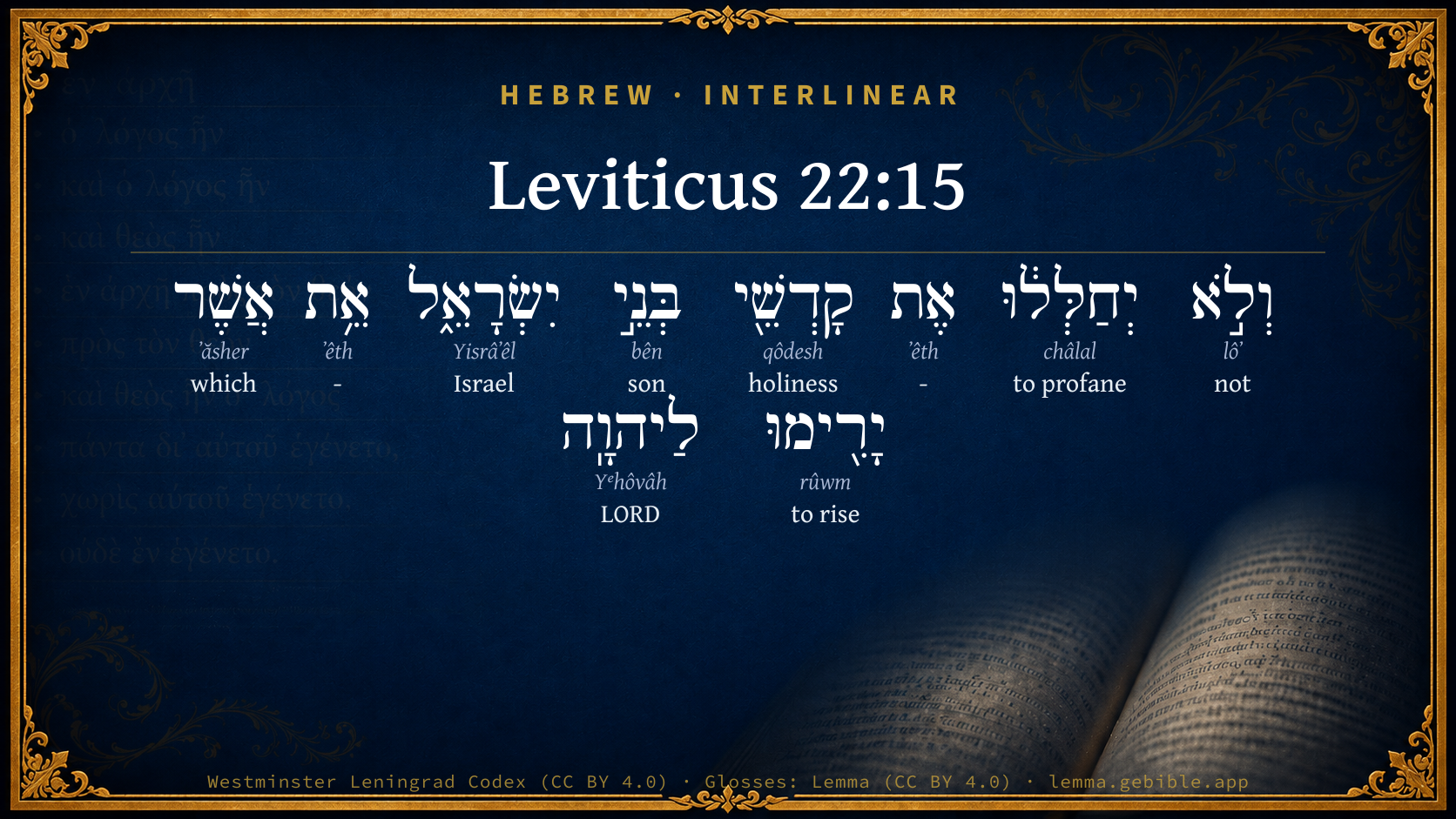
  1. וְלֹ֣א lôʼ H3808 “and · not” Conjunction + Particle, Negative
  2. אֶת ʼêth H853 “-” Particle, Direct Object
  3. קָדְשֵׁ֖י qôdesh H6944 “holy things of” Noun, Common, Masculine, Plural, Construct
  4. בְּנֵ֣י bên H1121 “sons of” Noun, Common, Masculine, Plural, Construct
  5. יִשְׂרָאֵ֑ל Yisrâʼêl H3478 “Israel” Noun, Proper
  6. אֵ֥ת ʼêth H853 “-” Particle, Direct Object
  7. אֲשֶׁר ʼăsher H834 “which” Particle, Relative
  8. יָרִ֖ימוּ rûwm H7311 “to rise” Verb, Hiphil, Imperfect, 3rd Person, Masculine, Plural
  9. לַיהוָֽה Yᵉhôvâh H3068 “to/for · LORD” Preposition + Noun, Proper

About this verse

These counts appear in no published source. They are computed here, from the morphology-tagged text and Lemma’s own curated glosses. What Lemma adds →

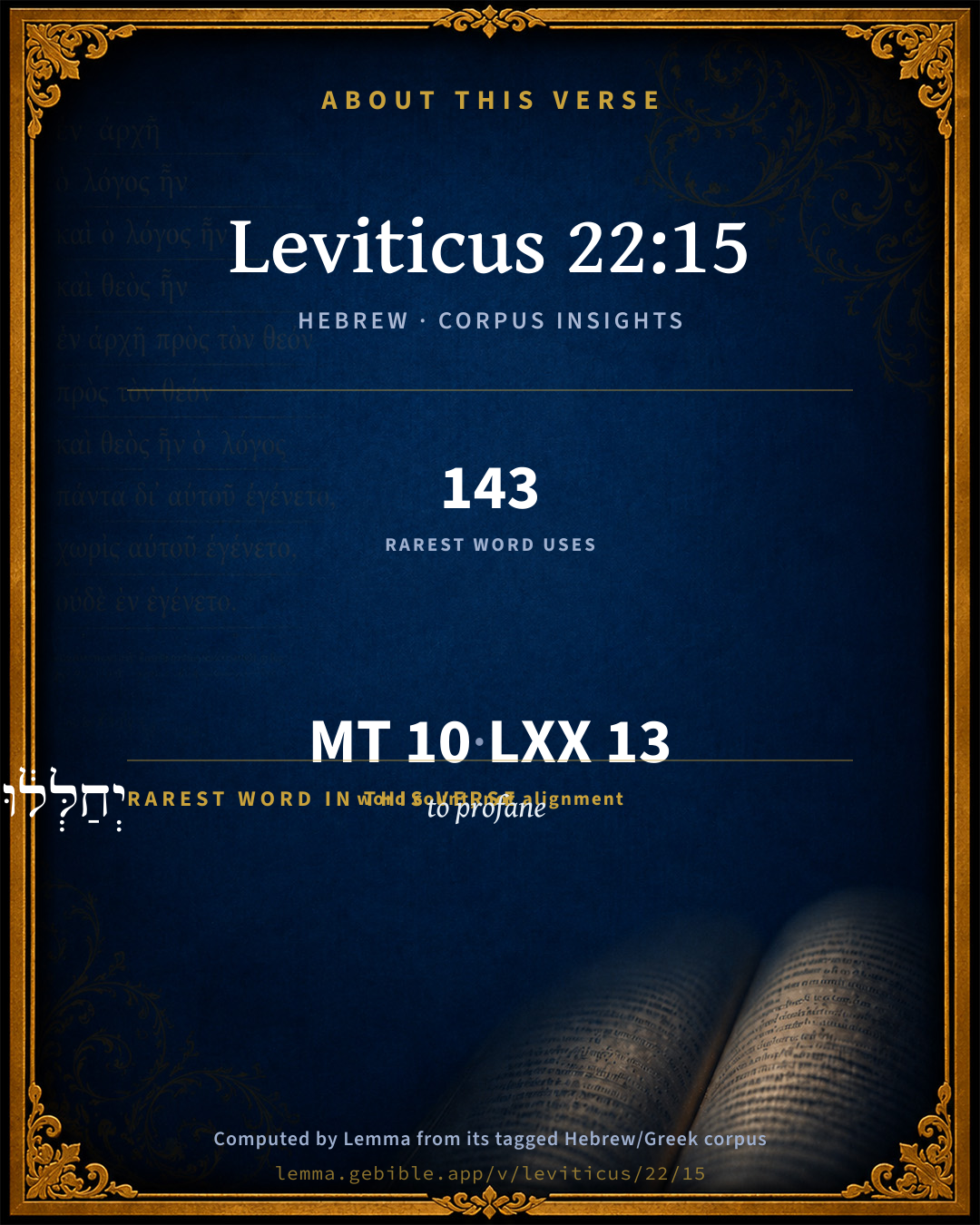
10
words
9
distinct lemmas
Pentateuch
section

Grammatical profile

  • 2 verbs
  • 4 nouns
  • 4 particles

Verb forms

  • יְחַלְּל֔וּ Piel · Imperfect
  • יָרִ֖ימוּ Hiphil · Imperfect

Hebrew & Septuagint length

In English translation the verse runs 18 words from the Hebrew and 19 from the Septuagint (LXX English) — closely comparable.

A rough comparison of the two English renderings, which tokenize alike — not a word-level alignment.

Word counts can differ between the Hebrew and the Greek without any difference in meaning — e.g. the Hebrew direct-object marker אֵת has no separate Greek word, and Greek often adds the article ὁ.

In the original languages it is 10 Hebrew tokens and 13 Greek tokens — but the two are counted differently (Hebrew bundles its prefixes and suffixes into one token; the Greek is in lemma form), so that isn’t a like-for-like length.

Cross-references

4

Topical passages linked to Leviticus 22:15 in the Treasury of Scripture Knowledge — connected by theme and wording, ordered by reader-vote popularity; previews shown in the World English Bible.

  • Numbers 18:32 You shall bear no sin by reason of it, when you have heaved from it the best of it: and you shall not profane the holy things of the children of Israel, that you not die.
  • Leviticus 19:8 but everyone who eats it shall bear his iniquity, because he has profaned the holy thing of Yahweh, and that soul shall be cut off from his people.
  • Leviticus 22:9 "'They shall therefore keep my charge, lest they bear sin for it, and die therein, if they profane it. I am Yahweh who sanctifies them.
  • Ezekiel 22:26 Her priests have done violence to my law, and have profaned my holy things: they have made no distinction between the holy and the common, neither have they caused men to discern between the unclean and the clean, and have hid their eyes from my Sabbaths, and I am profaned among them.

Cross-references courtesy of OpenBible.info (CC BY 4.0).

Hebrew and Greek witnesses Masoretic Hebrew ↔ Greek Septuagint

The same verse in the two great witnesses to the Old Testament, shown verse-for-verse.

These are two independent witnesses, not word-aligned to each other, and the Septuagint is shown in lemma (dictionary) form.

Hebrew Leviticus 22:15 Masoretic · Westminster Leningrad Codex

וְלֹ֣א יְחַלְּל֔וּ אֶת קָדְשֵׁ֖י בְּנֵ֣י יִשְׂרָאֵ֑ל אֵ֥ת אֲשֶׁר יָרִ֖ימוּ לַיהוָֽה

The priests shall not profane the holy things of the children of Israel, which they offer to Yahweh,

World English Bible · Public Domain

Greek LXX Leviticus 22:15 Septuagint · lemma form

καί οὐ βεβηλόω ὁ ἅγιος ὁ υἱός ἰσραήλ ὅς αὐτός ἀποαἱρέω ὁ κύριος

And they shall not profane the holy things of the children of Israel, which they offer to the Lord.

LXX2012 (modern English Septuagint) · Public Domain

On this verse, John Gill's Exposition discusses the Septuagint’s reading. Read the note in Commentary ↓

Hebrew: Westminster Leningrad Codex (CC BY 4.0). Greek: Septuagint (public domain); English from LXX2012 (modern English Septuagint) (Public Domain). How the Septuagint differs from the Hebrew →

Targum (Aramaic paraphrase)

2

The Targum is the ancient Jewish Aramaic paraphrase of the Hebrew Scriptures — an interpretive translation, not the Hebrew text itself. Onkelos (literal) and Pseudo-Jonathan (expansive) render the Torah, and Jonathan the Prophets. Coverage is partial: where no permissively-licensed English translation exists for a verse, only the Aramaic is shown. This is verse-level text, not a word-by-word alignment to the Hebrew.

  1. Targum Onkelos Torah (Genesis–Deuteronomy)
    וְלָא יְחַלוּן יָת קוּדְשַׁיָא דִבְנֵי יִשְׂרָאֵל יָת דִי יַפְרְשׁוּן קֳדָם יְיָ

    (no public-domain English translation for this verse)

    Targum Onkelos — Aramaic: “Onkelos Genesis” (public domain); “Onkelos Exodus” (public domain); “Onkelos Leviticus” (public domain); “Onkelos Numbers” (public domain); “Onkelos Deuteronomy” (public domain). English: “Sefaria Community Translation” (CC0 1.0 (public-domain dedication)); “J.W. Etheridge. The Targums of Onkelos and Jonathan Ben Uzziel on the Pentateuch. London: Longmans, Green, 1862” (public domain). Text via Sefaria.

  2. Targum Pseudo-Jonathan Torah (Genesis–Deuteronomy)
    וְלָא יִפְסוּן יַת קוּדְשָׁא דִבְנֵי יִשְרָאֵל יַת דְיַפְרְשׁוּן לִשְׁמָא דַיְיָ

    Let them not profane the sacred things of the children of Israel which are set apart unto the Name of the Lord,

    Targum Pseudo-Jonathan — Aramaic: “Targum Jonathan on Genesis” (public domain); “Targum Jonathan on Exodus” (public domain); “Targum Jonathan on Leviticus” (public domain); “Targum Jonathan on Numbers” (public domain); “Targum Jonathan on Deuteronomy” (public domain). English: “The Targum of Jonathan ben Uzziel, trans. J. W. Etheridge, London, 1862” (public domain). Text via Sefaria.

Commentary

Notes on Leviticus 22:15 from classic Christian and Jewish commentators (each source and its license shown beneath its notes). The classic Christian expositions comment on the surrounding passage and are grouped to its opening verse, so a note may address several verses; the Jewish commentaries on the Tanakh (Rashi and others) are per-verse, so they appear only where the commentator wrote on this verse.

Lemma curates 59 commentaries, every one of them public domain or Creative Commons licensed, each selected and text-cleaned for this edition rather than reprinted as found. About our sources →

Trapp's Complete Commentary

John Trapp

Lev 22:15 And they shall not profane the holy things of the children of Israel, which they offer unto the LORD;

Ver. 15. Profane.] By suffering the holy things to be eaten of strangers.

John Trapp, A Commentary or Exposition upon All the Books of the Old and New Testament (1647–1656) — public domain. Text from a community e-Sword module.

Joseph Benson's Commentary

Lev 22:15. They — The people; shall not profane them, by eating them: or the priests shall not profane them, that is, suffer the people to profane them, without censure and punishment.

Joseph Benson's Commentary on the Old and New Testaments (1811–1818) — public domain. Text from a community e-Sword module.

Tyndale Open Study Notes

Tyndale Open Resources

22:15 An Israelite who ate the “most holy” priestly portion as if it were common food would defile it.

Tyndale Open Study Notes — © Tyndale Open Resources, licensed CC BY-SA 4.0. Text via the HelloAO Bible API.

Jamieson, Fausset & Brown

Robert Jamieson, A. R. Fausset & David Brown

they shall not profane the holy things of the children of Israel--There is some difficulty felt in determining to whom "they" refers. The subject of the preceding context being occupied about the priests, it is supposed by some that this relates to them also; and the meaning then is that the whole people would incur guilt through the fault of the priests, if they should defile the sacred offerings, which they would have done had they presented them while under any defilement [CALVIN]. According to others, "the children of Israel" is the nominative in the sentence; which thus signifies, the children of Israel shall not profane or defile their offerings, by touching them or reserving any part of them, lest they incur the guilt of eating what is divinely appointed to the priests alone [CALMET].

Jamieson, Fausset & Brown — Commentary Critical and Explanatory on the Whole Bible (1871) — public domain (CC PDM 1.0). Text via the HelloAO Bible API.

Ellicott's Commentary for English Readers

(15) And they shall not profane.—That is, the priests are not to desecrate the holy gifts of the Israelites by carelessly exposing them, and by not treating them with that sacred regard which is due to their being the bread of God.

A Bible Commentary for English Readers, edited by Charles John Ellicott (1878–1897) — public domain. Text from a community e-Sword module.

John Gill's Exposition

And they shall not profane the holy things of the children of Israel, which they offer unto the Lord. By causing or suffering strangers to eat of them; so Jarchi, referring the words to the priests, who should be careful that strangers ate not of sacred things; or by the strangers themselves eating them, whereby they were profaned and used as common things.

And they shall not profane the holy things of the children of Israel, which they offer unto the Lord. By causing or suffering strangers to eat of them; so Jarchi, referring the words to the priests, who should be careful that strangers ate not of sacred things; or by the strangers themselves eating them, whereby they were profaned and used as common things.

Leviticus 22:16

lev 22:16

lev 22:16

lev 22:16Or suffer them to bear the iniquity of trespass,.... The punishment of sin: either the strangers:

when they eat their holy things; the holy things belonging to the priests, which they permitting them to do, suffer them to be liable to the punishment incurred thereby, or else the priests themselves; so the Septuagint version renders the word "themselves"; and in like manner Jarchi interprets it; and then the sense may be, according to the Targums of Jonathan and Onkelos, that the priests shall bear the punishment of their sins,"when they shall eat the holy things in uncleanness,''which is what is forbidden them in the former part of the chapter; but this seems to be too remote; rather the former sense is best:

for I the Lord do sanctify them; both the priests, to whom the holy things belong, and the holy things for their use, and the use of their families, and them only.

John Gill's Exposition of the Whole Bible (1746–1763) — public domain (CC PDM 1.0). Text via the HelloAO Bible API.

Albert Barnes' Notes on the Bible

These verses are rather difficult. Their meaning appears to be: “The holy things of the children of Israel which are heaved before Yahweh” (see Lev 7:30) “shall not be profaned; and they shall incur a sin of trespass who eat of their holy things (so as to profane them).”

Albert Barnes' Notes on the Bible (1834–1885) — public domain. Text from a community e-Sword/MySword module.

Haydock's Catholic Bible Commentary

They; the common people shall not profane, by touching them afterwards, or by retaining any part. (Calmet) --- The priests shall answer for the profanation, if it be committed through their neglect. (Haydock)

George Leo Haydock (1774–1849), Haydock's Catholic Family Bible and Commentary, 1859 edition — public domain. Excludes Psalms (Douay-Rheims chapter numbering differs from Protestant) and Deuterocanonical books (Catholic canon only).

Matthew Poole's English Annotations

Either,

1. The people shall not profane them, by eating them. Or,

2. The priests shall not profane them, i.e. suffer the people to profane them, without censure and punishment. Both come to the same thing; the people shall not do it, nor the priests suffer it.

Matthew Poole's English Annotations on the Holy Bible (1683–1685) — public domain. Text from a community e-Sword/MySword module.

The Pulpit Commentary

Vers. 15, 16. These verses present some difficulties of construction. The rendering of the Authorized Version is as follows: And they shall not profane the holy things of the children of Israel, which they offer unto the Lord; or suffer them to bear the iniquity of trespass, when they eat their holy things: for I the Lord do sanctify them. If this rendering is accepted, it would mean that the priests are not to profane the holy things by any irregularity on their part as to the eating of them, nor to suffer laymen to incur the guilt of a trespass by eating them. The marginal rendering, which is to be preferred, gives the passage as follows: And they shall not profane the holy things of the children of Israel, which they offer unto the Lord; or lade themselves with the iniquity of trespass in their eating. According to this translation, the meaning would be that laymen (who had been spoken of in the previous verse) should not profane the holy things, or become guilty of a trespass (as defined in verse 15) by eating them. Technically and literally, David was guilty of this trespass in an aggravated form, when he and his followers ate the shewbread at Nob, (1Sa_21:6) for the shewbread was not only holy, but most holy. But his act is excused by our Lord, on the plea of necessity, (Mat_12:3, Mat_12:4) even though it was done on the sabbath day. (1Sa_21:5, margin)

The Pulpit Commentary (1880–1919), ed. H.D.M. Spence-Jones & Joseph S. Exell — public domain. Text from a community e-Sword module.

John Wesley's Explanatory Notes

They - The people shall not profane them, by eating them: or the priests shall not profane them, that is, suffer the people to profane them, without censure and punishment.

John Wesley, Explanatory Notes Upon the Whole Bible (1754–1765) — public domain. Text via the GEBible commentary corpus.

Rashi

Rabbi Shlomo Yitzchaki (Rashi)

'‎ולא יחוללו וגו‎‎ AND THEY SHALL NOT PROFANE [THE HOLY THINGS OF THE CHILDREN OF ISRAEL] — by giving them to non-priests to eat of them.

Rashi on the Tanakh — English translations: “The Judaica Press complete Tanach with Rashi, translated by A. J. Rosenberg” (CC BY 4.0); “Pentateuch with Rashi's commentary by M. Rosenbaum and A.M. Silbermann, 1929-1934” (public domain); “The Metsudah Tanach series, Lakewood, N.J” (CC BY 4.0); and “The Book of Joshua, Metsudah Publications, 1997” (CC BY 4.0). Text via Sefaria.

Ramban (Nachmanides)

Rabbi Moshe ben Nachman (Ramban / Nachmanides)

AND THEY SHALL NOT PROFANE THE HOLY THINGS OF THE CHILDREN OF ISRAEL — “by giving them to non-priests to be eaten.” 16. AND SO CAUSE ‘OTHAM’ (THEM) TO BEAR THE INIQUITY THAT BRINGETH GUILT. “[The word otham here means] ‘themselves,’ meaning that they [the priests) cause themselves to bear iniquity when they [the non-priests] eat the holy things which have been set aside as the heave-offering, and have become sanctified as such, and forbidden to them [the non-priests]. And Onkelos who rendered the verse: ‘when they [the priests] eat them in impurity’ has translated it so unnecessarily.” (Verse 4; Makkoth 14 b). Thus far is the language of Rashi, of blessed memory.But I did not understand Rashi’s opinion. For it would appear from his words that this negative commandment constitutes a prohibition to the priests, that they are not to give the heave-offering to non-priests to eat of it. And if so, it would be fitting to explain [the word ‘otham’ in the phrase] and so cause ‘otham’ (them), as a pronoun for “Israel,” meaning that the priests will thereby burden the Israelites with the iniquity that beareth guilt, when they [the Israelites] eat the holy things! Why then did Rabbi Yishmael find it necessary to interpret the word otham [as a reflexive form], meaning “themselves” [as Rashi mentioned]? Besides, this negative commandment is not mentioned [specifically] in the Talmud, but instead the priest is forbidden to do so as is the case with all other prohibitions [where we are forbidden to help or cause another person to commit a transgression]. Rather, the explanation of the phrase the children of Israel [in Verse 15] is that it refers back to the beginning [part of that verse, thus making it as follows]: “and the children of Israel shall not profane the holy things of the children of Israel which they set apart unto the Eternal,” the verse thus constituting a second admonition. to the non-priest that he is not to eat of the holy things, [and the reason why it is repeated is] because He wanted to mention the punishment for the transgression thereof, stating and they will cause themselves to bear the iniquity etc. when they [the non-priests] will eat their holy things.Now our Rabbis explained [that the reason for] the repetition of this admonition was to forbid the eating of tevel. is produce from which the heave-offering and the tithes have not been separated. Thus they have said: “Whence do we know that one who eats tevel is liable to death [by the hand of Heaven]? From the verse, And they shall not profane the holy things of the children of Israel which ‘yarimu’ (they shall set apart) unto the Eternal. Now the verse refers to that which is yet to be offered [namely, the verse refers to the holy things — the heave-offering and the tithes — which are not yet set apart from the produce, so that it is all tevel]; is produce from which the heave-offering and the tithes have not been separated. and then an identity of law is learned from the use of ‘profanation’ here and in the case of the heave-offering:. See “The Commandments,” Vol. II pp. 143-145, where this whole subject is discussed at length. [just as there the penalty is death by the hand of Heaven, so here too].”However, in the Torath Kohanim I have found this text: 6:8-10. “And they shall not profane. This includes one who anoints himself with or drinks [oil of heave-offering]. The holy things of the children of Israel. For the things [declared] holy by the children of Israel, [a non-priest who eats of them by mistake] is liable to pay the priest their value and the added fifth [in fruits], but for the things [declared] holy by non-Jews, he [a non-priest] is not liable to repay [the priest] their value and the added fifth. 6:8-10, the reading is as follows: “For the holy things of the children of Israel, [a non-priest who eats of them by mistake] is liable to add a fifth [to the original value], but for the holy things of non-Jews, he is not obliged to pay the added fifth.” The original value he must of course repay, since they were not his. I might think that he is liable [to pay a fifth] for the heave-offering that is in the tevel is produce from which the heave-offering and the tithes have not been separated. [as will be explained further on]; Scripture therefore states, that which ‘yarimu’ (they will set apart) unto the Eternal. For that which has been set apart they are liable to pay [an added fifth], but they are not liable to pay [an added fifth] for the heave-offering in the tevel [which has not yet been set apart]. And so they will cause them to bear the iniquity that bringeth guilt. This teaches us that for eating tevel is produce from which the heave-offering and the tithes have not been separated. one is also punishable by death [by the hand of Heaven].” Now this [Beraitha of the Torath Kohanim] is not in accord with the way of the Gemara [mentioned above]. etc. as referring to that which is yet to be offered [as explained above in the text], and the Torath Kohanim explained it to include anointing oneself with or drinking oil of heave-offering. (b) In the Gemara the Rabbis derived from the Scriptural use of the word yarimu (they shall set apart) in the future, that this establishes the prohibition against eating tevel [as explained in the text], while the Torath Kohanim interpreted it to teach that for the heave-offering in the tevel he does not pay a fifth, if he ate it in error. But I say that the inclusion of anointing and drinking [in the prohibition of our verse] is only a Scriptural support for a Rabbinic ordinance, since drinking is included in the term eating [and just as a non-priest is Scripturally forbidden to eat the heave-offering, so too he is Scripturally forbidden to drink it, without the necessity for a special inclusionary phrase], whilst anointing oneself with it is [only] prohibited by Rabbinic ordinance. It is so clearly explained in the Yerushalmi. And since He stated with reference to tevel, is produce from which the heave-offering and the tithes have not been separated. And they shall not profane the holy things of the children of Israel, because they are going to set aside a part thereof for the Eternal [as the future tense in the word yarimu — “they will set apart” — indicates], the Rabbis deduced from this that [only] the portion which is set apart [as the heave-offering] is called “holy”, and not the tevel. And if so, [eating tevel] is not included in the terms of the law, And if a man eat of ‘the holy’ thing through error, then he shall add its fifth to it, so that he be liable to pay the additional fifth. contains the heave-offering which will be set apart for the priest, a non-priest who eats it by mistake should therefore make restitution to the priest by giving him its value and an added fifth, just as if he had eaten separately heave-offering which has already been removed from the produce. To preclude us from such reasoning, Scripture states here that he does not have to pay the additional fifth. However, the Divine punishment for eating tevel is the same as for eating the heave-offering, as Ramban continues. It is for this reason that He teaches again, and so cause them to bear the iniquity that bringeth guilt, thereby teaching that eating tevel is also punishable by death [by the hand of Heaven], for it is the heave-offering in the tevel that is mentioned here. In brief, this verse speak of tevel and warns with reference to that which is yet to be offered in the future, according to the interpretation of our Rabbis.

Ramban (Nachmanides) on the Tanakh — English translation: “Commentary on the Torah by Ramban (Nachmanides). Translated and annotated by Charles B. Chavel. New York, Shilo Pub. House, 1971-1976” (CC BY 4.0). Text via Sefaria.

Lesson kit

Teaching starters — assembled from the data on this page, not authored interpretation. Every prompt links to the verse data it draws on. Edit before teaching.

Leviticus, in the Pentateuch, opens this verse with 10 words (9 distinct Hebrew lemmas). Its most distinctive word is châlal (“to profane”). A historical commentator’s framing appears above. Read the whole chapter for the surrounding context.

Discussion questions

  1. The word châlal carries the sense “to profane.” How does it shape the verse?
  2. Numbers 18:32 shares this passage’s theme. How do the two illuminate each other?
  3. These translations render this verse differently; the difference is in the English rendering, not the original. What questions does that raise?
  4. The verb «יְחַלְּל֔וּ» is Piel Imperfect. How does its form color the action?
  5. Reading how Trapp's Complete Commentary and Joseph Benson's Commentary read this verse, where do the two commentators agree and where do they part?

Things to notice

Reading settings

Reading text

Shown beneath each verse's original-language words.

Old Testament
Old Testament edition

Read the OT as the Masoretic Hebrew (MT) or the Greek Septuagint (LXX).

English shown for the Greek Septuagint (in the Hebrew ↔ Greek comparison).

Comparing translations? Open the Compare panel on any verse page to stack up to four side by side.