
1 Kings 7:50

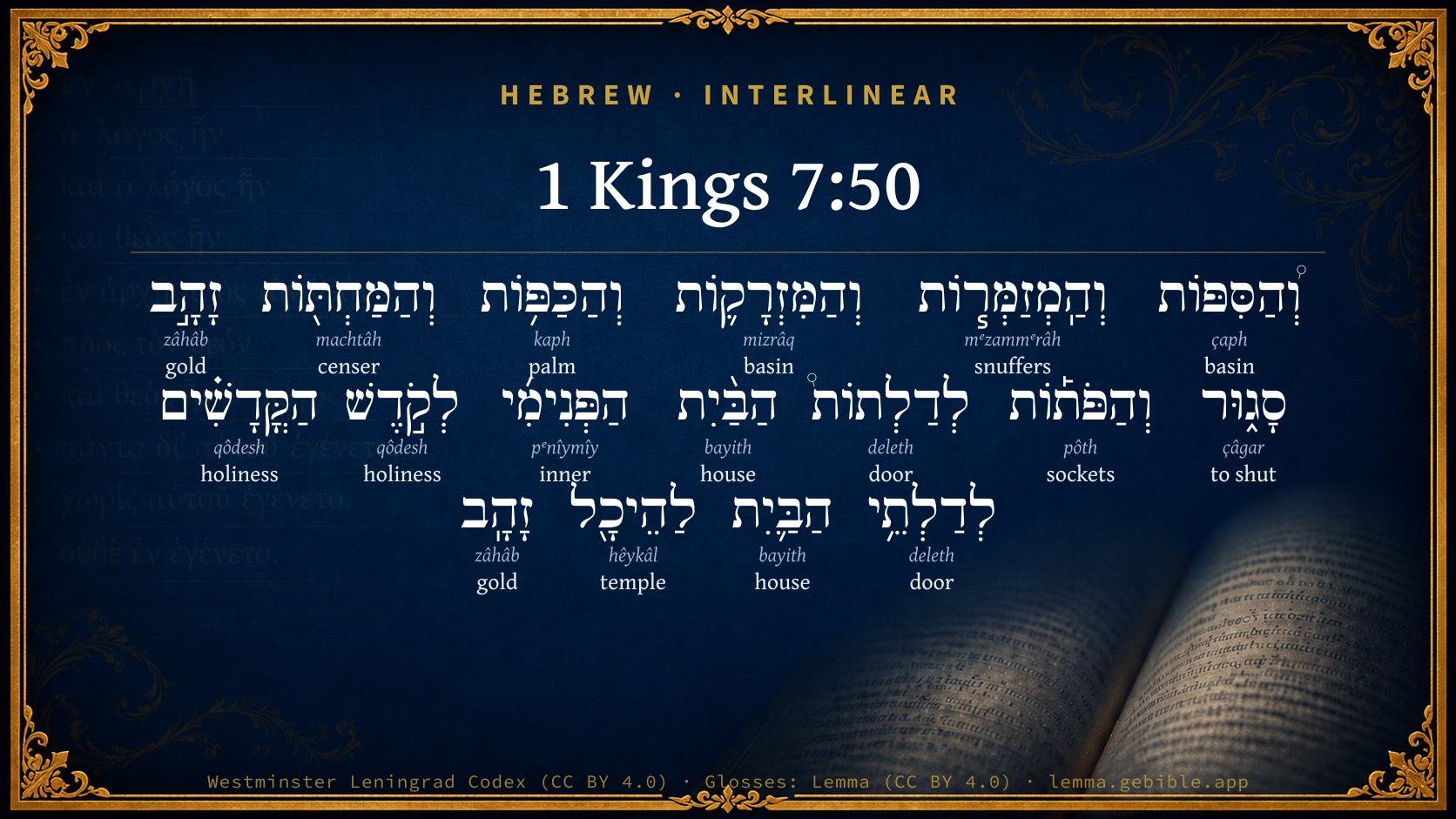
Hebrew (Westminster Leningrad Codex) 1 Kings 7:50 appears in the Hebrew Old Testament. The text above is from the Westminster Leningrad Codex. Each word links to its Strong’s number, a concise gloss, and parsing drawn from the Open Scriptures Hebrew Bible morphology. Click any word for its full Brown-Driver-Briggs (BDB) entry.
Download image
Cite this verse

1 Kings 7:50 (World English Bible). Public Domain. Lemma interlinear Bible study tool, https://lemma.gebible.app/v/1-kings/7/50.

Show BibTeX & RIS
BibTeX
RIS
English Translation
and the cups, and the snuffers, and the basins, and the spoons, and the fire pans, of pure gold; and the hinges, both for the doors of the inner house, the most holy place, and for the doors of the house, [to wit], of the temple, of gold.
World English Bible · Public Domain
Highlights
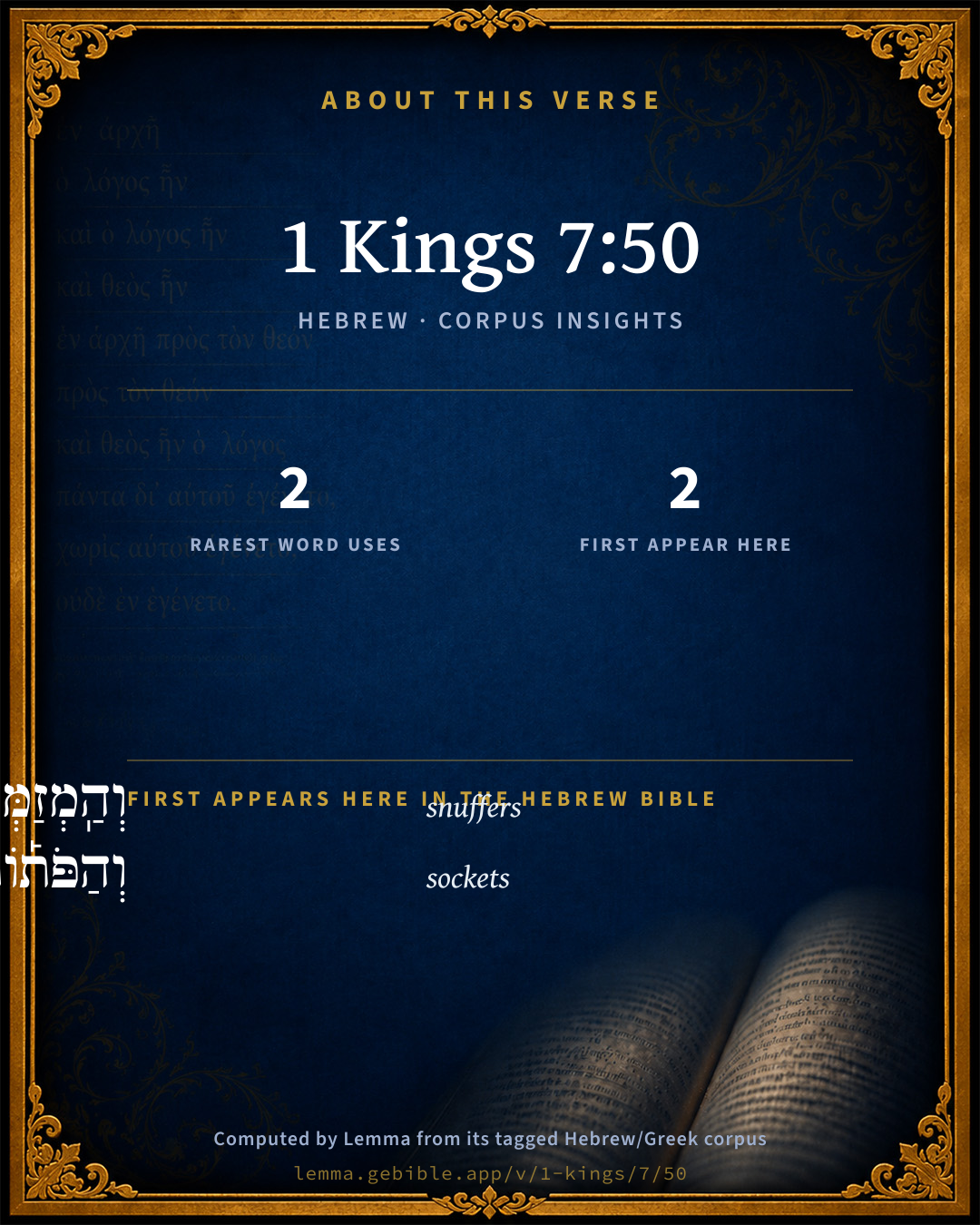
  • 2 first appearances in the Hebrew Bible
Full analysis ↓
Download a study sheet

One document with this verse’s original text, its word-by-word gloss line, the meaning frame, cross-references with their text, attributed commentary, and full source and license credits — printable, and it pastes into notes with its structure intact.

This verse Autodidact and up

Study sheet (.html) Plain text (.txt)

A passage Seminary Student

Up to 50 verses in one chapter. A passage sheet keeps up to 6 commentary sources and 12 cross-references per verse, in the order this page ranks them, and says so on the sheet whenever that leaves anything out. Ask for a single verse and you get the Autodidact verse sheet above.

Everything on this page stays free to read, with no account — the sheet is a download of what is already on screen, not access to it.

Want to remove ads? Support Godless Engineer
Compare translations 3

The same verse in 3 English versions, stacked beneath the original-language interlinear above. Click any original word for its lexicon entry.

Each is an independent rendering of the whole verse — the interlinear is not word-aligned to these translations.

Highlighted words mark where these versions differ — a whole-verse word diff, not a word-by-word alignment.

  • World English Bible Public Domain
    and the cups, and the snuffers, and the basins, and the spoons, and the fire pans, of pure gold; and the hinges, both for the doors of the inner house, the most holy place, and for the doors of the house, [to wit], of the temple, of gold.
  • King James Version Public Domain
    And the bowls, and the snuffers, and the basins, and the spoons, and the censers of pure gold; and the hinges of gold, both for the doors of the inner house, the most holy place, and for the doors of the house, to wit, of the temple.
  • unfoldingWord Literal Text CC BY-SA 4.0
    and the basins and the trimmers and the sprinkling bowls and the palms and the firepans, pure gold, and the sockets of the doors of the inner house, for the Holy of Holies, for the doors of the house, for the temple, gold.

unfoldingWord Literal Text — © unfoldingWord, licensed CC BY-SA 4.0. Word-aligned USFM3 via Door43 (git.door43.org/unfoldingWord/en_ult).

Versions to compare (up to 4)

3 of 4 selected

Show all 18 translations

Every available English version of this verse, each an independent rendering of the whole verse.

  • World English Bible Public Domain
    and the cups, and the snuffers, and the basins, and the spoons, and the fire pans, of pure gold; and the hinges, both for the doors of the inner house, the most holy place, and for the doors of the house, [to wit], of the temple, of gold.
  • Berean Standard Bible Public Domain
    the pure gold basins, wick trimmers, sprinkling bowls, ladles, and censers; and the gold hinges for the doors of the inner temple (that is, the Most Holy Place) as well as for the doors of the main hall of the temple.
  • Majority Standard Bible Public Domain
    the pure gold basins, wick trimmers, sprinkling bowls, ladles, and censers; and the gold hinges for the doors of the inner temple (that is, the Most Holy Place) as well as for the doors of the main hall of the temple.
  • King James Version Public Domain
    And the bowls, and the snuffers, and the basins, and the spoons, and the censers of pure gold; and the hinges of gold, both for the doors of the inner house, the most holy place, and for the doors of the house, to wit, of the temple.
  • American Standard Version (1901) Public Domain
    and the cups, and the snuffers, and the basins, and the spoons, and the firepans, of pure gold; and the hinges, both for the doors of the inner house, the most holy place, and for the doors of the house, `to wit', of the temple, of gold.
  • Revised Version (1885) Public Domain
    and the cups, and the snuffers, and basons, and the spoons, and the firepans, of pure gold; and the hinges, both for the doors of the inner house, the most holy place, and for the doors of the house, to wit, of the temple, of gold.
  • Geneva Bible (1599) Public Domain
    And the bowles, and the hookes, and the basens, and the spoones, and the ashpannes of pure golde, and the hinges of golde for the doores of the house within, euen for the most holy place, and for the doores of the house, to wit, of the Temple.
  • Douay-Rheims (1899) Public Domain
    And pots, and fleshhooks, and bowls, and mortars, and censers, of most pure gold: and the hinges for the doors of the inner house of the holy of holies, and for the doors of the house of the temple were of gold.
  • Young's Literal Translation Public Domain
    and the basins, and the snuffers, and the bowls, and the spoons, and the censers, of refined gold, and the hinges for the doors of the inner-house, for the holy of holies, for the doors of the house of the temple, of gold.
  • Literal Standard Version CC BY-SA 4.0
    and the basins, and the snuffers, and the bowls, and the spoons, and the censers, of refined gold, and the hinges for the doors of the inner-house, for the Holy of Holies, for the doors of the house of the temple, of gold.
  • Unlocked Literal Bible CC BY-SA 4.0
    Solomon also had made the cups, lamp trimmers, basins, spoons, and incense burners, all of which were made of pure gold; he had sockets of gold made for the doors of the inner room (which was the most holy place), and for the doors of the main hall of the temple.
  • unfoldingWord Literal Text CC BY-SA 4.0
    and the basins and the trimmers and the sprinkling bowls and the palms and the firepans, pure gold, and the sockets of the doors of the inner house, for the Holy of Holies, for the doors of the house, for the temple, gold.
  • Darby Bible Public Domain
    and the basons, and the knives, and the bowls, and the cups, and the censers of pure gold; and the hinges of gold, for the folding-doors of the inner house, the most holy place, [and] for the doors of the house, of the temple.
  • World Messianic Bible Public Domain
    the cups, the snuffers, the basins, the spoons, and the fire pans, of pure gold; and the hinges, both for the doors of the inner house, the most holy place, and for the doors of the house, of the temple, of gold.
  • Webster's Bible Public Domain
    And the bowls, and the snuffers, and the basins, and the spoons, and the censers of pure gold; and the hinges of gold, both for the doors of the inner house, the most holy place, and for the doors of the house, to wit, of the temple.
  • Free Bible Version CC BY-SA 4.0
    the basins, wick trimmers, bowls, ladles, and censers that again were all made of pure gold; and the gold hinges for the doors of the inner sanctuary, the Most Holy Place, in addition to the doors of the main hall of the Temple.
  • Bible in Basic English Public Domain
    And the cups and the scissors and the basins and the spoons and the fire-trays, all of gold; and the pins on which the doors were turned, the doors of the inner house, the most holy place, and the doors of the Temple, all of gold.
  • JPS Tanakh (1917) Public Domain
    and the cups, and the snuffers, and the basins, and the pans, and the fire-pans, of pure gold; and the hinges, both for the doors of the inner house, the most holy place, and for the doors of the house, that is, of the temple, of gold.

Literal Standard Version (2020), Covenant Press — licensed CC BY-SA 4.0. Text via the HelloAO Bible API (eBible.org). Unlocked Literal Bible (unfoldingWord) — licensed CC BY-SA 4.0. Text via the HelloAO Bible API (eBible.org). unfoldingWord Literal Text — © unfoldingWord, licensed CC BY-SA 4.0. Word-aligned USFM3 via Door43 (git.door43.org/unfoldingWord/en_ult). Free Bible Version, Dr. Jonathan Gallagher — licensed CC BY-SA 4.0. Text via the HelloAO Bible API (eBible.org).

Word by word

More ways to search: Search by grammar → Find every occurrence → Compare this word →

Practice this passage: Drill this verse → Learn its vocabulary →

וְהַפֹּת֡וֹת
pôth
H6596
“and · the · sockets”
Conjunction + Particle, Definite Article + Noun, Common, Feminine, Plural, Absolute
Part of Speech
Conjunction + Particle + Noun
Type
Common
Gender
Feminine
Number
Plural
State
Absolute
Full BDB Definition

Origin: from an unused root meaning to open

TWOT: 1850

sockets, hinges, secret parts (meaning dubious) - sockets - secret parts
  1. וְ֠הַסִּפּוֹת çaph H5592 “and · the · basins” Conjunction + Particle, Definite Article + Noun, Common, Masculine, Plural, Absolute
  2. וְהַֽמְזַמְּר֧וֹת mᵉzammᵉrâh H4212 “and · the · snuffers” Conjunction + Particle, Definite Article + Noun, Common, Feminine, Plural, Absolute
  3. וְהַמִּזְרָק֛וֹת mizrâq H4219 “and · the · basins” Conjunction + Particle, Definite Article + Noun, Common, Masculine, Plural, Absolute
  4. וְהַכַּפּ֥וֹת kaph H3709 “and · the · palms” Conjunction + Particle, Definite Article + Noun, Common, Feminine, Plural, Absolute
  5. וְהַמַּחְתּ֖וֹת machtâh H4289 “and · the · censers” Conjunction + Particle, Definite Article + Noun, Common, Feminine, Plural, Absolute
  6. זָהָ֣ב zâhâb H2091 “gold” Noun, Common, Masculine, Singular, Absolute
  7. סָג֑וּר çâgar H5462 “pure” Noun, Common, Masculine, Singular, Absolute
  8. לְדַלְתוֹת֩ deleth H1817 “to/for · doors of” Preposition + Noun, Common, Feminine, Plural, Construct
  9. הַבַּ֨יִת bayith H1004 “the · house” Particle, Definite Article + Noun, Common, Masculine, Singular, Absolute
  10. הַפְּנִימִ֜י pᵉnîymîy H6442 “the · inner” Particle, Definite Article + Adjective, Adjective, Masculine, Singular, Absolute
  11. לְקֹ֣דֶשׁ qôdesh H6944 “to/for · holiness of” Preposition + Noun, Common, Masculine, Singular, Construct
  12. הַקֳּדָשִׁ֗ים qôdesh H6944 “the · holy things” Particle, Definite Article + Noun, Common, Masculine, Plural, Absolute
  13. לְדַלְתֵ֥י deleth H1817 “to/for · doors of” Preposition + Noun, Common, Feminine, Dual, Construct
  14. הַבַּ֛יִת bayith H1004 “the · house” Particle, Definite Article + Noun, Common, Masculine, Singular, Absolute
  15. לַהֵיכָ֖ל hêykâl H1964 “to/for the · temple” Preposition, Determined + Noun, Common, Masculine, Singular, Absolute
  16. זָהָֽב zâhâb H2091 “gold” Noun, Common, Masculine, Singular, Absolute

About this verse

These counts appear in no published source. They are computed here, from the morphology-tagged text and Lemma’s own curated glosses. What Lemma adds →

17
words
13
distinct lemmas
Historical
section

Notable vocabulary

The rarest word here is וְהַפֹּת֡וֹת sockets H6596 — appearing just 2 times in the whole Hebrew Bible.

First appearance in Scripture

These words make their first canonical appearance in the Hebrew Bible here:

  • וְהַֽמְזַמְּר֧וֹת snuffers H4212
  • וְהַפֹּת֡וֹת sockets H6596

Shared distinctive vocabulary

וְהַפֹּת֡וֹת sockets H6596 occurs in 2 verses of the Hebrew Bible. Also found in:

Grammatical profile

  • 16 nouns
  • 1 adjective

Repetition

Words recur within this verse — often emphatic in Hebrew:

  • זָהָ֣ב gold H2091 ×2
  • לְדַלְתוֹת֩ door H1817 ×2
  • הַבַּ֨יִת house H1004 ×2
  • לְקֹ֣דֶשׁ holiness H6944 ×2

Hebrew & Septuagint length

In English translation the verse runs 48 words from the Hebrew and 47 from the Septuagint (LXX English) — closely comparable.

A rough comparison of the two English renderings, which tokenize alike — not a word-level alignment.

Word counts can differ between the Hebrew and the Greek without any difference in meaning — e.g. the Hebrew direct-object marker אֵת has no separate Greek word, and Greek often adds the article ὁ.

Cross-references

5

Topical passages linked to 1 Kings 7:50 in the Treasury of Scripture Knowledge — connected by theme and wording, ordered by reader-vote popularity; previews shown in the World English Bible.

  • Exodus 25:29 You shall make its dishes, its spoons, its ladles, and its bowls to pour out offerings with. Of pure gold shall you make them.
  • Exodus 27:3 You shall make its pots to take away its ashes, its shovels, its basins, its flesh hooks, and its fire pans: all its vessels you shall make of brass.
  • Leviticus 16:12 He shall take a censer full of coals of fire from off the altar before Yahweh, and two handfuls of sweet incense beaten small, and bring it within the veil:
  • Numbers 7:86 the twelve golden ladles, full of incense, weighing ten shekels apiece, after the shekel of the sanctuary; all the gold of the ladles weighed one hundred twenty shekels;
  • 2 Chronicles 4:21–22 and the flowers, and the lamps, and the tongs, of gold, and that perfect gold;

Cross-references courtesy of OpenBible.info (CC BY 4.0).

Hebrew and Greek witnesses Masoretic Hebrew ↔ Greek Septuagint

The same verse in the two great witnesses to the Old Testament, shown verse-for-verse.

These are two independent witnesses, not word-aligned to each other, and the Septuagint is shown in lemma (dictionary) form.

Hebrew 1 Kings 7:50 Masoretic · Westminster Leningrad Codex

וְ֠הַסִּפּוֹת וְהַֽמְזַמְּר֧וֹת וְהַמִּזְרָק֛וֹת וְהַכַּפּ֥וֹת וְהַמַּחְתּ֖וֹת זָהָ֣ב סָג֑וּר וְהַפֹּת֡וֹת לְדַלְתוֹת֩ הַבַּ֨יִת הַפְּנִימִ֜י לְקֹ֣דֶשׁ הַקֳּדָשִׁ֗ים לְדַלְתֵ֥י הַבַּ֛יִת לַהֵיכָ֖ל זָהָֽב

and the cups, and the snuffers, and the basins, and the spoons, and the fire pans, of pure gold; and the hinges, both for the doors of the inner house, the most holy place, and for the doors of the house, [to wit], of the temple, of gold.

World English Bible · Public Domain

Greek LXX 1 Kings 7:50 Septuagint · lemma form

καί συντελέω σαλωμών ὅλος ὁ οἶκος αὐτός

And there were made the porches, and the nails, and the bowls, and the spoons, and the golden censers, of pure gold: and the panels of the doors of the innermost part of the house, even the holy of holies, and the golden doors of the temple.

LXX2012 (modern English Septuagint) · Public Domain

On this verse, The Pulpit Commentary discusses the Septuagint’s reading. Read the note in Commentary ↓

Hebrew: Westminster Leningrad Codex (CC BY 4.0). Greek: Septuagint (public domain); English from LXX2012 (modern English Septuagint) (Public Domain). How the Septuagint differs from the Hebrew →

Targum (Aramaic paraphrase)

1

The Targum is the ancient Jewish Aramaic paraphrase of the Hebrew Scriptures — an interpretive translation, not the Hebrew text itself. Onkelos (literal) and Pseudo-Jonathan (expansive) render the Torah, and Jonathan the Prophets. Coverage is partial: where no permissively-licensed English translation exists for a verse, only the Aramaic is shown. This is verse-level text, not a word-by-word alignment to the Hebrew.

  1. Targum Jonathan Prophets (Joshua–Malachi)
    וְקוֹלַיָא וּמְזַמְרַיָא וּמִזְרְקַיָא וּבָזִיכַיָא וּמַחְתְּיָתָא דַהֲבָא טָבָא וּמוּגְלְסַיָא לְדָשֵׁי בֵית גַוָאָה לְקוֹדֶשׁ קוּדְשַׁיָא לְדָשֵׁי בֵיתָא לְהֵיכְלָא דַהֲבָא:

    (no public-domain English translation for this verse)

    Targum Jonathan — Aramaic: “Mikraot Gedolot” (public domain). English: “Sefaria Community Translation” (CC0 1.0 (public-domain dedication)); “London "Chaldee Paraphrase," 1871” (public domain). Text via Sefaria.

Commentary

Notes on 1 Kings 7:50 from classic Christian and Jewish commentators (each source and its license shown beneath its notes). The classic Christian expositions comment on the surrounding passage and are grouped to its opening verse, so a note may address several verses; the Jewish commentaries on the Tanakh (Rashi and others) are per-verse, so they appear only where the commentator wrote on this verse.

Lemma curates 59 commentaries, every one of them public domain or Creative Commons licensed, each selected and text-cleaned for this edition rather than reprinted as found. About our sources →

Trapp's Complete Commentary

John Trapp

1Ki 7:50 And the bowls, and the snuffers, and the basons, and the spoons, and the censers [of] pure gold; and the hinges [of] gold, [both] for the doors of the inner house, the most holy [place, and] for the doors of the house, [to wit], of the temple.

Ver. 50. And the hinges of gold.] Hinges and hooks, and all were of gold: to teach us that in a holy and religious soul dedicated to God, there should be nothing found but what is pure, solid, and precious. "The tongue of the just is as choice silver; the heart of the wicked is little worth." {Pro 10:20}

John Trapp, A Commentary or Exposition upon All the Books of the Old and New Testament (1647–1656) — public domain. Text from a community e-Sword module.

The Biblical Illustrator

Joseph S. Exell

1Ki_7:50

Snuffers.

Snuffers

(Childrens service):--You smile at such a text, and no wonder! But snuffers were very useful in the temple; they kept the lights trim and bright.

1. Now you see what snuffers are for; they are for making a dull light shine brighter. When the candle has been burning for some time it seems to get dull and drowsy, then snap go the snuffers, and the light gets bright! There are snuffers which do that for boys and girls, and men and women, too, for that matter. There was that sum you worked out on your slate. It was all wrong. What did the master do? Rub it all out. That was the snap of the snuffers. It made you brighter; you took more care over your sums next time. You see these men lopping the trees? Why do they do that? To make them bear more fruit. The trees are the better for the sharp snuffers--and so are you. Never be discouraged.

2. Sometimes you are the snuffers. Theres your little brother, for instance, he isnt half so wise as you, and sometimes he makes mistakes. Put him right; but take care how you use the snuffers. If you use them carelessly you may put out the light altogether. What I mean is this--you may so discourage him that he wont have any heart to try to do better. Therefore, use the snuffers gently. Dont call him stupid, or ridicule him. Remember, God wants your light to shine that others may get blessing by it; so you must expect Him now and again to trim it. By one way or other He tries to trim our light that it may shine the brighter. Think of this when any trouble comes: God wants to make use of it to make you braver, better, purer. (J. Reid Howatt.)

.

The Biblical Illustrator, edited by Joseph S. Exell (c. 1880s–1900s) — public domain. Text from a community e-Sword module.

Joseph Benson's Commentary

1Ki 7:50. The bowls and the snuffers, &c. — The use of the different articles here named is manifest. The bowls were to contain oil for the lamps, the snuffers to trim them: the basins, which were a hundred, as we learn 2Ch 4:8, were to receive the water of sprinkling, and the blood of the sacrifices, which was sometimes brought into the most holy place. The spoons served to take up the oil. The censers were for offering incense. The hinges of gold, &c. — This shows the vast riches of Solomon, and his great piety, which made him spare no cost to beautify the house of God, and all things belonging to it.

Joseph Benson's Commentary on the Old and New Testaments (1811–1818) — public domain. Text from a community e-Sword module.

Tyndale Open Study Notes

Tyndale Open Resources

7:50-51 The writer emphasizes Solomon’s abundant use of gold in furnishing the Temple. David and the people had collected an enormous amount of gold to be used for the Temple (1 Chr 29:1-9), and Solomon also amassed gold annually (1 Kgs 10:14), so he had a ready supply (see 10:21).

Tyndale Open Study Notes — © Tyndale Open Resources, licensed CC BY-SA 4.0. Text via the HelloAO Bible API.

Geneva Bible (1599)

Geneva Bible translators

Some take this for some instrument of music.

Geneva Bible (1599) marginal notes — public domain. Text via Bolls.life.

The Cambridge Bible for Schools and Colleges

gen. ed. J. J. S. Perowne

50. and the bowls] This is the word which is usually rendered ‘basons.’ See 2Sa_17:28, &c. A different word is translated ‘bowl’ elsewhere, see Jdg_6:38. As ‘basons’ occurs later on in the verse, the R.V. has changed ‘bowls’ here to ‘cups,’ a rendering given for this word sometimes on the margin of A. V.

and the censers] This Hebrew word is frequently rendered ‘censer,’ but as in Exo_27:3; Exo_38:3 and other places, where it relates to the altar furniture and fittings, the plural is rendered ‘fire pans,’ the R.V. has introduced that rendering here. Cf. also 2Ki_25:15 and Jer_52:19. In the latter part of this verse the R.V. preserves the order of the Hebrew, and gives a little more explicitness, by removing ‘of gold’ after ‘hinges’ to the end of the verse. With the description here given should be compared the account of the vessels of the Mosaic tabernacle. Exodus 25-30.

The Cambridge Bible for Schools and Colleges (gen. ed. J. J. S. Perowne; Cambridge University Press, 1878–1918) — public domain. Text from a community e-Sword module.

John Gill's Exposition

So was ended all the work that King Solomon made for the house of the Lord,.... Which he ordered to be made to be put into it, either for the ornament of it, or for the use and service of it; all was completely finished in the space of seven years:

and Solomon had brought in the things which David his father had dedicated; had laid up for, and devoted to the building of the temple, and for the service of it; not all, but what was left; what was over and above there was a need of; though the Jews commonly say, that he made use of none of his father's, but built it and furnished it at his own expense; for which reason he did not begin to build as soon as he came to the throne, they suppose, but waited four years, until he had laid up a sufficiency of his own to defray the expense of it; but it is certain he made use of the brass his father reserved for this work, see Ch1 18:8 and which, perhaps it may be said, is the reason it is not mentioned here as laid up: even the silver, and the gold, and the vessels, did he put among the treasures of the house of the Lord; he did not convert them to his own use, but laid them up in the treasury of the sanctuary, for the purchase of sacrifices, the repair of the house in future times, &c.

Next: 1 Kings Chapter 8

John Gill's Exposition of the Whole Bible (1746–1763) — public domain (CC PDM 1.0). Text via the HelloAO Bible API.

Whedon's Commentary on the Bible

Daniel D. Whedon

50. Bowls — Used for drinking out of, and sometimes, like the basins, for sprinkling. Compare Exo_12:22.

Spoons — כפות, pans, or dishes; for what particular purpose does not appear.

Censers — Fire-pans, in which coals were taken up and incense kindled. These smaller vessels are not described, but are supposed to have been like those of the tabernacle.

ON THE SYMBOLISM OF THE TEMPLE.

The temple of Solomon, so far as it was a reproduction, on an enlarged scale, of the tabernacle, was, like that more ancient structure, the pattern, example, and shadow of heavenly things. Heb_8:5. But Solomon introduced a number of additions to the ancient pattern shown to Moses in the mount. The side-chambers, the colossal cherubim, the molten sea on twelve oxen in place of the more simple laver of the tabernacle-court, the ten smaller lavers and their bases, the ten tables and the ten golden candlesticks, all seem to have been the product and expression of theocratic ideas that had been maturing in the Israelitish mind for more than four hundred years, though many of them were probably demanded by the more extensive and elaborate service of Solomon’s time. An attempt to point out the sacred symbolism and meaning of the various parts and vessels of the temple must, in many respects, at best end only in conjectures. But this subject should not, therefore, be passed without remark. Dr. Bahr well observes, that if the entire system of Hebrew worship “were no idle ceremony, still less could the structure where this worship became concentrated be an empty, meaningless piece of architectural splendour. All the ancients so founded, arranged, and adorned their temples that they were the expression and the representation of their specific religious contemplation. The temple of Solomon would have been an exception to all the sacred buildings of high antiquity, had it not been the expression of the specifically Israelitish Old Testament ideas of religion.”

The writer just quoted has made this subject a special study, and has written extensively upon it, both in his Commentary on Kings, and his able work on the “Symbolism of the Mosaic Worship.” The present note is based largely on his exposition. Remarks on the typical significance of the altars, laver, table of showbread, golden candlestick, and mercyseat belong rather to the explanation of the tabernacle. We notice here only the leading outlines of the temple-plan, and the significance of its principal parts.

Though Solomon was well aware that “the heaven and heaven of heavens” could not contain the God of Israel, (1Ki_8:27,) yet he built the temple with the declared purpose of providing a house for Jehovah to dwell in — a settled place for his abode. 1Ki_8:13. He could therefore have entertained no such thought as that by dwelling in the temple God ceased to be omnipresent; but the temple was specifically the place where Jehovah recorded his name, and therefore the visible sign and pledge of his covenant with Israel. It was the abode of his holiness, the place where he was to be consulted and understood by his people. Hence the graduated sanctity of the court, the holy place, and the holy of holies, was adapted to teach an impressive lesson of the absolute holiness of Jehovah.

While the temple was thus specifically the dwellingplace of Jehovah, it also typified heaven itself, which is “the true tabernacle.” Heb_8:2; Heb_9:24. Accordingly, in Solomon’s prayer at the dedication we find a continued contrast between “this house” or “this place,” and “heaven, thy dwellingplace,” or simply “heaven.” 1Ki_8:30-49. And so the pious Israelite might ever see in the holy and beautiful house where Jehovah recorded his name a type and symbol of heaven itself. It was the temple of his holiness. Psa_5:7; Psa_79:1; Psa_138:2.

Bahr totally rejects the opinion that the temple was a representation of the theocracy of the kingdom of God in Israel, or of the New Testament “kingdom of heaven,” and urges that the latter is a divine-human relation, while the dwelling of Jehovah is a place. But he seems to overlook in this connexion the great truth that the divine-human relationship realized in the kingdom of grace is truly God dwelling in man, (1Jn_4:12; 1Jn_4:16,) or making his abode with him, (Joh_14:23;) and that the great body of his people in whom he thus dwells are called “the temple of the living God,” “a habitation of God through the Spirit.” 1Co_3:17; 2Co_6:16; Eph_2:21-22. We may, therefore, look upon the temple that rose to completion so silently that neither hammer nor axe was heard while it was building, as a glorious type of that “spiritual house,” built of “lively stones,” (1Pe_2:5,) “Jesus Christ himself being the chief cornerstone; in whom all the building fifty framed together groweth unto a holy temple in the Lord.” Eph_2:21.

Nor should we overlook the profound symbolism of the divine-human relationship set forth in the two main apartments of the temple. Why, in the temple as in the tabernacle, have two holy rooms, rather than three or more? Why, except, as Fairbairn admirably shows, (Typology, vol. ii, p. 250,) to express the twofold relation that essentially exists between the worshipper and God? The holy of holies, with its profound symbols of “mercy covering wrath,” showed God’s relation to his people; how and on what terms the Almighty and Holy One would dwell with man. The holy place, where the consecrated priests ministered, with its incense-altar and tables and candlesticks, expressed the relation of the true worshipper to God. The devout worshippers, who offer before God the incense of continual prayer, are at once the salt of the earth and the light of the world. And this is the one great truth embodied in the several symbols of the holy place. Thus in the two main apartments were exhibited “the two great branches into which the tree of Divine knowledge always, of necessity, runs, namely, the things to be believed concerning God, and the things to be done by his believing people.”

When we come to observe the details of the structure we notice, first of all, the graduated sanctity of the three holy places. First, the court, where nothing unclean might enter; then the holy place, where only the consecrated priests might go to perform holy services; and, beyond this, vailed in thick darkness, the holy of holies, where only the high priest entered, and he but once a year, on the great day of atonement. Here was symbolized not only the absolute holiness of Him who “dwelt in the thick darkness,” but also the gradual and progressive revelations of his name and nature, which have been made known to men. Whilst the temple and the priesthood remained, the Holy Ghost signified that the way into the holiest of all was not yet made manifest, (Heb_9:8;) but since Christ has rent the vail, and entered heaven itself for us, we all may, with boldness and full assurance of faith, enter into the holiest, and have everlasting communion and fellowship with God. Heb_9:24; Heb_10:19-22.

The square form of all the apartments and courts of the temple is not without meaning. The oracle was a perfect square; the nave a double square; the porch half a square, etc. Nowhere do we find the form of the triangle, the pentagon, or the circle, but every thing about the sanctuary seems, like the heavenly Jerusalem, to be quadrangular, as if to correspond with the four corners of heaven, the upper dwelling-place of God. Jer_49:36; Mat_24:31. Equally noticeable is the predominance of the numbers ten and three. The length and breadth of all the apartments and the courts is a common multiple of ten — the number of the commandments written on the tables of testimony within the ark. Ten is the number of the candlesticks and tables, the bases and lavers; ten cubits was the height of the cherubim, and the extent of their outspread wings; ten cubits was the breadth of the molten sea. Then we note the three holy apartments, each with its type of expiation — the altar or burnt offerings, the altar of incense, and the mercyseat; the last within the most holy place, which bore the form of a perfect cube, the length and the breadth and the height of it being equal. Each apartment also had three principal kinds of articles of furniture. In the oracle were the cherubim, the ark, and the tables of the law; in the nave were the candlesticks, the tables, and the altar of incense; and in the court were the brazen sea, the lavers, and the altar of burnt offerings. There were, also, the three stories of side-chambers. In this symbolism of numbers we may discern a mystic representation both of the variety and unity of all Divine revelation. “What happens thrice, is the genuine once; what is divided into three, is a true unity. The one dwelling by its division into three parts, is designated as one complete whole; and the three kinds of articles of use which are in the three parts, or in one of them, again form a complete whole, and belong under it to the one or the other relation. While the number ten gives the impress of finishing and completing to multiplicity, the number three is the signature of perfect unity, and thus also of the Divine being.”

The adornings of the temple, the cherubim, lions, oxen, palms, flowers, and lily work, were representative of all created life, and signified that while Jehovah condescended to make the temple his special dwellingplace, his presence fills the universe with life. He upholds all things by the word of his power. Angels and men, cattle and creeping things and fowl, and all inanimate creation, have their being from Him whom the heaven of heavens cannot contain. And thus was added to the various lessons of Jehovah’s absolute holiness and infinite perfections, which the temple symbolized, this ornamental expression of his universal Providence.

Daniel D. Whedon (gen. ed.), Commentary on the Old and New Testaments (1874–1909) — public domain. Text from a community e-Sword module.

The Pulpit Commentary

And the bowls same word in Exo_12:22. The "dishes" Exo_25:29 Exo_37:16, with which Rawlinson identifies them, are expressed by a different word. He thinks they were for the oil which the connexion would seem to imply but they may have been for the blood, and the snuffers Heb. knives, rmz, carpsit. The word is used of the pruning hook in Isa_2:4; cf., Lev_25:3. They served the purpose though they had not the shape of our snuffers and the basons same word as in vers. 40, 45. These latter, however, were of brass, while those of the text were of pure gold. According toz) 2Ch_4:8, they were a hundred in number. As the root (qr) signifies to sprinkle, they were probably either for the water or the blood of sprinkling. Keil thinks they were for the wine of the libations, and the spoons twOpK lit., palms (of hands), hence used of shallow vessels (Exo_25:29; Num_7:84, Num_7:86. The last cited passage (cf. vers. 14, 20, 26) shows that they were used for the incense, (Lev_24:7, etc.) LXX quiskai, and the censers or snuffers, extinguishers; marg. ash-pans. Exo_25:38 the word is translated snuff, dishes. In Num_4:14, Num_16:6, it signifies censers, which may well be the meaning here of pure gold; and the hinges or sockets of the hinges (Gesen., Keil) of gold, both for the doors of the inner house, the most holy place Heb. for the holy of holies, and for the doors of the house, to wit, of the temple. These were evidently of inferior (not pure) metal.

The Pulpit Commentary (1880–1919), ed. H.D.M. Spence-Jones & Joseph S. Exell — public domain. Text from a community e-Sword module.

unfoldingWord translationNotes

Door43 World Missions Community

had made the cups ... all of which were made of pure gold

This can be stated in active form. AT: "had his workers make all the cups ... out of pure gold" (See: Active or Passive)

sockets of gold made for the doors

Here "sockets" may refer to either 1) the sockets in which the door pegs turned, or 2) the hinges on which the doors hung.

translationWords

incense

holy place

temple

unfoldingWord translationNotes — © Distant Shores Media and the Door43 World Missions Community, licensed CC BY-SA 4.0. Source: git.door43.org/Door43/en_tn.

Rashi

Rabbi Shlomo Yitzchaki (Rashi)

The Sippos. A type of musical instrument, and similarly, “מזמרות.”

The basins. To receive the blood.

The spoons. As vessels for frankincense.

And the fire pans. To remove the ashes and coals, and to carry them from the outer altar to the inner altar to burn incense.

The keys. Keys, I heard, with which to open [מפתחין] with them the locks.

For the doors of the [inner] Beis Hamikdosh. Which is the Holy of Holies.

For the doors of the Beis Hamikdosh. Which is for the Sanctuary, all of their entrances were of gold.

Rashi on the Tanakh — English translations: “The Judaica Press complete Tanach with Rashi, translated by A. J. Rosenberg” (CC BY 4.0); “Pentateuch with Rashi's commentary by M. Rosenbaum and A.M. Silbermann, 1929-1934” (public domain); “The Metsudah Tanach series, Lakewood, N.J” (CC BY 4.0); and “The Book of Joshua, Metsudah Publications, 1997” (CC BY 4.0). Text via Sefaria.

Lesson kit

Teaching starters — assembled from the data on this page, not authored interpretation. Every prompt links to the verse data it draws on. Edit before teaching.

1 Kings, in the Historical, opens this verse with 17 words (13 distinct Hebrew lemmas). Its most distinctive word is pôth (“sockets”). A historical commentator’s framing appears above. Read the whole chapter for the surrounding context.

Discussion questions

  1. The word pôth carries the sense “sockets.” How does it shape the verse?
  2. 2 words make their first appearance in Scripture here. What does this debut establish?
  3. How does Isaiah 3:17, which shares the word «sockets», read alongside this verse?
  4. What does the repetition of “gold” (2× in this one verse) do in this verse?
  5. The translations on this page render this verse differently — a whole-verse word diff, not a word-by-word alignment. What might account for the different wordings?
  6. Compare how Trapp's Complete Commentary and The Biblical Illustrator read this verse. Where do they agree or differ?

Things to notice

  • 2 words make their first canonical appearance in Scripture here.
  • These translations choose different wording for 18 words in this verse.
  • “gold” occurs 2× in this single verse.
  • 13 distinct Hebrew lemmas span 17 words in this verse.

Reading settings

Reading text

Shown beneath each verse's original-language words.

Old Testament
Old Testament edition

Read the OT as the Masoretic Hebrew (MT) or the Greek Septuagint (LXX).

English shown for the Greek Septuagint (in the Hebrew ↔ Greek comparison).

Comparing translations? Open the Compare panel on any verse page to stack up to four side by side.