
Exodus 28:4

Hebrew (Westminster Leningrad Codex) Exodus 28:4 appears in the Hebrew Old Testament. The text above is from the Westminster Leningrad Codex. Each word links to its Strong’s number, a concise gloss, and parsing drawn from the Open Scriptures Hebrew Bible morphology. Click any word for its full Brown-Driver-Briggs (BDB) entry.
Download image
Cite this verse

Exodus 28:4 (World English Bible). Public Domain. Lemma interlinear Bible study tool, https://lemma.gebible.app/v/exodus/28/4.

Show BibTeX & RIS
BibTeX
RIS
English Translation
These are the garments which they shall make: a breastplate, and an ephod, and a robe, and a coat of checker work, a turban, and a sash: and they shall make holy garments for Aaron your brother, and his sons, that he may minister to me in the priest's office.
World English Bible · Public Domain
Highlights
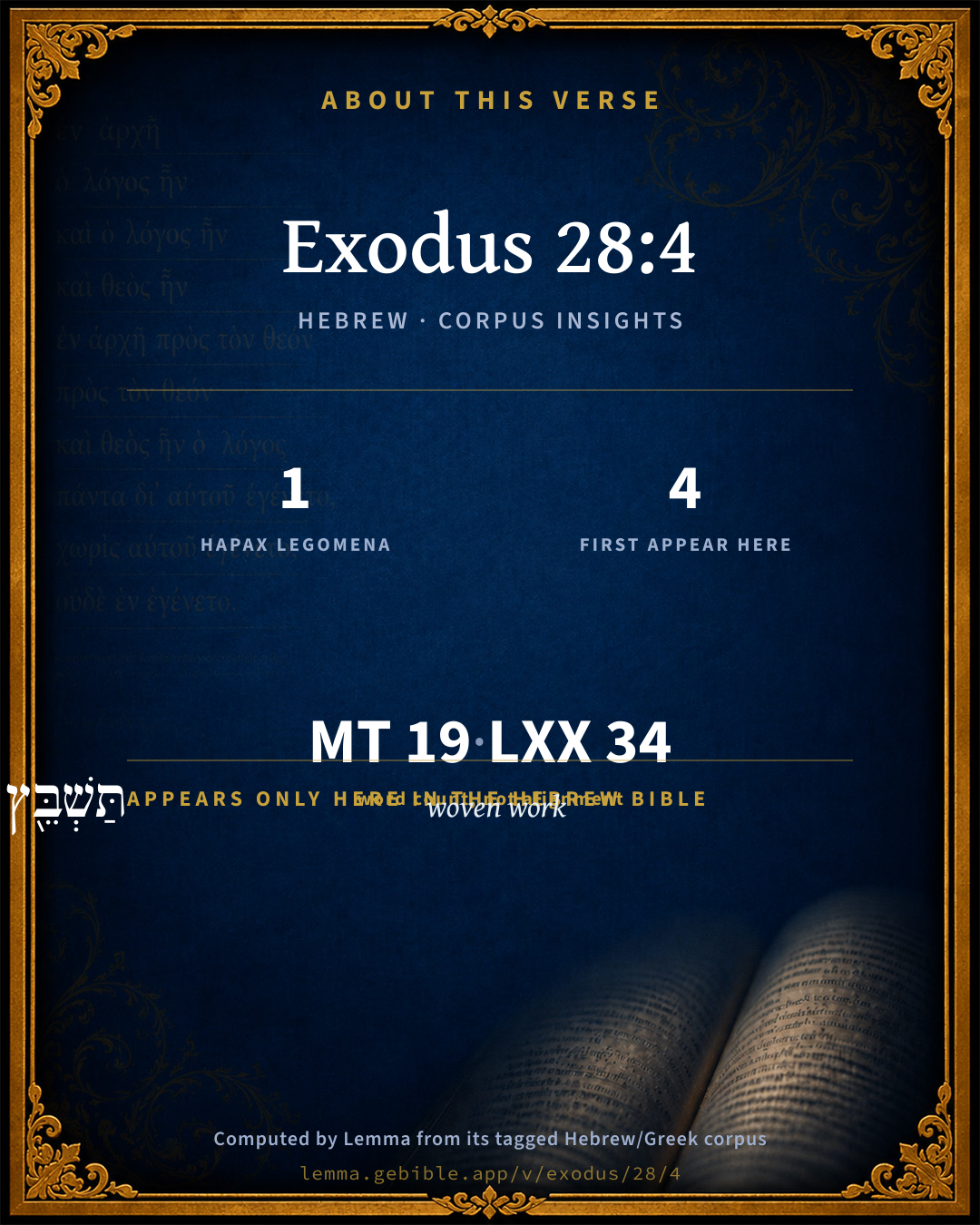
  • 1 hapax legomenon — only here in the Hebrew Bible
  • 4 first appearances in the Hebrew Bible
Full analysis ↓
Download a study sheet

One document with this verse’s original text, its word-by-word gloss line, the meaning frame, cross-references with their text, attributed commentary, and full source and license credits — printable, and it pastes into notes with its structure intact.

This verse Autodidact and up

Study sheet (.html) Plain text (.txt)

A passage Seminary Student

Up to 50 verses in one chapter. A passage sheet keeps up to 6 commentary sources and 12 cross-references per verse, in the order this page ranks them, and says so on the sheet whenever that leaves anything out. Ask for a single verse and you get the Autodidact verse sheet above.

Everything on this page stays free to read, with no account — the sheet is a download of what is already on screen, not access to it.

Want to remove ads? Support Godless Engineer
Compare translations 3

The same verse in 3 English versions, stacked beneath the original-language interlinear above. Click any original word for its lexicon entry.

Each is an independent rendering of the whole verse — the interlinear is not word-aligned to these translations.

Highlighted words mark where these versions differ — a whole-verse word diff, not a word-by-word alignment.

  • World English Bible Public Domain
    These are the garments which they shall make: a breastplate, and an ephod, and a robe, and a coat of checker work, a turban, and a sash: and they shall make holy garments for Aaron your brother, and his sons, that he may minister to me in the priest's office.
  • King James Version Public Domain
    And these are the garments which they shall make; a breastplate, and an ephod, and a robe, and a broidered coat, a mitre, and a girdle: and they shall make holy garments for Aaron thy brother, and his sons, that he may minister unto me in the priest's office.
  • unfoldingWord Literal Text CC BY-SA 4.0
    And these are the clothes that they shall make: a breastpiece and an ephod and a robe and a tunic of woven work, a turban and a sash. And they shall make clothes of holiness for your brother Aaron and for his sons to be priests for me.

unfoldingWord Literal Text — © unfoldingWord, licensed CC BY-SA 4.0. Word-aligned USFM3 via Door43 (git.door43.org/unfoldingWord/en_ult).

Versions to compare (up to 4)

3 of 4 selected

Show all 18 translations

Every available English version of this verse, each an independent rendering of the whole verse.

  • World English Bible Public Domain
    These are the garments which they shall make: a breastplate, and an ephod, and a robe, and a coat of checker work, a turban, and a sash: and they shall make holy garments for Aaron your brother, and his sons, that he may minister to me in the priest's office.
  • Berean Standard Bible Public Domain
    These are the garments that they shall make: a breastpiece, an ephod, a robe, a woven tunic, a turban, and a sash. They are to make these holy garments for your brother Aaron and his sons, so that they may serve Me as priests.
  • Majority Standard Bible Public Domain
    These are the garments that they shall make: a breastpiece, an ephod, a robe, a woven tunic, a turban, and a sash. They are to make these holy garments for your brother Aaron and his sons, so that they may serve Me as priests.
  • King James Version Public Domain
    And these are the garments which they shall make; a breastplate, and an ephod, and a robe, and a broidered coat, a mitre, and a girdle: and they shall make holy garments for Aaron thy brother, and his sons, that he may minister unto me in the priest's office.
  • American Standard Version (1901) Public Domain
    And these are the garments which they shall make: a breastplate, and an ephod, and a robe, and a coat of checker work, a mitre, and a girdle: and they shall make holy garments for Aaron thy brother, and his sons, that he may minister unto me in the priest's office.
  • Revised Version (1885) Public Domain
    And these are the garments which they shall make; a breastplate, and an ephod, and a robe, and a coat of chequer work, a mitre, and a girdle: and they shall make holy garments for Aaron thy brother, and his sons, that he may minister unto me in the priest’s office.
  • Geneva Bible (1599) Public Domain
    Nowe these shall be the garments, which they shall make, a brest plate, and an Ephod, and a robe, and a broydred coate, a miter, and a girdle. so these holy garments shall they make for Aaron thy brother, and for his sonnes, that he may serue me in the Priests office.
  • Douay-Rheims (1899) Public Domain
    And these shall be the vestments that they shall make: A rational and an ephod, a tunick and a strait linen garment, a mitre and a girdle. They shall make the holy vestments for thy brother Aaron and his sons, that they may do the office of priesthood unto me.
  • Young's Literal Translation Public Domain
    `And these `are' the garments which they make: a breastplate, and an ephod, and an upper robe, and an embroidered coat, a mitre, and a girdle; yea, they have made holy garments for Aaron thy brother, and for his sons, for his being priest to Me.
  • Literal Standard Version CC BY-SA 4.0
    And these [are] the garments which they make: a breastplate, and an ephod, and an upper robe, and an embroidered coat, a turban, and a girdle; indeed, they have made holy garments for your brother Aaron, and for his sons, for his being priest to Me.
  • Unlocked Literal Bible CC BY-SA 4.0
    The garments that they must make are a breastpiece, an ephod, a robe, a coat of woven work, a turban, and a sash. They must make these garments that are set them apart to me. They will be for your brother Aaron and his sons so that they may serve me as priests.
  • unfoldingWord Literal Text CC BY-SA 4.0
    And these are the clothes that they shall make: a breastpiece and an ephod and a robe and a tunic of woven work, a turban and a sash. And they shall make clothes of holiness for your brother Aaron and for his sons to be priests for me.
  • Darby Bible Public Domain
    And these are the garments which they shall make: a breastplate, and an ephod, and a cloak, and a checkered vest, a turban, and a girdle; and they shall make holy garments for Aaron thy brother, and his sons, that he may serve me as priest.
  • World Messianic Bible Public Domain
    These are the garments which they shall make: a breastplate, an ephod, a robe, a fitted tunic, a turban, and a sash. They shall make holy garments for Aaron your brother and his sons, that he may minister to me in the priest’s office.
  • Webster's Bible Public Domain
    And these are the garments which they shall make; a breast-plate, and an ephod, and a robe, and a broidered coat, a miter, and a girdle; and they shall make holy garments for Aaron thy brother, and his sons, that he may minister to me in the priest's office.
  • Free Bible Version CC BY-SA 4.0
    These are the clothes for them to make: a breastpiece, an ephod, a robe, a pleated tunic, a turban, and a sash. These are the holy clothes they shall make for your brother Aaron and his sons so that they can serve me as priests.
  • Bible in Basic English Public Domain
    This is what they are to make: a priest's bag, an ephod, and a robe, and a coat of coloured needlework, a head-dress, and a linen band; they are to make holy robes for Aaron your brother and for his sons, so that they may do the work of priests for me.
  • JPS Tanakh (1917) Public Domain
    And these are the garments which they shall make: a breastplate, and an ephod, and a robe, and a tunic of chequer work, a mitre, and a girdle; and they shall make holy garments for Aaron thy brother, and his sons, that he may minister unto Me in the priest's office.

Literal Standard Version (2020), Covenant Press — licensed CC BY-SA 4.0. Text via the HelloAO Bible API (eBible.org). Unlocked Literal Bible (unfoldingWord) — licensed CC BY-SA 4.0. Text via the HelloAO Bible API (eBible.org). unfoldingWord Literal Text — © unfoldingWord, licensed CC BY-SA 4.0. Word-aligned USFM3 via Door43 (git.door43.org/unfoldingWord/en_ult). Free Bible Version, Dr. Jonathan Gallagher — licensed CC BY-SA 4.0. Text via the HelloAO Bible API (eBible.org).

Word by word

More ways to search: Search by grammar → Find every occurrence → Compare this word →

Practice this passage: Drill this verse → Learn its vocabulary →

תַּשְׁבֵּ֖ץ
tashbêts
H8665
“woven work”
Noun, Common, Masculine, Singular, Absolute
Part of Speech
Noun
Type
Common
Gender
Masculine
Number
Singular
State
Absolute
Full BDB Definition

Origin: from H7660

TWOT: 2320c

woven work, checkered material, chequered or plaited work
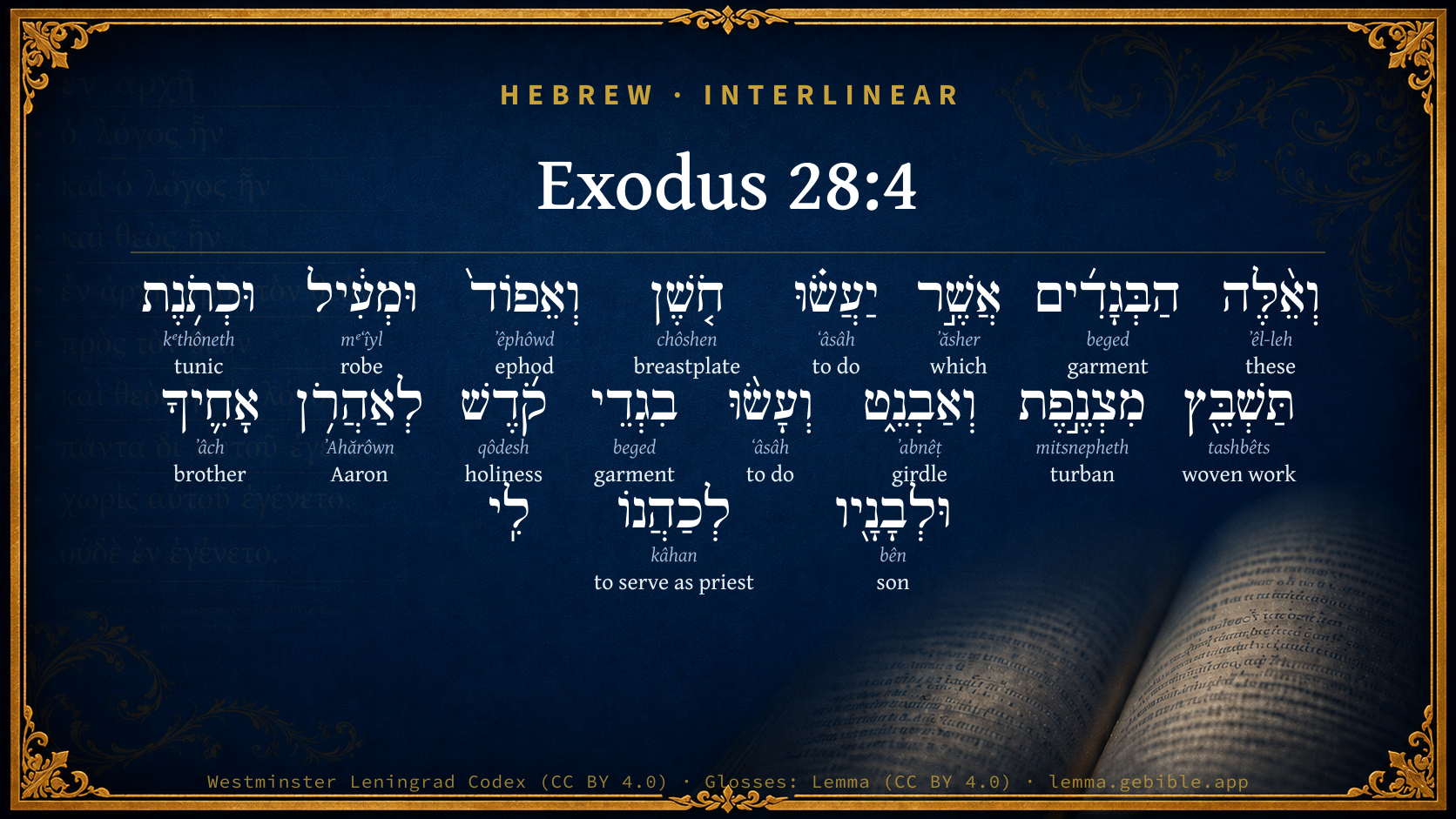
  1. וְאֵ֨לֶּה ʼêl-leh H428 “and · these” Conjunction + Pronoun, Demonstrative, Common, Plural
  2. הַבְּגָדִ֜ים beged H899 “the · garments” Particle, Definite Article + Noun, Common, Masculine, Plural, Absolute
  3. אֲשֶׁ֣ר ʼăsher H834 “which” Particle, Relative
  4. יַעֲשׂ֗וּ ʻâsâh H6213 “to do” Verb, Qal, Imperfect, 3rd Person, Masculine, Plural
  5. חֹ֤שֶׁן chôshen H2833 “breastplate” Noun, Common, Masculine, Singular, Absolute
  6. וְאֵפוֹד֙ ʼêphôwd H646 “and · ephod” Conjunction + Noun, Common, Masculine, Singular, Absolute
  7. וּמְעִ֔יל mᵉʻîyl H4598 “and · robe” Conjunction + Noun, Common, Masculine, Singular, Absolute
  8. וּכְתֹ֥נֶת kᵉthôneth H3801 “and · tunic of” Conjunction + Noun, Common, Feminine, Singular, Construct
  9. מִצְנֶ֣פֶת mitsnepheth H4701 “turban” Noun, Common, Feminine, Singular, Absolute
  10. וְאַבְנֵ֑ט ʼabnêṭ H73 “and · girdle” Conjunction + Noun, Common, Masculine, Singular, Absolute
  11. וְעָשׂ֨וּ ʻâsâh H6213 “and · to do” Conjunction + Verb, Qal, Sequential Perfect, 3rd Person, Common, Plural
  12. בִגְדֵי beged H899 “garments of” Noun, Common, Masculine, Plural, Construct
  13. קֹ֜דֶשׁ qôdesh H6944 “holiness” Noun, Common, Masculine, Singular, Absolute
  14. לְאַהֲרֹ֥ן ʼAhărôwn H175 “to/for · Aaron” Preposition + Noun, Proper
  15. אָחִ֛יךָ ʼâch H251 “brother · your” Noun, Common, Masculine, Singular, Construct + Suffix, Personal, 2nd Person, Masculine, Singular
  16. וּלְבָנָ֖יו bên H1121 “and · to/for · sons · his” Conjunction + Preposition + Noun, Common, Masculine, Plural, Construct + Suffix, Personal, 3rd Person, Masculine, Singular
  17. לְכַהֲנוֹ kâhan H3547 “to serve as priest · him” Preposition + Verb, Piel, Infinitive Construct + Suffix, Personal, 3rd Person, Masculine, Singular

About this verse

These counts appear in no published source. They are computed here, from the morphology-tagged text and Lemma’s own curated glosses. What Lemma adds →

19
words
16
distinct lemmas
Pentateuch
section

Notable vocabulary

1 hapax legomenon — a word that appears only here in the entire Hebrew Bible:

  • תַּשְׁבֵּ֖ץ woven work H8665

First appearance in Scripture

These words make their first canonical appearance in the Hebrew Bible here:

  • וּמְעִ֔יל robe H4598
  • תַּשְׁבֵּ֖ץ woven work H8665
  • מִצְנֶ֣פֶת turban H4701
  • וְאַבְנֵ֑ט girdle H73

Shared distinctive vocabulary

וְאַבְנֵ֑ט girdle H73 occurs in 9 verses of the Hebrew Bible. Also found in:

Grammatical profile

  • 3 verbs
  • 13 nouns
  • 1 pronoun
  • 1 preposition
  • 1 particle

Verb forms

  • יַעֲשׂ֗וּ Qal · Imperfect
  • וְעָשׂ֨וּ Qal · Sequential Perfect
  • לְכַהֲנוֹ Piel · Infinitive Construct

Repetition

Words recur within this verse — often emphatic in Hebrew:

  • הַבְּגָדִ֜ים garment H899 ×2
  • יַעֲשׂ֗וּ to do H6213 ×2

Hebrew & Septuagint length

In English translation the verse runs 50 words from the Hebrew and 47 from the Septuagint (LXX English) — closely comparable.

A rough comparison of the two English renderings, which tokenize alike — not a word-level alignment.

Word counts can differ between the Hebrew and the Greek without any difference in meaning — e.g. the Hebrew direct-object marker אֵת has no separate Greek word, and Greek often adds the article ὁ.

In the original languages it is 19 Hebrew tokens and 34 Greek tokens — but the two are counted differently (Hebrew bundles its prefixes and suffixes into one token; the Greek is in lemma form), so that isn’t a like-for-like length.

Cross-references

17

Topical passages linked to Exodus 28:4 in the Treasury of Scripture Knowledge — connected by theme and wording, ordered by reader-vote popularity; previews shown in the World English Bible.

  • Ephesians 6:14 Stand therefore, having the utility belt of truth buckled around your waist, and having put on the breastplate of righteousness,
  • Revelation 9:17 Thus I saw the horses in the vision, and those who sat on them, having breastplates of fiery red, hyacinth blue, and sulfur yellow; and the heads of lions. Out of their mouths proceed fire, smoke, and sulfur.
  • Exodus 28:39–40 You shall weave the coat in checker work of fine linen, and you shall make a turban of fine linen, and you shall make a sash, the work of the embroiderer.
  • Isaiah 59:17 He put on righteousness as a breastplate, and a helmet of salvation on his head; and he put on garments of vengeance for clothing, and was clad with zeal as a mantle.
  • 1 Thessalonians 5:8 But let us, since we belong to the day, be sober, putting on the breastplate of faith and love, and, for a helmet, the hope of salvation.
  • Exodus 28:6–35 "They shall make the ephod of gold, of blue, and purple, scarlet, and fine twined linen, the work of the skillful workman.
  • Exodus 39:2–5 He made the ephod of gold, blue, purple, scarlet, and fine twined linen.
  • Exodus 39:8–22 He made the breastplate, the work of a skillful workman, like the work of the ephod; of gold, of blue, purple, scarlet, and fine twined linen.
  • Exodus 39:25–26 They made bells of pure gold, and put the bells between the pomegranates around the skirts of the robe, between the pomegranates;
  • Exodus 39:28 and the turban of fine linen, and the linen headbands of fine linen, and the linen breeches of fine twined linen,
  • Leviticus 8:7–9 He put the coat on him, tied the sash on him, clothed him with the robe, put the ephod on him, and he tied the skillfully woven band of the ephod on him, and fastened it to him with it.
  • 1 Samuel 2:18 But Samuel ministered before Yahweh, being a child, girded with a linen ephod.
  • 1 Samuel 22:18 The king said to Doeg, Turn you, and fall on the priests. Doeg the Edomite turned, and he fell on the priests, and he killed on that day eighty-five persons who wore a linen ephod.
  • 1 Samuel 23:6 It happened, when Abiathar the son of Ahimelech fled to David to Keilah, that he came down with an ephod in his hand.
  • 1 Samuel 30:7 David said to Abiathar the priest, the son of Ahimelech, Please bring me here the ephod. Abiathar brought there the ephod to David.
  • 2 Samuel 6:14 David danced before Yahweh with all his might; and David was girded with a linen ephod.
  • Isaiah 11:5 Righteousness shall be the belt of his waist, and faithfulness the belt of his loins.

Cross-references courtesy of OpenBible.info (CC BY 4.0).

Hebrew and Greek witnesses Masoretic Hebrew ↔ Greek Septuagint

The same verse in the two great witnesses to the Old Testament, shown verse-for-verse.

These are two independent witnesses, not word-aligned to each other, and the Septuagint is shown in lemma (dictionary) form.

Hebrew Exodus 28:4 Masoretic · Westminster Leningrad Codex

וְאֵ֨לֶּה הַבְּגָדִ֜ים אֲשֶׁ֣ר יַעֲשׂ֗וּ חֹ֤שֶׁן וְאֵפוֹד֙ וּמְעִ֔יל וּכְתֹ֥נֶת תַּשְׁבֵּ֖ץ מִצְנֶ֣פֶת וְאַבְנֵ֑ט וְעָשׂ֨וּ בִגְדֵי קֹ֜דֶשׁ לְאַהֲרֹ֥ן אָחִ֛יךָ וּלְבָנָ֖יו לְכַהֲנוֹ לִֽי

These are the garments which they shall make: a breastplate, and an ephod, and a robe, and a coat of checker work, a turban, and a sash: and they shall make holy garments for Aaron your brother, and his sons, that he may minister to me in the priest's office.

World English Bible · Public Domain

Greek LXX Exodus 28:4 Septuagint · lemma form

καί οὗτος ὁ στολή ὅς ποιέω ὁ περιστήθιον καί ὁ ἐπωμίς καί ὁ ποδήρης καί χιτών κοσυμβωτός καί κίδαρις καί ζωνή καί ποιέω στολή ἅγιος ααρων καί ὁ υἱός αὐτός εἰς ὁ ἱερατεύω ἐγώ

And these are the garments which they shall make: the breast-plate, and the shoulder-piece, and the full-length robe, and the tunic with a fringe, and the tire, and the girdle; and they shall make holy garments for Aaron and his sons to minister to me as priests.

LXX2012 (modern English Septuagint) · Public Domain

Hebrew: Westminster Leningrad Codex (CC BY 4.0). Greek: Septuagint (public domain); English from LXX2012 (modern English Septuagint) (Public Domain). How the Septuagint differs from the Hebrew →

Targum (Aramaic paraphrase)

2

The Targum is the ancient Jewish Aramaic paraphrase of the Hebrew Scriptures — an interpretive translation, not the Hebrew text itself. Onkelos (literal) and Pseudo-Jonathan (expansive) render the Torah, and Jonathan the Prophets. Coverage is partial: where no permissively-licensed English translation exists for a verse, only the Aramaic is shown. This is verse-level text, not a word-by-word alignment to the Hebrew.

  1. Targum Onkelos Torah (Genesis–Deuteronomy)
    וְאִלֵין לְבוּשַׁיָא דִי יַעְבְּדוּן חוּשְׁנָא וְאֵפוֹדָא וּמְעִילָא וְכִתּוּנָא מְרַמְצָא מִצְנֶפְתָּא וְהֶמְיָנָא וְיַעְבְּדוּן לְבוּשֵׁי קוּדְשָׁא לְאַהֲרֹן אָחוּךְ וְלִבְנוֹהִי לְשַׁמָשָׁא קֳדָמַי:

    (no public-domain English translation for this verse)

    Targum Onkelos — Aramaic: “Onkelos Genesis” (public domain); “Onkelos Exodus” (public domain); “Onkelos Leviticus” (public domain); “Onkelos Numbers” (public domain); “Onkelos Deuteronomy” (public domain). English: “Sefaria Community Translation” (CC0 1.0 (public-domain dedication)); “J.W. Etheridge. The Targums of Onkelos and Jonathan Ben Uzziel on the Pentateuch. London: Longmans, Green, 1862” (public domain). Text via Sefaria.

  2. Targum Pseudo-Jonathan Torah (Genesis–Deuteronomy)
    וְאִלֵּין לְבוּשַׁיָא דְיַעַבְדוּן חוּשְׁנָא וְאֵיפוֹדָא וּמְעִילָא וְכִיתּוּנוּן מְרַמְצִין מַצִינְפַן וְקִימוֹרִין וְיַעַבְדוּן לְבוּשֵׁי קוּדְשָׁא לְאַהֲרן אָחוּךְ וְלִבְנוֹי לְשַׁמָּשָׁא קֳדָמַי

    And these are the vestments they shall make: the breastplate and ephoda, and the robe, and the embroidered tunics, the mitres and girdles; and they shall make the holy garments for Aharon thy brother, and for his sons, to minister before Me.

    Targum Pseudo-Jonathan — Aramaic: “Targum Jonathan on Genesis” (public domain); “Targum Jonathan on Exodus” (public domain); “Targum Jonathan on Leviticus” (public domain); “Targum Jonathan on Numbers” (public domain); “Targum Jonathan on Deuteronomy” (public domain). English: “The Targum of Jonathan ben Uzziel, trans. J. W. Etheridge, London, 1862” (public domain). Text via Sefaria.

Commentary

Notes on Exodus 28:4 from classic Christian and Jewish commentators (each source and its license shown beneath its notes). The classic Christian expositions comment on the surrounding passage and are grouped to its opening verse, so a note may address several verses; the Jewish commentaries on the Tanakh (Rashi and others) are per-verse, so they appear only where the commentator wrote on this verse.

Lemma curates 59 commentaries, every one of them public domain or Creative Commons licensed, each selected and text-cleaned for this edition rather than reprinted as found. About our sources →

Trapp's Complete Commentary

John Trapp

Exo 28:4 And these [are] the garments which they shall make; a breastplate, and an ephod, and a robe, and a broidered coat, a mitre, and a girdle: and they shall make holy garments for Aaron thy brother, and his sons, that he may minister unto me in the priest’s office.

Ver. 4. An ephod.] Not that which was common to all priests, {1Sa 2:18; 1Sa 22:18} but peculiar to the high priest. See Exo 28:6.

John Trapp, A Commentary or Exposition upon All the Books of the Old and New Testament (1647–1656) — public domain. Text from a community e-Sword module.

Geneva Bible (1599)

Geneva Bible translators

A short and straight coat without sleeves, put upmost upon his garments to keep them close unto him.

Geneva Bible (1599) marginal notes — public domain. Text via Bolls.life.

Adam Clarke's Commentary

Verse 4. Breastplate] חשן choshen. See Clarke on Ex 25:7.

Ephod] אפד. See Clarke on Ex 25:7.

Robe] מעיל meil, from עלה alah, to go up, go upon; hence the meil may be considered as an upper coat, a surtout. It is described by Josephus as a garment that reaches down to the feet, not made of two distinct pieces, but was one entire long garment, woven throughout. This was immediately under the ephod. See Clarke on Ex 28:31, c.

Broidered coat] כתנת תשבץ kethoneth, tashbets, what Parkhurst translates a close, strait coat or garment according to Josephus, "a tunic circumscribing or closely encompassing the body, and having tight sleeves for the arms." This was immediately under the meil or robe, and answered the same purpose to the priests that our shirts do to us. See Clarke on Ex 28:13.

Mitre] מצנפת mitsnepheth. As this word comes from the root צנף tsanaph, to roll or wrap round, it evidently means that covering of the head so universal in the eastern countries which we call turban or turband, corrupted from the Persian [Persic] doolbend, which signifies what encompasses and binds the head or body; and hence is applied, not only to this covering of the head, but to a sash in general. As the Persian word is compounded of [Persic] dool, or dawal, a revolution, vicissitude, wheel, c., and [Persic] binden, to bind it is very likely that the Hebrew words דור dur, to go round, and בנט benet, a band, may have been the original of doolbend and turband. It is sometimes called [Persiac] serbend, from [Persic] ser, the head, and [Persic] binden, to bind. The turban consists generally of two parts: the cap, which goes on the head; and the long sash of muslin, linen, or silk, that is wrapped round the head. These sashes are generally several yards in length.

A girdle] אבנט abnet, a belt or girdle; see before. This seems to have been the same kind of sash or girdle, so common in the eastern countries, that confined the loose garments about the waist; and in which their long skirts were tucked up when they were employed in work, or on a journey. After being tied round the waist, the two ends of it fell down before, to the skirts of their robes.

Adam Clarke's Commentary on the Bible (1810–1826) — public domain. Text from a community e-Sword/MySword module.

Ellicott's Commentary for English Readers

(4). These are the garments.—The garments peculiar to the high priest are taken first, and described with great elaboration in thirty-six verses (4-39). The most conspicuous was the breastplate, described in Exo_28:13-30, and here mentioned first of all. Next to this came the peculiar vestment called the “ephod,” a sort of jerkin or waistcoat, upon which the breastplate was worn (described in Exo_28:6-12). Under the ephod was the long robe of blue, called “the robe of the ephod,” which may be considered as the main garment, and which is described in Exo_28:31-35. Upon his head the high priest wore a “mitre” or turban (described in Exo_28:36-38); and inside his “robe” he wore a linen shirt or tunic, secured by a girdle (Exo_28:39). Underneath the tunic he wore linen drawers (Exo_28:42-43). Nothing is said as to any covering for his feet; but it is probable that they were protected by sandals.

A Bible Commentary for English Readers, edited by Charles John Ellicott (1878–1897) — public domain. Text from a community e-Sword module.

The Cambridge Bible for Schools and Colleges

gen. ed. J. J. S. Perowne

4. The vestments to be made: a pouch (v. 15 ff.), an ephod (v. 6ff.), a robe (v. 31 ff.), a tunic (v. 39), a turban, and a sash (ib.).

The Cambridge Bible for Schools and Colleges (gen. ed. J. J. S. Perowne; Cambridge University Press, 1878–1918) — public domain. Text from a community e-Sword module.

John Gill's Exposition

And these are the garments which they shall make,.... Some for Aaron and some for his sons, some peculiar to the high priest, and others in common to him and other priests:

a breastplate, and an ephod, and a robe, and a broidered coat, a mitre, and a girdle; of each of which, with others, there is a more particular account in this chapter, and will be observed in their order:

and they shall make holy garments for Aaron thy brother, and his sons: as those before mentioned, with some others not mentioned; some for Aaron only, and others that were to be worn by his sons also:

that he may minister unto me in the priest's office; these were absolutely necessary to the execution of the priestly office, and an essential qualification for it, and without which it was not lawful to serve in it.

John Gill's Exposition of the Whole Bible (1746–1763) — public domain (CC PDM 1.0). Text via the HelloAO Bible API.

Haydock's Catholic Bible Commentary

Rational and ephod. See chap. xxv. 7. --- Tunic, long robe or cloak of blue wool. --- Garment, next the body, and woven very close and thick. --- Mitre, like a tiara or turban of linen, or rather of byssus, or fine cotton. This was never laid aside in the temple; as, to appear uncovered was then esteemed a mark of insolence. Eneas introduced the Phrygian custom into Italy, of sacrificing with a cap on the head. --- Girdle, for his under-garment, besides that which formed a part of the ephod. (Calmet) --- By these vestments, we are admonished to exercise the virtues of discretion, &c. (St. Jerome, ep. ad Fab.)

George Leo Haydock (1774–1849), Haydock's Catholic Family Bible and Commentary, 1859 edition — public domain. Excludes Psalms (Douay-Rheims chapter numbering differs from Protestant) and Deuterocanonical books (Catholic canon only).

Matthew Poole's English Annotations

An ephod was a short upper garment, made without sleeves, which was girt about the body. And it was twofold; the one made of fine linen, which was common not only to all the priests, as 1Sa 2:18; 22:18; but to some others also upon solemn and sacred occasions, as 2Sa 6:14; the other made of divers stuffs and colours, peculiar to the high priest; the parts whereof were not sewed, but tied together.

A robe; an upper garment like a surplice.

A broidered coat; an under coat curiously wrought with circular works like eyes, as the word notes, and richly adorned with gems and other things.

A mitre; a kind of bonnet or cap for the covering of the head, supposed to be something like a Turkish turban for the form of it. A

girdle, to enclose and fasten all the other garments, which were loose in themselves, that he might be more expeditious in his work.

Matthew Poole's English Annotations on the Holy Bible (1683–1685) — public domain. Text from a community e-Sword/MySword module.

Whedon's Commentary on the Bible

Daniel D. Whedon

4, 5. These are the garments — In these two verses the principal articles of the priestly dress are mentioned, and the materials which were to be used in making them, but the fuller description of the several articles is given in the sequel of the chapter.

Daniel D. Whedon (gen. ed.), Commentary on the Old and New Testaments (1874–1909) — public domain. Text from a community e-Sword module.

The Pulpit Commentary

These are the garments. The enumeration does not follow the same order exactly as the description. The two agree, however, in giving the precedence to the same three articles of apparel out of the six viz., the breast-plate, the ephod, and the robe. His sonsi.e. , his successors in the office of high priest,

The Pulpit Commentary (1880–1919), ed. H.D.M. Spence-Jones & Joseph S. Exell — public domain. Text from a community e-Sword module.

Scofield Reference Notes

C. I. Scofield

garments

(See Scofield "Exo 29:5").

The Scofield Reference Bible (1917 edition), notes by C. I. Scofield — public domain. Text from a community e-Sword module.

unfoldingWord translationNotes

Door43 World Missions Community

General Information:

Yahweh continues telling Moses what the people must do.

a coat of woven work

"a coat with a design woven into it"

turban

a tall head covering made from cloth wrapped around the head several times.

sash

a piece of cloth that people wear around their waist or across their chest

translationWords

breastplate

ephod

robe

set apart

Aaron

servant

priest

unfoldingWord translationNotes — © Distant Shores Media and the Door43 World Missions Community, licensed CC BY-SA 4.0. Source: git.door43.org/Door43/en_tn.

Rashi

Rabbi Shlomo Yitzchaki (Rashi)

חשן A BREAST-PLATE — an ornament borne in front of the heart.

ואפוד AND AN EPHOD — I have heard no tradition nor have I found in the Boraitha any description of its shape, but my own mind tells me that it was tied on behind him; its breadth was the same as the breadth of a man’s back like a kind of apron which is called pourceint in old French which ladies of rank tie on when they ride on horse-back. Such, as mentioned, was the way in which the lower part was made, as it is said, (II Samuel 6:14) “And David was girded with a linen ephod” — this informs us that the ephod was something tied on the body. It is, however, not possible to say that it consisted of a girdle only, because it is said (Leviticus 8:7) “And he put the ephod upon him”, and afterwards it is stated “and he girded him with the חשב of the ephod” and this Onkelos translated by “the girdle of the ephod.” This, therefore, informs us that the חשב is the girdle and the אפור is the name of the ornamental garment itself. Further, it is not possible to assert that it was on account of the two shoulder-straps that it was called אפוד (i. e. that the term אפוד applies to these two straps and the girdle to which they were attached) for it is said, (v. 27) “the two shoulder-pieces of the ephod” — this tells us that the ephod is a separate name, the shoulderpieces a separate name and the girdle a separate name (i. e. each of these is the name of separate articles). Consequently I say that it is called אפוד in reference to the apron-like garment which hung down and that it was so called because they bedecked him (אופדו) and ornamented him with it, as it is said, (Leviticus 8:7) “And he bedecked (ויאפוד) him with it.” The חשב was the girdle which was on the upper portion of it (the ephod), and the shoulder-pieces were attached to it. Further, my own mind tells me that there is evidence that it was a kind of garment, for Jonathan ben Uzziel translates (II Samuel 6:14) “And David was girded with a linen ephod” by “a linen כרדוט” and exactly similarly does he translate מעילים, “robes”, by כרדוטין in the story of Tamar, Absolom’s sister, (II Samuel 13:18) “For with such robes (מעילים) were the king’s daughters that were virgins apparelled”.

מעיל — This was a kind of shirt and so, too, the כתונת, except that the כתונת was worn immediately on the body and מעיל is a term for the outer shirt.

תשבץ A QUILTED [INNER GARMENT] — made with משבצות as ornaments. These משבצות were a kind of indentations which are made in gold ornaments as a setting in which to fix precious stones and pearls, as it is said of the stones of the ephod, (v. 11) “enclosed in settings (משבצות) of gold.” In old French they call them castons.

מצנפת — a kind of domed helmet which they call cofea in old French, for in another passage (v. 40) it calls them מגבעות which we translate in the Targum by כובעין, helmets.

ואבנט — This was a girdle upon the inner-garment, and the ephod was the girdle over the outer-garment, just as we find it stated in the description of the order in which they were donned: (Leviticus 8:7), “And he put upon him the inner-garment (כתנת) and girded him with the belt (אבנט) and clothed him with the mantle (מעיל) and put the ephod (אפוד) upon him.”

בגדי קדש lit., GARMENTS OF THE HOLY THING — i. e. from the heave-offering that is sanctified (מקדשת) to My Name shall they make them (Sifra, Acharei Mot, Chapter 1 10).

Rashi on the Tanakh — English translations: “The Judaica Press complete Tanach with Rashi, translated by A. J. Rosenberg” (CC BY 4.0); “Pentateuch with Rashi's commentary by M. Rosenbaum and A.M. Silbermann, 1929-1934” (public domain); “The Metsudah Tanach series, Lakewood, N.J” (CC BY 4.0); and “The Book of Joshua, Metsudah Publications, 1997” (CC BY 4.0). Text via Sefaria.

Lesson kit

Teaching starters — assembled from the data on this page, not authored interpretation. Every prompt links to the verse data it draws on. Edit before teaching.

Exodus, in the Pentateuch, opens this verse with 19 words (16 distinct Hebrew lemmas). Its most distinctive word is tashbêts (“woven work”). A historical commentator’s framing appears above. Read the whole chapter for the surrounding context.

Discussion questions

  1. What does “woven work” (tashbêts) contribute to the verse as a whole?
  2. This verse holds 1 word here found nowhere else in the Hebrew Bible. What might the rare word draw attention to?
  3. 4 words here appear for the first time in Scripture. What is being introduced at this debut?
  4. Exodus 28:39 shares the word «girdle» with this verse. How do the two illuminate each other?
  5. “garment” occurs 2× in this one verse. What is the effect of the repetition?
  6. These translations render this verse differently. What is at stake in choosing one wording over another?
  7. The verb «יַעֲשׂ֗וּ» is Qal Imperfect. How does its form color the action?
  8. Reading how Trapp's Complete Commentary and Geneva Bible (1599) read this verse, where do the two commentators agree and where do they part?

Things to notice

  • 1 word in this verse appears nowhere else in the Hebrew Bible.
  • 4 words make their first canonical appearance in Scripture here.
  • This verse counts 19 Hebrew ↔ 34 Greek words.
  • These translations choose different wording for 22 words in this verse.
  • “garment” occurs 2× in this single verse.

Reading settings

Reading text

Shown beneath each verse's original-language words.

Old Testament
Old Testament edition

Read the OT as the Masoretic Hebrew (MT) or the Greek Septuagint (LXX).

English shown for the Greek Septuagint (in the Hebrew ↔ Greek comparison).

Comparing translations? Open the Compare panel on any verse page to stack up to four side by side.