Numbers 7:9

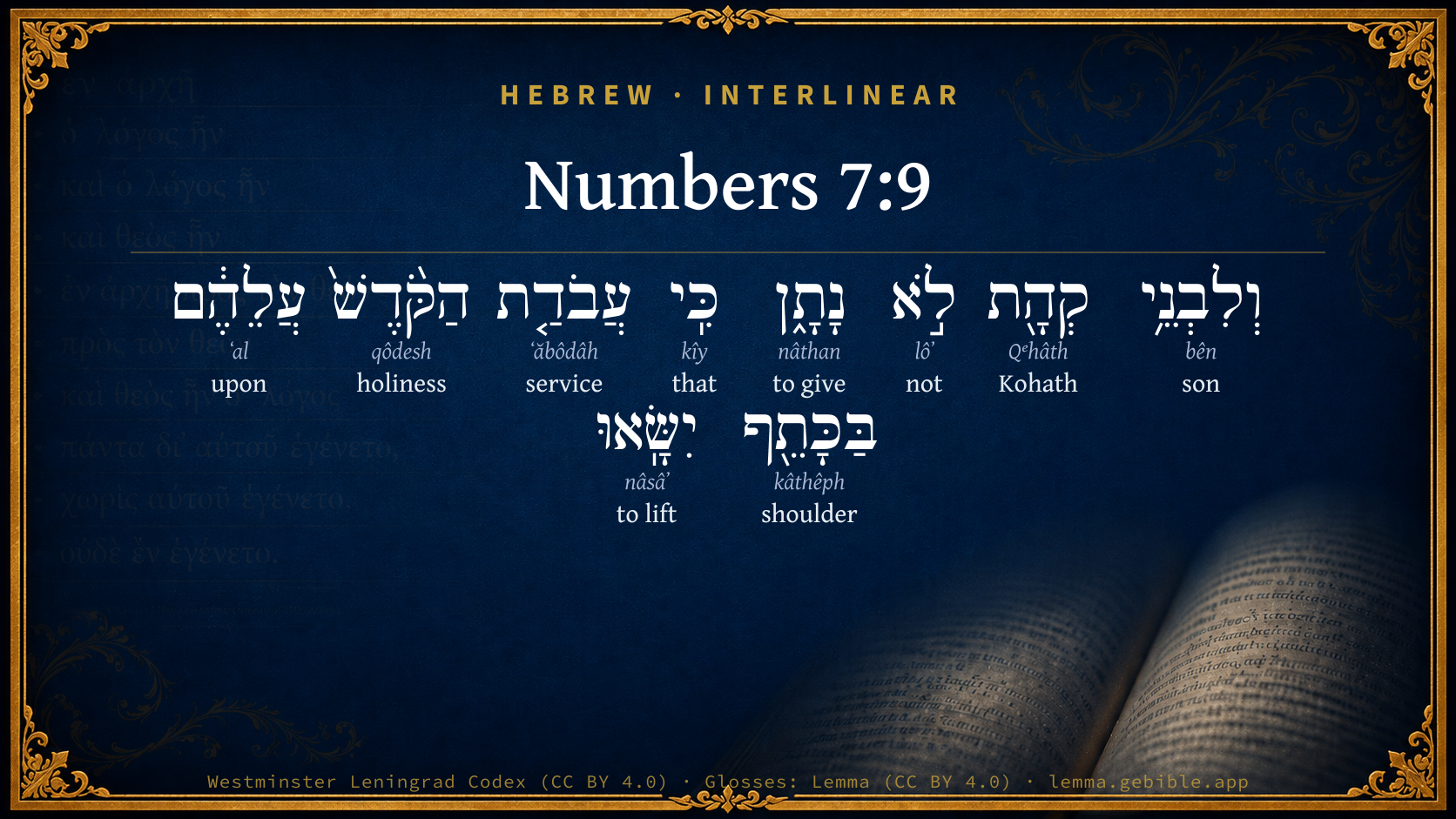
Hebrew (Westminster Leningrad Codex) Numbers 7:9 appears in the Hebrew Old Testament. The text above is from the Westminster Leningrad Codex. Each word links to its Strong’s number, a concise gloss, and parsing drawn from the Open Scriptures Hebrew Bible morphology. Click any word for its full Brown-Driver-Briggs (BDB) entry.
Download image
Cite this verse

Numbers 7:9 (World English Bible). Public Domain. Lemma interlinear Bible study tool, https://lemma.gebible.app/v/numbers/7/9.

Show BibTeX & RIS
BibTeX
RIS
English Translation
But to the sons of Kohath he gave none, because the service of the sanctuary belonged to them; they carried it on their shoulders.
World English Bible · Public Domain
Download a study sheet

One document with this verse’s original text, its word-by-word gloss line, the meaning frame, cross-references with their text, attributed commentary, and full source and license credits — printable, and it pastes into notes with its structure intact.

This verse Autodidact and up

Study sheet (.html) Plain text (.txt)

A passage Seminary Student

Up to 50 verses in one chapter. A passage sheet keeps up to 6 commentary sources and 12 cross-references per verse, in the order this page ranks them, and says so on the sheet whenever that leaves anything out. Ask for a single verse and you get the Autodidact verse sheet above.

Everything on this page stays free to read, with no account — the sheet is a download of what is already on screen, not access to it.

Want to remove ads? Support Godless Engineer
Compare translations 3

The same verse in 3 English versions, stacked beneath the original-language interlinear above. Click any original word for its lexicon entry.

Each is an independent rendering of the whole verse — the interlinear is not word-aligned to these translations.

Highlighted words mark where these versions differ — a whole-verse word diff, not a word-by-word alignment.

  • World English Bible Public Domain
    But to the sons of Kohath he gave none, because the service of the sanctuary belonged to them; they carried it on their shoulders.
  • King James Version Public Domain
    But unto the sons of Kohath he gave none: because the service of the sanctuary belonging unto them was that they should bear upon their shoulders.
  • unfoldingWord Literal Text CC BY-SA 4.0
    But to the sons of Kohath he did not give, for the service of the holy place upon them. They carried on the shoulder.

unfoldingWord Literal Text — © unfoldingWord, licensed CC BY-SA 4.0. Word-aligned USFM3 via Door43 (git.door43.org/unfoldingWord/en_ult).

Versions to compare (up to 4)

3 of 4 selected

Show all 18 translations

Every available English version of this verse, each an independent rendering of the whole verse.

  • World English Bible Public Domain
    But to the sons of Kohath he gave none, because the service of the sanctuary belonged to them; they carried it on their shoulders.
  • Berean Standard Bible Public Domain
    But he did not give any to the Kohathites, since they were to carry on their shoulders the holy objects for which they were responsible.
  • Majority Standard Bible Public Domain
    But he did not give any to the Kohathites, since they were to carry on their shoulders the holy objects for which they were responsible.
  • King James Version Public Domain
    But unto the sons of Kohath he gave none: because the service of the sanctuary belonging unto them was that they should bear upon their shoulders.
  • American Standard Version (1901) Public Domain
    But unto the sons of Kohath he gave none, because the service of the sanctuary belonged unto them; they bare it upon their shoulders.
  • Revised Version (1885) Public Domain
    But unto the sons of Kohath he gave none: because the service of the sanctuary belonged unto them; they bare it upon their shoulders.
  • Geneva Bible (1599) Public Domain
    But to the sonnes of Kohath he gaue none, because the charge of the Sanctuarie belonged to them, which they did beare vpon their shoulders.
  • Douay-Rheims (1899) Public Domain
    Moses therefore receiving the wagons and the oxen, delivered them to the Levites.
  • Young's Literal Translation Public Domain
    and to the sons of Kohath he hath not given, for the service of the sanctuary `is' on them: on the shoulder they bear.
  • Literal Standard Version CC BY-SA 4.0
    but he has not given [any] to the sons of Kohath, for the service of the holy place [is] on them, [which] they carry on the shoulder.
  • Unlocked Literal Bible CC BY-SA 4.0
    But he gave none of those things to the descendants of Kohath, because theirs would be the work related to the things that belong to Yahweh that they would carry on their own shoulders.
  • unfoldingWord Literal Text CC BY-SA 4.0
    But to the sons of Kohath he did not give, for the service of the holy place upon them. They carried on the shoulder.
  • Darby Bible Public Domain
    But unto the sons of Kohath he gave none, for the service of the sanctuary was upon them: they bore [what they carried] upon the shoulder.
  • World Messianic Bible Public Domain
    But to the sons of Kohath he gave none, because the service of the sanctuary belonged to them; they carried it on their shoulders.
  • Webster's Bible Public Domain
    But to the sons of Kohath he gave none: because the service of the sanctuary belonging to them was that they should bear upon their shoulders.
  • Free Bible Version CC BY-SA 4.0
    He didn't give any wagons or oxen to the Kohathites because their responsibility was to carry on their shoulders the holy objects assigned to their care.
  • Bible in Basic English Public Domain
    But to the sons of Kohath he gave nothing; because they had the care of the holy place, taking it about on their backs.
  • JPS Tanakh (1917) Public Domain
    But unto the sons of Kohath he gave none, because the service of the holy things belonged unto them: they bore them upon their shoulders.

Literal Standard Version (2020), Covenant Press — licensed CC BY-SA 4.0. Text via the HelloAO Bible API (eBible.org). Unlocked Literal Bible (unfoldingWord) — licensed CC BY-SA 4.0. Text via the HelloAO Bible API (eBible.org). unfoldingWord Literal Text — © unfoldingWord, licensed CC BY-SA 4.0. Word-aligned USFM3 via Door43 (git.door43.org/unfoldingWord/en_ult). Free Bible Version, Dr. Jonathan Gallagher — licensed CC BY-SA 4.0. Text via the HelloAO Bible API (eBible.org).

Word by word

More ways to search: Search by grammar → Find every occurrence → Compare this word →

Practice this passage: Drill this verse → Learn its vocabulary →

About this verse

These counts appear in no published source. They are computed here, from the morphology-tagged text and Lemma’s own curated glosses. What Lemma adds →

10
words
10
distinct lemmas
Pentateuch
section

Shared distinctive vocabulary

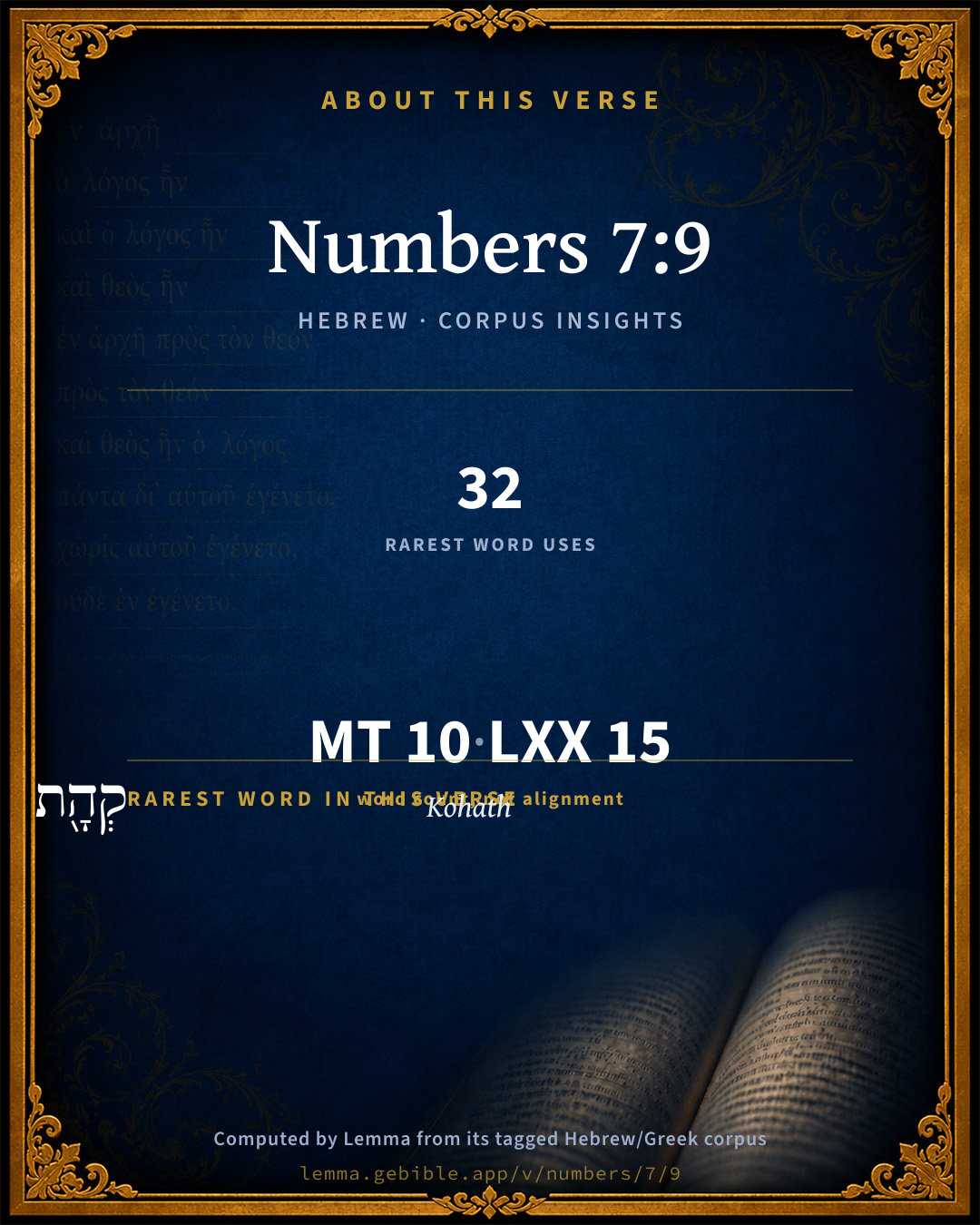
קְהָ֖ת Kohath H6955 occurs in 29 verses of the Hebrew Bible. Also found in:

Grammatical profile

  • 2 verbs
  • 5 nouns
  • 1 preposition
  • 1 conjunction
  • 1 particle

Verb forms

  • נָתָ֑ן Qal · Perfect
  • יִשָּֽׂאוּ Qal · Imperfect

Hebrew & Septuagint length

In English translation the verse runs 24 words from the Hebrew and 26 from the Septuagint (LXX English) — closely comparable.

A rough comparison of the two English renderings, which tokenize alike — not a word-level alignment.

Word counts can differ between the Hebrew and the Greek without any difference in meaning — e.g. the Hebrew direct-object marker אֵת has no separate Greek word, and Greek often adds the article ὁ.

In the original languages it is 10 Hebrew tokens and 15 Greek tokens — but the two are counted differently (Hebrew bundles its prefixes and suffixes into one token; the Greek is in lemma form), so that isn’t a like-for-like length.

Cross-references

7

Topical passages linked to Numbers 7:9 in the Treasury of Scripture Knowledge — connected by theme and wording, ordered by reader-vote popularity; previews shown in the World English Bible.

  • Numbers 3:31 Their charge shall be the ark, the table, the lamp stand, the altars, the vessels of the sanctuary with which they minister, and the screen, and all its service.
  • Numbers 4:4–16 This is the service of the sons of Kohath in the Tent of Meeting, the most holy things.
  • 2 Samuel 6:13 It was so, that, when those who bore the ark of Yahweh had gone six paces, he sacrificed an ox and a fattened calf.
  • 1 Chronicles 15:13 For because you didn't carry it at the first, Yahweh our God made a breach on us, because we didn't seek him according to the ordinance.
  • 2 Samuel 6:6 When they came to the threshing floor of Nacon, Uzzah put forth [his hand] to the ark of God, and took hold of it; for the oxen stumbled.
  • 1 Chronicles 15:3 David assembled all Israel at Jerusalem, to bring up the ark of Yahweh to its place, which he had prepared for it.
  • 1 Chronicles 23:26 and also the Levites shall no more have need to carry the tent and all the vessels of it for the service of it.

Cross-references courtesy of OpenBible.info (CC BY 4.0).

Hebrew and Greek witnesses Masoretic Hebrew ↔ Greek Septuagint

The same verse in the two great witnesses to the Old Testament, shown verse-for-verse.

These are two independent witnesses, not word-aligned to each other, and the Septuagint is shown in lemma (dictionary) form.

Hebrew Numbers 7:9 Masoretic · Westminster Leningrad Codex

וְלִבְנֵ֥י קְהָ֖ת לֹ֣א נָתָ֑ן כִּֽי עֲבֹדַ֤ת הַקֹּ֨דֶשׁ֙ עֲלֵהֶ֔ם בַּכָּתֵ֖ף יִשָּֽׂאוּ

But to the sons of Kohath he gave none, because the service of the sanctuary belonged to them; they carried it on their shoulders.

World English Bible · Public Domain

Greek LXX Numbers 7:9 Septuagint · lemma form

καί ὁ υἱός κααθ οὐ δίδωμι ὅτι ὁ λειτούργημα ὁ ἅγιος ἔχω ἐπί ὦμος αἴρω

But to the sons of Caath he gave them not, because they have the ministrations of the sacred things: they shall bear them on their shoulders.

LXX2012 (modern English Septuagint) · Public Domain

Hebrew: Westminster Leningrad Codex (CC BY 4.0). Greek: Septuagint (public domain); English from LXX2012 (modern English Septuagint) (Public Domain). How the Septuagint differs from the Hebrew →

Targum (Aramaic paraphrase)

2

The Targum is the ancient Jewish Aramaic paraphrase of the Hebrew Scriptures — an interpretive translation, not the Hebrew text itself. Onkelos (literal) and Pseudo-Jonathan (expansive) render the Torah, and Jonathan the Prophets. Coverage is partial: where no permissively-licensed English translation exists for a verse, only the Aramaic is shown. This is verse-level text, not a word-by-word alignment to the Hebrew.

  1. Targum Onkelos Torah (Genesis–Deuteronomy)
    וְלִבְנֵי קְהָת לָא יְהָב אֲרֵי פוּלְחַן קוּדְשָׁא עֲלֵיהוֹן בְּכַתְפָּא נָטְלִין

    (no public-domain English translation for this verse)

    Targum Onkelos — Aramaic: “Onkelos Genesis” (public domain); “Onkelos Exodus” (public domain); “Onkelos Leviticus” (public domain); “Onkelos Numbers” (public domain); “Onkelos Deuteronomy” (public domain). English: “Sefaria Community Translation” (CC0 1.0 (public-domain dedication)); “J.W. Etheridge. The Targums of Onkelos and Jonathan Ben Uzziel on the Pentateuch. London: Longmans, Green, 1862” (public domain). Text via Sefaria.

  2. Targum Pseudo-Jonathan Torah (Genesis–Deuteronomy)
    וְלִבְנֵי קְהָת לָא יְהַב עֶגְלָן וְתוֹרִין אֲרוּם פּוּלְחַן קוּדְשָׁא רַמְיָא עֲלֵיהוֹן בְּכַתְפָא נַטְלִין

    But to the sons of Kehath he gave neither wagons nor oxen, because on them was laid the service of the sanctuary, to be carried on their shoulders.

    Targum Pseudo-Jonathan — Aramaic: “Targum Jonathan on Genesis” (public domain); “Targum Jonathan on Exodus” (public domain); “Targum Jonathan on Leviticus” (public domain); “Targum Jonathan on Numbers” (public domain); “Targum Jonathan on Deuteronomy” (public domain). English: “The Targum of Jonathan ben Uzziel, trans. J. W. Etheridge, London, 1862” (public domain). Text via Sefaria.

Commentary

Notes on Numbers 7:9 from classic Christian and Jewish commentators (each source and its license shown beneath its notes). The classic Christian expositions comment on the surrounding passage and are grouped to its opening verse, so a note may address several verses; the Jewish commentaries on the Tanakh (Rashi and others) are per-verse, so they appear only where the commentator wrote on this verse.

Lemma curates 59 commentaries, every one of them public domain or Creative Commons licensed, each selected and text-cleaned for this edition rather than reprinted as found. About our sources →

Trapp's Complete Commentary

John Trapp

Num 7:9 But unto the sons of Kohath he gave none: because the service of the sanctuary belonging unto them [was that] they should bear upon their shoulders.

Ver. 9. Bear upon their shoulders.] Therefore when David carted the ark, as the Philistines had done before, God was angry, and made a breach upon Uzza, because they sought him not in due order. {1Ch 15:13}

John Trapp, A Commentary or Exposition upon All the Books of the Old and New Testament (1647–1656) — public domain. Text from a community e-Sword module.

Joseph Benson's Commentary

Num 7:9. Because of the sanctuary, &c. — The Seventy translate it more literally, Because they have the service of the holy things, (that is, of the ark, Num 4:5; Num 4:15.) They shall carry it upon their shoulders — This way of carrying the ark was both for greater dignity, on account of the superior holiness and value of it, and its contents and appurtenances, and that the structure of it might not be discomposed, as it might have been by the shaking of a wagon.

Joseph Benson's Commentary on the Old and New Testaments (1811–1818) — public domain. Text from a community e-Sword module.

Tyndale Open Study Notes

Tyndale Open Resources

7:9 A later Israelite attempt to transport the Ark by cart ended in tragedy (1 Sam 6:8, 11; 2 Sam 6:3, 6-7).

Tyndale Open Study Notes — © Tyndale Open Resources, licensed CC BY-SA 4.0. Text via the HelloAO Bible API.

Geneva Bible (1599)

Geneva Bible translators

The holy thing of the Sanctuary must be carried upon their shoulders and not drawn with oxen, Num. 4:15.

Geneva Bible (1599) marginal notes — public domain. Text via Bolls.life.

Adam Clarke's Commentary

Verse 9. Unto the sons of Kohath he gave none] Because they had the charge of the ark, table, candlestick, altars, c., Nu 4:5-15, which were to be carried upon their shoulders for those sacred things must not be drawn by beasts.

Adam Clarke's Commentary on the Bible (1810–1826) — public domain. Text from a community e-Sword/MySword module.

The Cambridge Bible for Schools and Colleges

gen. ed. J. J. S. Perowne

9. the sanctuary] the holy things. See on Num_4:15.

upon their shoulders] In early days this form of honour was not always paid to the ark; see 2Sa_6:3.

The Cambridge Bible for Schools and Colleges (gen. ed. J. J. S. Perowne; Cambridge University Press, 1878–1918) — public domain. Text from a community e-Sword module.

John Gill's Exposition

But unto the sons of Kohath he gave none,.... Being all disposed of to the sons of Gershon and Merari: the reason of which follows:

because the service of the sanctuary belonging unto them was that they should bear upon their shoulders; as the ark with the mercy seat, and cherubim, the shewbread table, the candlestick, and the two altars; though in later times we find the ark was sometimes not only carried by the priests, but upon a cart, Jos 3:17.

John Gill's Exposition of the Whole Bible (1746–1763) — public domain (CC PDM 1.0). Text via the HelloAO Bible API.

Haydock's Catholic Bible Commentary

Serve in removing the most sacred vessels of the sanctuary, chap. iv. 4. --- Shoulders, out of respect. Yet the ark itself was placed on a cart, (2 Kings vi. 3.; Haydock.) improperly. (Du Hamel)

George Leo Haydock (1774–1849), Haydock's Catholic Family Bible and Commentary, 1859 edition — public domain. Excludes Psalms (Douay-Rheims chapter numbering differs from Protestant) and Deuterocanonical books (Catholic canon only).

Matthew Poole's English Annotations

Because of the greater worth and holiness of the things which they carried. See Num 4:6,8,10,12,14; 2Sa 6:6,13.

Matthew Poole's English Annotations on the Holy Bible (1683–1685) — public domain. Text from a community e-Sword/MySword module.

Whedon's Commentary on the Bible

Daniel D. Whedon

9. The sons of Kohath received no vehicles, because the sacred furniture might not be drawn by beasts. Only with the greatest precaution could it be approached and borne by its appointed Levitical guardians. Num_4:4-20, notes.

Daniel D. Whedon (gen. ed.), Commentary on the Old and New Testaments (1874–1909) — public domain. Text from a community e-Sword module.

The Pulpit Commentary

Upon their shoulders. For which purpose poles or bearing-frames had been provided, as implying more honour anti care than the use of carriages. The death of Uzzah seems to have been the melancholy consequence of neglecting this rule. (2Sa_6:3, 2Sa_6:7, as compared with 1Ch_15:13)

The Pulpit Commentary (1880–1919), ed. H.D.M. Spence-Jones & Joseph S. Exell — public domain. Text from a community e-Sword module.

John Wesley's Explanatory Notes

Upon their shoulders - Because of the greater worth and holiness of the things which they carried.

John Wesley, Explanatory Notes Upon the Whole Bible (1754–1765) — public domain. Text via the GEBible commentary corpus.

unfoldingWord translationNotes

Door43 World Missions Community

none of those things

This refers to the carts and oxen.

Kohath

See how you translated this man's name in Numbers 3:17.

theirs would be the work

"their work would be"

the things that belong to Yahweh

You can make explicit the implicit meaning of what belongs to Yahweh. AT: "the things that Yahweh reserved for the tabernacle" (See: Assumed Knowledge and Implicit Information)

unfoldingWord translationNotes — © Distant Shores Media and the Door43 World Missions Community, licensed CC BY-SA 4.0. Source: git.door43.org/Door43/en_tn.

Rashi

Rabbi Shlomo Yitzchaki (Rashi)

כי עבדת הקדש עלהם [BUT TO THE SONS OF KOHATH HE GAVE NONE (NO WAGGONS)] BECAUSE THE עבדת הקדש BELONGS UNTO THEM — (not the service of the Sanctuary devolved upon them, but the service in connection with) carrying the most holy objects: the ark, the table, etc. was incumbent upon them, therefore בכתף ישאו they should carry upon their shoulders (not in wagons).

Rashi on the Tanakh — English translations: “The Judaica Press complete Tanach with Rashi, translated by A. J. Rosenberg” (CC BY 4.0); “Pentateuch with Rashi's commentary by M. Rosenbaum and A.M. Silbermann, 1929-1934” (public domain); “The Metsudah Tanach series, Lakewood, N.J” (CC BY 4.0); and “The Book of Joshua, Metsudah Publications, 1997” (CC BY 4.0). Text via Sefaria.

Sforno

Rabbi Ovadia Sforno

Because the sacred work was upon them. The sons of Kehos had the work of the Mikdash and not the work of the Tent. By the Divine word, the wagons would be for the work of the Tent of Meeting, which was carried by the sons of Gershon and Merori. The sons of Kehos, on the other hand, carried nothing from the structure of the Tent of Meeting. They carried the Holy Vessels that were inside, which are collectively called the Mikdash, as it says, “The Kehos family, the carriers of the Mikdash, traveled”.

Sforno on the Tanakh — English translation: “Yalkut, Sifsei Chachomim Chumash, Metsudah Publications, 2009” (CC BY 4.0). Text via Sefaria.

Lesson kit

Teaching starters — assembled from the data on this page, not authored interpretation. Every prompt links to the verse data it draws on. Edit before teaching.

Numbers, in the Pentateuch, opens this verse with 10 words (10 distinct Hebrew lemmas). Its most distinctive word is Qᵉhâth (“Kohath”). A historical commentator’s framing appears above. Read the whole chapter for the surrounding context.

Discussion questions

  1. How does “Kohath” (Qᵉhâth) shape what this verse is saying?
  2. Genesis 46:11 shares the word «Kohath» with this verse. How do the two illuminate each other?
  3. These translations render this verse differently; the difference is in the English rendering, not the original. What questions does that raise?
  4. The verb «נָתָ֑ן» is Qal Perfect. How does its form color the action?
  5. Reading how Trapp's Complete Commentary and Joseph Benson's Commentary read this verse, where do the two commentators agree and where do they part?

Things to notice

Reading settings

Reading text

Shown beneath each verse's original-language words.

Old Testament
Old Testament edition

Read the OT as the Masoretic Hebrew (MT) or the Greek Septuagint (LXX).

English shown for the Greek Septuagint (in the Hebrew ↔ Greek comparison).

Comparing translations? Open the Compare panel on any verse page to stack up to four side by side.