
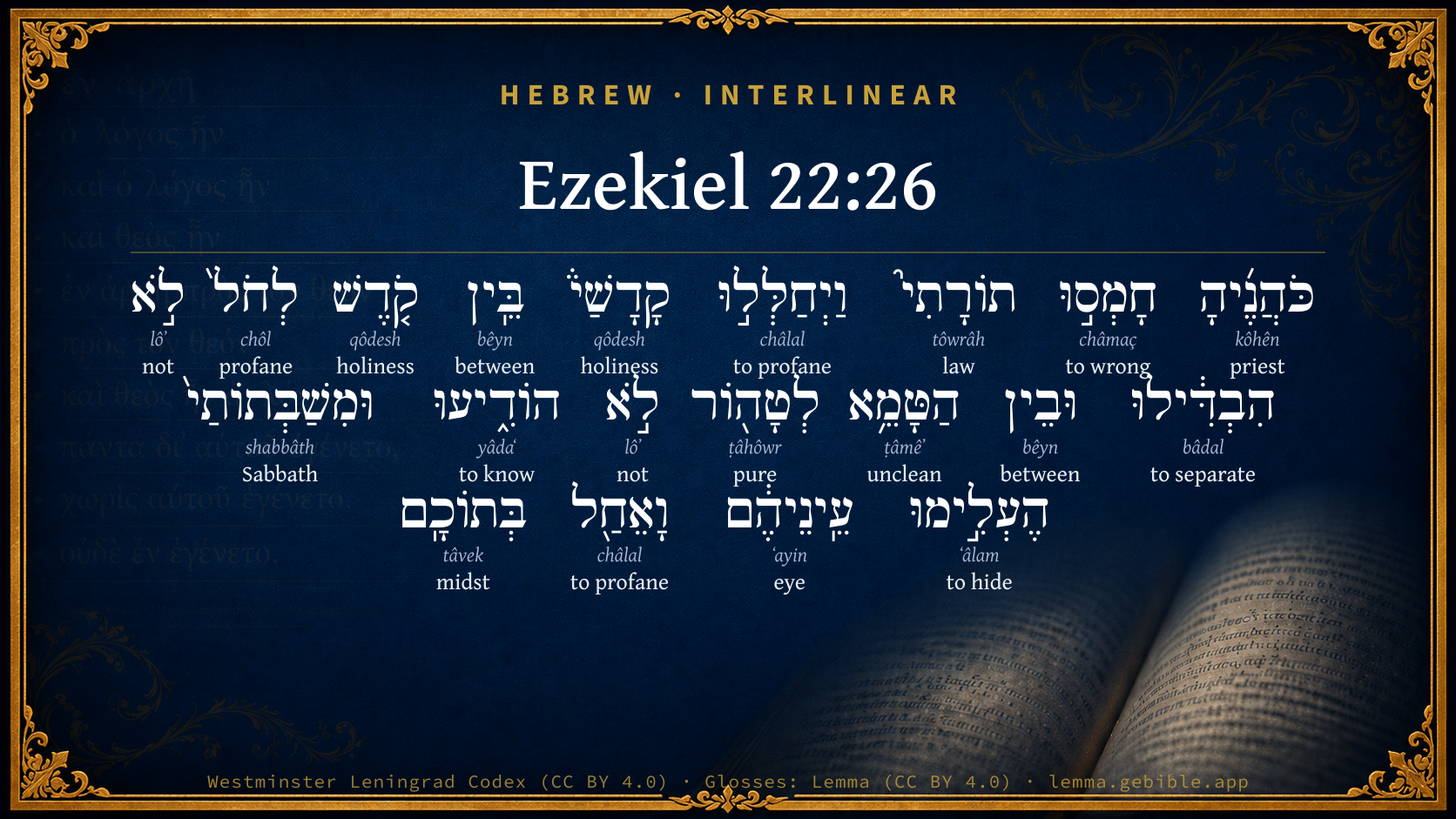
Ezekiel 22:26

Hebrew (Westminster Leningrad Codex) Ezekiel 22:26 appears in the Hebrew Old Testament. The text above is from the Westminster Leningrad Codex. Each word links to its Strong’s number, a concise gloss, and parsing drawn from the Open Scriptures Hebrew Bible morphology. Click any word for its full Brown-Driver-Briggs (BDB) entry.
Download image
Cite this verse

Ezekiel 22:26 (World English Bible). Public Domain. Lemma interlinear Bible study tool, https://lemma.gebible.app/v/ezekiel/22/26.

Show BibTeX & RIS
BibTeX
RIS
English Translation
Her priests have done violence to my law, and have profaned my holy things: they have made no distinction between the holy and the common, neither have they caused men to discern between the unclean and the clean, and have hid their eyes from my Sabbaths, and I am profaned among them.
World English Bible · Public Domain
Download a study sheet

One document with this verse’s original text, its word-by-word gloss line, the meaning frame, cross-references with their text, attributed commentary, and full source and license credits — printable, and it pastes into notes with its structure intact.

This verse Autodidact and up

Study sheet (.html) Plain text (.txt)

A passage Seminary Student

Up to 50 verses in one chapter. A passage sheet keeps up to 6 commentary sources and 12 cross-references per verse, in the order this page ranks them, and says so on the sheet whenever that leaves anything out. Ask for a single verse and you get the Autodidact verse sheet above.

Everything on this page stays free to read, with no account — the sheet is a download of what is already on screen, not access to it.

Want to remove ads? Support Godless Engineer
Compare translations 3

The same verse in 3 English versions, stacked beneath the original-language interlinear above. Click any original word for its lexicon entry.

Each is an independent rendering of the whole verse — the interlinear is not word-aligned to these translations.

Highlighted words mark where these versions differ — a whole-verse word diff, not a word-by-word alignment.

  • World English Bible Public Domain
    Her priests have done violence to my law, and have profaned my holy things: they have made no distinction between the holy and the common, neither have they caused men to discern between the unclean and the clean, and have hid their eyes from my Sabbaths, and I am profaned among them.
  • King James Version Public Domain
    Her priests have violated my law, and have profaned mine holy things: they have put no difference between the holy and profane, neither have they shewed difference between the unclean and the clean, and have hid their eyes from my sabbaths, and I am profaned among them.
  • unfoldingWord Literal Text CC BY-SA 4.0
    Her priests do violence to my law, and they profane my holy things. They do not distinguish between holy things and profane things, and do not teach the difference between the unclean and the clean. They hide their eyes from my Sabbaths so that I am profaned in their midst.

unfoldingWord Literal Text — © unfoldingWord, licensed CC BY-SA 4.0. Word-aligned USFM3 via Door43 (git.door43.org/unfoldingWord/en_ult).

Versions to compare (up to 4)

3 of 4 selected

Show all 18 translations

Every available English version of this verse, each an independent rendering of the whole verse.

  • World English Bible Public Domain
    Her priests have done violence to my law, and have profaned my holy things: they have made no distinction between the holy and the common, neither have they caused men to discern between the unclean and the clean, and have hid their eyes from my Sabbaths, and I am profaned among them.
  • Berean Standard Bible Public Domain
    Her priests do violence to My law and profane My holy things. They make no distinction between the holy and the common, and they fail to distinguish between the clean and the unclean. They disregard My Sabbaths, so that I am profaned among them.
  • Majority Standard Bible Public Domain
    Her priests do violence to My law and profane My holy things. They make no distinction between the holy and the common, and they fail to distinguish between the clean and the unclean. They disregard My Sabbaths, so that I am profaned among them.
  • King James Version Public Domain
    Her priests have violated my law, and have profaned mine holy things: they have put no difference between the holy and profane, neither have they shewed difference between the unclean and the clean, and have hid their eyes from my sabbaths, and I am profaned among them.
  • American Standard Version (1901) Public Domain
    Her priests have done violence to my law, and have profaned my holy things: they have made no distinction between the holy and the common, neither have they caused men to discern between the unclean and the clean, and have hid their eyes from my sabbaths, and I am profaned among them.
  • Revised Version (1885) Public Domain
    Her priests have done violence to my law, and have profaned mine holy things: they have put no difference between the holy and the common, neither have they caused men to discern between the unclean and the clean, and have hid their eyes from my sabbaths, and I am profaned among them.
  • Geneva Bible (1599) Public Domain
    Her Priests haue broken my Lawe, and haue defiled mine holy things: they haue put no difference betweene the holy and prophane, neither discerned betweene the vncleane, and the cleane, and haue hid their eyes from my Sabbaths, and I am prophaned among them.
  • Douay-Rheims (1899) Public Domain
    Her priests have despised my law, and have defiled my sanctuaries: they have put no difference between holy and profane: nor have distinguished between the polluted and the clean: and they have turned away their eyes from my sabbaths, and I was profaned in the midst of them.
  • Young's Literal Translation Public Domain
    Its priests have wronged My law, And they pollute My holy things, Between holy and common they have not made separation, And between the unclean and the clean they have not made known, And from my sabbaths they have hidden their eyes, And I am pierced in their midst.
  • Literal Standard Version CC BY-SA 4.0
    Its priests have wronged My law, || And they defile My holy things, || They have not made separation between holy and common, || And they have not made known [the difference] between the unclean and the clean, || And they have hidden their eyes from My Sabbaths, || And I am pierced in their midst.
  • Unlocked Literal Bible CC BY-SA 4.0
    Her priests do violence to my law, and they profane my holy things. They do not distinguish between holy things and profane things, and do not teach the difference between the unclean and the clean. They hide their eyes from my Sabbaths so that I am profaned in their midst.
  • unfoldingWord Literal Text CC BY-SA 4.0
    Her priests do violence to my law, and they profane my holy things. They do not distinguish between holy things and profane things, and do not teach the difference between the unclean and the clean. They hide their eyes from my Sabbaths so that I am profaned in their midst.
  • Darby Bible Public Domain
    her priests do violence to my law, and profane my holy things: they put no difference between the holy and profane, neither do they make known [the difference] between the unclean and the clean, and they hide their eyes from my sabbaths, and I am profaned among them.
  • World Messianic Bible Public Domain
    Her priests have done violence to my law and have profaned my holy things. They have made no distinction between the holy and the common, neither have they caused men to discern between the unclean and the clean, and have hidden their eyes from my Sabbaths. So I am profaned among them.
  • Webster's Bible Public Domain
    Her priests have violated my law, and have profaned my holy things: they have put no difference between the holy and profane, neither have they shown difference between the unclean and the clean, and have hid their eyes from my sabbaths, and I am profaned among them.
  • Free Bible Version CC BY-SA 4.0
    Her priests pervert my law and make my holy things unclean. They don't distinguish between what is holy and what is ordinary, and they don't separate the clean from the unclean. They forget about my Sabbaths, and they lead people to treat me with no respect.
  • Bible in Basic English Public Domain
    Her priests have been acting violently against my law; they have made my holy things unclean: they have made no division between what is holy and what is common, and they have not made it clear that the unclean is different from the clean, and their eyes have been shut to my Sabbaths, and I am not honoured among them.
  • JPS Tanakh (1917) Public Domain
    Her priests have done violence to My law, and have profaned My holy things; they have put no difference between the holy and the common, neither have they taught difference between the unclean and the clean, and have hid their eyes from My sabbaths, and I am profaned among them.

Literal Standard Version (2020), Covenant Press — licensed CC BY-SA 4.0. Text via the HelloAO Bible API (eBible.org). Unlocked Literal Bible (unfoldingWord) — licensed CC BY-SA 4.0. Text via the HelloAO Bible API (eBible.org). unfoldingWord Literal Text — © unfoldingWord, licensed CC BY-SA 4.0. Word-aligned USFM3 via Door43 (git.door43.org/unfoldingWord/en_ult). Free Bible Version, Dr. Jonathan Gallagher — licensed CC BY-SA 4.0. Text via the HelloAO Bible API (eBible.org).

Word by word

More ways to search: Search by grammar → Find every occurrence → Compare this word →

Practice this passage: Drill this verse → Learn its vocabulary →

לְחֹל֙
chôl
H2455
“to/for · profane”
Preposition + Noun, Common, Masculine, Singular, Absolute
Part of Speech
Preposition + Noun
Type
Common
Gender
Masculine
Number
Singular
State
Absolute
Full BDB Definition

Origin: from H2490

TWOT: 623a , 661a

profaneness, commonness, unholy, profane, common, sand
  1. כֹּהֲנֶ֜יהָ kôhên H3548 “priests · her” Noun, Common, Masculine, Plural, Construct + Suffix, Personal, 3rd Person, Feminine, Singular
  2. חָמְס֣וּ châmaç H2554 “to wrong” Verb, Qal, Perfect, 3rd Person, Common, Plural
  3. תוֹרָתִי֮ tôwrâh H8451 “law · my” Noun, Common, Feminine, Singular, Construct + Suffix, Personal, 1st Person, Common, Singular
  4. וַיְחַלְּל֣וּ châlal H2490 “and · to profane” Conjunction + Verb, Piel, Sequential Imperfect, 3rd Person, Masculine, Plural
  5. קָדָשַׁי֒ qôdesh H6944 “holy things · my” Noun, Common, Masculine, Plural, Construct + Suffix, Personal, 1st Person, Common, Singular
  6. בֵּֽין bêyn H996 “between” Preposition
  7. קֹ֤דֶשׁ qôdesh H6944 “holiness” Noun, Common, Masculine, Singular, Absolute
  8. לֹ֣א lôʼ H3808 “not” Particle, Negative
  9. הִבְדִּ֔ילוּ bâdal H914 “to separate” Verb, Hiphil, Perfect, 3rd Person, Common, Plural
  10. וּבֵין bêyn H996 “and · between” Conjunction + Preposition
  11. הַטָּמֵ֥א ṭâmêʼ H2931 “the · unclean” Particle, Definite Article + Adjective, Adjective, Masculine, Singular, Absolute
  12. לְטָה֖וֹר ṭâhôwr H2889 “to/for · pure” Preposition + Adjective, Adjective, Masculine, Singular, Absolute
  13. לֹ֣א lôʼ H3808 “not” Particle, Negative
  14. הוֹדִ֑יעוּ yâdaʻ H3045 “to know” Verb, Hiphil, Perfect, 3rd Person, Common, Plural
  15. וּמִשַׁבְּתוֹתַי֙ shabbâth H7676 “and · from · Sabbaths · my” Conjunction + Preposition + Noun, Common, Both, Plural, Construct + Suffix, Personal, 1st Person, Common, Singular
  16. הֶעְלִ֣ימוּ ʻâlam H5956 “to hide” Verb, Hiphil, Perfect, 3rd Person, Common, Plural
  17. עֵֽינֵיהֶ֔ם ʻayin H5869 “eyes · their” Noun, Common, Both, Dual, Construct + Suffix, Personal, 3rd Person, Masculine, Plural
  18. וָאֵחַ֖ל châlal H2490 “and · to profane” Conjunction + Verb, Niphal, Sequential Imperfect, 1st Person, Common, Singular
  19. בְּתוֹכָֽם tâvek H8432 “in/at · midst · their” Preposition + Noun, Common, Masculine, Singular, Construct + Suffix, Personal, 3rd Person, Masculine, Plural

About this verse

These counts appear in no published source. They are computed here, from the morphology-tagged text and Lemma’s own curated glosses. What Lemma adds →

20
words
16
distinct lemmas
Prophets
section

Notable vocabulary

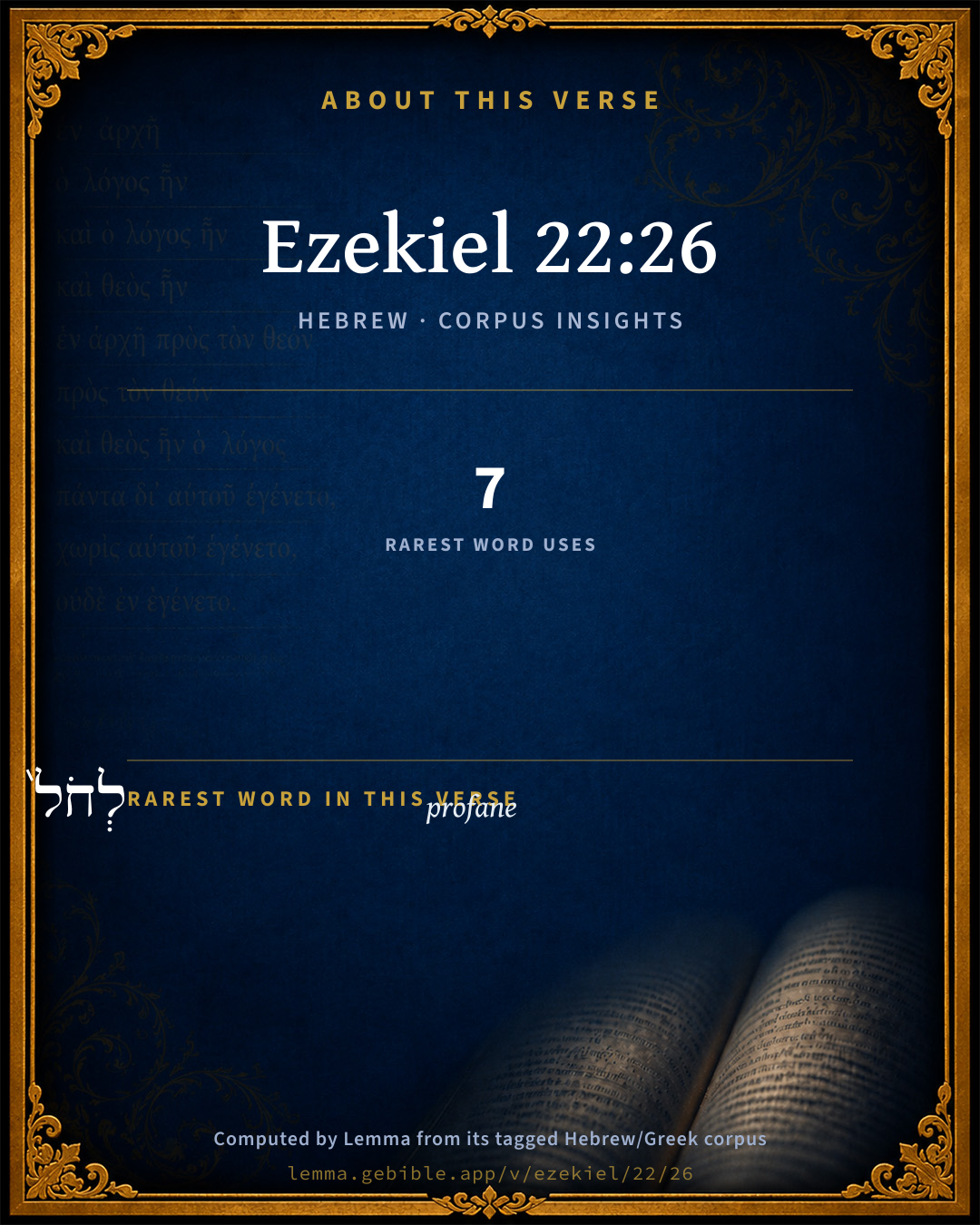
The rarest word here is לְחֹל֙ profane H2455 — appearing just 7 times in the whole Hebrew Bible.

Shared distinctive vocabulary

לְחֹל֙ profane H2455 occurs in 7 verses of the Hebrew Bible. Also found in:

Grammatical profile

  • 6 verbs
  • 8 nouns
  • 2 adjectives
  • 2 prepositions
  • 2 particles

Verb forms

  • חָמְס֣וּ Qal · Perfect
  • וַיְחַלְּל֣וּ Piel · Sequential Imperfect
  • הִבְדִּ֔ילוּ Hiphil · Perfect
  • הוֹדִ֑יעוּ Hiphil · Perfect
  • הֶעְלִ֣ימוּ Hiphil · Perfect
  • וָאֵחַ֖ל Niphal · Sequential Imperfect

Repetition

Words recur within this verse — often emphatic in Hebrew:

  • וַיְחַלְּל֣וּ to profane H2490 ×2
  • קָדָשַׁי֒ holiness H6944 ×2
  • בֵּֽין between H996 ×2
  • לֹ֣א not H3808 ×2

Hebrew & Septuagint length

In English translation the verse runs 52 words from the Hebrew and 50 from the Septuagint (LXX English) — closely comparable.

A rough comparison of the two English renderings, which tokenize alike — not a word-level alignment.

Word counts can differ between the Hebrew and the Greek without any difference in meaning — e.g. the Hebrew direct-object marker אֵת has no separate Greek word, and Greek often adds the article ὁ.

Cross-references

23

Topical passages linked to Ezekiel 22:26 in the Treasury of Scripture Knowledge — connected by theme and wording, ordered by reader-vote popularity; previews shown in the World English Bible.

  • Leviticus 10:10 and that you are to make a distinction between the holy and the common, and between the unclean and the clean;
  • Ezekiel 22:8 You have despised my holy things, and have profaned my Sabbaths.
  • Ezekiel 44:23 They shall teach my people the difference between the holy and the common, and cause them to discern between the unclean and the clean.
  • Malachi 2:8 But you have turned aside out of the way. You have caused many to stumble in the law. You have corrupted the covenant of Levi," says Yahweh of Hosts.
  • 1 Samuel 2:12–17 Now the sons of Eli were base men; they didn't know Yahweh.
  • Jeremiah 2:8 The priests didn't say, Where is Yahweh? and those who handle the law didn't know me: the rulers also transgressed against me, and the prophets prophesied by Baal, and walked after things that do not profit.
  • Micah 3:11–12 Her leaders judge for bribes, And her priests teach for a price, And her prophets of it tell forturnes for money: Yet they lean on Yahweh, and say, Isn't Yahweh in the midst of us? No disaster will come on us.
  • 1 Samuel 2:22 Now Eli was very old; and he heard all that his sons did to all Israel, and how that they lay with the women who served at the door of the tent of meeting.
  • Jeremiah 15:19 Therefore thus says Yahweh, If you return, then will I bring you again, that you may stand before me; and if you take forth the precious from the vile, you shall be as my mouth: they shall return to you, but you shall not return to them.
  • Ezekiel 36:20 When they came to the nations, where they went, they profaned my holy name; in that men said of them, These are the people of Yahweh, and are gone forth out of his land.
  • Leviticus 10:1–3 Nadab and Abihu, the sons of Aaron, each took his censer, and put fire in it, and laid incense on it, and offered strange fire before Yahweh, which he had not commanded them.
  • Leviticus 11:47 to make a distinction between the unclean and the clean, and between the living thing that may be eaten and the living thing that may not be eaten.'"
  • Leviticus 20:25 "'You shall therefore make a distinction between the clean animal and the unclean, and between the unclean fowl and the clean: and you shall not make yourselves abominable by animal, or by bird, or by anything with which the ground teems, which I have separated from you as unclean for you.
  • Leviticus 22:2–33 "Tell Aaron and his sons to separate themselves from the holy things of the children of Israel, which they make holy to me, and that they not profane my holy name. I am Yahweh.
  • 1 Samuel 2:29 Why kick you at my sacrifice and at my offering, which I have commanded in [my] habitation, and honor your sons above me, to make yourselves fat with the best of all the offerings of Israel my people?
  • Jeremiah 2:26–27 As the thief is ashamed when he is found, so is the house of Israel ashamed; they, their kings, their princes, and their priests, and their prophets;
  • Lamentations 4:13 [It is] because of the sins of her prophets, [and] the iniquities of her priests, That have shed the blood of the just in the midst of her.
  • Ezekiel 20:12–13 Moreover also I gave them my Sabbaths, to be a sign between me and them, that they might know that I am Yahweh who sanctifies them.
  • Zephaniah 3:3–4 Her princes in the midst of her are roaring lions. Her judges are evening wolves. They leave nothing until the next day.
  • Haggai 2:11–14 "Thus says Yahweh of Hosts: Ask now the priests concerning the law, saying,
  • Malachi 1:6–8 "A son honors his father, and a servant his master. If I am a father, then where is my honor? And if I am a master, where is the respect due me? Says Yahweh of Hosts to you, priests, who despise my name. You say, 'How have we despised your name?'
  • Malachi 2:1–3 "Now, you priests, this commandment is for you.
  • Romans 2:24 For "the name of God is blasphemed among the Gentiles because of you," just as it is written.

Cross-references courtesy of OpenBible.info (CC BY 4.0).

Hebrew and Greek witnesses Masoretic Hebrew ↔ Greek Septuagint

The same verse in the two great witnesses to the Old Testament, shown verse-for-verse.

These are two independent witnesses, not word-aligned to each other, and the Septuagint is shown in lemma (dictionary) form.

Hebrew Ezekiel 22:26 Masoretic · Westminster Leningrad Codex

כֹּהֲנֶ֜יהָ חָמְס֣וּ תוֹרָתִי֮ וַיְחַלְּל֣וּ קָדָשַׁי֒ בֵּֽין קֹ֤דֶשׁ לְחֹל֙ לֹ֣א הִבְדִּ֔ילוּ וּבֵין הַטָּמֵ֥א לְטָה֖וֹר לֹ֣א הוֹדִ֑יעוּ וּמִשַׁבְּתוֹתַי֙ הֶעְלִ֣ימוּ עֵֽינֵיהֶ֔ם וָאֵחַ֖ל בְּתוֹכָֽם

Her priests have done violence to my law, and have profaned my holy things: they have made no distinction between the holy and the common, neither have they caused men to discern between the unclean and the clean, and have hid their eyes from my Sabbaths, and I am profaned among them.

World English Bible · Public Domain

Greek LXX Ezekiel 22:26 Septuagint · lemma form

καί ὁ ἱερεύς αὐτός ἀθετέω νόμος ἐγώ καί βεβηλόω ὁ ἅγιος ἐγώ ἀνά μέσος ἅγιος καί βέβηλος οὐ διαστέλλω καί ἀνά μέσος ἀκάθαρτος καί ὁ καθαρός οὐ διαστέλλω καί ἀπό ὁ σάββατον ἐγώ παρακαλύπτω ὁ ὀφθαλμός αὐτός καί βεβηλόω ἐν μέσος αὐτός

Her priests also have set at nothing my law, and profaned my holy things: they have not distinguished between the holy and profane, nor have they distinguished between the unclean and the clean, and have hid their eyes from my sabbaths, and I was profaned in the midst of them.

LXX2012 (modern English Septuagint) · Public Domain

Hebrew: Westminster Leningrad Codex (CC BY 4.0). Greek: Septuagint (public domain); English from LXX2012 (modern English Septuagint) (Public Domain). How the Septuagint differs from the Hebrew →

Targum (Aramaic paraphrase)

1

The Targum is the ancient Jewish Aramaic paraphrase of the Hebrew Scriptures — an interpretive translation, not the Hebrew text itself. Onkelos (literal) and Pseudo-Jonathan (expansive) render the Torah, and Jonathan the Prophets. Coverage is partial: where no permissively-licensed English translation exists for a verse, only the Aramaic is shown. This is verse-level text, not a word-by-word alignment to the Hebrew.

  1. Targum Jonathan Prophets (Joshua–Malachi)
    כַּהֲנָהָא חָטְפִין בְּאוֹרַיְתִי וּמַפְסִין קֳדָשַׁי בֵּין קוּדְשָׁא לְחוֹלָא לָא אַפְרִישׁוּ וּבֵין מְסַאֲבָא לְדַכְיָא לָא הוֹדִיעוּ וּמִיוֹמֵי שַׁבַּיָא דִילִי כְבָשׁוּ עֵינֵיהוֹן וְחַלַת רְעוּתִי בֵּינֵיהוֹן:

    (no public-domain English translation for this verse)

    Targum Jonathan — Aramaic: “Mikraot Gedolot” (public domain). English: “Sefaria Community Translation” (CC0 1.0 (public-domain dedication)); “London "Chaldee Paraphrase," 1871” (public domain). Text via Sefaria.

Commentary

Notes on Ezekiel 22:26 from classic Christian and Jewish commentators (each source and its license shown beneath its notes). The classic Christian expositions comment on the surrounding passage and are grouped to its opening verse, so a note may address several verses; the Jewish commentaries on the Tanakh (Rashi and others) are per-verse, so they appear only where the commentator wrote on this verse.

Lemma curates 59 commentaries, every one of them public domain or Creative Commons licensed, each selected and text-cleaned for this edition rather than reprinted as found. About our sources →

Trapp's Complete Commentary

John Trapp

Eze 22:26 Her priests have violated my law, and have profaned mine holy things: they have put no difference between the holy and profane, neither have they shewed [difference] between the unclean and the clean, and have hid their eyes from my sabbaths, and I am profaned among them.

Ver. 26. Her priests have violated my law.] {a} By infringing, and enforcing it to speak what it never meant; to go two miles when it would go but one, &c.

They have put no difference.] They have not taken out the precious from the vile, but made it open tide, and admitted all pellmell, as they say.

And have hid their eyes from my Sabbaths,] i.e., Either framed excuse that they might themselves break it; or else connived at others that have.

{a} Plane palamque contra faciunt, quam ipsis imperavi lege. - Jun.

John Trapp, A Commentary or Exposition upon All the Books of the Old and New Testament (1647–1656) — public domain. Text from a community e-Sword module.

Joseph Benson's Commentary

Eze 22:26. Her priests have violated my law — Which they ought to have observed, and to have taught the people to observe; and have profaned my holy things — The gifts and sacrifices offered in my service; either by offering them in an undue manner, as the sons of Eli did, 1Sa 2:15, or without due purification of themselves; or else eating them as common meats, without regard to the rules prescribed in the law. They have put no difference between the holy and profane — They have not shown any regard to the rules of my law, concerning what is holy and unholy, clean and unclean, and that both with respect to persons and things. And they are guilty of this neglect in contradiction to an express charge given them respecting this matter, Lev 10:10. By the holy is here meant that which was peculiarly dedicated to God; by the profane, things in common use; by the unclean, those meats which were forbidden to be eaten; by the clean, what it was lawful to eat. And have hid their eyes from my sabbaths — They have taken no care that my sabbaths should be kept, and have not attended themselves upon my public worship on the sabbath days, 2Ch 29:7; and thereby have encouraged my people in the neglect and profanation of it. And I am profaned among them — I am dishonoured by them, and they use my name to false and wicked purposes.

Joseph Benson's Commentary on the Old and New Testaments (1811–1818) — public domain. Text from a community e-Sword module.

Geneva Bible (1599)

Geneva Bible translators

They have neglected my service.

Geneva Bible (1599) marginal notes — public domain. Text via Bolls.life.

Jamieson, Fausset & Brown

Robert Jamieson, A. R. Fausset & David Brown

Her priests--whose "lips should have kept knowledge" (Mal 2:7).

violated--not simply transgressed; but, have done violence to the law, by wresting it to wrong ends, and putting wrong constructions on it.

put no difference between the holy and profane, &c.--made no distinction between the clean and unclean (Lev 10:10), the Sabbath and other days, sanctioning violations of that holy day. "Holy" means, what is dedicated to God; "profane," what is in common use; "unclean," what is forbidden to be eaten; "clean," what is lawful to be eaten.

I am profaned among them--They abuse My name to false or unjust purposes.

Jamieson, Fausset & Brown — Commentary Critical and Explanatory on the Whole Bible (1871) — public domain (CC PDM 1.0). Text via the HelloAO Bible API.

Adam Clarke's Commentary

Verse 26. Her priests] Even they whose lips should preserve knowledge, have not instructed the people: they have violated my law, not only in their private conduct, but in their careless and corrupt manner of serving in my temple.

Adam Clarke's Commentary on the Bible (1810–1826) — public domain. Text from a community e-Sword/MySword module.

Ellicott's Commentary for English Readers

(26) Have violated my law.—The next class to be spoken of, as the next in influence, were the priests. It was their especial office to observe and to teach the distinction between the holy and the unholy (Lev_10:10), and to care for the Sabbath. In all they had been unfaithful. (Comp. Mic_3:11; Zep_3:4.)

A Bible Commentary for English Readers, edited by Charles John Ellicott (1878–1897) — public domain. Text from a community e-Sword module.

The Cambridge Bible for Schools and Colleges

gen. ed. J. J. S. Perowne

26. The great influence possessed by the priests in this age appears from the place they occupy next the royal house. Jer_2:8; Jer_2:26; Jer_4:9; Jer_8:1; Jer_13:13; Jer_26:11.

between the holy and profane] ch. Eze_44:23; Jer_15:19; Lev_10:10.

The Cambridge Bible for Schools and Colleges (gen. ed. J. J. S. Perowne; Cambridge University Press, 1878–1918) — public domain. Text from a community e-Sword module.

John Gill's Exposition

Her priests have violated my law,.... Or, "forced it" (i); they gave a wrong explanation of it, made it speak what it should not; they wrested the sense and meaning of it, and did and taught things contrary to it; they broke it themselves, who should have instructed others in it, and exhorted them to have kept it, and encouraged them by their own example:

and have profaned my holy things; sacrifices and oblations, which were only to be offered and eaten by holy persons; they made them common to others who should not have partook of them:

they have put no difference between the holy and the profane; between holy persons and things, and profane persons and things; they made no difference in their practice between the one and the other; but promiscuously conversed with holy and profane persons, and used holy and profane things, without distinguishing one from the other:

neither have they showed the difference between the unclean and the clean: they did not show to the people, as was the duty of their office, what was clean or unclean for sacrifice; what was clean and allowed to be eaten, and what was unclean and forbid to be eaten; nor who were clean and who were unclean persons for conversation; who were to be kept company with, and who not:

and have hid their eyes from my sabbaths; were not careful to observe them themselves, and connived at them that broke them; they might have seen men carrying burdens, and doing other servile works on such days, but they turned their eyes another way, and would not look at them; and when they did see them were silent, and would not reprove them:

and I am profaned among them; for the law of God being profaned, his institutions profaned, and his sabbaths profaned, he himself was profaned; inasmuch as he was not sanctified by them, through the just observation of those things. The Targum is,

"my will is profaned among them.''

(i) "vim faciunt legimeae", Junius & Tremellius: Polanus; "vim fecerunt", Cocceius: Starckius.

John Gill's Exposition of the Whole Bible (1746–1763) — public domain (CC PDM 1.0). Text via the HelloAO Bible API.

Matthew Poole's English Annotations

Her priests; God owns them not as his, they were priests that suited such a people.

Priests; men by office bound to reverence the law, to study it, and to preserve it from men’s corruptions.

Violated my law; wrested it to oppression and impiety, and to maintain errors, and made it speak what they would, not what it did.

Profaned; lightly esteemed, as if they had been but common things, and accordingly use them.

My holy things; sacrifices and oblations, which were consecrated to holy uses, should be offered with holy hearts and hands, and be eaten by holy persons in due time and place. All this neglected with profane spirits.

They have put no difference between the holy and profane: this and the following clause may be an exegesis, explication of the former, or else thus; Neither have they in their own practice differenced holy, and profane, nor in their teaching acquainted the people with the difference, nor in the exercise of their authority separated the profane from the holy, either persons or things, but with promiscuous intermixtures of every thing, and all persons have been alike to them, whether holy or profane, i.e. of common and ordinary use.

Neither have they showed difference; have not made the people know, so the word.

Between the unclean and the clean; things and persons, what things might be touched or eaten, or what might not, what persons might not be approached to and conversed with, and what might; all which was the duty of the priests, the neglect whereof spread the uncleanness of the Jews over the whole land.

Hid their eyes; despised, and would not see the holiness of the sabbaths, nor would look on such as observed them aright to encourage them, or on those that profaned them to reprove them; so they did not see what they would not see.

From my sabbaths; though they are expressly commanded to be kept holy, and with great care and exactness, Isa 58:13; Jer 17:21,22; though the portion of time I consecrated to my service, they sacrilegiously direct to other uses, and grudge it me, nay, rob me of it.

I am profaned; contemned, dishonoured, disobeyed, and all my laws represented as trivial and light things.

Matthew Poole's English Annotations on the Holy Bible (1683–1685) — public domain. Text from a community e-Sword/MySword module.

Whedon's Commentary on the Bible

Daniel D. Whedon

26. The priests are as bad as the royal princes. They regarded neither the prescriptions of the ceremonial nor the moral law. (Compare Eze_22:8; Eze_44:23; Lev_10:10.) The rites and ordinances of worship which Jehovah commands cannot be ignored or changed without guilt. The entire temple service was an object lesson teaching the people the meaning of “holiness.” Whatever belonged to Jehovah was holy. “Holiness is God’s claim to the proprietorship and use of certain objects.” As Dr. James Agar Beet has shown, from the earliest time the word contained a deep spiritual meaning. A holy people is a people devoted, separated, to God, and to whom God is devoted.

Daniel D. Whedon (gen. ed.), Commentary on the Old and New Testaments (1874–1909) — public domain. Text from a community e-Sword module.

The Pulpit Commentary

The sins of the prophets are followed by these of the priests. Their guilt was that they blurred over the distinction between the holy and the profane (Revised Version, "common"), between the clean and the unclean. (comp. Eze_44:23; Lev_10:10, where the same terms are used) in what we have learnt to call the positive and ceremonial ordinances of the Law, and so blunted their keenness of perception in regard to analogous moral distinctions. Extremes meet, and in our Lord"s time the same result was brought about by an exaggerated scrupulosity about the very things the neglect of which was, in Ezekiel"s time, the root of the evils which he condemns. This was true generally, conspicuously true in the case of the sabbath. Its neglect was a crying evil in Ezekiel"s time, just as its exaggeration was in the later development of Judaism. Though in itself positive rather than moral, to hide the eyes from its holiness was, for these to whom the commandment had been given, an act of immorality.

Holy and profane.

I THE TRUE DISTINCTION BETWEEN HOLY AND PROFANE. The Jewish Law made elaborate distinctions between the clean and the unclean, some of which were founded on moral differences, some on sanitary requirements, but others OH merely symbolical and ceremonial points. Many of these distinctions were only temporary, as that between certain foods, and that between Jews and Gentiles, the abolition of which was revealed to St. Peter in his vision at Joppa. (Act_10:15) Christ denounced the folly of formal distinctions. (Mat_15:11) St. Paul claimed large liberty in this respect, and pointed out the danger and delusion of the will-worship which was associated with too punctilious an observance of minute external distinctions. (Col_2:23) Nevertheless, there remain true distinctions apart from the formal and ceremonial differences.

1. The distinction between holiness and sin. In this distinction we have -the root out of which the ceremonial notions of cleanness and uncleanness sprang. The formal notions may pass, the moral foundation is eternal.

2. The distinction between the service of God and the service of the world. We do not want to regard the temple as the only sacred place, so that the forum must be relegated to profanity. In the Christian age, "Holiness unto the Lord" is not only to be inscribed on the bells of the high priest; it is to be seen on the bells of the horses. (Zec_14:20) But this means a dedication of all to the service of God. If we neglect that service and sink into secularism, we fail to observe the holiness; we then make all things profane temple as well as forum.

II THE SIN OF DESTROYING THE DISTINCTION BETWEEN SACRED AND PROFANE. We have not now to do with definite Jewish offences against the Law of Moses, in which the finely drawn distinction between the clean and the unclean is disregarded. Sacred things of the temple were desecrated by the insolent heathen at Belshazzar"s feast, but they had been first desecrated by Jews in the house of God, while they were touched with sinful hands and used without holy motives. They who are most careful to keep up the ceremonial distinction may yet profane sacred things.

1. The sabbath is profaned, not only when the shops are open and when crowds throng the public resorts of amusement, but when the congregations at church play the part of ostentatious Pharisees, and mock God with pretentious prayers while their hearts and thoughts are far from him.

2. The Bible is profaned when it is quoted to prop up a private opinion in disregard to the royal rights of truth.

3. The gospel is profaned when it is preached for the sake of winning popularity or raising money, to the neglect of the claims of Christ and the needs of mankind.

4. The conscience, which should be a holy standard of right, is profaned when it is distorted by casuistry into excusing a lack of integrity.

5. The body is profaned when, instead of being a temple of the Holy Ghost, it is an instrument of sin. (1Co_6:15)

6. The Church, which should be the bride of the Lamb, is profaned when she sinks into worldly living or is divided against herself in bitter uncharitableness.

The Pulpit Commentary (1880–1919), ed. H.D.M. Spence-Jones & Joseph S. Exell — public domain. Text from a community e-Sword module.

John Wesley's Explanatory Notes

My holy things - Sacrifices, and oblations. Put no difference - Neither have they in their practice, differenced holy and profane, nor in their teaching acquainted the people with the difference, nor in the exercise of their authority, separated the profane from the holy, either persons, or things. Hid their eyes - Despised, and would not see the holiness of the sabbaths. Profaned - Contemned, dishonoured, disobeyed.

John Wesley, Explanatory Notes Upon the Whole Bible (1754–1765) — public domain. Text via the GEBible commentary corpus.

unfoldingWord translationNotes

Door43 World Missions Community

her

This pronoun refers to Jerusalem.

do violence to my law

"disobey my laws"

the unclean and the clean

This refers to unclean and clean things. Something that God considers spiritually unacceptable or defiled is spoken of as if it were physically unclean. AT: "things that are unclean and things that are clean" (See: Nominal Adjectives and Metaphor)

They hide their eyes from my Sabbaths

This speaks of the people ignoring and not observing the Sabbath and if they were hiding their eyes from the Sabbath" AT: "They ignore my Sabbaths" (See: Metaphor)

so that I am profaned in their midst

This can be stated in active form. AT: "and profane me among themselves" (See: Active or Passive)

Her princes within her are like wolves tearing apart their victims

This compares Israel's princes to wolves who attack and kill their victims. (See: Simile)

They pour out blood and destroy life

These two phrases mean basically the same thing and emphasize the violence that the princes practice. AT: "They murder people" (See: Parallelism)

Her prophets have painted them over with whitewash

This speaks of the prophets trying to hide these sins as if they were something that they could paint over with whitewash. AT: "It is like her prophets have painted over their sins with whitewash" or "Their prophets try to hide these evil things" (See: Metaphor)

whitewash

This is a solution that is painted on things to make them white that is similar to white paint.

predict falsehoods to them

"predict lies for the princes." The word "them" refers to the princes.

translationWords

priest

law

profane

clean

Sabbath

prince

wolf

Lord Yahweh

unfoldingWord translationNotes — © Distant Shores Media and the Door43 World Missions Community, licensed CC BY-SA 4.0. Source: git.door43.org/Door43/en_tn.

Rashi

Rabbi Shlomo Yitzchaki (Rashi)

robbed My Torah It was incumbent upon them to reprove, to instruct, and to make known statutes and ordinances, but they did not do so. This is robbery, for they robbed it from those who needed to learn.

and I was profaned in their midst Heb. וָאֵחַל, and I was profaned.

Rashi on the Tanakh — English translations: “The Judaica Press complete Tanach with Rashi, translated by A. J. Rosenberg” (CC BY 4.0); “Pentateuch with Rashi's commentary by M. Rosenbaum and A.M. Silbermann, 1929-1934” (public domain); “The Metsudah Tanach series, Lakewood, N.J” (CC BY 4.0); and “The Book of Joshua, Metsudah Publications, 1997” (CC BY 4.0). Text via Sefaria.

Lesson kit

Teaching starters — assembled from the data on this page, not authored interpretation. Every prompt links to the verse data it draws on. Edit before teaching.

Ezekiel, in the Prophets, opens this verse with 20 words (16 distinct Hebrew lemmas). Its most distinctive word is chôl (“profane”). A historical commentator’s framing appears above. Read the whole chapter for the surrounding context.

Discussion questions

  1. How does “profane” (chôl) shape what this verse is saying?
  2. How does Leviticus 10:10, which shares the word «profane», read alongside this verse?
  3. What does the repetition of “to profane” (2× in this one verse) do in this verse?
  4. The translations on this page render this verse differently — a whole-verse word diff, not a word-by-word alignment. What might account for the different wordings?
  5. «חָמְס֣וּ» is a Qal Perfect verb. How does that grammatical form shape the action described?
  6. Compare how Trapp's Complete Commentary and Joseph Benson's Commentary read this verse. Where do they agree or differ?

Things to notice

Reading settings

Reading text

Shown beneath each verse's original-language words.

Old Testament
Old Testament edition

Read the OT as the Masoretic Hebrew (MT) or the Greek Septuagint (LXX).

English shown for the Greek Septuagint (in the Hebrew ↔ Greek comparison).

Comparing translations? Open the Compare panel on any verse page to stack up to four side by side.