
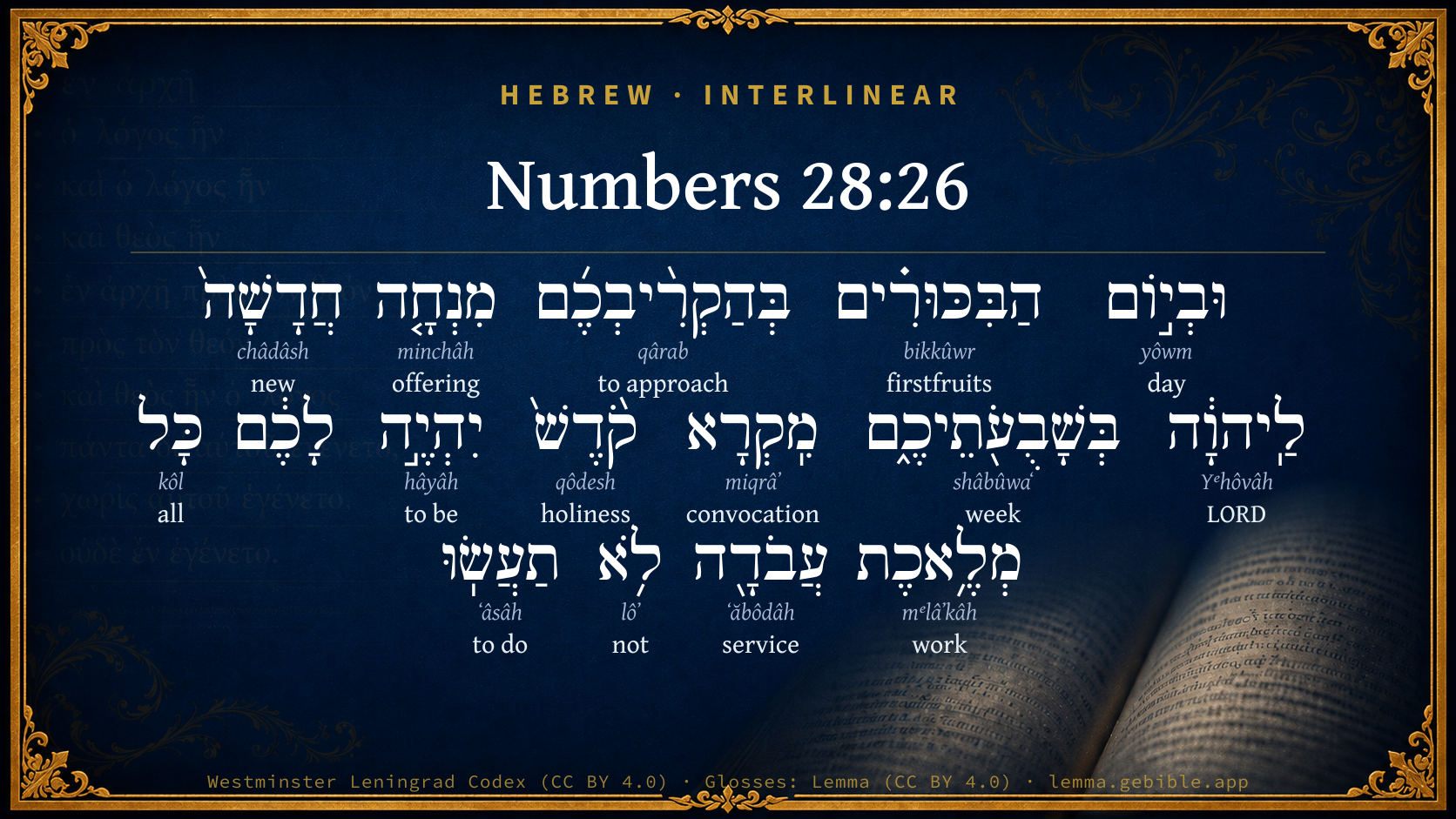
Numbers 28:26

Hebrew (Westminster Leningrad Codex) Numbers 28:26 appears in the Hebrew Old Testament. The text above is from the Westminster Leningrad Codex. Each word links to its Strong’s number, a concise gloss, and parsing drawn from the Open Scriptures Hebrew Bible morphology. Click any word for its full Brown-Driver-Briggs (BDB) entry.
Download image
Cite this verse

Numbers 28:26 (World English Bible). Public Domain. Lemma interlinear Bible study tool, https://lemma.gebible.app/v/numbers/28/26.

Show BibTeX & RIS
BibTeX
RIS
English Translation
Also in the day of the first fruits, when you offer a new meal-offering to Yahweh in your [feast of] weeks, you shall have a holy convocation; you shall do no servile work;
World English Bible · Public Domain
Download a study sheet

One document with this verse’s original text, its word-by-word gloss line, the meaning frame, cross-references with their text, attributed commentary, and full source and license credits — printable, and it pastes into notes with its structure intact.

This verse Autodidact and up

Study sheet (.html) Plain text (.txt)

A passage Seminary Student

Up to 50 verses in one chapter. A passage sheet keeps up to 6 commentary sources and 12 cross-references per verse, in the order this page ranks them, and says so on the sheet whenever that leaves anything out. Ask for a single verse and you get the Autodidact verse sheet above.

Everything on this page stays free to read, with no account — the sheet is a download of what is already on screen, not access to it.

Want to remove ads? Support Godless Engineer
Compare translations 3

The same verse in 3 English versions, stacked beneath the original-language interlinear above. Click any original word for its lexicon entry.

Each is an independent rendering of the whole verse — the interlinear is not word-aligned to these translations.

Highlighted words mark where these versions differ — a whole-verse word diff, not a word-by-word alignment.

  • World English Bible Public Domain
    Also in the day of the first fruits, when you offer a new meal-offering to Yahweh in your [feast of] weeks, you shall have a holy convocation; you shall do no servile work;
  • King James Version Public Domain
    Also in the day of the firstfruits, when ye bring a new meat offering unto the LORD, after your weeks be out, ye shall have an holy convocation; ye shall do no servile work:
  • unfoldingWord Literal Text CC BY-SA 4.0
    And on the day of the firstfruits, when you offer the new grain offering to Yahweh in your festival of weeks, there shall be a convocation of holiness for you. You shall not do any work of labor.

unfoldingWord Literal Text — © unfoldingWord, licensed CC BY-SA 4.0. Word-aligned USFM3 via Door43 (git.door43.org/unfoldingWord/en_ult).

Versions to compare (up to 4)

3 of 4 selected

Show all 18 translations

Every available English version of this verse, each an independent rendering of the whole verse.

  • World English Bible Public Domain
    Also in the day of the first fruits, when you offer a new meal-offering to Yahweh in your [feast of] weeks, you shall have a holy convocation; you shall do no servile work;
  • Berean Standard Bible Public Domain
    On the day of firstfruits, when you present an offering of new grain to the LORD during the Feast of Weeks, you are to hold a sacred assembly; you must not do any regular work.
  • Majority Standard Bible Public Domain
    On the day of firstfruits, when you present an offering of new grain to the LORD during the Feast of Weeks, you are to hold a sacred assembly; you must not do any regular work.
  • King James Version Public Domain
    Also in the day of the firstfruits, when ye bring a new meat offering unto the LORD, after your weeks be out, ye shall have an holy convocation; ye shall do no servile work:
  • American Standard Version (1901) Public Domain
    Also in the day of the first-fruits, when ye offer a new meal-offering unto Jehovah in your `feast of' weeks, ye shall have a holy convocation; ye shall do no servile work;
  • Revised Version (1885) Public Domain
    Also in the day of the firstfruits, when ye offer a new meal offering unto the LORD in your feast of weeks, ye shall have an holy convocation; ye shall do no servile work:
  • Geneva Bible (1599) Public Domain
    Also in the day of your first fruits, when ye bring a newe meate offring vnto the Lord, according to your weekes ye shall haue an holy conuocation, and ye shall do no seruile worke in it:
  • Douay-Rheims (1899) Public Domain
    The day also of firstfruits, when after the weeks are accomplished, you shall offer new fruits to the Lord, shall be venerable and holy: you shall do no servile work therein.
  • Young's Literal Translation Public Domain
    `And in the day of the first-fruits, in your bringing near a new present to Jehovah, in your weeks, a holy convocation ye have; ye do no servile work;
  • Literal Standard Version CC BY-SA 4.0
    And on the day of the first-fruits, in your bringing a new present near to YHWH, in your weeks, you have a holy convocation; you do no servile work.
  • Unlocked Literal Bible CC BY-SA 4.0
    Also on the day of the firstfruits, when you offer a new grain offering to Yahweh in your Festival of Weeks, you must have a holy assembly to honor Yahweh, and you must not do regular work on that day.
  • unfoldingWord Literal Text CC BY-SA 4.0
    And on the day of the firstfruits, when you offer the new grain offering to Yahweh in your festival of weeks, there shall be a convocation of holiness for you. You shall not do any work of labor.
  • Darby Bible Public Domain
    And on the day of the first-fruits, when ye present a new oblation to Jehovah, after your weeks, ye shall have a holy convocation: no manner of servile work shall ye do.
  • World Messianic Bible Public Domain
    “‘Also in the day of the first fruits, when you offer a new meal offering to the LORD in your feast of weeks, you shall have a holy convocation. You shall do no regular work;
  • Webster's Bible Public Domain
    Also in the day of the first-fruits, when ye bring a new meat-offering to the LORD, after your weeks are ended, ye shall have a holy convocation; ye shall do no servile work:
  • Free Bible Version CC BY-SA 4.0
    During the time you celebrate the Festival of Weeks, hold a holy meeting on the day of firstfruits when you present an offering of new grain to the Lord. Don't do any of your normal work.
  • Bible in Basic English Public Domain
    And at the time of the first-fruits, when you give an offering of new meal to the Lord at your feast of weeks, there is to be a holy meeting: you may do no field-work:
  • JPS Tanakh (1917) Public Domain
    Also in the day of the first-fruits, when ye bring a new meal-offering unto the LORD in your feast of weeks, ye shall have a holy convocation: ye shall do no manner of servile work;

Literal Standard Version (2020), Covenant Press — licensed CC BY-SA 4.0. Text via the HelloAO Bible API (eBible.org). Unlocked Literal Bible (unfoldingWord) — licensed CC BY-SA 4.0. Text via the HelloAO Bible API (eBible.org). unfoldingWord Literal Text — © unfoldingWord, licensed CC BY-SA 4.0. Word-aligned USFM3 via Door43 (git.door43.org/unfoldingWord/en_ult). Free Bible Version, Dr. Jonathan Gallagher — licensed CC BY-SA 4.0. Text via the HelloAO Bible API (eBible.org).

Word by word

More ways to search: Search by grammar → Find every occurrence → Compare this word →

Practice this passage: Drill this verse → Learn its vocabulary →

הַבִּכּוּרִ֗ים
bikkûwr
H1061
“the · firstfruits”
Particle, Definite Article + Noun, Common, Both, Plural, Absolute
Part of Speech
Particle + Noun
Type
Common
Gender
Both
Number
Plural
State
Absolute
Full BDB Definition

Origin: from H1069

TWOT: 244e

first-fruits - the first of the crops and fruit that ripened, was gathered, and offered to God according to the ritual of Pentecost - the bread made of the new grain offered at Pentecost - the day of the first-fruits (Pentecost)
  1. וּבְי֣וֹם yôwm H3117 “and · in/at · day of” Conjunction + Preposition + Noun, Common, Masculine, Singular, Construct
  2. בְּהַקְרִ֨יבְכֶ֜ם qârab H7126 “in/at · to approach · you” Preposition + Verb, Hiphil, Infinitive Construct + Suffix, Personal, 2nd Person, Masculine, Plural
  3. מִנְחָ֤ה minchâh H4503 “offering” Noun, Common, Feminine, Singular, Absolute
  4. חֲדָשָׁה֙ châdâsh H2319 “new” Adjective, Adjective, Feminine, Singular, Absolute
  5. לַֽיהוָ֔ה Yᵉhôvâh H3068 “to/for · LORD” Preposition + Noun, Proper
  6. בְּשָׁבֻעֹ֖תֵיכֶ֑ם shâbûwaʻ H7620 “in/at · weeks · your” Preposition + Noun, Common, Masculine, Plural, Construct + Suffix, Personal, 2nd Person, Masculine, Plural
  7. מִֽקְרָא miqrâʼ H4744 “convocation of” Noun, Common, Masculine, Singular, Construct
  8. קֹ֨דֶשׁ֙ qôdesh H6944 “holiness” Noun, Common, Masculine, Singular, Absolute
  9. יִהְיֶ֣ה hâyâh H1961 “to be” Verb, Qal, Imperfect, 3rd Person, Masculine, Singular
  10. כָּל kôl H3605 “all of” Noun, Common, Masculine, Singular, Construct
  11. מְלֶ֥אכֶת mᵉlâʼkâh H4399 “work of” Noun, Common, Feminine, Singular, Construct
  12. עֲבֹדָ֖ה ʻăbôdâh H5656 “service” Noun, Common, Feminine, Singular, Absolute
  13. לֹ֥א lôʼ H3808 “not” Particle, Negative
  14. תַעֲשֽׂוּ ʻâsâh H6213 “to do” Verb, Qal, Imperfect, 2nd Person, Masculine, Plural

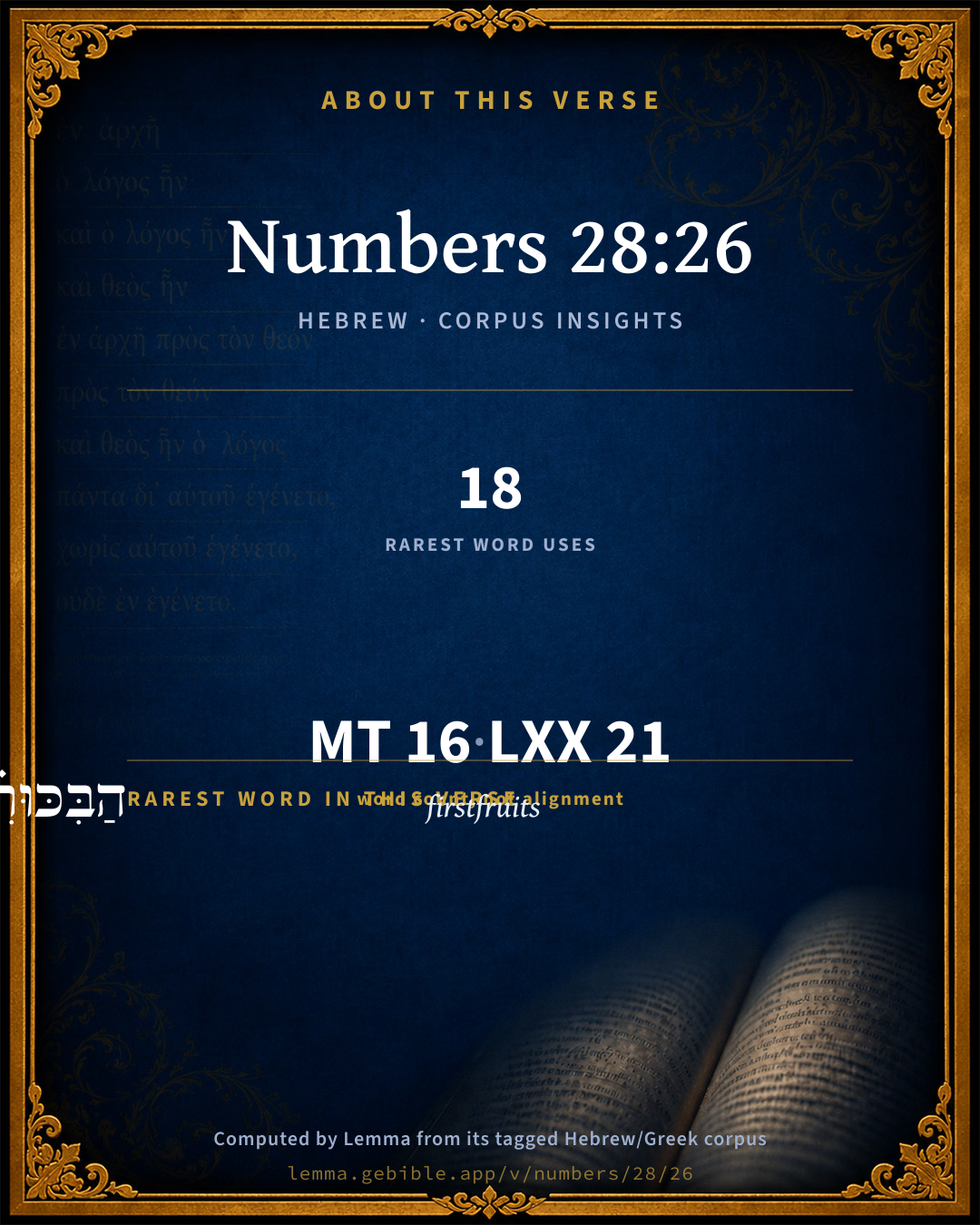
About this verse

These counts appear in no published source. They are computed here, from the morphology-tagged text and Lemma’s own curated glosses. What Lemma adds →

16
words
15
distinct lemmas
Pentateuch
section

Notable vocabulary

The rarest word here is הַבִּכּוּרִ֗ים firstfruits H1061 — appearing just 18 times in the whole Hebrew Bible.

Shared distinctive vocabulary

הַבִּכּוּרִ֗ים firstfruits H1061 occurs in 16 verses of the Hebrew Bible. Also found in:

Grammatical profile

  • 3 verbs
  • 10 nouns
  • 1 adjective
  • 1 preposition
  • 1 particle

Verb forms

  • בְּהַקְרִ֨יבְכֶ֜ם Hiphil · Infinitive Construct
  • יִהְיֶ֣ה Qal · Imperfect
  • תַעֲשֽׂוּ Qal · Imperfect

Hebrew & Septuagint length

In English translation the verse runs 33 words from the Hebrew and 37 from the Septuagint (LXX English) — closely comparable.

A rough comparison of the two English renderings, which tokenize alike — not a word-level alignment.

Word counts can differ between the Hebrew and the Greek without any difference in meaning — e.g. the Hebrew direct-object marker אֵת has no separate Greek word, and Greek often adds the article ὁ.

In the original languages it is 16 Hebrew tokens and 21 Greek tokens — but the two are counted differently (Hebrew bundles its prefixes and suffixes into one token; the Greek is in lemma form), so that isn’t a like-for-like length.

Cross-references

9

Topical passages linked to Numbers 28:26 in the Treasury of Scripture Knowledge — connected by theme and wording, ordered by reader-vote popularity; previews shown in the World English Bible.

  • Exodus 23:16 And the feast of harvest, the first fruits of your labors, which you sow in the field: and the feast of harvest, at the end of the year, when you gather in your labors out of the field.
  • Exodus 34:22 You shall observe the feast of weeks with the first fruits of wheat harvest, and the feast of harvest at the year's end.
  • Leviticus 23:10 "Speak to the children of Israel, and tell them, 'When you have come into the land which I give to you, and shall reap its the harvest, then you shall bring the sheaf of the first fruits of your harvest to the priest:
  • Leviticus 23:15–21 "'You shall count from the next day after the Sabbath, from the day that you brought the sheaf of the wave offering; seven Sabbaths shall be completed:
  • Deuteronomy 16:9–11 Seven weeks shall you number to you: from the time you begin to put the sickle to the standing grain shall you begin to number seven weeks.
  • 1 Corinthians 15:20 But now Christ has been raised from the dead. He became the first fruits of those who are asleep.
  • Numbers 28:18 In the first day shall be a holy convocation: you shall do no servile work;
  • Acts 2:1–13 Now when the day of Pentecost had come, they were all with one accord in one place.
  • James 1:18 Of his own will he brought us forth by the word of truth, that we should be a kind of first fruits of his creatures.

Cross-references courtesy of OpenBible.info (CC BY 4.0).

Hebrew and Greek witnesses Masoretic Hebrew ↔ Greek Septuagint

The same verse in the two great witnesses to the Old Testament, shown verse-for-verse.

These are two independent witnesses, not word-aligned to each other, and the Septuagint is shown in lemma (dictionary) form.

Hebrew Numbers 28:26 Masoretic · Westminster Leningrad Codex

וּבְי֣וֹם הַבִּכּוּרִ֗ים בְּהַקְרִ֨יבְכֶ֜ם מִנְחָ֤ה חֲדָשָׁה֙ לַֽיהוָ֔ה בְּשָׁבֻעֹ֖תֵיכֶ֑ם מִֽקְרָא קֹ֨דֶשׁ֙ יִהְיֶ֣ה לָכֶ֔ם כָּל מְלֶ֥אכֶת עֲבֹדָ֖ה לֹ֥א תַעֲשֽׂוּ

Also in the day of the first fruits, when you offer a new meal-offering to Yahweh in your [feast of] weeks, you shall have a holy convocation; you shall do no servile work;

World English Bible · Public Domain

Greek LXX Numbers 28:26 Septuagint · lemma form

καί ὁ ἡμέρα ὁ νέος ὅταν προςφέρω θυσία νέος κύριος ὁ ἑβδομάς ἐπίκλητος ἅγιος εἰμί σύ πᾶς ἔργον λατρευτός οὐ ποιέω

And on the day of the new corn, when you⌃ shall offer a new sacrifice at the festival of weeks to the Lord, there shall be to you a holy convocation; you⌃ shall do no servile work,

LXX2012 (modern English Septuagint) · Public Domain

Hebrew: Westminster Leningrad Codex (CC BY 4.0). Greek: Septuagint (public domain); English from LXX2012 (modern English Septuagint) (Public Domain). How the Septuagint differs from the Hebrew →

Targum (Aramaic paraphrase)

2

The Targum is the ancient Jewish Aramaic paraphrase of the Hebrew Scriptures — an interpretive translation, not the Hebrew text itself. Onkelos (literal) and Pseudo-Jonathan (expansive) render the Torah, and Jonathan the Prophets. Coverage is partial: where no permissively-licensed English translation exists for a verse, only the Aramaic is shown. This is verse-level text, not a word-by-word alignment to the Hebrew.

  1. Targum Onkelos Torah (Genesis–Deuteronomy)
    וּבְיוֹמָא דְבִכּוּרַיָא בְּקָרוֹבֵיכוֹן מִנְחֲתָא חֲדַתָּא קֳדָם יְיָ בְּעַצְרָתֵיכוֹן מְעָרַע קַדִישׁ יְהֵי לְכוֹן כָּל עִבִידַת פּוּלְחַן לָא תַעַבְדוּן

    (no public-domain English translation for this verse)

    Targum Onkelos — Aramaic: “Onkelos Genesis” (public domain); “Onkelos Exodus” (public domain); “Onkelos Leviticus” (public domain); “Onkelos Numbers” (public domain); “Onkelos Deuteronomy” (public domain). English: “Sefaria Community Translation” (CC0 1.0 (public-domain dedication)); “J.W. Etheridge. The Targums of Onkelos and Jonathan Ben Uzziel on the Pentateuch. London: Longmans, Green, 1862” (public domain). Text via Sefaria.

  2. Targum Pseudo-Jonathan Torah (Genesis–Deuteronomy)
    וּבְיוֹמָא דְבִכּוּרַיָא בִּקְרוּבְכוֹן דוֹרָנָא מִן עֲלַלְתָּא חַדְתָּא קֳדָם יְיָ בַּעֲצַרְתְּכוֹן כַּד יִתְמְלוּן שִׁבְעָתֵי שְׁבוּעַיָא מְאָרַע קַדִישׁ יְהֵי לְכוֹן כָּל עִיבִידַת פּוּלְחָנָא לָא תַעַבְדוּן

    Likewise on the day of your firstlings, when you offer the gift from the new produce before the Lord in your ingatherings, after the seven weeks are completed, you shall have a holy convocation, no servile work shall you do;

    Targum Pseudo-Jonathan — Aramaic: “Targum Jonathan on Genesis” (public domain); “Targum Jonathan on Exodus” (public domain); “Targum Jonathan on Leviticus” (public domain); “Targum Jonathan on Numbers” (public domain); “Targum Jonathan on Deuteronomy” (public domain). English: “The Targum of Jonathan ben Uzziel, trans. J. W. Etheridge, London, 1862” (public domain). Text via Sefaria.

Commentary

Notes on Numbers 28:26 from classic Christian and Jewish commentators (each source and its license shown beneath its notes). The classic Christian expositions comment on the surrounding passage and are grouped to its opening verse, so a note may address several verses; the Jewish commentaries on the Tanakh (Rashi and others) are per-verse, so they appear only where the commentator wrote on this verse.

Lemma curates 59 commentaries, every one of them public domain or Creative Commons licensed, each selected and text-cleaned for this edition rather than reprinted as found. About our sources →

Joseph Benson's Commentary

Num 28:26. Also in the day of the first-fruits — In the feast of pentecost, Act 2:1. The weeks — The seven weeks which you are to number from the passover. This fifth stated and national sacrifice was also annual, namely, at the harvest festival, when the first-fruits of corn were to be offered up, Exo 23:16. This festival was two-fold; first, the barley- harvest first-fruits, beginning at the passover; and then, at seven weeks’ end, the wheat-harvest festival, called the feast of weeks, which is here intended. When ye bring a new meat or bread-offering — That is, two loaves made of the first wheat flour, as the first-fruits of the said wheat- harvest.

Joseph Benson's Commentary on the Old and New Testaments (1811–1818) — public domain. Text from a community e-Sword module.

Whedon's Commentary on the Bible

Daniel D. Whedon

OFFERINGS AT THE FEAST OF FIRSTFRUITS, Num_28:26-31.

26. Firstfruits — Called the feast of harvest, Exo_23:16; of weeks, Exo_34:22; and day of Pentecost, Act_2:1. See Lev_23:15-21, notes.

A new meat offering — New in respect to the former offered at the passover. Lev_23:16, note.

After your weeks — Fifty days after the passover.

Daniel D. Whedon (gen. ed.), Commentary on the Old and New Testaments (1874–1909) — public domain. Text from a community e-Sword module.

Tyndale Open Study Notes

Tyndale Open Resources

28:26-31 The Festival of Harvest was later called the Festival of Pentecost (see Acts 2:1); see also Lev 23:15-22. It celebrated the end of the barley harvest and the beginning of the wheat harvest in early summer (May~June). The Greek name Pentecost means “fiftieth day” (i.e., after Passover; see Acts 20:16; 1 Cor 16:8).

Tyndale Open Study Notes — © Tyndale Open Resources, licensed CC BY-SA 4.0. Text via the HelloAO Bible API.

Geneva Bible (1599)

Geneva Bible translators

In counting seven weeks from the Passover to Whitsuntide, as Lev. 23:15.

Geneva Bible (1599) marginal notes — public domain. Text via Bolls.life.

Jamieson, Fausset & Brown

Robert Jamieson, A. R. Fausset & David Brown

in the day of the first-fruits . . . offer the burnt offering--A new sacrifice is here ordered for the celebration of this festival, in addition to the other offering, which was to accompany the first-fruits (Lev 23:18).

Next: Numbers Chapter 29

Jamieson, Fausset & Brown — Commentary Critical and Explanatory on the Whole Bible (1871) — public domain (CC PDM 1.0). Text via the HelloAO Bible API.

Adam Clarke's Commentary

Verse 26. Day of the first-fruits] Called also the feast of weeks, and the feast of pentecost. See it explained, Clarke "Ex 23:14", and "Le 23:15".

Adam Clarke's Commentary on the Bible (1810–1826) — public domain. Text from a community e-Sword/MySword module.

Ellicott's Commentary for English Readers

(26) In the day of the firstfruits.—See Exo_23:16; Exo_34:22; Lev_23:15-21, and Notes.

A new meat offering . . . —See Lev_23:16.

After your weeks be out.—Hebrew, in your weeks—i.e., at the expiration of a week of weeks from the morrow after the chief day of the feast of the Passover.

A Bible Commentary for English Readers, edited by Charles John Ellicott (1878–1897) — public domain. Text from a community e-Sword module.

John Gill's Exposition

But ye shall offer the burnt offering for a sweet savour unto the Lord,.... Which was of the same kind, and was of the same number of creatures as on the first day of the month, and on the seven days of unleavened bread, Num 28:11, and the meat offering which went along with this was of the same quantity of flour to each creature as in the above mentioned sacrifices; and on this day also was offered a kid of the goats for a sin offering; and there were also peace offerings which are not mentioned here, nor is there any mention of any in the whole chapter; see Lev 23:19.

Numbers 28:31

John Gill's Exposition of the Whole Bible (1746–1763) — public domain (CC PDM 1.0). Text via the HelloAO Bible API.

Albert Barnes' Notes on the Bible

The festival offering at the season of first-fruits was to be offered on one day only; and was the same with that of the new moon and Passover. It nearly though not entirely accords with the sacrificial offering prescribed in Lev 23:18 ff.

Albert Barnes' Notes on the Bible (1834–1885) — public domain. Text from a community e-Sword/MySword module.

Haydock's Catholic Bible Commentary

The day of Pentecost, seven weeks after the Passover, was the next in solemnity, to thank God for the wheat harvest, of which the first-fruits were now presented. (Haydock) --- Two loaves, made with leaven, were given to the priests. (Lamy.) See Leviticus xxiii. 17.

George Leo Haydock (1774–1849), Haydock's Catholic Family Bible and Commentary, 1859 edition — public domain. Excludes Psalms (Douay-Rheims chapter numbering differs from Protestant) and Deuterocanonical books (Catholic canon only).

Matthew Poole's English Annotations

In the day of the first-fruits; in the feast of pentecost, Act 2:1.

A new meat-offering; new fruits, two loaves made of your new corn, Lev 23:16.

Your weeks, i.e. the seven weeks which you are to number from the passover, Lev 23:15 Heb. in the weeks, in being put for after, as it is Isa 20:1; Luk 9:36; 11:37.

Matthew Poole's English Annotations on the Holy Bible (1683–1685) — public domain. Text from a community e-Sword/MySword module.

The Pulpit Commentary

In the day of the first-fruits. The feast of weeks, or day of Pentecost. (Lev_23:15-21)

Vers. 26-31. The feast of the first-fruits.

I A RECOGNITION OF THE ANNUAL SUPPLY OF FOOD FROM GOD. The day of the first-fruits was the day for bringing "a new meat offering unto the Lord" (verse 26). This meat offering was to consist of two wave loaves made of fine flour. (Lev_23:17) Hence by this an indication was given that the chief constituent of the daily meat offering would not be lacking during the following twelve months. Corn is appropriately singled out above all the fruits of the earth as furnishing the staple of man"s food. Other things, even the oil and the wine, are to be counted as luxuries in comparison. The prominence here given to bread accords with our Lord"s teaching, when he tells us to pray not for daily food in general, but for the daily bread. It was a good thing thus to mark in a special way the completion of the corn harvest, that which had been "sown in the field," and not to wait and merely include it when the labours of the year had been gathered in. (Exo_23:16) God"s mercy in the daily bread flows out of his mercy in the annual harvest. We are called upon to behold him, year after year, filling the storehouse whence day by day he draws and distributes the daily supply. As we behold the annual harvest we can join the appreciative souls of the world in thanking God for the production of bread. And then in the daily offering we equally thank him for the distribution of what has been produced.

II A RECOGNITION OF GOD"S EFFECTUAL BLESSING ON HUMAN INDUSTRY, How much in the way of combined effort is suggested by the sight of a tiny grain of corn! What mighty forces are represented there heat, light, air, moisture, soil all acting on a living germ! And not only these. That grain also represents human industry, forethought, attention, patience, all crowned with the blessing of God. (1Co_3:6) And if we look upon the grain now, we see the light of modern science brought to bear upon its growth and increase in addition to all the other necessary effort. We may be quite sure that God will bless all honest: intelligent, and sedulous effort to increase the fruits of the earth. After all these centuries, man hardly yet seems to appreciate the scope of that command, "Subdue the earth". (Gen_1:28) Man has rather learnt to replenish the earth with those who use it as a vantage ground whereon to subdue and devour one another.

III To a Christian the feast of the first-fruits must ever bring to mind THE ALL-IMPORTANT EVENT WHICH HAPPENED AT THE FIRST PENTECOST AFTER THE ASCENSION or CHRIST. There was doubtless some weighty reason for choosing the time when the day of Pentecost was fully come as the time when the disciples were to be all filled with the Holy Ghost. There was a close connection, we know, between the Passover feast and the Pentecost feast. A complete week of weeks, a perfect period, intervened between that day of the Passover feast when a sheaf of the harvest firstfruits was waved before the Lord (Leviticus 23), and the day of Pentecost, when the full meat offering was presented. Thus in this interval the harvest was gathered in, and then by the Pentecostal service it was signified that in the strength of the food which he had gathered man could go on for another year. And as God chose the Passover season, when the great deliverance from Egypt was celebrated, for that death and resurrection of Christ whereby he delivers his people from guilt, and spiritual bondage, and helplessness, so he chose Pentecost for the entrance of that Holy Spirit who makes the deliverance to be followed by such unspeakable positive consequences. The risen Saviour gives liberty to those who believe in him, and then he gives the Holy Spirit, that the right of liberty may not be a barren gift. What is even a free man without daily food? What advantage is it to a man if you liberate him from prison merely to turn him into a sandy desert? The forgiven sinner with his awakened spirit and new needs has the evident fullness of God"s Spirit to which he may continually apply himself. God availed himself of the place which Pentecost naturally held in the minds of the disciples to teach them a great lesson. Hebrew Christians were not likely to give up their old times and seasons, and so the Passover feast was still further glorified by the recollection of Jesus dying for them, and the Pentecost feast by the recollection of how the Spirit had been poured upon all flesh. It is very certain that we do not sufficiently appreciate the practical significance of that memorable Pentecost. It ought to stand in our minds side by side with that other memorable day when the Word that became flesh first breathed at Bethlehem the air of this sin-tainted world. Is it not a matter of the greatest significance that after Pentecost the Holy Spirit of God was among men as he was not before? What a blessing, and yet what a responsibility, to feel that thus and then he came, and, as he came, still remains! Y.

The Pulpit Commentary (1880–1919), ed. H.D.M. Spence-Jones & Joseph S. Exell — public domain. Text from a community e-Sword module.

John Wesley's Explanatory Notes

The day of the first fruits - In the feast of pentecost, Acts ii, 1. Your weeks - The seven weeks which you are to number from the passover.

John Wesley, Explanatory Notes Upon the Whole Bible (1754–1765) — public domain. Text via the GEBible commentary corpus.

Keil & Delitzsch

C. F. Keil & F. Delitzsch

The same number of sacrifices is appointed for the day of the first-fruits, i.e., for the feast of Weeks or Harvest feast (cf. Lev 23:15-22). The festal burnt-offering and sin-offering of this one day was independent of the supplementary burnt-offering and sin-offering of the wave-loaves appointed in Lev 23:18, and was to be offered before these and after the daily morning sacrifice.

Keil & Delitzsch — Biblical Commentary on the Old Testament (1861–1891) — public domain (CC PDM 1.0). Text via the HelloAO Bible API. (Old Testament only.)

Kretzmann's Popular Commentary

Paul E. Kretzmann

The Sacrifices of Pentecost

v. 26. Also in the day of the first-fruits, when ye bring a new meat-offering, of the flour of the new harvest, unto the Lord, after your weeks be out, the seven weeks after the sixteenth of Nisan, ye shall have an holy convocation; ye shall do no servile work;

v. 27. but ye shall offer the burnt offering for a sweet savor unto the Lord: two young bullocks, one ram, seven lambs of the first year, as on the other festivals;

v. 28. and their meat-offering of flour mingled with oil, three-tenth deals unto one bullock, two-tenth deals unto one ram,

v. 29. a several tenth deal unto one lamb, throughout the seven lambs;

v. 30. and one kid of the goats, to make an atonement for you, for that was the purpose of the sin-offering.

v. 31. Ye shall offer them beside (in addition to) the continual burnt offering and his meat-offering (they shall be unto you without blemish) and their drink-offerings. These sacrifices were made in addition to the characteristic offering of the day, that of the two wave-loaves prepared from the flour of the new harvest, Lev 23:18. The directions of the Lord were very detailed and explicit, for He wanted these ordinances observed with great exactness, since His honor was thereby exalted.

Paul E. Kretzmann, Popular Commentary of the Bible (1921–1924) — public domain. Text from a community e-Sword module.

unfoldingWord translationNotes

Door43 World Missions Community

General Information:

Yahweh continues telling Moses what the people must do.

the day of the firstfruits

"the day of the firstfruits, that is the day." This refers to the day during the Festival of Weeks when they offer the grain offering to Yahweh.

have a holy assembly to honor Yahweh

"gather together to worship and honor Yahweh." The phrase "a holy assembly" means the people gather together to worship Yahweh. Worshiping Yahweh is a holy event.

mixed with oil

This can be stated in active form. AT: "which you have mixed with oil" (See: Active or Passive)

three-tenths of an ephah

"Three tenths" means three parts out of ten equal parts. This can be written in modern measurements. AT: "six liters" or "three-tenths of an ephah (which is about six liters)" (See: Fractions and Biblical Volume)

three-tenths of an ephah

"Three tenths" means three parts out of ten equal parts. This can be written in modern measurements. AT: "six liters" or "three-tenths of an ephah (which is about six liters)" (See: Fractions and Biblical Volume)

two-tenths

The words "of an ephah of fine flour" are understood from the previous phrase and can be repeated. "Two-tenths" means two parts out of ten equal parts. This can be written in modern measurements. AT: "four and a half liters of fine flour" or "two-tenths of an ephah of fine flour (which is about 4.5 liters)" (See: Ellipsis and Fractions and Biblical Volume)

translationWords

firstfruits

grain offering

Yahweh

Pentecost

day

cow

ewe

lamb

year

unfoldingWord translationNotes — © Distant Shores Media and the Door43 World Missions Community, licensed CC BY-SA 4.0. Source: git.door43.org/Door43/en_tn.

Rashi

Rabbi Shlomo Yitzchaki (Rashi)

וביום הבכורים AND ON THE DAY OF THE FIRSTLINGS — The Feast of Weeks is called the firstlings of the wheat harvest (Exodus 34:22) because of the two loaves (Leviticus 23:17) which were the first of the wheat meal offerings which were brought from the new grain (Menachot 84b).

Rashi on the Tanakh — English translations: “The Judaica Press complete Tanach with Rashi, translated by A. J. Rosenberg” (CC BY 4.0); “Pentateuch with Rashi's commentary by M. Rosenbaum and A.M. Silbermann, 1929-1934” (public domain); “The Metsudah Tanach series, Lakewood, N.J” (CC BY 4.0); and “The Book of Joshua, Metsudah Publications, 1997” (CC BY 4.0). Text via Sefaria.

Lesson kit

Teaching starters — assembled from the data on this page, not authored interpretation. Every prompt links to the verse data it draws on. Edit before teaching.

Numbers, in the Pentateuch, opens this verse with 16 words (15 distinct Hebrew lemmas). Its most distinctive word is bikkûwr (“firstfruits”). A historical commentator’s framing appears above. Read the whole chapter for the surrounding context.

Discussion questions

  1. What does “firstfruits” (bikkûwr) contribute to the verse as a whole?
  2. Exodus 23:16 shares the word «firstfruits» with this verse. How do the two illuminate each other?
  3. These translations render this verse differently; the difference is in the English rendering, not the original. What questions does that raise?
  4. The verb «בְּהַקְרִ֨יבְכֶ֜ם» is Hiphil Infinitive Construct. How does its form color the action?
  5. Reading how Joseph Benson's Commentary and Whedon's Commentary on the Bible read this verse, where do the two commentators agree and where do they part?

Things to notice

Reading settings

Reading text

Shown beneath each verse's original-language words.

Old Testament
Old Testament edition

Read the OT as the Masoretic Hebrew (MT) or the Greek Septuagint (LXX).

English shown for the Greek Septuagint (in the Hebrew ↔ Greek comparison).

Comparing translations? Open the Compare panel on any verse page to stack up to four side by side.