
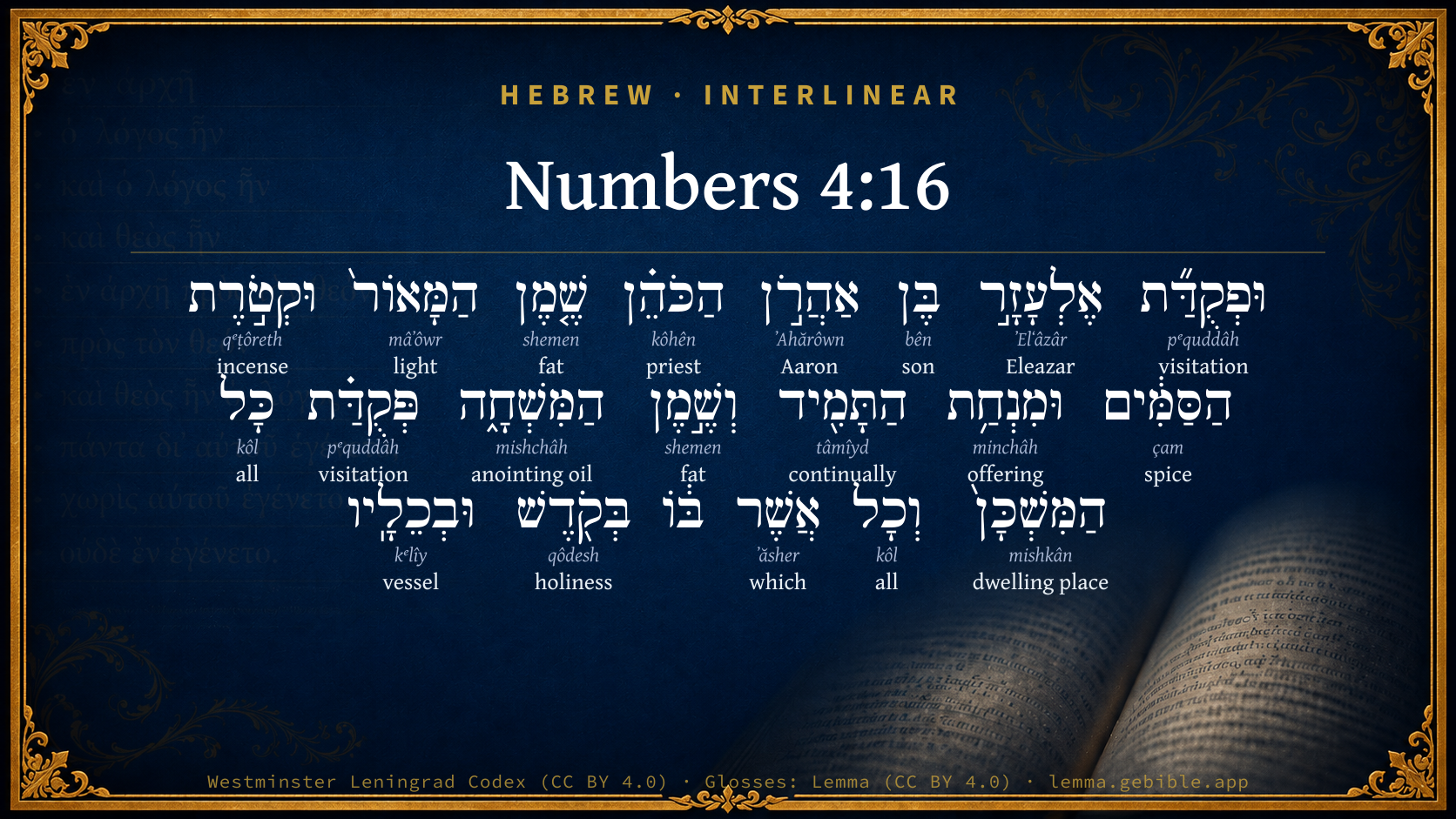
Numbers 4:16

Hebrew (Westminster Leningrad Codex) Numbers 4:16 appears in the Hebrew Old Testament. The text above is from the Westminster Leningrad Codex. Each word links to its Strong’s number, a concise gloss, and parsing drawn from the Open Scriptures Hebrew Bible morphology. Click any word for its full Brown-Driver-Briggs (BDB) entry.
Download image
Cite this verse

Numbers 4:16 (World English Bible). Public Domain. Lemma interlinear Bible study tool, https://lemma.gebible.app/v/numbers/4/16.

Show BibTeX & RIS
BibTeX
RIS
English Translation
"The charge of Eleazar the son of Aaron the priest shall be the oil for the light, the sweet incense, the continual meal offering, and the anointing oil, the charge of all the tabernacle, and of all that is in it, the sanctuary, and its furnishings."
World English Bible · Public Domain
Download a study sheet

One document with this verse’s original text, its word-by-word gloss line, the meaning frame, cross-references with their text, attributed commentary, and full source and license credits — printable, and it pastes into notes with its structure intact.

This verse Autodidact and up

Study sheet (.html) Plain text (.txt)

A passage Seminary Student

Up to 50 verses in one chapter. A passage sheet keeps up to 6 commentary sources and 12 cross-references per verse, in the order this page ranks them, and says so on the sheet whenever that leaves anything out. Ask for a single verse and you get the Autodidact verse sheet above.

Everything on this page stays free to read, with no account — the sheet is a download of what is already on screen, not access to it.

Want to remove ads? Support Godless Engineer
Compare translations 3

The same verse in 3 English versions, stacked beneath the original-language interlinear above. Click any original word for its lexicon entry.

Each is an independent rendering of the whole verse — the interlinear is not word-aligned to these translations.

Highlighted words mark where these versions differ — a whole-verse word diff, not a word-by-word alignment.

  • World English Bible Public Domain
    "The charge of Eleazar the son of Aaron the priest shall be the oil for the light, the sweet incense, the continual meal offering, and the anointing oil, the charge of all the tabernacle, and of all that is in it, the sanctuary, and its furnishings."
  • King James Version Public Domain
    And to the office of Eleazar the son of Aaron the priest pertaineth the oil for the light, and the sweet incense, and the daily meat offering, and the anointing oil, and the oversight of all the tabernacle, and of all that therein is, in the sanctuary, and in the vessels thereof.
  • unfoldingWord Literal Text CC BY-SA 4.0
    And the oversight of Eleazar, the son of Aaron the priest, the oil of the light and the incense of the spices and the grain offering of continuity and the oil of the anointing, the oversight of all the Dwelling and all that in it, in the holy place, and in its vessels.”

unfoldingWord Literal Text — © unfoldingWord, licensed CC BY-SA 4.0. Word-aligned USFM3 via Door43 (git.door43.org/unfoldingWord/en_ult).

Versions to compare (up to 4)

3 of 4 selected

Show all 18 translations

Every available English version of this verse, each an independent rendering of the whole verse.

  • World English Bible Public Domain
    "The charge of Eleazar the son of Aaron the priest shall be the oil for the light, the sweet incense, the continual meal offering, and the anointing oil, the charge of all the tabernacle, and of all that is in it, the sanctuary, and its furnishings."
  • Berean Standard Bible Public Domain
    Eleazar son of Aaron the priest shall oversee the oil for the light, the fragrant incense, the daily grain offering, and the anointing oil. He has oversight of the entire tabernacle and everything in it, including the holy objects and their utensils.”
  • Majority Standard Bible Public Domain
    Eleazar son of Aaron the priest shall oversee the oil for the light, the fragrant incense, the daily grain offering, and the anointing oil. He has oversight of the entire tabernacle and everything in it, including the holy objects and their utensils.”
  • King James Version Public Domain
    And to the office of Eleazar the son of Aaron the priest pertaineth the oil for the light, and the sweet incense, and the daily meat offering, and the anointing oil, and the oversight of all the tabernacle, and of all that therein is, in the sanctuary, and in the vessels thereof.
  • American Standard Version (1901) Public Domain
    And the charge of Eleazar the son of Aaron the priest shall be the oil for the light, and the sweet incense, and the continual meal-offering, and the anointing oil, the charge of all the tabernacle, and of all that therein is, the sanctuary, and the furniture thereof.
  • Revised Version (1885) Public Domain
    And the charge of Eleazar the son of Aaron the priest shall be the oil for the light, and the sweet incense, and the continual meal offering, and the anointing oil, the charge of all the tabernacle, and of all that therein is, the sanctuary, and the furniture thereof.
  • Geneva Bible (1599) Public Domain
    And to the office of Eleazar the sonne of Aaron the Priest pertaineth the oyle for the light, and the sweete incense and the dayly meat offring, and the anointing oyle, with the ouersight of all the Tabernacle, and of all that therein is, both in the Sanctuarie and in all the instruments thereof.
  • Douay-Rheims (1899) Public Domain
    And over them shall be Eleazar the son of Aaron the priest, to whose charge pertaineth the oil to dress the lamps, and the sweet incense, and the sacrifice, that is always offered, and the oil of unction, and whatsoever pertaineth to the service of the tabernacle, and of all the vessels that are in the sanctuary.
  • Young's Literal Translation Public Domain
    `And the oversight of Eleazar, son of Aaron the priest, `is' the oil of the lamp, and the spice-perfume, and the present of continuity, and the anointing oil, the oversight of all the tabernacle, and of all that `is' in it, in the sanctuary, and in its vessels.'
  • Literal Standard Version CC BY-SA 4.0
    And the oversight of Eleazar, son of Aaron the priest, [is] the oil of the lamp, and the spice-incense, and the present of continuity, and the anointing oil, the oversight of all the Dwelling Place and of all that [is] in it, in the sanctuary and in its vessels.”
  • Unlocked Literal Bible CC BY-SA 4.0
    Eleazar son of Aaron the priest oversees the care of the oil for the light, the sweet incense, the regular grain offering, and the anointing oil. He oversees the care of the entire tabernacle and all that is in it, the holy place and its equipment.”
  • unfoldingWord Literal Text CC BY-SA 4.0
    And the oversight of Eleazar, the son of Aaron the priest, the oil of the light and the incense of the spices and the grain offering of continuity and the oil of the anointing, the oversight of all the Dwelling and all that in it, in the holy place, and in its vessels.”
  • Darby Bible Public Domain
    And Eleazar the son of Aaron the priest shall have the oversight of the oil for the light, and the fragrant incense, and the continual oblation, and the anointing oil, -- the oversight of the whole tabernacle, and of all that is therein, over the sanctuary, and over its furniture.
  • World Messianic Bible Public Domain
    “The duty of Eleazar the son of Aaron the priest shall be the oil for the light, the sweet incense, the continual meal offering, and the anointing oil, the requirements of all the tabernacle, and of all that is in it, the sanctuary, and its furnishings.”
  • Webster's Bible Public Domain
    And to the office of Eleazar the son of Aaron the priest pertain the oil for the light, and the sweet incense, and the daily meat-offering, and the anointing oil, and the oversight of all the tabernacle, and of all that is in it, in the sanctuary, and in its vessels.
  • Free Bible Version CC BY-SA 4.0
    Eleazar, son of Aaron the priest, is to supervise obtaining olive oil for the lamps, the aromatic incense, the daily grain offering, and the anointing oil. He is in charge of the whole Tabernacle and everything in it—all the holy things and equipment.”
  • Bible in Basic English Public Domain
    And Eleazar, the son of Aaron the priest, is to be responsible for the oil for the light, and the sweet perfumes for burning, and the regular meal offering, and the holy oil; the House and the holy place and everything in it will be in his care.
  • JPS Tanakh (1917) Public Domain
    And the charge of Eleazar the son of Aaron the priest shall be the oil for the light, and the sweet incense, and the continual meal-offering, and the anointing oil: he shall have the charge of all the tabernacle, and of all that therein is, whether it be the sanctuary, or the furniture thereof.'

Literal Standard Version (2020), Covenant Press — licensed CC BY-SA 4.0. Text via the HelloAO Bible API (eBible.org). Unlocked Literal Bible (unfoldingWord) — licensed CC BY-SA 4.0. Text via the HelloAO Bible API (eBible.org). unfoldingWord Literal Text — © unfoldingWord, licensed CC BY-SA 4.0. Word-aligned USFM3 via Door43 (git.door43.org/unfoldingWord/en_ult). Free Bible Version, Dr. Jonathan Gallagher — licensed CC BY-SA 4.0. Text via the HelloAO Bible API (eBible.org).

Word by word

More ways to search: Search by grammar → Find every occurrence → Compare this word →

Practice this passage: Drill this verse → Learn its vocabulary →

הַסַּמִּ֔ים
çam
H5561
“the · spices”
Particle, Definite Article + Noun, Common, Masculine, Plural, Absolute
Part of Speech
Particle + Noun
Type
Common
Gender
Masculine
Number
Plural
State
Absolute
Full BDB Definition

Origin: from an unused root meaning to smell sweet

TWOT: 1516a

spice - a spice used in incense
  1. וּפְקֻדַּ֞ת pᵉquddâh H6486 “and · visitation of” Conjunction + Noun, Common, Feminine, Singular, Construct
  2. אֶלְעָזָ֣ר ʼElʻâzâr H499 “Eleazar” Noun, Proper
  3. בֶּן bên H1121 “son of” Noun, Common, Masculine, Singular, Construct
  4. אַהֲרֹ֣ן ʼAhărôwn H175 “Aaron” Noun, Proper
  5. הַכֹּהֵ֗ן kôhên H3548 “the · priest” Particle, Definite Article + Noun, Common, Masculine, Singular, Absolute
  6. שֶׁ֤מֶן shemen H8081 “fat of” Noun, Common, Masculine, Singular, Construct
  7. הַמָּאוֹר֙ mâʼôwr H3974 “the · light” Particle, Definite Article + Noun, Common, Masculine, Singular, Absolute
  8. וּקְטֹ֣רֶת qᵉṭôreth H7004 “and · incense of” Conjunction + Noun, Common, Feminine, Singular, Construct
  9. וּמִנְחַ֥ת minchâh H4503 “and · offering of” Conjunction + Noun, Common, Feminine, Singular, Construct
  10. הַתָּמִ֖יד tâmîyd H8548 “the · continually” Particle, Definite Article + Noun, Common, Masculine, Singular, Absolute
  11. וְשֶׁ֣מֶן shemen H8081 “and · fat of” Conjunction + Noun, Common, Masculine, Singular, Construct
  12. הַמִּשְׁחָ֑ה mishchâh H4888 “the · anointing oil” Particle, Definite Article + Noun, Common, Feminine, Singular, Absolute
  13. פְּקֻדַּ֗ת pᵉquddâh H6486 “visitation of” Noun, Common, Feminine, Singular, Construct
  14. כָּל kôl H3605 “all of” Noun, Common, Masculine, Singular, Construct
  15. הַמִּשְׁכָּן֙ mishkân H4908 “the · dwelling place” Particle, Definite Article + Noun, Common, Masculine, Singular, Absolute
  16. וְכָל kôl H3605 “and · all of” Conjunction + Noun, Common, Masculine, Singular, Construct
  17. אֲשֶׁר ʼăsher H834 “which” Particle, Relative
  18. בְּקֹ֖דֶשׁ qôdesh H6944 “in/at · holiness” Preposition + Noun, Common, Masculine, Singular, Absolute
  19. וּבְכֵלָֽיו kᵉlîy H3627 “and · in/at · vessels · his” Conjunction + Preposition + Noun, Common, Masculine, Plural, Construct + Suffix, Personal, 3rd Person, Masculine, Singular

About this verse

These counts appear in no published source. They are computed here, from the morphology-tagged text and Lemma’s own curated glosses. What Lemma adds →

21
words
17
distinct lemmas
Pentateuch
section

Notable vocabulary

The rarest word here is הַסַּמִּ֔ים spice H5561 — appearing just 16 times in the whole Hebrew Bible.

Shared distinctive vocabulary

הַסַּמִּ֔ים spice H5561 occurs in 15 verses of the Hebrew Bible. Also found in:

Grammatical profile

  • 19 nouns
  • 1 preposition
  • 1 particle

Repetition

Words recur within this verse — often emphatic in Hebrew:

  • וּפְקֻדַּ֞ת visitation H6486 ×2
  • שֶׁ֤מֶן fat H8081 ×2
  • כָּל all H3605 ×2

Hebrew & Septuagint length

In English translation the verse runs 46 words from the Hebrew and 51 from the Septuagint (LXX English) — closely comparable.

A rough comparison of the two English renderings, which tokenize alike — not a word-level alignment.

Word counts can differ between the Hebrew and the Greek without any difference in meaning — e.g. the Hebrew direct-object marker אֵת has no separate Greek word, and Greek often adds the article ὁ.

Cross-references

17

Topical passages linked to Numbers 4:16 in the Treasury of Scripture Knowledge — connected by theme and wording, ordered by reader-vote popularity; previews shown in the World English Bible.

  • Exodus 25:6 oil for the light, spices for the anointing oil and for the sweet incense,
  • Leviticus 24:2 "Command the children of Israel, that they bring to you pure olive oil beaten for the light, to cause a lamp to burn continually.
  • Exodus 30:23–38 "Also take fine spices: of liquid myrrh, five hundred shekels; and of fragrant cinnamon half as much, even two hundred and fifty; and of fragrant cane, two hundred and fifty;
  • 1 Peter 2:25 For you were going astray like sheep; but are now returned to the Shepherd and Overseer of your souls.
  • Exodus 27:20–21 "You shall command the children of Israel, that they bring to you pure olive oil beaten for the light, to cause a lamp to burn continually.
  • Exodus 29:39–41 The one lamb you shall offer in the morning; and the other lamb you shall offer at evening:
  • Exodus 31:11 the anointing oil, and the incense of sweet spices for the holy place: according to all that I have commanded you they shall do."
  • Exodus 37:29 He made the holy anointing oil and the pure incense of sweet spices, after the art of the perfumer.
  • Leviticus 6:20 "This is the offering of Aaron and of his sons, which they shall offer to Yahweh in the day when he is anointed: the tenth part of an ephah of fine flour for a meal offering perpetually, half of it in the morning, and half of it in the evening.
  • Numbers 3:32 Eleazar the son of Aaron the priest shall be prince of the princes of the Levites, with the oversight of those who keep the charge of the sanctuary.
  • Luke 4:18 "The Spirit of the Lord is on me, Because he has anointed me to preach good news to the poor. He has sent me to heal the brokenhearted, To proclaim release to the captives, Recovering of sight to the blind, To deliver those who are crushed,
  • Acts 20:28 Take heed, therefore, to yourselves, and to all the flock, in which the Holy Spirit has made you overseers, to shepherd the assembly of the Lord and God which he purchased with his own blood.
  • 1 Corinthians 4:1 So let a man think of us as Christ's servants, and stewards of God's mysteries.
  • 1 Timothy 2:5 For there is one God, and one mediator between God and men, the man Christ Jesus,
  • Hebrews 3:1 Therefore, holy brothers, partakers of a heavenly calling, consider the Apostle and High Priest of our confession, Jesus;
  • Hebrews 3:6 but Christ is faithful as a Son over his house; whose house we are, if we hold fast our confidence and the glorying of our hope firm to the end.
  • 1 Peter 5:2 Shepherd the flock of God which is among you, exercising the oversight, not under compulsion, but voluntarily, not for dishonest gain, but willingly;

Cross-references courtesy of OpenBible.info (CC BY 4.0).

Hebrew and Greek witnesses Masoretic Hebrew ↔ Greek Septuagint

The same verse in the two great witnesses to the Old Testament, shown verse-for-verse.

These are two independent witnesses, not word-aligned to each other, and the Septuagint is shown in lemma (dictionary) form.

Hebrew Numbers 4:16 Masoretic · Westminster Leningrad Codex

וּפְקֻדַּ֞ת אֶלְעָזָ֣ר בֶּן אַהֲרֹ֣ן הַכֹּהֵ֗ן שֶׁ֤מֶן הַמָּאוֹר֙ וּקְטֹ֣רֶת הַסַּמִּ֔ים וּמִנְחַ֥ת הַתָּמִ֖יד וְשֶׁ֣מֶן הַמִּשְׁחָ֑ה פְּקֻדַּ֗ת כָּל הַמִּשְׁכָּן֙ וְכָל אֲשֶׁר בּ֔וֹ בְּקֹ֖דֶשׁ וּבְכֵלָֽיו

"The charge of Eleazar the son of Aaron the priest shall be the oil for the light, the sweet incense, the continual meal offering, and the anointing oil, the charge of all the tabernacle, and of all that is in it, the sanctuary, and its furnishings."

World English Bible · Public Domain

Greek LXX Numbers 4:16 Septuagint · lemma form

ἐπισκοπός ελεαζαρ υἱός ἀαρών ὁ ἱερεύς ὁ ἔλαιον ὁ φῶς καί ὁ θυμίαμα ὁ σύνθεσις καί ὁ θυσία ὁ κατά ἡμέρα καί ὁ ἔλαιον ὁ χρίσις ὁ ἐπισκοπή ὅλος ὁ σκηνή καί ὅσος εἰμί ἐν αὐτός ἐν ὁ ἅγιος ἐν πᾶς ὁ ἔργον

Eleazar the son of Aaron the priest is overseer—the oil of the light, and the incense of composition, and the daily meat-offering and the anointing oil, are his charge; even the oversight of the whole tabernacle, and all things that are in it in the holy place, in all the works.

LXX2012 (modern English Septuagint) · Public Domain

On this verse, The Pulpit Commentary discusses the Septuagint’s reading. Read the note in Commentary ↓

Hebrew: Westminster Leningrad Codex (CC BY 4.0). Greek: Septuagint (public domain); English from LXX2012 (modern English Septuagint) (Public Domain). How the Septuagint differs from the Hebrew →

Targum (Aramaic paraphrase)

2

The Targum is the ancient Jewish Aramaic paraphrase of the Hebrew Scriptures — an interpretive translation, not the Hebrew text itself. Onkelos (literal) and Pseudo-Jonathan (expansive) render the Torah, and Jonathan the Prophets. Coverage is partial: where no permissively-licensed English translation exists for a verse, only the Aramaic is shown. This is verse-level text, not a word-by-word alignment to the Hebrew.

  1. Targum Onkelos Torah (Genesis–Deuteronomy)
    וְדִי מְסִיר לְאֶלְעָזָר בַּר אַהֲרֹן כַּהֲנָא מִשְׁחָא דְאַנְהָרוּתָא וּקְטוֹרֶת בּוּסְמַיָא וּמִנְחָתָּא תְדִירָא וּמִשְׁחָא דִרְבוּתָא מַטְרַת כָּל מַשְׁכְּנָא וְכָל דִי בֵהּ בְּקוּדְשָׁא וּבְמָנוֹהִי

    (no public-domain English translation for this verse)

    Targum Onkelos — Aramaic: “Onkelos Genesis” (public domain); “Onkelos Exodus” (public domain); “Onkelos Leviticus” (public domain); “Onkelos Numbers” (public domain); “Onkelos Deuteronomy” (public domain). English: “Sefaria Community Translation” (CC0 1.0 (public-domain dedication)); “J.W. Etheridge. The Targums of Onkelos and Jonathan Ben Uzziel on the Pentateuch. London: Longmans, Green, 1862” (public domain). Text via Sefaria.

  2. Targum Pseudo-Jonathan Torah (Genesis–Deuteronomy)
    וְדִמְסִיר לְאֶלְעָזָר בַּר אַהֲרן כַּהֲנָא מִשְׁחָא דְאַנְהָרוּתָא וּקְטוֹרֶת בּוּסְמַיָא וּמִנְחָה דִתְדִירָא וּמִשְׁחָא דִרְבוּתָא מַטְרַת כָּל מַשְׁכְּנָא וְכָל דְבֵיהּ בְּקוּדְשָׁא וּבְמָנוֹי

    And that delivered to Elazar bar Aharon the priest shall be the oil for the light, the aromatic incense, the perpetual mincha, the oil of anointing, and the custody of all the tabernacle, and whatever is in it in the sanctuary and its vessels.

    Targum Pseudo-Jonathan — Aramaic: “Targum Jonathan on Genesis” (public domain); “Targum Jonathan on Exodus” (public domain); “Targum Jonathan on Leviticus” (public domain); “Targum Jonathan on Numbers” (public domain); “Targum Jonathan on Deuteronomy” (public domain). English: “The Targum of Jonathan ben Uzziel, trans. J. W. Etheridge, London, 1862” (public domain). Text via Sefaria.

Commentary

Notes on Numbers 4:16 from classic Christian and Jewish commentators (each source and its license shown beneath its notes). The classic Christian expositions comment on the surrounding passage and are grouped to its opening verse, so a note may address several verses; the Jewish commentaries on the Tanakh (Rashi and others) are per-verse, so they appear only where the commentator wrote on this verse.

Lemma curates 59 commentaries, every one of them public domain or Creative Commons licensed, each selected and text-cleaned for this edition rather than reprinted as found. About our sources →

Trapp's Complete Commentary

John Trapp

Num 4:16 And to the office of Eleazar the son of Aaron the priest [pertaineth] the oil for the light, and the sweet incense, and the daily meat offering, and the anointing oil, [and] the oversight of all the tabernacle, and of all that therein [is], in the sanctuary, and in the vessels thereof.

Ver. 16. And to the office of Eleazar.] Called therefore prince of the princes of the Levites. {Num 3:32}

John Trapp, A Commentary or Exposition upon All the Books of the Old and New Testament (1647–1656) — public domain. Text from a community e-Sword module.

The Biblical Illustrator

Joseph S. Exell

Num_4:16

The office of Eleazar.

The Eleazar priesthood:

There are few chapters which will so amply repay patient study as this. It might be styled the directory for the pilgrim priest, and therefore it is of great importance to us who wish to retain our priestly purity in the midst of the wilderness of this earthly life. The first verse tells us that it is addressed to Moses the lawgiver, and to Aaron the priest. We therefore at once expect to find here a linking of duties and privileges. If you want to know what was the great duty of the pilgrim priest, it was to carry the tabernacle throughout the wilderness, so that wherever the children of Israel pitched they might have a meeting-place where they might commune with God. And so this great work in which we are engaged may be summed up in these words, To carry Christ with us throughout this wilderness; and as the Levites motto might be, To me to live is the tabernacle: so to me to live is Christ, to carry Christ whereer I go. Some of us may be entrusted with what the world considers the more important service--with the holy vessels; others may have the heavier burden, or the little vexatious duties, but they are all for this great purpose, that the children of Israel may constantly hold communion with their God. Nay, mark you, more: not only does the great High Priest appoint each of us to service and burdens--both passive burdens and active service--but in the case of Merari there was to be a special inventory of everything entrusted to their care, so that they might not consider for one single moment that their part of the work was of less importance. The 16th verse brings before us not so much the responsibility as the privilege. To the office of Eleazar the priest pertain these four things--the oil for the light, the sweet incense, the daily meat-offering, and the anointing oil. As Christian men and women, are they not, spiritually speaking, just the four things you need now in your daily life?

1. The first is this: To the office of Eleazar the priest pertaineth oil for light. We recognise that God has made us the lights of the world. He bids us shine forth to the glory of God. He has given to us that high dignity. But, alas! too often our lights are going out; they do not shine as brightly as they ought. It seems as though we were hiding our light under the bushel of business or the bed of sloth, instead of putting it on a candlestick that it might give light to others. Call to your Eleazar Priest; ask Him to give of His oil; ask Him to take away sin, and to give you the oil of His Holy Spirit, for it is to the office of Eleazar the priest that pertaineth the oil for the light.

2. The second thing pertaining to his office was the sweet incense. You remember the use of the sweet incense. Whilst the children of Israel were praying in the outer court, the priest went into the holy place, and took with him the incense, laid it upon the altar, and, as the prayers ascended from the people outside, the incense ascended from the priest inside. Now, have you not ofttimes felt the necessity of that sweet incense? O Thou Eleazar Priest, do Thou purify my prayers with Thine own sweet incense, so that God may listen to my cry, and forgive the evil of my prayer: purge out the unclean selfishness of my prayer, that it may ascend up to my Father in heaven. Thank God, to His office it pertains to provide that sweet incense. You have not to provide the incense.

3. Thirdly, to his office pertaineth the daily meat-offering. You remember what that was. Every morning the children of Israel were obliged to bring a lamb for the burnt-offering, and the same every evening; but as soon as the lamb was offered upon the altar, the daily meat-offering had to be added representing the pure and spotless character of Christ. Now, in the same way, you and I have to bring the daily burnt-offering to God. Every morning you ought to say: Here I present myself to Thee, O God, to be a holy, living sacrifice unto Thee, which is but my reasonable service. Every day you ought to bring your daily burnt-offering, and put it upon the altar, and then, when you have thus dedicated yourself to God, and consecrated yourself to His service, have you not often felt--I come and offer myself to God, but what a poor offering it is! And when I consecrate myself upon the altar, how I need that which shall make my burnt-offering acceptable to God! And morning by morning God accepts you in the Beloved--not for what you are in yourself, but for what He is. What can I do for God, I am so weak and feeble? If I put myself upon Gods altar, can He use me for His service? Yes, He can; because to the office of Eleazar the priest pertaineth the meat-offering, and He will make acceptable your burnt-offering.

4. One thing more: I have prayed Him co give me oil for the light. I have come to Him, and I have acknowledged that even in my prayers there is a good deal of self that cannot be acceptable to God except perfumed by the merits of my Saviour; and although I have put myself upon the altar to be used as He will, I recognise that in myself dwelleth no good thing, that I want the daily meat-offering to atone for my burnt-offering. Now, what do I want? I want power--power to serve God: I want that my life may be an influence for good. I want to be a man full of power, by the Spirit of God. To the office of Eleazar the priest pertaineth the anointing with oil, and that oil goes down to the very skirts of his garments, even to the very humblest believer. I heard only yesterday of a young girl in a house of business, only sixteen years of age, whose confirmation time was a time of grand decision for God. She went back to that house of business, where the principals were practically atheists; but I was told yesterday that that young girl, whose life had been anointed with the holy anointing oil, had such power in that business that the principal and his wife have both been converted. The principal is now a lay preacher in the Church of England, and the lady of the business holds a large Bible-class for those in houses of business; one of them traces back the blessing to the quiet, holy influence of that little girl, the power of the Holy One resting upon her. Oh, that I might thus be filled with power, have the anointing oil upon me. Is not that what you want in the midst of this wilderness journey, in the midst of all the trials and temptations of daily life? (E. A. Stuart, M. A.)

The Biblical Illustrator, edited by Joseph S. Exell (c. 1880s–1900s) — public domain. Text from a community e-Sword module.

Joseph Benson's Commentary

Num 4:16. Eleazar — He himself is to carry these things, and not to commit them to the sons of Kohath. The oversight — The care that all the things above mentioned be carried by the persons and in the manner expressed.

Joseph Benson's Commentary on the Old and New Testaments (1811–1818) — public domain. Text from a community e-Sword module.

Geneva Bible (1599)

Geneva Bible translators

Which was offered at morning and evening.

Geneva Bible (1599) marginal notes — public domain. Text via Bolls.life.

Jamieson, Fausset & Brown

Robert Jamieson, A. R. Fausset & David Brown

to the office of Eleazar . . . pertaineth the oil for the light, and the sweet incense, &c.--He was charged with the special duty of superintending the squadron who were employed in the carrying of the sacred furniture; besides, to his personal care were committed the materials requisite for the daily service, and which it was necessary he should have easily at his command (Exo 29:38).

Jamieson, Fausset & Brown — Commentary Critical and Explanatory on the Whole Bible (1871) — public domain (CC PDM 1.0). Text via the HelloAO Bible API.

Ellicott's Commentary for English Readers

(16) The oil for the light.—Or, for the candlestick (Exo_25:6).

The sweet incense.—Or, the incense of spices (Exo_25:6).

The daily meat offering.—Better, the continual meat offering—i.e., the morning and evening minchah (Exo_29:38-42).

The anointing oil.—i.e., “the oil of holy ointment” with which the tent of meeting, the vessels of the Sanctuary, and the priests were to be anointed (Exo_30:23-31).

A Bible Commentary for English Readers, edited by Charles John Ellicott (1878–1897) — public domain. Text from a community e-Sword module.

The Cambridge Bible for Schools and Colleges

gen. ed. J. J. S. Perowne

16. Eleazar superintends the Kohathites, and has personal charge of the oil for the light (Exo_27:20), the ‘incense of sweet spices’ (Exo_25:6; Exo_30:34-38), the ‘continual meal-offering,’ and the anointing oil (Exo_30:22-33).

The Cambridge Bible for Schools and Colleges (gen. ed. J. J. S. Perowne; Cambridge University Press, 1878–1918) — public domain. Text from a community e-Sword module.

John Gill's Exposition

And the Lord spake unto Moses, and unto Aaron,.... And gave them a very solemn and awful charge about this affair of the Kohathites, it being a very hazardous one they were employed in:

saying; as follows.

John Gill's Exposition of the Whole Bible (1746–1763) — public domain (CC PDM 1.0). Text via the HelloAO Bible API.

Haydock's Catholic Bible Commentary

Over them. The sons of Caath, to whose care the more sacred things were entrusted; or Hebrew, "over the oil," &c. --- Sacrifice of flour, wine, &c. These always accompanied the morning and evening holocaust. It hence appears that this law was already in force, and probably all such precepts were observed as were not incompatible with the wandering state of the Hebrews. (Calmet)

George Leo Haydock (1774–1849), Haydock's Catholic Family Bible and Commentary, 1859 edition — public domain. Excludes Psalms (Douay-Rheims chapter numbering differs from Protestant) and Deuterocanonical books (Catholic canon only).

Matthew Poole's English Annotations

i.e. He himself is to carry these things, and not to commit them to the sons of Kohath. The daily meat-offering of fine flour, which was to be offered every morning and evening with the daily burnt-offering. See Exo 29:38,39.

The oversight of all the tabernacle, i.e. the care that all the things above mentioned be carried by the persons and in the manner expressed.

Matthew Poole's English Annotations on the Holy Bible (1683–1685) — public domain. Text from a community e-Sword/MySword module.

Whedon's Commentary on the Bible

Daniel D. Whedon

16. The office of Eleazar — It is the statement of Jewish commentators that Eleazar bore upon his person four burdens: “The oil of the light in his right hand, and the anointing oil in his left; the incense in his bosom, and the meat offering on his shoulder.” But it is not credible that one man should be so heavily laden, for the anointing oil alone, according to the lowest computation, weighed at least fifty pounds. Exo_30:23-24. It is reasonable to suppose that he was specially charged with the care of these, but that he was assisted by the Levites.

Sweet incense — The emblem of acceptable prayer. It was compounded of several spices and aromatic gums, (see Exo_30:34-36,) indicating the different exercises in prayer, as adoration, confession, etc. In this minute description of the materials for the daily service with which Eleazar was charged there is no mention of the sacred fire, which had to be kept always burning. An item so important must have been provided for, and some persons must have transported and kept alive the sacred coals in a censer.

Daniel D. Whedon (gen. ed.), Commentary on the Old and New Testaments (1874–1909) — public domain. Text from a community e-Sword module.

The Pulpit Commentary

To the office of Eleazar,... oversight. Septuagint, episkopov Eleazar ...: h episkoph . On him was laid the oversight of and the responsibility for all the material appliances of Divine worship, and in especial it devolved upon him to see to the oil, the incense, and the chrism, and the materials for the daily meat offering. No doubt it is intended, although not precisely expressed, that the Kohathites were specially under his orders.

Vers. 17-20. The Lord is to be served with fear.

"LEST THEY DIE: "that note of warning is often heard in the law. If any man or woman touched the flaming mount, it was death. (Exo_19:12) It was death if the high priest entered into the holiest on any day but one, or on that day if he omitted to shroud the mercy-seat in a cloud of fragrant incense. (Lev_16:3-13) It was death if any son of Aaron transgressed the ritual, were it only by officiating in any other than the appointed garments. (Exo_28:43) In the same strain, this law in Numbers makes it death for any common Levite to touch, or gaze upon, the holy things till the priest has packed them up in their thick wrappings. (verses 19, 20; cf. Num_1:51 Num_3:10) The example first of Nadab and Abihu, and afterwards of Korah and his company, showed that these threats were spoken in earnest. We cannot marvel that, after hearing and seeing all this, the people were smitten with terror, and cried out to Moses, "We perish, we perish, we all perish. Whosoever cometh anything near unto the tabernacle of the Lord shall die. Shall we be consumed with dying?". (Num_17:13)

I THIS FEATURE OF THE LAW WILL HELP YOU TO UNDERSTAND THE DEPRECIATORY TERMS IN WHICH IT IS SO OFTEN MENTIONED IN THE NEW TESTAMENT, especially by the Apostle Paul. The law was "the ministration of death and of condemnation"; (2Co_3:7, 2Co_3:9) it "worketh wrath"; (Rom_4:15) it breathed a "spirit of bondage" and fear; (Rom_8:15) it "gendered to bondage"; (Gal_4:24) it was "an intolerable yoke". (Act_15:10) Not that the whole contents of the Pentateuch fell under this description. Much of promise was spoken in presence of the mountain of the law. But let the law be taken by itself, and let the gospel verities foreshadowed by its ritual be shut out from view, and does it not answer to the disparaging descriptions? It was full of wrath, condemnation, fear. No doubt there was an element of grace even in the covenant of Sinai. It was a benefit done to Israel when the Lord delivered to them the commandments, pitched his tabernacle among them, and suffered them to draw near under the conditions of the ritual. Nevertheless, the conditions were hard and terrible; we may well thank God for abolishing them. They are utterly abolished. The veil is rent from top to bottom; the yoke is broken; we have received the spirit of adoption, not the spirit of bondage again to fear; we have boldness to enter into the holiest.

II NOTHING THAT HAS BEEN SAID IMPLIES THAT THE LEVITICAL LAW WAS REALLY UNWORTHY OF THE WISDOM OR THE GRACE OF GOD. For the time then present it was the best thing that could be. Certain truths of primary importance men were everywhere forgetting: among others, the holy majesty of God; that communion with God is to the soul of man the very breath of life; that man is a sinner for whom there is no remission, no access, without atonement. These lessons the law was meant and fitted to teach. These lessons it did teach, burning them into the conscience of the nation. The law was not the gospel, but it led forward to the gospel. A service beyond all price.

III NOR HAS THE BENEFICENT OFFICE OF THE LAW CEASED WITH THE ADVENT OF THE BETTER TIME. Men are ready to abuse the grace of God, to give harbour to licentiousness on pretext of Christian liberty. If you doubt it, search well your own heart. What is the remedy? It is found sometimes in the rod of God"s afflicting providence, sometimes in the searching discipline of the law. For the law, although in its letter abrogated, abides for ever in its substance. We are not bound we are not at liberty to slay sin offerings or burn incense. But we are bound to ruminate on the law of sacrifice and intercession. The Levitical ritual belongs in this sense to us as much as it ever belonged to the Jews. It admonishes us of the reverence due to God. A certain filial boldness he will welcome, but presumptuous trifling with his majesty and holiness he will not suffer. If we would be accepted, we must worship God with reverence and godly fear, for our God is still a consuming fire. B. (Heb_12:29)

The Pulpit Commentary (1880–1919), ed. H.D.M. Spence-Jones & Joseph S. Exell — public domain. Text from a community e-Sword module.

John Wesley's Explanatory Notes

Eleazar - He himself is to carry these things, and not to commit them to the sons of Kohath. The oversight - The care that all the things above mentioned be carried by the persons and in the manner expressed.

John Wesley, Explanatory Notes Upon the Whole Bible (1754–1765) — public domain. Text via the GEBible commentary corpus.

Keil & Delitzsch

C. F. Keil & F. Delitzsch

The oversight of the oil for the candlestick (Exo 27:20), the incense (Exo 30:34), the continual meat-offering (Exo 29:40), and the anointing oil (Exo 30:23), belonged to Eleazar as the head of all the Levites (Num 3:32). He had also the oversight of the dwelling and all the holy things and furniture belonging to it; and, as a comparison of Num 4:28 and Num 4:33 clearly shows, of the services of the Kohathites also.

Keil & Delitzsch — Biblical Commentary on the Old Testament (1861–1891) — public domain (CC PDM 1.0). Text via the HelloAO Bible API. (Old Testament only.)

Rashi

Rabbi Shlomo Yitzchaki (Rashi)

ופקדת אלעזר AND THE CHARGE OF ELEAZAR … [WERE THE OIL FOR THE LIGHT, AND THE INCENSE OF AROMATICS, AND THE CONTINUAL MEAL OFFERING, AND THE ANOINTING OIL] — This means: the charge of Eleazar who was appointed over them to carry them were the oil, and the incense and the anointing oil. As regards the continual meal-offering mentioned here, upon him lay the charge to give orders and to urge on that it should be offered at the time when they encamped.

פקדת כל המשכן means: and further he was appointed over the burden of the sons of Kohath, i.e., to give each man orders regarding his service and his burden, which was the Tabernacle and all that was therein — all the articles set forth above in this section. The burden of the sons of Gershon and of the sons of Merari, however, which did not appertain to things of most holy character, was carried out by order of Ithamar, as is set forth in the section commencing with the word נשא (vv. 21—34).

Rashi on the Tanakh — English translations: “The Judaica Press complete Tanach with Rashi, translated by A. J. Rosenberg” (CC BY 4.0); “Pentateuch with Rashi's commentary by M. Rosenbaum and A.M. Silbermann, 1929-1934” (public domain); “The Metsudah Tanach series, Lakewood, N.J” (CC BY 4.0); and “The Book of Joshua, Metsudah Publications, 1997” (CC BY 4.0). Text via Sefaria.

Ramban (Nachmanides)

Rabbi Moshe ben Nachman (Ramban / Nachmanides)

AND THE CHARGE OF ELEAZAR THE SON OF AARON THE PRIEST SHALL BE THE OIL FOR THE LIGHT, AND THE SWEET INCENSE, AND THE CONTINUAL MEAL-OFFERING, AND THE ANOINTING OIL: HE SHALL HAVE THE CHARGE OF ALL THE TABERNACLE, AND OF ALL THAT THEREIN IS, IN THE SANCTUARY, AND IN THE VESSELS THEREOF. Scripture is stating that Eleazar was in charge of all these things, and the meaning of [the end of the verse] is that “he was in charge of all the Tabernacle and in charge of all that therein is.” And Rabbi Abraham ibn Ezra explained that it means that “Eleazar’s charge extended also to the Tabernacle and to all its vessels, together with his brother Ithamar, the son of Aaron who was in charge of the work of the sons of Gershon [in carrying the curtains, etc.] and of the work of the sons of Merari [in carrying the boards and bars of the Tabernacle, etc.]. Why then does Scripture state here that the charge of Eleazar was all the Tabernacle etc.? Ibn Ezra answers that Eleazar shared together with his brother Ithamar in the charge of all the Tabernacle etc., and that the first part of our verse is pointing out that in addition to sharing the general charge of the Tabernacle, Eleazar was, due to his great distinction, solely in charge of the oil for the light etc. Ramban objects to this interpretation and suggests his own explanation. and that due to Eleazar’s great distinction, he alone was in charge of the oil [for the light], and the incense.” But this is not correct, since Scripture states [that the services of the sons of Gershon and Merari were] under the hand of Ithamar [which thus indicates that Eleazar had no share in it]! And [Scripture] explained here [that Eleazar’s charge was] in the Sanctuary and in the vessels thereof, and similarly it stated above, And Eleazar the son of Aaron the priest, was prince over the princes of the Levites and had the oversight of them that keep the charge of the Sanctuary meaning to say that he was the prince [who supervised] the charge of those that guarded the Sanctuary, which was in the hands of the Kohathites inasmuch as he supervised the most holy things. In Verse 4 above it is clearly stated that the sons of Kohath — alone — were in charge of the most holy things, thus disproving Ibn Ezra’s explanation quoted above. If so, the phrase the charge of all the Tabernacle must be in apposition to the end of the verse namely in the Sanctuary, and in the vessels thereof, and the meaning is as follows: “the charge of the oil for the light, etc., the charge of all the Tabernacle, that is, in the Sanctuary, and in the vessels thereof which refers to the most holy things [the ark, etc.] they were given over to the Kohathites — and all these were under the charge of Eleazar,” just as Ithamar was in charge of the work of the sons of Gershon and Merari. In addition to supervising the Kohathites, and assigning each one his particular duty, Eleazar was also chief of all three main Levite families, as will be explained. [i.e., he supervised the most holy things — the ark, the table, candelabrum, altars, Veils and the vessels used in the Divine Service]. But the meaning of the charge of all the Tabernacle is that “the charge of … the oil for the light, and the incense, and the meal-offering, and the anointing oil, and the charge of all the Tabernacle — in the Sanctuary, and of all that therein is of the holy vessels — they were all under the hand of Eleazar,” inasmuch as he supervised the most holy things. In Verse 4 above it is clearly stated that the sons of Kohath — alone — were in charge of the most holy things, thus disproving Ibn Ezra’s explanation quoted above. If so, the phrase the charge of all the Tabernacle must be in apposition to the end of the verse namely in the Sanctuary, and in the vessels thereof, and the meaning is as follows: “the charge of the oil for the light, etc., the charge of all the Tabernacle, that is, in the Sanctuary, and in the vessels thereof which refers to the most holy things [the ark, etc.] they were given over to the Kohathites — and all these were under the charge of Eleazar,” just as Ithamar was in charge of the work of the sons of Gershon and Merari. In addition to supervising the Kohathites, and assigning each one his particular duty, Eleazar was also chief of all three main Levite families, as will be explained. and they are those mentioned here when He stated, And when Aaron and his sons have made an end of covering the Sanctuary and all the vessels of the Sanctuary. Eleazar was thus officer over the three princes, Verse 30), and of the families of Merari, Tzuriel the son of Abichail (ibid., Verse 35). The prince over the princes of the Levites was Eleazar the son of Aaron (ibid., Verse 32). [of the Levites], and [also] overseer of the charge of the Kohathites, and Ithamar was overseer of [the charges of the families of] Gershon and Merari. Now since Scripture does not say that Eleazar “shall bear” [the oil for the light etc.] as is said of the Levites, it would appear that Eleazar did not carry them, but was in charge over them and would give them from hand to hand to those Kohathites whom he chose because of their zeal and piety. It was they who carried them, and they returned them to his control when the Tabernacle was set up. This also [is the meaning of the verse which says that Eleazar was the prince over the princes of the Levites,] having the oversight of them that keep the charge of the Sanctuary, and the verse stating, and by name ye shall appoint the vessels of the charge of their burden [conveying the same thought, that the individual families of the Levites were to be told by the overseer what their particular kind of work would be, and Eleazar, as the prince over the princes, was the overseer of all the service of the Levites].But according to the opinion of the Yerushalmi, (p. 192, Note 44). mentioned in the commentaries of Rashi that he [Eleazar himself] carried them [all the objects enumerated], it would be a heavy load! For the incense consisted of three hundred and sixty-eight manehs, arid [surely] Moses our teacher would not have prepared [only] half of the required quantity, and the oil for the light for a whole year was a large amount, namely one hundred and eighty-three logs, ). and as for [the ingredients required for] the continual meal-offering, we do not know how many days’ supply he carried! But [we would have to say that] Eleazar was very strong and powerful, as was our patriarch Jacob, (Genesis 29:10) — “as easily as one draws the stopper from the mouth of a bottle. Scripture thus informs you how strong he was” (Rashi ibid., on the basis of Bereshith Rabbah 70:10). and so also were Moses our teacher and his brother Aaron, and they that wait for the Eternal shall renew their strength.

Ramban (Nachmanides) on the Tanakh — English translation: “Commentary on the Torah by Ramban (Nachmanides). Translated and annotated by Charles B. Chavel. New York, Shilo Pub. House, 1971-1976” (CC BY 4.0). Text via Sefaria.

Lesson kit

Teaching starters — assembled from the data on this page, not authored interpretation. Every prompt links to the verse data it draws on. Edit before teaching.

Numbers, in the Pentateuch, opens this verse with 21 words (17 distinct Hebrew lemmas). Its most distinctive word is çam (“spice”). A historical commentator’s framing appears above. Read the whole chapter for the surrounding context.

Discussion questions

  1. The word çam carries the sense “spice.” How does it shape the verse?
  2. How does Exodus 25:6, which shares the word «spice», read alongside this verse?
  3. What does the repetition of “visitation” (2× in this one verse) do in this verse?
  4. These translations render this verse differently; the difference is in the English rendering, not the original. What questions does that raise?
  5. Compare how Trapp's Complete Commentary and The Biblical Illustrator read this verse. Where do they agree or differ?

Things to notice

Reading settings

Reading text

Shown beneath each verse's original-language words.

Old Testament
Old Testament edition

Read the OT as the Masoretic Hebrew (MT) or the Greek Septuagint (LXX).

English shown for the Greek Septuagint (in the Hebrew ↔ Greek comparison).

Comparing translations? Open the Compare panel on any verse page to stack up to four side by side.