Exodus 15:13

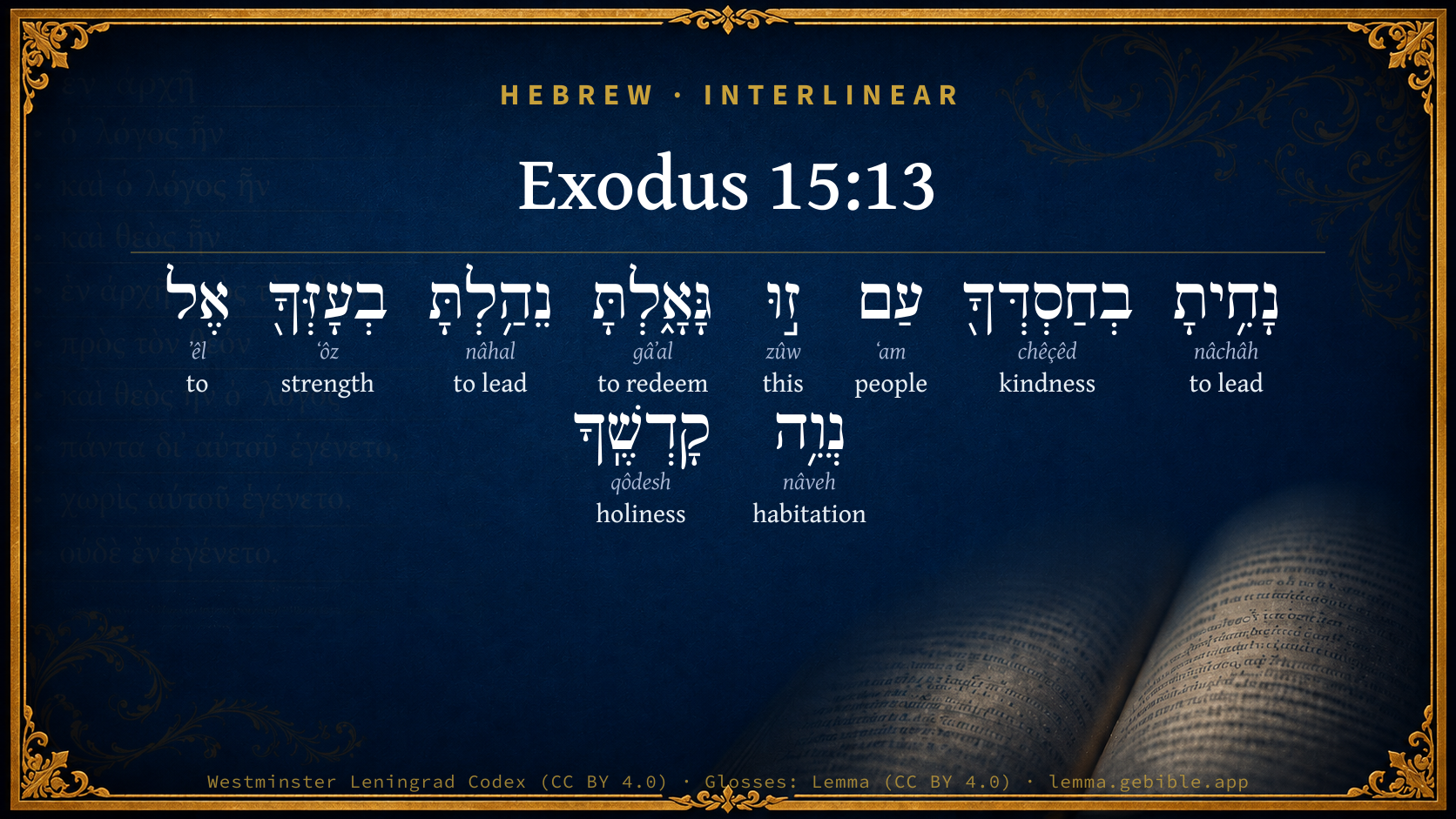
Hebrew (Westminster Leningrad Codex) Exodus 15:13 appears in the Hebrew Old Testament. The text above is from the Westminster Leningrad Codex. Each word links to its Strong’s number, a concise gloss, and parsing drawn from the Open Scriptures Hebrew Bible morphology. Click any word for its full Brown-Driver-Briggs (BDB) entry.
Download image
Cite this verse

Exodus 15:13 (World English Bible). Public Domain. Lemma interlinear Bible study tool, https://lemma.gebible.app/v/exodus/15/13.

Show BibTeX & RIS
BibTeX
RIS
English Translation
"You, in your loving kindness, have led the people that you have redeemed. You have guided them in your strength to your holy habitation.
World English Bible · Public Domain
Highlights
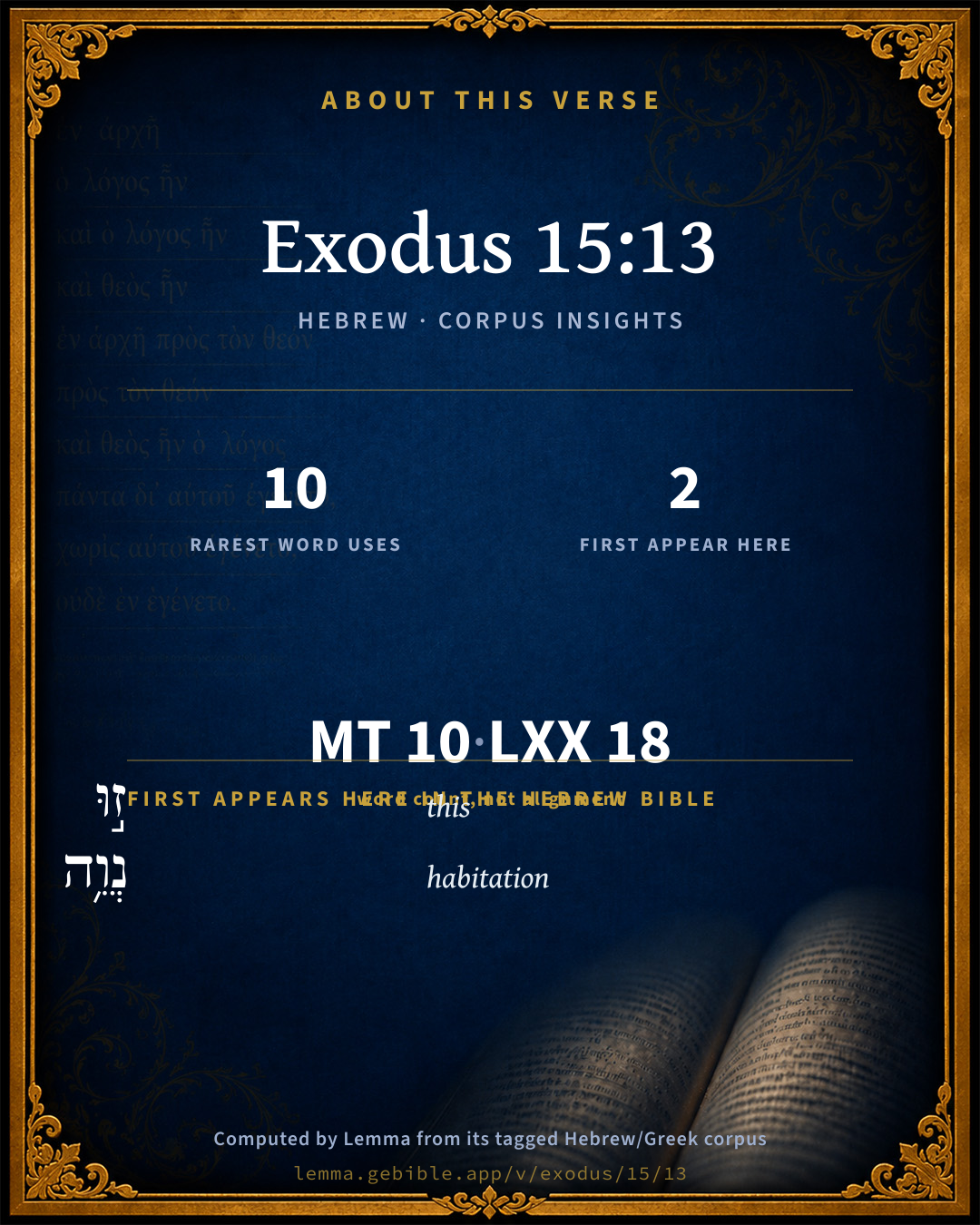
  • 2 first appearances in the Hebrew Bible
Full analysis ↓
Download a study sheet

One document with this verse’s original text, its word-by-word gloss line, the meaning frame, cross-references with their text, attributed commentary, and full source and license credits — printable, and it pastes into notes with its structure intact.

This verse Autodidact and up

Study sheet (.html) Plain text (.txt)

A passage Seminary Student

Up to 50 verses in one chapter. A passage sheet keeps up to 6 commentary sources and 12 cross-references per verse, in the order this page ranks them, and says so on the sheet whenever that leaves anything out. Ask for a single verse and you get the Autodidact verse sheet above.

Everything on this page stays free to read, with no account — the sheet is a download of what is already on screen, not access to it.

Want to remove ads? Support Godless Engineer
Compare translations 3

The same verse in 3 English versions, stacked beneath the original-language interlinear above. Click any original word for its lexicon entry.

Each is an independent rendering of the whole verse — the interlinear is not word-aligned to these translations.

Highlighted words mark where these versions differ — a whole-verse word diff, not a word-by-word alignment.

  • World English Bible Public Domain
    "You, in your loving kindness, have led the people that you have redeemed. You have guided them in your strength to your holy habitation.
  • King James Version Public Domain
    Thou in thy mercy hast led forth the people which thou hast redeemed: thou hast guided them in thy strength unto thy holy habitation.
  • unfoldingWord Literal Text CC BY-SA 4.0
    In your covenant faithfulness, you led this people you redeemed. In your strength, you guided them to the home of your holiness.

unfoldingWord Literal Text — © unfoldingWord, licensed CC BY-SA 4.0. Word-aligned USFM3 via Door43 (git.door43.org/unfoldingWord/en_ult).

Versions to compare (up to 4)

3 of 4 selected

Show all 18 translations

Every available English version of this verse, each an independent rendering of the whole verse.

  • World English Bible Public Domain
    "You, in your loving kindness, have led the people that you have redeemed. You have guided them in your strength to your holy habitation.
  • Berean Standard Bible Public Domain
    With loving devotion You will lead the people You have redeemed; with Your strength You will guide them to Your holy dwelling.
  • Majority Standard Bible Public Domain
    With loving devotion You will lead the people You have redeemed; with Your strength You will guide them to Your holy dwelling.
  • King James Version Public Domain
    Thou in thy mercy hast led forth the people which thou hast redeemed: thou hast guided them in thy strength unto thy holy habitation.
  • American Standard Version (1901) Public Domain
    Thou in thy lovingkindness hast led the people that thou hast redeemed: Thou hast guided them in thy strength to thy holy habitation.
  • Revised Version (1885) Public Domain
    Thou in thy mercy hast led the people which thou hast redeemed: Thou hast guided them in thy strength to thy holy habitation.
  • Geneva Bible (1599) Public Domain
    Thou wilt by thy mercie cary this people, which thou deliueredst: thou wilt bring them in thy strength vnto thine holy habitation.
  • Douay-Rheims (1899) Public Domain
    In thy mercy thou hast been a leader to the people which thou hast redeemed: and in thy strength thou hast carried them to thy holy habitation.
  • Young's Literal Translation Public Domain
    Thou hast led forth in Thy kindness The people whom Thou hast redeemed. Thou hast led on in Thy strength Unto Thy holy habitation.
  • Literal Standard Version CC BY-SA 4.0
    You have led forth in Your kindness || The people whom You have redeemed. You have led on in Your strength || To Your holy habitation.
  • Unlocked Literal Bible CC BY-SA 4.0
    In your covenant loyalty you have led the people you have rescued. In your strength you have led them to the holy place where you live.
  • unfoldingWord Literal Text CC BY-SA 4.0
    In your covenant faithfulness, you led this people you redeemed. In your strength, you guided them to the home of your holiness.
  • Darby Bible Public Domain
    Thou by thy mercy hast led forth the people that thou hast redeemed; Thou hast guided them by thy strength unto the abode of thy holiness.
  • World Messianic Bible Public Domain
    “You, in your loving kindness, have led the people that you have redeemed. You have guided them in your strength to your holy habitation.
  • Webster's Bible Public Domain
    Thou in thy mercy hast led forth the people which thou hast redeemed: thou hast guided them in thy strength to thy holy habitation.
  • Free Bible Version CC BY-SA 4.0
    You led the people you saved with your trustworthy love. You will guide them in your strength to your holy home.
  • Bible in Basic English Public Domain
    In your mercy you went before the people whom you have made yours; guiding them in your strength to your holy place.
  • JPS Tanakh (1917) Public Domain
    Thou in Thy love hast led the people that Thou hast redeemed; Thou hast guided them in Thy strength to Thy holy habitation.

Literal Standard Version (2020), Covenant Press — licensed CC BY-SA 4.0. Text via the HelloAO Bible API (eBible.org). Unlocked Literal Bible (unfoldingWord) — licensed CC BY-SA 4.0. Text via the HelloAO Bible API (eBible.org). unfoldingWord Literal Text — © unfoldingWord, licensed CC BY-SA 4.0. Word-aligned USFM3 via Door43 (git.door43.org/unfoldingWord/en_ult). Free Bible Version, Dr. Jonathan Gallagher — licensed CC BY-SA 4.0. Text via the HelloAO Bible API (eBible.org).

Word by word

More ways to search: Search by grammar → Find every occurrence → Compare this word →

Practice this passage: Drill this verse → Learn its vocabulary →

נֵהַ֥לְתָּ
nâhal
H5095
“to lead”
Verb, Piel, Perfect, 2nd Person, Masculine, Singular
Part of Speech
Verb
Stem
Piel
Form
Perfect
Person
2nd Person
Gender
Masculine
Number
Singular
Full BDB Definition

Origin: a primitive root

TWOT: 1312

to lead, give rest, lead with care, guide to a watering place or station, cause to rest, bring to a station or place of rest, guide, refresh - (Piel) - to lead to a watering-place or station and cause to rest there - to lead or bring to a station or goal - to lead, guide - to give rest to - to refresh (with food) - (Hithpael) - to lead on - to journey by stations or stages
  1. נָחִ֥יתָ nâchâh H5148 “to lead” Verb, Qal, Perfect, 2nd Person, Masculine, Singular
  2. בְחַסְדְּךָ֖ chêçêd H2617 “in/at · kindness · your” Preposition + Noun, Common, Masculine, Singular, Construct + Suffix, Personal, 2nd Person, Masculine, Singular
  3. עַם ʻam H5971 “people” Noun, Common, Masculine, Singular, Absolute
  4. ז֣וּ zûw H2098 “this” Particle, Relative
  5. גָּאָ֑לְתָּ gâʼal H1350 “to redeem” Verb, Qal, Perfect, 2nd Person, Masculine, Singular
  6. בְעָזְּךָ֖ ʻôz H5797 “in/at · strength · your” Preposition + Noun, Common, Masculine, Singular, Construct + Suffix, Personal, 2nd Person, Masculine, Singular
  7. אֶל ʼêl H413 “to” Preposition
  8. נְוֵ֥ה nâveh H5116 “habitation of” Noun, Common, Both, Singular, Construct
  9. קָדְשֶֽׁךָ qôdesh H6944 “holiness · your” Noun, Common, Masculine, Singular, Construct + Suffix, Personal, 2nd Person, Masculine, Singular

About this verse

These counts appear in no published source. They are computed here, from the morphology-tagged text and Lemma’s own curated glosses. What Lemma adds →

10
words
10
distinct lemmas
Pentateuch
section

Notable vocabulary

The rarest word here is נֵהַ֥לְתָּ to lead H5095 — appearing just 10 times in the whole Hebrew Bible.

First appearance in Scripture

These words make their first canonical appearance in the Hebrew Bible here:

  • ז֣וּ this H2098
  • נְוֵ֥ה habitation H5116

Shared distinctive vocabulary

נֵהַ֥לְתָּ to lead H5095 occurs in 10 verses of the Hebrew Bible. Also found in:

Grammatical profile

  • 3 verbs
  • 5 nouns
  • 1 preposition
  • 1 particle

Verb forms

  • נָחִ֥יתָ Qal · Perfect
  • גָּאָ֑לְתָּ Qal · Perfect
  • נֵהַ֥לְתָּ Piel · Perfect

Hebrew & Septuagint length

In English translation the verse runs 24 words from the Hebrew and 24 from the Septuagint (LXX English) — the same length.

A rough comparison of the two English renderings, which tokenize alike — not a word-level alignment.

Word counts can differ between the Hebrew and the Greek without any difference in meaning — e.g. the Hebrew direct-object marker אֵת has no separate Greek word, and Greek often adds the article ὁ.

In the original languages it is 10 Hebrew tokens and 18 Greek tokens — but the two are counted differently (Hebrew bundles its prefixes and suffixes into one token; the Greek is in lemma form), so that isn’t a like-for-like length.

Cross-references

11

Topical passages linked to Exodus 15:13 in the Treasury of Scripture Knowledge — connected by theme and wording, ordered by reader-vote popularity; previews shown in the World English Bible.

  • Psalms 77:20 You led your people like a flock, By the hand of Moses and Aaron.
  • 1 Peter 1:5 who by the power of God are guarded through faith for a salvation ready to be revealed in the last time.
  • Psalms 77:14–15 You are the God who does wonders. You have made your strength known among the peoples.
  • Psalms 78:52–54 But he led forth his own people like sheep, And guided them in the wilderness like a flock.
  • Psalms 106:9 He rebuked the Red Sea also, and it was dried up; So he led them through the depths, as through a desert.
  • Isaiah 63:12–13 who caused his glorious arm to go at the right hand of Moses? who divided the waters before them, to make himself an everlasting name?
  • Jeremiah 2:6 Neither said they, Where is Yahweh who brought us up out of the land of Egypt, who led us through the wilderness, through a land of deserts and of pits, through a land of drought and of the shadow of death, through a land that none passed through, and where no man lived?
  • Genesis 19:16 But he lingered; and the men laid hold on his hand, and on the hand of his wife, and on the hand of his two daughters, Yahweh being merciful to him; and they took him out, and set him outside of the city.
  • Psalms 80:1 Hear us, Shepherd of Israel, You who lead Joseph like a flock, You who sit above the cherubim, shine forth.
  • Ephesians 2:4 But God, being rich in mercy, for his great love with which he loved us,
  • Nehemiah 9:12 Moreover in a pillar of cloud you led them by day; and in a pillar of fire by night, to give them light in the way in which they should go.

Cross-references courtesy of OpenBible.info (CC BY 4.0).

Hebrew and Greek witnesses Masoretic Hebrew ↔ Greek Septuagint

The same verse in the two great witnesses to the Old Testament, shown verse-for-verse.

These are two independent witnesses, not word-aligned to each other, and the Septuagint is shown in lemma (dictionary) form.

Hebrew Exodus 15:13 Masoretic · Westminster Leningrad Codex

נָחִ֥יתָ בְחַסְדְּךָ֖ עַם ז֣וּ גָּאָ֑לְתָּ נֵהַ֥לְתָּ בְעָזְּךָ֖ אֶל נְוֵ֥ה קָדְשֶֽׁךָ

"You, in your loving kindness, have led the people that you have redeemed. You have guided them in your strength to your holy habitation.

World English Bible · Public Domain

Greek LXX Exodus 15:13 Septuagint · lemma form

ὁδηγέω ὁ δικαιοσύνη σύ ὁ λαός σύ οὗτος ὅς λυτρόω παρακαλέω ὁ ἰσχύς σύ εἰς κατάλυμα ἅγιος σύ

You have guided in your righteousness this your people whom you have redeemed, by your strength you have called them into your holy resting-place.

LXX2012 (modern English Septuagint) · Public Domain

Hebrew: Westminster Leningrad Codex (CC BY 4.0). Greek: Septuagint (public domain); English from LXX2012 (modern English Septuagint) (Public Domain). How the Septuagint differs from the Hebrew →

Targum (Aramaic paraphrase)

2

The Targum is the ancient Jewish Aramaic paraphrase of the Hebrew Scriptures — an interpretive translation, not the Hebrew text itself. Onkelos (literal) and Pseudo-Jonathan (expansive) render the Torah, and Jonathan the Prophets. Coverage is partial: where no permissively-licensed English translation exists for a verse, only the Aramaic is shown. This is verse-level text, not a word-by-word alignment to the Hebrew.

  1. Targum Onkelos Torah (Genesis–Deuteronomy)
    דַבַּרְהִי בְטַבְוָתָךְ עַמָא דְנַן דִפְרָקְתָּ סוֹבַרְהִי בְתָקְפָּךְ לְדִירָא דְקֻדְשָׁךְ:

    (no public-domain English translation for this verse)

    Targum Onkelos — Aramaic: “Onkelos Genesis” (public domain); “Onkelos Exodus” (public domain); “Onkelos Leviticus” (public domain); “Onkelos Numbers” (public domain); “Onkelos Deuteronomy” (public domain). English: “Sefaria Community Translation” (CC0 1.0 (public-domain dedication)); “J.W. Etheridge. The Targums of Onkelos and Jonathan Ben Uzziel on the Pentateuch. London: Longmans, Green, 1862” (public domain). Text via Sefaria.

  2. Targum Pseudo-Jonathan Torah (Genesis–Deuteronomy)
    דַּבַּרְתְּ בְּחַסְדָּךְ עַמָךְ הָאִילֵין דִּי פָרַקְתְּ וְאַחֲסִינַת יַתְהוֹן טַוָור בֵּית מַקְדְּשָׁךְ מְדוֹר בֵּית שְׁכִינַת קוּדְשָׁךְ

    Thou hast led in Thy mercy the people whom Thou hast redeemed, and given them the heritage of the mountain of Thy sanctuary, the place of the dwelling of Thy holy Shekinah.

    Targum Pseudo-Jonathan — Aramaic: “Targum Jonathan on Genesis” (public domain); “Targum Jonathan on Exodus” (public domain); “Targum Jonathan on Leviticus” (public domain); “Targum Jonathan on Numbers” (public domain); “Targum Jonathan on Deuteronomy” (public domain). English: “The Targum of Jonathan ben Uzziel, trans. J. W. Etheridge, London, 1862” (public domain). Text via Sefaria.

Commentary

Notes on Exodus 15:13 from classic Christian and Jewish commentators (each source and its license shown beneath its notes). The classic Christian expositions comment on the surrounding passage and are grouped to its opening verse, so a note may address several verses; the Jewish commentaries on the Tanakh (Rashi and others) are per-verse, so they appear only where the commentator wrote on this verse.

Lemma curates 59 commentaries, every one of them public domain or Creative Commons licensed, each selected and text-cleaned for this edition rather than reprinted as found. About our sources →

Ellicott's Commentary for English Readers

(13) Hast led forth . . . hast guided.—Or, leadest forth . . . guidest. The guidance was not over; rather, it was just begun. The want of a present tense in Hebrew causes the preterite and future to have, both of them, under certain circumstances, the force of the present.

Thy holy habitation.—It might be supposed that Canaan was the “habitation” intended; but the words of Exo_15:17 imply something more. Moses certainly knew that when Canaan was reached God would select a place to “put His name there” (Deu_12:5; Deu_12:11; Deu_12:14; Deu_14:23-24; Deu_16:6; Deu_16:11, &c.), and possibly knew by revelation what place would be ultimately selected.

(13-18) The concluding stanza of the ode involves a change of attitude, and deals with new matters. The poet’s eye fixes itself upon the future. First, he speaks of the guidance of God, lately begun, and about to continue until Canaan is reached (Exo_15:13). Then his glance turns to the enemies of Israel, and he considers. The effect which the miraculous deliverance of Israel from Egypt will have upon them (Exo_15:14-16). Finally, he sees the people brought into the “land of their inheritance,” and securely established there under the ordering of Divine Providence. Then, with an ascription of glory which may be compared with the Doxology attached to the Lord’s Prayer in St. Matthew (Exo_6:13), and to that attached in the Liturgies of the Church to the Psalms and Canticles, he terminates his composition.

A Bible Commentary for English Readers, edited by Charles John Ellicott (1878–1897) — public domain. Text from a community e-Sword module.

Trapp's Complete Commentary

John Trapp

Exo 15:13 Thou in thy mercy hast led forth the people [which] thou hast redeemed: thou hast guided [them] in thy strength unto thy holy habitation.

Ver. 13. Unto thy holy habitation.] Canaan, where God chose to dwell. This he is said already to have done, because he would certainly do it. God’s promises are his performances, and every former mercy a pledge of a future.

John Trapp, A Commentary or Exposition upon All the Books of the Old and New Testament (1647–1656) — public domain. Text from a community e-Sword module.

Joseph Benson's Commentary

Exo 15:13. Thou in thy mercy, &c. — This and the four following verses contain a prophetic declaration of the glorious protection which God would grant his people after having brought them out of Egypt. And the reader does not know which to admire most, God’s tenderness for his people, whose guide and conductor he himself will be; or his formidable power, which, by causing terror and dread to walk before it, freezes with fear all such nations as should presume to oppose the passage of the Israelites through the Red sea, and strikes those nations, so that they become motionless as a stone; or, lastly, God’s wonderful care to settle them in a fixed and permanent manner in the promised land, or rather to plant them in it, an emphatic expression, and which alone recalls to mind all that the Scriptures observe, in so many places, concerning the care which God has taken to plant his beloved vine, to water it, to enclose it with fences, and to multiply and extend its fruitful branches to a great distance.

Joseph Benson's Commentary on the Old and New Testaments (1811–1818) — public domain. Text from a community e-Sword module.

MacLaren's Expositions of Holy Scripture

Alexander MacLaren

Exodus

THE SHEPHERD AND THE FOLD

Exo 15:13.

What a grand triumphal ode! The picture of Moses and the children of Israel singing, and Miriam and the women answering: a gush of national pride and of worship! We belong to a better time, but still we can feel its grandeur. The deliverance has made the singer look forward to the end, and his confidence in the issue is confirmed.

I. The guiding God: or the picture of the leading. The original is ‘lead gently.’ Cf. Isa 40:11, Psa 23:2. The emblem of a flock underlies the word. There is not only guidance, but gentle guidance. The guidance was gentle, though accompanied with so tremendous and heart-curdling a judgment. The drowned Egyptians were strange examples of gentle leading. But God’s redemptive acts are like the guiding pillar of fire, in that they have a side that reveals wrath and evokes terror, and a side that radiates lambent love and kindles happy trust.

‘In Thy strength.’ Cf. Isa 40:10, ‘with strong hand.’ ‘He shall gently lead.’ Note the combination with gentleness. That divine strength is the only power which is able to guide. We are so weak that it takes all His might to hold us up. It is His strength, not ours. ‘My strength is made perfect in {thy} weakness.’

‘To the resting-place of Thy holiness.’ The word is used for pasture, or resting-places for cattle. Here it meant Canaan; for us it means Heaven-’the green pastures’ of real participation in His holiness.

II. The triumphant confidence as to the future based upon the deliverance of the past. ‘Hast,’ a past tense. It is as good as done. The believing use of God’s great past, and initial mercy, to make us sure of His future.

{a} In that He will certainly accomplish it.

{b} In that even now there is a foretaste-rest in toil. He guides to the ‘waters of resting.’ A rest now {Heb 4:3}; a rest ‘that remaineth’ {Heb 4:3, Heb 4:9}.

III. The warning against confidence in self. These people who sang thus perished in the wilderness! They let go hold of God’s hand, so they ‘sank like lead.’ So He will fulfil begun work {Php 1:6}. Let us cleave to Him. In Heb 3:1 - Heb 3:19 and Heb 4:1 - Heb 4:16 lessons are drawn from the Israelites not ‘entering in.’ See also Psa 95:1 - Psa 95:11.

Alexander MacLaren, Expositions of Holy Scripture (1904–1910) — public domain. Text from a community e-Sword module.

Tyndale Open Study Notes

Tyndale Open Resources

15:13-18 The people God has redeemed have confidence for the future. In light of what the Lord had done in rescuing Israel from his enemies, there was no question that he would be able to carry through on his promise to take them safely into the Promised Land.

15:13 In light of God’s unfailing love and his might, there is no reason to doubt that he will be able to keep his promises. “Unfailing love” is a translation of the Hebrew word khesed, which speaks of the undeserved kindness and loyalty of a superior to an inferior. It is the most frequent descriptor of God’s character in the Old Testament (see Ps 136). If God had such a character but did not have the might to carry out his good intentions toward his people, his character would be of little value to us. The good news is that he has both a loving character and all power. • sacred home: God has chosen his people and gathered them to himself in order to dwell in their midst (see also Exod 15:17).

Tyndale Open Study Notes — © Tyndale Open Resources, licensed CC BY-SA 4.0. Text via the HelloAO Bible API.

Geneva Bible (1599)

Geneva Bible translators

That is, into the land of Canaan: or into mount Zion.

Geneva Bible (1599) marginal notes — public domain. Text via Bolls.life.

Adam Clarke's Commentary

Verse 13. Thou hast guided them in thy strength unto thy holy habitation.] As this ode was dictated by the Spirit of God, It is most natural to understand this and the following verses, to the end of the 18th, as containing a prediction of what God would do for this people which he had so miraculously redeemed. On this mode of interpretation it would be better to read several of the verbs in the future tense.

Adam Clarke's Commentary on the Bible (1810–1826) — public domain. Text from a community e-Sword/MySword module.

The Cambridge Bible for Schools and Colleges

gen. ed. J. J. S. Perowne

13. Thou didst lead in thy mercy the people which thou hadst redeemed; Thou didst guide them in thy strength to thy holy habitation.

lead] As Exo_13:17; Exo_13:21, Exo_32:34, Psa_77:20; Psa_78:14,—all of the Divine guidance of Israel in the wilderness.

redeemed] See on Exo_6:6.

guide] Properly, it seems, to judge from the Arabic, to lead to a watering-place; of Jehovah leading His servant, or His people, as a shepherd, Psa_23:2 (to ‘waters of rest’), Isa_40:11 (EVV. ‘gently lead’), Isa_49:10 (to ‘springs of water’).

habitation] Heb. נָוֶה, properly homestead, or abode of shepherds and flocks (Isa_65:10, Jer_23:3); but often used in poetry of a habitation in general (as Pro_3:33, Isa_33:20). Here Canaan is probably meant (cf. Jer_10:25, Psa_79:7), though the reference might be to Zion (2Sa_15:25).

13–17. Israel’s providential guidance through the wilderness to its home in Canaan. As translated in Revelation , vv13-16 describe, in anticipation, as if completed, the journey to, and settlement in, Canaan; but it is far from natural to understand the past tenses (in the Heb.) in vv. 13–15, except as referring to events actually past; and there is little doubt that the verses were really written long after Israel was settled in Canaan, as a poetical description of their journey through the wilderness, and establishment in Canaan (cf. Deu_32:10-14). The verbs should therefore all be rendered as aorists.

The Cambridge Bible for Schools and Colleges (gen. ed. J. J. S. Perowne; Cambridge University Press, 1878–1918) — public domain. Text from a community e-Sword module.

John Gill's Exposition

Thou in thy mercy hast led forth the people which thou hast redeemed,.... From their servitude and bondage in Egypt; and so they were the Lord's people, peculiar to him, and distinct from all others: those he led forth, as out of Egypt, so through the Red sea onward towards Canaan's land; which was owing to his mercy, pity, and compassion to them in their affliction and distress: thus the spiritual Israel are a people redeemed by Christ from the bondage of sin, Satan, and the law, and are his property, special and peculiar to him, and distinguished from all others: those he leads forth out of the state of nature in which they are, which is a very uncomfortable one, dark, bewildered, and forlorn, and out of their own ways, both of sin and self-righteousness; he leads them in himself the true way to eternal life, and in the paths of faith, truth, and holiness; and he leads to himself, his blood, righteousness, and fulness, and into his Father's presence, into his house and ordinances, and at last to heaven, the city of their habitation: and though it is sometimes in a rough way he leads them thither, yet always in a right one; and this must be ascribed to his grace and mercy, and not to the merits of his people: it was owing to his mercy he engaged for them as a surety, and came into this world to be their Saviour, in his love and pity he redeemed them; and it is according to abundant mercy they are regenerated, and called, and saved:

thou hast guided them in thy strength unto thy holy habitation; or rather, "art guiding them" (w); for as yet they were not brought to their rest, the land of Canaan, where God had chosen a place for his people and himself to dwell in; nor was the tabernacle as yet made, much less the temple, where Jehovah took up his residence; but as he had brought out his people Israel from Egypt with a strong hand, and mighty arm, he was guiding and directing them onward in their journey, in the same greatness of his strength, which he would and did continue, until he brought them to the place he had chosen for his habitation; which was typical, both tabernacle and temple, of the human nature of Christ, in which the fulness of the Godhead dwells, and which is holy, being perfectly free from sin, and to which the people of God are guided as the new and living way to the Father, and whereby they have communion with him: likewise they were an emblem of the church of God, where Jehovah, Father, Son, and Spirit, dwell, and which consists of holy persons, and where holy services are performed; and hither the Lord guides and directs his people, and where he gives them a nature and a place better than that of sons and daughters; and also of heaven, where the Lord dwells, and which is the habitation of his holiness, where are holy angels, and the spirits of just men made perfect, and into which none shall enter but those that are holy; and hither the Lord guides all his people, with his counsel, and by his Spirit and word, and by his almighty power brings them thither;

(w) "commode ducis", Junius & Tremellius.

John Gill's Exposition of the Whole Bible (1746–1763) — public domain (CC PDM 1.0). Text via the HelloAO Bible API.

Haydock's Catholic Bible Commentary

Hast been. This is a prophecy of what should happen to the Hebrews till they should be put in quiet possession of Chanaan, (Calmet) of which they had an earnest, in the protection which they had already experienced. (Haydock) --- Holy, on account of the temple, and of the patriarchs, and Jesus Christ, who dwelt there. (Menochius)

George Leo Haydock (1774–1849), Haydock's Catholic Family Bible and Commentary, 1859 edition — public domain. Excludes Psalms (Douay-Rheims chapter numbering differs from Protestant) and Deuterocanonical books (Catholic canon only).

Matthew Poole's English Annotations

i.e. Canaan, the place where not only they shall dwell, but thou in and with them. See Psa 78:52, &c.

Matthew Poole's English Annotations on the Holy Bible (1683–1685) — public domain. Text from a community e-Sword/MySword module.

The Pulpit Commentary

PART II

Thou in thy mercy hast led forth. Or "leadest forth." See the Introduction to the chapter. Which thou hast redeemed. See the comment on Exo_6:6. Then hast guided. Or "thou guidest." Thy holy habitation . By "God"s holy habitation" some understand Mount Sinai, others Canaan, others Mount Moriah, or even tile temple there to be built ultimately. That Sinai is not intended seems clear from verses 14, 15, where the nations mentioned are such as were untouched by the occupation of that mountain. Canaan might sufficiently answer the requirements of the present verse, but scarcely comes up to those of verse 17. Altogether, it is clear that Moses knew there would be a place in theland of Canaan where God would "put his name"; (Deu_12:5, Deu_12:11, 14 14:23, 24 16:6, 11 26:2; etc.) and it would seem to be not unlikely that he may have known where the place would be by special revelation.

The Pulpit Commentary (1880–1919), ed. H.D.M. Spence-Jones & Joseph S. Exell — public domain. Text from a community e-Sword module.

John Wesley's Explanatory Notes

Thou in thy mercy hast led forth the People - Out of the bondage of Egypt, and out of the perils of the Red-sea. Thou hast guided them to thy holy habitation - Thou hast put them into the way to it, and wilt in due time bring them to the end of that way.

John Wesley, Explanatory Notes Upon the Whole Bible (1754–1765) — public domain. Text via the GEBible commentary corpus.

Scofield Reference Notes

C. I. Scofield

redeemed

Heb. "gaal," Redemp. (Kinsman type). Isa 59:20. (See Scofield "Isa 59:20").

The Scofield Reference Bible (1917 edition), notes by C. I. Scofield — public domain. Text from a community e-Sword module.

Rashi

Rabbi Shlomo Yitzchaki (Rashi)

נהלת is of the same root, conjugation and meaning as מנהל a leader; Onkelos translated it in the sense of bearing and carrying, but he was not particular to translate according to the Hebrew expression (i. e., to translate literally)

Rashi on the Tanakh — English translations: “The Judaica Press complete Tanach with Rashi, translated by A. J. Rosenberg” (CC BY 4.0); “Pentateuch with Rashi's commentary by M. Rosenbaum and A.M. Silbermann, 1929-1934” (public domain); “The Metsudah Tanach series, Lakewood, N.J” (CC BY 4.0); and “The Book of Joshua, Metsudah Publications, 1997” (CC BY 4.0). Text via Sefaria.

Ramban (Nachmanides)

Rabbi Moshe ben Nachman (Ramban / Nachmanides)

THOU IN THY LOVE HAST LED THE PEOPLE THAT THOU HAST REDEEMED; THOU HAST GUIDED THEM IN THY STRENGTH TO THY HOLY HABITATION. Rabbi Abraham ibn Ezra explained that this is a past tense in place of the future, as is customary in prophecies. In my opinion, Moses is saying: “Thou stretchedst out Thy right hand upon the enemy, and the earth swallowed them, but Thou in Thy love hast led — in a pillar of cloud, to lead them the way — the people that Thou hast redeemed, and Thou hast guided them in the strength of Thy hands to Thy holy habitation,” for it is to that holy habitation that they were going, and so also, And all nations shall flow unto it. Thy holy habitation is a reference to the Sanctuary [in Jerusalem], as Moses says again, The Sanctuary, O Lord, which Thy hands have established. And so the Rabbis have said in the Mechilta: “Habitation is but a designation for the Sanctuary, as it is said, Look upon Zion, the city of our solemn gatherings; thine eyes shall see Jerusalem a peaceful habitation.”

Ramban (Nachmanides) on the Tanakh — English translation: “Commentary on the Torah by Ramban (Nachmanides). Translated and annotated by Charles B. Chavel. New York, Shilo Pub. House, 1971-1976” (CC BY 4.0). Text via Sefaria.

Lesson kit

Teaching starters — assembled from the data on this page, not authored interpretation. Every prompt links to the verse data it draws on. Edit before teaching.

Exodus, in the Pentateuch, opens this verse with 10 words (10 distinct Hebrew lemmas). Its most distinctive word is nâhal (“to lead”). A historical commentator’s framing appears above. Read the whole chapter for the surrounding context.

Discussion questions

  1. How does “to lead” (nâhal) shape what this verse is saying?
  2. 2 words here appear for the first time in Scripture. What is being introduced at this debut?
  3. Genesis 33:14 shares the word «to lead» with this verse. How do the two illuminate each other?
  4. These translations render this verse differently. What is at stake in choosing one wording over another?
  5. The verb «נָחִ֥יתָ» is Qal Perfect. How does its form color the action?
  6. Reading how Ellicott's Commentary for English Readers and Trapp's Complete Commentary read this verse, where do the two commentators agree and where do they part?

Things to notice

Reading settings

Reading text

Shown beneath each verse's original-language words.

Old Testament
Old Testament edition

Read the OT as the Masoretic Hebrew (MT) or the Greek Septuagint (LXX).

English shown for the Greek Septuagint (in the Hebrew ↔ Greek comparison).

Comparing translations? Open the Compare panel on any verse page to stack up to four side by side.