
Leviticus 16:33

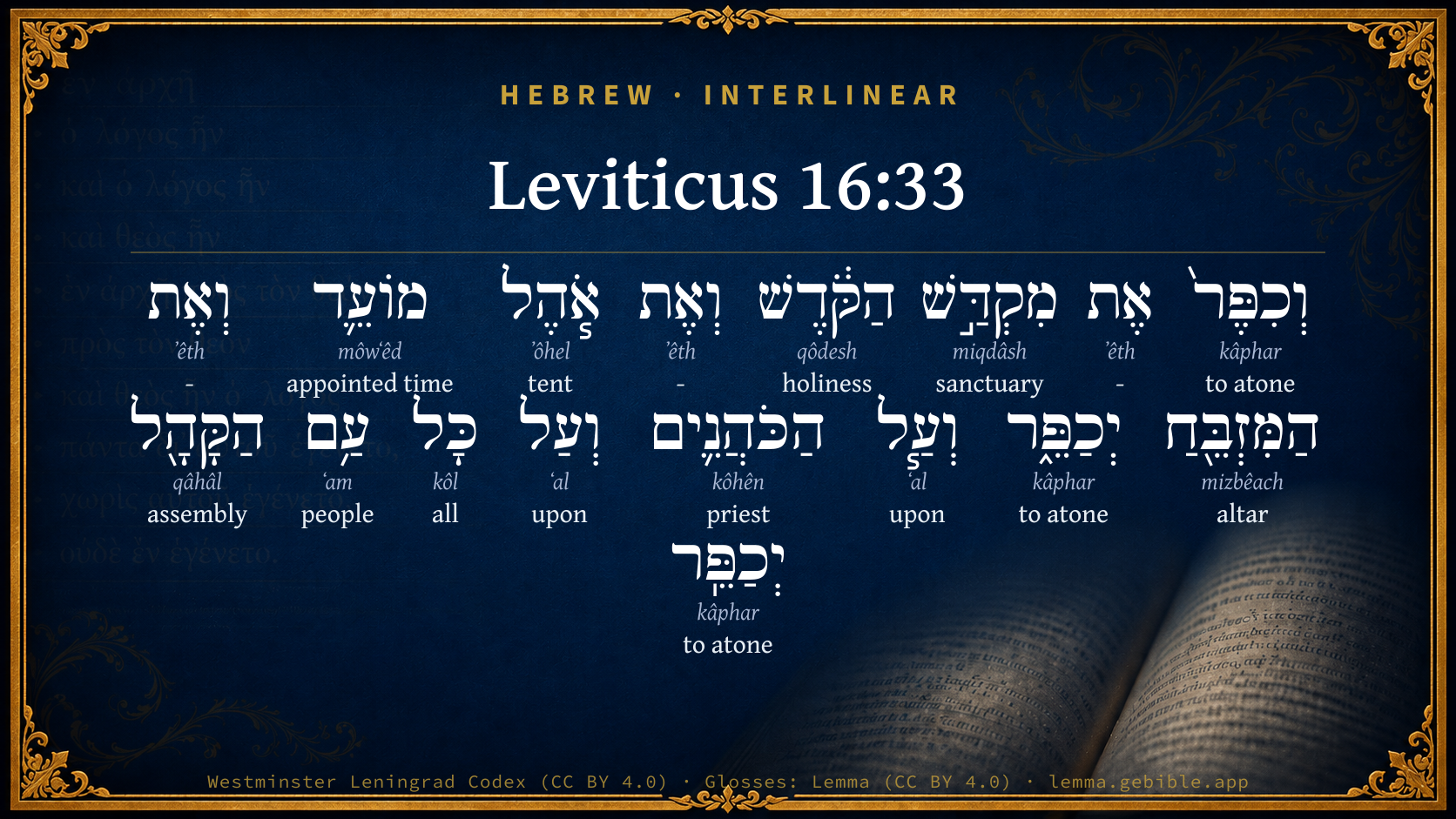
Hebrew (Westminster Leningrad Codex) Leviticus 16:33 appears in the Hebrew Old Testament. The text above is from the Westminster Leningrad Codex. Each word links to its Strong’s number, a concise gloss, and parsing drawn from the Open Scriptures Hebrew Bible morphology. Click any word for its full Brown-Driver-Briggs (BDB) entry.
Download image
Cite this verse

Leviticus 16:33 (World English Bible). Public Domain. Lemma interlinear Bible study tool, https://lemma.gebible.app/v/leviticus/16/33.

Show BibTeX & RIS
BibTeX
RIS
English Translation
Then he shall make atonement for the Holy Sanctuary; and he shall make atonement for the Tent of Meeting and for the altar; and he shall make atonement for the priests and for all the people of the assembly.
World English Bible · Public Domain
Download a study sheet

One document with this verse’s original text, its word-by-word gloss line, the meaning frame, cross-references with their text, attributed commentary, and full source and license credits — printable, and it pastes into notes with its structure intact.

This verse Autodidact and up

Study sheet (.html) Plain text (.txt)

A passage Seminary Student

Up to 50 verses in one chapter. A passage sheet keeps up to 6 commentary sources and 12 cross-references per verse, in the order this page ranks them, and says so on the sheet whenever that leaves anything out. Ask for a single verse and you get the Autodidact verse sheet above.

Everything on this page stays free to read, with no account — the sheet is a download of what is already on screen, not access to it.

Want to remove ads? Support Godless Engineer
Compare translations 3

The same verse in 3 English versions, stacked beneath the original-language interlinear above. Click any original word for its lexicon entry.

Each is an independent rendering of the whole verse — the interlinear is not word-aligned to these translations.

Highlighted words mark where these versions differ — a whole-verse word diff, not a word-by-word alignment.

  • World English Bible Public Domain
    Then he shall make atonement for the Holy Sanctuary; and he shall make atonement for the Tent of Meeting and for the altar; and he shall make atonement for the priests and for all the people of the assembly.
  • King James Version Public Domain
    And he shall make an atonement for the holy sanctuary, and he shall make an atonement for the tabernacle of the congregation, and for the altar, and he shall make an atonement for the priests, and for all the people of the congregation.
  • unfoldingWord Literal Text CC BY-SA 4.0
    And he shall make atonement the Holy Place of holiness, and he shall make atonement the tent of meeting and the altar. And he shall make atonement for the priests and for all the people of the assembly.

unfoldingWord Literal Text — © unfoldingWord, licensed CC BY-SA 4.0. Word-aligned USFM3 via Door43 (git.door43.org/unfoldingWord/en_ult).

Versions to compare (up to 4)

3 of 4 selected

Show all 18 translations

Every available English version of this verse, each an independent rendering of the whole verse.

  • World English Bible Public Domain
    Then he shall make atonement for the Holy Sanctuary; and he shall make atonement for the Tent of Meeting and for the altar; and he shall make atonement for the priests and for all the people of the assembly.
  • Berean Standard Bible Public Domain
    and make atonement for the Most Holy Place, the Tent of Meeting, and the altar, and for the priests and all the people of the assembly.
  • Majority Standard Bible Public Domain
    and make atonement for the Most Holy Place, the Tent of Meeting, and the altar, and for the priests and all the people of the assembly.
  • King James Version Public Domain
    And he shall make an atonement for the holy sanctuary, and he shall make an atonement for the tabernacle of the congregation, and for the altar, and he shall make an atonement for the priests, and for all the people of the congregation.
  • American Standard Version (1901) Public Domain
    and he shall make atonement for the holy sanctuary; and he shall make atonement for the tent of meeting and for the altar; and he shall make atonement for the priests and for all the people of the assembly.
  • Revised Version (1885) Public Domain
    and he shall make atonement for the holy sanctuary, and he shall make atonement for the tent of meeting and for the altar; and he shall make atonement for the priests and for all the people of the assembly.
  • Geneva Bible (1599) Public Domain
    And shall purge the Holy Sanctuarie and the Tabernacle of the Congregation, and shall clense the altar, and make an atonement for the Priests and for all the people of the Congregation.
  • Douay-Rheims (1899) Public Domain
    And he shall expiate the sanctuary and the tabernacle of the testimony and the altar, the priest also and all the people.
  • Young's Literal Translation Public Domain
    and he hath made atonement `for' the holy sanctuary; and `for' the tent of meeting, even `for' the altar he doth make atonement; yea, for the priests, and for all the people of the assembly he maketh atonement.
  • Literal Standard Version CC BY-SA 4.0
    and he has made atonement [for] the holy sanctuary; and [for] the Tent of Meeting, even [for] the altar he makes atonement; indeed, he makes atonement for the priests and for all the people of the assembly.
  • Unlocked Literal Bible CC BY-SA 4.0
    He must make atonement for the most holy place; he must make atonement for the tent of meeting and for the altar, and he must make atonement for the priests and for all the people of the assembly.
  • unfoldingWord Literal Text CC BY-SA 4.0
    And he shall make atonement the Holy Place of holiness, and he shall make atonement the tent of meeting and the altar. And he shall make atonement for the priests and for all the people of the assembly.
  • Darby Bible Public Domain
    And he shall make atonement for the holy sanctuary; and for the tent of meeting, and for the altar shall he make atonement; and for the priests, and for the whole people of the congregation shall he make atonement.
  • World Messianic Bible Public Domain
    Then he shall make atonement for the Holy Sanctuary; and he shall make atonement for the Tent of Meeting and for the altar; and he shall make atonement for the priests and for all the people of the assembly.
  • Webster's Bible Public Domain
    And he shall make an atonement for the holy sanctuary, and he shall make an atonement for the tabernacle of the congregation, and for the altar: and he shall make an atonement for the priests, and for all the people of the congregation.
  • Free Bible Version CC BY-SA 4.0
    He will carry out the purification of the Most Holy Place, the Tent of Meeting, and the altar, also making right the priests and all the people.
  • Bible in Basic English Public Domain
    And he will make the holy place and the Tent of meeting and the altar free from sin; he will take away sin from the priests and from all the people.
  • JPS Tanakh (1917) Public Domain
    And he shall make atonement for the most holy place, and he shall make atonement for the tent of meeting and for the altar; and he shall make atonement for the priests and for all the people of the assembly.

Literal Standard Version (2020), Covenant Press — licensed CC BY-SA 4.0. Text via the HelloAO Bible API (eBible.org). Unlocked Literal Bible (unfoldingWord) — licensed CC BY-SA 4.0. Text via the HelloAO Bible API (eBible.org). unfoldingWord Literal Text — © unfoldingWord, licensed CC BY-SA 4.0. Word-aligned USFM3 via Door43 (git.door43.org/unfoldingWord/en_ult). Free Bible Version, Dr. Jonathan Gallagher — licensed CC BY-SA 4.0. Text via the HelloAO Bible API (eBible.org).

Word by word

More ways to search: Search by grammar → Find every occurrence → Compare this word →

Practice this passage: Drill this verse → Learn its vocabulary →

מִקְדַּ֣שׁ
miqdâsh
H4720
“sanctuary of”
Noun, Common, Masculine, Singular, Construct
Part of Speech
Noun
Type
Common
Gender
Masculine
Number
Singular
State
Construct
Full BDB Definition

Origin: from H6942

TWOT: 1990f

sacred place, sanctuary, holy place - sanctuary - of the temple - of the tabernacle - of Ezekiel's temple - of Jehovah
  1. וְכִפֶּר֙ kâphar H3722 “and · to atone” Conjunction + Verb, Piel, Sequential Perfect, 3rd Person, Masculine, Singular
  2. אֶת ʼêth H853 “-” Particle, Direct Object
  3. הַקֹּ֔דֶשׁ qôdesh H6944 “the · holiness” Particle, Definite Article + Noun, Common, Masculine, Singular, Absolute
  4. וְאֶת ʼêth H853 “and · -” Conjunction + Particle, Direct Object
  5. אֹ֧הֶל ʼôhel H168 “tent of” Noun, Common, Masculine, Singular, Construct
  6. מוֹעֵ֛ד môwʻêd H4150 “appointed time” Noun, Common, Masculine, Singular, Absolute
  7. וְאֶת ʼêth H853 “and · -” Conjunction + Particle, Direct Object
  8. הַמִּזְבֵּ֖חַ mizbêach H4196 “the · altar” Particle, Definite Article + Noun, Common, Masculine, Singular, Absolute
  9. יְכַפֵּ֑ר kâphar H3722 “to atone” Verb, Piel, Imperfect, 3rd Person, Masculine, Singular
  10. וְעַ֧ל ʻal H5921 “and · upon” Conjunction + Preposition
  11. הַכֹּהֲנִ֛ים kôhên H3548 “the · priests” Particle, Definite Article + Noun, Common, Masculine, Plural, Absolute
  12. וְעַל ʻal H5921 “and · upon” Conjunction + Preposition
  13. כָּל kôl H3605 “all of” Noun, Common, Masculine, Singular, Construct
  14. עַ֥ם ʻam H5971 “people of” Noun, Common, Masculine, Singular, Construct
  15. הַקָּהָ֖ל qâhâl H6951 “the · assembly” Particle, Definite Article + Noun, Common, Masculine, Singular, Absolute
  16. יְכַפֵּֽר kâphar H3722 “to atone” Verb, Piel, Imperfect, 3rd Person, Masculine, Singular

About this verse

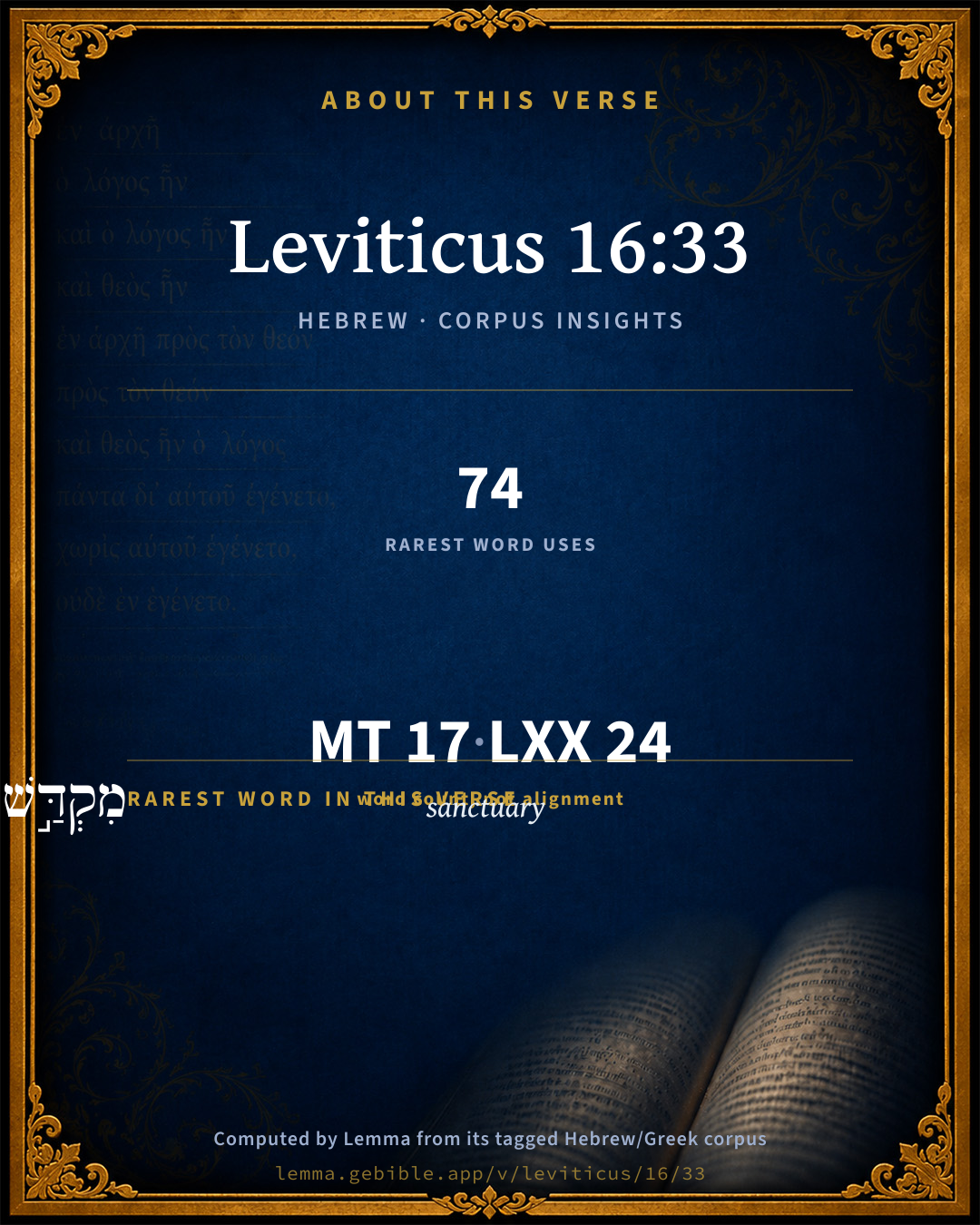
These counts appear in no published source. They are computed here, from the morphology-tagged text and Lemma’s own curated glosses. What Lemma adds →

17
words
12
distinct lemmas
Pentateuch
section

Grammatical profile

  • 3 verbs
  • 9 nouns
  • 2 prepositions
  • 3 particles

Verb forms

  • וְכִפֶּר֙ Piel · Sequential Perfect
  • יְכַפֵּ֑ר Piel · Imperfect
  • יְכַפֵּֽר Piel · Imperfect

Repetition

Words recur within this verse — often emphatic in Hebrew:

  • וְכִפֶּר֙ to atone H3722 ×3
  • וְעַ֧ל upon H5921 ×2

Hebrew & Septuagint length

In English translation the verse runs 39 words from the Hebrew and 36 from the Septuagint (LXX English) — closely comparable.

A rough comparison of the two English renderings, which tokenize alike — not a word-level alignment.

Word counts can differ between the Hebrew and the Greek without any difference in meaning — e.g. the Hebrew direct-object marker אֵת has no separate Greek word, and Greek often adds the article ὁ.

In the original languages it is 17 Hebrew tokens and 24 Greek tokens — but the two are counted differently (Hebrew bundles its prefixes and suffixes into one token; the Greek is in lemma form), so that isn’t a like-for-like length.

Cross-references

6

Topical passages linked to Leviticus 16:33 in the Treasury of Scripture Knowledge — connected by theme and wording, ordered by reader-vote popularity; previews shown in the World English Bible.

  • Leviticus 16:16 and he shall make atonement for the Holy Place, because of the uncleanness of the children of Israel, and because of their transgressions, even all their sins; and so he shall do for the Tent of Meeting, that dwells with them in the midst of their uncleanness.
  • Leviticus 16:6 "Aaron shall offer the bull of the sin offering, which is for himself, and make atonement for himself and for his house.
  • Leviticus 16:24 Then he shall bathe himself in water in a holy place, and put on his garments, and come out and offer his burnt offering and the burnt offering of the people, and make atonement for himself and for the people.
  • Exodus 20:25–26 If you make me an altar of stone, you shall not build it of hewn stones; for if you lift up your tool on it, you have polluted it.
  • Leviticus 16:11 "Aaron shall present the bull of the sin offering, which is for himself, and shall make atonement for himself and for his house, and shall kill the bull of the sin offering which is for himself.
  • Leviticus 16:18–19 "He shall go out to the altar that is before Yahweh and make atonement for it, and shall take some of the bull's blood, and some of the goat's blood, and put it on the horns of the altar round about.

Cross-references courtesy of OpenBible.info (CC BY 4.0).

Hebrew and Greek witnesses Masoretic Hebrew ↔ Greek Septuagint

The same verse in the two great witnesses to the Old Testament, shown verse-for-verse.

These are two independent witnesses, not word-aligned to each other, and the Septuagint is shown in lemma (dictionary) form.

Hebrew Leviticus 16:33 Masoretic · Westminster Leningrad Codex

וְכִפֶּר֙ אֶת מִקְדַּ֣שׁ הַקֹּ֔דֶשׁ וְאֶת אֹ֧הֶל מוֹעֵ֛ד וְאֶת הַמִּזְבֵּ֖חַ יְכַפֵּ֑ר וְעַ֧ל הַכֹּהֲנִ֛ים וְעַל כָּל עַ֥ם הַקָּהָ֖ל יְכַפֵּֽר

Then he shall make atonement for the Holy Sanctuary; and he shall make atonement for the Tent of Meeting and for the altar; and he shall make atonement for the priests and for all the people of the assembly.

World English Bible · Public Domain

Greek LXX Leviticus 16:33 Septuagint · lemma form

καί ἐκἱλάσκομαι ὁ ἅγιος ὁ ἅγιος καί ὁ σκηνή ὁ μαρτύριον καί ὁ θυσιαστήριον ἐκἱλάσκομαι καί περί ὁ ἱερεύς καί περί πᾶς συναγωγή ἐκἱλάσκομαι

And he shall make atonement for the most holy place, and the tabernacle of witness; and he shall make atonement for the altar, and for the priests; and he shall make atonement for all the congregation.

LXX2012 (modern English Septuagint) · Public Domain

Hebrew: Westminster Leningrad Codex (CC BY 4.0). Greek: Septuagint (public domain); English from LXX2012 (modern English Septuagint) (Public Domain). How the Septuagint differs from the Hebrew →

Targum (Aramaic paraphrase)

2

The Targum is the ancient Jewish Aramaic paraphrase of the Hebrew Scriptures — an interpretive translation, not the Hebrew text itself. Onkelos (literal) and Pseudo-Jonathan (expansive) render the Torah, and Jonathan the Prophets. Coverage is partial: where no permissively-licensed English translation exists for a verse, only the Aramaic is shown. This is verse-level text, not a word-by-word alignment to the Hebrew.

  1. Targum Onkelos Torah (Genesis–Deuteronomy)
    וִיכַפֵּר עַל מִקְדַשׁ קוּדְשָׁא וְעַל מַשְׁכַּן זִמְנָא וְעַל מַדְבְּחָא יְכַפַּר וְעַל כַּהֲנַיָא וְעַל כָּל עַמָא דִקְהָלָא יְכַפַּר

    (no public-domain English translation for this verse)

    Targum Onkelos — Aramaic: “Onkelos Genesis” (public domain); “Onkelos Exodus” (public domain); “Onkelos Leviticus” (public domain); “Onkelos Numbers” (public domain); “Onkelos Deuteronomy” (public domain). English: “Sefaria Community Translation” (CC0 1.0 (public-domain dedication)); “J.W. Etheridge. The Targums of Onkelos and Jonathan Ben Uzziel on the Pentateuch. London: Longmans, Green, 1862” (public domain). Text via Sefaria.

  2. Targum Pseudo-Jonathan Torah (Genesis–Deuteronomy)
    וִיכַפֵּר עַל מַקְדַשׁ קוּדְשָׁא וְעַל מַשְׁכַּן זִמְנָא וְעַל מַדְבְּחָא וְעַל כַּהֲנַיָא וְעַל כָּל עַמָא דִקְהָלָא יְכַפֵּר בְּאִישְׁתְּעוּת מִלַיָא

    And he shall make atonement for the Holy of Holies, and for the tabernacle of ordinance, and for the altar; and for the priests, and for all the people of the congregation, shall he atone, with confession of words.

    Targum Pseudo-Jonathan — Aramaic: “Targum Jonathan on Genesis” (public domain); “Targum Jonathan on Exodus” (public domain); “Targum Jonathan on Leviticus” (public domain); “Targum Jonathan on Numbers” (public domain); “Targum Jonathan on Deuteronomy” (public domain). English: “The Targum of Jonathan ben Uzziel, trans. J. W. Etheridge, London, 1862” (public domain). Text via Sefaria.

Commentary

Notes on Leviticus 16:33 from classic Christian and Jewish commentators (each source and its license shown beneath its notes). The classic Christian expositions comment on the surrounding passage and are grouped to its opening verse, so a note may address several verses; the Jewish commentaries on the Tanakh (Rashi and others) are per-verse, so they appear only where the commentator wrote on this verse.

Lemma curates 59 commentaries, every one of them public domain or Creative Commons licensed, each selected and text-cleaned for this edition rather than reprinted as found. About our sources →

Trapp's Complete Commentary

John Trapp

Lev 16:33 And he shall make an atonement for the holy sanctuary, and he shall make an atonement for the tabernacle of the congregation, and for the altar, and he shall make an atonement for the priests, and for all the people of the congregation.

Ver. 33. For the holy sanctuary.] For all the sins of your holy services, it being the manner that either makes or mars an action.

John Trapp, A Commentary or Exposition upon All the Books of the Old and New Testament (1647–1656) — public domain. Text from a community e-Sword module.

Ellicott's Commentary for English Readers

(33) And he shall make an atonement.—Like Aaron, the successor to the pontificate is to perform the service of expiation as detailed in this chapter, a summary of which is here given.

A Bible Commentary for English Readers, edited by Charles John Ellicott (1878–1897) — public domain. Text from a community e-Sword module.

The Cambridge Bible for Schools and Colleges

gen. ed. J. J. S. Perowne

33. all the people of the assembly] An unusual expression, contrasting them with the priests who were also members of it.

The Cambridge Bible for Schools and Colleges (gen. ed. J. J. S. Perowne; Cambridge University Press, 1878–1918) — public domain. Text from a community e-Sword module.

John Gill's Exposition

And this shall be an everlasting statute unto you,.... Which is the third time of its being observed, see Lev 16:29, to show that this was a law of considerable moment, and to be taken notice of, and strictly and closely kept by the priests, to whom these words are directed, and on whom the chief service of the day lay:

to make atonement for the children of Israel for all their sins once a year; namely, on the tenth day of the seventh month, or Tisri, as before directed:

and he did as the Lord commanded Moses; that is, Aaron did, as the Targum of Jonathan, Aben Ezra, and Ben Gersom supply it; when the day of atonement came, as Jarchi expresses it, he did according to this order, to fulfil the decree of the king, even the King of kings; whose will it was that such a day should be yearly observed, and such and such rules performed in it; so very significant of Christ, and of the atonement to be made by him, and which has been made.

Next: Leviticus Chapter 17

John Gill's Exposition of the Whole Bible (1746–1763) — public domain (CC PDM 1.0). Text via the HelloAO Bible API.

Albert Barnes' Notes on the Bible

A summary of what was done on the day of atonement.

The day was intended as an occasion for expressing more completely than could be done in the ordinary sacrifices the spiritual truth of atonement, with a fuller acknowledgment of the sinfulness and weakness of man and of the corruptible nature of all earthly things, even of those most solemnly consecrated and devoted to the service of God. It belonged to its observances especially to set forth, by the entrance of the high priest into the holy of holies, that atonement could only he effected before the throne of Yahweh Himself (compare Mat 9:6; Mar 2:7-10; Heb 4:16, etc.); and, by the goat sent into the wilderness, that the sins atoned for were not only forgiven, but carried wholly away. See Lev 16:22 note. The rites were a solemn gathering up of all other rites of atonement, so as to make them point more expressively to the revelation to come of God’s gracious purpose to man in sending His Son to be delivered for our offences, and to rise again for our justification; to be our great high priest forever after the order of Melchisedec, and to enter for us within the veil Rom 4:25; Heb 6:20. The Day of Atonement expanded the meaning of every sin-offering, in the same way as the services for Good Friday and Ash Wednesday expand the meaning of our litany days throughout the year, and Easter Day, that of our Sundays.

Albert Barnes' Notes on the Bible (1834–1885) — public domain. Text from a community e-Sword/MySword module.

Whedon's Commentary on the Bible

Daniel D. Whedon

33. The holy sanctuary — The holy of holies, as distinguished from the tabernacle of the congregation, the apartment of the priests. “The holy things were rendered unclean, not only by the sins of those who touched them, but by the uncleanness, that is, the bodily manifestation, of the sin of the nation; so that they required a yearly expiation and cleansing through the expiatory blood of sacrifice.” — Keil and Delitzsch. “Thus was the sanctuary cleansed from the defilement of priests and worshippers, and the communion of the Church with its Lord re-established. Alike priests and worshippers could now again have sacrificial access to and fellowship with God. It still remained to cleanse from personal guilt and sin. This was effected by the so-called ‘scapegoat.’” — Dr. Edersheim. The human nature of the Word made flesh in which he tabernacled (εσκηνωσεν) (Joh_1:14) and wrought out the work of human redemption, being absolutely holy, never needed purification, since in both flesh and spirit he was “holy, harmless, and undefiled.”

Daniel D. Whedon (gen. ed.), Commentary on the Old and New Testaments (1874–1909) — public domain. Text from a community e-Sword module.

The Pulpit Commentary

Vers. 33, 34. The imperfect ritual and the All-sufficient Sacrifice.

If we place ourselves at the standpoint of a devout and inquiring Hebrew worshipper, we can suppose ourselves to ask, on the morning and evening of the Day of Atonement

I WHY THIS ANNUAL CEREMONY? Have not numerous sacrifices been presented all the year round without intermission? Have not daily offerings been laid on the altar, morning and evening? and double sacrifices every sabbath day? and special offerings every month? And have not the people been bringing their presentations, from flock and herd, as piety has dictated, or special circumstances have required, all through the seasons? Have not these "come up with acceptance" before the altar of Jehovah? Has not sin been atoned for? What need, then, of these annual solemnities, of this very special ceremony at the tabernacle?

And if to such reflecting worshipper it should occur that the blood of lambs and bullocks, of doves and pigeons, was no real substitute for the forfeited life of men, would he not take a further step in his inquiry, and ask

II CAN THIS SUFFICE, ALL OTHER FAILING? What is there in the ceremonies of this sacred day which will avail, if all the year"s sacrifices are insufficient? Will the fact that one man will stand in the inner instead of the outer side of a separating vail, and sprinkle blood on one article of tabernacle furniture rather than another, will this make the difference between the adequacy and the inadequacy of animal sacrifice for human sin? Will the ceremony of slaying one goat and leading the other out into the wilderness constitute the one needful thing that is wanted to remove the guilt of a nation? Surely something more and something greater is wanted still. To these suggested and probable inquiries of the Hebrew worshipper, we reply

III THESE TYPICAL SOLEMNITIES DID NOT SUFFICE. It was a striking mark of their insufficiency that the very altar and tabernacle of the congregation, even the "holy sanctuary" itself, (verse 33; see verse 16 and Heb 4) had to be "atoned for." Even they became affected by the "uncleanness of the children of Israel." Here was imperfection legibly written on the holy things. And our instructed reason tells us that these things were inherently unsatisfactory. "It is not possible that the blood of bulls and of goats should take away sins". (Heb_10:4) Such "gifts and sacrifices could not make him that did the service perfect". (Heb_9:9 Heb_7:18, Heb_7:19) They only served for a time, and drew their temporary sufficiency from the fact that they were to be completed and fulfilled in one Divine Offering, which should be presented in "the fullness of time." And thus we come to

IV THE ONE ALL-AVAILING SACRIFICE. In the one Great Sacrifice at Calvary, the death of the Lord Jesus Christ, there is everything which a guilty race requires.

1. No need, now, for annual sacrifices; "in those sacrifices there is a remembrance again made of sins every year". (Heb_10:3) "But this man, after he had offered one sacrifice for sins for ever," etc., "by one offering he hath perfected for ever them that are sanctified". (Heb_10:14) Not "once a year," but once for all, once for ever!

2. No need for purifying the holy place. He hath passed into the heavens; has sat down at the right hand of God. The "uncleanness of man cannot stain his throne of grace.

3. No question as to the efficacy of his atonement. "If the blood of bulls and of goats," etc. (Heb_9:13, Heb_9:14)

4. No limit to the application of his atoning death. The cross of Christ is that on which not merely "all the people of the congregation" (verse 33), but all human souls in every land and through every age may look, in which they may glory, at which they may leave their sin and fear, from which they may date their inextinguishable hope and their everlasting joy. C.

The Pulpit Commentary (1880–1919), ed. H.D.M. Spence-Jones & Joseph S. Exell — public domain. Text from a community e-Sword module.

Lesson kit

Teaching starters — assembled from the data on this page, not authored interpretation. Every prompt links to the verse data it draws on. Edit before teaching.

Leviticus, in the Pentateuch, opens this verse with 17 words (12 distinct Hebrew lemmas). Its most distinctive word is miqdâsh (“sanctuary”). A historical commentator’s framing appears above. Read the whole chapter for the surrounding context.

Discussion questions

  1. How does “sanctuary” (miqdâsh) shape what this verse is saying?
  2. How does Leviticus 16:16, which shares this passage’s theme, read alongside this verse?
  3. What does the repetition of “to atone” (3× in this one verse) do in this verse?
  4. The translations on this page render this verse differently — a whole-verse word diff, not a word-by-word alignment. What might account for the different wordings?
  5. «וְכִפֶּר֙» is a Piel Sequential Perfect verb. How does that grammatical form shape the action described?
  6. Compare how Trapp's Complete Commentary and Ellicott's Commentary for English Readers read this verse. Where do they agree or differ?

Things to notice

Reading settings

Reading text

Shown beneath each verse's original-language words.

Old Testament
Old Testament edition

Read the OT as the Masoretic Hebrew (MT) or the Greek Septuagint (LXX).

English shown for the Greek Septuagint (in the Hebrew ↔ Greek comparison).

Comparing translations? Open the Compare panel on any verse page to stack up to four side by side.