
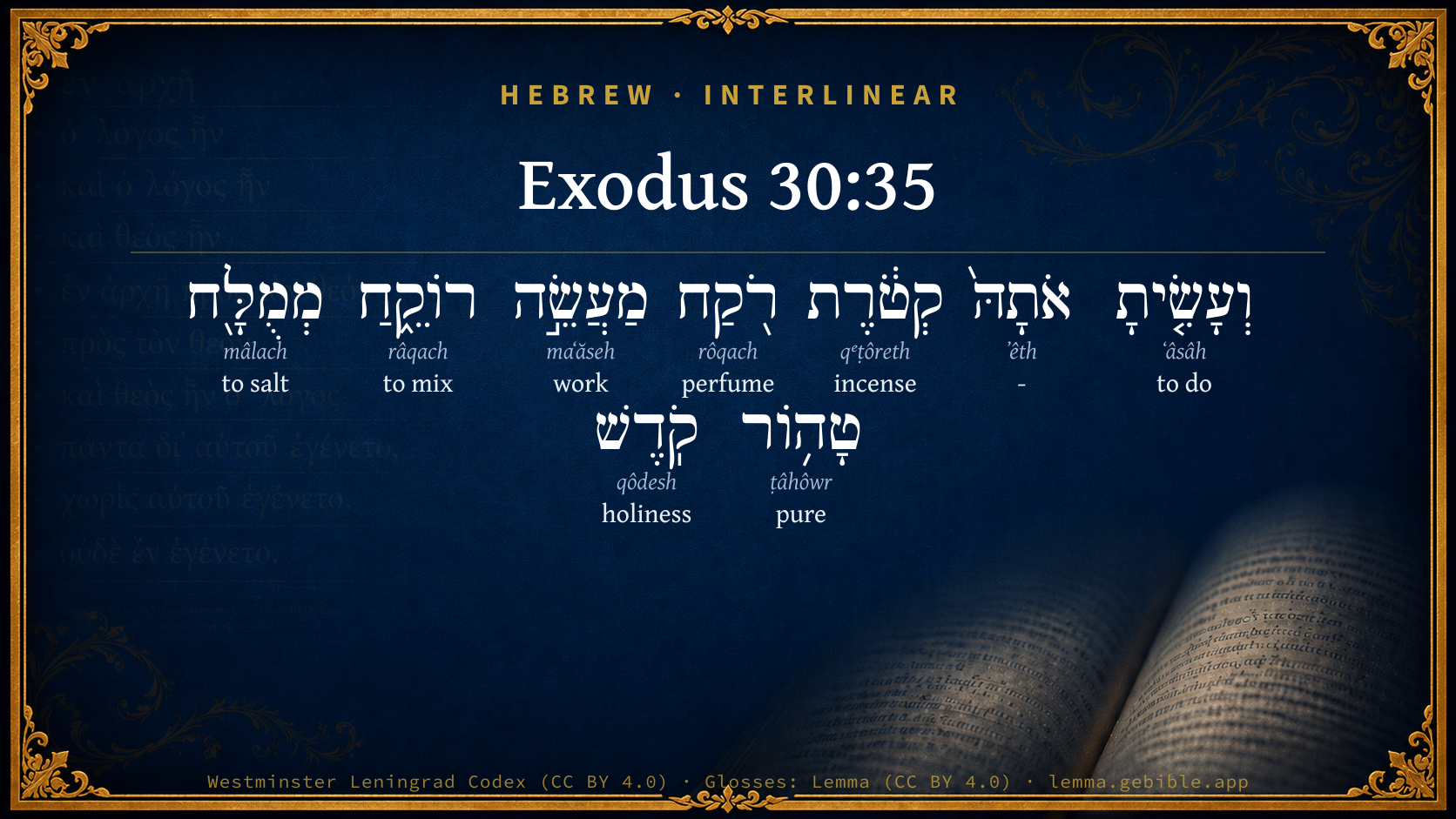
Exodus 30:35

Hebrew (Westminster Leningrad Codex) Exodus 30:35 appears in the Hebrew Old Testament. The text above is from the Westminster Leningrad Codex. Each word links to its Strong’s number, a concise gloss, and parsing drawn from the Open Scriptures Hebrew Bible morphology. Click any word for its full Brown-Driver-Briggs (BDB) entry.
Download image
Cite this verse

Exodus 30:35 (World English Bible). Public Domain. Lemma interlinear Bible study tool, https://lemma.gebible.app/v/exodus/30/35.

Show BibTeX & RIS
BibTeX
RIS
English Translation
and you shall make incense of it, a perfume after the art of the perfumer, seasoned with salt, pure and holy:
World English Bible · Public Domain
Highlights
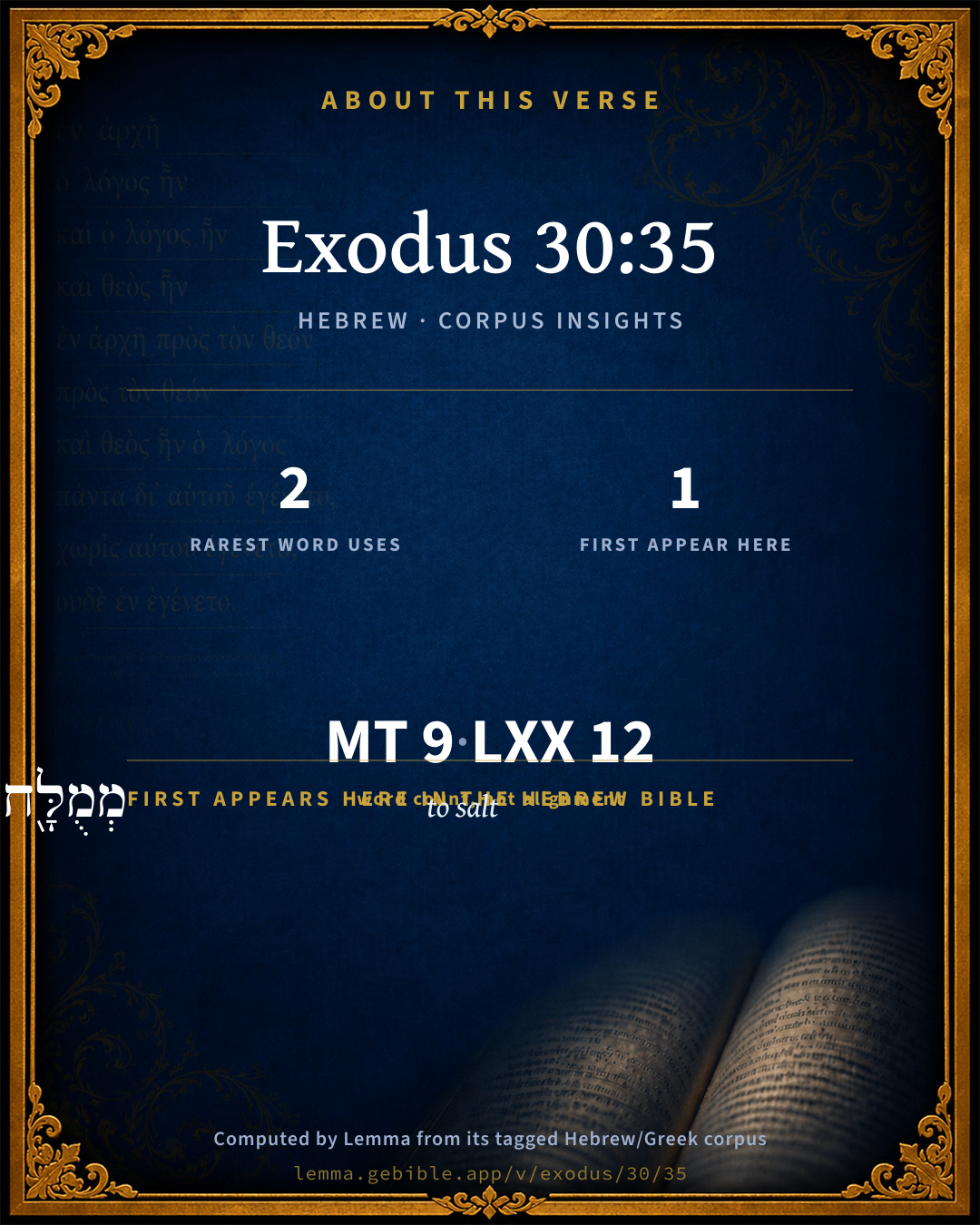
  • 1 first appearance in the Hebrew Bible
Full analysis ↓
Download a study sheet

One document with this verse’s original text, its word-by-word gloss line, the meaning frame, cross-references with their text, attributed commentary, and full source and license credits — printable, and it pastes into notes with its structure intact.

This verse Autodidact and up

Study sheet (.html) Plain text (.txt)

A passage Seminary Student

Up to 50 verses in one chapter. A passage sheet keeps up to 6 commentary sources and 12 cross-references per verse, in the order this page ranks them, and says so on the sheet whenever that leaves anything out. Ask for a single verse and you get the Autodidact verse sheet above.

Everything on this page stays free to read, with no account — the sheet is a download of what is already on screen, not access to it.

Want to remove ads? Support Godless Engineer
Compare translations 3

The same verse in 3 English versions, stacked beneath the original-language interlinear above. Click any original word for its lexicon entry.

Each is an independent rendering of the whole verse — the interlinear is not word-aligned to these translations.

Highlighted words mark where these versions differ — a whole-verse word diff, not a word-by-word alignment.

  • World English Bible Public Domain
    and you shall make incense of it, a perfume after the art of the perfumer, seasoned with salt, pure and holy:
  • King James Version Public Domain
    And thou shalt make it a perfume, a confection after the art of the apothecary, tempered together, pure and holy:
  • unfoldingWord Literal Text CC BY-SA 4.0
    And you shall make it incense, an ointment, the work of an ointment mixer: salted, pure, holy.

unfoldingWord Literal Text — © unfoldingWord, licensed CC BY-SA 4.0. Word-aligned USFM3 via Door43 (git.door43.org/unfoldingWord/en_ult).

Versions to compare (up to 4)

3 of 4 selected

Show all 18 translations

Every available English version of this verse, each an independent rendering of the whole verse.

  • World English Bible Public Domain
    and you shall make incense of it, a perfume after the art of the perfumer, seasoned with salt, pure and holy:
  • Berean Standard Bible Public Domain
    and make a fragrant blend of incense, the work of a perfumer, seasoned with salt, pure and holy.
  • Majority Standard Bible Public Domain
    and make a fragrant blend of incense, the work of a perfumer, seasoned with salt, pure and holy.
  • King James Version Public Domain
    And thou shalt make it a perfume, a confection after the art of the apothecary, tempered together, pure and holy:
  • American Standard Version (1901) Public Domain
    and thou shalt make of it incense, a perfume after the art of the perfumer, seasoned with salt, pure `and' holy:
  • Revised Version (1885) Public Domain
    and thou shalt make of it incense, a perfume after the art of the perfumer, seasoned with salt, pure and holy:
  • Geneva Bible (1599) Public Domain
    Then thou shalt make of them perfume composed after the arte of the apothecarie, mingled together, pure and holy.
  • Douay-Rheims (1899) Public Domain
    And thou shalt make incense compounded by the work of the perfumer, well tempered together, and pure, and most worthy of sanctification.
  • Young's Literal Translation Public Domain
    and thou hast made it a perfume, a compound, work of a compounder, salted, pure, holy;
  • Literal Standard Version CC BY-SA 4.0
    and you have made it an incense, a compound, work of a compounder, salted, pure, holy;
  • Unlocked Literal Bible CC BY-SA 4.0
    Make it into the form of incense, blended by a perfumer, seasoned with salt, pure and set apart.
  • unfoldingWord Literal Text CC BY-SA 4.0
    And you shall make it incense, an ointment, the work of an ointment mixer: salted, pure, holy.
  • Darby Bible Public Domain
    And thou shalt make it into incense, a perfume, after the work of the perfumer, salted, pure, holy.
  • World Messianic Bible Public Domain
    You shall make incense of it, a perfume after the art of the perfumer, seasoned with salt, pure and holy.
  • Webster's Bible Public Domain
    And thou shalt make it a perfume, a confection after the art of the apothecary, tempered together, pure and holy:
  • Free Bible Version CC BY-SA 4.0
    Add some salt and make pure and holy incense blended like the product of an expert perfumer.
  • Bible in Basic English Public Domain
    And make from them a perfume, such as is made by the art of the perfume-maker, mixed with salt, and clean and holy.
  • JPS Tanakh (1917) Public Domain
    And thou shalt make of it incense, a perfume after the art of the perfumer, seasoned with salt, pure and holy.

Literal Standard Version (2020), Covenant Press — licensed CC BY-SA 4.0. Text via the HelloAO Bible API (eBible.org). Unlocked Literal Bible (unfoldingWord) — licensed CC BY-SA 4.0. Text via the HelloAO Bible API (eBible.org). unfoldingWord Literal Text — © unfoldingWord, licensed CC BY-SA 4.0. Word-aligned USFM3 via Door43 (git.door43.org/unfoldingWord/en_ult). Free Bible Version, Dr. Jonathan Gallagher — licensed CC BY-SA 4.0. Text via the HelloAO Bible API (eBible.org).

Word by word

More ways to search: Search by grammar → Find every occurrence → Compare this word →

Practice this passage: Drill this verse → Learn its vocabulary →

About this verse

These counts appear in no published source. They are computed here, from the morphology-tagged text and Lemma’s own curated glosses. What Lemma adds →

9
words
9
distinct lemmas
Pentateuch
section

Notable vocabulary

The rarest word here is רֹ֖קַח perfume H7545 — appearing just 2 times in the whole Hebrew Bible.

First appearance in Scripture

This word makes its first canonical appearance in the Hebrew Bible here:

  • מְמֻלָּ֖ח to salt H4414

Shared distinctive vocabulary

רֹ֖קַח perfume H7545 occurs in 2 verses of the Hebrew Bible. Also found in:

Grammatical profile

  • 3 verbs
  • 4 nouns
  • 1 adjective
  • 1 particle

Verb forms

  • וְעָשִׂ֤יתָ Qal · Sequential Perfect
  • רוֹקֵ֑חַ Qal · Participle Active
  • מְמֻלָּ֖ח Pual · Participle Passive

Hebrew & Septuagint length

In English translation the verse runs 21 words from the Hebrew and 19 from the Septuagint (LXX English) — closely comparable.

A rough comparison of the two English renderings, which tokenize alike — not a word-level alignment.

Word counts can differ between the Hebrew and the Greek without any difference in meaning — e.g. the Hebrew direct-object marker אֵת has no separate Greek word, and Greek often adds the article ὁ.

In the original languages it is 9 Hebrew tokens and 12 Greek tokens — but the two are counted differently (Hebrew bundles its prefixes and suffixes into one token; the Greek is in lemma form), so that isn’t a like-for-like length.

Cross-references

6

Topical passages linked to Exodus 30:35 in the Treasury of Scripture Knowledge — connected by theme and wording, ordered by reader-vote popularity; previews shown in the World English Bible.

  • Exodus 30:25 You shall make it a holy anointing oil, a perfume compounded after the art of the perfumer: it shall be a holy anointing oil.
  • Leviticus 2:13 Every offering of your meal offering you shall season with salt; neither shall you allow the salt of the covenant of your God to be lacking from your meal offering. With all your offerings you shall offer salt.
  • Proverbs 27:9 Perfume and incense bring joy to the heart; So does earnest counsel from a man's friend.
  • Song of Solomon 1:3 Your oils have a pleasing fragrance. Your name is oil poured forth, Therefore the virgins love you.
  • Song of Solomon 3:6 Who is this who comes up from the wilderness like pillars of smoke, Perfumed with myrrh and frankincense, With all spices of the merchant?
  • John 12:3 Mary, therefore, took a pound of ointment of pure nard, very precious, and anointed the feet of Jesus, and wiped his feet with her hair. The house was filled with the fragrance of the ointment.

Cross-references courtesy of OpenBible.info (CC BY 4.0).

Hebrew and Greek witnesses Masoretic Hebrew ↔ Greek Septuagint

The same verse in the two great witnesses to the Old Testament, shown verse-for-verse.

These are two independent witnesses, not word-aligned to each other, and the Septuagint is shown in lemma (dictionary) form.

Hebrew Exodus 30:35 Masoretic · Westminster Leningrad Codex

וְעָשִׂ֤יתָ אֹתָהּ֙ קְטֹ֔רֶת רֹ֖קַח מַעֲשֵׂ֣ה רוֹקֵ֑חַ מְמֻלָּ֖ח טָה֥וֹר קֹֽדֶשׁ

and you shall make incense of it, a perfume after the art of the perfumer, seasoned with salt, pure and holy:

World English Bible · Public Domain

Greek LXX Exodus 30:35 Septuagint · lemma form

καί ποιέω ἐν αὐτός θυμίαμα μυρεψικός ἔργον μυρεψός μίγνυμι καθαρός ἔργον ἅγιος

And they shall make with it perfumed incense, tempered with the art of a perfumer, a pure holy work.

LXX2012 (modern English Septuagint) · Public Domain

On this verse, Ellicott's Commentary for English Readers discusses the Septuagint’s reading. Read the note in Commentary ↓

Hebrew: Westminster Leningrad Codex (CC BY 4.0). Greek: Septuagint (public domain); English from LXX2012 (modern English Septuagint) (Public Domain). How the Septuagint differs from the Hebrew →

Targum (Aramaic paraphrase)

2

The Targum is the ancient Jewish Aramaic paraphrase of the Hebrew Scriptures — an interpretive translation, not the Hebrew text itself. Onkelos (literal) and Pseudo-Jonathan (expansive) render the Torah, and Jonathan the Prophets. Coverage is partial: where no permissively-licensed English translation exists for a verse, only the Aramaic is shown. This is verse-level text, not a word-by-word alignment to the Hebrew.

  1. Targum Onkelos Torah (Genesis–Deuteronomy)
    וְתַעְבֵּד יָתַהּ קְטוֹרֶת בּוּסְמִין בּוֹסֶם עוֹבַד בּוּסְמָנוּ מְעָרַב דְכֵי קוּדְשָׁא:

    (no public-domain English translation for this verse)

    Targum Onkelos — Aramaic: “Onkelos Genesis” (public domain); “Onkelos Exodus” (public domain); “Onkelos Leviticus” (public domain); “Onkelos Numbers” (public domain); “Onkelos Deuteronomy” (public domain). English: “Sefaria Community Translation” (CC0 1.0 (public-domain dedication)); “J.W. Etheridge. The Targums of Onkelos and Jonathan Ben Uzziel on the Pentateuch. London: Longmans, Green, 1862” (public domain). Text via Sefaria.

  2. Targum Pseudo-Jonathan Torah (Genesis–Deuteronomy)
    וְתַעֲבֵיד יָתֵיהּ קְטוֹרֶת בּוּסְמָנָן בּוֹשֶם עוֹבַד מַמְזִיג מְעַרֵב דְּכֵי קוּדְשָׁא

    And confect therewith a fragrant incense, the work of the compounder, a pure and sacred mixture.

    Targum Pseudo-Jonathan — Aramaic: “Targum Jonathan on Genesis” (public domain); “Targum Jonathan on Exodus” (public domain); “Targum Jonathan on Leviticus” (public domain); “Targum Jonathan on Numbers” (public domain); “Targum Jonathan on Deuteronomy” (public domain). English: “The Targum of Jonathan ben Uzziel, trans. J. W. Etheridge, London, 1862” (public domain). Text via Sefaria.

Commentary

Notes on Exodus 30:35 from classic Christian and Jewish commentators (each source and its license shown beneath its notes). The classic Christian expositions comment on the surrounding passage and are grouped to its opening verse, so a note may address several verses; the Jewish commentaries on the Tanakh (Rashi and others) are per-verse, so they appear only where the commentator wrote on this verse.

Lemma curates 59 commentaries, every one of them public domain or Creative Commons licensed, each selected and text-cleaned for this edition rather than reprinted as found. About our sources →

Ellicott's Commentary for English Readers

(35) A confection after the art of the apothecary.—See Note on Exo_30:25. Bezaleel’s art was called in, both for the composition of the holy oil and of the holy incense (Exo_37:29).

Tempered together.—So the LXX., the Vulg., and the Targums of Onkelos and Jonathan. But most moderns render “salted,” or “mixed with salt.” (See Buxtorf, Gesenius, Lee, Rosenmüller, De Wette, Kalisch, Keil, &c.). The word used is capable of either meaning.

A Bible Commentary for English Readers, edited by Charles John Ellicott (1878–1897) — public domain. Text from a community e-Sword module.

The Cambridge Bible for Schools and Colleges

gen. ed. J. J. S. Perowne

35. a perfume, the work of the perfumer] as v. 25.

seasoned with salt] salted (cf. Sir_49:1 Heb.). In spite of the Versions (‘mixed’; and so RVm. = AV. tempered together [without ‘with salt’]), this is the only rend. which philology permits (so Ges. Di. Bä. &c.). ‘Seasoned with salt’ is, however, a doubtful paraphrase; for the incense was not a food. Salt, from its purifying and antiseptic properties, may have been added to the other ingredients, as symbolical of what was wholesome and sound; it has also been supposed (J. D. Michaelis, as cited by Di. and Bä.) that it may have been used, as causing the incense to kindle more rapidly, for the purpose of diffusing a wider cloud of smoke. The incense used in the Herodian temple is stated by Jos. (B.J. v. 5. 5) and the Talm, to have consisted of thirteen ingredients: see EB. ii. 2167.

pure] a different word from the ‘pure’ of v. 34, and meaning free from adulteration, or other impurities.

The Cambridge Bible for Schools and Colleges (gen. ed. J. J. S. Perowne; Cambridge University Press, 1878–1918) — public domain. Text from a community e-Sword module.

John Gill's Exposition

And thou shalt make it a perfume,.... By mixing the above spices together:

a confection after the art of the apothecary; in the manner they beat, compound, and mix several ingredients together:

tempered together; or "salted" (l), with salt of Sodom, as Aben Ezra interprets it; and Maimonides (m) says, there was a fourth part of a kab of salt of Sodom put into it: and whether this incense or perfume respects the intercession of Christ or the prayers of his people, they are both savoury and acceptable to God, the latter on account of the former; in all sacrifices salt was used, and every spiritual sacrifice of ours should be seasoned with grace:

pure and holy; such should be the prayers of the saints, and such most certainly is the mediation of Christ, which is his much incense.

(l) "salitum", Montanus, Drusius. Junius & Tremellius, & Piscator. (m) Cele Hamikdash, c. 2. sect. 3.

John Gill's Exposition of the Whole Bible (1746–1763) — public domain (CC PDM 1.0). Text via the HelloAO Bible API.

Haydock's Catholic Bible Commentary

Together. Hebrew literally, "salted," (Chaldean) as salt was to accompany all the sacrifices, Leviticus ii. 13. But it was not, perhaps, to be mixed with this perfume, no more than with the wine of libations. The word may signify "a thing used in embalming, pure and holy."

George Leo Haydock (1774–1849), Haydock's Catholic Family Bible and Commentary, 1859 edition — public domain. Excludes Psalms (Douay-Rheims chapter numbering differs from Protestant) and Deuterocanonical books (Catholic canon only).

Matthew Poole's English Annotations

Tempered together, Heb. salted; either,

1. Properly, for salt was to be offered with all offerings, Lev 2:13. And the Hebrew doctors tell us that six egg-shells full of salt were used. Or,

2. Metaphorically, well mixed together, as salt was with things either offered to God, or eaten by man.

Pure, of the best of each kind of drugs, the most perfect and uncorrupted.

Matthew Poole's English Annotations on the Holy Bible (1683–1685) — public domain. Text from a community e-Sword/MySword module.

Whedon's Commentary on the Bible

Daniel D. Whedon

35. Art of the apothecary — See on Exo_30:25.

Tempered together — Rather, seasoned with salt, after the manner of meat offerings. See on Lev_2:13.

Daniel D. Whedon (gen. ed.), Commentary on the Old and New Testaments (1874–1909) — public domain. Text from a community e-Sword module.

The Pulpit Commentary

A confection after the art of the apothecary. Like the holy oil, the incense was to be artistically compounded by one accustomed to deal with such ingredients. It was actually, in the first instance, the work of Bezaleel. (Exo_27:2-9) Tempered together. This translation is supported by the authority of the Septuagint and the Vulgate, and is defended by Canon Cook. But the mass of modern critics is in favour of the translation "salted," or "with salt." (So Buxtorf, Gesenius, De Wette, Kalisch, Keil, etc.) If, nobel suggests "comminuted," identifying malakh with marakh. The point is not one of much importance.

The Pulpit Commentary (1880–1919), ed. H.D.M. Spence-Jones & Joseph S. Exell — public domain. Text from a community e-Sword module.

Rashi

Rabbi Shlomo Yitzchaki (Rashi)

ממלח TEMPERED TOGETHER — Understand this as the Targum renders it: מעורב, mixed — that they should thoroughly intermix the powder of the ingredients. I think that similar in meaning to it are the nouns in (Jona 1:5) “Then the mariners (המלחים) were afraid”; (Ezekiel 27:27) “thy mariners (מלחיך) and thy pilots”, who are so called because they turn over (stir up) the water with oars when they propel the ship — like a person who stirs up beaten eggs with a spoon in order to mix them with water. Anything that a person wishes to mix up thoroughly he stirs up with his finger or with a spoon.

ממלח טהור קדש TEMPERED TOGETHER, PURE AND HOLY — i. e. tempered together shall it (the compound) be, pure shall it be, and holy shall it be.

Rashi on the Tanakh — English translations: “The Judaica Press complete Tanach with Rashi, translated by A. J. Rosenberg” (CC BY 4.0); “Pentateuch with Rashi's commentary by M. Rosenbaum and A.M. Silbermann, 1929-1934” (public domain); “The Metsudah Tanach series, Lakewood, N.J” (CC BY 4.0); and “The Book of Joshua, Metsudah Publications, 1997” (CC BY 4.0). Text via Sefaria.

Ramban (Nachmanides)

Rabbi Moshe ben Nachman (Ramban / Nachmanides)

MEMULACH’ (SEASONED WITH SALT), PURE AND HOLY. This means that it be seasoned with salt of Sodom, just as the Rabbis have said: “Of salt of Sodom, the fourth part of a kab.” Onkelos translated [memulach as] m’areiv (mixed together). By this he intended to say that memulach means “rubbed out” — that the ingredients should all be so well-ground and mixed so thoroughly together, that their identity is “rubbed out” and none of the [individual] ingredients can be recognized. This is of the expression: For the heavens ‘nimlochu’ (shall vanish away) like smoke. Similarly: ‘u’vloyei m’lachim’ (and worn rags); A fruitful land ‘limleichah’ (into a salt waste). These are all expressions of destruction and annihilation.And Rashi explained that the term memluach means that it be thoroughly mixed together in the grinding of the ingredients one with another. To this interpretation Rashi brought proof from the verse similar in meaning: ‘malachayich’ (thy mariners) and thy pilots, who are so called “because they turn over the water with the oars when they propel the ship, like a person who stirs up beaten eggs with a spoon in order to mix them thoroughly.”In my opinion mariners are called malachim [of the root melach — salt] because they know the “taste” of the sea, as if they could feel if it is “salty” or “sweet;” that is to say, they know when it will be sweet and pleasant for those travelling by sea, and when it will be bad and bitter for them. It is not those who hold the oars [propelling the ship] who are called malachim [as Rashi said], for it is written on Tyre, The inhabitants of Sidon and Arvad were thy ‘shotim’ (rowers);, Verse 8. The elders of Gebal and the wise men thereof were in thee thy calkers; all the ships of the sea ‘u’malacheyhem’ (and their mariners) were in thee., Verse 9. For it is the older captains who know the sea that are called malachim. And it is further written, And all that handle the oar, ‘malachim’ (the mariners), and all the pilots of the sea, shall come down from their ships, they shall stand upon the land., Verse 29. Thus three categories are mentioned: those that handle the oar, the mariners, and the pilots [which proves that malachim — the mariners — are not those that handle the oar].Similarly, a fruitful land ‘limleichah’ means “to a salt land,” for in a salt land nothing will grow, just as is written of Sodom, The whole land thereof is brimstone, and salt, and a burning, that it is not sown, nor beareth, and it is further written, and he sowed it with salt. It is possible that the letter lamed is redundant in the verse, for the heavens ‘nimlochu’ like smoke, the intent thereof being as in the word nimchu (erased), which would make it similar to these cases: ba’l'umim; (among the nations). wholly ‘shalanan’ (at ease) and quiet. (ease).

Ramban (Nachmanides) on the Tanakh — English translation: “Commentary on the Torah by Ramban (Nachmanides). Translated and annotated by Charles B. Chavel. New York, Shilo Pub. House, 1971-1976” (CC BY 4.0). Text via Sefaria.

Lesson kit

Teaching starters — assembled from the data on this page, not authored interpretation. Every prompt links to the verse data it draws on. Edit before teaching.

Exodus, in the Pentateuch, opens this verse with 9 words (9 distinct Hebrew lemmas). Its most distinctive word is rôqach (“perfume”). A historical commentator’s framing appears above. Read the whole chapter for the surrounding context.

Discussion questions

  1. What does “perfume” (rôqach) contribute to the verse as a whole?
  2. This is the first place “to salt” appears in Scripture (first appears here). What does its debut here establish?
  3. How does Exodus 30:25, which shares the word «perfume», read alongside this verse?
  4. These translations render this verse differently. What is at stake in choosing one wording over another?
  5. «וְעָשִׂ֤יתָ» is a Qal Sequential Perfect verb. How does that grammatical form shape the action described?
  6. Compare how Ellicott's Commentary for English Readers and The Cambridge Bible for Schools and Colleges read this verse. Where do they agree or differ?

Things to notice

Reading settings

Reading text

Shown beneath each verse's original-language words.

Old Testament
Old Testament edition

Read the OT as the Masoretic Hebrew (MT) or the Greek Septuagint (LXX).

English shown for the Greek Septuagint (in the Hebrew ↔ Greek comparison).

Comparing translations? Open the Compare panel on any verse page to stack up to four side by side.